


Gennett Records

Encyclopedia
Gennett was a United States
based record label
which flourished in the 1920s.
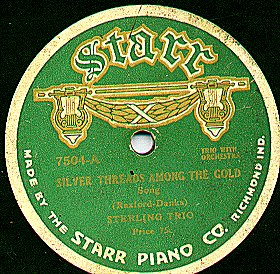 Gennett records was founded in Richmond, Indiana
by the Starr Piano Company, and released its first records in October 1917. The company took its name from its top managers: Harry, Fred and Clarence Gennett. Earlier, the company had produced recordings under the Starr Records
label. The early issues were vertically cut in the gramophone record
grooves, using the hill-and-dale method of a U-shaped groove and sapphire ball stylus, but they switched to the more popular lateral cut method in April 1919.
The Starr Piano Company also produced Gennett brand home phonograph
s, but these did not seem to have been sold in great numbers outside of the area around Indiana
.
Gennett set up recording studio
s in New York City
and later, in 1921, set up a second studio on the grounds of the piano
factory in Richmond, Indiana
under the supervision of Ezra C.A. Wickemeyer. The sides recorded in New York are generally of about typical audio fidelity for a minor label of the time, and some masters were leased from other New York area firms. The sides recorded in Richmond are decidedly below average in audio fidelity, and sometimes have a crude sound and show problems of inconsistent speed of the turntable while the master was being recorded, problems which the major labels had solved some 20 years earlier.
Gennett is best remembered for the wealth of early jazz
talent recorded on the label, including sessions by Jelly Roll Morton
, Bix Beiderbecke
, The New Orleans Rhythm Kings
, "King" Joe Oliver's band with young Louis Armstrong
, Hoagy Carmichael
, Duke Ellington
, The Red Onion Jazz Babies
,The State Street Ramblers, Zach Whyte and his Chocolate Beau Brummels, Alphonse Trent
and his Orchestra and many others. Gennett also recorded early blues
artists such as Thomas A. Dorsey
, Sam Collins
, Jaybird Coleman
, and Big Boy Cleveland, and early "hillbilly
" or country music
performers such as Vernon Dalhart
, Bradley Kincaid
, Ernest Stoneman
, Fiddlin' Doc Roberts
, and Gene Autry
. Many early religious recordings were made by Homer Rodeheaver
, early shape note
singers and others.
Gennett issued a few early electrically recorded masters recorded in the Autograph
studios of Chicago in 1925. These recordings were exceptionally crude, and like many other Autograph issues are easily mistaken for acoustic masters by the casual listener. Gennett began serious electrical recording in March 1926, using a process licensed from General Electric
. This process was found by to be unsatisfactory, for although the quality of the recordings taken by the General Electric process was quite good, there were many customer complaints about the wear characteristics of the electric process records. The composition of the Gennett biscuit (record material) was of insufficient hardness to withstand the increased wear that resulted when the new recordings with their greatly increased frequency range were played on obsolete phonographs with mica diaphragm reproducers. The company discontinued recording by this process in August 1926, and did not return to electric recording until February 1927, after signing a new agreement to license the RCA
Photophone recording process. At this time the company also introduced an improved record biscuit which was adequate to the demands imposed by the electric recording process. The improved records were identified by a newly designed black label touting the "New Electrobeam" process.
From 1925 to 1934, Gennett released recordings by hundreds of "old-time music" artists, precursors to country music
, including such artists as Doc Roberts and Gene Autry
. By the late 1920s, Gennett was pressing records for more than 25 labels worldwide, including budget disks for Sears, Roebuck's catalog. In 1926, Fred Gennett created Champion Records
as a budget label for tunes previously released on Gennett.
The Gennett Company was hit severely by the Great Depression
in 1930, and massively cut back on record recording and production until it was halted altogether in 1934. At this time the only product Gennett Records produced under its own name was a series of recorded sound effect
s for use by radio
stations. In 1935 the Starr Piano Company sold some Gennett masters, and the Gennett and Champion
trademarks to Decca Records
. Jack Kapp of Decca was primarily interested in some jazz, blues and old time music items in the Gennett catalog which he thought would add depth to the selections offered by the newly organized Decca company. Kapp also attempted to revive the Gennett and Champion labels between 1935 and 1937 as specialists in bargain pressings of race and old-time music with but little success.
The Starr record plant soldiered on under the supervision of Harry Gennett through the remainder of the decade by offering contract pressing services. For a time the Starr Piano Company was the principal manufacturer of Decca records, but much of this business dried up after Decca purchased its own pressing plant in 1938 (the Newaygo, Michigan
plant that formerly had pressed Brunswick and Vocalion records). In the years remaining before World War II
, Gennett did contract pressing for a number of New York-based jazz and folk music labels, including Joe Davis, Keynote and Asch.
With the declaration of war in December 1941, the War Industries Board
declared shellac
a rationed
commodity, and newly organized record labels were forced to purchase their shellac allocations from existing companies. Joe Davis purchased the Gennett shellac allocation, some of which he used for his own labels, and some of which he sold to the newly organized Capitol Records
. Harry Gennett intended to use the funds from the sale of his shellac ration to modernize this pressing plant after Victory, but there is no indication that he did so, Gennett sold increasingly small numbers of special purpose records (mostly sound effects, skating rink, and church tower chimes) until 1947 or 1948, and the business then seemed to just fade away.
Brunswick acquired the old Gennett pressing plant for Decca. After Decca opened a new pressing plant in Pinckneyville, Illinois
in 1956, the old Gennett plant in Richmond, Indiana was sold to Mercury Records
in 1958. Mercury operated the historic plant until 1969 when it moved to a nearby modern plant later operated by Cinram
. Located at 1600 Rich Road, Cinram closed the plant in 2009.
The Gennett company produced the Gennett, Starr, Champion
, Superior, and Van Speaking labels, and also produced some Supertone
, Silvertone
, and Challenge
records under contract. The firm pressed most Autograph
, Rainbow
, Hitch, KKK, Our Song, and Vaughn records under contract.
The Gennett Walk of Fame is located along South 1st Street in Richmond at the site of the Starr Piano Company and embedded in the Whitewater Gorge Trail, which connects to the longer Cardinal Greenway Trail. Both trails are part of the American Discovery Trail
, the only coast-to-coast, non-motorized recreational trail.
Markers are three-dimensional, cast bronze
and colored tile mosaic
emblems in the form of 78 rpm phonograph records. Each marker features the classic Gennett label design and an artistic mosaic rendering of the represented musician. A smaller bronze plaque is installed next to each record to recognize the accomplishments of the inductee. The Foundation estimates that the Walk of Fame eventually will contain up to 80 markers.
The Foundation convened its National Advisory Board for the first time in January, 2006, to select the first 10 inductees for the Gennett Records Walk of Fame. The Advisory Board selects inductees from these categories: classic jazz, old-time country, blues, gospel (African-American and Southern), American popular song, ethnic, historic/spoken, and classical, giving preference to classic jazz, old-time country, blues, gospel, and American popular song.
The Advisory Board's consensus selection for the first inductee in the Gennett Walk of Fame was Louis Armstrong. The following is a list of the first ten inductees:
A second set of ten nominees was inducted in 2008:
2009 Inductees:
2010 Inductees:
2011 Inductees:
United States
The United States of America is a federal constitutional republic comprising fifty states and a federal district...
based record label
Record label
In the music industry, a record label is a brand and a trademark associated with the marketing of music recordings and music videos. Most commonly, a record label is the company that manages such brands and trademarks, coordinates the production, manufacture, distribution, marketing and promotion,...
which flourished in the 1920s.
Label history
Richmond, Indiana
Richmond is a city largely within Wayne Township, Wayne County, in east central Indiana, United States, which borders Ohio. The city also includes the Richmond Municipal Airport, which is in Boston Township and separated from the rest of the city...
by the Starr Piano Company, and released its first records in October 1917. The company took its name from its top managers: Harry, Fred and Clarence Gennett. Earlier, the company had produced recordings under the Starr Records
Starr Records
Starr Records was a record label manufactured by the Starr Piano Company of Richmond, Indiana, which was also the parent company of the better known Gennett Records....
label. The early issues were vertically cut in the gramophone record
Gramophone record
A gramophone record, commonly known as a phonograph record , vinyl record , or colloquially, a record, is an analog sound storage medium consisting of a flat disc with an inscribed, modulated spiral groove...
grooves, using the hill-and-dale method of a U-shaped groove and sapphire ball stylus, but they switched to the more popular lateral cut method in April 1919.
The Starr Piano Company also produced Gennett brand home phonograph
Phonograph
The phonograph record player, or gramophone is a device introduced in 1877 that has had continued common use for reproducing sound recordings, although when first developed, the phonograph was used to both record and reproduce sounds...
s, but these did not seem to have been sold in great numbers outside of the area around Indiana
Indiana
Indiana is a US state, admitted to the United States as the 19th on December 11, 1816. It is located in the Midwestern United States and Great Lakes Region. With 6,483,802 residents, the state is ranked 15th in population and 16th in population density. Indiana is ranked 38th in land area and is...
.
Gennett set up recording studio
Recording studio
A recording studio is a facility for sound recording and mixing. Ideally both the recording and monitoring spaces are specially designed by an acoustician to achieve optimum acoustic properties...
s in New York City
New York City
New York is the most populous city in the United States and the center of the New York Metropolitan Area, one of the most populous metropolitan areas in the world. New York exerts a significant impact upon global commerce, finance, media, art, fashion, research, technology, education, and...
and later, in 1921, set up a second studio on the grounds of the piano
Piano
The piano is a musical instrument played by means of a keyboard. It is one of the most popular instruments in the world. Widely used in classical and jazz music for solo performances, ensemble use, chamber music and accompaniment, the piano is also very popular as an aid to composing and rehearsal...
factory in Richmond, Indiana
Richmond, Indiana
Richmond is a city largely within Wayne Township, Wayne County, in east central Indiana, United States, which borders Ohio. The city also includes the Richmond Municipal Airport, which is in Boston Township and separated from the rest of the city...
under the supervision of Ezra C.A. Wickemeyer. The sides recorded in New York are generally of about typical audio fidelity for a minor label of the time, and some masters were leased from other New York area firms. The sides recorded in Richmond are decidedly below average in audio fidelity, and sometimes have a crude sound and show problems of inconsistent speed of the turntable while the master was being recorded, problems which the major labels had solved some 20 years earlier.
Gennett is best remembered for the wealth of early jazz
Jazz
Jazz is a musical style that originated at the beginning of the 20th century in African American communities in the Southern United States. It was born out of a mix of African and European music traditions. From its early development until the present, jazz has incorporated music from 19th and 20th...
talent recorded on the label, including sessions by Jelly Roll Morton
Jelly Roll Morton
Ferdinand Joseph LaMothe , known professionally as Jelly Roll Morton, was an American ragtime and early jazz pianist, bandleader and composer....
, Bix Beiderbecke
Bix Beiderbecke
Leon Bismark "Bix" Beiderbecke was an American jazz cornetist, jazz pianist, and composer.With Louis Armstrong, Beiderbecke was one of the most influential jazz soloists of the 1920s...
, The New Orleans Rhythm Kings
New Orleans Rhythm Kings
The New Orleans Rhythm Kings were one of the most influential jazz bands of the early-to-mid 1920s. The band was a combination of New Orleans and Chicago musicians who helped shape Chicago Jazz and influenced many younger jazz musicians....
, "King" Joe Oliver's band with young Louis Armstrong
Louis Armstrong
Louis Armstrong , nicknamed Satchmo or Pops, was an American jazz trumpeter and singer from New Orleans, Louisiana....
, Hoagy Carmichael
Hoagy Carmichael
Howard Hoagland "Hoagy" Carmichael was an American composer, pianist, singer, actor, and bandleader. He is best known for writing "Stardust", "Georgia On My Mind", "The Nearness of You", and "Heart and Soul", four of the most-recorded American songs of all time.Alec Wilder, in his study of the...
, Duke Ellington
Duke Ellington
Edward Kennedy "Duke" Ellington was an American composer, pianist, and big band leader. Ellington wrote over 1,000 compositions...
, The Red Onion Jazz Babies
Red Onion Jazz Babies
The Red Onion Jazz Babies was an early supergroup of the Jazz Age. Among its members were Louis Armstrong, Sidney Bechet, Lil Hardin and others in the early 1920s. As it comprised some of the most influential soloists and performers of the era, the group was significant in highlighting the early...
,The State Street Ramblers, Zach Whyte and his Chocolate Beau Brummels, Alphonse Trent
Alphonse Trent
Alphonse "Alphonso" Trent was an American jazz pianist and territory band leader.Trent played piano since childhood and worked in local bands in Arkansas through his youth. He led his first band in the mid-1920s, possibly as early as 1923...
and his Orchestra and many others. Gennett also recorded early blues
Blues
Blues is the name given to both a musical form and a music genre that originated in African-American communities of primarily the "Deep South" of the United States at the end of the 19th century from spirituals, work songs, field hollers, shouts and chants, and rhymed simple narrative ballads...
artists such as Thomas A. Dorsey
Thomas A. Dorsey
Thomas Andrew Dorsey was known as "the father of black gospel music" and was at one time so closely associated with the field that songs written in the new style were sometimes known as "dorseys." Earlier in his life he was a leading blues pianist known as Georgia Tom.As formulated by Dorsey,...
, Sam Collins
Sam Collins
Samuel Jason "Sam" Collins is an English footballer who plays as a defender for Hartlepool United, where he serves as captain. His brother, Simon, is also a former professional footballer and manager....
, Jaybird Coleman
Jaybird Coleman
Burl C. "Jaybird" Coleman was an American country blues harmonica player, guitarist and singer.Born in Gainesville, Alabama, United States, the son of sharecroppers and one of four children. He was born, raised and worked on a farm, and picked up and learned the harmonica at 12 years of age...
, and Big Boy Cleveland, and early "hillbilly
Hillbilly
Hillbilly is a term referring to certain people who dwell in rural, mountainous areas of the United States, primarily Appalachia but also the Ozarks. Owing to its strongly stereotypical connotations, the term is frequently considered derogatory, and so is usually offensive to those Americans of...
" or country music
Country music
Country music is a popular American musical style that began in the rural Southern United States in the 1920s. It takes its roots from Western cowboy and folk music...
performers such as Vernon Dalhart
Vernon Dalhart
Vernon Dalhart , born Marion Try Slaughter, was a popular American singer and songwriter of the early decades of the 20th century. He is a major influence in the field of country music.-Early life:...
, Bradley Kincaid
Bradley Kincaid
William Bradley Kincaid was an American folk singer and radio entertainer.He was born in Point Level, Garrard County, Kentucky but built a music career in the northern states. His first radio appearance came in 1926 when he performed on the National Barn Dance show on WLS-AM in Chicago, Illinois...
, Ernest Stoneman
Ernest Stoneman
Ernest Van "Pop" Stoneman ranked among the prominent recording artists of country music's first commercial decade.-Biography:...
, Fiddlin' Doc Roberts
Fiddlin' Doc Roberts
Fiddlin' Doc Roberts was an American Kentucky-style old-time fiddler.-Biography:Dock Philipine Roberts was born and raised on a farm in Madison County, Kentucky and learned to play the fiddle at an early age with some help from his older brother Liebert. Doc's and Liebert's musical mentor was the...
, and Gene Autry
Gene Autry
Orvon Grover Autry , better known as Gene Autry, was an American performer who gained fame as The Singing Cowboy on the radio, in movies and on television for more than three decades beginning in the 1930s...
. Many early religious recordings were made by Homer Rodeheaver
Homer Rodeheaver
Homer Alvan Rodeheaver was an American evangelist, music director, music publisher, composer of gospel songs, and pioneer in the recording of sacred music.- Early career :...
, early shape note
Shape note
Shape notes are a music notation designed to facilitate congregational and community singing. The notation, introduced in 1801, became a popular teaching device in American singing schools...
singers and others.
Gennett issued a few early electrically recorded masters recorded in the Autograph
Autograph Records
Autograph Records was a United States record label of the 1920s.Autograph was a small label, owned by Marsh Laboratories Incorporated of Chicago, Illinois. Marsh Laboratories in turn was owned by electrical engineer Orlando R. Marsh...
studios of Chicago in 1925. These recordings were exceptionally crude, and like many other Autograph issues are easily mistaken for acoustic masters by the casual listener. Gennett began serious electrical recording in March 1926, using a process licensed from General Electric
General Electric
General Electric Company , or GE, is an American multinational conglomerate corporation incorporated in Schenectady, New York and headquartered in Fairfield, Connecticut, United States...
. This process was found by to be unsatisfactory, for although the quality of the recordings taken by the General Electric process was quite good, there were many customer complaints about the wear characteristics of the electric process records. The composition of the Gennett biscuit (record material) was of insufficient hardness to withstand the increased wear that resulted when the new recordings with their greatly increased frequency range were played on obsolete phonographs with mica diaphragm reproducers. The company discontinued recording by this process in August 1926, and did not return to electric recording until February 1927, after signing a new agreement to license the RCA
RCA
RCA Corporation, founded as the Radio Corporation of America, was an American electronics company in existence from 1919 to 1986. The RCA trademark is currently owned by the French conglomerate Technicolor SA through RCA Trademark Management S.A., a company owned by Technicolor...
Photophone recording process. At this time the company also introduced an improved record biscuit which was adequate to the demands imposed by the electric recording process. The improved records were identified by a newly designed black label touting the "New Electrobeam" process.
From 1925 to 1934, Gennett released recordings by hundreds of "old-time music" artists, precursors to country music
Country music
Country music is a popular American musical style that began in the rural Southern United States in the 1920s. It takes its roots from Western cowboy and folk music...
, including such artists as Doc Roberts and Gene Autry
Gene Autry
Orvon Grover Autry , better known as Gene Autry, was an American performer who gained fame as The Singing Cowboy on the radio, in movies and on television for more than three decades beginning in the 1930s...
. By the late 1920s, Gennett was pressing records for more than 25 labels worldwide, including budget disks for Sears, Roebuck's catalog. In 1926, Fred Gennett created Champion Records
Champion Records
The name Champion Records has been used by at least four record labels.An early Champion label was produced by Gennett Records as an inexpensive label that featured country or "hillbilly" artists, as well as popular bands, hot jazz and blues...
as a budget label for tunes previously released on Gennett.
The Gennett Company was hit severely by the Great Depression
Great Depression
The Great Depression was a severe worldwide economic depression in the decade preceding World War II. The timing of the Great Depression varied across nations, but in most countries it started in about 1929 and lasted until the late 1930s or early 1940s...
in 1930, and massively cut back on record recording and production until it was halted altogether in 1934. At this time the only product Gennett Records produced under its own name was a series of recorded sound effect
Sound effect
For the album by The Jam, see Sound Affects.Sound effects or audio effects are artificially created or enhanced sounds, or sound processes used to emphasize artistic or other content of films, television shows, live performance, animation, video games, music, or other media...
s for use by radio
Radio
Radio is the transmission of signals through free space by modulation of electromagnetic waves with frequencies below those of visible light. Electromagnetic radiation travels by means of oscillating electromagnetic fields that pass through the air and the vacuum of space...
stations. In 1935 the Starr Piano Company sold some Gennett masters, and the Gennett and Champion
Champion Records
The name Champion Records has been used by at least four record labels.An early Champion label was produced by Gennett Records as an inexpensive label that featured country or "hillbilly" artists, as well as popular bands, hot jazz and blues...
trademarks to Decca Records
Decca Records
Decca Records began as a British record label established in 1929 by Edward Lewis. Its U.S. label was established in late 1934; however, owing to World War II, the link with the British company was broken for several decades....
. Jack Kapp of Decca was primarily interested in some jazz, blues and old time music items in the Gennett catalog which he thought would add depth to the selections offered by the newly organized Decca company. Kapp also attempted to revive the Gennett and Champion labels between 1935 and 1937 as specialists in bargain pressings of race and old-time music with but little success.
The Starr record plant soldiered on under the supervision of Harry Gennett through the remainder of the decade by offering contract pressing services. For a time the Starr Piano Company was the principal manufacturer of Decca records, but much of this business dried up after Decca purchased its own pressing plant in 1938 (the Newaygo, Michigan
Newaygo, Michigan
Newaygo is a city in Newaygo County in the U.S. state of Michigan. The population was 1,976 at the 2010 census. The character of the town is quite rural.-Geography:...
plant that formerly had pressed Brunswick and Vocalion records). In the years remaining before World War II
World War II
World War II, or the Second World War , was a global conflict lasting from 1939 to 1945, involving most of the world's nations—including all of the great powers—eventually forming two opposing military alliances: the Allies and the Axis...
, Gennett did contract pressing for a number of New York-based jazz and folk music labels, including Joe Davis, Keynote and Asch.
With the declaration of war in December 1941, the War Industries Board
War Industries Board
The War Industries Board was a United States government agency established on July 28, 1917, during World War I, to coordinate the purchase of war supplies. The organization encouraged companies to use mass-production techniques to increase efficiency and urged them to eliminate waste by...
declared shellac
Shellac
Shellac is a resin secreted by the female lac bug, on trees in the forests of India and Thailand. It is processed and sold as dry flakes , which are dissolved in ethyl alcohol to make liquid shellac, which is used as a brush-on colorant, food glaze and wood finish...
a rationed
Rationing
Rationing is the controlled distribution of scarce resources, goods, or services. Rationing controls the size of the ration, one's allotted portion of the resources being distributed on a particular day or at a particular time.- In economics :...
commodity, and newly organized record labels were forced to purchase their shellac allocations from existing companies. Joe Davis purchased the Gennett shellac allocation, some of which he used for his own labels, and some of which he sold to the newly organized Capitol Records
Capitol Records
Capitol Records is a major United States based record label, formerly located in Los Angeles, but operating in New York City as part of Capitol Music Group. Its former headquarters building, the Capitol Tower, is a major landmark near the corner of Hollywood and Vine...
. Harry Gennett intended to use the funds from the sale of his shellac ration to modernize this pressing plant after Victory, but there is no indication that he did so, Gennett sold increasingly small numbers of special purpose records (mostly sound effects, skating rink, and church tower chimes) until 1947 or 1948, and the business then seemed to just fade away.
Brunswick acquired the old Gennett pressing plant for Decca. After Decca opened a new pressing plant in Pinckneyville, Illinois
Pinckneyville, Illinois
Pinckneyville is a city in Perry County, Illinois, United States. The population was 5,464 at the 2000 census. It is the county seat of Perry County...
in 1956, the old Gennett plant in Richmond, Indiana was sold to Mercury Records
Mercury Records
Mercury Records is a record label operating as a standalone company in the UK and as part of the Island Def Jam Motown Music Group in the US; both are subsidiaries of Universal Music Group. There is also a Mercury Records in Australia, which is a local artist and repertoire division of Universal...
in 1958. Mercury operated the historic plant until 1969 when it moved to a nearby modern plant later operated by Cinram
Cinram
Cinram International Income Fund is a Toronto, Ontario-based manufacturer of pre-recorded DVDs, VHS videocassettes, CD-Audio, CD-ROMs, and audio cassettes. Cinram was established in 1969 in Montreal by Isidore Philosophe and Samuel Sokoloff....
. Located at 1600 Rich Road, Cinram closed the plant in 2009.
The Gennett company produced the Gennett, Starr, Champion
Champion Records
The name Champion Records has been used by at least four record labels.An early Champion label was produced by Gennett Records as an inexpensive label that featured country or "hillbilly" artists, as well as popular bands, hot jazz and blues...
, Superior, and Van Speaking labels, and also produced some Supertone
Supertone Records
Supertone Records was a United States record label of the 1920s. Supertone Records were marketed by Sears, Roebuck & Co..Supertone was one of several record disc brand names marketed by Sears....
, Silvertone
Silvertone Records (1905)
Silvertone Records was a record label manufactured for Sears, Roebuck and Co. for sale in their chain of department stores and through mail order....
, and Challenge
Challenge Records (1920s)
Challenge Records was a record label sold by the Sears-Roebuck Company. Releases were drawn from other recordings on other labels in the late 1920s, such as Banner, Gennett, Paramount Records and others. Sears also had the Silvertone label and the same recording of "Black Bottom" by Joe Candullo &...
records under contract. The firm pressed most Autograph
Autograph Records
Autograph Records was a United States record label of the 1920s.Autograph was a small label, owned by Marsh Laboratories Incorporated of Chicago, Illinois. Marsh Laboratories in turn was owned by electrical engineer Orlando R. Marsh...
, Rainbow
Rainbow Records
Rainbow Records was a record label based in the United States of America in the 1920s which featured recordings of Christian gospel music, hymns, and spirituals....
, Hitch, KKK, Our Song, and Vaughn records under contract.
Gennett Walk of Fame
In September 2007, the Starr-Gennett Foundation began to recognize the most important Gennett artists on a Walk of Fame near the site of Gennett's Richmond, Indiana recording studio.The Gennett Walk of Fame is located along South 1st Street in Richmond at the site of the Starr Piano Company and embedded in the Whitewater Gorge Trail, which connects to the longer Cardinal Greenway Trail. Both trails are part of the American Discovery Trail
American Discovery Trail
The American Discovery Trail is a coast-to-coast hiking and biking trail across the mid-tier of the United States. It starts on the Delmarva Peninsula on the Atlantic Ocean and ends on the northern California coast on the Pacific Ocean, and is signed on over of trail. This includes the doubled...
, the only coast-to-coast, non-motorized recreational trail.
Markers are three-dimensional, cast bronze
Bronze
Bronze is a metal alloy consisting primarily of copper, usually with tin as the main additive. It is hard and brittle, and it was particularly significant in antiquity, so much so that the Bronze Age was named after the metal...
and colored tile mosaic
Mosaic
Mosaic is the art of creating images with an assemblage of small pieces of colored glass, stone, or other materials. It may be a technique of decorative art, an aspect of interior decoration, or of cultural and spiritual significance as in a cathedral...
emblems in the form of 78 rpm phonograph records. Each marker features the classic Gennett label design and an artistic mosaic rendering of the represented musician. A smaller bronze plaque is installed next to each record to recognize the accomplishments of the inductee. The Foundation estimates that the Walk of Fame eventually will contain up to 80 markers.
The Foundation convened its National Advisory Board for the first time in January, 2006, to select the first 10 inductees for the Gennett Records Walk of Fame. The Advisory Board selects inductees from these categories: classic jazz, old-time country, blues, gospel (African-American and Southern), American popular song, ethnic, historic/spoken, and classical, giving preference to classic jazz, old-time country, blues, gospel, and American popular song.
The Advisory Board's consensus selection for the first inductee in the Gennett Walk of Fame was Louis Armstrong. The following is a list of the first ten inductees:
- Louis ArmstrongLouis ArmstrongLouis Armstrong , nicknamed Satchmo or Pops, was an American jazz trumpeter and singer from New Orleans, Louisiana....
- Bix BeiderbeckeBix BeiderbeckeLeon Bismark "Bix" Beiderbecke was an American jazz cornetist, jazz pianist, and composer.With Louis Armstrong, Beiderbecke was one of the most influential jazz soloists of the 1920s...
- Jelly Roll MortonJelly Roll MortonFerdinand Joseph LaMothe , known professionally as Jelly Roll Morton, was an American ragtime and early jazz pianist, bandleader and composer....
- Hoagy CarmichaelHoagy CarmichaelHoward Hoagland "Hoagy" Carmichael was an American composer, pianist, singer, actor, and bandleader. He is best known for writing "Stardust", "Georgia On My Mind", "The Nearness of You", and "Heart and Soul", four of the most-recorded American songs of all time.Alec Wilder, in his study of the...
- Gene AutryGene AutryOrvon Grover Autry , better known as Gene Autry, was an American performer who gained fame as The Singing Cowboy on the radio, in movies and on television for more than three decades beginning in the 1930s...
- Vernon DalhartVernon DalhartVernon Dalhart , born Marion Try Slaughter, was a popular American singer and songwriter of the early decades of the 20th century. He is a major influence in the field of country music.-Early life:...
- Big Bill BroonzyBig Bill BroonzyBig Bill Broonzy was a prolific American blues singer, songwriter and guitarist. His career began in the 1920s when he played country blues to mostly black audiences. Through the ‘30s and ‘40s he successfully navigated a transition in style to a more urban blues sound popular with white audiences...
- Georgia Tom
- Joe "King" Oliver
- Lawrence WelkLawrence WelkLawrence Welk was an American musician, accordionist, bandleader, and television impresario, who hosted The Lawrence Welk Show from 1955 to 1982...
A second set of ten nominees was inducted in 2008:
- Homer RodeheaverHomer RodeheaverHomer Alvan Rodeheaver was an American evangelist, music director, music publisher, composer of gospel songs, and pioneer in the recording of sacred music.- Early career :...
- Fats WallerFats WallerFats Waller , born Thomas Wright Waller, was a jazz pianist, organist, composer, singer, and comedic entertainer...
- Duke EllingtonDuke EllingtonEdward Kennedy "Duke" Ellington was an American composer, pianist, and big band leader. Ellington wrote over 1,000 compositions...
- Uncle Dave MaconUncle Dave MaconUncle Dave Macon , born David Harrison Macon—also known as "The Dixie Dewdrop"—was an American banjo player, singer, songwriter, and comedian...
- Coleman HawkinsColeman HawkinsColeman Randolph Hawkins was an American jazz tenor saxophonist. Hawkins was one of the first prominent jazz musicians on his instrument. As Joachim E. Berendt explained, "there were some tenor players before him, but the instrument was not an acknowledged jazz horn"...
- Charley Patton
- Sidney BechetSidney BechetSidney Bechet was an American jazz saxophonist, clarinetist, and composer.He was one of the first important soloists in jazz , and was perhaps the first notable jazz saxophonist...
- Blind Lemon JeffersonBlind Lemon Jefferson"Blind" Lemon Jefferson was an American blues singer and guitarist from Texas. He was one of the most popular blues singers of the 1920s, and has been titled "Father of the Texas Blues"....
- Fletcher HendersonFletcher HendersonJames Fletcher Hamilton Henderson, Jr. was an American pianist, bandleader, arranger and composer, important in the development of big band jazz and swing music. His was one of the most prolific black orchestras and his influence was vast...
- Guy LombardoGuy LombardoGaetano Alberto "Guy" Lombardo was a Canadian-American bandleader and violinist.Forming "The Royal Canadians" in 1924 with his brothers Carmen, Lebert, and Victor and other musicians from his hometown, Lombardo led the group to international success, billing themselves as creating "The Sweetest...
2009 Inductees:
- Artie ShawArtie ShawArthur Jacob Arshawsky , better known as Artie Shaw, was an American jazz clarinetist, composer, and bandleader. He was also the author of both fiction and non-fiction writings....
- Wendell HallWendell HallWendell Woods Hall was an American country singer, vaudeville artist, song writer, pioneer radio performer, Victor recording artist and ukelele player.-Biography:...
- Bradley KincaidBradley KincaidWilliam Bradley Kincaid was an American folk singer and radio entertainer.He was born in Point Level, Garrard County, Kentucky but built a music career in the northern states. His first radio appearance came in 1926 when he performed on the National Barn Dance show on WLS-AM in Chicago, Illinois...
- Ernest StonemanErnest StonemanErnest Van "Pop" Stoneman ranked among the prominent recording artists of country music's first commercial decade.-Biography:...
& Hattie Frost Stoneman - New Orleans Rhythm KingsNew Orleans Rhythm KingsThe New Orleans Rhythm Kings were one of the most influential jazz bands of the early-to-mid 1920s. The band was a combination of New Orleans and Chicago musicians who helped shape Chicago Jazz and influenced many younger jazz musicians....
2010 Inductees:
- Alberta HunterAlberta HunterAlberta Hunter was an American blues singer, songwriter, and nurse. Her career had started back in the early 1920s, and from there on, she became a successful jazz and blues recording artist, being critically acclaimed to the ranks of Ethel Waters and Bessie Smith...
- Lonnie JohnsonLonnie JohnsonAlonzo "Lonnie" Johnson was an American blues and jazz singer/guitarist and songwriter who pioneered the role of jazz guitar and is recognized as the first to play single-string guitar solos...
- Pace Jubilee Singers
2011 Inductees:
- Roosevelt SykesRoosevelt SykesRoosevelt Sykes was an American blues musician, also known as "The Honeydripper". He was a successful and prolific cigar-chomping blues piano player, whose rollicking thundering boogie-woogie was highly influential.-Career:Born in Elmar, Arkansas, Sykes grew up near Helena but at age 15, went on...
- Bailey's Lucky Seven