

Coleman Hawkins

Encyclopedia
Coleman Randolph Hawkins (November 21, 1904 – May 19, 1969) was an American jazz
tenor saxophonist
. Hawkins was one of the first prominent jazz musicians on his instrument. As Joachim E. Berendt
explained, "there were some tenor players before him, but the instrument was not an acknowledged jazz horn". While Hawkins is most strongly associated with the swing music and big band
era, he had a role in the development of bebop
in the 1940s.
Lester Young
, who was called "Pres", in a 1959 interview with The Jazz Review
, said "As far as I'm concerned, I think Coleman Hawkins was the President first, right? As far as myself, I think I'm the second one." Miles Davis once said: "When I heard Hawk, I learned to play ballads." Hawkins was nickname
d "Hawk" and sometimes "Bean".
in 1904. Some out-of-date sources say 1901, but there is no evidence to prove an earlier date. He was named Coleman after his mother Cordelia's maiden name.
He attended high school in Chicago, then in Topeka
, Kansas
at Topeka High School
. He later stated that he studied harmony and composition for two years at Washburn College
in Topeka while still attending THS. In his youth he played piano
and cello
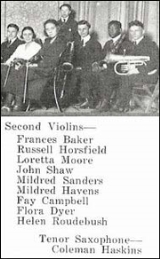
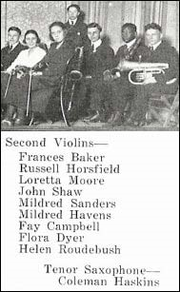
, and started playing saxophone at the age of nine; by the age of fourteen he was playing around eastern Kansas.
Hawkins joined Mamie Smith
's Jazz Hounds in 1921, whom he toured with through 1923, when he settled in New York City
. Hawkins joined Fletcher Henderson
's Orchestra, where he remained until 1934, sometimes doubling on clarinet
and bass saxophone
. Hawkins's playing changed significantly during Louis Armstrong
's tenure with the Henderson Orchestra during 1924-25. In the late 20's, Hawkins also participated in some of the earliest interracial recording sessions with the Mound City Blue Blowers. During the time with Henderson, he became a star soloist with an increasing amount of star solos on record. While with the band, he and Henry "Red" Allen recorded a series of small group sides for ARC
(on their Perfect, Melotone, Romeo, and Oriole labels). Hawkins also recorded a number of solo recordings, with either piano or with a pick-up band of Henderson's musicians in 1933-34, just prior to his European trip. He was also featured on a landmark Benny Goodman
February 2, 1934 session for Columbia
, which also featured Mildred Bailey
as guest vocalist.
In late 1934, Hawkins accepted an invitation to play with Jack Hylton
's band in London, and toured Europe
as a soloist until 1939, memorably working with Django Reinhardt
and Benny Carter
in Paris in 1937. Having returned to the United States, on October 11, 1939 he recorded a two chorus performance of the pop standard "Body and Soul
", which he had been performing at Kelly's Stables. A landmark recording of the Swing Era, recorded as an afterthought at the session, it is notable in that Hawkins ignores almost all of the melody, only the first four bars are stated in a recognizable fashion. In its exploration of harmonic structure it is considered by many to be the next evolutionary step in jazz recording from where Louis Armstrong's "West End Blues
" in 1928 left off.
, he led a combo at Kelly's Stables on Manhattan
's 52nd Street with Thelonious Monk
, Oscar Pettiford
, Miles Davis
, and Max Roach
as sidemen. He was leader on what is generally considered the first ever bebop
recording session with Dizzy Gillespie
and Max Roach
in 1944. Later he toured with Howard McGhee
and recorded with J. J. Johnson and Fats Navarro
. He also toured with Jazz at the Philharmonic
.
In 1948 Hawkins recorded Picasso, an early piece for unaccompanied saxophone.
After 1948 Hawkins divided his time between New York and Europe, making numerous freelance recordings. In the 1960s, he appeared regularly at the Village Vanguard
in Manhattan
.
Hawkins directly influenced many bebop
performers, and later in his career, recorded or performed with such adventurous musicians as Sonny Rollins
, who considered him as his main influence, and John Coltrane
. He appears on the Thelonious Monk with John Coltrane
(Riverside) record. In 1960 he recorded on Max Roach's We Insist! - Freedom Now
suite.
and Roy Eldridge
with whom he appeared at the 1957 Newport Jazz Festival
and recorded Coleman Hawkins Encounters Ben Webster
with fellow tenor saxophonist Ben Webster
along with Oscar Peterson
(piano), Herb Ellis
(guitar), Ray Brown
(bass), and Alvin Stoller
(drums).
In the 1960s, Hawkins began to drink heavily and his recording output began to wane. However, he did manage to record some notable albums with musicians such as Duke Ellington
, among others. His last recording was in 1966.
With failing health, Hawkins succumbed to pneumonia
in 1969 and is interred in the Yew Plot at the Woodlawn Cemetery
in the Bronx.
The Song of the Hawk, a 1990 biography written by British jazz historian John Chilton
, chronicles Hawkins' career as one of the influential jazz performers of the 20th century.
Impulse! Records
Xanadu Records
Verve Records
With Shelly Manne
With Thelonious Monk
With Max Roach
Jazz
Jazz is a musical style that originated at the beginning of the 20th century in African American communities in the Southern United States. It was born out of a mix of African and European music traditions. From its early development until the present, jazz has incorporated music from 19th and 20th...
tenor saxophonist
Tenor saxophone
The tenor saxophone is a medium-sized member of the saxophone family, a group of instruments invented by Adolphe Sax in the 1840s. The tenor, with the alto, are the two most common types of saxophones. The tenor is pitched in the key of B, and written as a transposing instrument in the treble...
. Hawkins was one of the first prominent jazz musicians on his instrument. As Joachim E. Berendt
Joachim-Ernst Berendt
Joachim-Ernst Berendt was a German music journalist, book author and producer specialized on Jazz.-Life:...
explained, "there were some tenor players before him, but the instrument was not an acknowledged jazz horn". While Hawkins is most strongly associated with the swing music and big band
Big band
A big band is a type of musical ensemble associated with jazz and the Swing Era typically consisting of rhythm, brass, and woodwind instruments totaling approximately twelve to twenty-five musicians...
era, he had a role in the development of bebop
Bebop
Bebop differed drastically from the straightforward compositions of the swing era, and was instead characterized by fast tempos, asymmetrical phrasing, intricate melodies, and rhythm sections that expanded on their role as tempo-keepers...
in the 1940s.
Lester Young
Lester Young
Lester Willis Young , nicknamed "Prez", was an American jazz tenor saxophonist and clarinetist. He also played trumpet, violin, and drums....
, who was called "Pres", in a 1959 interview with The Jazz Review
The Jazz Review
The Jazz Review was a magazine which was founded by Nat Hentoff, Martin Williams, and Hsio Wen Shih, in New York City in 1958. It was published until 1961...
, said "As far as I'm concerned, I think Coleman Hawkins was the President first, right? As far as myself, I think I'm the second one." Miles Davis once said: "When I heard Hawk, I learned to play ballads." Hawkins was nickname
Nickname
A nickname is "a usually familiar or humorous but sometimes pointed or cruel name given to a person or place, as a supposedly appropriate replacement for or addition to the proper name.", or a name similar in origin and pronunciation from the original name....
d "Hawk" and sometimes "Bean".
Biography
Early life and the Swing era
Hawkins was born in Saint Joseph, MissouriSaint Joseph, Missouri
Saint Joseph is the second largest city in northwest Missouri, only second to Kansas City in size, serving as the county seat for Buchanan County. As of the 2010 census, Saint Joseph had a total population of 76,780, making it the eighth largest city in the state. The St...
in 1904. Some out-of-date sources say 1901, but there is no evidence to prove an earlier date. He was named Coleman after his mother Cordelia's maiden name.
He attended high school in Chicago, then in Topeka
Topeka, Kansas
Topeka |Kansa]]: Tó Pee Kuh) is the capital city of the U.S. state of Kansas and the county seat of Shawnee County. It is situated along the Kansas River in the central part of Shawnee County, located in northeast Kansas, in the Central United States. As of the 2010 census, the city population was...
, Kansas
Kansas
Kansas is a US state located in the Midwestern United States. It is named after the Kansas River which flows through it, which in turn was named after the Kansa Native American tribe, which inhabited the area. The tribe's name is often said to mean "people of the wind" or "people of the south...
at Topeka High School
Topeka High School
Topeka High School is a fully accredited high school, serving students in grades 9-12, located in Topeka, Kansas. It is one of four high schools within Topeka Public Schools. The school colors are black and gold...
. He later stated that he studied harmony and composition for two years at Washburn College
Washburn University
Washburn University is a co-educational, public institution of higher learning in Topeka, Kansas, USA. It offers undergraduate and graduate programs, as well as professional programs in law and business. Washburn has 550 faculty members, who teach more than 6,400 undergraduate students and...
in Topeka while still attending THS. In his youth he played piano
Piano
The piano is a musical instrument played by means of a keyboard. It is one of the most popular instruments in the world. Widely used in classical and jazz music for solo performances, ensemble use, chamber music and accompaniment, the piano is also very popular as an aid to composing and rehearsal...
and cello
Cello
The cello is a bowed string instrument with four strings tuned in perfect fifths. It is a member of the violin family of musical instruments, which also includes the violin, viola, and double bass. Old forms of the instrument in the Baroque era are baryton and viol .A person who plays a cello is...
, and started playing saxophone at the age of nine; by the age of fourteen he was playing around eastern Kansas.
Hawkins joined Mamie Smith
Mamie Smith
-External links:* African American Registry* with photos* with .ram files of her early recordings* NPR special on the selection on "Crazy Blues" to the 2005...
's Jazz Hounds in 1921, whom he toured with through 1923, when he settled in New York City
New York City
New York is the most populous city in the United States and the center of the New York Metropolitan Area, one of the most populous metropolitan areas in the world. New York exerts a significant impact upon global commerce, finance, media, art, fashion, research, technology, education, and...
. Hawkins joined Fletcher Henderson
Fletcher Henderson
James Fletcher Hamilton Henderson, Jr. was an American pianist, bandleader, arranger and composer, important in the development of big band jazz and swing music. His was one of the most prolific black orchestras and his influence was vast...
's Orchestra, where he remained until 1934, sometimes doubling on clarinet
Clarinet
The clarinet is a musical instrument of woodwind type. The name derives from adding the suffix -et to the Italian word clarino , as the first clarinets had a strident tone similar to that of a trumpet. The instrument has an approximately cylindrical bore, and uses a single reed...
and bass saxophone
Bass saxophone
The bass saxophone is the second largest member of the saxophone family. Its design is similar to that of the baritone saxophone, with a loop of tubing near the mouthpiece. It was the first type of saxophone presented to the public, when Adolphe Sax exhibited a bass saxophone in C at an exhibition...
. Hawkins's playing changed significantly during Louis Armstrong
Louis Armstrong
Louis Armstrong , nicknamed Satchmo or Pops, was an American jazz trumpeter and singer from New Orleans, Louisiana....
's tenure with the Henderson Orchestra during 1924-25. In the late 20's, Hawkins also participated in some of the earliest interracial recording sessions with the Mound City Blue Blowers. During the time with Henderson, he became a star soloist with an increasing amount of star solos on record. While with the band, he and Henry "Red" Allen recorded a series of small group sides for ARC
American Record Corporation
ARC, the American Record Company, also referred to as American Record Corporation, or as ARC Records, was a United States based record company...
(on their Perfect, Melotone, Romeo, and Oriole labels). Hawkins also recorded a number of solo recordings, with either piano or with a pick-up band of Henderson's musicians in 1933-34, just prior to his European trip. He was also featured on a landmark Benny Goodman
Benny Goodman
Benjamin David “Benny” Goodman was an American jazz and swing musician, clarinetist and bandleader; widely known as the "King of Swing".In the mid-1930s, Benny Goodman led one of the most popular musical groups in America...
February 2, 1934 session for Columbia
Columbia Records
Columbia Records is an American record label, owned by Japan's Sony Music Entertainment, operating under the Columbia Music Group with Aware Records. It was founded in 1888, evolving from an earlier enterprise, the American Graphophone Company — successor to the Volta Graphophone Company...
, which also featured Mildred Bailey
Mildred Bailey
Mildred Bailey was a popular and influential American jazz singer during the 1930s, known as "The Rockin' Chair Lady" and "Mrs. Swing"...
as guest vocalist.
In late 1934, Hawkins accepted an invitation to play with Jack Hylton
Jack Hylton
Jack Hylton was a British band leader and impresario.He was born John Greenhalgh Hilton in the Great Lever area of Bolton, Lancashire, the son of George Hilton, a cotton yarn twister. His father was an amateur singer at the local Labour Club and Jack learned piano to accompany him on the stage...
's band in London, and toured Europe
Europe
Europe is, by convention, one of the world's seven continents. Comprising the westernmost peninsula of Eurasia, Europe is generally 'divided' from Asia to its east by the watershed divides of the Ural and Caucasus Mountains, the Ural River, the Caspian and Black Seas, and the waterways connecting...
as a soloist until 1939, memorably working with Django Reinhardt
Django Reinhardt
Django Reinhardt was a pioneering virtuoso jazz guitarist and composer who invented an entirely new style of jazz guitar technique that has since become a living musical tradition within French gypsy culture...
and Benny Carter
Benny Carter
Bennett Lester Carter was an American jazz alto saxophonist, clarinetist, trumpeter, composer, arranger, and bandleader. He was a major figure in jazz from the 1930s to the 1990s, and was recognized as such by other jazz musicians who called him King...
in Paris in 1937. Having returned to the United States, on October 11, 1939 he recorded a two chorus performance of the pop standard "Body and Soul
Body and Soul (song)
"Body and Soul" was recorded as a duet by Tony Bennett and Amy Winehouse in 2011. It was the final recording made by Winehouse before her death on July 23, 2011. The single was released worldwide on September 14, 2011 on iTunes, MTV and VH1....
", which he had been performing at Kelly's Stables. A landmark recording of the Swing Era, recorded as an afterthought at the session, it is notable in that Hawkins ignores almost all of the melody, only the first four bars are stated in a recognizable fashion. In its exploration of harmonic structure it is considered by many to be the next evolutionary step in jazz recording from where Louis Armstrong's "West End Blues
West End Blues
"West End Blues" is a multi-strain 12 bar blues composition by Joe "King" Oliver. It is most commonly performed as an instrumental, although it has lyrics added by Clarence Williams....
" in 1928 left off.
The Bebop era
After an unsuccessful attempt to establish a big bandBig band
A big band is a type of musical ensemble associated with jazz and the Swing Era typically consisting of rhythm, brass, and woodwind instruments totaling approximately twelve to twenty-five musicians...
, he led a combo at Kelly's Stables on Manhattan
Manhattan
Manhattan is the oldest and the most densely populated of the five boroughs of New York City. Located primarily on the island of Manhattan at the mouth of the Hudson River, the boundaries of the borough are identical to those of New York County, an original county of the state of New York...
's 52nd Street with Thelonious Monk
Thelonious Monk
Thelonious Sphere Monk was an American jazz pianist and composer considered "one of the giants of American music". Monk had a unique improvisational style and made numerous contributions to the standard jazz repertoire, including "Epistrophy", "'Round Midnight", "Blue Monk", "Straight, No Chaser"...
, Oscar Pettiford
Oscar Pettiford
Oscar Pettiford was an American jazz double bassist, cellist and composer known particularly for his pioneering work in bebop.-Biography:...
, Miles Davis
Miles Davis
Miles Dewey Davis III was an American jazz musician, trumpeter, bandleader, and composer. Widely considered one of the most influential musicians of the 20th century, Miles Davis was, with his musical groups, at the forefront of several major developments in jazz music, including bebop, cool jazz,...
, and Max Roach
Max Roach
Maxwell Lemuel "Max" Roach was an American jazz percussionist, drummer, and composer.A pioneer of bebop, Roach went on to work in many other styles of music, and is generally considered alongside the most important drummers in history...
as sidemen. He was leader on what is generally considered the first ever bebop
Bebop
Bebop differed drastically from the straightforward compositions of the swing era, and was instead characterized by fast tempos, asymmetrical phrasing, intricate melodies, and rhythm sections that expanded on their role as tempo-keepers...
recording session with Dizzy Gillespie
Dizzy Gillespie
John Birks "Dizzy" Gillespie was an American jazz trumpet player, bandleader, singer, and composer dubbed "the sound of surprise".Together with Charlie Parker, he was a major figure in the development of bebop and modern jazz...
and Max Roach
Max Roach
Maxwell Lemuel "Max" Roach was an American jazz percussionist, drummer, and composer.A pioneer of bebop, Roach went on to work in many other styles of music, and is generally considered alongside the most important drummers in history...
in 1944. Later he toured with Howard McGhee
Howard McGhee
Howard McGhee was one of the very first bebop jazz trumpeters, together with Dizzy Gillespie, Fats Navarro and Idrees Sulieman. He was known for lightning-fast fingers and very high notes...
and recorded with J. J. Johnson and Fats Navarro
Fats Navarro
Theodore "Fats" Navarro was an American jazz trumpet player. He was a pioneer of the bebop style of jazz improvisation in the 1940s. He had a strong stylistic influence on many other players, most notably Clifford Brown.-Life:Navarro was born in Key West, Florida, to Cuban-Black-Chinese parentage...
. He also toured with Jazz at the Philharmonic
Jazz at the Philharmonic
Jazz at the Philharmonic, or JATP, was the title of a series of jazz concerts, tours and recordings produced by Norman Granz....
.
In 1948 Hawkins recorded Picasso, an early piece for unaccompanied saxophone.
After 1948 Hawkins divided his time between New York and Europe, making numerous freelance recordings. In the 1960s, he appeared regularly at the Village Vanguard
Village Vanguard
The Village Vanguard is a jazz club located at in Greenwich Village, New York City. The club was opened on February 22, 1935, by Max Gordon. At first, it also featured other forms of music such as folk music and beat poetry, but it switched to an all-jazz format in 1957.-History:Over 100 jazz...
in Manhattan
Manhattan
Manhattan is the oldest and the most densely populated of the five boroughs of New York City. Located primarily on the island of Manhattan at the mouth of the Hudson River, the boundaries of the borough are identical to those of New York County, an original county of the state of New York...
.
Hawkins directly influenced many bebop
Bebop
Bebop differed drastically from the straightforward compositions of the swing era, and was instead characterized by fast tempos, asymmetrical phrasing, intricate melodies, and rhythm sections that expanded on their role as tempo-keepers...
performers, and later in his career, recorded or performed with such adventurous musicians as Sonny Rollins
Sonny Rollins
Theodore Walter "Sonny" Rollins is a Grammy-winning American jazz tenor saxophonist. Rollins is widely recognized as one of the most important and influential jazz musicians. A number of his compositions, including "St...
, who considered him as his main influence, and John Coltrane
John Coltrane
John William Coltrane was an American jazz saxophonist and composer. Working in the bebop and hard bop idioms early in his career, Coltrane helped pioneer the use of modes in jazz and later was at the forefront of free jazz...
. He appears on the Thelonious Monk with John Coltrane
Thelonious Monk with John Coltrane
Thelonious Monk with John Coltrane is a 1957 album by Thelonious Monk originally recorded for Riverside Records. It was recorded while Monk was engaged in a six-month stay at New York's legendary Five Spot in 1957 with his quartet of the time, which included Coltrane...
(Riverside) record. In 1960 he recorded on Max Roach's We Insist! - Freedom Now
We Insist! - Freedom Now
We Insist! Max Roach's Freedom Now Suite is a 1960 jazz album containing a suite which Max Roach and lyricist Oscar Brown had begun to develop in 1959 with a view to its performance in 1963 on the centennial of the Emancipation Proclamation. The cover references the sit-in movement of the Civil...
suite.
Later life
In the 1950s, Hawkins performed with more traditional musicians such as Henry "Red" AllenRed Allen
Henry James "Red" Allen was a jazz trumpeter and vocalist whose style has been claimed to be the first to fully incorporate the innovations of Louis Armstrong.-Life and career:...
and Roy Eldridge
Roy Eldridge
Roy David Eldridge , nicknamed "Little Jazz" was an American jazz trumpet player. His sophisticated use of harmony, including the use of tritone substitutions, his virtuosic solos and his strong influence on Dizzy Gillespie mark him as one of the most exciting musicians of the swing era and a...
with whom he appeared at the 1957 Newport Jazz Festival
Newport Jazz Festival
The Newport Jazz Festival is a music festival held every summer in Newport, Rhode Island, USA. It was established in 1954 by socialite Elaine Lorillard, who, together with husband Louis Lorillard, financed the festival for many years. The couple hired jazz impresario George Wein to organize the...
and recorded Coleman Hawkins Encounters Ben Webster
Coleman Hawkins Encounters Ben Webster
Coleman Hawkins Encounters Ben Webster is 1957 album by Coleman Hawkins and Ben Webster, accompanied by a trio led by Oscar Peterson .- Track listing :#"Blues for Yolande" – 6:44#"It Never Entered My Mind" – 5:47...
with fellow tenor saxophonist Ben Webster
Ben Webster
Benjamin Francis Webster , a.k.a. "The Brute" or "Frog," was an influential American jazz tenor saxophonist. Webster, born in Kansas City, Missouri, was considered one of the three most important "swing tenors" along with Coleman Hawkins and Lester Young...
along with Oscar Peterson
Oscar Peterson
Oscar Emmanuel Peterson was a Canadian jazz pianist and composer. He was called the "Maharaja of the keyboard" by Duke Ellington, "O.P." by his friends. He released over 200 recordings, won seven Grammy Awards, and received other numerous awards and honours over the course of his career...
(piano), Herb Ellis
Herb Ellis
Mitchell Herbert "Herb" Ellis was an American jazz guitarist. Perhaps best known for his 1950s membership in the trio of pianist Oscar Peterson, Ellis was also a staple of west-coast studio recording sessions, and was described by critic Scott Yanow as "an excellent bop-based guitarist with a...
(guitar), Ray Brown
Ray Brown (musician)
Raymond Matthews Brown was an American jazz double bassist.-Biography:Ray Brown was born in Pittsburgh, Pennsylvania, and had piano lessons from the age of eight. After noticing how many pianists attended his high school, he thought of taking up the trombone, but was unable to afford one...
(bass), and Alvin Stoller
Alvin Stoller
Alvin Stoller was an American jazz drummer. Though he seems to have been largely forgotten, he was held in high regard in the 1940s and 1950s...
(drums).
In the 1960s, Hawkins began to drink heavily and his recording output began to wane. However, he did manage to record some notable albums with musicians such as Duke Ellington
Duke Ellington
Edward Kennedy "Duke" Ellington was an American composer, pianist, and big band leader. Ellington wrote over 1,000 compositions...
, among others. His last recording was in 1966.
With failing health, Hawkins succumbed to pneumonia
Pneumonia
Pneumonia is an inflammatory condition of the lung—especially affecting the microscopic air sacs —associated with fever, chest symptoms, and a lack of air space on a chest X-ray. Pneumonia is typically caused by an infection but there are a number of other causes...
in 1969 and is interred in the Yew Plot at the Woodlawn Cemetery
Woodlawn Cemetery, Bronx
Woodlawn Cemetery is one of the largest cemeteries in New York City and is a designated National Historic Landmark.A rural cemetery located in the Bronx, it opened in 1863, in what was then southern Westchester County, in an area that was annexed to New York City in 1874.The cemetery covers more...
in the Bronx.
The Song of the Hawk, a 1990 biography written by British jazz historian John Chilton
John Chilton
John James Chilton is a British jazz trumpeter and writer. During the 1960s he also worked with pop bands, including The Swinging Blue Jeans and The Escorts....
, chronicles Hawkins' career as one of the influential jazz performers of the 20th century.
As leader
- Body and SoulBody and Soul (Coleman Hawkins album)Body and Soul is an album by the jazz tenor saxophonist Coleman Hawkins, including recordings made between 1939 and 1956. It takes its name from one of Hawkins' most famous performances — a 1939 recording of "Body and Soul"; the album also contains a 1956 recording of the same piece...
(1939–1956, RCARCARCA Corporation, founded as the Radio Corporation of America, was an American electronics company in existence from 1919 to 1986. The RCA trademark is currently owned by the French conglomerate Technicolor SA through RCA Trademark Management S.A., a company owned by Technicolor...
) - Picasso (album) (1948)
- The Hawk in Paris (1956, RCA Victor Gold)
- The Hawk Flies HighThe Hawk Flies HighThe Hawk Flies High is a 1957 album by jazz tenor saxophonist Coleman Hawkins. J.J. Johnson, Idrees Sulieman, Hank Jones, Oscar Pettiford, Barry Galbraith, and Jo Jones feature on the album.-Track listing:#Chant - 5:08#Juicy Fruit - 11:16...
(1957) - Hawk Eyes! (1959)
- In a Mellow ToneIn a Mellow Tone"In a Mellow Tone", also known as "In a Mellotone", is a 1939 jazz standard composed by Duke Ellington, with lyrics written by Milt Gabler. The song was based on the 1917 standard "Rose Room" by Art Hickman and Harry Williams...
(1960) - Bean Stalkin' (1960)
- At Ease with Coleman Hawkins (1960), Rerelease (1985) OJC-181
- Night Hawk (1961, with Eddie Lockjaw Davis, SwingvillePrestige RecordsPrestige Records was a jazz record label founded in 1949 by Bob Weinstock. The company was located at 203 South Washington Avenue in Bergenfield, New Jersey, and recorded hundreds of albums by many of the leading jazz musicians of the day, sometimes issuing them under the names of several...
) - The Hawk Relaxes (1961, MoodsvillePrestige RecordsPrestige Records was a jazz record label founded in 1949 by Bob Weinstock. The company was located at 203 South Washington Avenue in Bergenfield, New Jersey, and recorded hundreds of albums by many of the leading jazz musicians of the day, sometimes issuing them under the names of several...
) - Good Old Broadway (1962, MoodsvillePrestige RecordsPrestige Records was a jazz record label founded in 1949 by Bob Weinstock. The company was located at 203 South Washington Avenue in Bergenfield, New Jersey, and recorded hundreds of albums by many of the leading jazz musicians of the day, sometimes issuing them under the names of several...
) - Alive! (1962)
- Sonny Meets Hawk!Sonny Meets Hawk!Sonny Meets Hawk! is a 1963 album by jazz saxophonist Sonny Rollins, with Coleman Hawkins appearing as guest artist. It was recorded at RCA Victor Studio "B" in New York City on July 15 and 18, 1963....
with Sonny RollinsSonny RollinsTheodore Walter "Sonny" Rollins is a Grammy-winning American jazz tenor saxophonist. Rollins is widely recognized as one of the most important and influential jazz musicians. A number of his compositions, including "St...
(1963) - Sirius (1966)
- Jazz Reunion (with Pee Wee RussellPee Wee RussellCharles Ellsworth Russell, much better known by his nickname Pee Wee Russell, was a jazz musician. Early in his career he played clarinet and saxophones, but eventually focused solely on clarinet....
, Candid RecordsCandid RecordsCandid Records was founded as a subsidiary of Archie Bleyer's Cadence label in New York City in 1960. The jazz writer and civil rights activist, Nat Hentoff, worked as the label's A&R director, aiming to create a representative catalog of the jazz of the day...
)
Impulse! Records
Impulse! Records
Impulse! Records was an American jazz record label, originally established in 1960 by producer Creed Taylor as a subsidiary of ABC-Paramount Records, based in New York City...
- 1962: Duke Ellington Meets Coleman HawkinsDuke Ellington Meets Coleman HawkinsDuke Ellington Meets Coleman Hawkins is a jazz album by Duke Ellington and Coleman Hawkins recorded on August 28, 1962 and released in February 1963 by Impulse! Records....
- 1962: Today and NowToday and NowToday and Now is an album by American jazz saxophonist Coleman Hawkins featuring performances recorded in 1962 for the Impulse! label.-Reception:...
- 1962: DesafinadoDesafinado (album)Desafinado is an album by American jazz saxophonist Coleman Hawkins featuring performances recorded in 1962 for the Impulse! label.-Reception:The Allmusic review by Michael G...
- 1965: Wrapped TightWrapped TightWrapped Tight is an album by American jazz saxophonist Coleman Hawkins featuring performances recorded in 1965 for the Impulse! label.-Reception:...
Xanadu Records
Xanadu Records
Xanadu Records was a jazz music record label specializing in bebop throughout the 1970s and 1980s founded by Don Schlitten, recording and issuing recordings by some legendary names in jazz music.-Discography:...
- Jazz Tones
- Dutch Treat
- Thanks For The MemoryThanks for the Memory"Thanks for the Memory" is a popular song, with music composed by Ralph Rainger and lyrics by Leo Robin. It was introduced in the 1938 film The Big Broadcast of 1938 by Shep Fields and His Orchestra with vocals by Bob Hope and Shirley Ross...
Verve Records
Verve Records
Verve Records is an American jazz record label now owned by Universal Music Group. It was founded by Norman Granz in 1956, absorbing the catalogues of his earlier labels, Clef Records and Norgran Records , and material which had been licensed to Mercury previously.-Jazz and folk origins:The Verve...
- 1957: Coleman Hawkins Encounters Ben WebsterColeman Hawkins Encounters Ben WebsterColeman Hawkins Encounters Ben Webster is 1957 album by Coleman Hawkins and Ben Webster, accompanied by a trio led by Oscar Peterson .- Track listing :#"Blues for Yolande" – 6:44#"It Never Entered My Mind" – 5:47...
- 1957: The Genius of Coleman HawkinsThe Genius of Coleman HawkinsThe Genius of Coleman Hawkins is a 1957 album by tenor saxophonist Coleman Hawkins, featuring the Oscar Peterson quartet. -Track listing:# "I'll Never Be the Same" – 3:29...
- 1958: Coleman Hawkins and Confreres
- 1962: Hawkins! Eldridge! Hodges! Alive at the Village Gate
As sideman
With Abbey LincolnAbbey Lincoln
Anna Marie Wooldridge , better known by her stage name Abbey Lincoln, was a jazz vocalist, songwriter, and actress. Lincoln was unusual in that she wrote and performed her own compositions, expanding the expectations of jazz audiences.-Biography:Born in Chicago, Illinois, she was one of many...
- Straight AheadStraight Ahead (Abbey Lincoln album)Straight Ahead is an album by American jazz vocalist Abbey Lincoln featuring performances recorded in 1961 for the Candid label.-Reception:...
(Candid, 1961)
With Shelly Manne
Shelly Manne
Shelly Manne , born Sheldon Manne in New York City, was an American jazz drummer. Most frequently associated with West Coast jazz, he was known for his versatility and also played in a number of other styles, including Dixieland, swing, bebop, avant-garde jazz and fusion, as well as contributing...
- 2-3-42-3-42-3-4 is an album by American jazz drummer Shelly Manne featuring performances recorded in 1962 for the Impulse! label.-Background:2-3-4 was not a typical album for Manne...
(Impulse!, 1962)
With Thelonious Monk
Thelonious Monk
Thelonious Sphere Monk was an American jazz pianist and composer considered "one of the giants of American music". Monk had a unique improvisational style and made numerous contributions to the standard jazz repertoire, including "Epistrophy", "'Round Midnight", "Blue Monk", "Straight, No Chaser"...
- Thelonious Monk with John ColtraneThelonious Monk with John ColtraneThelonious Monk with John Coltrane is a 1957 album by Thelonious Monk originally recorded for Riverside Records. It was recorded while Monk was engaged in a six-month stay at New York's legendary Five Spot in 1957 with his quartet of the time, which included Coltrane...
(Riverside, 1957)
With Max Roach
Max Roach
Maxwell Lemuel "Max" Roach was an American jazz percussionist, drummer, and composer.A pioneer of bebop, Roach went on to work in many other styles of music, and is generally considered alongside the most important drummers in history...
- We Insist! - Freedom NowWe Insist! - Freedom NowWe Insist! Max Roach's Freedom Now Suite is a 1960 jazz album containing a suite which Max Roach and lyricist Oscar Brown had begun to develop in 1959 with a view to its performance in 1963 on the centennial of the Emancipation Proclamation. The cover references the sit-in movement of the Civil...
(Candid, 1960)