

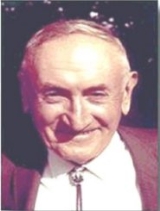
Fritz Zwicky

Encyclopedia
Fritz Zwicky was a Swiss astronomer
. He worked most of his life at the California Institute of Technology
in the United States of America, where he made many important contributions in theoretical and observational astronomy.
, Bulgaria
to a Swiss father. His father, Fridolin (b. 1868), was a prominent industrialist in the Bulgarian city and also served as ambassador of Norway
in Varna (1908–1933). The Zwicky House in Varna was designed and built by Fridolin Zwicky. Fritz's mother, Franziska Vrček (b. 1871), was an ethnic Czech
of the Austro-Hungarian Empire. Fritz was the oldest of the Zwicky family's three children: he had a younger brother named Rudolf and a sister called Leoni. Fritz's mother died in Varna in 1927 and his father Fridolin remained in Bulgaria until 1945, when he returned to Switzerland. His sister Leoni married to a Bulgarian from Varna and spent her entire life in the city.
In 1904, at the age of six, Fritz was sent to his grandparents in Glarus, Switzerland, "the Zwicky's ancestral Swiss canton, to study commerce." His interests shifted to math and physics and he received an advanced education in mathematics and experimental physics at the Swiss Federal Institute of Technology
, located in Zürich
, Switzerland
. In 1925, he emigrated to the United States
to work with Robert Millikan
at California Institute of Technology
(Caltech) after receiving the "international fellowship from the Rockefeller Foundation."
He was responsible for positing numerous cosmological theories that have a profound impact on understanding of our universe today. He was appointed Professor of Astronomy at Caltech in 1942 and also worked as a research director/consultant for Aerojet Engineering Corporation (1943–1961) and staff member of Mount Wilson Observatory
and Palomar Observatory
for most of his career. He developed some of the earliest jet engines and holds over 50 patents, many in jet propulsion, and is the inventor of the Underwater Jet (TIME March 14, 1949), the Two Piece Jet Thrust Motor and Inverted Hydro Pulse.
In April 1932, Fritz Zwicky married Dorothy Vernon Gates, the daughter of a prominent local family and Senator Egbert Gates. Her money was instrumental in the funding of the Palomar Observatory
during the Great Depression
. Nicholas Roosevelt
, cousin of President Theodore Roosevelt, was his brother-in-law by marriage to Tirzah Gates. Zwicky and Dorothy divorced amicably in 1941. In 1947 Zwicky was married in Switzerland to Anna Margaritha Zurcher, and they had three daughters, Margrit, Franziska, and Barbarina. Three grandchildren were born after his passing away. The Zwicky Museum at the Landesbibliothek, Glarus
, houses many of his papers and scientific works, and the Fritz Zwicky Stiftung (Foundation) in Switzerland carries on his ideas relating to "morphological analysis
". Zwicky died in Pasadena on February 8, 1974 and was buried in Mollis
, Switzerland.
 Fritz Zwicky was a prolific scientist and made important contributions in many areas of astronomy.
, Zwicky pioneered and promoted the use of the first Schmidt telescope
s used in a mountain-top observatory in 1935. He hand-carried the Schmidt lens from Germany, which had been polished by the optician, Bernard Schmidt. In 1934 he and Baade coined the term "supernova
" and hypothesized that they were the transition of normal stars into neutron stars, as well as the origin of cosmic ray
s. It was a prescient insight that had tremendous impact in determining the size and age of the universe in subsequent decades.
In support of this hypothesis, Zwicky started hunting for supernovae, and found a total of 120 by himself (and one more, SN 1963J, in concert with Paul Wild
) over a stretch of 52 years (SN 1921B through SN 1973K), a record which still stands as of 2006 (the current runner-up is Jean Mueller
, with 98 discoveries and 9 co-discoveries).
proposed using supernova
e as standard candles to estimate distances in deep space. Because light curves of many type-Ia supernovae show a common peak luminosity, they establish a cosmological distance scale by a well known intrinsic brightness.
Distant Type Ia supernova
e show a nonlinear Hubble relationship, which scientists have explained in terms of an acceleration in the expansion rate for the universe.
es by the previously discovered Einstein effect. It was not until 1979 that this effect was confirmed by observation of the so-called "Twin Quasar
" Q0957+561.
. He was able to infer the average mass of galaxies within the cluster, and obtained a value about 160 times greater than expected from their luminosity, and proposed that most of the matter was dark. The same calculation today shows a smaller factor, based on greater values for the mass of luminous material; but it is still clear that the great majority of matter is dark.
discovered a linear relationship between the distance to a galaxy and its redshift expressed as a velocity, Zwicky immediately speculated that the effect was due not to motions of the galaxy, but to an unknown phenomenon that caused photons to lose energy as they traveled through space. He considered the most likely candidate process to be a drag effect in which photons transfer momentum to surrounding masses through gravitational interactions; and proposed that an attempt be made to put this effect on a sound theoretical footing with general relativity. He also considered and rejected explanations involving interactions with free electrons, or the expansion of space.
Zwicky was skeptical of the expansion of space in 1929, because the rates measured at that time seemed too large. It was not until 1956 that Walter Baade
corrected the distance scale based on Cepheid variable
stars, and ushered in the first accurate measures of the expansion rate. Cosmological redshift is now conventionally understood to be a consequence of the expansion of space; a feature of Big Bang cosmology
.
Astronomer
An astronomer is a scientist who studies celestial bodies such as planets, stars and galaxies.Historically, astronomy was more concerned with the classification and description of phenomena in the sky, while astrophysics attempted to explain these phenomena and the differences between them using...
. He worked most of his life at the California Institute of Technology
California Institute of Technology
The California Institute of Technology is a private research university located in Pasadena, California, United States. Caltech has six academic divisions with strong emphases on science and engineering...
in the United States of America, where he made many important contributions in theoretical and observational astronomy.
Biography
Fritz Zwicky was born in VarnaVarna
Varna is the largest city and seaside resort on the Bulgarian Black Sea Coast and third-largest in Bulgaria after Sofia and Plovdiv, with a population of 334,870 inhabitants according to Census 2011...
, Bulgaria
Bulgaria
Bulgaria , officially the Republic of Bulgaria , is a parliamentary democracy within a unitary constitutional republic in Southeast Europe. The country borders Romania to the north, Serbia and Macedonia to the west, Greece and Turkey to the south, as well as the Black Sea to the east...
to a Swiss father. His father, Fridolin (b. 1868), was a prominent industrialist in the Bulgarian city and also served as ambassador of Norway
Norway
Norway , officially the Kingdom of Norway, is a Nordic unitary constitutional monarchy whose territory comprises the western portion of the Scandinavian Peninsula, Jan Mayen, and the Arctic archipelago of Svalbard and Bouvet Island. Norway has a total area of and a population of about 4.9 million...
in Varna (1908–1933). The Zwicky House in Varna was designed and built by Fridolin Zwicky. Fritz's mother, Franziska Vrček (b. 1871), was an ethnic Czech
Czech people
Czechs, or Czech people are a western Slavic people of Central Europe, living predominantly in the Czech Republic. Small populations of Czechs also live in Slovakia, Austria, the United States, the United Kingdom, Chile, Argentina, Canada, Germany, Russia and other countries...
of the Austro-Hungarian Empire. Fritz was the oldest of the Zwicky family's three children: he had a younger brother named Rudolf and a sister called Leoni. Fritz's mother died in Varna in 1927 and his father Fridolin remained in Bulgaria until 1945, when he returned to Switzerland. His sister Leoni married to a Bulgarian from Varna and spent her entire life in the city.
In 1904, at the age of six, Fritz was sent to his grandparents in Glarus, Switzerland, "the Zwicky's ancestral Swiss canton, to study commerce." His interests shifted to math and physics and he received an advanced education in mathematics and experimental physics at the Swiss Federal Institute of Technology
ETH Zurich
The Swiss Federal Institute of Technology Zurich or ETH Zürich is an engineering, science, technology, mathematics and management university in the City of Zurich, Switzerland....
, located in Zürich
Zürich
Zurich is the largest city in Switzerland and the capital of the canton of Zurich. It is located in central Switzerland at the northwestern tip of Lake Zurich...
, Switzerland
Switzerland
Switzerland name of one of the Swiss cantons. ; ; ; or ), in its full name the Swiss Confederation , is a federal republic consisting of 26 cantons, with Bern as the seat of the federal authorities. The country is situated in Western Europe,Or Central Europe depending on the definition....
. In 1925, he emigrated to the United States
United States
The United States of America is a federal constitutional republic comprising fifty states and a federal district...
to work with Robert Millikan
Robert Millikan
Robert A. Millikan was an American experimental physicist, and Nobel laureate in physics for his measurement of the charge on the electron and for his work on the photoelectric effect. He served as president of Caltech from 1921 to 1945...
at California Institute of Technology
California Institute of Technology
The California Institute of Technology is a private research university located in Pasadena, California, United States. Caltech has six academic divisions with strong emphases on science and engineering...
(Caltech) after receiving the "international fellowship from the Rockefeller Foundation."
He was responsible for positing numerous cosmological theories that have a profound impact on understanding of our universe today. He was appointed Professor of Astronomy at Caltech in 1942 and also worked as a research director/consultant for Aerojet Engineering Corporation (1943–1961) and staff member of Mount Wilson Observatory
Mount Wilson Observatory
The Mount Wilson Observatory is an astronomical observatory in Los Angeles County, California, United States. The MWO is located on Mount Wilson, a 5,715 foot peak in the San Gabriel Mountains near Pasadena, northeast of Los Angeles...
and Palomar Observatory
Palomar Observatory
Palomar Observatory is a privately owned observatory located in San Diego County, California, southeast of Pasadena's Mount Wilson Observatory, in the Palomar Mountain Range. At approximately elevation, it is owned and operated by the California Institute of Technology...
for most of his career. He developed some of the earliest jet engines and holds over 50 patents, many in jet propulsion, and is the inventor of the Underwater Jet (TIME March 14, 1949), the Two Piece Jet Thrust Motor and Inverted Hydro Pulse.
In April 1932, Fritz Zwicky married Dorothy Vernon Gates, the daughter of a prominent local family and Senator Egbert Gates. Her money was instrumental in the funding of the Palomar Observatory
Palomar Observatory
Palomar Observatory is a privately owned observatory located in San Diego County, California, southeast of Pasadena's Mount Wilson Observatory, in the Palomar Mountain Range. At approximately elevation, it is owned and operated by the California Institute of Technology...
during the Great Depression
Great Depression
The Great Depression was a severe worldwide economic depression in the decade preceding World War II. The timing of the Great Depression varied across nations, but in most countries it started in about 1929 and lasted until the late 1930s or early 1940s...
. Nicholas Roosevelt
Nicholas Roosevelt (diplomat)
Nicholas Roosevelt was an American diplomat and journalist. A member of the Roosevelt family and first-cousin once removed of U.S. President Theodore Roosevelt, he was born in New York City to James West Roosevelt, a brother of Hilborne Roosevelt, and Laura Henrietta d'Oremieulx...
, cousin of President Theodore Roosevelt, was his brother-in-law by marriage to Tirzah Gates. Zwicky and Dorothy divorced amicably in 1941. In 1947 Zwicky was married in Switzerland to Anna Margaritha Zurcher, and they had three daughters, Margrit, Franziska, and Barbarina. Three grandchildren were born after his passing away. The Zwicky Museum at the Landesbibliothek, Glarus
Glarus
Glarus is the capital of the Canton of Glarus in Switzerland. Glarus municipality since 1 January 2011 incorporates the former municipalities of Ennenda, Netstal and Riedern....
, houses many of his papers and scientific works, and the Fritz Zwicky Stiftung (Foundation) in Switzerland carries on his ideas relating to "morphological analysis
Morphological analysis
Morphological Analysis or General Morphological Analysis is a method developed by Fritz Zwicky for exploring all the possible solutions to a multi-dimensional, non-quantified problem complex.-Overview:...
". Zwicky died in Pasadena on February 8, 1974 and was buried in Mollis
Mollis
Mollis is a former municipality in the canton of Glarus in Switzerland. Effective from 1 January 2011, Mollis is part of the municipality of Glarus Nord.-Geography:...
, Switzerland.
Scientific work
Supernovae and neutron stars
Together with colleague Walter BaadeWalter Baade
Wilhelm Heinrich Walter Baade was a German astronomer who worked in the USA from 1931 to 1959.-Biography:He took advantage of wartime blackout conditions during World War II, which reduced light pollution at Mount Wilson Observatory, to resolve stars in the center of the Andromeda galaxy for the...
, Zwicky pioneered and promoted the use of the first Schmidt telescope
Schmidt camera
A Schmidt camera, also referred to as the Schmidt telescope, is a catadioptric astrophotographic telescope designed to provide wide fields of view with limited aberrations. Other similar designs are the Wright Camera and Lurie-Houghton telescope....
s used in a mountain-top observatory in 1935. He hand-carried the Schmidt lens from Germany, which had been polished by the optician, Bernard Schmidt. In 1934 he and Baade coined the term "supernova
Supernova
A supernova is a stellar explosion that is more energetic than a nova. It is pronounced with the plural supernovae or supernovas. Supernovae are extremely luminous and cause a burst of radiation that often briefly outshines an entire galaxy, before fading from view over several weeks or months...
" and hypothesized that they were the transition of normal stars into neutron stars, as well as the origin of cosmic ray
Cosmic ray
Cosmic rays are energetic charged subatomic particles, originating from outer space. They may produce secondary particles that penetrate the Earth's atmosphere and surface. The term ray is historical as cosmic rays were thought to be electromagnetic radiation...
s. It was a prescient insight that had tremendous impact in determining the size and age of the universe in subsequent decades.
In support of this hypothesis, Zwicky started hunting for supernovae, and found a total of 120 by himself (and one more, SN 1963J, in concert with Paul Wild
Paul Wild (Swiss astronomer)
Professor Paul Wild of Berne, Switzerland, is an astronomer who discovered numerous comets and asteroids.- Career :Professor Wild was director of the Astronomical Institute of the University of Berne from 1980 to 1991...
) over a stretch of 52 years (SN 1921B through SN 1973K), a record which still stands as of 2006 (the current runner-up is Jean Mueller
Jean Mueller
Jean Mueller is an American astronomer.Working at Palomar Observatory, she has discovered a total of 15 comets, including 7 periodic comets 120P/Mueller, 131P/Mueller, 136P/Mueller, 149P/Mueller, 173P/Mueller, 188P/LINEAR-Mueller, 190P/Mueller, and 8 non-periodic comets.She has also discovered 10...
, with 98 discoveries and 9 co-discoveries).
Standard candles
In 1938, Zwicky's colleague Walter BaadeWalter Baade
Wilhelm Heinrich Walter Baade was a German astronomer who worked in the USA from 1931 to 1959.-Biography:He took advantage of wartime blackout conditions during World War II, which reduced light pollution at Mount Wilson Observatory, to resolve stars in the center of the Andromeda galaxy for the...
proposed using supernova
Supernova
A supernova is a stellar explosion that is more energetic than a nova. It is pronounced with the plural supernovae or supernovas. Supernovae are extremely luminous and cause a burst of radiation that often briefly outshines an entire galaxy, before fading from view over several weeks or months...
e as standard candles to estimate distances in deep space. Because light curves of many type-Ia supernovae show a common peak luminosity, they establish a cosmological distance scale by a well known intrinsic brightness.
Distant Type Ia supernova
Type Ia supernova
A Type Ia supernova is a sub-category of supernovae, which in turn are a sub-category of cataclysmic variable stars, that results from the violent explosion of a white dwarf star. A white dwarf is the remnant of a star that has completed its normal life cycle and has ceased nuclear fusion...
e show a nonlinear Hubble relationship, which scientists have explained in terms of an acceleration in the expansion rate for the universe.
Gravitational lenses
In 1937, Zwicky posited that galaxy clusters could act as gravitational lensGravitational lens
A gravitational lens refers to a distribution of matter between a distant source and an observer, that is capable of bending the light from the source, as it travels towards the observer...
es by the previously discovered Einstein effect. It was not until 1979 that this effect was confirmed by observation of the so-called "Twin Quasar
Twin Quasar
The Twin Quasar , also known as SBS 0957+561, or TXS 0957+561 , was the first identified gravitationally lensed object.-Quasar:...
" Q0957+561.
Dark matter
While examining the Coma galaxy cluster in 1933, Zwicky was the first to use the virial theorem to infer the existence of unseen matter, what is now called dark matterDark matter
In astronomy and cosmology, dark matter is matter that neither emits nor scatters light or other electromagnetic radiation, and so cannot be directly detected via optical or radio astronomy...
. He was able to infer the average mass of galaxies within the cluster, and obtained a value about 160 times greater than expected from their luminosity, and proposed that most of the matter was dark. The same calculation today shows a smaller factor, based on greater values for the mass of luminous material; but it is still clear that the great majority of matter is dark.
Tired light
When Edwin HubbleEdwin Hubble
Edwin Powell Hubble was an American astronomer who profoundly changed the understanding of the universe by confirming the existence of galaxies other than the Milky Way - our own galaxy...
discovered a linear relationship between the distance to a galaxy and its redshift expressed as a velocity, Zwicky immediately speculated that the effect was due not to motions of the galaxy, but to an unknown phenomenon that caused photons to lose energy as they traveled through space. He considered the most likely candidate process to be a drag effect in which photons transfer momentum to surrounding masses through gravitational interactions; and proposed that an attempt be made to put this effect on a sound theoretical footing with general relativity. He also considered and rejected explanations involving interactions with free electrons, or the expansion of space.
Zwicky was skeptical of the expansion of space in 1929, because the rates measured at that time seemed too large. It was not until 1956 that Walter Baade
Walter Baade
Wilhelm Heinrich Walter Baade was a German astronomer who worked in the USA from 1931 to 1959.-Biography:He took advantage of wartime blackout conditions during World War II, which reduced light pollution at Mount Wilson Observatory, to resolve stars in the center of the Andromeda galaxy for the...
corrected the distance scale based on Cepheid variable
Cepheid variable
A Cepheid is a member of a class of very luminous variable stars. The strong direct relationship between a Cepheid variable's luminosity and pulsation period, secures for Cepheids their status as important standard candles for establishing the Galactic and extragalactic distance scales.Cepheid...
stars, and ushered in the first accurate measures of the expansion rate. Cosmological redshift is now conventionally understood to be a consequence of the expansion of space; a feature of Big Bang cosmology
Big Bang
The Big Bang theory is the prevailing cosmological model that explains the early development of the Universe. According to the Big Bang theory, the Universe was once in an extremely hot and dense state which expanded rapidly. This rapid expansion caused the young Universe to cool and resulted in...
.
Morphological analysis
Zwicky developed a generalised form of morphological analysis, which is a method for systematically structuring and investigating the total set of relationships contained in multi-dimensional, usually non-quantifiable, problem complexes. He wrote a book on the subject in 1969, and claimed that he made many of his discoveries using this method.Catalog of Galaxies and Clusters
Zwicky devoted considerable time to the search for galaxies and the production of catalogs. From 1961 to 1968 he and his colleagues published a comprehensive six volume Catalogue of galaxies and of clusters of galaxies. They were all published in Pasadena, by the California Institute of Technology.-
-
-
-
-
Galaxies in the original catalog are called Zwicky galaxies, and the catalog is still maintained and updated today. Zwicky with his wife Margaritha also produced an important catalog of compact galaxies, sometimes called simply The Red Book.
Guns and goblins
Zwicky was an extraordinarily original thinker, and his contemporaries frequently had no way of knowing which of his ideas would work out and which would not. In a retrospective look at Zwicky's life and work, Stephen Maurer said:When researchers talk about neutron stars, dark matter, and gravitational lenses, they all start the same way: “Zwicky noticed this problem in the 1930s. Back then, nobody listened . . .”
He is celebrated for the discovery of neutron stars. He also went on to consider nuclear goblins, which he proposed as "a body of nuclear density ... only stable under sufficient external pressure within a massive and dense star". He considered that goblins could move within a star, and explode violently as they reach less dense regions towards the star's surface, and serve to explain eruptive phenomena, such as flare stars. This idea has never caught on.
An anecdote often told of Zwicky concerns an informal experiment to see if he could reduce problems with turbulence hindering an observation session one night at Mount Wilson observatory. He told his assistant to fire a gun out through the telescope slit, in the hope it would help to smooth out the turbulence. No effect was noticed, but the event shows the kind of lateral thinking for which Zwicky was famous.
He was also very proud of his work in producing the first artificial meteors. He placed explosive charges in the nose cone of a V2 rocket, to be detonated at high altitude and fire high velocity pellets of metal through the atmosphere. The first attempts appeared to be failures, and Zwicky sought to try again with the Aerobee rocket. His requests were denied, until the Soviet Union launched Sputnik 1Sputnik 1Sputnik 1 ) was the first artificial satellite to be put into Earth's orbit. It was launched into an elliptical low Earth orbit by the Soviet Union on 4 October 1957. The unanticipated announcement of Sputnik 1s success precipitated the Sputnik crisis in the United States and ignited the Space...
. Twelve days later, on October 16, 1957, Zwicky launched his experiment on the Aerobee, and successfully fired pellets visible from the Mount Palomar observatory. It is thought that one of these pellets may have escaped the gravitational pull of the Earth and become the first object launched into a solar orbit.
Zwicky also considered the possibility of rearranging the universe to our own liking. In a lecture in 1948 he spoke of changing planets, or relocating them within the solar system. In the 1960s he even considered how the whole solar system might be moved like a giant spaceship to travel to other stars. He considered this might be achieved by firing pellets into the Sun to produce asymmetrical fusion explosions, and by this means he thought that the star Alpha Centauri might be reached within 2500 years.
Humanitarian
Although Zwicky had difficulties in personal relationships with his peers and had few formal students, he was a generous humanitarian with a great concern for wider society. These two sides of his nature came together in the aftermath of the second World War, when Zwicky worked hard to collect tons of books on astronomy and other topics, and shipped them to the war ravaged scientific libraries in Europe and Asia.
He also had a longstanding involvement with the charitable Pestalozzi Foundation of America, supporting orphanages. Zwicky received their gold medal in 1955, in recognition of his services.
Zwicky loved the mountains, and was an accomplished alpine climber.
He was a strong critic of organized religion but not individual faith, and of nationalism, and was critical of political posturing by all sides in the Middle East, and of the use of nuclear weapons in World War II. He considered that hope for the world lay with free people of good will who work together as needed, without institutions or permanent organizations.
Honors
In 1949, Truman awarded Zwicky the Presidential Medal of FreedomPresidential Medal of FreedomThe Presidential Medal of Freedom is an award bestowed by the President of the United States and is—along with thecomparable Congressional Gold Medal bestowed by an act of U.S. Congress—the highest civilian award in the United States...
, for work on rocket propulsion during World War II. In 1968, Zwicky was made professor emeritus at California Institute of TechnologyCalifornia Institute of TechnologyThe California Institute of Technology is a private research university located in Pasadena, California, United States. Caltech has six academic divisions with strong emphases on science and engineering...
.
In 1972, Zwicky was awarded the Gold Medal of the Royal Astronomical SocietyGold Medal of the Royal Astronomical Society-History:In the early years, more than one medal was often awarded in a year, but by 1833 only one medal was being awarded per year. This caused a problem when Neptune was discovered in 1846, because many felt an award should jointly be made to John Couch Adams and Urbain Le Verrier...
, their most prestigious award, for "distinguished contributions to astronomy and cosmology". This award noted in particular his work on neutron stars, dark matter, and cataloging of galaxies.
The asteroidAsteroidAsteroids are a class of small Solar System bodies in orbit around the Sun. They have also been called planetoids, especially the larger ones...
1803 Zwicky1803 Zwicky1803 Zwicky is a main-belt asteroid discovered on February 6, 1967 by P. Wild at Zimmerwald.- External links :*...
and the lunar crater ZwickyZwicky (crater)Zwicky is a lunar impact crater that is located on the far side of the Moon. It lies to the west of the crater Aitken, and is attached to the western rim of Vertregt. Attached to the northern end of Zwicky is Heaviside. Zwicky is a considerably eroded formation with an irregular rim and interior...
are both named in his honour.
Publications
Zwicky produced hundreds of publications over a long career, covering a great breadth of topics. This brief selection, with comments, gives a taste of his work.
. This is the article that proposes a tired lightTired lightTired light is a class of hypothetical redshift mechanisms that was proposed as an alternative explanation for the redshift-distance relationship. These models have been proposed as alternatives to the metric expansion of space of which the Big Bang and the Steady State cosmologies are the most...
model to explain Hubble's lawHubble's lawHubble's law is the name for the astronomical observation in physical cosmology that: all objects observed in deep space are found to have a doppler shift observable relative velocity to Earth, and to each other; and that this doppler-shift-measured velocity, of various galaxies receding from...
. (full article), and . These consecutive articles introduce the notion of a supernovaSupernovaA supernova is a stellar explosion that is more energetic than a nova. It is pronounced with the plural supernovae or supernovas. Supernovae are extremely luminous and cause a burst of radiation that often briefly outshines an entire galaxy, before fading from view over several weeks or months...
and a neutron starNeutron starA neutron star is a type of stellar remnant that can result from the gravitational collapse of a massive star during a Type II, Type Ib or Type Ic supernova event. Such stars are composed almost entirely of neutrons, which are subatomic particles without electrical charge and with a slightly larger...
respectively.. The idea of a neutron starNeutron starA neutron star is a type of stellar remnant that can result from the gravitational collapse of a massive star during a Type II, Type Ib or Type Ic supernova event. Such stars are composed almost entirely of neutrons, which are subatomic particles without electrical charge and with a slightly larger...
, previously introduced in the supernova paper, is explained along with the idea of critical stellar mass and black holes.. Zwicky argues that the shape of nebulae indicate a universe far older than can be accounted for by an expanding universe model.. Zwicky was a great advocate for the use of the wide angle Schmidt telescope, which he used to great effect to make many discoveries.. Zwicky did work on jet propulsion and other matters with Aerojet corporation during and after the war.. In this book Zwicky gives free rein to his ideas on morphological research as a tool for making discoveries in astronomy.. As well as proposing neutron stars, Zwicky also proposed unstable aggregations of neutron density matter within larger stars.. Zwicky also proposed that the morphological approach could be applied to all kinds of issues in disciplines going far beyond basic science.
External links
-
-
-
-