


Freeze drying

Encyclopedia

Drying (food)
Drying is a method of food preservation that works by removing water from the food, which inhibits the growth of microorganisms and hinders quality decay. Drying food using sun and wind to prevent spoilage has been practised since ancient times, and was the earliest form of food curing...
process typically used to preserve
Food preservation
Food preservation is the process of treating and handling food to stop or slow down spoilage and thus allow for longer storage....
a perishable material or make the material more convenient for transport. Freeze-drying works by freezing
Freezing
Freezing or solidification is a phase change in which a liquid turns into a solid when its temperature is lowered below its freezing point. The reverse process is melting....
the material and then reducing the surrounding pressure
Pressure
Pressure is the force per unit area applied in a direction perpendicular to the surface of an object. Gauge pressure is the pressure relative to the local atmospheric or ambient pressure.- Definition :...
to allow the frozen water in the material to sublimate directly from the solid phase to the gas phase.
The origins of freeze drying
Freeze-drying was first actively developed during WWII. SerumSerum
Serum may refer to:*Blood serum, a component of blood which is collected after coagulation.**Antiserum, blood serum with specific antibodies for passive immunity*Serous fluid, any clear bodily fluid*any drug derived from an animal's blood or serous fluid...
being sent to Europe for medical treatment of the wounded required refrigeration. Due to the lack of available refrigeration, many serum supplies were spoiling before reaching the intended recipients. The freeze-drying process was developed as a commercial technique that enabled serum to be rendered chemically stable and viable without having to be refrigerated. Shortly thereafter, the freeze dry process was applied to penicillin and bone, and lyophilization became recognized as an important technique for preservation of biologicals. Since that time, freeze-drying has been used as a preservation or processing technique for a wide variety of products. Some of the applications include the processing of food, pharmaceuticals, diagnostic kits, restoration of water damaged documents, river bottom sludge prepared for hydrocarbon analysis, ceramics used in the semiconductor industry, viral or bacterial cultures, tissues prepared for analysis, the production of synthetic skins and restoration of historic/reclaimed boat hulls.
The freeze-drying process
There are four stages in the complete drying process: pretreatment, freezing, primary drying, and secondary drying.Pretreatment
Pretreatment includes any method of treating the product prior to freezing. This may include concentrating the product, formulation revision (i.e., addition of components to increase stability and/or improve processing), decreasing a high vapor pressure solvent or increasing the surface area. In many instances the decision to pretreat a product is based on theoretical knowledge of freeze-drying and its requirements, or is demanded by cycle time or product quality considerations. Methods of pretreatment include: Freeze concentration, Solution phase concentration, Formulation to Preserve Product Appearance, Formulation to Stabilize Reactive Products, Formulation to Increase the Surface Area, and Decreasing High Vapor Pressure Solvents.Freezing
In a lab, this is often done by placing the material in a freeze-drying flask and rotating the flask in a bath, called a shell freezer, which is cooled by mechanical refrigeration, dry iceDry ice
Dry ice, sometimes referred to as "Cardice" or as "card ice" , is the solid form of carbon dioxide. It is used primarily as a cooling agent. Its advantages include lower temperature than that of water ice and not leaving any residue...
and methanol
Methanol
Methanol, also known as methyl alcohol, wood alcohol, wood naphtha or wood spirits, is a chemical with the formula CH3OH . It is the simplest alcohol, and is a light, volatile, colorless, flammable liquid with a distinctive odor very similar to, but slightly sweeter than, ethanol...
, or liquid nitrogen
Liquid nitrogen
Liquid nitrogen is nitrogen in a liquid state at a very low temperature. It is produced industrially by fractional distillation of liquid air. Liquid nitrogen is a colourless clear liquid with density of 0.807 g/mL at its boiling point and a dielectric constant of 1.4...
. On a larger scale, freezing is usually done using a freeze-drying machine. In this step, it is important to cool the material below its triple point
Triple point
In thermodynamics, the triple point of a substance is the temperature and pressure at which the three phases of that substance coexist in thermodynamic equilibrium...
, the lowest temperature at which the solid and liquid phases of the material can coexist. This ensures that sublimation rather than melting will occur in the following steps. Larger crystals are easier to freeze-dry. To produce larger crystals, the product should be frozen slowly or can be cycled up and down in temperature. This cycling process is called annealing
Annealing (metallurgy)
Annealing, in metallurgy and materials science, is a heat treatment wherein a material is altered, causing changes in its properties such as strength and hardness. It is a process that produces conditions by heating to above the recrystallization temperature, maintaining a suitable temperature, and...
. However, in the case of food, or objects with formerly-living cells, large ice crystals will break the cell walls (a problem discovered, and solved, by Clarence Birdseye
Clarence Birdseye
Clarence Frank Birdseye II was an American inventor who is considered the founder of the modern method of freezing food.- Early work :...
), resulting in the destruction of more cells, which can result in increasingly poor texture and nutritive content. In this case, the freezing is done rapidly, in order to lower the material to below its eutectic point
Eutectic point
A eutectic system is a mixture of chemical compounds or elements that has a single chemical composition that solidifies at a lower temperature than any other composition. This composition is known as the eutectic composition and the temperature is known as the eutectic temperature...
quickly, thus avoiding the formation of ice crystals. Usually, the freezing temperatures are between −50 °C and −80 °C. The freezing phase is the most critical in the whole freeze-drying process, because the product can be spoiled if badly done.
Amorphous materials do not have a eutectic point, but they do have a critical point, below which the product must be maintained to prevent melt-back or collapse during primary and secondary drying.
Primary drying
During the primary drying phase, the pressure is lowered (to the range of a few millibarsBar (unit)
The bar is a unit of pressure equal to 100 kilopascals, and roughly equal to the atmospheric pressure on Earth at sea level. Other units derived from the bar are the megabar , kilobar , decibar , centibar , and millibar...
), and enough heat is supplied to the material for the water to sublime. The amount of heat necessary can be calculated using the sublimating molecules’ latent heat of sublimation
Latent heat
Latent heat is the heat released or absorbed by a chemical substance or a thermodynamic system during a process that occurs without a change in temperature. A typical example is a change of state of matter, meaning a phase transition such as the melting of ice or the boiling of water. The term was...
. In this initial drying phase, about 95% of the water in the material is sublimated. This phase may be slow (can be several days in the industry), because, if too much heat is added, the material’s structure could be altered.
In this phase, pressure is controlled through the application of partial vacuum
Vacuum
In everyday usage, vacuum is a volume of space that is essentially empty of matter, such that its gaseous pressure is much less than atmospheric pressure. The word comes from the Latin term for "empty". A perfect vacuum would be one with no particles in it at all, which is impossible to achieve in...
. The vacuum speeds sublimation, making it useful as a deliberate drying process. Furthermore, a cold condenser chamber and/or condenser plates provide a surface(s) for the water vapour to re-solidify on. This condenser plays no role in keeping the material frozen; rather, it prevents water vapor from reaching the vacuum pump, which could degrade the pump's performance. Condenser temperatures are typically below −50 °C (−60 °F).
It is important to note that, in this range of pressure, the heat is brought mainly by conduction or radiation; the convection effect is negligible, due to the low air density.
Secondary drying
The secondary drying phase aims to remove unfrozen water molecules, since the ice was removed in the primary drying phase. This part of the freeze-drying process is governed by the material’s adsorption isotherms. In this phase, the temperature is raised higher than in the primary drying phase, and can even be above 0 °C, to break any physico-chemical interactions that have formed between the water molecules and the frozen material. Usually the pressure is also lowered in this stage to encourage desorption (typically in the range of microbars, or fractions of a pascalPascal (unit)
The pascal is the SI derived unit of pressure, internal pressure, stress, Young's modulus and tensile strength, named after the French mathematician, physicist, inventor, writer, and philosopher Blaise Pascal. It is a measure of force per unit area, defined as one newton per square metre...
). However, there are products that benefit from increased pressure as well.
After the freeze-drying process is complete, the vacuum is usually broken with an inert gas, such as nitrogen, before the material is sealed.
At the end of the operation, the final residual water content in the product is extremely low, around 1% to 4%.
Properties of freeze-dried products
If a freeze-dried substance is sealed to prevent the reabsorption of moisture, the substance may be stored at room temperatureRoom temperature
-Comfort levels:The American Society of Heating, Refrigerating and Air-Conditioning Engineers has listings for suggested temperatures and air flow rates in different types of buildings and different environmental circumstances. For example, a single office in a building has an occupancy ratio per...
without refrigeration, and be protected against spoilage for many years. Preservation is possible because the greatly reduced water content inhibits the action of microorganism
Microorganism
A microorganism or microbe is a microscopic organism that comprises either a single cell , cell clusters, or no cell at all...
s and enzyme
Enzyme
Enzymes are proteins that catalyze chemical reactions. In enzymatic reactions, the molecules at the beginning of the process, called substrates, are converted into different molecules, called products. Almost all chemical reactions in a biological cell need enzymes in order to occur at rates...
s that would normally spoil
Decomposition
Decomposition is the process by which organic material is broken down into simpler forms of matter. The process is essential for recycling the finite matter that occupies physical space in the biome. Bodies of living organisms begin to decompose shortly after death...
or degrade the substance.
Freeze-drying also causes less damage to the substance than other dehydration
Dehydration
In physiology and medicine, dehydration is defined as the excessive loss of body fluid. It is literally the removal of water from an object; however, in physiological terms, it entails a deficiency of fluid within an organism...
methods using higher temperatures. Freeze-drying does not usually cause shrinkage or toughening of the material being dried. In addition, flavours, smells and nutritional content generally remain unchanged, making the process popular for preserving food. However, water is not the only chemical capable of sublimation, and the loss of other volatile compounds such as acetic acid (vinegar) and alcohols can yield undesirable results.
Freeze-dried products can be rehydrated (reconstituted) much more quickly and easily because the process leaves microscopic pores. The pores are created by the ice crystals that sublimate, leaving gaps or pores in their place. This is especially important when it comes to pharmaceutical uses. Freeze-drying can also be used to increase the shelf life of some pharmaceuticals for many years.
Freeze-drying protectants
Similar to cryoprotectants, some molecules protect freeze-dried material. Known as lyoprotectants, these molecules are typically polyhydroxy compounds such as sugarSugar
Sugar is a class of edible crystalline carbohydrates, mainly sucrose, lactose, and fructose, characterized by a sweet flavor.Sucrose in its refined form primarily comes from sugar cane and sugar beet...
s (mono-
Monosaccharide
Monosaccharides are the most basic units of biologically important carbohydrates. They are the simplest form of sugar and are usually colorless, water-soluble, crystalline solids. Some monosaccharides have a sweet taste. Examples of monosaccharides include glucose , fructose , galactose, xylose...
, di-
Disaccharide
A disaccharide or biose is the carbohydrate formed when two monosaccharides undergo a condensation reaction which involves the elimination of a small molecule, such as water, from the functional groups only. Like monosaccharides, disaccharides form an aqueous solution when dissolved in water...
, and polysaccharide
Polysaccharide
Polysaccharides are long carbohydrate molecules, of repeated monomer units joined together by glycosidic bonds. They range in structure from linear to highly branched. Polysaccharides are often quite heterogeneous, containing slight modifications of the repeating unit. Depending on the structure,...
s), polyalcohols
Sugar alcohol
A sugar alcohol is a hydrogenated form of carbohydrate, whose carbonyl group has been reduced to a primary or secondary hydroxyl group . Sugar alcohols have the general formula Hn+1H, whereas sugars have HnHCO...
, and their derivatives. Trehalose
Trehalose
Trehalose, also known as mycose or tremalose, is a natural alpha-linked disaccharide formed by an α,α-1,1-glucoside bond between two α-glucose units. In 1832, H.A.L. Wiggers discovered trehalose in an ergot of rye, and in 1859 Marcellin Berthelot isolated it from trehala manna, a substance made...
and sucrose
Sucrose
Sucrose is the organic compound commonly known as table sugar and sometimes called saccharose. A white, odorless, crystalline powder with a sweet taste, it is best known for its role in human nutrition. The molecule is a disaccharide composed of glucose and fructose with the molecular formula...
are natural lyoprotectants. Trehalose is produced by a variety of plant, fungi, and invertebrate animals that remain in a state of suspended animation
Suspended animation
Suspended animation is the slowing of life processes by external means without termination. Breathing, heartbeat, and other involuntary functions may still occur, but they can only be detected by artificial means. Extreme cold can be used to precipitate the slowing of an individual's functions; use...
during periods of drought (also known as anhydrobiosis
Cryptobiosis
Cryptobiosis is an ametabolic state of life entered by an organism in response to adverse environmental conditions such as desiccation, freezing, and oxygen deficiency. In the cryptobiotic state, all metabolic procedures stop, preventing reproduction, development, and repair...
).
Pharmaceutical and biotechnology
Pharmaceutical companies often use freeze-drying to increase the shelf life of products, such as vaccines and other injectables. By removing the water from the material and sealing the material in a vial, the material can be easily stored, shipped, and later reconstituted to its original form for injection. Another example from the pharmaceutical industry is the use of freeze drying to produce tablets or wafers, the advantage of which is less excipientExcipient
An excipient is generally a pharmacologically inactive substance used as a carrier for the active ingredients of a medication. In many cases, an "active" substance may not be easily administered and absorbed by the human body; in such cases the substance in question may be dissolved into or...
as well as a rapidly absorbed and easily administered dosage form.
Food industry
Freeze-drying is used to preserve foodFood
Food is any substance consumed to provide nutritional support for the body. It is usually of plant or animal origin, and contains essential nutrients, such as carbohydrates, fats, proteins, vitamins, or minerals...
, the resulting product being very lightweight. The process has been popularized in the forms of freeze-dried ice cream
Freeze-dried ice cream
Freeze dried ice cream, is ice cream that has been freeze dried.A major type is astronaut ice cream or space ice cream, typically a slab of dehydrated ice cream that is always ready to eat, with no need for refrigeration. Compared to regular ice cream it can be kept at room temperature without...
, an example of astronaut food
Space food
Space food is food products, specially created and processed for consumption by astronauts in outer space. The food has specific requirements of providing balanced nutrition for the health of individuals working in space, while being easy and safe to store, prepare and consume in the machinery...
. It is also widely used to produce essences or flavourings to add to food. Because of its light weight per volume of reconstituted food, freeze dried product is also popular and convenient for hikers
Hiking
Hiking is an outdoor activity which consists of walking in natural environments, often in mountainous or other scenic terrain. People often hike on hiking trails. It is such a popular activity that there are numerous hiking organizations worldwide. The health benefits of different types of hiking...
. More dried food can be carried per the same weight of wet food, and has the benefit of "long life" compared to wet food that tends to spoil quickly. The hikers then reconstitute the food with water available at point of use. Instant coffee
Instant coffee
Instant coffee, also called soluble coffee and coffee powder, is a beverage derived from brewed coffee beans. Instant coffee is commercially prepared by either freeze-drying or spray drying, after which it can be rehydrated...
is sometimes freeze-dried, despite the high costs of the freeze-driers used. The coffee is often dried by vaporization in a hot air flow, or by projection on hot metallic plates. Freeze-dried fruits are used in some breakfast cereal or sold as a snack
Snack
A snack is a small portion of food eaten between meals. The food might be snack food—items like potato chips or baby carrots—but could also simply be a smaller amount of any food item.-Snacks and health:...
, and are an especially popular snack among toddlers and preschoolers . Culinary herbs are also freeze-dried, although air-dried herbs are far more common and less expensive.
Technological industry
In chemical synthesisChemical synthesis
In chemistry, chemical synthesis is purposeful execution of chemical reactions to get a product, or several products. This happens by physical and chemical manipulations usually involving one or more reactions...
, products are often freeze-dried to make them more stable, or easier to dissolve
Solution
In chemistry, a solution is a homogeneous mixture composed of only one phase. In such a mixture, a solute is dissolved in another substance, known as a solvent. The solvent does the dissolving.- Types of solutions :...
in water
Water
Water is a chemical substance with the chemical formula H2O. A water molecule contains one oxygen and two hydrogen atoms connected by covalent bonds. Water is a liquid at ambient conditions, but it often co-exists on Earth with its solid state, ice, and gaseous state . Water also exists in a...
for subsequent use.
In bioseparations, freeze-drying can be used also as a late-stage purification procedure, because it can effectively remove solvents. Furthermore, it is capable of concentrating substances with low molecular weights that are too small to be removed by a filtration
Filtration
Filtration is commonly the mechanical or physical operation which is used for the separation of solids from fluids by interposing a medium through which only the fluid can pass...
membrane.
Freeze-drying is a relatively expensive process. The equipment is about three times as expensive as the equipment used for other separation processes, and the high energy demands lead to high energy costs. Furthermore, freeze-drying also has a long process time, because the addition of too much heat to the material can cause melting or structural deformations. Therefore, freeze-drying is often reserved for materials that are heat-sensitive, such as protein
Protein
Proteins are biochemical compounds consisting of one or more polypeptides typically folded into a globular or fibrous form, facilitating a biological function. A polypeptide is a single linear polymer chain of amino acids bonded together by peptide bonds between the carboxyl and amino groups of...
s, enzyme
Enzyme
Enzymes are proteins that catalyze chemical reactions. In enzymatic reactions, the molecules at the beginning of the process, called substrates, are converted into different molecules, called products. Almost all chemical reactions in a biological cell need enzymes in order to occur at rates...
s, microorganism
Microorganism
A microorganism or microbe is a microscopic organism that comprises either a single cell , cell clusters, or no cell at all...
s, and blood plasma
Blood plasma
Blood plasma is the straw-colored liquid component of blood in which the blood cells in whole blood are normally suspended. It makes up about 55% of the total blood volume. It is the intravascular fluid part of extracellular fluid...
. The low operating temperature
Operating temperature
An operating temperature is the temperature at which an electrical or mechanical device operates. The device will operate effectively within a specified temperature range which varies based on the device function and application context, and ranges from the minimum operating temperature to the...
of the process leads to minimal damage of these heat-sensitive products
Other uses
Organizations such as the Document Conservation Laboratory at the United States National Archives and Records Administration (NARA) have done studies on freeze-drying as a recovery method of water-damaged books and documents. While recovery is possible, restoration quality depends on the material of the documents. If a document is made of a variety of materials, which have different absorption properties, expansion will occur at a non-uniform rate, which could lead to deformations. Water can also cause mold to grow or make inks bleed. In these cases, freeze-drying may not be an effective restoration method.In bacteriology
Bacteriology
Bacteriology is the study of bacteria. This subdivision of microbiology involves the identification, classification, and characterization of bacterial species...
freeze-drying is used to conserve special strains
Strain (biology)
In biology, a strain is a low-level taxonomic rank used in three related ways.-Microbiology and virology:A strain is a genetic variant or subtype of a micro-organism . For example, a "flu strain" is a certain biological form of the influenza or "flu" virus...
.
In high-altitude environments, the low temperatures and pressures can sometimes produce natural mummies by a process of freeze-drying.
Advanced ceramic
Ceramic
A ceramic is an inorganic, nonmetallic solid prepared by the action of heat and subsequent cooling. Ceramic materials may have a crystalline or partly crystalline structure, or may be amorphous...
s processes sometimes use freeze-drying to create a formable powder from a sprayed slurry
Slurry
A slurry is, in general, a thick suspension of solids in a liquid.-Examples of slurries:Examples of slurries include:* Lahars* A mixture of water and cement to form concrete* A mixture of water, gelling agent, and oxidizers used as an explosive...
mist. Freeze-drying creates softer particles with a more homogeneous chemical composition than traditional hot spray drying
Spray drying
Spray drying is a method of producing a dry powder from a liquid or slurry by rapidly drying with a hot gas. This is the preferred method of drying of many thermally-sensitive materials such as foods and pharmaceuticals. A consistent particle size distribution is a reason for spray drying some...
, but it is also more expensive.
Freeze drying is also used for floral preservation. Wedding bouquet
Flower bouquet
A flower bouquet is a collection of flowers in a creative arrangement. There are different kinds including nosegay, crescent, and cascading bouquets. Flower bouquets are often given for special occasions such as birthdays or anniversaries. They are also used extensively in weddings. Traditionally...
preservation has become very popular with brides who want to preserve their wedding day flowers
A new form of burial which previously freeze-dries the body with liquid nitrogen
Liquid nitrogen
Liquid nitrogen is nitrogen in a liquid state at a very low temperature. It is produced industrially by fractional distillation of liquid air. Liquid nitrogen is a colourless clear liquid with density of 0.807 g/mL at its boiling point and a dielectric constant of 1.4...
has been developed by the Swedish company Promessa Organic AB
Promessa Organic
Promessa Organic AB is a Swedish company with headquarters in Göteborg, Sweden. For over 20 years, marine biologist Susanne Wiigh-Masak, in collaboration with AGA AB, has been developing a new form of ecological burial....
, which puts it forward as an environmentally friendly alternative to traditional casket and cremation burials.
Freeze-drying equipment

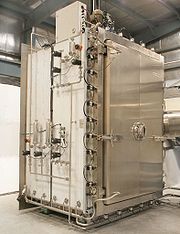
Rotary freeze-dryers are usually used for drying pellets, cubes and other pourable substances. The rotary dryers have a cylindrical reservoir that is rotated during drying to achieve a more uniform drying throughout the substance. Tray style freeze-dryers usually have rectangular reservoir with shelves on which products, such as pharmaceutical solutions and tissue extracts
Biological tissue
Tissue is a cellular organizational level intermediate between cells and a complete organism. A tissue is an ensemble of cells, not necessarily identical, but from the same origin, that together carry out a specific function. These are called tissues because of their identical functioning...
, can be placed in trays, vials and other containers.
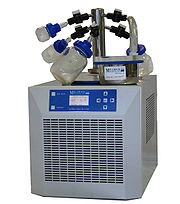
Manifold freeze-dryers are usually used in a laboratory setting when drying liquid substances in small containers and when the product will be used in a short period of time. A manifold dryer will dry the product to less than 5% moisture content. Without heat, only primary drying (removal of the unbound water) can be achieved. A heater must be added for secondary drying, which will remove the bound water and will produce a lower moisture content.
Tray style freeze-dryers are typically larger than the manifold dryers and are more sophisticated. Tray style freeze-dryers are used to dry a variety of materials. A tray freeze-dryer is used to produce the driest product for long-term storage. A tray freeze-dryer allows the product to be frozen in place and performs both primary (unbound water removal) and secondary (bound water removal) freeze-drying, thus producing the dryest possible end-product. Tray freeze-dryers can dry products in bulk or in vials or other containers. When drying in vials, the freeze-drier is supplied with a stoppering mechanism that allows a stopper to be pressed into place, sealing the vial before it is exposed to the atmosphere. This is used for long-term storage, such as vaccines.
Improved freeze drying techniques are being developed to extend the range of products that can be freeze dried, to improve the quality of the product, and to produce the product faster with less labor.
Ever since the 1930s, industrial freeze drying had been dependent on a single type of equipment: the tray freeze drier. In 2005 a quicker and less-labor intensive freeze drying method was developed for bulk materials. This freeze drying process proved to be able to produce free-flowing powder from a single vessel. Known as [Active Freeze Drying] AFD technology, the new process used continuous motion to improve mass transfer and hence cutting processing time, while also eliminating the need to transfer to and from drying trays and downstream size reduction devices.
See also
- Food preservationFood preservationFood preservation is the process of treating and handling food to stop or slow down spoilage and thus allow for longer storage....
- Supercritical dryingSupercritical dryingSupercritical drying is a process to remove liquid in a precisely controlled way. It is useful in the production of microelectromechanical systems , the drying of spices, the production of aerogel, and in the preparation of biological specimens for scanning electron microscopy.As the substance in...
- Freeze-dried Food and NASA
External links
- International Society of Lyophilization - Freeze Drying
- Freeze Drying Webinars presented by Industry Experts
- Freeze Drying Technical Briefs in Multiple Languages
- Freeze Drying Info Website
- Pharmaceutical research, new technical developments, PAT, newest Publications Research group on freeze-drying of university of Erlangen, Germany ( Website)
- FDA Guide to inspections of lyophilization of parentals
- Lyophilization: Freeze-Drying A Downstream Process
- Passage FreezeDrying Software for Lyophilizating Process
- Document Freeze Drying Resources