
All Topics  
Eutectic point


   Email Print
   Bookmark   Link


Eutectic point


The melting point
Melting point

The melting point of a solid is the temperature range at which it changes states of matter from solid to liquid. At the melting point the solid and liquid phase exist in equilibrium....
 of a mixture of two or more solids (such as an alloy
Alloy

An alloy is a partial or complete solid solution of one or more chemical element in a metallic matrix. Complete solid solution alloys give single solid phase microstructure, while partial solutions give two or more phases that may be homogeneous in distribution depending on thermal history....
) depends on the relative proportions of its ingredients. A eutectic or eutectic mixture is a mixture at such proportions that the melting point is as low as possible, and that furthermore all the constituents crystallize simultaneously at this temperature from molten liquid solution. Such a simultaneous crystallization of a eutectic mixture is known as a eutectic reaction, the temperature at which it takes place is the eutectic temperature, and the composition and temperature at which it takes place is called the eutectic point.

The term comes from the Greek
Greek language

Greek is an Indo-European languages native to the southern Balkan peninsula, the language of the Greek people. It forms an independent branch within Indo-European....
 eutektos, meaning 'easily melted.'

The equilibrium phase diagram
Phase diagram

A phase diagram in physical chemistry, mineralogy, and materials science is a type of Graph of a function used to show conditions at which thermodynamically-distinct phase can occur at thermodynamic equilibrium....
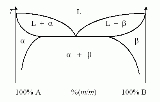
 at the right displays a simple binary system composed of two components, A and B, which has a eutectic point.


Discussion
Ask a question about 'Eutectic point'
Start a new discussion about 'Eutectic point'
Answer questions from other users
Full Discussion Forum


Recent Posts


Encyclopedia


The melting point
Melting point

The melting point of a solid is the temperature range at which it changes states of matter from solid to liquid. At the melting point the solid and liquid phase exist in equilibrium....
 of a mixture of two or more solids (such as an alloy
Alloy

An alloy is a partial or complete solid solution of one or more chemical element in a metallic matrix. Complete solid solution alloys give single solid phase microstructure, while partial solutions give two or more phases that may be homogeneous in distribution depending on thermal history....
) depends on the relative proportions of its ingredients. A eutectic or eutectic mixture is a mixture at such proportions that the melting point is as low as possible, and that furthermore all the constituents crystallize simultaneously at this temperature from molten liquid solution. Such a simultaneous crystallization of a eutectic mixture is known as a eutectic reaction, the temperature at which it takes place is the eutectic temperature, and the composition and temperature at which it takes place is called the eutectic point.

The term comes from the Greek
Greek language

Greek is an Indo-European languages native to the southern Balkan peninsula, the language of the Greek people. It forms an independent branch within Indo-European....
 eutektos, meaning 'easily melted.'

The equilibrium phase diagram
Phase diagram

A phase diagram in physical chemistry, mineralogy, and materials science is a type of Graph of a function used to show conditions at which thermodynamically-distinct phase can occur at thermodynamic equilibrium....
 at the right displays a simple binary system composed of two components, A and B, which has a eutectic point. The phase diagram plots relative concentrations of A and B along the horizontal axis, and temperature
Temperature

In physics, temperature is a physical property of a Physical system that underlies the common notions of hot and cold; something that feels hotter generally has the greater temperature....
 along the vertical axis. The eutectic point is the point at which the liquid
Liquid

Liquid is one of the principal states of matter. A liquid is a fluid that has the particles loose and can freely form a distinct surface at the boundaries of its bulk material....
 phase L borders directly on the solid phase a + ß (a homogeneous mixture composed of both A and B), representing the minimum melting temperature of any possible alloy of A and B.

Not all binary system alloys have a eutectic point: those that form a solid solution
Solid solution

A solid solution is a solid-phase solution of one or more soluble in a solvent. Such a mixture is considered a solution rather than a Chemical compound when the crystal structure of the solvent remains unchanged by addition of the solutes, and when the mixture remains in a single wiktionary:Homogeneous phase ....
 at all concentrations, such as the gold
Gold

Gold is a chemical element with the symbol Au and atomic number 79. It is a highly sought-after precious metal, having been used as money, as a store of value, in jewelry, in sculpture, and for ornamentation since the beginning of recorded history....
-silver
Silver

Silver is a chemical element with the chemical symbol Ag and atomic number 47. A soft, white, lustrous transition metal, it has the highest electrical conductivity of any element and the highest thermal conductivity of any metal....
 system, have no eutectic. An alloy system that has a eutectic is often referred to as a eutectic system, or eutectic alloy.

Solid products of a eutectic reaction can often be identified by their lamellar structure
Lamellar structure

Lamellar structures or microstructures are composed of fine, alternating layers of different materials in the form of lamellae . They are often observed in cases where a phase transformation front moves quickly, leaving behind two solid products, as in rapid cooling of eutectic or eutectoid systems....
, as opposed to the dendritic
Dendrite (crystal)

A crystal dendrite is a crystal that develops with a typical multi-branching tree-like form. Dendritic crystal growth is very common and illustrated by snowflake formation and frost patterns on a window....
 structures commonly seen in non-eutectic solidification. The same conditions that force the material to form lamellae can instead form an amorphous solid
Amorphous solid

An amorphous solid is a solid in which there is no long-range order of the positions of the atoms. . Most classes of solid materials can be found or prepared in an amorphous form....
 if pushed to an extreme.

Metallic eutectics

The term is often used in metallurgy
Metallurgy

Metallurgy is a domain of materials science that studies the physical and chemical behavior of metallic Chemical element, their intermetallics, and their mixtures, which are called alloys....
 to describe the alloy
Alloy

An alloy is a partial or complete solid solution of one or more chemical element in a metallic matrix. Complete solid solution alloys give single solid phase microstructure, while partial solutions give two or more phases that may be homogeneous in distribution depending on thermal history....
 of two or more component materials having the relative concentrations specified at the eutectic point. When a non-eutectic alloy freezes, its components crystallize at different temperatures, exhibiting a plastic melting range. A eutectic alloy freezes at a single, sharp temperature. The phase transformations that occur while freezing a given alloy can be understood by drawing a vertical line from the liquid phase to the solid phase on a phase diagram.

Some uses include:
  • eutectic alloys for soldering
    Soldering

    Soldering is a process in which two or more metal items are joined together by melting and flowing a filler metal into the joint, the filler metal having a relatively low melting point....
    , composed of tin
    Tin

    Tin is a chemical element with the symbol Sn and atomic number 50. Tin is obtained chiefly from the mineral cassiterite, where it occurs as an oxide, SnO2....
     (Sn), lead
    Lead

    Lead is a main-group Chemical element with symbol Pb and atomic number 82. Lead is a soft, malleable poor metal, also considered to be one of the heavy metal ....
     (Pb) and sometimes silver
    Silver

    Silver is a chemical element with the chemical symbol Ag and atomic number 47. A soft, white, lustrous transition metal, it has the highest electrical conductivity of any element and the highest thermal conductivity of any metal....
     (Ag) or gold
    Gold

    Gold is a chemical element with the symbol Au and atomic number 79. It is a highly sought-after precious metal, having been used as money, as a store of value, in jewelry, in sculpture, and for ornamentation since the beginning of recorded history....
     (Au).
  • casting alloys, such as aluminium
    Aluminium

    Aluminium or aluminum is a silvery white and ductile member of the boron group of chemical elements. It has the symbol Al; its atomic number is 13....
    -silicon
    Silicon

    Silicon is the most common metalloid. It is a chemical element, which has the symbol Si and atomic number 14. The atomic mass is 28.0855....
     and cast iron
    Cast iron

    Cast iron usually refers to Gray iron, but also identifies a large group of ferrous alloys, which solidify with a eutectic. The color of a fractured surface can be used to identify an alloy....
     (at the composition for an austenite
    Austenite

    Austenite is a metallic non-magnetic solid solution of iron and an alloying element. In plain-carbon steel, austenite exists above the critical eutectoid temperature of 1000 K ; other alloys of steel have different eutectoid temperatures....
    -cementite
    Cementite

    Cementite or iron carbide is a chemical compound with the formula Fe3C , and an orthorhombic crystal structure. It is a hard, brittle material, normally classified as a ceramic in its pure form, though it is more important in metallurgy....
     eutectic in the iron
    Iron

    Iron is a chemical element with the symbol Fe and atomic number 26. Iron is a Group 8 element and period 4 element. Iron is lustrous and silvery in color....
    -carbon
    Carbon

    Carbon is a chemical element with chemical symbol C and atomic number 6. As a member of group 14 on the periodic table, it is nonmetallic and tetravalence?making four electrons available to form covalent bond chemical bonds....
     system).
  • brazing
    Brazing

    Brazing is a joining process whereby a filler metal or alloy is heated to melting temperature above ?or, by the traditional definition in the United States, above ?and distributed between two or more close-fitting parts by capillary action....
    , where diffusion can remove alloying elements from the joint, so that eutectic melting is only possible early in the brazing process.
  • temperature response, i.e. Wood's metal
    Wood's metal

    Wood's metal, named for American metallurgist B. Wood, is also known as Lipowitz's alloy or by the commercial names cerrobend, bendalloy or pewtalloy....
     and Field's metal
    Field's metal

    Field's metal, or Field's alloy , is a fusible alloy alloy that becomes liquid at approximately . It is a eutectic alloy of bismuth, indium, and tin, with the following percentages by weight: 32.5% Bi, 51% In, 16.5% Sn....
     for fire sprinkler
    Fire sprinkler

    A fire sprinkler system is an active fire protection measure, consisting of a water supply, providing adequate pressure and flowrate to a water distribution piping system, onto which fire sprinklers are connected....
    s.
  • non-toxic mercury
    Mercury (element)

    Mercury , also called quicksilver or hydrargyrum , is a chemical element with the symbol Hg and atomic number 80. A heavy, silvery d-block metal, mercury is one of six elements that are liquid at or near room temperature and pressure....
     replacements, such as galinstan
    Galinstan

    Galinstan is an eutectic alloy of gallium, indium, and tin which is liquid at room temperature, typically freezing at -19 ?Degree Celsius . Due to the low toxicity of its component metals, it finds use as a non-toxic replacement for many applications that previously employed liquid mercury or NaK ....
    .
  • experimental metallic glasses
    Amorphous metal

    An amorphous metal is a metallic material with a disordered atomic-scale structure. In contrast to most metals, which are crystalline and therefore have a highly ordered arrangement of atoms, amorphous solid alloys are non-crystalline....
    , with extremely high strength and corrosion
    Corrosion

    Corrosion means the breaking down of essential properties in a material due to chemical reactions with its surroundings. In the most common use of the word, this means a loss of electrons of metals reacting with water and oxygen....
     resistance.
  • eutectic alloys of sodium
    Sodium

    Sodium is an element which has the symbol Na , atomic number 11, atomic mass 23 amu , and a common oxidation number +1. Sodium is a soft, silvery white, highly reactive element and is a member of the alkali metals within "group 1" ....
     and potassium
    Potassium

    Potassium is a chemical element. It has the symbol K , atomic number 19, and atomic mass 39.0983. Potassium was first isolated from potash, hence the name....
     (NaK
    NaK

    NaK is a sodium - potassium alloy usually liquid at room temperature. Various commercial grades are available. NaK is highly reactive with air or water and must be handled with special precautions....
    ) that are liquid at room temperature and used as coolant
    Coolant

    A coolant is a fluid which flows through a device in order to prevent its overheating, transferring the heat produced by the device to other devices that utilize or dissipate it....
     in experimental fast neutron nuclear reactor
    Fast neutron reactor

    A fast neutron reactor or simply a fast reactor is a category of nuclear reactor in which the fission chain reaction is sustained by fast neutrons....
    s.


Other eutectic mixtures

Sodium chloride
Sodium chloride

Sodium chloride, also known as common salt, table salt, or halite, is a chemical compound with the chemical formula SodiumChlorine....
 and water
Water

Water is a common chemical substance that is essential for the survival of all known forms of life. In typical usage, water refers only to its liquid form or States of matter, but the substance also has a solid state, ice, and a gaseous state, water vapor or steam....
 form a eutectic mixture. It has a eutectic point of -21.2 C and 23.3% salt by weight. The eutectic nature of salt and water is exploited when salt is spread on roads to aid snow removal
Snow removal

Snow removal is the job of removing snow after a snowfall to make travel easier and safer. This is done by both individual households and by governments and institutions....
, or mixed with ice to produce low temperatures (for example, in traditional ice cream
Ice cream

Ice cream or ice-cream is a frozen dessert usually made from dairy products, such as milk and cream, combined with fruits or other ingredients....
 making).

Lidocaine
Lidocaine

Lidocaine or lignocaine is a common local anesthetic and antiarrhythmic agent drug. Lidocaine is used topically to relieve itching, burning and pain from skin inflammations, injected as a dental anesthetic, and in minor surgery....
 and prilocaine
Prilocaine

Prilocaine is a local anesthetic of the amino amide type. In its parenteral form , it is often used in dentistry. It is also often combined with lidocaine as a preparation for dermal anesthesia ....
, both solids at room temperature, form a eutectic that is an oil with a 16°C melting point, used in EMLA
Lidocaine/prilocaine

Lidocaine/prilocaine is a Eutectic point mixture of equal quantities of lidocaine and prilocaine. A 5% emulsion preparation, containing 2.5% each of lidocaine/prilocaine, is marketed by APP Pharmaceuticals under the trade name EMLA ....
 (Eutectic Mixture of Local Anesthetic) preparations.

Mineral
Mineral

A mineral is a naturally occurring solid formed through Geology processes that has a characteristic chemical composition, a highly ordered atomic structure, and specific physical properties....
s may form eutectic mixtures in igneous rocks, giving rise to characteristic intergrowth textures
Rock microstructure

Rock microstructure includes the Texture of a rock and the small scale rock structures. The words "texture" and "microstructure" are interchangeable, with the latter preferred in modern geological literature....
 such as that of granophyre
Granophyre

Granophyre is an igneous rock that contains quartz and alkali feldspar in characteristic angular intergrowths such as those in the accompanying image....
.

Some inks are eutectic mixtures, allowing inkjet printer
Inkjet printer

File:Canon BJ-10v Lite inkjet printer with Scale.JPGInkjet printers operate by propelling variably-sized droplets of liquid or molten material onto almost any sized page....
s to operate at lower temperatures.

Other critical points


Eutectoid

When the solution above the transformation point is solid, rather than liquid, an analogous eutectoid transformation can occur. For instance, in the iron
Iron

Iron is a chemical element with the symbol Fe and atomic number 26. Iron is a Group 8 element and period 4 element. Iron is lustrous and silvery in color....
-carbon
Carbon

Carbon is a chemical element with chemical symbol C and atomic number 6. As a member of group 14 on the periodic table, it is nonmetallic and tetravalence?making four electrons available to form covalent bond chemical bonds....
 system, the austenite
Austenite

Austenite is a metallic non-magnetic solid solution of iron and an alloying element. In plain-carbon steel, austenite exists above the critical eutectoid temperature of 1000 K ; other alloys of steel have different eutectoid temperatures....
 phase can undergo a eutectoid transformation to produce ferrite
Ferrite

Ferrite may refer to:* Ferrite , iron or iron alloys with a body centred cubic crystal structure.* Ferrite , ferrimagnetic ceramic materials used in magnetic applications....
 and cementite
Cementite

Cementite or iron carbide is a chemical compound with the formula Fe3C , and an orthorhombic crystal structure. It is a hard, brittle material, normally classified as a ceramic in its pure form, though it is more important in metallurgy....
 (iron carbide), often in lamellar structure
Lamellar structure

Lamellar structures or microstructures are composed of fine, alternating layers of different materials in the form of lamellae . They are often observed in cases where a phase transformation front moves quickly, leaving behind two solid products, as in rapid cooling of eutectic or eutectoid systems....
s such as pearlite
Pearlite

Pearlite is a Phase , Lamellar structure structure composed of alternating layers ofFerrite and cementite that occurs in some steels and cast irons....
 and bainite
Bainite

Bainite is a phase that exists in steel microstructures after certain heat treatments. First described by Davenport ES and Edgar Bain, it is one of the phase transformation that may form when austenite is cooled past a critical temperature of 723 ?C ....
. This eutectoid point occurs at 727°C (1340.6 ºF) and about 0.83% carbon; alloys of nearly this composition are called high-carbon steel, while those which have less carbon are termed mild steel. The process analogous to glass formation in this system is the martensitic transformation
Martensite

Martensite, named after the German :category:metallurgists Adolf Martens , most commonly refers to a very hard form of steel crystalline structure, but it is also any crystal structure that is formed by displacive transformation....
.

Phase Diag Iron Carbon

Peritectic

Peritectic transformations are also similar to eutectic reactions. Here, a liquid and solid phase of fixed proportions react at a fixed temperature to yield a single solid phase. Since the solid product forms at the interface between the two reactants, it can form a diffusion barrier and generally causes such reactions to proceed much more slowly than eutectic or eutectoid transformations. Because of this, when a peritectic composition solidifies it does not show the lamellar structure that you find with eutectic freezing.

Such a transformation exists in the iron
Iron

Iron is a chemical element with the symbol Fe and atomic number 26. Iron is a Group 8 element and period 4 element. Iron is lustrous and silvery in color....
-carbon
Carbon

Carbon is a chemical element with chemical symbol C and atomic number 6. As a member of group 14 on the periodic table, it is nonmetallic and tetravalence?making four electrons available to form covalent bond chemical bonds....
 system, as seen near the upper-left corner of the figure. It resembles an inverted eutectic, with the d phase combining with the liquid to produce pure austenite
Austenite

Austenite is a metallic non-magnetic solid solution of iron and an alloying element. In plain-carbon steel, austenite exists above the critical eutectoid temperature of 1000 K ; other alloys of steel have different eutectoid temperatures....
 at 1495 °C and 0.17 mass percent carbon.

Bibliography


See also

  • Azeotrope
    Azeotrope

    An azeotrope is a mixture of two or more liquids in such a ratio that its composition cannot be changed by simple distillation. This occurs because, when an azeotrope is boiled, the resulting vapor has the same ratio of constituents as the original mixture....
  • Solid solution
    Solid solution

    A solid solution is a solid-phase solution of one or more soluble in a solvent. Such a mixture is considered a solution rather than a Chemical compound when the crystal structure of the solvent remains unchanged by addition of the solutes, and when the mixture remains in a single wiktionary:Homogeneous phase ....
  • Phase diagram
    Phase diagram

    A phase diagram in physical chemistry, mineralogy, and materials science is a type of Graph of a function used to show conditions at which thermodynamically-distinct phase can occur at thermodynamic equilibrium....
  • Freezing point depression
  • Hypoeutectic alloy
    Hypoeutectic alloy

    A hypoeutectic alloy is a binary alloy in which the composition is to the left hand side of the eutectic point on the equilibrium diagram of a binary eutectic system....