


Francesca da Rimini

Encyclopedia
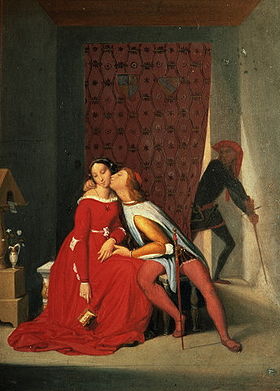
.jpg)
Ravenna
Ravenna is the capital city of the Province of Ravenna in the Emilia-Romagna region of Italy and the second largest comune in Italy by land area, although, at , it is little more than half the size of the largest comune, Rome...
. She was a historical contemporary of Dante Alighieri
Dante Alighieri
Durante degli Alighieri, mononymously referred to as Dante , was an Italian poet, prose writer, literary theorist, moral philosopher, and political thinker. He is best known for the monumental epic poem La commedia, later named La divina commedia ...
, who portrayed her as a character in the Divine Comedy.
Arranged marriage
Guido I da PolentaGuido I da Polenta
Guido I da Polenta was lord of Ravenna from 1275 until his death.The son of Lamberto da Polenta, he was ousted from Ravenna by the imperial troops in 1240. When the city was returned to the Papal States in 1248, Guido was able to return and was made chief of the local council...
had been at war with the Malatesta family
House of Malatesta
The House of Malatesta was an Italian family that ruled over Rimini from 1295 until 1500, as well as other lands and towns in Romagna.Malatesta da Verucchio The House of Malatesta was an Italian family that ruled over Rimini from 1295 until 1500, as well as (in different periods) other lands and...
. When a peace was negotiated, Guido wanted to solidify it by marrying his daughter Francesca to the Malatestan heir, Giovanni Malatesta
Giovanni Malatesta
Giovanni Malatesta , known, from his lameness, as Gianciotto, or Giovanni, lo Sciancato, was the eldest son of Malatesta da Verucchio of Rimini.From 1275 onwards he played an active part in the Romagnole Wars and factions...
(Gianciotto), son of Malatesta da Verucchio
Malatesta da Verucchio
Malatesta da Verucchio was the founder of the powerful Italian Malatesta family and a famous condottiero. He was born in Verucchio....
, lord of Rimini
Rimini
Rimini is a medium-sized city of 142,579 inhabitants in the Emilia-Romagna region of Italy, and capital city of the Province of Rimini. It is located on the Adriatic Sea, on the coast between the rivers Marecchia and Ausa...
. Giovanni was brave but deformed. Guido knew Francesca would refuse Giovanni, so the wedding
Wedding
A wedding is the ceremony in which two people are united in marriage or a similar institution. Wedding traditions and customs vary greatly between cultures, ethnic groups, religions, countries, and social classes...
was performed by proxy through Giovanni's handsome brother, Paolo
Paolo Malatesta
Paolo Malatesta was the third son of Malatesta da Verucchio, lord of Rimini. He is best known for the story of his affair with Francesca da Polenta, portrayed by Dante in a famous episode of his Inferno...
.
Francesca fell in love with Paolo and was unaware of the deception until the morning after the wedding day.
According to Dante, Francesca and Paolo were seduced by reading the story of Lancelot
Lancelot
Sir Lancelot du Lac is one of the Knights of the Round Table in the Arthurian legend. He is the most trusted of King Arthur's knights and plays a part in many of Arthur's victories...
and Guinevere
Guinevere
Guinevere was the legendary queen consort of King Arthur. In tales and folklore, she was said to have had a love affair with Arthur's chief knight Sir Lancelot...
, and became lovers. Subsequently they were surprised and murdered by Giovanni before they were able to repent. However, it is likely that the adultery was much more calculated. Both Francesca and the also-married Paolo had their own children. Dante used the romance of Lancelot in order to fit within the scheme of lyric love poetry
Lyric poetry
Lyric poetry is a genre of poetry that expresses personal and emotional feelings. In the ancient world, lyric poems were those which were sung to the lyre. Lyric poems do not have to rhyme, and today do not need to be set to music or a beat...
, which Francesca emulates in her lines of Infernos Canto V.
Related works
In the 19th century the story of Paolo and Francesca inspired numerous theatrical, operatic and symphonic adaptations:Poetry
- DanteDANTEDelivery of Advanced Network Technology to Europe is a not-for-profit organisation that plans, builds and operates the international networks that interconnect the various national research and education networks in Europe and surrounding regions...
, Divine Comedy. (InfernoInferno (Dante)Inferno is the first part of Dante Alighieri's 14th-century epic poem Divine Comedy. It is followed by Purgatorio and Paradiso. It is an allegory telling of the journey of Dante through what is largely the medieval concept of Hell, guided by the Roman poet Virgil. In the poem, Hell is depicted as...
, Canto V), (1308–1321) - Leigh Hunt, The Story of Rimini (1816).
Theatre and opera
- Silvio PellicoSilvio PellicoSilvio Pellico was an Italian writer, poet, dramatist and patriot.-Biography:Silvio Pellico was born at Saluzzo . He spent the earlier portion of his life at Pinerolo and Turin, under the tuition of a priest named Manavella. At the age of ten he composed a tragedy inspired by a translation of the...
, Francesca da Rimini. (1818). Tragedy. - Feliciano Strepponi, Francesca da Rimini. Opera; Padua, (1823).
- Paolo CarliniPaolo CarliniPaolo Carlini was an Italian film actor. He appeared in 45 films between 1940 and 1979.-Selected filmography:* La Grande strada * The Mute of Portici * It Started in Naples...
, Francesca da Rimini. Opera; Naples,(1825). - Saverio MercadanteSaverio MercadanteGiuseppe Saverio Raffaele Mercadante was an Italian composer, particularly of operas. While Mercadante may not have retained the international celebrity of Gaetano Donizetti or Gioachino Rossini beyond his own lifetime, he composed as impressive a number of works as either; and his development of...
, Francesca da Rimini. Opera; Madrid, (1828). - Gaetano Quilici, Francesca da Rimini. Opera; Lucca, (1829).
- Pietro GeneraliPietro GeneraliPietro Generali is a former basketball player from Italy, who won the silver medal with his national team at the 1980 Summer Olympics in Moscow.-References:...
, Francesca da Rimini. Opera; Venice, (1829). - Giuseppe StaffaGiuseppe StaffaGiuseppe Staffa was an Italian composer and conductor. He is best remembered for his seven operas which he composed between 1827 and 1852. He was active as a conductor in Naples at the Teatro del Fondo and Teatro Nuovo. One of his students was Enrico Bevignani.-References:...
, Francesca da Rimini. Opera; Naples, (1831). - Fournier-Gorre, Francesca da Rimini. Opera; Livorno, (1832).
- Francesco MorlacchiFrancesco MorlacchiFrancesco Morlacchi was an Italian composer of more than twenty operas. During the many years he spent as the royal Royal Kapellmeister in Dresden, he was instrumental in popularizing the Italian style of opera.-Biography:...
, Francesca da Rimini. Opera (1836), unperformed. - Antonio TamburiniAntonio TamburiniAntonio Tamburini was an Italian operatic baritone.Born in Faenza, then part of the Papal States, Tamburini studied the orchestral horn with his father and voice with Aldobrando Rossi, before making his debut as a singer, aged 18, in La contessa di colle erbose . He went on to become one of the...
, Francesca da Rimini. Opera; Rimini, (1836). - Emanuele Borgatta, Francesca da Rimini. Opera; Genoa, (1837).
- Gioacchino Maglioni, Francesca da Rimini. Opera; Genoa, (1840).
- Eugene Nordal, Francesca da Rimini. Opera; Linz, (1840, posth.)
- Salvatore Papparlado, Francesca da Rimini. Opera; Genoa, (1840), not performed.
- George Henry BokerGeorge Henry BokerGeorge Henry Boker was an American poet, playwright, and diplomat.-Youth:Boker was born in Philadelphia, Pennsylvania. His father was Charles S...
, Francesca da Rimini. (1853). Play. - Jan NerudaJan NerudaJan Nepomuk Neruda was a Czech journalist, writer and poet, one of the most prominent representatives of Czech Realism and a member of "the May school".-Early life:...
, Francesca di Rimini. (1860). Play. - Gabriele d'AnnunzioGabriele D'AnnunzioGabriele D'Annunzio or d'Annunzio was an Italian poet, journalist, novelist, and dramatist...
, Francesca da Rimini. Tragedy written (1901) for d'Annunzio's mistressMistress (lover)A mistress is a long-term female lover and companion who is not married to her partner; the term is used especially when her partner is married. The relationship generally is stable and at least semi-permanent; however, the couple does not live together openly. Also the relationship is usually,...
, Eleonora DuseEleonora Duse-Life and career:Duse was born in Vigevano, Lombardy, and began acting as a child. Both her father and her grandfather were actors, and she joined the troupe at age four. Due to poverty, she initially worked continually, traveling from city to city with whichever troupe her family was currently...
. - Stephen PhillipsStephen PhillipsStephen Phillips was a highly famed English poet and dramatist, who enjoyed considerable popularity in his lifetime....
, Paolo and Francesca. Play (1902). - Francis Marion CrawfordFrancis Marion CrawfordFrancis Marion Crawford was an American writer noted for his many novels, especially those set in Italy, and for his classic weird and fantastic stories.-Life:...
, Francesca da Rimini. (1902). Play. - Marcel SchwobMarcel SchwobMarcel Schwob was a Jewish French writer.-Biography:He was born in Chaville, Hauts-de-Seine on 23 August 1867...
, Francesca da Rimini. Play (1903), translation of Crawford. - Sergei RachmaninoffSergei RachmaninoffSergei Vasilievich Rachmaninoff was a Russian composer, pianist, and conductor. Rachmaninoff is widely considered one of the finest pianists of his day and, as a composer, one of the last great representatives of Romanticism in Russian classical music...
, Francesca da Rimini. Opera (1906). - Luigi MancinelliLuigi MancinelliLuigi Mancinelli was a leading Italian orchestral conductor. He also composed music for the stage and concert hall and played the cello....
, Francesca da Rimini. Opera in 1 act, (1907). - Emil ÁbrányiEmil ÁbrányiEmil Ábrányi was a Hungarian composer, conductor, and opera director.He was conductor at the Royal Hungarian Opera House from 1911 to 1919 and director there from 1919 to 1920. In 1921 he became the director at the Budapest Municipal Theatre where he remained until 1926. For many years he taught...
, Paolo és Francesca (3 acts, libretto after Dante by Emil Ábrányi, Sr.), Opera (1912). - Franco LeoniFranco LeoniFranco Leoni was an Italian opera composer. After training in Milan, he made most of his career in England, composing for Covent Garden and West End theatres. He is best known for the opera L'Oracolo, written for Covent Garden but taken up successfully by the Metropolitan Opera in New York...
, Francesca da Rimini. Opera (1914), based on Crawford's play. - Primo RiccitelliPrimo RiccitelliPrimo Riccitelli , was an Italian composer.One of six children, he was born in the village of Cognoli, Campli in the Abruzzo Region of Italy. His father, Giuseppe, was a small land owner and his mother, Maria Maiaroli, a homemaker. The one-day old infant was baptized at the local parish hall of...
, Francesca da Rimini. Opera - Riccardo ZandonaiRiccardo ZandonaiRiccardo Zandonai was an Italian composer.-Biography:Zandonai was born in Borgo Sacco, Rovereto, then part of Austria–Hungary....
, Francesca da RiminiFrancesca da Rimini (Zandonai)Francesca da Rimini is an opera in four acts, composed by Riccardo Zandonai, with libretto by Tito Ricordi, , after a play by Gabriele D'Annunzio. It was premiered at the Teatro Regio in Turin on February 19, 1914, and is still staged occasionally.This opera is Zandonai's best-known work...
. Libretto by Tito Ricordi, based on D'Annunzio; Opera (1914). - Nino Berrini, Francesca da Rimini. Play (1924).
Music
- Pyotr Ilyich TchaikovskyPyotr Ilyich TchaikovskyPyotr Ilyich Tchaikovsky Pyotr Ilyich Tchaikovsky Pyotr Ilyich Tchaikovsky (Russian: Пётр Ильи́ч Чайко́вский ; often "Peter Ilich Tchaikovsky" in English. His names are also transliterated "Piotr" or "Petr"; "Ilitsch", "Il'ich" or "Illyich"; and "Tschaikowski", "Tschaikowsky", "Chajkovskij"...
, Francesca da Rimini. Symphonic PoemFrancesca da Rimini (Tchaikovsky)Pyotr Ilyich Tchaikovsky's symphonic poem Francesca da Rimini: Symphonic Fantasy after Dante, Op. 32, was composed in less than three weeks during his visit to Bayreuth in the autumn of 1876....
(1876). - Arthur FooteArthur FooteArthur William Foote was an American classical composer, and a member of the "Boston Six." The other five were George Whitefield Chadwick, Amy Beach, Edward MacDowell, John Knowles Paine, and Horatio Parker.The modern tendency is to view Foote’s music as “Romantic” and “European” in light of the...
, Symphonic Prologue Francesca da Rimini, Op.24 (1890). - Antonio BazziniAntonio BazziniAntonio Joseph Bazzini was an Italian violinist, composer and teacher. As a composer his most enduring work is his chamber music which has earned him a central place in the Italian instrumental renaissance of the 19th century...
, Symphonic Poem Francesca da Rimini, Op.77 (Berlin, 1889/90). - Paul von KlenauPaul von KlenauPaul August von Klenau was a Danish-born composer who worked primarily in Germany and Austria.Klenau was born and died in Copenhagen...
, Symphonic Poem Francesca da Rimini, (1913 - rev.1919). - Peter DizozzaPeter DizozzaPeter William Dizozza is a music composer who also produces supplemental material as a writer, pianist, performer, photographer, and filmmaker. Since 2000 he has been the director of the WAH Theater at the Williamsburg Art & Historical Center.Peter William Dizozza was born on September 5, 1958 in...
, Mini-Opera for Dramatizing Dante The Afterdeath, (2010). - Mediaeval Baebes, The Circle Of The Lustful from The Rose album (2002)
- Olga GorelliOlga GorelliOlga Gorelli, was well known for her musical talents as a composer and pianist. Olga Gorelli, maiden name Gratch, immigrated to the United States in 1937 with her family and settled in New Jersey. She married a physician, and had two children. She was a resident of Pennington, New Jersey...
, Paolo e Francesca from 20th Century Chamber Music for the Home album. A guitar duo. - Gioacchino RossiniGioacchino RossiniGioachino Antonio Rossini was an Italian composer who wrote 39 operas as well as sacred music, chamber music, songs, and some instrumental and piano pieces...
, Francesca da Rimini ("Faro' come colui che piange e dice") (1848).
Art
- Joseph Anton KochJoseph Anton KochJoseph Anton Koch was an Austrian painter of the German Romantic movement.-Biography:The Tyrolese painter was born in Elbigenalp. He started life tending cattle. Through the recommendation of Bishop Umgelder , he received academic training in the Karlsschule Stuttgart, a strict military academy...
, Paolo and Francesca Surprised by Gianciotto (1805–10). Watercolor, Thorvaldsen Museum, CopenhagenCopenhagenCopenhagen is the capital and largest city of Denmark, with an urban population of 1,199,224 and a metropolitan population of 1,930,260 . With the completion of the transnational Øresund Bridge in 2000, Copenhagen has become the centre of the increasingly integrating Øresund Region...
. - Marie-Philippe Coupin de la CouperieMarie-Philippe Coupin de la CouperieMarie-Philippe Coupin de la Couperie was a French painter of the Troubadour style. He was a friend of the painter Anne-Louis Girodet de Roussy-Trioson. Among his patrons were Joséphine de Beauharnais, who bought his The Tragic Love of Francesca da Rimini for her gallery at Château de...
, The Tragic Love of Francesca da Rimini (1812). Oil on canvas, Napoleon Museum, ArenbergArenbergArenberg, also spelled as Aremberg or Ahremberg, is a historic county, principality and finally duchy located in modern Germany. The Dukes of Arenberg remain a prominent Belgian aristocratic family.- History :... - Jean-Auguste-Dominique Ingres, Paolo and Francesca (1819). Oil on canvas. Musée des Beaux-Arts, AngersAngersAngers is the main city in the Maine-et-Loire department in western France about south-west of Paris. Angers is located in the French region known by its pre-revolutionary, provincial name, Anjou, and its inhabitants are called Angevins....
, France. - Ary SchefferAry SchefferAry Scheffer , French painter of Dutch and German extraction, was born in Dordrecht.-Life:After the early death of his father Johann Baptist, a poor painter, Ary's mother Cornelia, herself a painter and daughter of landscapist Arie Lamme, took him to Paris and placed him in the studio of...
, Francesca da Rimini and Paolo Malatesta appraised by Dante and VirgilFrancesca da Rimini and Paolo Malatesta appraised by Dante and VirgilFrancesca da Rimini and Paolo Malatesta appraised by Dante and Virgil is the title of three paintings by Ary Scheffer, all oils on canvas showing a scene from Dante's Inferno of Dante and Virgil viewing Francesca da Rimini and Paolo Malatesta in Hell....
(1835). Oil on canvas. Wallace CollectionWallace CollectionThe Wallace Collection is a museum in London, with a world-famous range of fine and decorative arts from the 15th to the 19th centuries with large holdings of French 18th-century paintings, furniture, arms & armour, porcelain and Old Master paintings arranged into 25 galleries.It was established in...
, LondonLondonLondon is the capital city of :England and the :United Kingdom, the largest metropolitan area in the United Kingdom, and the largest urban zone in the European Union by most measures. Located on the River Thames, London has been a major settlement for two millennia, its history going back to its...
. - Ary SchefferAry SchefferAry Scheffer , French painter of Dutch and German extraction, was born in Dordrecht.-Life:After the early death of his father Johann Baptist, a poor painter, Ary's mother Cornelia, herself a painter and daughter of landscapist Arie Lamme, took him to Paris and placed him in the studio of...
, Francesca da Rimini and Paolo Malatesta appraised by Dante and VirgilFrancesca da Rimini and Paolo Malatesta appraised by Dante and VirgilFrancesca da Rimini and Paolo Malatesta appraised by Dante and Virgil is the title of three paintings by Ary Scheffer, all oils on canvas showing a scene from Dante's Inferno of Dante and Virgil viewing Francesca da Rimini and Paolo Malatesta in Hell....
(1855). Oil on canvas. LouvreLouvreThe Musée du Louvre – in English, the Louvre Museum or simply the Louvre – is one of the world's largest museums, the most visited art museum in the world and a historic monument. A central landmark of Paris, it is located on the Right Bank of the Seine in the 1st arrondissement...
, ParisParisParis is the capital and largest city in France, situated on the river Seine, in northern France, at the heart of the Île-de-France region...
. - Gustave DoréGustave DoréPaul Gustave Doré was a French artist, engraver, illustrator and sculptor. Doré worked primarily with wood engraving and steel engraving.-Biography:...
, Francesca da Rimini (illustration to DanteDANTEDelivery of Advanced Network Technology to Europe is a not-for-profit organisation that plans, builds and operates the international networks that interconnect the various national research and education networks in Europe and surrounding regions...
's Inferno, 1857). - Alexandre CabanelAlexandre CabanelAlexandre Cabanel was a French painter.- Biography :Cabanel was born in Montpellier, Hérault. He painted historical, classical and religious subjects in the academic style. He was also well known as a portrait painter...
, The Death of Francesca da Rimini and Paolo Malatesta (1870). Oil on canvas. Musée d'OrsayMusée d'OrsayThe Musée d'Orsay is a museum in Paris, France, on the left bank of the Seine. It is housed in the former Gare d'Orsay, an impressive Beaux-Arts railway station built between 1898 and 1900. The museum holds mainly French art dating from 1848 to 1915, including paintings, sculptures, furniture,...
, ParisParisParis is the capital and largest city in France, situated on the river Seine, in northern France, at the heart of the Île-de-France region...
. - George Frederic WattsGeorge Frederic WattsGeorge Frederic Watts, OM was a popular English Victorian painter and sculptor associated with the Symbolist movement. Watts became famous in his lifetime for his allegorical works, such as Hope and Love and Life...
, Paolo and Francesca. Oil on canvas (1872-1884 (?)), Private collection. - Auguste RodinAuguste RodinFrançois-Auguste-René Rodin , known as Auguste Rodin , was a French sculptor. Although Rodin is generally considered the progenitor of modern sculpture, he did not set out to rebel against the past...
, The KissThe Kiss (Rodin sculpture)The Kiss is an 1889 marble sculpture by the French sculptor Auguste Rodin. Like many of Rodin's best-known individual sculptures, including The Thinker, the embracing couple depicted in the sculpture appeared originally as part of a group of reliefs decorating Rodin's monumental bronze portal The...
. Marble sculpture (1888), Musée RodinMusée RodinThe Musée Rodin in Paris, France, is a museum that was opened in 1919 in the Hôtel Biron and surrounding grounds. It displays works by the French sculptor Auguste Rodin....
, ParisParisParis is the capital and largest city in France, situated on the river Seine, in northern France, at the heart of the Île-de-France region...
.
External links
- World of Dante Multimedia website that includes gallery of images of the Paolo and Francesca episode.
- WisdomPortal Includes images of related artworks.
- The Story of Rimini Google Books edition of Leigh Hunt's poem.