

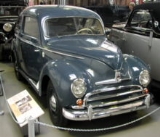
Ford Taunus

Encyclopedia
The Ford Taunus is a family car
sold by Ford
in Germany
and other countries. Models from 1970 onward were similar to the Ford Cortina
in the United Kingdom
. The model line was named after the Taunus
mountain range in Germany and was first made in 1939 and continued through several versions until 1994.
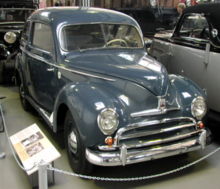 The Ford Taunus G93A
was a development of the Ford Eifel
and used the same 1172 cc four cylinder engine but in a longer chassis and a streamlined body. It was the first German Ford to have hydraulic brakes. Due to the war, production was interrupted from 1942 to 1948. 74,128 were made including estate cars and light vans.
The 12, 15 and 17M models had a straight-4
, later ones a V4
engine. The 20 and 26M models had the Ford Cologne V6 engine
. The 12, 15, 17 etc. refer to the engine displacement
; 1200, 1500, 1700 cc etc.
From 1962 to 1970, the smaller models 12M (P4) and 12M/15M (P6) had front wheel drive. All other models had rear wheel drive.
The following models were offered:
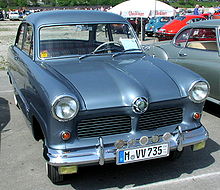 The Taunus 12M presented in 1952
was the first new German Ford after World War II. It featured ponton
styling, similar in style to British Ford Zephyr
.
Something else the new Ford Taunus 12M had in common with its British Ford cousins was the retention of an old sidevalve engine
at a time when competitors were increasingly moving over to ohc units. The Taunus 15M used a new and more powerful engine:
Body styles were two door sedan, two door station wagon
and sedan delivery
.
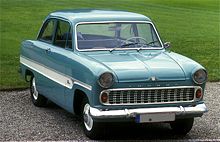 Not a new car, but a rework of the 1952 model. All cars are called 12M, though both engines are continued (the car with the bigger engine is called "Taunus 12M 1.5 litre").
Body styles were the same as in the 1952 model.
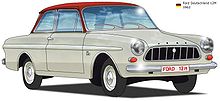 The new Ford Taunus 12M P4
was similar in size, but a completely new car based on the Ford Cardinal project. New body, new V4 engine
, front wheel drive. The first Ford car with front wheel drive (second is Ford Corcel
, third is Ford Fiesta
). Engines:
Body styles were two door sedan, four door sedan, two door coupé, two door station wagon and sedan delivery.
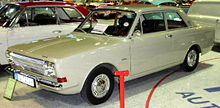
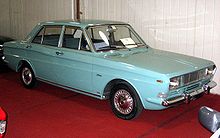 The Ford Taunus P6
came with new bodies: engines and platform are continued. Again, the car with the bigger engine is called 15M. Engines:
Body styles were unchanged from the P4.
In 1970, the P6 is replaced by the Taunus TC (see below).
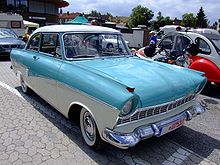 Growing prosperity in postwar Germany encouraged Ford to offer a line of bigger and more expensive cars. The Ford Taunus 17M of 1957
was as long as (though significantly narrower than) the British Consul Mk2
, but a different car. It presented a style similar to American 1956 Fords, featuring substantial (at least by European standards) tailfins. The transatlantic flamboyance of the car's styling gained it the sobriquet "Baroque Taunus". Unusually for middle class German cars of this period, it was available with either two or four doors. The competition noticed, and from 1959 it would become possible to buy an Opel Rekord
with four doors.
The P2 used a ohv engine with 1698 cc and 60 hp (44 kW). A maximum speed of 128 km/h (80 mph) was quoted. A road test of the time commended the smoothness of the three speed all-synchromesh manual transmission system.
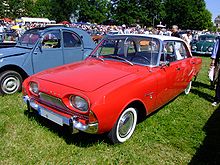 The Ford Taunus P3
had a completely new body in a very modern style. The look of car reminded some critics of a bath tub, and it consequently gained the soubriquet "Taunus Badewanne". At a time when competitors boasted that all four corners of the vehicles were visible from the driver's seat, the new Taunus instead offered a streamlined form. However, in Germany the concept of streamlining in cars was associated with narrow passenger cabins reminiscent of the 1930s and of the still popular Volksagen Beetle. The new Taunus, however, provided greater interior width than its predecessor despite being no wider on the outside. Although the 1.7 litre version was launched with the same 60 PS power output as the outgoing model, the new model was a full 10 km/h (6 mph) faster, which was attributed to improved aerodynamics and a lighter bodyshell. The front end styling is reminiscent of the 1961 U.S. Ford Thunderbird and Lincoln Continental.
Three engine sizes were now offered:
A very successful car.
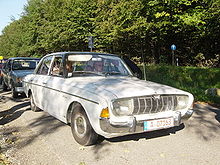 The Ford Taunus P5
came with a new body and new engines. 17M now gets a V4 engine
:
New 20M gets a V6 engine
with 1.8 litres and 82 hp, or 2.0 litres (1998 cc) and 85 or 90 hp (63 or 66 kW) with a top speed of 158 or 161 km/h (99 or 101 mph).
Again, a good selling car.
there was a new body: engines and platform were carried over from the P5. Rear lights no longer mounted at corners. Sportiest TS-model with fake air scoop on bonnet and new bigger engine.
The engines of the 17M/20M P5 are continued with only one addition on the top end. It is the
26M, introduced in 1969, is the top of the line version with new bigger engine (2.6 litres), bigger brakes, dual headlight, power steering, and the most luxurious trim level. The engine programme is enlarged; now there are two base engines (V4 and V6) in six displacement sizes and nine power stages:
Ford 20M RS Coupé made in Germany as a (2300 S) P7b and (2600) P7b.
In the 1968 London-Sydney Marathon
Ford used three Ford 20M RS from Germany and Belgium. In 1969 a Ford 20M RS won the Safari
and as well occasionally a Capri was seen with works involvement.
This is the last specifically German Ford. In early 1972, it is replaced by the new Consul
and Granada
.
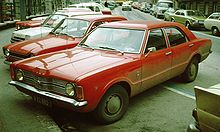 In 1970 a new Taunus, the Taunus Cortina (TC), was introduced, as a two- or four-door sedan, station wagon (or Turnier) and coupé
. It was very similar to the British Ford Cortina
Mk III but without the "coke bottle" belt line. Also, the Taunus was available as a coupe, a bodystyle that the Cortina was never made in.
Both cars were developed under the auspices of Ford of Europe, and most major components including key parts of the bodyshell were identical. From 1976 Taunus and Cortina models were identical in all but name, 'Taunus' being the name used in left hand drive (LHD) markets, and 'Cortina' in right hand drive ones, although the Cortina name was used in LHD South Korea
and Taiwan
. The Mk III was also sold in Scandinavia
, alongside the Taunus.
The Ford Taunus TC series was conceived in the late 1960s to be a "world car" alongside its technical sibling the Cortina Mk III, with construction and design work taking place on both sides of the Atlantic. As with the design of the first generation, it was done under the supervision of Semon "Bunkie" Knudsen, of former General Motors fame. The car is often nicknamed "Barock 2" (pointing back to the Taunus P2 series of the late 1950s, commonly known as the "Barock-Taunus") or "The Knudsen Nose" by its German owners because of the pointy hood scoop that, as the legend has it, was put there on direct order from Knudsen. Otherwise the major design work is rumoured to have been done by German car designer Luigi Colani
, who also did design concepts for BMW
's motorcycle division in the late 1970s.
The Taunus TC along with the Cortina Mk III and their successors have been produced in slightly updated forms in Europe, Argentina and Asia (some Cortinas were built under license by Korean automaker Hyundai) with the last Turkish Otosan-Taunus leaving the factory in 1994. However the major components remained basically the same through the entire production run only receiving minor body changes with the biggest re-engineering in the 1979 model year, which involved a facelift (identical to the Ford Cortina
Mk5 update).
The Taunus/Cortina was finally replaced by the Sierra in late 1982. The Sierra carried over the Cortina/Taunus OHC Pinto Engines and RWD configuration but was otherwise an all new car with independent suspension all round.
The Taunus and Cortina models are very easy to service and share a lot of mechanical components with the other European Ford cars of the period (excluding the Ford Fiesta), making them extremely easy to fix, although they are now a rare sight in even the markets where they were most popular. For example, the British Cortinas of this generation sold more than 1,000,000 units, but little more than 2,000 were in circulation by 2006. The Taunus, however, still can be seen in circulation, in nations like Spain
, Germany
and Scandinavia
and there is an active owners club.
In 1982 production of the Taunus ceased in Europe; it was replaced by the Ford Sierra
. Production continued in Argentina
until 1984, where a coupé version (effectively a two-door saloon) remained in the line-up right until the end (while in Germany the coupé was dropped after the 1975 facelift), and at Otosan
in Turkey
, where a restyled version of the last model continued in production until 1994.
Prior to introduction the reborn "TC1" after a year of road testing received improvements to critical chassis components due to the harsher roads of rural Argentina and a lot of parts were re-selected for ease of availability although most of it still had to be imported from European Ford plants. One of the most significant technical differences is that the Argentine Taunus cars used Dana rear axles, as opposed to the European Taunus and Cortinas that used Atlas or Salisbury rear axles, individually depending mostly on engine size.
The Argentine models produced were the "TC1" in 4-door saloon versions (2000L, 2000GXL and 2300GXL) or 2 door fastback coupè (2300GT and 2300GT/SP) from 1974 to 1980. The "TC2"/Cortina Mk 4 was never produced, switching instead to the "TC3"/Cortina Mk5 bodies directly and also introducing the uniquely Argentine facelift-version of the fastback coupe with the "TC3" nose and its own taillights only found on this version.
Both saloon (2.0L, 2.3 Ghia and 2.3 Ghia S) and Coupè (2.3 GT, 2.3 SP and 2.3 SP5) were produced, being the only coupè bodies ever made using the TC3/Mk5 styling. No estates or 2 door saloon were ever produced. 4 and 5 speed manual and 3 speed automatic transmission
s were available, the last two only on 2.3L-engined models.
Even though the Taunus/Cortina is not a usual sight anymore in many countries where it used to be a best-seller, it is indeed pretty common in Argentina, where a number of Clubs keep the cars in top condition, but it is also a regular transport with many families in the country.
Ford started production of the Sierra in 1984, replacing the Taunus definitely in 1985 and continuing production until 1993, without ever updating its styling as Europe did.
(Roger Moore
) - in his Lotus Esprit - in the 1977 film The Spy Who Loved Me
on the roads of Sardinia
. A notable passenger of the Taunus was the iconic Jaws (Richard Kiel
), who was presumably the only survivor when Bond managed to shake off the pursuing car and cause it to overshoot a cliff and plough into the roof of a barn. A blue 1948 model Taunus was driven by Steve Forrest in the very first episode of the 1965 TV series The Baron. http://www.imcdb.org/vehicle_10521-Ford-Taunus-TC2-1976.html A 1979 Ford Taunus is a main feature of the Swedish classic television show Ronny&Ragge.
Modified Taunus TCs are used as the Omega forces patrol vehicles in the spaghetti Mad Max film Warrior of the Lost World
http://imcdb.org/vehicle_270426-Ford-Taunus-TC1-1974.html
Family car
A family car is a car classification used in Europe to describe normally-sized cars. The name comes from the suitability of these cars to carry a whole family locally or on vacations. Most family cars are hatchbacks or saloons, although there are MPVs, estates and cabriolets with the same structure...
sold by Ford
Ford Germany
-Ford Motor Co. AG:Until 27 January 1950 all Ford's European operations other than in the USSR were run from Dagenham and owned by Ford Motor Company Limited, Dearborn's 55% owned subsidiary...
in Germany
Germany
Germany , officially the Federal Republic of Germany , is a federal parliamentary republic in Europe. The country consists of 16 states while the capital and largest city is Berlin. Germany covers an area of 357,021 km2 and has a largely temperate seasonal climate...
and other countries. Models from 1970 onward were similar to the Ford Cortina
Ford Cortina
As the 1960s dawned, BMC were revelling in the success of their new Mini – the first successful true minicar to be built in Britain in the postwar era...
in the United Kingdom
United Kingdom
The United Kingdom of Great Britain and Northern IrelandIn the United Kingdom and Dependencies, other languages have been officially recognised as legitimate autochthonous languages under the European Charter for Regional or Minority Languages...
. The model line was named after the Taunus
Taunus
The Taunus is a low mountain range in Hesse, Germany that composes part of the Rhenish Slate Mountains. It is bounded by the river valleys of Rhine, Main and Lahn. On the opposite side of the Rhine, the mountains are continued by the Hunsrück...
mountain range in Germany and was first made in 1939 and continued through several versions until 1994.
Taunus G73A(1939–1942)/G93A(1948-1952)
Ford Taunus G93A
The Ford Taunus G93A was a small family car produced by Ford of Germany between 1939 and 1942 in succession to the Ford Eifel. In 1948 the car reappeared as the Ford Taunus G73A, and the G73A remained in production until 1952...
was a development of the Ford Eifel
Ford Eifel
Ford Eifel was a car manufactured by Ford Germany and Ford Hungary between 1935 and 1940. It was derived from the Ford Model C platform, and is related to the contemporary Ford Anglia and Ford Prefect....
and used the same 1172 cc four cylinder engine but in a longer chassis and a streamlined body. It was the first German Ford to have hydraulic brakes. Due to the war, production was interrupted from 1942 to 1948. 74,128 were made including estate cars and light vans.
Taunus M-series (1952–1968)
From 1952 to 1968 all German Fords were called the Taunus, using the model names 12M, 15M, 17M, 20M, and 26M. The "M" is said to stand for "Meisterstück", in English "Masterpiece". Taunus was also sometimes adopted as the brand-name in export markets, particularly where British and North American Fords were also available.The 12, 15 and 17M models had a straight-4
Straight-4
The inline-four engine or straight-four engine is an internal combustion engine with all four cylinders mounted in a straight line, or plane along the crankcase. The single bank of cylinders may be oriented in either a vertical or an inclined plane with all the pistons driving a common crankshaft....
, later ones a V4
Ford Taunus V4 engine
The Taunus V4 was a V4 piston engine with one balance shaft, introduced by Ford Motor Company in Germany in 1962. The German V4 was built in the Cologne plant and powered the Ford Taunus and German versions of the Granada, Capri and Transit...
engine. The 20 and 26M models had the Ford Cologne V6 engine
Ford Cologne V6 engine
The original Ford Cologne V6, also known as the 'Ford Taunus V6', is a series of 60° cast iron block V6 engines produced continuously by the Ford Motor Company in Cologne, Germany since 1968...
. The 12, 15, 17 etc. refer to the engine displacement
Engine displacement
Engine displacement is the volume swept by all the pistons inside the cylinders of an internal combustion engine in a single movement from top dead centre to bottom dead centre . It is commonly specified in cubic centimeters , litres , or cubic inches...
; 1200, 1500, 1700 cc etc.
From 1962 to 1970, the smaller models 12M (P4) and 12M/15M (P6) had front wheel drive. All other models had rear wheel drive.
The following models were offered:
First generation 12M (G13) (1952-1959), 15M (1955–1959)
Ford Taunus P1
The Ford Taunus 12 M was a small family saloon/sedan produced by Ford of Germany from 1952. Between 1955 and 1959 it was joined by the larger-engined Ford Taunus 15M...
was the first new German Ford after World War II. It featured ponton
Ponton (automobile)
Ponton or Pontoon styling refers to a 1930s-1960s design genre — ultimately the precursor of modern automotive styling. The trend emerged as distinct running boards and fully articulated fenders became less common and bodywork began to enclose the full width and uninterrupted length of a car...
styling, similar in style to British Ford Zephyr
Ford Zephyr
The Ford Zephyr was a car manufactured by the Ford Motor Company in the United Kingdom. Between 1950 and 1972, it was sold as a more powerful six-cylinder saloon to complement the four-cylinder Ford Consul: from 1962 the Zephyr itself was offered in both four- and six-cylinder versions.The Zephyr...
.
Something else the new Ford Taunus 12M had in common with its British Ford cousins was the retention of an old sidevalve engine
Ford Sidevalve engine
The Ford Sidevalve is a side valve from the British arm of the Ford Motor Company. The engine had its origins in the 1930s Ford Model Y, and were made in two sizes, 933cc or "8 HP", and 1172cc or "10 HP". The early engines were very basic and did not have a waterpump as standard relying on...
at a time when competitors were increasingly moving over to ohc units. The Taunus 15M used a new and more powerful engine:
- 12M: 1172 cc, 38 hp (28 kW), 112 km/h (70 mph)
- 15M: 1498 cc, 55 hp (40 kW), 128 km/h (80 mph)
Body styles were two door sedan, two door station wagon
Station wagon
A station wagon is a body style variant of a sedan/saloon with its roof extended rearward over a shared passenger/cargo volume with access at the back via a third or fifth door , instead of a trunk lid...
and sedan delivery
Sedan delivery
A sedan delivery, commonly called a delivery in American English and a car derived van in British English, is a two-door station wagon with a driver or driver and front passenger seats, and steel sheet-metal panels in place of rear side windows...
.
Second generation 12M (1959–1962)
Body styles were the same as in the 1952 model.
Third generation 12M (P4) (1962–1966)
Ford Taunus P4
The Ford Taunus 12 M was a small family saloon/sedan produced by Ford of Germany between 1962 and 1966.The Taunus 12M name had been used for the car’s predecessor and it would apply also to subsequent Ford models which is why the 12M introduced in 1962 is usually identified, in retrospect, as the...
was similar in size, but a completely new car based on the Ford Cardinal project. New body, new V4 engine
Ford Taunus V4 engine
The Taunus V4 was a V4 piston engine with one balance shaft, introduced by Ford Motor Company in Germany in 1962. The German V4 was built in the Cologne plant and powered the Ford Taunus and German versions of the Granada, Capri and Transit...
, front wheel drive. The first Ford car with front wheel drive (second is Ford Corcel
Ford Corcel
The Ford Corcel is a car which was sold by the Ford Motor Company in Brazil, Chile and Venezuela.The Corcel's origins lay in the Renault 12. Willys-Overland's Brazilian operation included manufacturing the Renault Dauphine and Gordini and, when it was bought by Ford do Brasil in 1967, plans were...
, third is Ford Fiesta
Ford Fiesta
The Ford Fiesta is a front wheel drive supermini/subcompact manufactured and marketed by Ford Motor Company and built in Europe, Brazil, Argentina, Mexico, Venezuela, China, India, Thailand and South Africa...
). Engines:
- 1.2 litre: 1183 cc, 40 hp (29 kW), 123 km/h (77 mph)
- 1.5 litre: 1498 cc, 50, 55 or 65 hp (37, 40 or 48 kW), 135, 139 or 144 km/h (84, 87 or 90 mph)
Body styles were two door sedan, four door sedan, two door coupé, two door station wagon and sedan delivery.
Fourth generation 12M (P6) (1966–1970), 15M (P6) (1966–1970)
Ford Taunus P6
The Ford Taunus 12 M was a range of small family saloon/sedan produced by Ford of Germany between 1966 and 1970. There were two different engine sizes in the 12M. Two larger engines were available in the otherwise very similar Ford Taunus 15 M. From the outside the 15M was differentiated by...
came with new bodies: engines and platform are continued. Again, the car with the bigger engine is called 15M. Engines:
- 12M 1.2 litre: 1183 cc, 45 hp (33 kW), 125 km/h (78 mph)
- 12M 1.3 litre: 1305 cc, 50 or 53 hp (37 or 39 kW), 130 or 134 km/h (81 or 84 mph)
- 15M 1.5 litre: 1498 cc, 55 or 65 hp (40 or 47 kW), 136 or 145 km/h (85 or 90 mph)
- 15M 1.7 litre: 1699 cc, 70 or 75 hp (51 or 55 kW), 153 or 158 km/h (95 or 98 mph)
Body styles were unchanged from the P4.
In 1970, the P6 is replaced by the Taunus TC (see below).
First generation 17M (P2) (1957–1960)
Ford Taunus P2
The Ford Taunus 17 M was a middle sized family saloon/sedan produced by Ford of Germany between 1957 and 1960. The Taunus 17M name was also applied to subsequent Ford models which is why the car is usually identified, in retrospect, as the Ford Taunus P2...
was as long as (though significantly narrower than) the British Consul Mk2
Ford Consul
The Ford Consul is a car manufactured by Ford in Britain.Between 1951 and 1962 the Consul was the four-cylinder base model of the three-model Ford Zephyr range, comprising Consul, Zephyr and Zephyr Zodiac...
, but a different car. It presented a style similar to American 1956 Fords, featuring substantial (at least by European standards) tailfins. The transatlantic flamboyance of the car's styling gained it the sobriquet "Baroque Taunus". Unusually for middle class German cars of this period, it was available with either two or four doors. The competition noticed, and from 1959 it would become possible to buy an Opel Rekord
Opel Rekord
The Opel Rekord was a large family car/executive car which was built in several generations by the German car manufacturer Opel.-Naming:The Rekord name evolved into the main name of the model; at first the name was used in close relationship with the Opel Olympia name, which pre-dated the Rekord...
with four doors.
The P2 used a ohv engine with 1698 cc and 60 hp (44 kW). A maximum speed of 128 km/h (80 mph) was quoted. A road test of the time commended the smoothness of the three speed all-synchromesh manual transmission system.
Second generation 17M (P3) (1960–1964)
Ford Taunus P3
The Ford Taunus 17 M was a middle sized family saloon/sedan produced by Ford of Germany between 1960 and 1964. The Taunus 17M name had been applied to the car’s predecessor and it would apply also to subsequent Ford models which is why the 17M introduced in 1960 is usually identified, in...
had a completely new body in a very modern style. The look of car reminded some critics of a bath tub, and it consequently gained the soubriquet "Taunus Badewanne". At a time when competitors boasted that all four corners of the vehicles were visible from the driver's seat, the new Taunus instead offered a streamlined form. However, in Germany the concept of streamlining in cars was associated with narrow passenger cabins reminiscent of the 1930s and of the still popular Volksagen Beetle. The new Taunus, however, provided greater interior width than its predecessor despite being no wider on the outside. Although the 1.7 litre version was launched with the same 60 PS power output as the outgoing model, the new model was a full 10 km/h (6 mph) faster, which was attributed to improved aerodynamics and a lighter bodyshell. The front end styling is reminiscent of the 1961 U.S. Ford Thunderbird and Lincoln Continental.
Three engine sizes were now offered:
- 1.5 litre: 1498 cc, 55 hp (40 kW), 136 km/h (85 mph)
- 1.7 litre: 1698 cc, 60 or 65 hp (44 or 48 kW), 138 or 140 km/h (86 or 88 mph)
- 1.8 litre: 1758 cc, 70 or 75 hp (51 or 55 kW), 148 or 154 km/h (92 or 96 mph).
A very successful car.
Third generation 17M (P5) (1964–1967), 20M (P5) (1964–1967)
Ford Taunus P5
The Ford Taunus 17 M was a middle-weight family saloon/sedan produced by Ford of Germany between 1964 and 1967. The Taunus 17M name had been applied to the car’s predecessor and it would apply also to subsequent Ford models which is why the 17M introduced in 1964 is usually identified, in...
came with a new body and new engines. 17M now gets a V4 engine
Ford Taunus V4 engine
The Taunus V4 was a V4 piston engine with one balance shaft, introduced by Ford Motor Company in Germany in 1962. The German V4 was built in the Cologne plant and powered the Ford Taunus and German versions of the Granada, Capri and Transit...
:
- 1.5 litre: 1498 cc, 60 hp (44 kW), 140 km/h (88 mph)
- 1.7 litre: 1699 cc, 65 or 70 hp (48 or 51 kW), 145 or 150 km/h (91 or 94 mph).
New 20M gets a V6 engine
Ford Cologne V6 engine
The original Ford Cologne V6, also known as the 'Ford Taunus V6', is a series of 60° cast iron block V6 engines produced continuously by the Ford Motor Company in Cologne, Germany since 1968...
with 1.8 litres and 82 hp, or 2.0 litres (1998 cc) and 85 or 90 hp (63 or 66 kW) with a top speed of 158 or 161 km/h (99 or 101 mph).
Again, a good selling car.
Fourth generation 17M (P7) (1967–1968), 20M (P7) (1967–1968)
For the new Ford P7Ford P7
The Ford 17 M was a range of large family saloons/sedans produced by Ford of Germany between Autumn 1967 and December 1971. There were, at launch, four different engine sizes available, ranging from 1.5 to 2.3 litres....
there was a new body: engines and platform were carried over from the P5. Rear lights no longer mounted at corners. Sportiest TS-model with fake air scoop on bonnet and new bigger engine.
The engines of the 17M/20M P5 are continued with only one addition on the top end. It is the
- 20M 2.3 litre: 2293 cc, 108 hp (79 kW), 170 km/h (106 mph).
Fifth generation 17M (P7.2) (1968–1971), 20M (P7.2) (1968–1971), 26M (1969–1971)
Shrinking sales of the P7 are forcing Ford to offer a restyled car only one year later and the new car is again called P7. Here, to avoid confusion, it is called P7.2, sometimes it is called P7b. The name "Taunus" no longer used.26M, introduced in 1969, is the top of the line version with new bigger engine (2.6 litres), bigger brakes, dual headlight, power steering, and the most luxurious trim level. The engine programme is enlarged; now there are two base engines (V4 and V6) in six displacement sizes and nine power stages:
- V4
- 17M 1.5 litre: 1498 cc, 60 hp (44 kW), 135 km/h (85 mph)
- 17M 1.7 litre: 1699 cc, 65 or 75 hp (48 or 55 kW), 140 or 150 km/h (88 or 94 mph)
- V6
- 17M 1.8 litre: 1812 cc, 82 hp (60 kW), 153 km/h (96 mph)
- 20M 2.0 litre: 1998 cc, 85 or 90 hp (63 or 66 kW), 155 or 160 km/h (97 or 100 mph)
- 20M 2.3 litre: 2293 cc, 108 or 125 hp (79 or 92 kW), 170 or 180 km/h (106 or 112 mph)
- 20M 2.6 litre, 26M: 2550 cc, 125 hp (92 kW), 180 km/h (112 mph), optional on 20M, but standard on 26M.
Ford 20M RS
Ford 20M RS Coupé made in Germany as a (2300 S) P7b and (2600) P7b.
In the 1968 London-Sydney Marathon
London-Sydney Marathon
The London–Sydney Marathon was a car rally from the United Kingdom to Australia. It was first run in 1968, a second event was organised in 1977 and a third in 1993 to commemorate the 25th anniversary of the original. Two further rallies have subsequently been contested in 2000 and 2004.The original...
Ford used three Ford 20M RS from Germany and Belgium. In 1969 a Ford 20M RS won the Safari
Safari Rally
The Safari Rally is considered by many to be the world's toughest rally. It was first held from 27 May to 1 June 1953 as the East African Coronation Safari in Kenya, Uganda and Tanganyika, as a celebration of the coronation of Queen Elizabeth II...
and as well occasionally a Capri was seen with works involvement.
This is the last specifically German Ford. In early 1972, it is replaced by the new Consul
Ford Consul
The Ford Consul is a car manufactured by Ford in Britain.Between 1951 and 1962 the Consul was the four-cylinder base model of the three-model Ford Zephyr range, comprising Consul, Zephyr and Zephyr Zodiac...
and Granada
Ford Granada (Europe)
The March 1972 released Granada succeeded the British Ford Zephyr, and the German P7-series as Ford's European executive car offering. At first, lower models in the range were called the Ford Consul, but from 1975 on they were all called Granadas. The car soon became popular for taxi, fleet and...
.
Taunus TC (1970–1976)
Coupé
A coupé or coupe is a closed car body style , the precise definition of which varies from manufacturer to manufacturer, and over time...
. It was very similar to the British Ford Cortina
Ford Cortina
As the 1960s dawned, BMC were revelling in the success of their new Mini – the first successful true minicar to be built in Britain in the postwar era...
Mk III but without the "coke bottle" belt line. Also, the Taunus was available as a coupe, a bodystyle that the Cortina was never made in.
Both cars were developed under the auspices of Ford of Europe, and most major components including key parts of the bodyshell were identical. From 1976 Taunus and Cortina models were identical in all but name, 'Taunus' being the name used in left hand drive (LHD) markets, and 'Cortina' in right hand drive ones, although the Cortina name was used in LHD South Korea
South Korea
The Republic of Korea , , is a sovereign state in East Asia, located on the southern portion of the Korean Peninsula. It is neighbored by the People's Republic of China to the west, Japan to the east, North Korea to the north, and the East China Sea and Republic of China to the south...
and Taiwan
Taiwan
Taiwan , also known, especially in the past, as Formosa , is the largest island of the same-named island group of East Asia in the western Pacific Ocean and located off the southeastern coast of mainland China. The island forms over 99% of the current territory of the Republic of China following...
. The Mk III was also sold in Scandinavia
Scandinavia
Scandinavia is a cultural, historical and ethno-linguistic region in northern Europe that includes the three kingdoms of Denmark, Norway and Sweden, characterized by their common ethno-cultural heritage and language. Modern Norway and Sweden proper are situated on the Scandinavian Peninsula,...
, alongside the Taunus.
The Ford Taunus TC series was conceived in the late 1960s to be a "world car" alongside its technical sibling the Cortina Mk III, with construction and design work taking place on both sides of the Atlantic. As with the design of the first generation, it was done under the supervision of Semon "Bunkie" Knudsen, of former General Motors fame. The car is often nicknamed "Barock 2" (pointing back to the Taunus P2 series of the late 1950s, commonly known as the "Barock-Taunus") or "The Knudsen Nose" by its German owners because of the pointy hood scoop that, as the legend has it, was put there on direct order from Knudsen. Otherwise the major design work is rumoured to have been done by German car designer Luigi Colani
Luigi Colani
Luigi Colani, , is a German industrial designer whose father came from Madulain near St. Moritz in Switzerland....
, who also did design concepts for BMW
BMW
Bayerische Motoren Werke AG is a German automobile, motorcycle and engine manufacturing company founded in 1916. It also owns and produces the Mini marque, and is the parent company of Rolls-Royce Motor Cars. BMW produces motorcycles under BMW Motorrad and Husqvarna brands...
's motorcycle division in the late 1970s.
Taunus TC2 (1976-1979) and TC3 (1979-1982 /1994)
As from the 1976 model year the Taunus and Cortina were almost identical, apart from regional variations (in terms of specification changes and trim levels).The Taunus TC along with the Cortina Mk III and their successors have been produced in slightly updated forms in Europe, Argentina and Asia (some Cortinas were built under license by Korean automaker Hyundai) with the last Turkish Otosan-Taunus leaving the factory in 1994. However the major components remained basically the same through the entire production run only receiving minor body changes with the biggest re-engineering in the 1979 model year, which involved a facelift (identical to the Ford Cortina
Ford Cortina
As the 1960s dawned, BMC were revelling in the success of their new Mini – the first successful true minicar to be built in Britain in the postwar era...
Mk5 update).
The Taunus/Cortina was finally replaced by the Sierra in late 1982. The Sierra carried over the Cortina/Taunus OHC Pinto Engines and RWD configuration but was otherwise an all new car with independent suspension all round.
The Taunus and Cortina models are very easy to service and share a lot of mechanical components with the other European Ford cars of the period (excluding the Ford Fiesta), making them extremely easy to fix, although they are now a rare sight in even the markets where they were most popular. For example, the British Cortinas of this generation sold more than 1,000,000 units, but little more than 2,000 were in circulation by 2006. The Taunus, however, still can be seen in circulation, in nations like Spain
Spain
Spain , officially the Kingdom of Spain languages]] under the European Charter for Regional or Minority Languages. In each of these, Spain's official name is as follows:;;;;;;), is a country and member state of the European Union located in southwestern Europe on the Iberian Peninsula...
, Germany
Germany
Germany , officially the Federal Republic of Germany , is a federal parliamentary republic in Europe. The country consists of 16 states while the capital and largest city is Berlin. Germany covers an area of 357,021 km2 and has a largely temperate seasonal climate...
and Scandinavia
Scandinavia
Scandinavia is a cultural, historical and ethno-linguistic region in northern Europe that includes the three kingdoms of Denmark, Norway and Sweden, characterized by their common ethno-cultural heritage and language. Modern Norway and Sweden proper are situated on the Scandinavian Peninsula,...
and there is an active owners club.
In 1982 production of the Taunus ceased in Europe; it was replaced by the Ford Sierra
Ford Sierra
The Ford Sierra is a large family car that was built by Ford Europe from 1982 until 1993. It was designed by Uwe Bahnsen, Robert Lutz and Patrick le Quément. The code used during development was "Project Toni"....
. Production continued in Argentina
Argentina
Argentina , officially the Argentine Republic , is the second largest country in South America by land area, after Brazil. It is constituted as a federation of 23 provinces and an autonomous city, Buenos Aires...
until 1984, where a coupé version (effectively a two-door saloon) remained in the line-up right until the end (while in Germany the coupé was dropped after the 1975 facelift), and at Otosan
Otosan
Otosan is a Turkish automotive production company, which is a joint venture between Ford Motor Company and Koç Holding...
in Turkey
Turkey
Turkey , known officially as the Republic of Turkey , is a Eurasian country located in Western Asia and in East Thrace in Southeastern Europe...
, where a restyled version of the last model continued in production until 1994.
Production in Argentina
The Taunus was produced in Argentina from 1974 up until the end of 1984, when the production assembly was sold to Turkey to manufacture the Otosan Taunus. The Otosan factory also came to take over the tools for manufacturing the previously South African-built Cortina mk V-based Ford P100 pick-up truck, although building it with their own loading bed with foldable sides (reminiscent of the Peugeot U10) and its own front end with dual square headlights and a colourmatched grille. The Argentine models had different engines than the European versions, although the "Pinto" 2.0L OHC straight four was the base engine. Options were the North American 2.3L "Lima" engine which was derived from the "Pinto" engine but they differ in several specs. The biggest engine available in the Argentine Taunus was a updated version of the old Falcon straight six-cylinder engine.Prior to introduction the reborn "TC1" after a year of road testing received improvements to critical chassis components due to the harsher roads of rural Argentina and a lot of parts were re-selected for ease of availability although most of it still had to be imported from European Ford plants. One of the most significant technical differences is that the Argentine Taunus cars used Dana rear axles, as opposed to the European Taunus and Cortinas that used Atlas or Salisbury rear axles, individually depending mostly on engine size.
The Argentine models produced were the "TC1" in 4-door saloon versions (2000L, 2000GXL and 2300GXL) or 2 door fastback coupè (2300GT and 2300GT/SP) from 1974 to 1980. The "TC2"/Cortina Mk 4 was never produced, switching instead to the "TC3"/Cortina Mk5 bodies directly and also introducing the uniquely Argentine facelift-version of the fastback coupe with the "TC3" nose and its own taillights only found on this version.
Both saloon (2.0L, 2.3 Ghia and 2.3 Ghia S) and Coupè (2.3 GT, 2.3 SP and 2.3 SP5) were produced, being the only coupè bodies ever made using the TC3/Mk5 styling. No estates or 2 door saloon were ever produced. 4 and 5 speed manual and 3 speed automatic transmission
Automatic transmission
An automatic transmission is one type of motor vehicle transmission that can automatically change gear ratios as the vehicle moves, freeing the driver from having to shift gears manually...
s were available, the last two only on 2.3L-engined models.
Even though the Taunus/Cortina is not a usual sight anymore in many countries where it used to be a best-seller, it is indeed pretty common in Argentina, where a number of Clubs keep the cars in top condition, but it is also a regular transport with many families in the country.
Ford started production of the Sierra in 1984, replacing the Taunus definitely in 1985 and continuing production until 1993, without ever updating its styling as Europe did.
Notable media appearances
A black 1976 model Taunus was driven by henchman chasing James BondJames Bond
James Bond, code name 007, is a fictional character created in 1953 by writer Ian Fleming, who featured him in twelve novels and two short story collections. There have been a six other authors who wrote authorised Bond novels or novelizations after Fleming's death in 1964: Kingsley Amis,...
(Roger Moore
Roger Moore
Sir Roger George Moore KBE , is an English actor, perhaps best known for portraying British secret agent James Bond in seven films from 1973 to 1985. He also portrayed Simon Templar in the long-running British television series The Saint.-Early life:Moore was born in Stockwell, London...
) - in his Lotus Esprit - in the 1977 film The Spy Who Loved Me
The Spy Who Loved Me
The Spy Who Loved Me is the ninth novel in Ian Fleming's James Bond series, first published by Jonathan Cape on 16 April 1962. It is the shortest and most sexually explicit of Fleming's novels as well as a clear departure from previous Bond novels in that the story is told in the first person by a...
on the roads of Sardinia
Sardinia
Sardinia is the second-largest island in the Mediterranean Sea . It is an autonomous region of Italy, and the nearest land masses are the French island of Corsica, the Italian Peninsula, Sicily, Tunisia and the Spanish Balearic Islands.The name Sardinia is from the pre-Roman noun *sard[],...
. A notable passenger of the Taunus was the iconic Jaws (Richard Kiel
Richard Kiel
Richard Dawson Kiel is an American actor best known for his role as the steel-toothed Jaws in the James Bond movies The Spy Who Loved Me and Moonraker as well as the video game Everything or Nothing, and Mr. Larson in Happy Gilmore...
), who was presumably the only survivor when Bond managed to shake off the pursuing car and cause it to overshoot a cliff and plough into the roof of a barn. A blue 1948 model Taunus was driven by Steve Forrest in the very first episode of the 1965 TV series The Baron. http://www.imcdb.org/vehicle_10521-Ford-Taunus-TC2-1976.html A 1979 Ford Taunus is a main feature of the Swedish classic television show Ronny&Ragge.
Modified Taunus TCs are used as the Omega forces patrol vehicles in the spaghetti Mad Max film Warrior of the Lost World
Warrior of the Lost World
Warrior of the Lost World is a 1983 Italian post-apocalyptic science fiction film written and directed by David Worth starring Robert Ginty, Persis Khambatta, and Donald Pleasence...
http://imcdb.org/vehicle_270426-Ford-Taunus-TC1-1974.html
External links
- Dutch Ford Taunus GT and Ford OSI page
- Austrian Ford Taunus site (English language)
- German Ford Taunus site
- German Ford Taunus-Board (mainly German language, but also English and others)
- German site for M-series 1952 - 1972
- Swiss Ford Taunus site
- Hungarian Ford Taunus site
- Taunus 20M used as unmarked U.S. military sedan in Cold War Berlin
| Preceded by: Ford V8 G78 Ford Rheinland Ford Rheinland The Ford Rheinland was an automobile built by Ford of Germany that was in production from 1933 to 1936.The name comes from the German region of the Rhineland. In total 5575 of them were made... |
Taunus 17M/20M/26M (1957–1971) |
Succeeded by: Ford Granada Ford Granada (Europe) The March 1972 released Granada succeeded the British Ford Zephyr, and the German P7-series as Ford's European executive car offering. At first, lower models in the range were called the Ford Consul, but from 1975 on they were all called Granadas. The car soon became popular for taxi, fleet and... |
| Preceded by: Ford Eifel Ford Eifel Ford Eifel was a car manufactured by Ford Germany and Ford Hungary between 1935 and 1940. It was derived from the Ford Model C platform, and is related to the contemporary Ford Anglia and Ford Prefect.... Ford Köln Ford Köln Not to be confused with the Ford FK 1000 from 1953 which was also named Ford Köln.----Ford Köln is an automobile from the Cologne, Germany plant of the Ford Motor Company that was in production from 1932 to 1935. It was the German version of the Ford Model Y. The name came from the German name for... |
Taunus G73A/G93A (1939–1951) |
Taunus 12M/15M (1952–1970) |
Ford Taunus (1970–1982) |
Succeeded by: Ford Sierra Ford Sierra The Ford Sierra is a large family car that was built by Ford Europe from 1982 until 1993. It was designed by Uwe Bahnsen, Robert Lutz and Patrick le Quément. The code used during development was "Project Toni".... |