


Ford Sierra

Encyclopedia
The Ford Sierra is a large family car
that was built by Ford Europe
from 1982 until 1993. It was designed by Uwe Bahnsen
, Robert Lutz and Patrick le Quément
. The code used during development was "Project Toni".
First unveiled on 22 September 1982 and with sales beginning on 15 October 1982, it replaced the Ford Cortina
. Its aerodynamic styling was ahead of its time and as such, many conservative buyers (including company car drivers) did not take fondly to the Ford Cortina's replacement.
Possibly for this reason (and the fact that the smaller Escort was enjoying an increase in sales during the early 1980s), and the early lack of a saloon variant, it was mainly manufactured in Germany, Belgium, and the United Kingdom, although Sierras were also assembled in Argentina, Venezuela, South Africa and New Zealand.
The Sierra was the 1983 Semperit Irish Car of the Year
in Ireland.
. The good reception this received encouraged Ford's management to go ahead with a production car with styling almost as challenging. This "aero" look influenced Fords worldwide: the 1983 Ford Thunderbird
in North America introduced similar rounded, flowing lines, and some other new Fords of the time adopted the look.
By September of 1981, it had been confirmed that the Cortina's replacement - still a year away - would be marketed as the Sierra.
The aerodynamic features of the Sierra were developed from those first seen in the Escort Mark III—the "Aeroback" bootlid stump was proved to reduce the drag coefficient
of the bodyshell significantly, which was a class leading Cd0.34 at its launch, though not as good as the Cd0.22 of the visually similar Ford Probe III concept car of the previous year, and also behind the contemporary third generation Audi 100
that was unveiled the same year - the first production car to get below the Cd0.30 barrier with an impressive figure of Cd0.28. The aerodynamic styling of the Sierra would later be seen in North America's Ford Taurus
.
At first, many found the design blob-like and difficult to accept after being used to the sharp-edged, straight-line styling of the Cortina
, and it picked up nicknames such as "Jellymould" and "The Salesman's Spaceship" (the latter thanks to its status as a popular fleet car in the United Kingdom). Sales were slow at first. It was later in the Sierra's life that the styling began to pay off; ten years after its introduction, the Sierra's styling was not nearly as outdated as its contemporaries, even though all major competitors were newer designs, although the Sierra had been tweaked on several occasions. The most notable changes came at the start of 1987, with a major facelift and the addition of a Sapphire saloon. As other manufacturers adopted similar aerodynamic styling, the Sierra looked more normal.
Early versions suffered from crosswind stability problems, which were addressed in 1985 with the addition of "strakes" (small spoilers), on the rear edge of the rubber seals of the rear most side windows. These shortcomings saw a lot of press attention, and contributed to early slow sales. Other rumours that the car hid major crash damage (in part true, as the new bumper design sprung back after minor impact and couldn't be "read" to interpret major damage) also harmed the car's reputation. This reached near-hysterical heights at one point with UK press making a report that Ford would reintroduce the previous Cortina model out of desperation or import the American Ford Taurus to Europe. However, these reports were swiftly denied by Ford.
At its launch some of the Sierra's external styling differed depending on the specification. In place of the model's regular 2-bar grille, which was unpainted on the lowest specification model, the Ghia featured a narrower blanked-off grille between wider, but still inset, headlights while the front bumper was also restyled and featured combined indicator/foglight units compared to the lower specification model's slimmer but wider indicator units. The XR4i had an identical front end to the Ghia, bar the bumper which was slightly different. The rear lights of the Ghia were the same shape and layout as other models, but featured tiny horiziontals strakes on the lenses to give the impression that they were smoked. A couple of years later all the lower spec models adopting the Ghia and XR4i's front grille and headlight treatment.
The XR4x4 was now based on the 5 door hatchback bodystyle and featured different front and rear body-coloured bumper styling, along with wider side rubbing strips. The RS Cosworth was now based on the newly introduced saloon bodystyle and featured another style of front bumper as well as the black grille which was only found on UK versions of the saloon bodystyle.
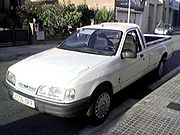
From 1988 a Sierra-based pickup
called the P100
was produced in Portugal for the European market.
It was narrowly beaten to the European Car of the Year
award by the Audi 100.
The Sierra was Ford's answer to the similar-sized Opel Ascona
, which had been launched a year earlier with front-wheel drive and a hatchback bodystyle. Unusually in its sector by that time, the Sierra was still rear-wheel drive. It was a strong competitor for other rivals of the early 1980s, including the Talbot Alpine, Peugeot 505
and Morris Ital
and the Citroën BX
, but later in its life it had to compete with the Austin Montego
(1984), Peugeot 405
(1987) and Opel Vectra
(1988).
and a 5-door estate
, and from 1983 as a 3-door hatchback. Until the launch of the Orion
in 1983, the larger and more expensive Granada
was the only saloon-bodied car available in the European Ford
range.
During the life of the car, two different styles of 3-door body were used; one with two pillars rear of the door, looking very much like a modified 5-door frame, as used on the high-performance XR4i; and a one-pillar design used on standard-performance 3-door hatchbacks and also at the other end of the scale as the basis for the very high-performance RS Cosworth
. At the time of the car's launch, both styles were already envisaged, and a demonstration model with one style on either side was displayed at a Sierra design exhibition at the Victoria and Albert Museum
in London.
The Ford Cortina
had been manufactured in saloon and estate bodystyles but after the switch to the Sierra, combined with the redesign of the Escort
to Mark III level in 1980 and the introduction of the Granada
Mark III in 1985, Ford had changed its saloon-based line-up into a hatchback-based one.
The company launched the Ford Orion
in 1983 to fill the gap in the saloon range between the late Cortina and the new Sierra. Ford found that customers were more attached to the idea of a saloon than they had expected, and this was further addressed in 1987 by the production of a saloon version of the Sierra. In the UK, this model was called the Ford Sierra Sapphire. This differed from the other Sierra models in having a traditional black grille, which only appeared in right hand drive markets. The 3-door Sierra was dropped in the UK in 1985, although the Cosworth version continued. Production of the 3-door Sierra continued in Europe, including after the Sierra range was given a facelift in 1987. The remodelled 3-door was never offered in the UK, having been withdrawn in 1984.
1300, 1600 and 2000 engines all have a 4-speed manual gearbox; a 5-speed manual gearbox was optional with 1600 and 2000 engines, and standard with the 1600 Economy engine, the 2300 and 2300 Diesel. An optional 3-speed automatic transmission was available with 1600, 2000 and 2300 engines.
Sporting models utilized the 2.8 / 2.9 litre V6 engines coupled to a four wheel drive system (GLS4X4/XR4x4) and, more notably the well known Cosworth model which was powered by a turbocharged 16 valve 4-cylinder engine known as the YB which was based on the Ford 'Pinto' block. The Ford Sierra Cosworth was first introduced in 1985 as a three door hatchback, with a 2 litre DOHC turbo engine producing 204 PS. At the time Ford wanted to compete in group A touring cars and therefore eligible to produce a limited run of 10% of the initial production, therefore this would be 500 cars. this was known as an 'evolution' model. Ford employed Tickford to help with the development. The Sierra RS500 as it was known sported a small additional rear spoiler, and larger front chin spoiler, extra cooling ducts for the engine, brakes and intercooler. Under the bonnet a larger turbo and intercooler was fitted along with an extra set of injectors, so instead of the standard four injectors it was built with eight, although in road trim these extra injectors did not function. These modifications produced 225 PS in road trim and around 550 hp in race trim. They were very successful in motorsport and are highly tunable road cars with a very large following.
In 1987, Ford introduced a four door saloon (marketed in the UK as the Sierra Sapphire), which was sold alongside the hatchback and estate until the Sierra was replaced by the Mondeo in early 1993. The last Sierra rolled off the production line in December 1992.
 Versions sold in South Africa were available with 1.6 (Kent engine
) and 2.0 (Cologne) 4-cylinder, 2.3 V6 (Cologne) or 3.0-litre V6 (Essex) petrol engines. While the Cortina MkV in South Africa had retained the old 3.0 V6 Essex engine, the Sierra was initially given the new 2.3 V6 Cologne motor, this being fitted to the top of the line model only. However, owing to the low cost of petrol, and the popularity of the old Cortina XR6, a Sierra XR6 was launched in 1986/7, featuring the old Essex, initially producing 103 kW.
Versions were LX, GL and GLX, the Ghia trim level was not available for the South African market
except on the Ford Sapphire, the sedan version and the Ford Falcon
.
As the 2.8/2.9 Cologne was never launched in South Africa, the venerable and popular Essex V6 remained the best normal production engine fitted to the Sierra. At the top of the range, the 2.3 GLS quickly gave way to a 3.0 GLX flagship model (producing less power but more torque than the XR6) and that was the end of the Cologne in South Africa, even the station wagon receiving the 3.0 V6 Essex. By 1985, the Sierra had become the largest Ford model, following the demise of the Granada
.
Towards the end of its production life, the Essex was modified again - the standard carb version tuned to produce 110 kW from 1991 to 1993, while a fuel injected version was available from 1992 to 1993. Fitted to the Sierra as the 3.0i RS (replacing the XR6) and to the Sapphire sedan as the Sapphire Ghia (replacing the 3.0 GLX), the fuel-injected Essex put out around 117 kW and was the most powerful Sierra/Sapphire version sold in South Africa, excluding the small number of XR8s built for homologation purposes (see next paragraph).
Uniquely, the South African market also saw the introduction of a 5.0L XR8 between 1986 and 1988. A limited number of 250 Sierras were made for the purposes of homolgation, as this model was the premier Ford used in Group A racing. The XR8 was fitted with the 302ci engine from the US Ford Mustang, and the Borg Warner T5 heavy duty transmission. Front brakes were AP Racing 4-piston calipers on 280mm discs.
The 1.6 Kent continued almost unchanged during the 9 year life of the Sierra/Sapphire, while the 2.0 Cologne was revised several times, being fitted to the Sierra 2.0 GL and GLE and later to the stripped down Sierra 2.0 LX and Sapphire 2.0 GL and GLE models. It eventually even received fuel injection in the Sapphire 2.0GLi, boosting the power from 77 kW to 85 kW.
The Sierra was eventually replaced in South Africa by the Telstar in 1993. Samcor
, which assembled Ford models under license after Ford had divested from the country, was already assembling the smaller Laser
and Meteor
, alongside the Mazda 323, on which they were based, as well as an earlier version of the Mazda 626
. The Telstar was finally replaced by the Mondeo in 1998.
replaced the Cortina with the Ford Telstar
range. This led to Ford importing CKD ("completely knocked down") kits of the Sierra wagon for local assembly in 1984. The wagon was offered in 1.6 (base) and 2.0 litre "L" and "Ghia" models initially, and proved to be a strong seller. In one month in 1987, the facelifted Ford Sierra, by then a single station wagon model, was the country's top-selling car range.
However, Ford cancelled the Sierra once Mazda, which developed the Telstar, could offer a station wagon. The Telstar wagon, while popular, never reached the Sierra's heights, especially its competition successes overseas. Further reasons could be customers' knowledge of the Telstar's Japanese roots, and that the equivalent Mazda 626
wagon offered a considerably longer warranty at a similar price.
Relative rejection of the Telstar forced Ford to import completely built-up (CBU) premium models built in Genk
, Belgium from 1990: the Sierra 2.0 GLX Wagon, the Sierra Sapphire 2.0 Ghia and the XR4×4 were part of this range. The advertising copy read, "Introducing the new car that needs no introduction." However, a relatively high price did not help – the Wagon began at over NZ$31,000 – and production errors in the launch brochure showed cars with no steering wheels. Furthermore, any marketing boosts Ford could have gained through Group A touring car racing were over with the Escort Cosworth becoming the company's standard-bearer in competition (and the Escort, meanwhile, was absent from the New Zealand market).
The Sierra was withdrawn from the New Zealand market in 1992, and it would be another five years before its European successor the Mondeo would arrive there. Sierra Cosworth's remain sought after performance cars.
By contrast, the Sierra was never sold in Australia, as there was less demand for a medium-sized wagon than in New Zealand, although the RS Cosworth/RS500 was used in the Australian Touring Car Championships from the late 80's and early 90's.
and Venezuela
. In Argentina, it was offered in three and five-door hatchback and station wagon bodystyles. The facelifted post-1987 model was built in Venezuela, but not in Argentina until 1989, where the range continued with a Merkur XR4Ti-like grille until 1991 for XR4 and 1992 for four door models, when it was replaced by the Volkswagen Santana
-based Galaxy. The 1.6 L was offered in GL model only, LX, Ghia, Ghia SX and XR4 were based in a 2.3 engine with some differences. Some Ghia models also featured automatic transmission as an optional. The station wagon was called the Sierra Rural—"Rural" being used for station wagons in Argentina in the same way "Turnier" is used in Germany.
GL model was the base model replaced by the LX with same equipment.
XR4 was replaced by the 4-door Ghia SX.
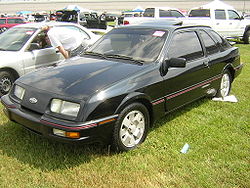 In the USA, the Ford Sierra and the Ford Scorpio
were offered under the failed Merkur
brand. The Sierra was imported as a three door only, and called the XR4Ti (similar to sub-model designations in other markets). The Sierra name was not used by Ford in the US; the market had already seen the similar-sounding Oldsmobile Ciera, and the Sierra name was used by General Motors Corporation from the 1970s as a trim level on its pickup trucks and because it would have interfered sales of the Ford Taurus
.
The car was offered from the start of the Merkur brand in 1985 until 1989. It was equipped with a 2.3 L variant of the SOHC "Lima" engine, equipped with a turbocharger and fuel injection but no intercooler.
The Merkur
brand is claimed to have been a commercial flop. The reasons vary. Safety and emissions regulations in the U.S. forced Ford to make costly modifications, resulting in relatively high prices. Exchange rates also fluctuated too frequently. Moreover, since Merkurs were sold at Lincoln–Mercury dealers, many customers were more attracted towards Mercury models because of their lower prices.
.
In the beginning the Sierra used engines
and transmissions from the Taunus / Cortina. The engines were of two types, the SOHC Ford Pinto engine
in 1.3, 1.6, 1.8 and 2.0 L displacements
, and the OHV Cologne V6 engine
(in 2.3 and 2.8, rarely 2.9 L capacities). Towards the end of the 1980s due to tightening emission standards, the Pinto engine began to be phased out-the 1.8 in 1988 replaced by a 1.8 CVH, the 2.0 in 1989,replaced with the Ford I4 DOHC engine
and the 1.6 in 1992, replaced by the 1.6 CVH first seen in the Escort in 1980, described as a "CFi", a single point fuel injection system with a catalytic converter.The 2.9 L Cologne engine
was available in the Sierra XR4x4 and the rear wheel drive Sierra Ghia. Models with the 2.0 L and Cologne V6 engines had an option of a limited slip differential
. Models built until 1989 used the type 9 gearbox that had been used in the Cortina, with the exception of 2WD Cosworth models that used the T5. The T5 had several variations, most were internal. This was basically the same transmission used in the Ford Mustang. The .80 overdrive gears were the weak link. It was later superseded by the MT75 unit (for DOHC, 4X4 and V6 models). All Sierras had rear drum brake
s, except sporting models (2.0iS (some), 2.0 GLX & GLS, XR4x4, Sierra Cosworth, other special/sporting models inc 2.0i 4x4) and models with anti-lock brakes. American versions meanwhile were sold only with a 2.3 L four cylinder turbocharged version of the Pinto engine.
The Sierra also had a diesel option on the engine, namely at launch the 2.3 L normally aspirated 67 PS Diesel made by Peugeot. This engine was also used in contemporary Granadas and whilst reliable and economical it made an unrefined, noisy and very slow vehicle, but remained a popular option for Taxi firms. This was later superseded in 1990 by a 1.8 L turbocharged
powerplant of Ford's own design which offered better response times and slightly more power.
2.8 Injection of that era and sported a restyled version of the 3-door Sierra bodyshell. The double rear spoiler and curious multi-pillared rear windows were considered over-styled by some prospective buyers, and the car never achieved the cult status of the smaller Fiesta XR2 and Escort XR3i. A version of the XR4i with a 2.3 L turbocharged engine was sold in the United States as the Merkur XR4Ti
. The XR4Ti was raced in Europe, most noticeably by Andy Rouse who used one to win the 1985 BTCC.
In South Africa, there was a 3.0 L V6 version, called the XR6, also made in South Africa was a limited run of 250 eight-cylinder XR8s for saloon car racing homologation in 1984. These were based on the Ford Windsor 302 engine
.
In 1985 the XR4i was replaced by the XR4x4, which was based on the five-door hatchback, had four wheel drive and was powered by the same 2.8 L V6 engine. By the end of its production in 1990, 23,540 had been produced. From 1990 to 1993 the XR4x4 was available with both the revised 2.9EFi and 2.0 DOHC EFi engines. The XR4i also made a reappearance (as a badging exercise) in 5-door form but with the DOHC 2.0 engine instead of the V6.
In 1989, Ford nodded towards its past and created the Sierra 2.0i 2000E, a model name used with limited success on the Mk3 Cortina. The Sierra 2000E had two-tone metallic paint, alloys, light grey leather interior, and a trip computer in addition the standard features on the 'Ghia' models. It was only available in saloon form and a limited number of models were sold between 1989-1991. Ford used this to showcase the new DOHC twin cam engine which was also released in 1989.
In Argentina the non-injected XR4 model was equipped with the Taunus 2.3 engine and was produced between 1986 and 1991. In this market the most direct rival was the Renault Fuego
2.2.
In July 1986, a special version called the Ford Sierra RS Cosworth
was launched, using the 2.0 OHC bottom end with a 16V DOHC cylinder head specially developed by Cosworth. With the Cosworth Garret T3 turbocharger
and intercooler
setup the engine produced 204 PS. It was designed by Ford's Special Vehicle Engineering (SVE) group and made in Ford's Genk factory in Belgium for use in group A. It was based on a three-door Sierra with the dashboard
from the Merkur XR4Ti. The car was available in only white, black or Ford's 'Moonstone Blue' and only 5545 were made.
In 1987, a 225 PS Sierra Cosworth, the RS500, was sold alongside the regular version. Only 500 were produced as the minimum number of road-going cars required to meet with newly introduced homologation racing rules, allowing it to compete in evolution form for group A racing. The car was modified by the Tickford Engineering Company
in conjunction with Ford. Revisions included uprated brakes and larger brake cooling ducts and modified front and rear spoilers (a second smaller rear spoiler was added beneath the large "whale-tail"), a modified front bumper to allow extra cooling for a larger intercooler, as well as various engine upgrades including a larger turbocharger and a second fuel rail (which did not operate on road models). Race outputs were as high as 550 bhp, in which the Sierra dominated group A series around the world.
Racing versions of the Cosworth were highly successful in European and World touring car racing throughout the late 1980s and early 1990s', and the RS500 helped Ford to win the manufacturer's title in the 1987 World Touring Car Championship. Ford was forced to fall back on the Sierra for rallying from 1987, after the banning of the Group B
formula. With only rear-drive, the Sierra struggled to compete on looser surfaces but was very quick on asphalt, Didier Auriol
winning his first World Championship rally in a Sierra in Corsica, 1988. It was replaced by the 4x4 Sapphire version from 1990, which never managed to win a World Championship event but became a popular and successful car in national championships. The Sierra was replaced by the Escort Cosworth
in 1993.
In 1988, a new Cosworth was produced which was based on the Sierra Sapphire saloon. 13,140 were produced until it was replaced in 1990 by a four wheel drive version, the Sierra Sapphire RS Cosworth 4x4, of which 12,250 were built. Its replacement came in the form of the Escort RS Cosworth which appeared in 1992, which used a shortened and developed version of the Sierra platform and running gear but clothed with an Escort-esque bodyshell and the return of the whale-tail spoiler.
In Finland, tax laws made the 1.3 L-engined Sierra an attractive business car in the mid 1980s. A number of these underpowered engines were turbocharged by local Ford dealers in order to gain 2.0 L engine power with 1.3 L tax fees to the owner of the vehicle. The 1.6 L and 2.0 L OHC engines were also turbocharged. Some of these "Stockmann Turbo" Sierras, called so after a major dealer that made the conversions, are still running today.
By the early 1990s, however, it had become clear that the Sierra had fallen out of step technologically against modern Japanese rivals which offered multi-valve engines and multi-link rear suspension. All of these features appeared on the Sierra's replacement, the front wheel drive Mondeo
, which was unveiled at the end of 1992 and launched the following March.
Large family car
A large family car, also known as a D-segment car, is a European automobile classification which is larger than a small family car and smaller than an executive car. Multi-purpose vehicles based on a large family car design are often called large MPVs, while similarly-priced models from luxury car...
that was built by Ford Europe
Ford Europe
-History:Ford of Europe was founded in 1967 on the merger of the British and German divisions of the Ford Motor Company. The original Ford Transit range of panel vans launched in 1965, was the first formal co-operation between the two entities, simultaneously developed to replace the German Ford...
from 1982 until 1993. It was designed by Uwe Bahnsen
Uwe Bahnsen
Uwe Bahnsen is a German car designer. After an apprenticeship as a window dresser Bahnsen studied at the College of Fine Arts in Hamburg. From 1958 to 1986 he was with Ford Europe held various positions, most recently as vice president for design. During this time, he created such icons of today's...
, Robert Lutz and Patrick le Quément
Patrick le Quément
Patrick G. M. Le Quément is a retired French car designer, formerly chief designer of Renault.Born in France but brought up in the United Kingdom, Le Quément holds a BA Hons...
. The code used during development was "Project Toni".
First unveiled on 22 September 1982 and with sales beginning on 15 October 1982, it replaced the Ford Cortina
Ford Cortina
As the 1960s dawned, BMC were revelling in the success of their new Mini – the first successful true minicar to be built in Britain in the postwar era...
. Its aerodynamic styling was ahead of its time and as such, many conservative buyers (including company car drivers) did not take fondly to the Ford Cortina's replacement.
Possibly for this reason (and the fact that the smaller Escort was enjoying an increase in sales during the early 1980s), and the early lack of a saloon variant, it was mainly manufactured in Germany, Belgium, and the United Kingdom, although Sierras were also assembled in Argentina, Venezuela, South Africa and New Zealand.
The Sierra was the 1983 Semperit Irish Car of the Year
Semperit Irish Car of the Year
The Semperit Irish Car of the Year award was established in 1978. It is organised and judged by the Irish Motoring Writers Association . It is sponsored by tyre manufactuer Semperit and specifically by their brand - 'Semperit'....
in Ireland.
Styling
The first Ford vehicle to have the bold new "aero" look styling was the 1981 Ford Probe III concept carConcept car
A concept vehicle or show vehicle is a car made to showcase new styling and or new technology. They are often shown at motor shows to gauge customer reaction to new and radical designs which may or may not have a chance of being produced....
. The good reception this received encouraged Ford's management to go ahead with a production car with styling almost as challenging. This "aero" look influenced Fords worldwide: the 1983 Ford Thunderbird
Ford Thunderbird
The Thunderbird , is an automobile manufactured by the Ford Motor Company in the United States over eleven model generations from 1955 through 2005...
in North America introduced similar rounded, flowing lines, and some other new Fords of the time adopted the look.
By September of 1981, it had been confirmed that the Cortina's replacement - still a year away - would be marketed as the Sierra.
The aerodynamic features of the Sierra were developed from those first seen in the Escort Mark III—the "Aeroback" bootlid stump was proved to reduce the drag coefficient
Drag coefficient
In fluid dynamics, the drag coefficient is a dimensionless quantity that is used to quantify the drag or resistance of an object in a fluid environment such as air or water. It is used in the drag equation, where a lower drag coefficient indicates the object will have less aerodynamic or...
of the bodyshell significantly, which was a class leading Cd0.34 at its launch, though not as good as the Cd0.22 of the visually similar Ford Probe III concept car of the previous year, and also behind the contemporary third generation Audi 100
Audi 100
The restyled C2 Audi 100 was launched in 1976, with an in-line five-cylinder engine...
that was unveiled the same year - the first production car to get below the Cd0.30 barrier with an impressive figure of Cd0.28. The aerodynamic styling of the Sierra would later be seen in North America's Ford Taurus
Ford Taurus
The Ford Taurus is an automobile manufactured by the Ford Motor Company in the United States. Originally introduced in the 1986 model year, it has remained in near-continuous production for more than two decades, making it the fourth oldest nameplate that is currently sold in the North American...
.
At first, many found the design blob-like and difficult to accept after being used to the sharp-edged, straight-line styling of the Cortina
Ford Cortina
As the 1960s dawned, BMC were revelling in the success of their new Mini – the first successful true minicar to be built in Britain in the postwar era...
, and it picked up nicknames such as "Jellymould" and "The Salesman's Spaceship" (the latter thanks to its status as a popular fleet car in the United Kingdom). Sales were slow at first. It was later in the Sierra's life that the styling began to pay off; ten years after its introduction, the Sierra's styling was not nearly as outdated as its contemporaries, even though all major competitors were newer designs, although the Sierra had been tweaked on several occasions. The most notable changes came at the start of 1987, with a major facelift and the addition of a Sapphire saloon. As other manufacturers adopted similar aerodynamic styling, the Sierra looked more normal.
Early versions suffered from crosswind stability problems, which were addressed in 1985 with the addition of "strakes" (small spoilers), on the rear edge of the rubber seals of the rear most side windows. These shortcomings saw a lot of press attention, and contributed to early slow sales. Other rumours that the car hid major crash damage (in part true, as the new bumper design sprung back after minor impact and couldn't be "read" to interpret major damage) also harmed the car's reputation. This reached near-hysterical heights at one point with UK press making a report that Ford would reintroduce the previous Cortina model out of desperation or import the American Ford Taurus to Europe. However, these reports were swiftly denied by Ford.
At its launch some of the Sierra's external styling differed depending on the specification. In place of the model's regular 2-bar grille, which was unpainted on the lowest specification model, the Ghia featured a narrower blanked-off grille between wider, but still inset, headlights while the front bumper was also restyled and featured combined indicator/foglight units compared to the lower specification model's slimmer but wider indicator units. The XR4i had an identical front end to the Ghia, bar the bumper which was slightly different. The rear lights of the Ghia were the same shape and layout as other models, but featured tiny horiziontals strakes on the lenses to give the impression that they were smoked. A couple of years later all the lower spec models adopting the Ghia and XR4i's front grille and headlight treatment.
1987 Facelift
In 1987 the Sierra was facelifted. The front end was completely revised, with the biggest difference seeing the indicators now positioned above the bumper and to the side of a new headlight design, and while the grille again remained blanked-off UK versions of the newly introduced saloon bodystyle, badged Sierra Sapphire, featured a unique shallow black grille between the headlights. That apart, all specifications of the Sierra now shared a common front end, compared to the car's original styling. The rear lights were slightly altered. This facelift made the Sierra look more normal.The XR4x4 was now based on the 5 door hatchback bodystyle and featured different front and rear body-coloured bumper styling, along with wider side rubbing strips. The RS Cosworth was now based on the newly introduced saloon bodystyle and featured another style of front bumper as well as the black grille which was only found on UK versions of the saloon bodystyle.
From 1988 a Sierra-based pickup
Pickup truck
A pickup truck is a light motor vehicle with an open-top rear cargo area .-Definition:...
called the P100
Ford P100
The Ford P100 was a pickup truck built from 1971 to 1993; initially in South Africa, and later Portugal upon the design of a medium-sized Ford car, originally the Ford Cortina and from 1988 the Ford Sierra.-Description:...
was produced in Portugal for the European market.
It was narrowly beaten to the European Car of the Year
European Car of the Year
The European Car of the Year award was established in 1964 by a collective of automobile magazines from different countries in Europe. The current organisers of the award are Auto , Autocar , Autopista , Autovisie , L'Automobile Magazine , Stern and Vi Bilägare .The voting jury consists of motoring...
award by the Audi 100.
The Sierra was Ford's answer to the similar-sized Opel Ascona
Opel Ascona
The Opel Ascona was a mid-sized car produced by Opel. It had three generations produced from 1970 to 1988. In motorsport, the Ascona 400 rally car driven by Walter Röhrl won the World Rally Championship drivers' title in the 1982 season....
, which had been launched a year earlier with front-wheel drive and a hatchback bodystyle. Unusually in its sector by that time, the Sierra was still rear-wheel drive. It was a strong competitor for other rivals of the early 1980s, including the Talbot Alpine, Peugeot 505
Peugeot 505
The Peugeot 505 is a large family car produced by the French manufacturer Peugeot from 1979 to 1992 in Sochaux, France. The 505 was Peugeot's last rear-wheel drive car...
and Morris Ital
Morris Ital
The Morris Ital was a medium-sized saloon car built by British Leyland from 1980 until 1984.-Design and launch:The Ital was first launched on 1 July 1980. It took its name from Giorgetto Giugiaro's ItalDesign studio, who had been employed by BL to manage the re-engineering of Morris Marina, a car...
and the Citroën BX
Citroën BX
The Citroën BX is a large family car that was produced by the French manufacturer Citroën from 1982 to 1994. In total, 2,315,739 BXs were built during its 12-year history. The hatchback was discontinued in 1993 with the arrival of the Xantia, but the estate continued for another year.-History:The...
, but later in its life it had to compete with the Austin Montego
Austin Montego
The Austin Montego is a British mid-size saloon car that was produced by the Austin Rover subsidiary of British Leyland , and its successors, from 1984 until 1994. The Montego was the replacement for the Morris Ital, to give British Leyland a modern competitor for the Ford Sierra and Vauxhall...
(1984), Peugeot 405
Peugeot 405
The Peugeot 405 is a large family car released by the French automaker Peugeot in July 1987 and which continues to be manufactured under licence outside France. It used TU/XU petrol and XUD diesel engines....
(1987) and Opel Vectra
Opel Vectra
The Opel Vectra is a large family car that was engineered and produced by Opel. In the United Kingdom, the car was sold under the Vauxhall marque as the Vauxhall Cavalier and later as the Vauxhall Vectra, from 1995 onwards...
(1988).
Body styles
In another departure from tradition, the Sierra was initially unavailable as a saloon. At its launch it was available as a 5-door hatchbackHatchback
A Hatchback is a car body style incorporating a shared passenger and cargo volume, with rearmost accessibility via a rear third or fifth door, typically a top-hinged liftgate—and features such as fold-down rear seats to enable flexibility within the shared passenger/cargo volume. As a two-box...
and a 5-door estate
Station wagon
A station wagon is a body style variant of a sedan/saloon with its roof extended rearward over a shared passenger/cargo volume with access at the back via a third or fifth door , instead of a trunk lid...
, and from 1983 as a 3-door hatchback. Until the launch of the Orion
Ford Orion
The Ford Orion is a saloon car built by the automaker Ford for the European market from 22 July 1983 until 19 September 1993. A total of 3,534,239 Orions were sold throughout the car's 10-year life....
in 1983, the larger and more expensive Granada
Ford Granada (Europe)
The March 1972 released Granada succeeded the British Ford Zephyr, and the German P7-series as Ford's European executive car offering. At first, lower models in the range were called the Ford Consul, but from 1975 on they were all called Granadas. The car soon became popular for taxi, fleet and...
was the only saloon-bodied car available in the European Ford
Ford Europe
-History:Ford of Europe was founded in 1967 on the merger of the British and German divisions of the Ford Motor Company. The original Ford Transit range of panel vans launched in 1965, was the first formal co-operation between the two entities, simultaneously developed to replace the German Ford...
range.
During the life of the car, two different styles of 3-door body were used; one with two pillars rear of the door, looking very much like a modified 5-door frame, as used on the high-performance XR4i; and a one-pillar design used on standard-performance 3-door hatchbacks and also at the other end of the scale as the basis for the very high-performance RS Cosworth
Cosworth
Cosworth is a high performance engineering company founded in London in 1958, specialising in engines and electronics for automobile racing , mainstream automotive and defence industries...
. At the time of the car's launch, both styles were already envisaged, and a demonstration model with one style on either side was displayed at a Sierra design exhibition at the Victoria and Albert Museum
Victoria and Albert Museum
The Victoria and Albert Museum , set in the Brompton district of The Royal Borough of Kensington and Chelsea, London, England, is the world's largest museum of decorative arts and design, housing a permanent collection of over 4.5 million objects...
in London.
The Ford Cortina
Ford Cortina
As the 1960s dawned, BMC were revelling in the success of their new Mini – the first successful true minicar to be built in Britain in the postwar era...
had been manufactured in saloon and estate bodystyles but after the switch to the Sierra, combined with the redesign of the Escort
Ford Escort (European)
The Mark I Ford Escort was introduced in the United Kingdom at the end of 1967, making its show debut at Brussels Motor Show in January 1968. It replaced the successful long running Anglia. The car was presented in continental Europe as a product of Ford's European operation...
to Mark III level in 1980 and the introduction of the Granada
Ford Granada (Europe)
The March 1972 released Granada succeeded the British Ford Zephyr, and the German P7-series as Ford's European executive car offering. At first, lower models in the range were called the Ford Consul, but from 1975 on they were all called Granadas. The car soon became popular for taxi, fleet and...
Mark III in 1985, Ford had changed its saloon-based line-up into a hatchback-based one.
The company launched the Ford Orion
Ford Orion
The Ford Orion is a saloon car built by the automaker Ford for the European market from 22 July 1983 until 19 September 1993. A total of 3,534,239 Orions were sold throughout the car's 10-year life....
in 1983 to fill the gap in the saloon range between the late Cortina and the new Sierra. Ford found that customers were more attached to the idea of a saloon than they had expected, and this was further addressed in 1987 by the production of a saloon version of the Sierra. In the UK, this model was called the Ford Sierra Sapphire. This differed from the other Sierra models in having a traditional black grille, which only appeared in right hand drive markets. The 3-door Sierra was dropped in the UK in 1985, although the Cosworth version continued. Production of the 3-door Sierra continued in Europe, including after the Sierra range was given a facelift in 1987. The remodelled 3-door was never offered in the UK, having been withdrawn in 1984.
Drivetrain options
The Sierra was available with a wide range of engines:- 1.3 OHC (1294 cc; 60 PS Pinto engineFord Pinto engineThe Ford Pinto engine was the unofficial but generic nickname for a 4-cylinder internal combustion engine built by Ford Europe. In Ford sales literature it was referred to as the EAO or OHC engine and because it was designed to the metric system, it was sometimes called the "Metric engine". The...
, available in standard or economy tune; - 1.6 OHC (1593 cc; 75 PS Pinto engineFord Pinto engineThe Ford Pinto engine was the unofficial but generic nickname for a 4-cylinder internal combustion engine built by Ford Europe. In Ford sales literature it was referred to as the EAO or OHC engine and because it was designed to the metric system, it was sometimes called the "Metric engine". The...
, available in standard or economy tune; - 2.0 OHC (1998 cc; 105 PS Pinto engineFord Pinto engineThe Ford Pinto engine was the unofficial but generic nickname for a 4-cylinder internal combustion engine built by Ford Europe. In Ford sales literature it was referred to as the EAO or OHC engine and because it was designed to the metric system, it was sometimes called the "Metric engine". The...
; - 1.8 OHC 90 PS Pinto engineFord Pinto engineThe Ford Pinto engine was the unofficial but generic nickname for a 4-cylinder internal combustion engine built by Ford Europe. In Ford sales literature it was referred to as the EAO or OHC engine and because it was designed to the metric system, it was sometimes called the "Metric engine". The...
(from 1984); - 2.0 OHC 115 PS Pinto engineFord Pinto engineThe Ford Pinto engine was the unofficial but generic nickname for a 4-cylinder internal combustion engine built by Ford Europe. In Ford sales literature it was referred to as the EAO or OHC engine and because it was designed to the metric system, it was sometimes called the "Metric engine". The...
with fuel injectionFuel injectionFuel injection is a system for admitting fuel into an internal combustion engine. It has become the primary fuel delivery system used in automotive petrol engines, having almost completely replaced carburetors in the late 1980s....
(from 1985); - 1.8 OHC 90 bhp CVH Engine (from 1989)
- 1.8 TD 75 PS Endura-D engine (from 1989);
- 2.0 DOHC (1998 cc; 125 PS DOHC engineFord I4 DOHC engineThe Ford I4 DOHC engine was a 4-cylinder inline internal combustion engine with twin overhead camshafts, produced by the Ford Motor Company. First with 2.0-litre 8-valve version, in later models with 2.0/2.3-litre 16-valve version from 1989 to the end of production of the MK2 Ford Galaxy in 2006...
(from 1989); - 2.3 V6 (2294 cc; 114 PS Cologne V6 engineFord Cologne V6 engineThe original Ford Cologne V6, also known as the 'Ford Taunus V6', is a series of 60° cast iron block V6 engines produced continuously by the Ford Motor Company in Cologne, Germany since 1968...
; - 2.3 D (2304 cc, 67 PS Peugeot Diesel engine;
- 2.8i (2792 cc; 150 PS Cologne V6 engine (XR4i, from 1983)
- 2.9i (2935 cc; 145 PS Cologne V6 engine (XR4x4, from 1987)
- RS Cosworth (1993 cc; 204 PS YB Turbo) (from 1986)
1300, 1600 and 2000 engines all have a 4-speed manual gearbox; a 5-speed manual gearbox was optional with 1600 and 2000 engines, and standard with the 1600 Economy engine, the 2300 and 2300 Diesel. An optional 3-speed automatic transmission was available with 1600, 2000 and 2300 engines.
Sporting models utilized the 2.8 / 2.9 litre V6 engines coupled to a four wheel drive system (GLS4X4/XR4x4) and, more notably the well known Cosworth model which was powered by a turbocharged 16 valve 4-cylinder engine known as the YB which was based on the Ford 'Pinto' block. The Ford Sierra Cosworth was first introduced in 1985 as a three door hatchback, with a 2 litre DOHC turbo engine producing 204 PS. At the time Ford wanted to compete in group A touring cars and therefore eligible to produce a limited run of 10% of the initial production, therefore this would be 500 cars. this was known as an 'evolution' model. Ford employed Tickford to help with the development. The Sierra RS500 as it was known sported a small additional rear spoiler, and larger front chin spoiler, extra cooling ducts for the engine, brakes and intercooler. Under the bonnet a larger turbo and intercooler was fitted along with an extra set of injectors, so instead of the standard four injectors it was built with eight, although in road trim these extra injectors did not function. These modifications produced 225 PS in road trim and around 550 hp in race trim. They were very successful in motorsport and are highly tunable road cars with a very large following.
In 1987, Ford introduced a four door saloon (marketed in the UK as the Sierra Sapphire), which was sold alongside the hatchback and estate until the Sierra was replaced by the Mondeo in early 1993. The last Sierra rolled off the production line in December 1992.
South Africa
In South Africa, the Sierra range featured both the hatchback and station wagon and production began at the Silverton (Pretoria) plant in 1985/6. The restyled Sierra range differed from its European equivalent by featuring the traditional black grille of the Sierra Sapphire sedan (known simply in South Africa as the Sapphire) on the hatchback and wagon. (Later, the grille would feature on these models in Europe.)Ford Kent engine
The Ford Kent is an internal combustion engine from Ford of Europe. Originally developed in 1959 for the Ford Anglia, it is an in-line four-cylinder engine with a cast-iron cylinder head and block.-Pre-Crossflow:...
) and 2.0 (Cologne) 4-cylinder, 2.3 V6 (Cologne) or 3.0-litre V6 (Essex) petrol engines. While the Cortina MkV in South Africa had retained the old 3.0 V6 Essex engine, the Sierra was initially given the new 2.3 V6 Cologne motor, this being fitted to the top of the line model only. However, owing to the low cost of petrol, and the popularity of the old Cortina XR6, a Sierra XR6 was launched in 1986/7, featuring the old Essex, initially producing 103 kW.
Versions were LX, GL and GLX, the Ghia trim level was not available for the South African market
except on the Ford Sapphire, the sedan version and the Ford Falcon
Ford Falcon
The Ford Falcon is a full-size car which has been manufactured by Ford Australia since 1960. Each model from the XA series of 1972 onward has been designed, developed and built in Australia and/or New Zealand, following the phasing out of the American Falcon of 1960–71 which had been re-engineered...
.
As the 2.8/2.9 Cologne was never launched in South Africa, the venerable and popular Essex V6 remained the best normal production engine fitted to the Sierra. At the top of the range, the 2.3 GLS quickly gave way to a 3.0 GLX flagship model (producing less power but more torque than the XR6) and that was the end of the Cologne in South Africa, even the station wagon receiving the 3.0 V6 Essex. By 1985, the Sierra had become the largest Ford model, following the demise of the Granada
Ford Granada (Europe)
The March 1972 released Granada succeeded the British Ford Zephyr, and the German P7-series as Ford's European executive car offering. At first, lower models in the range were called the Ford Consul, but from 1975 on they were all called Granadas. The car soon became popular for taxi, fleet and...
.
Towards the end of its production life, the Essex was modified again - the standard carb version tuned to produce 110 kW from 1991 to 1993, while a fuel injected version was available from 1992 to 1993. Fitted to the Sierra as the 3.0i RS (replacing the XR6) and to the Sapphire sedan as the Sapphire Ghia (replacing the 3.0 GLX), the fuel-injected Essex put out around 117 kW and was the most powerful Sierra/Sapphire version sold in South Africa, excluding the small number of XR8s built for homologation purposes (see next paragraph).
Uniquely, the South African market also saw the introduction of a 5.0L XR8 between 1986 and 1988. A limited number of 250 Sierras were made for the purposes of homolgation, as this model was the premier Ford used in Group A racing. The XR8 was fitted with the 302ci engine from the US Ford Mustang, and the Borg Warner T5 heavy duty transmission. Front brakes were AP Racing 4-piston calipers on 280mm discs.
The 1.6 Kent continued almost unchanged during the 9 year life of the Sierra/Sapphire, while the 2.0 Cologne was revised several times, being fitted to the Sierra 2.0 GL and GLE and later to the stripped down Sierra 2.0 LX and Sapphire 2.0 GL and GLE models. It eventually even received fuel injection in the Sapphire 2.0GLi, boosting the power from 77 kW to 85 kW.
The Sierra was eventually replaced in South Africa by the Telstar in 1993. Samcor
Samcor
The South African Motor Corporation, known more commonly as Samcor, was a South African car manufacturer created in 1985 through the merger of Ford's South African subsidiary and Anglo-American Motor Corporation, which produced Mazdas for the local market...
, which assembled Ford models under license after Ford had divested from the country, was already assembling the smaller Laser
Ford Laser
The 1985 KC Laser/GC Meteor was the model's first major redesign. All body styles were carried over, with the addition of a station wagon from 1986. A new "TX3" variant, which was half-way between "GL" & "Ghia" in specification level, replaced the "Sport" variant from the KB series. Unlike the...
and Meteor
Ford Meteor
Introduced in 1981, Ford Meteor was the name given to the sedan version of the Ford Laser, based on the Mazda Familia in markets including Australia and South Africa. Following much the same strategy in Europe was the Ford Orion, a four-door saloon which had Escort mechanicals...
, alongside the Mazda 323, on which they were based, as well as an earlier version of the Mazda 626
Mazda 626
The Mazda 626 is an automobile that was produced by Mazda for the export market. It was based on the Japan-market Mazda Capella. The 626 replaced the 616/618 and RX-2 in 1979 and was sold through 2002, when the new Mazda6 took over as Mazda's large family car...
. The Telstar was finally replaced by the Mondeo in 1998.
New Zealand
Whereas British buyers rued the absence of a saloon version of the Sierra, in New Zealand, it was the absence of an estate (a "station wagon" there) that customers missed, when Ford New ZealandFord New Zealand
Ford New Zealand is the New Zealand subsidiary of Ford Motor Company. It began in 1936. Since the closure of its assembly plant in Wiri, Auckland in 1997, all of its product offerings are fully imported, from Australia, Japan and increasingly, Europe...
replaced the Cortina with the Ford Telstar
Ford Telstar
The Ford Telstar is an automobile that was sold by the Ford Motor Company in Asia, Australasia and Africa, comparable in size to the European Ford Sierra and the American Ford Tempo. It has been progressively replaced by the Ford Mondeo....
range. This led to Ford importing CKD ("completely knocked down") kits of the Sierra wagon for local assembly in 1984. The wagon was offered in 1.6 (base) and 2.0 litre "L" and "Ghia" models initially, and proved to be a strong seller. In one month in 1987, the facelifted Ford Sierra, by then a single station wagon model, was the country's top-selling car range.
However, Ford cancelled the Sierra once Mazda, which developed the Telstar, could offer a station wagon. The Telstar wagon, while popular, never reached the Sierra's heights, especially its competition successes overseas. Further reasons could be customers' knowledge of the Telstar's Japanese roots, and that the equivalent Mazda 626
Mazda 626
The Mazda 626 is an automobile that was produced by Mazda for the export market. It was based on the Japan-market Mazda Capella. The 626 replaced the 616/618 and RX-2 in 1979 and was sold through 2002, when the new Mazda6 took over as Mazda's large family car...
wagon offered a considerably longer warranty at a similar price.
Relative rejection of the Telstar forced Ford to import completely built-up (CBU) premium models built in Genk
Genk
Genk is a city and municipality located in the Belgian province of Limburg near Hasselt. The municipality only comprises the city of Genk itself...
, Belgium from 1990: the Sierra 2.0 GLX Wagon, the Sierra Sapphire 2.0 Ghia and the XR4×4 were part of this range. The advertising copy read, "Introducing the new car that needs no introduction." However, a relatively high price did not help – the Wagon began at over NZ$31,000 – and production errors in the launch brochure showed cars with no steering wheels. Furthermore, any marketing boosts Ford could have gained through Group A touring car racing were over with the Escort Cosworth becoming the company's standard-bearer in competition (and the Escort, meanwhile, was absent from the New Zealand market).
The Sierra was withdrawn from the New Zealand market in 1992, and it would be another five years before its European successor the Mondeo would arrive there. Sierra Cosworth's remain sought after performance cars.
By contrast, the Sierra was never sold in Australia, as there was less demand for a medium-sized wagon than in New Zealand, although the RS Cosworth/RS500 was used in the Australian Touring Car Championships from the late 80's and early 90's.
South America
In South America, the Sierra was produced in ArgentinaArgentina
Argentina , officially the Argentine Republic , is the second largest country in South America by land area, after Brazil. It is constituted as a federation of 23 provinces and an autonomous city, Buenos Aires...
and Venezuela
Venezuela
Venezuela , officially called the Bolivarian Republic of Venezuela , is a tropical country on the northern coast of South America. It borders Colombia to the west, Guyana to the east, and Brazil to the south...
. In Argentina, it was offered in three and five-door hatchback and station wagon bodystyles. The facelifted post-1987 model was built in Venezuela, but not in Argentina until 1989, where the range continued with a Merkur XR4Ti-like grille until 1991 for XR4 and 1992 for four door models, when it was replaced by the Volkswagen Santana
Volkswagen Santana
The Volkswagen Santana is a three-box sedan, based on the second generation Volkswagen Passat . It was first introduced in 1981 and is scheduled to remain in production until 2012....
-based Galaxy. The 1.6 L was offered in GL model only, LX, Ghia, Ghia SX and XR4 were based in a 2.3 engine with some differences. Some Ghia models also featured automatic transmission as an optional. The station wagon was called the Sierra Rural—"Rural" being used for station wagons in Argentina in the same way "Turnier" is used in Germany.
GL model was the base model replaced by the LX with same equipment.
XR4 was replaced by the 4-door Ghia SX.
North America
Ford Scorpio
The Ford Scorpio is an automobile that was produced by the Ford Motor Company from 1985 through to 1998.It was the replacement for the European Ford Granada line...
were offered under the failed Merkur
Merkur
Merkur , Mercury) was an automobile brand which was briefly marketed by Ford Motor Company in the United States and Canada from 1985 to 1989...
brand. The Sierra was imported as a three door only, and called the XR4Ti (similar to sub-model designations in other markets). The Sierra name was not used by Ford in the US; the market had already seen the similar-sounding Oldsmobile Ciera, and the Sierra name was used by General Motors Corporation from the 1970s as a trim level on its pickup trucks and because it would have interfered sales of the Ford Taurus
Ford Taurus
The Ford Taurus is an automobile manufactured by the Ford Motor Company in the United States. Originally introduced in the 1986 model year, it has remained in near-continuous production for more than two decades, making it the fourth oldest nameplate that is currently sold in the North American...
.
The car was offered from the start of the Merkur brand in 1985 until 1989. It was equipped with a 2.3 L variant of the SOHC "Lima" engine, equipped with a turbocharger and fuel injection but no intercooler.
The Merkur
Merkur
Merkur , Mercury) was an automobile brand which was briefly marketed by Ford Motor Company in the United States and Canada from 1985 to 1989...
brand is claimed to have been a commercial flop. The reasons vary. Safety and emissions regulations in the U.S. forced Ford to make costly modifications, resulting in relatively high prices. Exchange rates also fluctuated too frequently. Moreover, since Merkurs were sold at Lincoln–Mercury dealers, many customers were more attracted towards Mercury models because of their lower prices.
Mechanicals
Unlike many of its rivals, the Sierra retained rear wheel drive, albeit with a modern, fully independent rear suspension, departing from the Cortina's live axleLive axle
A live axle, sometimes called a solid axle, is a type of beam axle suspension system that uses the driveshafts that transmit power to the wheels to connect the wheels laterally so that they move together as a unit....
.
In the beginning the Sierra used engines
Internal combustion engine
The internal combustion engine is an engine in which the combustion of a fuel occurs with an oxidizer in a combustion chamber. In an internal combustion engine, the expansion of the high-temperature and high -pressure gases produced by combustion apply direct force to some component of the engine...
and transmissions from the Taunus / Cortina. The engines were of two types, the SOHC Ford Pinto engine
Ford Pinto engine
The Ford Pinto engine was the unofficial but generic nickname for a 4-cylinder internal combustion engine built by Ford Europe. In Ford sales literature it was referred to as the EAO or OHC engine and because it was designed to the metric system, it was sometimes called the "Metric engine". The...
in 1.3, 1.6, 1.8 and 2.0 L displacements
Engine displacement
Engine displacement is the volume swept by all the pistons inside the cylinders of an internal combustion engine in a single movement from top dead centre to bottom dead centre . It is commonly specified in cubic centimeters , litres , or cubic inches...
, and the OHV Cologne V6 engine
Ford Cologne V6 engine
The original Ford Cologne V6, also known as the 'Ford Taunus V6', is a series of 60° cast iron block V6 engines produced continuously by the Ford Motor Company in Cologne, Germany since 1968...
(in 2.3 and 2.8, rarely 2.9 L capacities). Towards the end of the 1980s due to tightening emission standards, the Pinto engine began to be phased out-the 1.8 in 1988 replaced by a 1.8 CVH, the 2.0 in 1989,replaced with the Ford I4 DOHC engine
Ford I4 DOHC engine
The Ford I4 DOHC engine was a 4-cylinder inline internal combustion engine with twin overhead camshafts, produced by the Ford Motor Company. First with 2.0-litre 8-valve version, in later models with 2.0/2.3-litre 16-valve version from 1989 to the end of production of the MK2 Ford Galaxy in 2006...
and the 1.6 in 1992, replaced by the 1.6 CVH first seen in the Escort in 1980, described as a "CFi", a single point fuel injection system with a catalytic converter.The 2.9 L Cologne engine
Ford Cologne V6 engine
The original Ford Cologne V6, also known as the 'Ford Taunus V6', is a series of 60° cast iron block V6 engines produced continuously by the Ford Motor Company in Cologne, Germany since 1968...
was available in the Sierra XR4x4 and the rear wheel drive Sierra Ghia. Models with the 2.0 L and Cologne V6 engines had an option of a limited slip differential
Limited slip differential
A limited slip differential is a type of differential gear arrangement that allows for some difference in angular velocity of the output shafts, but imposes a mechanical bound on the disparity...
. Models built until 1989 used the type 9 gearbox that had been used in the Cortina, with the exception of 2WD Cosworth models that used the T5. The T5 had several variations, most were internal. This was basically the same transmission used in the Ford Mustang. The .80 overdrive gears were the weak link. It was later superseded by the MT75 unit (for DOHC, 4X4 and V6 models). All Sierras had rear drum brake
Drum brake
A drum brake is a brake in which the friction is caused by a set of shoes or pads that press against a rotating drum-shaped part called a brake drum....
s, except sporting models (2.0iS (some), 2.0 GLX & GLS, XR4x4, Sierra Cosworth, other special/sporting models inc 2.0i 4x4) and models with anti-lock brakes. American versions meanwhile were sold only with a 2.3 L four cylinder turbocharged version of the Pinto engine.
The Sierra also had a diesel option on the engine, namely at launch the 2.3 L normally aspirated 67 PS Diesel made by Peugeot. This engine was also used in contemporary Granadas and whilst reliable and economical it made an unrefined, noisy and very slow vehicle, but remained a popular option for Taxi firms. This was later superseded in 1990 by a 1.8 L turbocharged
Turbocharger
A turbocharger, or turbo , from the Greek "τύρβη" is a centrifugal compressor powered by a turbine that is driven by an engine's exhaust gases. Its benefit lies with the compressor increasing the mass of air entering the engine , thereby resulting in greater performance...
powerplant of Ford's own design which offered better response times and slightly more power.
XR4i and other sporting models
In 1983, the high-performance XR4i version was introduced. It utilised the same 2.8 L Cologne engine as used in the Ford CapriFord Capri
Ford Capri was a name used by the Ford Motor Company for three different automobile models. The Ford Consul Capri coupé was produced by Ford of Britain between 1961 and 1964. The Ford Capri coupé was produced by Ford of Europe from 1969 to 1986...
2.8 Injection of that era and sported a restyled version of the 3-door Sierra bodyshell. The double rear spoiler and curious multi-pillared rear windows were considered over-styled by some prospective buyers, and the car never achieved the cult status of the smaller Fiesta XR2 and Escort XR3i. A version of the XR4i with a 2.3 L turbocharged engine was sold in the United States as the Merkur XR4Ti
Merkur XR4Ti
The Merkur XR4Ti was a short-lived United States and Canada-market version of the European Ford Sierra XR4i. It was the brainchild of then Ford Vice President Bob Lutz. It was sold in the US from 1985 to 1989. It was the first vehicle of Ford's Merkur range, followed in 1988 by the Merkur Scorpio...
. The XR4Ti was raced in Europe, most noticeably by Andy Rouse who used one to win the 1985 BTCC.
In South Africa, there was a 3.0 L V6 version, called the XR6, also made in South Africa was a limited run of 250 eight-cylinder XR8s for saloon car racing homologation in 1984. These were based on the Ford Windsor 302 engine
Ford Windsor engine
The Windsor is a 90-degree small-block V8 engine from Ford Motor Company. It was introduced in 1962, replacing the previous Ford Y-block engine. Though not all of the engines in this family were produced at the Windsor, Ontario engine plant , the name stuck...
.
In 1985 the XR4i was replaced by the XR4x4, which was based on the five-door hatchback, had four wheel drive and was powered by the same 2.8 L V6 engine. By the end of its production in 1990, 23,540 had been produced. From 1990 to 1993 the XR4x4 was available with both the revised 2.9EFi and 2.0 DOHC EFi engines. The XR4i also made a reappearance (as a badging exercise) in 5-door form but with the DOHC 2.0 engine instead of the V6.
In 1989, Ford nodded towards its past and created the Sierra 2.0i 2000E, a model name used with limited success on the Mk3 Cortina. The Sierra 2000E had two-tone metallic paint, alloys, light grey leather interior, and a trip computer in addition the standard features on the 'Ghia' models. It was only available in saloon form and a limited number of models were sold between 1989-1991. Ford used this to showcase the new DOHC twin cam engine which was also released in 1989.
In Argentina the non-injected XR4 model was equipped with the Taunus 2.3 engine and was produced between 1986 and 1991. In this market the most direct rival was the Renault Fuego
Renault Fuego
The Renault Fuego is a four-seater, three-door hatchback produced by French automaker Renault from 1980 to 1992, replacing the Renault 15 and 17 coupés of the 1970s.- Development :...
2.2.
In July 1986, a special version called the Ford Sierra RS Cosworth
Ford Sierra RS Cosworth
The Ford Sierra RS Cosworth was a high-performance version of the Ford Sierra. It was the result of a Ford Motorsport project with the purpose of producing an outright winner for Group A racing in Europe.- Development :...
was launched, using the 2.0 OHC bottom end with a 16V DOHC cylinder head specially developed by Cosworth. With the Cosworth Garret T3 turbocharger
Turbocharger
A turbocharger, or turbo , from the Greek "τύρβη" is a centrifugal compressor powered by a turbine that is driven by an engine's exhaust gases. Its benefit lies with the compressor increasing the mass of air entering the engine , thereby resulting in greater performance...
and intercooler
Intercooler
An intercooler , or charge air cooler, is an air-to-air or air-to-liquid heat exchange device used on turbocharged and supercharged internal combustion engines to improve their volumetric efficiency by increasing intake air charge density through nearly isobaric cooling, which removes...
setup the engine produced 204 PS. It was designed by Ford's Special Vehicle Engineering (SVE) group and made in Ford's Genk factory in Belgium for use in group A. It was based on a three-door Sierra with the dashboard
Dashboard
A dashboard is a control panel placed in front of the driver of an automobile, housing instrumentation and controls for operation of the vehicle....
from the Merkur XR4Ti. The car was available in only white, black or Ford's 'Moonstone Blue' and only 5545 were made.
In 1987, a 225 PS Sierra Cosworth, the RS500, was sold alongside the regular version. Only 500 were produced as the minimum number of road-going cars required to meet with newly introduced homologation racing rules, allowing it to compete in evolution form for group A racing. The car was modified by the Tickford Engineering Company
Tickford
Tickford is an automobile engineering and testing company with a history of coachbuilding and tuning and is famous for such products as the 140 mph Tickford Turbo Capri.-Early years:...
in conjunction with Ford. Revisions included uprated brakes and larger brake cooling ducts and modified front and rear spoilers (a second smaller rear spoiler was added beneath the large "whale-tail"), a modified front bumper to allow extra cooling for a larger intercooler, as well as various engine upgrades including a larger turbocharger and a second fuel rail (which did not operate on road models). Race outputs were as high as 550 bhp, in which the Sierra dominated group A series around the world.
Racing versions of the Cosworth were highly successful in European and World touring car racing throughout the late 1980s and early 1990s', and the RS500 helped Ford to win the manufacturer's title in the 1987 World Touring Car Championship. Ford was forced to fall back on the Sierra for rallying from 1987, after the banning of the Group B
Group B
Group B was a set of regulations introduced in 1982 for competition vehicles in sportscar racing and rallying regulated by the FIA. The Group B regulations fostered some of the quickest, most powerful and sophisticated rally cars ever built. However, a series of major accidents, some fatal, were...
formula. With only rear-drive, the Sierra struggled to compete on looser surfaces but was very quick on asphalt, Didier Auriol
Didier Auriol
Didier Auriol is a French rally driver.Born in Montpellier, and initially an ambulance driver, Auriol made his name as a French rally driver in the World Rally Championship throughout the 1990s. He became World Rally Champion in 1994, the first from his country to do so...
winning his first World Championship rally in a Sierra in Corsica, 1988. It was replaced by the 4x4 Sapphire version from 1990, which never managed to win a World Championship event but became a popular and successful car in national championships. The Sierra was replaced by the Escort Cosworth
Ford Escort RS Cosworth
The Ford Escort RS Cosworth was a sports derivative of the Ford Escort. It was available from 1992-96 in very limited numbers.It was instantly recognisable due to its large "whale tail" rear spoiler...
in 1993.
In 1988, a new Cosworth was produced which was based on the Sierra Sapphire saloon. 13,140 were produced until it was replaced in 1990 by a four wheel drive version, the Sierra Sapphire RS Cosworth 4x4, of which 12,250 were built. Its replacement came in the form of the Escort RS Cosworth which appeared in 1992, which used a shortened and developed version of the Sierra platform and running gear but clothed with an Escort-esque bodyshell and the return of the whale-tail spoiler.
Turbocharged versions
Turbocharged versions of the Sierra were also available as post-production models from companies like Janspeed and, most notably, from Turbo Technics. The XR4x4 2.8 was available with a range of aftermarket kits pushing power from 150 PS to over 200 hp. The 2.9 got a twin-turbo setup, available with variants up to 280 hp. Even the DOHC version got a single turbo kit, of which only a small number were made. Turbo Technics even sold their own pre-prepared Sierra known as the Minker; only a handful were ever produced, as they cost significantly more than Ford's own RS Cosworth.In Finland, tax laws made the 1.3 L-engined Sierra an attractive business car in the mid 1980s. A number of these underpowered engines were turbocharged by local Ford dealers in order to gain 2.0 L engine power with 1.3 L tax fees to the owner of the vehicle. The 1.6 L and 2.0 L OHC engines were also turbocharged. Some of these "Stockmann Turbo" Sierras, called so after a major dealer that made the conversions, are still running today.
Changes during production life
In 1987, the Sierra was given some minor styling revisions (the windows were slightly enlarged, while the front fascia was tweaked), and a saloon (Ford Sierra Sapphire) version was introduced. Some detail styling changes were made in 1990, when the dashboard styling was freshened up, the front was given clear-lensed indicators, the rear given smoked rear lamp lenses, the steering wheel redesigned and a new front grille was added, together with fuel injection as standard, a new DOHC I4 engine (2.0 litre models), 15" wheels and rear disc brakes. A further revision to the interior trim (dash and door trimmings) and bumpers appeared for the 1992 line-up. UK production of the Sierra ceased, with right hand drive production moving to Belgium.By the early 1990s, however, it had become clear that the Sierra had fallen out of step technologically against modern Japanese rivals which offered multi-valve engines and multi-link rear suspension. All of these features appeared on the Sierra's replacement, the front wheel drive Mondeo
Ford Mondeo
The Mondeo was launched on 8 January 1993, and sales began on 22 March 1993. Available as a four-door saloon, a five-door hatchback, and a five-door estate, all models for the European market were produced at Ford's plant in the Belgian city of Genk...
, which was unveiled at the end of 1992 and launched the following March.