


Engine displacement

Encyclopedia
Volume
Volume is the quantity of three-dimensional space enclosed by some closed boundary, for example, the space that a substance or shape occupies or contains....
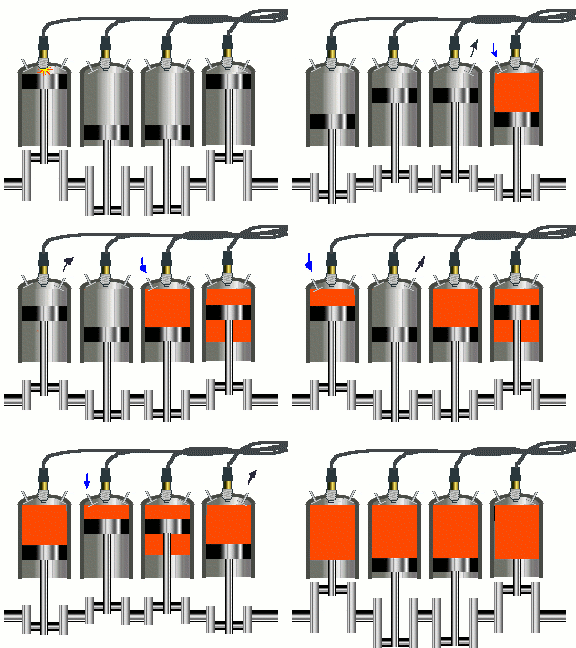
swept by all the piston
Piston
A piston is a component of reciprocating engines, reciprocating pumps, gas compressors and pneumatic cylinders, among other similar mechanisms. It is the moving component that is contained by a cylinder and is made gas-tight by piston rings. In an engine, its purpose is to transfer force from...
s inside the cylinders
Cylinder (engine)
A cylinder is the central working part of a reciprocating engine or pump, the space in which a piston travels. Multiple cylinders are commonly arranged side by side in a bank, or engine block, which is typically cast from aluminum or cast iron before receiving precision machine work...
of an internal combustion engine
Internal combustion engine
The internal combustion engine is an engine in which the combustion of a fuel occurs with an oxidizer in a combustion chamber. In an internal combustion engine, the expansion of the high-temperature and high -pressure gases produced by combustion apply direct force to some component of the engine...
in a single movement from top dead centre
Dead centre
In a reciprocating engine, the dead centre is the position of a piston in which it is farthest from, or nearest to, the crankshaft. The former is known as top dead centre while the latter is known as bottom dead centre ....
(TDC) to bottom dead centre (BDC). It is commonly specified in cubic centimeters (cc), litre
Litre
pic|200px|right|thumb|One litre is equivalent to this cubeEach side is 10 cm1 litre water = 1 kilogram water The litre is a metric system unit of volume equal to 1 cubic decimetre , to 1,000 cubic centimetres , and to 1/1,000 cubic metre...
s (l), or (mainly in North America) cubic inches (CID). Engine displacement does not include the total volume of the combustion chamber
Combustion chamber
A combustion chamber is the part of an engine in which fuel is burned.-Internal combustion engine:The hot gases produced by the combustion occupy a far greater volume than the original fuel, thus creating an increase in pressure within the limited volume of the chamber...
.
Definition
Engine displacement is determined from the bore and stroke of an engine's cylindersCylinder (engine)
A cylinder is the central working part of a reciprocating engine or pump, the space in which a piston travels. Multiple cylinders are commonly arranged side by side in a bank, or engine block, which is typically cast from aluminum or cast iron before receiving precision machine work...
. The bore is the diameter
Diameter
In geometry, a diameter of a circle is any straight line segment that passes through the center of the circle and whose endpoints are on the circle. The diameters are the longest chords of the circle...
of the circular chambers cut into the cylinder block
Cylinder block
A cylinder block is an integrated structure comprising the cylinder of a reciprocating engine and often some or all of their associated surrounding structures...
.

Examples: The 427 Chevy bore is 4.312 in, and the stroke is 3.65 in, therefore the displacement for this 8-cylinder engine is:
- 3.1416/4 * 4.3122 * 3.65 * 8 = 426.41380142592 CID.
If the bore is 10 cm and the stroke is 5 cm with 4 cylinders, the calculation is:
- 3.1416/4 * 102 * 5 * 4 = 1570 cm3 = 1.57 liters
Units of measure
In the United States, the cubic inch was the commonly used unit of measurement until the 1980s by the manufacturers to express the displacement of engines for cars, trucks, etc. (e.g., the "426" in 426 HEMI refers to 426 cubic inches displaced). It is still used for this purpose in the context of the classic-car hobby, auto racing, and so forth.The automotive industry nowadays uses the International System of Units / le Système international d'unités
International System of Units
The International System of Units is the modern form of the metric system and is generally a system of units of measurement devised around seven base units and the convenience of the number ten. The older metric system included several groups of units...
(SI), a modern metric system for this purpose worldwide (e.g. 6.1 litre
Litre
pic|200px|right|thumb|One litre is equivalent to this cubeEach side is 10 cm1 litre water = 1 kilogram water The litre is a metric system unit of volume equal to 1 cubic decimetre , to 1,000 cubic centimetres , and to 1/1,000 cubic metre...
HEMI). However, in markets accustomed to cubic inches, the actual displacement measurements of an engine are still given by many manufacturers in these units, usually along with metric value; e.g. the 6.1 litre HEMI's published displacement is 370.0 CID/6,059 cc. Some examples of common CID-to-litre conversions are given below. Note that nominal size
Nominal size
In manufacturing, a nominal size or trade size is a size "in name only" used for identification. The nominal size may not match any dimension of the product, but within the domain of that product the nominal size may correspond to a large number of highly standardized dimensions and tolerances.For...
s are not always precisely equal to actual sizes. This principle is frequently seen in engineering, tool standardization, etc. (for ease of use), and in marketing (when a big round number sounds more impressive, is more memorable, etc.).
| make (± division) | cubic inch displacement (CID) - (actual) (nearest 1) | cubic inch displacement (CID) - (nominal) | International System of Units International System of Units The International System of Units is the modern form of the metric system and is generally a system of units of measurement devised around seven base units and the convenience of the number ten. The older metric system included several groups of units... (SI) - (actual) (nearest 0.01) | International System of Units (SI) - (nominal) |
|---|---|---|---|---|
| Honda, Kawasaki, others | something close to 61 CID | N/A (not marketed in CID) | [something close to SI nominal] | 1000 cc (= 1.0 litre Litre pic|200px|right|thumb|One litre is equivalent to this cubeEach side is 10 cm1 litre water = 1 kilogram water The litre is a metric system unit of volume equal to 1 cubic decimetre , to 1,000 cubic centimetres , and to 1/1,000 cubic metre... ) |
| Honda, Kawasaki, others | something close to 98 CID | N/A (not marketed in CID) | [something close to SI nominal] | 1600 cc (= 1.6 litre) |
| Honda, Kawasaki, others; Ford | something close to 122 CID | N/A (not marketed in CID) | [something close to SI nominal] | 2000 cc (= 2.0 litre) |
| GM (Pontiac, Buick, Oldsmobile, GMC, others) | 151 CID | N/A (not marketed in CID) | [something close to SI nominal] | 2.5 litre GM Iron Duke engine Iron Dukes were fitted with fuel injection in 1982. This version was christened the Tech IV, though Car and Driver later ridiculed it as the low-Tech IV. Power output remained at .... |
| Toyota, Ford, Chrysler, others | something close to 183 CID | N/A (not marketed in CID) | [something close to SI nominal] | 3.0 litre |
| AMC, Jeep, Chrysler (I6) | 241.573 CID | 242 CID | 3,959 cc | 4.0 litre |
| Ford | something close to 244 CID | N/A (not marketed in CID) | [something close to SI nominal] | 4.0 litre |
| Ford (Ford, Mercury), GM (Chevrolet, GMC) | [something close to CID nominal] | 250 CID | 4.10 litre | 4.1 litre |
| AMC, Jeep, International Harvester | [something close to CID nominal] | 258 CID | 4.22 litre | 4.2 litre |
| GM (Chevrolet, GMC, Oldsmobile) | [something close to CID nominal] | 262 CID | 4.33 litre | 4.3 litre |
| Ford (Ford, Mercury) | [something close to CID nominal] | 289 CID Ford Windsor engine The Windsor is a 90-degree small-block V8 engine from Ford Motor Company. It was introduced in 1962, replacing the previous Ford Y-block engine. Though not all of the engines in this family were produced at the Windsor, Ontario engine plant , the name stuck... |
4.74 litre | N/A (not marketed in SI) |
| Ford (Ford trucks and vans) | [something close to CID nominal] | 300 CID | 4.92 litre | 4.9 litre |
| GM (Pontiac) | [something close to CID nominal] | 301 CID | 4.9 litre | N/A (not marketed in SI) |
| Ford, GM (Chevrolet) | [something close to CID nominal] | 302 CID (302 Windsor, 302 Cleveland, Chevrolet 302) | 4.95 litre | 5.0 litre |
| GM (Oldsmobile) | 303 CID | |||
| AMC, Jeep, International Harvester | [something close to CID nominal] | 304 CID | 4.98 litre | 5.0 litre |
| GM (Chevrolet, Pontiac, Oldsmobile, Buick) | [something close to CID nominal] | 305 CID | 5.0 litre | N/A (not marketed in S/I) |
| GM (Chevrolet; Buick) | 307 CID | 307 CID | 5.03 litre | N/A (not marketed in SI) |
| GM (Oldsmobile) | 307 CID | N/A (not marketed in CID) | 5.03 litre | 5.0 litre |
| Chrysler (Chrysler, Dodge, Plymouth) | [something close to CID nominal] | 318 CID Chrysler LA engine The LA engines are a family of pushrod OHV 90° V-block gasoline engines built by Chrysler Corporation and factory-installed in passenger vehicles, trucks and vans, commercial vehicles, marine and industrial applications from 1964 through 2003... |
5.21 litre | 5.2 litre |
| AMC, GM (Chevrolet) | 327 CID | 327 CID | 5.36 litre | N/A (not marketed in SI) |
| GM (Oldsmobile) | 330 CID | |||
| Buick, Chrysler (Chrysler, Dodge, Plymouth) | [something close to CID nominal] | 340 CID Chrysler LA engine The LA engines are a family of pushrod OHV 90° V-block gasoline engines built by Chrysler Corporation and factory-installed in passenger vehicles, trucks and vans, commercial vehicles, marine and industrial applications from 1964 through 2003... |
5.57 litre | N/A (not marketed in SI) |
| GM (GMC, Chevrolet, Buick, Oldsmobile, Pontiac, others) | [something close to CID nominal] | 350 CID | 5.74 litre | 5.7 litre |
| Ford (Ford, Mercury) | [something close to CID nominal] | 351 CID (Cleveland Ford 335 engine The Ford 335 engine family were a group of small-block V8 engines built by the Ford Motor Company between 1970 and 1985. The significance of the Numerals '335' designated to this series of Small block Ford V8 engines is relatively unknown... or Windsor Ford Windsor engine The Windsor is a 90-degree small-block V8 engine from Ford Motor Company. It was introduced in 1962, replacing the previous Ford Y-block engine. Though not all of the engines in this family were produced at the Windsor, Ontario engine plant , the name stuck... ) |
5.75 litre | 5.8 litre |
| AMC, Chrysler (Chrysler, Dodge, Plymouth) | [something close to CID nominal] | 360 CID Chrysler LA engine The LA engines are a family of pushrod OHV 90° V-block gasoline engines built by Chrysler Corporation and factory-installed in passenger vehicles, trucks and vans, commercial vehicles, marine and industrial applications from 1964 through 2003... |
5.90 litre | 5.9 litre |
| Chrysler (Chrysler, Dodge, Plymouth) | [something close to CID nominal] | 383 CID | 6.28 litre | N/A (not marketed in SI) |
| GM (Pontiac) | [something close to CID nominal] | 389 CID | 6.5 litre | N/A (not marketed in SI) |
| AMC, Ford, GM (Cadillac) | [something close to CID nominal] | 390 CID | 6.39 litre | N/A (not marketed in SI) |
| GM (Oldsmobile) | 394 CID | |||
| GM (Chevrolet) | [sometimes 396 CID, sometimes 402 CID] | 396 CID | 6.49 litre | N/A (not marketed in SI) |
| GM (Chevrolet, Pontiac, Oldsmobile) | [something close to CID nominal] | 400 CID | 6.55 litre | N/A (not marketed in SI) |
| GM (Buick) | 401 CID | |||
| GM (Chevrolet) | [something close to CID nominal] | 409 CID | 6.70 litre | N/A (not marketed in SI) |
| GM (Pontiac) | [something close to CID nominal] | 421 CID | 6.90 litre | N/A (not marketed in SI) |
| GM (Oldsmobile) | 425 CID | |||
| Chrysler (Chrysler, Dodge, Plymouth) | [something close to CID nominal] | 426 CID (Wedge or Hemi Chrysler Hemi engine The Chrysler Hemi engine, known by the trademark Hemi, is a series of V8 engines built by Chrysler with a hemispherical combustion chamber. Three different types of Hemi engines have been built by Chrysler for automobiles: the first from 1951–1958, the second from 1964–1971, and the third... ) |
6.98 litre | 7.0 litre |
| Ford (Ford, Mercury) | [something close to CID nominal] | 427 CID Ford FE engine The Ford FE engine is a Ford V8 engine used in vehicles sold in the North American market between 1958 and 1976. A related engine, the Ford FT engine, was used in medium and heavy trucks from 1964 through 1978. The FE filled the need for a medium-displacement engine created by the discontinuation... |
7.00 litre | 7.0 litre |
| GM (Pontiac),Ford (Ford, Mercury) | [something close to CID nominal] | 428 CID Ford FE engine The Ford FE engine is a Ford V8 engine used in vehicles sold in the North American market between 1958 and 1976. A related engine, the Ford FT engine, was used in medium and heavy trucks from 1964 through 1978. The FE filled the need for a medium-displacement engine created by the discontinuation... |
7.01 litre | 7.0 litre |
| Ford (Ford, Mercury) | [something close to CID nominal] | 429 CID Ford 385 engine The Ford 385 engine family was the Ford Motor Company's final big block V8 engine design, replacing the Ford MEL engine and gradually superseding the Ford FE engine family... |
7.03 litre | 7.0 litre |
| Chrysler (Chrysler, Dodge, Plymouth) | [something close to CID nominal] | 440 CID | 7.21 litre | 7.2 litre |
| GM (GMC, Chevrolet) | [something close to CID nominal] | 454 CID | 7.44 litre | 7.4 litre |
| GM (Buick, Oldsmobile, Pontiac) | [something close to CID nominal] | 455 CID | 7.46 litre | N/A (not marketed in SI) |
| Ford (Ford [trucks and vans]; Lincoln [cars]) | [something close to CID nominal] | 460 CID Ford FE engine The Ford FE engine is a Ford V8 engine used in vehicles sold in the North American market between 1958 and 1976. A related engine, the Ford FT engine, was used in medium and heavy trucks from 1964 through 1978. The FE filled the need for a medium-displacement engine created by the discontinuation... |
7.54 litre | 7.5 litre |
| GM (Cadillac) | [something close to CID nominal] | 472 CID | 7.73 litre | 7.7 litre |
| GM (Cadillac) | [something close to CID nominal] | 500 CID | 8.19 litre | 8.2 litre |
| Chrysler (Dodge) | 506.5 CID | 505 CID | 8285 cc | 8.3 litre |
| Chrysler (Dodge) | 509.8 CID | 510 CID | 8354 cc | 8.4 litre |
| GM (GM Performance Parts) | [something close to CID nominal] | 572 CID | 9373 cc | 9.4 litre |
Governmental regulations
Taxation of automobiles is sometimes based on engine displacement, rather than the actual power output. Displacement is a basic fundamental of engine design, whereas power output depends a great deal on other factors, particularly on how the car manufacturer has tunedEngine tuning
Engine tuning is the adjustment, modification or design of internal combustion engines to yield optimal performance, to increase an engine's power output, economy, or durability....
the engine from new. This has encouraged the development of other methods to increase engine power, such as variable valve timing
Variable valve timing
In internal combustion engines, variable valve timing , also known as Variable valve actuation , is a generalized term used to describe any mechanism or method that can alter the shape or timing of a valve lift event within an internal combustion engine...
and turbocharger
Turbocharger
A turbocharger, or turbo , from the Greek "τύρβη" is a centrifugal compressor powered by a turbine that is driven by an engine's exhaust gases. Its benefit lies with the compressor increasing the mass of air entering the engine , thereby resulting in greater performance...
s.
There are four major regulatory constraints for automobiles: the European, British, Japanese, and American. The method used in some European countries, and which predates the EU, has a level of taxation for engines over one 1.0 litre, and another at the level of about 1.6 litres. The British system of taxation depends upon vehicle emissions for cars registered after 1 March 2001, but for cars registered before this date, it depends on engine size. Cars under 1549 cc qualify for a cheaper rate of tax.
The Japanese method is similar to the European taxation by classes of displacement, plus a vehicle weight tax.
The United States does not tax a vehicle based on the displacement of the engine (this is also true in Canada, Australia, and New Zealand). Engine displacement is important in determining whether or not smaller vehicles need to be registered with the state and whether or not a license is required to operate such a vehicle. A common threshold is 50cc.
In the Netherlands and in Sweden, road tax is based on vehicle weight. However, Swedish cars registered in 2008, or later, are taxed based on carbon dioxide emissions.
Displacement is also used to distinguish categories of (heavier) and lighter motorbikes with respect to driving licence and insurance requirements. In France and some other EU countries, moped
Moped
Mopeds are a type of low-powered motorcycle designed to provide economical and relatively safe transport with minimal licensing requirements.Mopeds were once all equipped with bicycle-like pedals , but moped has been increasingly applied by governments to vehicles without pedals, based on their...
s of less than 50 cm3 displacement (and usually with a two-stroke engine), can be driven with minimum qualifications (previously, they could be driven by any person over 14). This led to all light motorbikes having a displacement of about 49.9 cm3. Some people tuned the engine by increasing the cylinder bore, increasing displacement; such mopeds cannot be driven legally on public roads since they do no longer conform to the original specifications and may go faster than 45 km/h.
Wankel engine
Wankel engine
The Wankel engine is a type of internal combustion engine using an eccentric rotary design to convert pressure into a rotating motion instead of using reciprocating pistons. Its four-stroke cycle takes place in a space between the inside of an oval-like epitrochoid-shaped housing and a rotor that...
s, due to the amount of power and emissions they create for their displacement, are generally taxed as 1.5 times their stated physical displacement (1.3 litres becomes effectively 2.0, 2.0 becomes effectively 3.0), although actual power outputs are far greater (the 1.3 litre 13B can produce power comparable to a 3.0 V6 engine
V6 engine
A V6 engine is a V engine with six cylinders mounted on the crankcase in two banks of three cylinders, usually set at either a right angle or an acute angle to each other, with all six pistons driving a common crankshaft...
, and the 2.0 litre 20B can produce power comparable to a 4.0 V8 engine
V8 engine
A V8 engine is a V engine with eight cylinders mounted on the crankcase in two banks of four cylinders, in most cases set at a right angle to each other but sometimes at a narrower angle, with all eight pistons driving a common crankshaft....
). As such, racing regulations actually use a much higher conversion factor.
Automotive model names
In the automotive industry, engine displacement is frequently encoded in the auto manufacturer's model names. For instance, Nissan's Teana 350JMNissan Teana
The Nissan Teana is a luxury mid-size car produced by Nissan of Japan, introduced in 2003. It is exported as the Nissan Maxima and Nissan Cefiro to certain markets, not to be confused with the Nissan Maxima sold in North America with which it shares a platform .It is also exported to Mauritius as...
is a car with a 3498 cc (213.5 cubic inch displacement (CID))]] engine). Motorcycles are often labeled similarly. However, this can be misleading. For instance, the BMW 335i only has a 3.0 litre (turbocharged) engine. Lexus hybrid vehicles (h) are marked higher than its engine size to signify the extra power from its auxiliary systems. (Examples: RX450h has a 3.5L engine, LS600h has a 5.0 engine)
See also
- Active Fuel ManagementActive Fuel ManagementActive Fuel Management is a trademarked name for the automobile variable displacement technology from General Motors. It allows a V6 or V8 engine to "turn off" half of the cylinders under light-load conditions to improve fuel economy...
- compression ratioCompression ratioThe 'compression ratio' of an internal-combustion engine or external combustion engine is a value that represents the ratio of the volume of its combustion chamber from its largest capacity to its smallest capacity...
- engine tuningEngine tuningEngine tuning is the adjustment, modification or design of internal combustion engines to yield optimal performance, to increase an engine's power output, economy, or durability....
- variable displacementVariable displacementVariable displacement is an automobile engine technology that allows the engine displacement to change, usually by deactivating cylinders, for improved fuel economy. The technology is primarily used in large, multi-cylinder engines...