

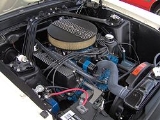
Ford 335 engine

Encyclopedia
The Ford 335 engine
family were a group of small-block V8 engines built by the Ford Motor Company
between 1970 and 1985. The significance of the Numerals '335' designated to this series of Small block Ford V8 engines is relatively unknown. Conjecture relating to this designation revolves around a prototype 335 CID (Cubic Inch Displacement) engine Ford developed for the Marine industry; to design a V8 motor eliminating the need for water to pass through the inlet manifold and to delete the need for a separate cam timing cover. The series was nicknamed Cleveland after the Cleveland, Ohio
engine plant
in which most were manufactured. The 335 was used as an option in mid-sized vehicles and trucks concurrently with the larger 351 member of the Windsor small-block family
as well as the mid-sized FE V8 family
. Although all three of these engine families continued in production the Cleveland, only outliving the FE by a half-decade, was eventually abandoned in favor of the more compact Windsor design.
A differentiation between the Windsor and Cleveland series are the location of the radiator hose — the Windsor routed coolant through the intake manifold, with the hose protruding horizontally, while the Cleveland had a dry manifold with the radiator hose connecting vertically to the cylinder block above the cam timing chain cover.
Inside the block, large main bearing caps are specified for durability, allowing 4-bolt mains on some engines. The 335 oiling system has been widely criticized because of its 'non main priority' schematic; however, for all but the highest level of performance applications, it has not proven any less reliable than the Windsor line.
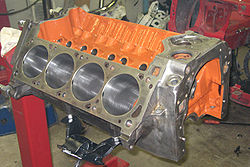
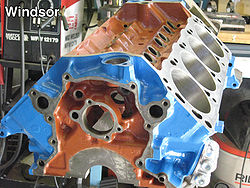
The 351 Cleveland was introduced in 1969 as Ford's new performance car engine and was built through the end of the 1974 model year. It incorporated elements learned on the 385 big-block
series and the Boss 302
, particularly the poly-angle combustion chambers with canted valves and the thin-wall casting technology.
Both a 4V (4-barrel carburetor) performance version and a 2V (2-barrel carburetor) basic version were built, both with 2 valves per cylinder. The latter had a different cylinder head with smaller valves, smaller ports, and open combustion chambers to suit its intended applications.
Only the Q-code 351 "Cobra Jet" (1971–1974), R-code "Boss" 351 (1971), and R-code 351 "HO" (1972) versions have 4-bolt mains although all 335 series engines (351C/351M/400) have provision for them. The main difference between 351C/351M/400 engines is connecting rod length and main bearing size. The 351M/400 engines have the largest bearing size and the tallest deck height while sharing the 429/460 bell housing
pattern. The 351C engine has a medium main bearing size (2.75") and shorter connecting rods (5.78") than the 351W (5.94") and the 351M/400 (6.58") while retaining the SBF (289-302w) engine mount locations and bell housing pattern. The 400 engine has the longest stroke (4.00") of any SBF or 335 series engine.
All of the 351C and 351M/400 engines differ from the 302/351W by having an integrated timing cover casting in the front of the block to which the radiator hose connects.
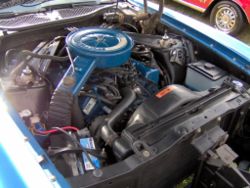 The majority of 351 Cleveland engines are H-code 2V (2-venturi carburetor) versions with low compression. They were produced from 1970 through 1974 and were used on a variety of Ford models, from ponycar to fullsize.
Ford owner's manuals for these engines recommended high octane gasoline (100+ octane in 1970) which was at the high end of the leaded gasoline available at the time. However, with the mid-1970s introduction of unleaded gasoline and lower octane ratings, and subsequent disappearance of the super high octane leaded fuels required to power these high compression engines, motorists were either unaware of potential damage or simply unable to find this kind of fuel any more. As a consequence, many of these otherwise durable engines met with an early demise due to the destructive effects of severe engine knocking
caused by using low octane fuel.
, constructed from high-strength nodular iron. The cylinder head
was modified for better airflow and solid lifters. The forged connecting rod
s were shot-peened and magnaflux
ed for strength, and used stronger bolts/nuts. Forged
domed piston
s gave a 11.3:1 nominal (11.1:1 advertised) compression ratio
. 1806 Boss 351 Mustangs were produced by Ford in 1971, 591 of which are registered and accounted for on the Boss 351 Registry site. The engine, like most Ford engines, was underrated. In the January 2010 issue of Hot Rod Magazine, they built a Boss 351 to exact specs of an original motor. It produced 383 hp at 6,100 rpm, and 391 lbft torque at 4,000 rpm.
and 248 hp in the Ford Torino
and Mercury Montego
. The horsepower rating dropped in 1973 to 246 hp for the 4-barrel for the intermediate Fords, and still retained the higher 266 hp rating in the Mustang. The 351 CJ (now referred to simply as the "351 4V") was rated at 255 hp in 1974 and was only installed in the Ford Ranchero
, Ford Torino
, Mercury Montego
and the Mercury Cougar
.
This engine was built only in Australia from 1972 to 1982, and was intended to give their consumers a smaller capacity alternative to the Geelong built 351 Cleveland, as Ford Australia inherited the patterns, molds and tooling for the 'Cleveland' it was a viable alternative to importing the 302 Windsor. Using a locally reproduced 351 Cleveland block (1972-1985), 302 cu in (4.9 L) was attained by reducing the stroke of the 351C from 3.5 to 3.0 inches (89 to 76 mm) and increasing the connecting rod length from 5.780" to 6.030". Additionally, the 302C cylinder heads were redesigned locally, with smaller combustion chamber(from 72cc to 58cc), to compensate for the reduced stroke of the engine.
The combination of closed combustion chambered quench heads with smaller 2 barrel style ports made a more powerful setup known in the USA as "Australian Cleveland heads". These heads interchange directly onto 351C engines, and are somewhat sought after outside of Australia as a low-cost method to increase compression ratio. They are a good street alternative to the over ported 4 barrel heads. Using the 302C cylinder heads on an otherwise unmodified 351C may increase the compression ratio beyond a safe level for regular pump fuel. Using the small chamber 302C cylinder heads properly requires engine design checks (deck clearance, piston design, camshaft specifications), all optimized for the intended use.
Even though the 302C was not made in Cleveland Ohio, (but in Geelong, Victoria. Australia) the engine has been affectionately referred to as the 302C. Ford engine suffixes are confusing enough, to say the least, so to keep it simple call it what it looks like: a 'Cleveland', as apposed to a 'Geelong'. The last 302C was installed into an Ford XE Falcon
Fairmont Ghia ESP Vehicle Identification Number
JG32AR33633K in November 1982. Ford Australia contuniued to use the 302 and 351 cleveland in the 4x4 Bronco range and in F-series ambulances until some time in 1985.
was getting outdated, and the 385 family
could not meet the efficiency requirements of the time. At the same time, the small-block Windsor engines
were too small and high-revving for Ford's fullsize car and truck applications. So the company went to work on a new small-block to meet the desired levels of economy while still providing the kind of big-block torque that was needed to move 2+ ton vehicles.
The Ford 400 engine was based on the 351 Cleveland but was produced with a taller deck height of 10.297 inches compared to the 351C's 9.206 inches. This allowed for a longer stroke while retaining the 351C's rod-stroke ratio. These blocks also share the same oiling route in the block. The 400 also featured larger (Windsor sized 3.00 inch with Cleveland cap register) main-bearing journals and had "square
" proportions, with a 4.0 in (102 mm) bore and stroke; it therefore displaced
402 cu in (6.6 L), making it the largest small-block V8 made at that time. It was introduced in model year
1971 with a full half-inch (12.7 mm) longer stroke than the 351 Cleveland, making it the longest-stroke Ford pushrod V8 engine. A long-stroke engine has good low-end torque. This was a good compromise given Ford's requirement for an engine to power heavier mid-size and full-size cars and light trucks. The M-block, as it later became known, was the last pushrod V8 block designed by Ford. The M-block also shares some elements with the Windsor engine family: bore spacing, cylinder head bolt-patterns and crankshaft journal dimensions.
The 400 was seen as a smaller and lighter replacement for the big Ford 385 engine
s, the 429 and 460, in Ford's big cars. Weighing just 80% of a similar big block, it was originally available in Ford's Custom
, Galaxie
and LTD
lines, and in Mercury
Monterey
, Marquis
, and Brougham
. Later, it would power the Ford Thunderbird
, the Lincoln
Continental
, Mark V
, mid-size Fords and Mercurys, and Ford light-duty trucks.
The vast majority of 400 blocks use the same bellhousing bolt pattern as the 385 family
big-block to make it compatible with the higher torque-capacity C6 transmission
used on the large cars and trucks. There were a small number of 400 block castings that use dual bellhousing patterns for mounting an FMX transmission. These castings are rare. The 400 was modified in 1975 to use unleaded gasoline.
When the 351 Cleveland was withdrawn after the end of the 1974 model year, Ford needed another engine in the 351 cubic inch (5.8 L) class, since production of the 351 Windsor was not sufficient and the 390 FE was being retired as well. To replace the 390, Ford took the 400 engine's tall-deck block and de-stroked it with the shorter throw crankshaft
from the 351 Windsor, and taller piston
s, to produce a 351 cubic inch (5.8 L) engine whose components were largely compatible with the 400. This engine was called the 351M and as a back-formation the taller-deck block became known as the M-block.
The M designation is commonly referred to “Modified”, and is derived from the use of both "Cleveland" (block, heads) and "Windsor" (crankshaft) components in the same engine, a modification for the parts' intended application, so to speak.
Another origin of the M designation may have come from where the engine blocks were cast. It follows the naming convention set forth by the 351C (Cleveland) cast at the Cleveland Foundry and 351W (Windsor) where the majority of the blocks were cast at the Windsor Casting Plant. From the introduction in the model year 1975, the 351M engine blocks (which are the same as the 400 engine block) were all produced at the Michigan Casting Center (MCC) in Flat Rock, MI or at the Cleveland Foundry (CF) also known as the Cleveland Casting Plant (CCP). To help distinguish it from the other two different 351s, the logical choice was to use the Michigan Casting Center, hence the “M” designation for 351 Michigan.
The 351 Cleveland had a well known, good reputation in the public. For a few of years after the introduction of the 351M, Ford marketing called the engine the "351 Cleveland". This led to confusion as to what 351 version was actually in the vehicle.
Later, car enthusiasts incorrectly referred to this engine as a "351 Midland" presumably a reference to Midland, Michigan, a city just northwest of Saginaw or reference to an iron foundry in Midland, Texas. But the Ford Motor Company never owned a “Midland” factory.
, Ford decided to replace its aging FE
big-block 360 and 390 engines in its light truck line with its new 351M and 400 engines. For light truck use, beefed-up blocks were designed. These enhancements were added to all M-block engines starting with the 1978 model year.
, but this was all built in to the M-block engine.
This all made adapting the M-block to the second generation of emissions control equipment harder. One requirement of the second-generation equipment was an oxygen (O2) sensor in the exhaust, which had to be placed before the Thermactor air was added. Since Thermactor air was injected right into the block's exhaust ports in the M-block, there was nowhere for the O2 sensor to go.
It would have been possible to alter the M-block to work, but it would have required significant effort and cost. Ford decided to simply scrap the M-block engines and replace them with updated 351 Windsor engines at the small end, and a combination of the 6.9 L Navistar International
diesel and the 460 at the top end. Sales of the M-block ended in 1982.
Internal combustion engine
The internal combustion engine is an engine in which the combustion of a fuel occurs with an oxidizer in a combustion chamber. In an internal combustion engine, the expansion of the high-temperature and high -pressure gases produced by combustion apply direct force to some component of the engine...
family were a group of small-block V8 engines built by the Ford Motor Company
Ford Motor Company
Ford Motor Company is an American multinational automaker based in Dearborn, Michigan, a suburb of Detroit. The automaker was founded by Henry Ford and incorporated on June 16, 1903. In addition to the Ford and Lincoln brands, Ford also owns a small stake in Mazda in Japan and Aston Martin in the UK...
between 1970 and 1985. The significance of the Numerals '335' designated to this series of Small block Ford V8 engines is relatively unknown. Conjecture relating to this designation revolves around a prototype 335 CID (Cubic Inch Displacement) engine Ford developed for the Marine industry; to design a V8 motor eliminating the need for water to pass through the inlet manifold and to delete the need for a separate cam timing cover. The series was nicknamed Cleveland after the Cleveland, Ohio
Cleveland, Ohio
Cleveland is a city in the U.S. state of Ohio and is the county seat of Cuyahoga County, the most populous county in the state. The city is located in northeastern Ohio on the southern shore of Lake Erie, approximately west of the Pennsylvania border...
engine plant
Cleveland Engine
Cleveland Engine is a Ford Motor Company engine manufacturing facility in Brook Park, Ohio, United States, a suburb of Cleveland.Opened in 1951, Cleveland Engine Plant number 1 was the site of production for Ford's first overhead valve engine, the Lincoln V8. It was later the site of production...
in which most were manufactured. The 335 was used as an option in mid-sized vehicles and trucks concurrently with the larger 351 member of the Windsor small-block family
Ford Windsor engine
The Windsor is a 90-degree small-block V8 engine from Ford Motor Company. It was introduced in 1962, replacing the previous Ford Y-block engine. Though not all of the engines in this family were produced at the Windsor, Ontario engine plant , the name stuck...
as well as the mid-sized FE V8 family
Ford FE engine
The Ford FE engine is a Ford V8 engine used in vehicles sold in the North American market between 1958 and 1976. A related engine, the Ford FT engine, was used in medium and heavy trucks from 1964 through 1978. The FE filled the need for a medium-displacement engine created by the discontinuation...
. Although all three of these engine families continued in production the Cleveland, only outliving the FE by a half-decade, was eventually abandoned in favor of the more compact Windsor design.
Overview
The 335 series, although sharing the same bore spacing and cylinder head bolt pattern, was very different internally from the somewhat similar-looking Windsor series. The 335 Cleveland used smaller 14 mm spark plugs in one of two different cylinder heads, both with 2 valves per cylinder. The '4V' heads had massive ports and valves compared to the '2V'. Both had the valves canted to the sides in a "poly-angle". The '2V' head had a open, almost hemispherical shaped combustion chamber while the '4V' sported a Quench type combustion chamber. The Cleveland has a very square type rocker cover while the Windsor has a more rounded end cover. All 335 covers are secured with 8 bolts, as opposed to 6 on the Windsor.A differentiation between the Windsor and Cleveland series are the location of the radiator hose — the Windsor routed coolant through the intake manifold, with the hose protruding horizontally, while the Cleveland had a dry manifold with the radiator hose connecting vertically to the cylinder block above the cam timing chain cover.
Inside the block, large main bearing caps are specified for durability, allowing 4-bolt mains on some engines. The 335 oiling system has been widely criticized because of its 'non main priority' schematic; however, for all but the highest level of performance applications, it has not proven any less reliable than the Windsor line.
351 Cleveland
| Code | Engine type | Years | Compression | Notes |
|---|---|---|---|---|
| H | 351C-2V | 1970–1974 | Low | |
| M | 351C-4V | 1970–1971 | High | |
| R | 351C-4V "Boss 351" | 1971 | High | Rare, solid lifters |
| R | 351C-4V HO | 1972 | Low | Very rare, solid lifters, open chamber |
| Q | 351C-4V "Cobra-Jet" | May 1971-1974 | Low | , open chamber |
- See also the Cleveland-derived Boss 351 and quite different 351 "Windsor"
The 351 Cleveland was introduced in 1969 as Ford's new performance car engine and was built through the end of the 1974 model year. It incorporated elements learned on the 385 big-block
Ford 385 engine
The Ford 385 engine family was the Ford Motor Company's final big block V8 engine design, replacing the Ford MEL engine and gradually superseding the Ford FE engine family...
series and the Boss 302
Ford Boss 302 engine
The Boss 302 engine is a high-performance small-block V8 from Ford Motor Company. It was a hybrid of small-block Ford V8s - It used the block of the small Ford Windsor engine and the heads of the larger Ford Cleveland engine...
, particularly the poly-angle combustion chambers with canted valves and the thin-wall casting technology.
Both a 4V (4-barrel carburetor) performance version and a 2V (2-barrel carburetor) basic version were built, both with 2 valves per cylinder. The latter had a different cylinder head with smaller valves, smaller ports, and open combustion chambers to suit its intended applications.
Only the Q-code 351 "Cobra Jet" (1971–1974), R-code "Boss" 351 (1971), and R-code 351 "HO" (1972) versions have 4-bolt mains although all 335 series engines (351C/351M/400) have provision for them. The main difference between 351C/351M/400 engines is connecting rod length and main bearing size. The 351M/400 engines have the largest bearing size and the tallest deck height while sharing the 429/460 bell housing
Bell housing
"Bell housing" is a colloquial/slang term for the portion of the transmission that covers the flywheel and the clutch or torque converter of the transmission on vehicles powered by internal combustion engines. This housing is bolted to the engine block and derives its name from the bell-like...
pattern. The 351C engine has a medium main bearing size (2.75") and shorter connecting rods (5.78") than the 351W (5.94") and the 351M/400 (6.58") while retaining the SBF (289-302w) engine mount locations and bell housing pattern. The 400 engine has the longest stroke (4.00") of any SBF or 335 series engine.
All of the 351C and 351M/400 engines differ from the 302/351W by having an integrated timing cover casting in the front of the block to which the radiator hose connects.
H-code
M-code
The 351C 4V engines produced in 1970 and 1971 used this code. Engines varied in compression ratio; 1970 engines were 11.0:1 compression and produced 300 bhp at 5400 rpm, while 1971 versions had a slightly lower compression ratio of 10.7:1, and a reduced power output of 285 bhp at 5400 rpm.Ford owner's manuals for these engines recommended high octane gasoline (100+ octane in 1970) which was at the high end of the leaded gasoline available at the time. However, with the mid-1970s introduction of unleaded gasoline and lower octane ratings, and subsequent disappearance of the super high octane leaded fuels required to power these high compression engines, motorists were either unaware of potential damage or simply unable to find this kind of fuel any more. As a consequence, many of these otherwise durable engines met with an early demise due to the destructive effects of severe engine knocking
Engine knocking
Knocking in spark-ignition internal combustion engines occurs when combustion of the air/fuel mixture in the cylinder starts off correctly in response to ignition by the spark plug, but one or more pockets of air/fuel mixture explode outside the envelope of the normal combustion front.The...
caused by using low octane fuel.
1971 R-code (Boss 351)
The Boss 351 is a high-performance variant available only in the 1971 Boss 351 Mustang. Rated at around 330 hp (246 kW), it was fitted with a four-barrel Autolite spreadbore carburetor, an aluminum intake manifold, and aluminum valve covers. It had four-bolt main block/caps and a premium crankshaftCrankshaft
The crankshaft, sometimes casually abbreviated to crank, is the part of an engine which translates reciprocating linear piston motion into rotation...
, constructed from high-strength nodular iron. The cylinder head
Cylinder head
In an internal combustion engine, the cylinder head sits above the cylinders on top of the cylinder block. It closes in the top of the cylinder, forming the combustion chamber. This joint is sealed by a head gasket...
was modified for better airflow and solid lifters. The forged connecting rod
Connecting rod
In a reciprocating piston engine, the connecting rod or conrod connects the piston to the crank or crankshaft. Together with the crank, they form a simple mechanism that converts linear motion into rotating motion....
s were shot-peened and magnaflux
Magnaflux
Magnetic Particle Inspection , developed originally by Alfred Victor de Forest and Foster Baird Doane, and developed further with the assistance of Carl E. Betz, is a method of testing ferrous metals for surface and subsurface flaws. The component being tested must be made of a ferromagnetic...
ed for strength, and used stronger bolts/nuts. Forged
Forging
Forging is a manufacturing process involving the shaping of metal using localized compressive forces. Forging is often classified according to the temperature at which it is performed: '"cold," "warm," or "hot" forging. Forged parts can range in weight from less than a kilogram to 580 metric tons...
domed piston
Piston
A piston is a component of reciprocating engines, reciprocating pumps, gas compressors and pneumatic cylinders, among other similar mechanisms. It is the moving component that is contained by a cylinder and is made gas-tight by piston rings. In an engine, its purpose is to transfer force from...
s gave a 11.3:1 nominal (11.1:1 advertised) compression ratio
Compression ratio
The 'compression ratio' of an internal-combustion engine or external combustion engine is a value that represents the ratio of the volume of its combustion chamber from its largest capacity to its smallest capacity...
. 1806 Boss 351 Mustangs were produced by Ford in 1971, 591 of which are registered and accounted for on the Boss 351 Registry site. The engine, like most Ford engines, was underrated. In the January 2010 issue of Hot Rod Magazine, they built a Boss 351 to exact specs of an original motor. It produced 383 hp at 6,100 rpm, and 391 lbft torque at 4,000 rpm.
1972 R-code
The R-code 351 Cleveland HO for 1972 was considerably different. The timing was changed to decrease compression for emissions compliance and used open-chamber heads. It had a solid lifter camshaft, however a four barrel carburetor was retained. It produced 275 hp (205 kW) using the new SAE net system.Q-code (Cobra-Jet)
The Q-code "351 Cobra Jet" version was produced from May 1971 through the 1974 model year. It was a low-compression design that included open-chamber "4V" heads, a special intake manifold, special hi-lift long duration hydraulic camshaft, special valve springs and dampers, a 750 CFM 4300-D Motorcraft Carburetor, dual-point distributor, and 4-bolt main bearing caps. It was rated at 280 bhp for all 1971 applications; 266 hp (SAE net) for 1972 when installed in the MustangFord Mustang
The Ford Mustang is an automobile manufactured by the Ford Motor Company. It was initially based on the second generation North American Ford Falcon, a compact car. Introduced early on April 17, 1964, as a "1964½" model, the 1965 Mustang was the automaker's most successful launch since the Model A...
and 248 hp in the Ford Torino
Ford Torino
The Ford Torino is an intermediate automobile produced by the Ford Motor Company for the North American market between 1968 and 1976. The car was named after the city of Turin , which is considered the Detroit of Italy...
and Mercury Montego
Mercury Montego
The Mercury Montego was a mid-size vehicle in the Mercury line of Ford Motor Company from 1968 to 1976. The namplate first appeared in 1967 in Canada as part of the Mercury-derived Meteor line. After 1976, the basic design of the Montego was updated and the nameplate disappeared as the Cougar...
. The horsepower rating dropped in 1973 to 246 hp for the 4-barrel for the intermediate Fords, and still retained the higher 266 hp rating in the Mustang. The 351 CJ (now referred to simply as the "351 4V") was rated at 255 hp in 1974 and was only installed in the Ford Ranchero
Ford Ranchero
The Ford Ranchero was a coupe utility produced between 1957 and 1979. Unlike a pickup truck, the Ranchero was adapted from a two-door station wagon platform that integrated the cab and cargo bed into the body. A total of 508,355 units were produced during the model's production run...
, Ford Torino
Ford Torino
The Ford Torino is an intermediate automobile produced by the Ford Motor Company for the North American market between 1968 and 1976. The car was named after the city of Turin , which is considered the Detroit of Italy...
, Mercury Montego
Mercury Montego
The Mercury Montego was a mid-size vehicle in the Mercury line of Ford Motor Company from 1968 to 1976. The namplate first appeared in 1967 in Canada as part of the Mercury-derived Meteor line. After 1976, the basic design of the Montego was updated and the nameplate disappeared as the Cougar...
and the Mercury Cougar
Mercury Cougar
The Mercury Cougar is an automobile which was sold under the Mercury brand of the Ford Motor Company's Lincoln-Mercury Division from 1967 to 2002. The name was first used in 1967 and was carried by a diverse series of cars over the next three decades. As is common with Mercury vehicles, the Cougar...
.
302 Cleveland
- Note that there was also a 302 "Windsor"
This engine was built only in Australia from 1972 to 1982, and was intended to give their consumers a smaller capacity alternative to the Geelong built 351 Cleveland, as Ford Australia inherited the patterns, molds and tooling for the 'Cleveland' it was a viable alternative to importing the 302 Windsor. Using a locally reproduced 351 Cleveland block (1972-1985), 302 cu in (4.9 L) was attained by reducing the stroke of the 351C from 3.5 to 3.0 inches (89 to 76 mm) and increasing the connecting rod length from 5.780" to 6.030". Additionally, the 302C cylinder heads were redesigned locally, with smaller combustion chamber(from 72cc to 58cc), to compensate for the reduced stroke of the engine.
The combination of closed combustion chambered quench heads with smaller 2 barrel style ports made a more powerful setup known in the USA as "Australian Cleveland heads". These heads interchange directly onto 351C engines, and are somewhat sought after outside of Australia as a low-cost method to increase compression ratio. They are a good street alternative to the over ported 4 barrel heads. Using the 302C cylinder heads on an otherwise unmodified 351C may increase the compression ratio beyond a safe level for regular pump fuel. Using the small chamber 302C cylinder heads properly requires engine design checks (deck clearance, piston design, camshaft specifications), all optimized for the intended use.
Even though the 302C was not made in Cleveland Ohio, (but in Geelong, Victoria. Australia) the engine has been affectionately referred to as the 302C. Ford engine suffixes are confusing enough, to say the least, so to keep it simple call it what it looks like: a 'Cleveland', as apposed to a 'Geelong'. The last 302C was installed into an Ford XE Falcon
Ford XE Falcon
The Ford XE Falcon is a car which was produced by the Ford Motor Company of Australia between 1982 and 1984. Introduced on 11 March 1982, the XE was a revised version of the XD Falcon, which it replaced...
Fairmont Ghia ESP Vehicle Identification Number
Vehicle identification number
A Vehicle Identification Number, commonly abbreviated to VIN, is a unique serial number used by the automotive industry to identify individual motor vehicles. VINs were first used in 1954...
JG32AR33633K in November 1982. Ford Australia contuniued to use the 302 and 351 cleveland in the 4x4 Bronco range and in F-series ambulances until some time in 1985.
400
The big-block FE engine familyFord FE engine
The Ford FE engine is a Ford V8 engine used in vehicles sold in the North American market between 1958 and 1976. A related engine, the Ford FT engine, was used in medium and heavy trucks from 1964 through 1978. The FE filled the need for a medium-displacement engine created by the discontinuation...
was getting outdated, and the 385 family
Ford 385 engine
The Ford 385 engine family was the Ford Motor Company's final big block V8 engine design, replacing the Ford MEL engine and gradually superseding the Ford FE engine family...
could not meet the efficiency requirements of the time. At the same time, the small-block Windsor engines
Ford Windsor engine
The Windsor is a 90-degree small-block V8 engine from Ford Motor Company. It was introduced in 1962, replacing the previous Ford Y-block engine. Though not all of the engines in this family were produced at the Windsor, Ontario engine plant , the name stuck...
were too small and high-revving for Ford's fullsize car and truck applications. So the company went to work on a new small-block to meet the desired levels of economy while still providing the kind of big-block torque that was needed to move 2+ ton vehicles.
The Ford 400 engine was based on the 351 Cleveland but was produced with a taller deck height of 10.297 inches compared to the 351C's 9.206 inches. This allowed for a longer stroke while retaining the 351C's rod-stroke ratio. These blocks also share the same oiling route in the block. The 400 also featured larger (Windsor sized 3.00 inch with Cleveland cap register) main-bearing journals and had "square
Stroke ratio
In a reciprocating piston engine, the stroke ratio, defined by either bore/stroke ratio or stroke/bore ratio, is a term which is used to describe the ratio between the diameter of the cylinder bore and the length of the piston stroke within its cylinders...
" proportions, with a 4.0 in (102 mm) bore and stroke; it therefore displaced
Engine displacement
Engine displacement is the volume swept by all the pistons inside the cylinders of an internal combustion engine in a single movement from top dead centre to bottom dead centre . It is commonly specified in cubic centimeters , litres , or cubic inches...
402 cu in (6.6 L), making it the largest small-block V8 made at that time. It was introduced in model year
Model year
The model year of a product is a number used worldwide, but with a high level of prominence in North America, to describe approximately when a product was produced, and indicates the coinciding base specification of that product....
1971 with a full half-inch (12.7 mm) longer stroke than the 351 Cleveland, making it the longest-stroke Ford pushrod V8 engine. A long-stroke engine has good low-end torque. This was a good compromise given Ford's requirement for an engine to power heavier mid-size and full-size cars and light trucks. The M-block, as it later became known, was the last pushrod V8 block designed by Ford. The M-block also shares some elements with the Windsor engine family: bore spacing, cylinder head bolt-patterns and crankshaft journal dimensions.
The 400 was seen as a smaller and lighter replacement for the big Ford 385 engine
Ford 385 engine
The Ford 385 engine family was the Ford Motor Company's final big block V8 engine design, replacing the Ford MEL engine and gradually superseding the Ford FE engine family...
s, the 429 and 460, in Ford's big cars. Weighing just 80% of a similar big block, it was originally available in Ford's Custom
Ford Custom
The Ford Custom is a car model name that has been used by the Ford Motor Company both in the United States and Canada from the 1930s to 1972....
, Galaxie
Ford Galaxie
The Ford Galaxie was a full-size car built in the United States by the Ford Motor Company for model years 1959 through 1974. The name was used for the top models in Ford’s full-size range from 1959 until 1961, in a marketing attempt to appeal to the excitement surrounding the Space Race...
and LTD
Ford LTD
The Ford LTD was a car produced by the Ford Motor Company in North America. A range of full-size cars wore various forms of the LTD nameplate from 1965 to 1991 in the United States...
lines, and in Mercury
Mercury (automobile)
Mercury was an automobile marque of the Ford Motor Company launched in 1938 by Edsel Ford, son of Henry Ford, to market entry-level luxury cars slotted between Ford-branded regular models and Lincoln-branded luxury vehicles, similar to General Motors' Buick brand, and Chrysler's namesake brand...
Monterey
Mercury Monterey
The Monterey was introduced in 1950 as a high-end two-door coupe in the same vein as the Ford Crestliner, the Lincoln Lido coupe and the Lincoln Cosmopolitan Capri coupe. The reason was to offer a more luxurious coupe as the FoMoCo still not had any hard top. The Mercury line got a styling redesign...
, Marquis
Mercury Marquis
These were known as the "Continental Styling" years, as Mercury was trying to market itself as an affordable Lincoln, rather than a more expensive Ford...
, and Brougham
Mercury Brougham
The Mercury Brougham was the Ford Motor Company's flagship Mercury model during its two year run from 1967-1968. As it was basically a trim line of the Park Lane, it is sometimes called a Park Lane Brougham. Powerful and luxurious, it was offered as a four-door sedan, a four-door hardtop and,...
. Later, it would power the Ford Thunderbird
Ford Thunderbird
The Thunderbird , is an automobile manufactured by the Ford Motor Company in the United States over eleven model generations from 1955 through 2005...
, the Lincoln
Lincoln (automobile)
Lincoln is an American luxury vehicle brand of the Ford Motor Company. Lincoln vehicles are sold mostly in North America.-History:The company was founded in August 1915 by Henry M. Leland, one of the founders of Cadillac . During World War I, he left Cadillac which was sold to General Motors...
Continental
Lincoln Continental
The Lincoln Continental is an automobile which was produced by the Lincoln division of Ford Motor Company from 1939 to 1948 and again from 1956 to 2002...
, Mark V
Lincoln Continental Mark V
The Lincoln Continental Mark V was a large coupe sold by Lincoln, the Ford Motor Company's luxury division, between the 1977 and 1979 model years. The Mark V was a restyled Mark IV, replacing that car's more rounded styling with a more squared-off, sharp-edged detailing. The Mark V was highly...
, mid-size Fords and Mercurys, and Ford light-duty trucks.
The vast majority of 400 blocks use the same bellhousing bolt pattern as the 385 family
Ford 385 engine
The Ford 385 engine family was the Ford Motor Company's final big block V8 engine design, replacing the Ford MEL engine and gradually superseding the Ford FE engine family...
big-block to make it compatible with the higher torque-capacity C6 transmission
Ford C6 transmission
The Ford C6 transmission was a heavy-duty automatic transmission built by the Ford Motor Company between 1966 and 1996. It featured three forward speeds and reverse, and was built around a Simpson planetary gearset....
used on the large cars and trucks. There were a small number of 400 block castings that use dual bellhousing patterns for mounting an FMX transmission. These castings are rare. The 400 was modified in 1975 to use unleaded gasoline.
351 M
| 351M/400 | 351C | |
|---|---|---|
| Nominal main bearing size | 3.000 in (76.2 mm) | 2.750 in (69.8 mm) |
| Rod length | 6.58 in (167.1 mm) | 5.78 in (146.8 mm) |
| Deck height | 10.297 in (261.5 mm) | 9.206 in (233.8 mm) |
When the 351 Cleveland was withdrawn after the end of the 1974 model year, Ford needed another engine in the 351 cubic inch (5.8 L) class, since production of the 351 Windsor was not sufficient and the 390 FE was being retired as well. To replace the 390, Ford took the 400 engine's tall-deck block and de-stroked it with the shorter throw crankshaft
Crankshaft
The crankshaft, sometimes casually abbreviated to crank, is the part of an engine which translates reciprocating linear piston motion into rotation...
from the 351 Windsor, and taller piston
Piston
A piston is a component of reciprocating engines, reciprocating pumps, gas compressors and pneumatic cylinders, among other similar mechanisms. It is the moving component that is contained by a cylinder and is made gas-tight by piston rings. In an engine, its purpose is to transfer force from...
s, to produce a 351 cubic inch (5.8 L) engine whose components were largely compatible with the 400. This engine was called the 351M and as a back-formation the taller-deck block became known as the M-block.
The M designation is commonly referred to “Modified”, and is derived from the use of both "Cleveland" (block, heads) and "Windsor" (crankshaft) components in the same engine, a modification for the parts' intended application, so to speak.
Another origin of the M designation may have come from where the engine blocks were cast. It follows the naming convention set forth by the 351C (Cleveland) cast at the Cleveland Foundry and 351W (Windsor) where the majority of the blocks were cast at the Windsor Casting Plant. From the introduction in the model year 1975, the 351M engine blocks (which are the same as the 400 engine block) were all produced at the Michigan Casting Center (MCC) in Flat Rock, MI or at the Cleveland Foundry (CF) also known as the Cleveland Casting Plant (CCP). To help distinguish it from the other two different 351s, the logical choice was to use the Michigan Casting Center, hence the “M” designation for 351 Michigan.
The 351 Cleveland had a well known, good reputation in the public. For a few of years after the introduction of the 351M, Ford marketing called the engine the "351 Cleveland". This led to confusion as to what 351 version was actually in the vehicle.
Later, car enthusiasts incorrectly referred to this engine as a "351 Midland" presumably a reference to Midland, Michigan, a city just northwest of Saginaw or reference to an iron foundry in Midland, Texas. But the Ford Motor Company never owned a “Midland” factory.
Light truck usage
For the 1977 model yearModel year
The model year of a product is a number used worldwide, but with a high level of prominence in North America, to describe approximately when a product was produced, and indicates the coinciding base specification of that product....
, Ford decided to replace its aging FE
Ford FE engine
The Ford FE engine is a Ford V8 engine used in vehicles sold in the North American market between 1958 and 1976. A related engine, the Ford FT engine, was used in medium and heavy trucks from 1964 through 1978. The FE filled the need for a medium-displacement engine created by the discontinuation...
big-block 360 and 390 engines in its light truck line with its new 351M and 400 engines. For light truck use, beefed-up blocks were designed. These enhancements were added to all M-block engines starting with the 1978 model year.
Replacement in cars
The final year the M-block engines were used in cars was 1982. After that, the Ford 351 Windsor at 5.8 L was the only large car engine used. Reduced demand for large engines due to fuel economy regulations led to the abandonment of the Cleveland production line, that produced the 351M and 400 engines, after 1982.Replacement in trucks
The M-block engine was designed when first-generation pollution controls were already in place. Most Ford V8s required bulky and unsightly external tubing to feed Thermactor air into the exhaust manifolds and exhaust gas to the EGR valve below the carburetorCarburetor
A carburetor , carburettor, or carburetter is a device that blends air and fuel for an internal combustion engine. It is sometimes shortened to carb in North America and the United Kingdom....
, but this was all built in to the M-block engine.
This all made adapting the M-block to the second generation of emissions control equipment harder. One requirement of the second-generation equipment was an oxygen (O2) sensor in the exhaust, which had to be placed before the Thermactor air was added. Since Thermactor air was injected right into the block's exhaust ports in the M-block, there was nowhere for the O2 sensor to go.
It would have been possible to alter the M-block to work, but it would have required significant effort and cost. Ford decided to simply scrap the M-block engines and replace them with updated 351 Windsor engines at the small end, and a combination of the 6.9 L Navistar International
Navistar International
Navistar International Corporation is a United States-based holding company that owns the manufacturer of International brand commercial trucks, MaxxForce brand diesel engines, IC Bus school and commercial buses, Workhorse brand chassis for motor homes and step vans, and is a private label...
diesel and the 460 at the top end. Sales of the M-block ended in 1982.