
All Topics  
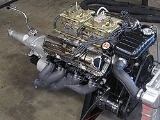
Ford FE engine

 
Ford FE Engine

   Email Print
   Bookmark   Link


Ford FE engine


The Ford FE engine was a Ford
Ford Motor Company

The Ford Motor Company is an United States multinational corporation and the world's List of automobile manufacturers#World Motor Vehicle Production by Manufacturer based on worldwide vehicle sales, following Toyota, General Motors, and Volkswagen Group....
 V8 engine used in vehicles sold in the North American market between 1958 and 1976. A related engine, the Ford FT engine, was used in medium and heavy trucks from 1964 through 1978. The FE filled the need for a medium-displacement engine created by the discontinuation of the Lincoln Y-block V8 engine
Lincoln Y-block V8 engine

The Lincoln V8 engine was Ford Motor Company's earliest Overhead valve V8 engine was introduced by Lincoln in 1952. Like the later Ford Y-block engine, its deep skirts made the block resemble the letter Y from the front....
. The FE joined Ford's other V8s which included a small Y-block
Ford Y-block engine

The Y-block engine is an overhead valve V8 automobile piston engine from Ford Motor Company. It was introduced in 1954 to replace the Side-valve engined Ford Flathead engine and was replaced by the Ford FE engine and the Ford Windsor engine in 1962, and lasted until 1964 in Ford trucks....
 and the big block MEL
Ford MEL engine

Ford Motor Company developed the MEL engine series for use in their line of Mercury models from 1958 through 1967. The MEL also replaced Lincoln 's unique Lincoln V8 engine....
 engines.

"FE" is an acronym for 'Ford-Edsel'.


Discussion
Ask a question about 'Ford FE engine'
Start a new discussion about 'Ford FE engine'
Answer questions from other users
Full Discussion Forum


Recent Posts


Encyclopedia


The Ford FE engine was a Ford
Ford Motor Company

The Ford Motor Company is an United States multinational corporation and the world's List of automobile manufacturers#World Motor Vehicle Production by Manufacturer based on worldwide vehicle sales, following Toyota, General Motors, and Volkswagen Group....
 V8 engine used in vehicles sold in the North American market between 1958 and 1976. A related engine, the Ford FT engine, was used in medium and heavy trucks from 1964 through 1978. The FE filled the need for a medium-displacement engine created by the discontinuation of the Lincoln Y-block V8 engine
Lincoln Y-block V8 engine

The Lincoln V8 engine was Ford Motor Company's earliest Overhead valve V8 engine was introduced by Lincoln in 1952. Like the later Ford Y-block engine, its deep skirts made the block resemble the letter Y from the front....
. The FE joined Ford's other V8s which included a small Y-block
Ford Y-block engine

The Y-block engine is an overhead valve V8 automobile piston engine from Ford Motor Company. It was introduced in 1954 to replace the Side-valve engined Ford Flathead engine and was replaced by the Ford FE engine and the Ford Windsor engine in 1962, and lasted until 1964 in Ford trucks....
 and the big block MEL
Ford MEL engine

Ford Motor Company developed the MEL engine series for use in their line of Mercury models from 1958 through 1967. The MEL also replaced Lincoln 's unique Lincoln V8 engine....
 engines.

"FE" is an acronym for 'Ford-Edsel'. The later versions used in trucks were known as "FT", an acronym for 'Ford-Truck'. Another engine family, the MEL
Ford MEL engine

Ford Motor Company developed the MEL engine series for use in their line of Mercury models from 1958 through 1967. The MEL also replaced Lincoln 's unique Lincoln V8 engine....
, stood for "Mercury-Edsel-Lincoln".

Usage

FE series engines powered most full-size
Full-size car

A full-size car is a marketing term used in North America for an automobile larger than a mid-size car. In the United States, the United States Environmental Protection Agency uses "large car" to denote full-size cars....
 Fords, some mid-size and performance models, and many Mercurys
Mercury (automobile)

Mercury is an automobile marque of the Ford Motor Company founded in 1939 by Edsel Ford, son of Henry Ford, to market entry-level-luxury cars slotted between Ford-branded regular models and Lincoln -branded luxury vehicles, similar to General Motors Corporation' Buick brand and Chrysler's Chrysler brand....
 from 1958 until 1971, and pickup trucks from 1965 through 1976.

Specific models that used FE engines include the AC Cobra
AC Cobra

The AC Cobra was a United Kingdom built and designed sports car that was produced during the 1960s....
 MKIII, AC Frua
AC Frua

The AC Frua or AC 428 is a United Kingdom Grand tourer car of the 1960s and early 1970s. Built by AC Cars from 1965 to 1973, it is extremely rare with only 81 cars built in total, 49 coup?s , 29 convertibles and 3 special bodied....
, high-performance Ford Mustang
Ford Mustang

File:Ford mustang badge.jpgThe Ford Mustang is an automobile manufactured by the Ford Motor Company. It was initially based on the Ford Falcon , a compact car....
s between 1967 and 1970, many Ford Galaxie
Ford Galaxie

The Ford Galaxie was a Ford full-size built in the United States by the Ford Motor Company for model years 1959 through 1974. The name was used for the top models in Ford?s full-size range from 1959 until 1966....
s including racing cars, some Ford Fairlane
Ford Fairlane

Ford Fairlane may refer to:...
s, Ford Thunderbird
Ford Thunderbird

The Thunderbird, often abbreviated as T-Bird, was an automobile manufactured by the Ford Motor Company in the United States from 1955 through 2005 — through thirteen generations and various body types....
s until halfway through 1968, and many others. The FE engine also saw use in industrial applications.

Description

The FE and FT engines are Y-block designs—so called because the cylinder block casting extends below the crankshaft centerline, giving great rigidity but heavy weight. In these engines, the casting extends 3.625 in (92 mm) below the crankshaft centerline, which is more than an inch below the bottom of the crank journals.

All FE and FT engines have a bore spacing (distance between cylinder centers) of 4.63 in (118 mm), and a deck height (distance from crank center to top of block) of 10.17 in (258 mm). The main journal (crankshaft bearing) diameter is 2.749 in (69.8 mm).
FE engine displacements
DisplacementBoreStroke
3324.000 in (101.6 mm)3.300 in (83.8 mm)
3524.002 in (101.7 mm)3.500 in (88.9 mm)
3604.052 in (102.8 mm)3.500 in (88.9 mm)
3614.047 in (102.8 mm)3.500 in (88.9 mm)
3904.052 in (102.9 mm)3.784 in (96.1 mm)
3914.052 in (102.9 mm)3.784 in (96.1 mm)
4064.130 in (104.9 mm)3.784 in (96.1 mm)
4104.054 in (103.0 mm) 3.98 in (101.1 mm)
4274.232 in (107.5 mm)3.784 in (96.1 mm)
4284.132 in (105.0 mm) 3.98 in (101.1 mm)


Generation 1


332


The smallest big-block Ford was the 332 of actual engine displacement
Engine displacement

Engine displacement is the volume swept by the all pistons of an engine in a single movement from top dead center to bottom dead center....
, with a bore and stroke. It was used in Ford and Edsel-brand cars in 1958 and 1959. A two-barrel
Carburetor

A carburetor or carburettor , is a device that blends Earth's atmosphere and fuel for an internal combustion engine. It was invented by Karl Benz before 1885 and patented in 1886....
 version produced , while a Holley or Autolite four-barrel version produced .

  • 4V, 9.5:1 — at 4600 rpm and at 2800 rpm
    • 1958 Ford
    • 1958 Edsel Ranger
      Edsel Ranger

      The Edsel Ranger was an automobile produced by the former Mercury-Edsel-Lincoln Division of the Ford Motor Company of Dearborn, Michigan, and sold through its Edsel marque in 1958....
      , Pacer
      Edsel Pacer

      The Edsel Pacer is an automobile produced by the former Mercury-Edsel-Lincoln Division of the Ford Motor Company of Dearborn, Michigan and sold through its Edsel marque in 1958....
      , Villager
      Edsel Villager

      The Edsel Villager was a station wagon produced by the former Mercury-Edsel-Lincoln Division of the Ford Motor Company of Dearborn, Michigan, and sold through its Edsel marque from 1958 to 1960....
      , Roundup
      Edsel Roundup

      The Edsel Roundup was a station wagon produced by the former Mercury-Edsel-Lincoln Division of the Ford Motor Company of Dearborn, Michigan, and sold through its Edsel marque in 1958....
       and Bermuda
      Edsel Bermuda

      The Edsel Bermuda was a station wagon produced by the Edsel Division, and later Mercury-Edsel-Lincoln Division of the Ford Motor Company of Dearborn, Michigan, and sold through its Edsel marque in 1958....
       overseas export vehicles only
  • 2V, 8.9:1 — at 4600 rpm and at 2200 rpm
    • 1959 Ford
    • 1959 Edsel Corsair
      Edsel Corsair

      The Edsel Corsair was an automobile produced by the former Mercury-Edsel-Lincoln Division of the Ford Motor Company of Dearborn, Michigan and sold through its Edsel marque in 1958 and 1959....
       and Villager
      Edsel Villager

      The Edsel Villager was a station wagon produced by the former Mercury-Edsel-Lincoln Division of the Ford Motor Company of Dearborn, Michigan, and sold through its Edsel marque from 1958 to 1960....
      , standard equipment, (called "Express V8")


352

1964 Ford Galaxie 500 Xl 352 Engine
Introduced in 1958 as part of the Interceptor line of Ford V8 engines, the Ford 352 of actual displacement was the replacement for the Lincoln Y-block. It is a 332 with stroke and a bore, and was rated from with a 2-barrel carburetor to over on the 4-barrel models. When these engines were introduced, they were called Interceptor V-8 on the base models and Interceptor Special V-8 on the 4-barrel models . The Interceptor name has caused confusion as many members of the automotive hobby mistakenly presume that if it says Interceptor it is a Police Interceptor; in fact the Interceptor was the base-performance engine in 1958. For the 1959 model year, the FE engine series was renamed the Thunderbird V-8 and the Thunderbird Special V-8. This series of engines usually weighed over .

  • 2V
    • 8.9:1 — at 4400 rpm and at 2400 rpm
      • 1961-1963 Ford
      • 1961-1963 Mercury (1961 Meteor
        Mercury Meteor

        The Mercury Meteor was an automobile model produced by the Lincoln Mercury division of the Ford Motor Company from 1961 to 1963. For 1961, the name was applied to low end full sized vehicles; for 1962 and 1963, the name was applied to Mercury's mid-sized sedans before being discontinued....
         and 1961-1963 Monterey
        Mercury Monterey

        For the Monterey minivan, produced from 2004-2007, see Ford Freestar.The Mercury Monterey is a full-size near-luxury car introduced by the Mercury division of the Ford Motor Company in 1950....
        )
  • 4V
    • 10.2:1 — at 4600 rpm and at 2800 rpm
      • 1958 Ford Interceptor
      • 1958-1959 Ford
      • 1958-1959 Ford Thunderbird
        Ford Thunderbird

        The Thunderbird, often abbreviated as T-Bird, was an automobile manufactured by the Ford Motor Company in the United States from 1955 through 2005 — through thirteen generations and various body types....
    • 9.6:1 — at 4600 rpm and at 2800 rpm
      • 1960 Ford
      • 1960 Edsel
        Edsel

        The Edsel was a marque of the Ford Motor Company during the 1958, 1959, and 1960 model years. The brand is known best as one of the biggest Failure#Commercial failures in the history of American business....
      • 1960 Ford Thunderbird
        Ford Thunderbird

        The Thunderbird, often abbreviated as T-Bird, was an automobile manufactured by the Ford Motor Company in the United States from 1955 through 2005 — through thirteen generations and various body types....
    • 10.6:1 — at 6000 rpm and at 3400 rpm
      • 1960 Ford
    • 8.9:1 — at 4400 rpm and at 2400 rpm
      • 1960 Ford
    • 9.3:1 — at 4400 rpm and at 2800 rpm
      • 1964-1966 Ford
    • 8.4:1 — at 4000 rpm and at 2800 rpm
      • 1965-1967 Ford F-Series
        Ford F-Series

        The F-Series is a series of pickup truck#North American full-size pickups from Ford Motor Company sold for over five decades. The most popular variant of the F-Series is the F-150....


361 Edsel

1959 Edsel Corsair 361 Engine
Edsel 361 engines were assembled in Cleveland Ohio, and Dearborn Michigan. They were standard equipment in the 1958 Edsel Ranger
Edsel Ranger

The Edsel Ranger was an automobile produced by the former Mercury-Edsel-Lincoln Division of the Ford Motor Company of Dearborn, Michigan, and sold through its Edsel marque in 1958....
, Pacer
Edsel Pacer

The Edsel Pacer is an automobile produced by the former Mercury-Edsel-Lincoln Division of the Ford Motor Company of Dearborn, Michigan and sold through its Edsel marque in 1958....
, Villager
Edsel Villager

The Edsel Villager was a station wagon produced by the former Mercury-Edsel-Lincoln Division of the Ford Motor Company of Dearborn, Michigan, and sold through its Edsel marque from 1958 to 1960....
, Roundup
Edsel Roundup

The Edsel Roundup was a station wagon produced by the former Mercury-Edsel-Lincoln Division of the Ford Motor Company of Dearborn, Michigan, and sold through its Edsel marque in 1958....
 and Bermuda
Edsel Bermuda

The Edsel Bermuda was a station wagon produced by the Edsel Division, and later Mercury-Edsel-Lincoln Division of the Ford Motor Company of Dearborn, Michigan, and sold through its Edsel marque in 1958....
, and optional in the 1959 Corsair
Edsel Corsair

The Edsel Corsair was an automobile produced by the former Mercury-Edsel-Lincoln Division of the Ford Motor Company of Dearborn, Michigan and sold through its Edsel marque in 1958 and 1959....
, Villager
Edsel Villager

The Edsel Villager was a station wagon produced by the former Mercury-Edsel-Lincoln Division of the Ford Motor Company of Dearborn, Michigan, and sold through its Edsel marque from 1958 to 1960....
 and Ranger
Edsel Ranger

The Edsel Ranger was an automobile produced by the former Mercury-Edsel-Lincoln Division of the Ford Motor Company of Dearborn, Michigan, and sold through its Edsel marque in 1958....
. The Edsel 361 was the very first FE block engine to be offered for sale in any market, having been introduced to the public on September 4, 1957, almost two months before any 1958 Fords were sold. Edsel 361 engines were also issued to law enforcement agencies and other emergency municipal services as the 1958 Ford "Police Power Pack."

  • 4V
    • 10.5:1 Compression Ratio
  • @4600 rpm
  • Torque @2900 rpm
  • x Bore/Stroke
    • 4-bbl Holley or Ford (Autolite) carburetor
    • Pushrod overhead valve
    • Angle-wedge machined combustion chamber
    • Firing order: 1-5-4-2-6-3-7-8
    • Cylinder numbering (front-to-rear): Right 1-2-3-4 Left 5-6-7-8
    • 18 mm spark plugs, 0.034 in. gap
      • 1958 Edsel Ranger
        Edsel Ranger

        The Edsel Ranger was an automobile produced by the former Mercury-Edsel-Lincoln Division of the Ford Motor Company of Dearborn, Michigan, and sold through its Edsel marque in 1958....
        , Pacer
        Edsel Pacer

        The Edsel Pacer is an automobile produced by the former Mercury-Edsel-Lincoln Division of the Ford Motor Company of Dearborn, Michigan and sold through its Edsel marque in 1958....
        , Villager
        Edsel Villager

        The Edsel Villager was a station wagon produced by the former Mercury-Edsel-Lincoln Division of the Ford Motor Company of Dearborn, Michigan, and sold through its Edsel marque from 1958 to 1960....
        , Roundup
        Edsel Roundup

        The Edsel Roundup was a station wagon produced by the former Mercury-Edsel-Lincoln Division of the Ford Motor Company of Dearborn, Michigan, and sold through its Edsel marque in 1958....
         and Bermuda
        Edsel Bermuda

        The Edsel Bermuda was a station wagon produced by the Edsel Division, and later Mercury-Edsel-Lincoln Division of the Ford Motor Company of Dearborn, Michigan, and sold through its Edsel marque in 1958....
        , standard equipment (called "E400")
  • 4V
    • 9.6:1 or 10.0:1 Compression Ratio depending on source of information
  • @4600 rpm
  • Torque @2800 rpm
  • x Bore/Stroke
    • 4-bbl Ford (Autolite) carburetor
    • Pushrod overhead valve
    • Angle-wedge cast combustion chamber
    • Firing order: 1-5-4-2-6-3-7-8
    • Cylinder numbering (front-to-rear): Right 1-2-3-4 Left 5-6-7-8
    • 18 mm spark plugs, 0.034 in. gap
      • 1959 Edsel Corsair
        Edsel Corsair

        The Edsel Corsair was an automobile produced by the former Mercury-Edsel-Lincoln Division of the Ford Motor Company of Dearborn, Michigan and sold through its Edsel marque in 1958 and 1959....
        , Villager
        Edsel Villager

        The Edsel Villager was a station wagon produced by the former Mercury-Edsel-Lincoln Division of the Ford Motor Company of Dearborn, Michigan, and sold through its Edsel marque from 1958 to 1960....
         and Ranger
        Edsel Ranger

        The Edsel Ranger was an automobile produced by the former Mercury-Edsel-Lincoln Division of the Ford Motor Company of Dearborn, Michigan, and sold through its Edsel marque in 1958....
        , optional equipment (called "Super Express V8")


360 Truck

The 360, of actual displacement, was introduced in 1968 and phased out at the end of the 1976 year run; it was used in the Ford F Series trucks and pickups. It is a destroked 390 with a bore of and the 352's stroke. 360s were also constructed with heavy duty internal components for truck use. Use of a standard 352/390 cam for use in passenger cars along with carburetor and distributor adjustment allowed the 360 to give performance similar to that of the 352 and 390 car engines. Rated at at 4200 rpm and of torque @3600 rpm (2-barrel carb, 1968).

  • 2V, 8.4:1
  • at 4400 rpm and at 2400 rpm
      • 1968-1971 Trucks
  • net at 4000 rpm and at 2400 rpm
      • 1972-1975 Trucks


390

1969 Ford Mustang 390 Fe
The 390, with true displacement, had a bore of and stroke of . It was the most common FE engine in later applications, used in many Ford cars as the standard engine as well as in many trucks. It was a popular high-performance engine; although not as powerful as the 427 and 428 models, it provided good performance, particularly in the lighter weight vehicles. The 2v is rated at @ 4,100 rpm.

  • 2V
    • 8.9:1 — at 4400 rpm and at 2400 rpm
      • 1963-1965 Mercury
    • 9.4:1 — at 4600 rpm and at 2400 rpm
      • 1964-1965 Mercury
    • 9.5:1 — at 4400 rpm and at 2600 rpm
      • 1966 Ford
      • 1966 Ford Fairlane
      • 1966 Mercury
      • 1966 Mercury Comet
    • 9.5:1 — at 4400 rpm and at 2600 rpm
      • 1967 Ford
      • 1967-1968 Ford Fairlane
      • 1967 Mercury
      • 1967 Mercury Comet
      • 1968 Ford Mustang
      • 1968 Mercury Cyclone GT
      • 1968 Mercury Cougar GT
    • 10.5:1 — at 4600 rpm and at 2800 rpm
      • 1968 Ford
      • 1969 Mercury
    • 9.5:1 — at 4400 rpm and at 2600 rpm
      • 1968 Ford Fairlane
      • 1968 Ford Torino
      • 1968-1970 Ford
      • 1968-1970 Mercury
    • 8.6:1 — at 4400 rpm and at 2600 rpm
      • 1968-1971 Trucks
    • 9:1 — at 4400 rpm and at 2600 rpm
      • 1971 Ford, Mercury
    • 8.6:1 — net at 4000 rpm and at 2600 rpm
      • 1972-1975 Trucks
  • 4V
    • 10.6:1 — at 6000 rpm and at 3400 rpm
      • 1961-1962 Ford
    • 9.6:1 — at 4600 rpm and at 2800 rpm
      • 1961-1963 Ford
      • 1961-1963 Ford Thunderbird
      • 1963 Mercury
    • 9.6:1 — at 5000 rpm and at 3200 rpm
      • 1961-1963 Ford Police Interceptor
      • 1963 Mercury Police Interceptor
    • 10.1:1 — 330 hp (246 kW) at 5000 rpm and 427 lb·ft (579 N·m) at 3200 rpm
      • 1964 Ford Police Interceptor
      • 1964 Mercury Police Interceptor
    • 11:1 — 300 hp (224 kW) at 4600 rpm and 427 lb·ft (579 N·m) at 2800 rpm
      • 1964-1965 Ford
      • 1964-1965 Mercury
      • 1964-1965 Ford Thunderbird
    • 10.5:1 — 315 hp (235 kW) at 4600 rpm and 427 lb·ft (579 N·m) at 2800 rpm
      • 1966-1967 Ford
      • 1966-1968 Ford Thunderbird
      • 1968 Mercury
    • 10.5:1 — 335 hp (251 kW) at 4600 rpm and 427 lb·ft (579 N·m) at 3200 rpm
      • 1967, 1969 Ford Mustang
      • 1967, 1969 Ford Fairlane
      • 1967, 1969 Mercury Cyclone GT
      • 1967, 1969 Mercury Cougar GT
      • 1969 Ford Torino
      • 1969 Mercury Montego
    • 10.5:1 — 325 hp (242 kW) at 4800 rpm and 427 lb·ft (579 N·m) at 2800 rpm
  • 3x2V, 10.6:1
    • 401 hp (299 kW) at 6000 rpm and 430 lb·ft (583 N·m) at 3500 rpm
      • 1961-1962 Ford
    • 340 hp (254 kW) at 6000 rpm and 430 lb·ft (583 N·m) at 3500 rpm
      • 1962 Ford
      • 1962-1963 Ford Thunderbird


Generation 2


406

Ford 406 Tripower
The 406 engine used a new bore with the 390's stroke, giving a displacement of , generously rounded up to "406" for the official designation. The larger bore required a new block casting with thicker walls but otherwise was very similar to the strengthened 390 high performance block.

The 406 was developed purely for racing and was sold to the public only to meet racing targets. It was available for less than two years before it was replaced by the 427.

Testing of the 406, with its higher power levels, led to cross-bolted mains — where the main bearing caps were not only secured by bolts at each end coming up from beneath but also by bolts coming in from the sides through the block, a spacer was used between the cap and the block face. Each spacer was custom fitted. This design prevented the main bearing caps from "walking" under extreme racing conditions. This cross-bolting can be found today in many of the most powerful and modern engines from many manufacturers.

  • 4V, 11.4:1 — 385 hp (287 kW) at 5800 rpm and 444 lb·ft (602 N·m) at 3400 rpm
    • 1962-1963 Ford
    • 1963 Mercury
  • 3x2V, 11.4:1 — 405 hp (302 kW) at 5800 rpm and 448 lb·ft (607 N·m) at 3500 rpm
    • 1962 Ford
  • 3x2V, 12.1:1 — 405 hp (302 kW) at 5800 rpm and 448 lb·ft (607 N·m) at 3500 rpm
    • 1963 Ford, Mercury


410

The 410 engine, used only in 1966 and 1967 Mercurys
Mercury (automobile)

Mercury is an automobile marque of the Ford Motor Company founded in 1939 by Edsel Ford, son of Henry Ford, to market entry-level-luxury cars slotted between Ford-branded regular models and Lincoln -branded luxury vehicles, similar to General Motors Corporation' Buick brand and Chrysler's Chrysler brand....
, used the same bore as the 390 engine, but with the 428's stroke, giving a real displacement. The standard 428 crankshaft was used, which meant that the 410, like the 428, required external balancing. A compression ratio
Compression ratio

The compression ratio of an internal-combustion engine or external combustion engine is a value that represents the ratio of the volume of its combustion chamber; from its largest capacity to its smallest capacity....
 of 10.5:1 was standard.

  • 4V, 10.5:1 — 330 hp (246 kW) at 4600 rpm and 444 lb·ft (602 N·m) at 2800 rpm
    • 1966-1967 Mercury


427

1966 Ford Galaxie Xl Convertible 427 Engine
Ford's 427 V8 was introduced in 1963 as a race-only engine. It was developed for NASCAR
NASCAR

The National Association for Stock Car Auto Racing is the largest sanctioning body of stock cars in the United States. The three largest racing series sanctioned by NASCAR are the Sprint Cup Series, the Nationwide Series and the Camping World Truck Series....
 stock car racing, drag racing, and serious street racers. The true displacement of the 427 was actually , but Ford called it the 427 because was the maximum displacement allowed by NASCAR. The stroke was the same as the 390 at , but the bore was increased to . The block was made of cast iron with an especially thickened deck to withstand higher compression. The cylinders were cast using cloverleaf molds—the corners were thicker all down the wall of each cylinder. Many 427s used a steel crankshaft and all were balanced internally. Most 427s used solid valve lifters with the exception of the 1968 block which was drilled for use with hydraulic lifters.

Two different models of 427 block were produced, the 427 top oiler and 427 side oiler. The top oiler version was the earlier, and delivered oil to the cam and valvetrain first and the crank second. It gained a reputation for insufficient crankshaft
Crankshaft

The crankshaft, sometimes casually abbreviated to crank , is the part of an engine which translates reciprocation linear piston motion into rotation....
 lubrication under severe usage; under extremely hard acceleration oil in the pan would tend to slosh back, uncovering the oil pickup. The side oiler block, introduced in 1965, sent oil to the crank first and the cam and valvetrain second. This was similar to the oiling design from the earlier Y-block
Ford Y-block engine

The Y-block engine is an overhead valve V8 automobile piston engine from Ford Motor Company. It was introduced in 1954 to replace the Side-valve engined Ford Flathead engine and was replaced by the Ford FE engine and the Ford Windsor engine in 1962, and lasted until 1964 in Ford trucks....
. The engine was available with low-riser, mid-riser, or high-riser intake manifolds, and either single or double four-barrel carburetion on an aluminum manifold. Ford never released an official power rating. Other models were rated at over 400 hp (299 kW).

In addition, Ford also produced tunnel-port heads and matching intakes for the FE engine. These lacked the limitations imposed by the other intakes' need to squeeze the intake port between two pushrods by running the pushrods through the intake ports in brass tunnels.

The 427 FE engine is currently enjoying a surge in popularity among Ford enthusiasts, and there are now a few companies producing aftermarket aluminum or iron replacement blocks.

  • Low-riser intake, 4V
    • 10.9:1 — 390 hp (291 kW) at 5600 rpm and 460 lb·ft (624 N·m) at 3200 rpm
      • 1968 Mercury Cougar GT-E only (it was to be offered in the Ford Mustang, according to early press releases, but there are no records or verification of any factory 427 Mustangs). In the spring of 1968, the 428 Cobra Jet officially replaced the 427; however, leftover 427s were installed until late June of that year, when stocks were depleted.
    • 11.6:1 — 410 hp (306 kW) at 5600 rpm and 476 lb·ft (645 N·m) at 3400 rpm
      • 1963-1964 Ford
      • 1963-1964 Mercury
  • Low-riser intake, 2x4V
    • 12:1 — 425 hp (317 kW) at 6000 rpm and 480 lb·ft (651 N·m) at 3700 rpm
      • 1963 Ford, Mercury
    • 11.6:1 — 425 hp (317 kW) at 6000 rpm and 480 lb·ft (651 N·m) at 3700 rpm
      • 1964 Ford, Fairlane, Mercury
  • Mid-riser intake, 4V
    • 11.6:1 — 410 hp (306 kW) at 5600 rpm and 476 lb·ft (645 N·m) at 3400 rpm
      • 1965-1967 Ford
      • 1965-1967 Mercury
  • Mid-riser intake, 2x4V
    • 11.6:1 — 425 hp (317 kW) at 6000 rpm and 480 lb·ft (651 N·m) at 3700 rpm
      • 1965-1967 Ford
      • 1965-1967 Mercury


427 SOHC "Cammer"

Ford 427 Sohc Thunderbird
The Ford Single Overhead Cam (SOHC) 427 V8 engine, familiarly known as the "Cammer", was released in 1964 to recapture NASCAR
NASCAR

The National Association for Stock Car Auto Racing is the largest sanctioning body of stock cars in the United States. The three largest racing series sanctioned by NASCAR are the Sprint Cup Series, the Nationwide Series and the Camping World Truck Series....
 dominance from the Chrysler 426 Hemi engine
Chrysler Hemi engine

A Chrysler Hemi engine, known by the trademark Hemi, is an internal combustion engine built by Chrysler that utilizes a Sphere combustion chamber....
. The Chrysler 426 used extremely large block casting that dwarfed the earlier 392 Hemi
Chrysler FirePower engine

The FirePower was Chrysler Corporation's first V8 engine. Introduced in the Fall of 1950 for the 1951 model year, the FirePower had hemispherical combustion chambers, leading some to refer to this engine as the early Hemi or Generation 1 hemi....
. The Ford 427 block was closer dimensionally to the early Hemis than to the elephantine 426 hemi (Ford FE bore spacing: 4.63"; Chrysler 392 bore spacing: 4.5625"; Ford FE deck height: 10.17"; Chrysler 392 deck height: 10.87"...the 426 Hemi has a deck height of 10.72" and bore spacing of 4.8" by comparison --- both Chrysler hemis have decks more than a 1/2" taller than the FE).

The engine was based on the ultra high performance 427 side-oiler block, providing race-proven durability. The block and associated parts were largely unchanged, the main difference being use of an idler shaft instead of the camshaft
Camshaft

The camshaft is an apparatus often used in piston engines to operate poppet valves. It consists of a cylindrical rod running the length of the cylinder bank with a number of oblong lobes or cams protruding from it, one for each valve....
 in the block, which necessitated plugging the remaining camshaft bearing
Bearing

Bearing may refer to:* Bearing , a term for direction* Bearing , a component that separates moving parts and takes a load...
 oiling holes.

The heads were newly-designed cast iron items with hemispherical combustion chamber
Combustion chamber

A combustion chamber is the part of an engine in which fuel is burned....
s and a single overhead camshaft
Overhead camshaft

Overhead camshaft, commonly abbreviated to OHC, valvetrain configurations place the engine camshaft within the cylinder heads, above the combustion chambers, and drive the poppet valve or tappets in a more direct manner compared to overhead valves and pushrods....
 on each head, operating shaft-mounted roller rocker arm
Rocker arm

Generally referred to within the internal combustion engine of automotive, marine, motorcycle and reciprocating aviation engines, the rocker arm is a reciprocating lever that conveys radial movement from the cam lobe into linear movement at the poppet valve to open it....
s. The valvetrain
Poppet valve

A poppet valve is a valve consisting of a hole, usually round or oval, and a tapered plug, usually a disk shape on the end of a shaft also called a valve stem....
 consisted of valves larger than those on Ford wedge head engines, made out of stainless steel
Stainless steel

In metallurgy, stainless steel is defined as a steel alloy with a minimum of 10% chromium content by mass. Stainless steel does not stain, corrode, or rust as easily as ordinary steel , but it is not stain-proof....
 and with sodium
Sodium

Sodium is an element which has the symbol Na , atomic number 11, atomic mass 23 amu , and a common oxidation number +1. Sodium is a soft, silvery white, highly reactive element and is a member of the alkali metals within "group 1" ....
-filled exhaust valves to prevent the valve heads from burning, and dual valve springs. This design allowed for high volumetric efficiency
Volumetric efficiency

Volumetric efficiency in internal combustion engine design refers to the efficiency with which the engine can move the charge into and out of the Cylinder ....
 at high engine speed.

The idler shaft in the block in place of the camshaft was driven by the timing chain and drove the distributor
Distributor

A distributor is a device in the ignition system of an internal combustion engine that routes high voltage from the ignition coil to the spark plugs in the correct firing order....
 and oil pump
Oil pump

Oil pump may refer to:* A Submersible pump, often used to pump oil out of wells* A Pump jack, often used to pump oil out of wells* An Oil pump , a part of the lubrication system that transports engine oil...
 in conventional fashion, with the same practical limit of about 7,000 rpm for the stock oil pump (a maximum of 20.5 US gallons (78 L) of SAE 40W per minute at 70 psi (480 kPa). An additional sprocket on this shaft drove a second, six foot long timing chain, which drove both overhead camshafts. The length of this chain made precision timing of the camshafts a problem at high rpm and necessitated a complex system of idlers.

The engine also had a dual-point distributor with a transistorized ignition amplifier system, running 12 amp
Ampere

The ampere is the International System of Units unit of electric current. The ampere, in practice often shortened to amp, is an SI base unit, and is named after Andr?-Marie Amp?re, one of the main discoverers of electromagnetism....
s of current through a high voltage ignition coil
Ignition coil

An ignition coil is an induction coil in an automobile's ignition system which transformer the Car battery 12 volts to the thousands of volts needed to spark the spark plugs....
.

All these engines were essentially hand-built with racing in mind. Combustion chambers were fully machined to reduce variability. Nevertheless, Ford recommended blueprinting
Blueprinting

Blueprinting can have several meanings.* See blueprint for the method of preparing engineering drawings.* See engine balance for the method of improving engine performance....
 the engines before use in racing applications. They were rated at 615 hp (458 kW) at 7,000 rpm with a single four-barrel carburetor, and 657 hp (490 kW) at 7,500 rpm with dual four barrel carburetors. Ford sold them via the parts counter, the single four-barrel model as part C6AE-6007-363S, the dual carburetor model as part C6AE-6007-359J for $2350.00 (as of October, 1968). Weight of the engine was 680 lb (308 kg).

Ford's plan was cut short, however; although Ford sold enough to have the design homologated, NASCAR effectively legislated the SOHC engine out of competition (despite permitting the hemi), and the awaited 1965 SOHC vs. Hemi competition at the Daytona 500
Daytona 500

The Daytona 500 is a 200-lap, -long NASCAR Sprint Cup Series race held annually at the Daytona International Speedway in Daytona Beach, Florida....
 season opener never occurred. This was the only engine ever banned from NASCAR. Nevertheless, the 427 found its niche in drag racing
Drag racing

Drag racing is a competition in which vehicles compete to be the first to cross a set finish line, usually from a dead stop, and in a straight line....
, powering many altered-wheelbase A/FX Mustangs (after NHRA banned it from stock classes), and becoming the basis for a few supercharged Top Fuel
Top Fuel

Top-Fuel Racing is a class of drag racing in which the cars are run on a maximum of 90% nitromethane and about 10% methanol , instead of gasoline....
 dragsters, including those of Connie Kalitta, Pete Robinson, and Lou Bany (driven by "Snake" Prudhomme
Don Prudhomme

Don 'The Snake' Prudhomme, is an American drag racer, who won the NHRA funny car championship four times in a thirty-five-year career. He was the first funny car driver to exceed 250 mph....
).

428

Ford Fe 428 Police Interceptor
The 427 was impractical to manufacture economically for street use; it required tighter tolerances during manufacture than Ford's regular engine plants could deliver. Therefore, Ford combined attributes that had worked well in previous incarnations of the FE: a stroke and a bore, creating an easier-to-make engine with nearly the same displacement. The engine used a cast nodular iron crankshaft and was externally balanced.

Standard 428 FE engines were fitted to Galaxies
Ford Galaxie

The Ford Galaxie was a Ford full-size built in the United States by the Ford Motor Company for model years 1959 through 1974. The name was used for the top models in Ford?s full-size range from 1959 until 1966....
(badged simply as '7 Litre') and Thunderbirds
Ford Thunderbird

The Thunderbird, often abbreviated as T-Bird, was an automobile manufactured by the Ford Motor Company in the United States from 1955 through 2005 — through thirteen generations and various body types....
 in the 1966 and 1967 model years.The Saleen S7 2000-2006 is also based upon it

  • 4V, 10.5:1
    • 345 hp (257 kW) at 4600 rpm and 462 lb·ft (626 N·m) at 2800 rpm
      • 1966-1967 Ford
      • 1966-1967 Ford Thunderbird
      • 1966-1967 Mercury
      • 1967 S-55
    • 360 hp (269 kW) at 5400 rpm and 459 lb·ft (622 N·m) at 3200 rpm
      • 1966-1968 Ford Police Interceptor
      • 1966-1968 Mercury Police Interceptor
    • 340 hp (254 kW) at 4600 rpm and 462 lb·ft (626 N·m) at 2800 rpm
      • 1968 Ford
      • 1968 Mercury
    • 360 hp (269 kW) at 5400 rpm and 420 lb·ft (570 N·m) at 3200 rpm
      • 1968 Shelby Cobra GT500
  • Cobra-Jet 4V, 10.8:1 — 335 hp (250 kW) at 5200 rpm and 440 lb·ft (597 N·m) at 3400 rpm
    • 1968 Ford Mustang
    • 1968 Mercury Cougar
    • 1968 Shelby GT500KR
  • Cobra-Jet and Super Cobra-Jet 4V, 10.6:1 — 335 hp (250 kW) at 5200 rpm and 440 lb·ft (597 N·m) at 3400 rpm
    • 1969-1970 Ford Mustang
    • 1969-1970 Mercury Cougar
    • 1969 Ford Fairlane
    • 1969 Ford Torino
    • 1969 Mercury Cyclone
  • 2x4V, 10.5:1 — 355 hp (265 kW) at 5400 rpm and 420 lb·ft (570 N·m) at 3200 rpm
    • 1967 Shelby GT500


428 Cobra Jet
The 428 Cobra Jet, launched in April 1968, was a version of the 428 FE engine built for performance rather than cruising smoothness. The 428 Cobra Jet could be made on a regular production line, not requiring the exacting tolerances required by the 427. The 428SCJ used special cylinder head casting # C8OE-6090-N. This casting had larger intake ports and valves than production FE. The Cobra Jet used a strengthened version of the 428 block with an extra main bearing webbing and thicker main caps than the standard block. The CJ used heavier connecting rods with a 13/32 rod bolt and a nodular iron crankshaft casting # 1UB. The engine was underrated at 335 hp (250 kW) at 5200 rpm. The 428 Cobra Jet actually produced 400 to 410 hp (299-306 kW).

428 Super Cobra Jet
The 428 Super Cobra Jet used the same top end as the 428 Cobra Jet but the crankshaft, connecting rods, and pistons are different. Cast high-performance pistons, a nodular iron crankshaft casting # 1UA was used as well as heavier 427 "Le Mans" connecting rods with capscrews instead of bolts for greater durability. The heavier connecting rods and the removal of the centre counterweight on the crankshaft 1UA, required an external weight on the snout of the crankshaft for balancing. An engine oil cooler was standard equipment with the Drag Pack and 3.9 or 4.3 rear end gear ratios. This engine was also underrated at .

Replacement

With the 428 the FE series block had been taken to the extremes of its capacity; no more growth was possible. The FE advances in engine technology had allowed its use across 3 decades. These advances included a thinwall casting process that made the engine comparatively light for its displacement, and the use of nodular iron for its crankshafts.

In the late 1960s however, Ford reviewed their entire engine family. The 335-series engines
Ford 335 engine

The Ford 335 internal combustion engine family were a group of small-block V8 V8 engines built by the Ford Motor Company between 1970 and 1982. The significance of the Numerals '335' designated to this series of Small block Ford V8 engines is relatively unknown....
, commonly referred to as Cleveland engines, were designed to replace the largest of the small-block Windsor engines
Ford Windsor engine

The Windsor engine is a 90-degree small-block V8 from Ford Motor Company. It was introduced in 1962, replacing the old Ford Y-block engine. Though not all of the engines in this family were produced at the Windsor, Ontario engine plant , the name stuck....
, with the 335 beginning at . The medium range of displacement needs was met by the 400M engine
Ford 335 engine

The Ford 335 internal combustion engine family were a group of small-block V8 V8 engines built by the Ford Motor Company between 1970 and 1982. The significance of the Numerals '335' designated to this series of Small block Ford V8 engines is relatively unknown....
, a Cleveland-style block with a raised deck allowing it to use a longer stroke crankshaft giving a displacement of . The 385-series engine
Ford 385 engine

The Ford 385 engine family was the United States Ford Motor Company's final big block V8 internal combustion engine design, replacing the Ford MEL engine and gradually superseding the Ford FE engine family....
 was to replace the MEL line in large cars and trucks. These began to be fitted to cars starting in 1973. However, the 385-series 429 replaced the 428 in some applications. The FE engines were gone from Ford cars by 1972 but lingered in trucks into the mid-1970s. In the late 1970s the Dearborn Engine Plant that produced these engines was completely retooled to produce the 1.6 L engine introduced in the Ford Escort in 1981.

In the late 1980s when both Ford and GM revamped their V8 offerings, many of the FE's designs were incorporated in the new engines, including the deep skirt, cross-bolting of the mains and thinwall casting.

Further reading


External links