
Home      Discussion      Topics      Dictionary      Almanac
Signup       Login
Ford Galaxie

Ford Galaxie

Overview
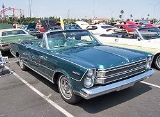
The Ford Galaxie was a full-size car built in the United States
United States
The United States of America is a federal constitutional republic comprising fifty states and a federal district...

 by the Ford Motor Company
Ford Motor Company
Ford Motor Company is an American multinational automaker based in Dearborn, Michigan, a suburb of Detroit. The automaker was founded by Henry Ford and incorporated on June 16, 1903. In addition to the Ford and Lincoln brands, Ford also owns a small stake in Mazda in Japan and Aston Martin in the UK...

 for model years 1959 through 1974. The name was used for the top models in Ford’s full-size range from 1959 until 1961, in a marketing attempt to appeal to the excitement surrounding the Space Race
Space Race
The Space Race was a mid-to-late 20th century competition between the Soviet Union and the United States for supremacy in space exploration. Between 1957 and 1975, Cold War rivalry between the two nations focused on attaining firsts in space exploration, which were seen as necessary for national...

. In 1962, all full-size Fords wore the Galaxie badge, with "500" and "500/XL" denoting the higher series. The Galaxie 500/LTD was introduced for 1965 followed by Galaxie 500 7-Litre in 1966. The Galaxie 500 part was dropped from the LTD in 1966, and from the XL in 1967; however the basic series structuring levels were maintained. The "regular" Galaxie 500 continued below the LTD as Ford’s mid-level full-size model from 1965 until its demise at the end of the 1974 model year.
Discussion
Ask a question about 'Ford Galaxie'
Start a new discussion about 'Ford Galaxie'
Answer questions from other users
Full Discussion Forum
 
Unanswered Questions
Recent Discussions
Encyclopedia
The Ford Galaxie was a full-size car built in the United States
United States
The United States of America is a federal constitutional republic comprising fifty states and a federal district...

 by the Ford Motor Company
Ford Motor Company
Ford Motor Company is an American multinational automaker based in Dearborn, Michigan, a suburb of Detroit. The automaker was founded by Henry Ford and incorporated on June 16, 1903. In addition to the Ford and Lincoln brands, Ford also owns a small stake in Mazda in Japan and Aston Martin in the UK...

 for model years 1959 through 1974. The name was used for the top models in Ford’s full-size range from 1959 until 1961, in a marketing attempt to appeal to the excitement surrounding the Space Race
Space Race
The Space Race was a mid-to-late 20th century competition between the Soviet Union and the United States for supremacy in space exploration. Between 1957 and 1975, Cold War rivalry between the two nations focused on attaining firsts in space exploration, which were seen as necessary for national...

. In 1962, all full-size Fords wore the Galaxie badge, with "500" and "500/XL" denoting the higher series. The Galaxie 500/LTD was introduced for 1965 followed by Galaxie 500 7-Litre in 1966. The Galaxie 500 part was dropped from the LTD in 1966, and from the XL in 1967; however the basic series structuring levels were maintained. The "regular" Galaxie 500 continued below the LTD as Ford’s mid-level full-size model from 1965 until its demise at the end of the 1974 model year.

The Galaxie was the high volume counterpart to the Chevrolet Impala
Chevrolet Impala
The Chevrolet Impala is a full-size automobile built by the Chevrolet division of General Motors introduced for the 1958 model year. Deriving its name from the southern African antelope, Chevrolet's most expensive passenger model through 1965 had become the best-selling automobile in the United...

. Some Galaxies were high-performance, racing specification machines, a larger forebear to the muscle car
Muscle car
Muscle car is a term used to refer to a variety of high-performance automobiles. The Merriam-Webster dictionary defines muscle cars as "any of a group of American-made 2-door sports coupes with powerful engines designed for high-performance driving." Usually, a large V8 engine is fitted in a...

 era. Others were plain family sedans.

A version of the car was also produced in Brazil under the names Galaxie 500, LTD and Landau
Ford Landau
For information on the Australian Ford Landau see Ford Landau Launched at the 1970 São Paulo Auto Show, the Ford Landau was a full-size car, manufactured in Brazil from 1971 until 1983 by the Ford Motor Company at their São Paulo facility. It became Ford's flagship in that country. It was based on...

 from 1967 to 1983.

The similarly named Ford Galaxy
Ford Galaxy
The first Galaxy was designed as a joint venture product between Ford and the Volkswagen Group. Produced at the joint-venture AutoEuropa plant in Palmela, Portugal, the vehicle was badge-engineered to create three vehicles: the Ford Galaxy; by Volkswagen Passenger Cars as the Volkswagen Sharan;...

 is a large car/minivan available in the European market. The vehicle's name is taken from the original Ford Galaxie.

1959

See also 1959 Ford

1959 saw the introduction of the Galaxie name in Ford's model lineup at mid-year. That year, the Galaxie range of six models were simply upscale versions of Ford's long-running Ford Fairlane with a revised rear roofline that mimicked the concurrent Thunderbird. In keeping with the era, the 1959 Galaxie was a chrome and stainless steel-bedecked, two-tone colored vehicle. It was the very image of late-1950s American automobile excess, albeit somewhat tamer than its Chevrolet and Plymouth competitors. Ford advertised "safety anchorage" for the front seats. The parking brake was now a pedal. Seat belts, a padded dash, and child-proof read door locks were optional, while a deep-dished steering wheel and double-door locks were standard.

Among the models was the Skyliner, featuring a retractable hardtop
Hardtop
A hardtop is a term for a rigid, rather than canvas, automobile roof. It has been used in several contexts: detachable hardtops, retractable hardtop roofs, and the so-called pillarless hardtop body style....

 that folded down into the trunk space; this feature, impressive but complicated, expensive and leaving very little trunk room when folded down, did not last long, being produced from 1957 through 1959. Power retractable hardtops have since been used by luxury manufacturers such as Mercedes-Benz
Mercedes-Benz
Mercedes-Benz is a German manufacturer of automobiles, buses, coaches, and trucks. Mercedes-Benz is a division of its parent company, Daimler AG...

, Lexus
Lexus
is the luxury vehicle division of Japanese automaker Toyota Motor Corporation. First introduced in 1989 in the United States, Lexus is now sold globally and has become Japan's largest-selling make of premium cars. The Lexus marque is marketed in over 70 countries and territories worldwide, and has...

, and Cadillac
Cadillac
Cadillac is an American luxury vehicle marque owned by General Motors . Cadillac vehicles are sold in over 50 countries and territories, but mostly in North America. Cadillac is currently the second oldest American automobile manufacturer behind fellow GM marque Buick and is among the oldest...

, but in all these cases the vehicle was a two-seater, allowing a much smaller top mechanism than the Skyliner's. Not until 2006, when the Pontiac G6
Pontiac G6
The Pontiac G6 was a mid-size car produced under the Pontiac brand of American automaker General Motors.It was introduced in the fall of 2004 to replace the Grand Am. The car was built on the GM Epsilon platform which it shared with the Chevrolet Malibu and Saab 9-3 along with other General Motors...

 convertible and Volkswagen Eos
Volkswagen Eos
The Volkswagen Eos is a four-seat retractable hardtop coupe convertible, introduced in 2006 as the successor to the Volkswagen Golf Cabriolet. The Eos is Volkswagen's first production coupe since the last Corrado in 1995....

 appeared, did another mass-market model with a rear seat appear in this category.

A fixture also was the previous year's 352 V8, still developing 300 hp.

1960–1964

See also 1960 Ford
1960 Ford
The mainstream full-sized Ford line of cars from 1960 to 1964 was now complemented by a variety of other Fords, including the Thunderbird and compact Falcon, and from 1962 the mid sized Fairlane. So the mainline car grew even more, now riding on a 119 in wheelbase...


The 1960 Galaxie was all-new in style, abandoning the ostentatious ornamentation of the 1950s for a futuristic, sleek look. A new body style this year was the Starliner, featuring a huge, curving rear observation window on a pillarless, hardtop bodyshell. The formal roofed 2-door hardtop was not available this year, but the roofline was used for the Galaxie 2-door pillared sedan, complete with chromed window frames. It had been the most popular body style in the line in 1959, and sales dropped off sharply. Contrary to Ford's tradition of pie-plate round taillghts, the 1960 featured "half-moon" lenses turned downward. The "A" pillar
Pillar (car)
Pillars are the vertical supports of the greenhouse of an automobile — known respectively as the A, B, C or D-pillar moving in profile view from the front to rear....

 now swept forward instead of backward, making entering and exiting the car more convenient. The appearance seems to be influenced by the flowing lines of the 1955 Crown Victoria
1955 Ford
The Ford line of cars gained a new body for 1955 to keep up with surging Chevrolet, although it remained similar to the 1952 Ford underneath...

 while eliminating the "basket handle", also called the "B" pillar.

For 1961, the bodywork was redone again, although the underpinnings were the same as in 1960. This time, the tailfins were almost gone; the small blade-like fins capped smaller versions of 1959's "pie-plate" round taillamps once again. Performance was beginning to be a selling point, and the 1961 Galaxie offered a new 390 CID (6.4 L) version of Ford's FE series
Ford FE engine
The Ford FE engine is a Ford V8 engine used in vehicles sold in the North American market between 1958 and 1976. A related engine, the Ford FT engine, was used in medium and heavy trucks from 1964 through 1978. The FE filled the need for a medium-displacement engine created by the discontinuation...

 pushrod V8, which was available with either a four-barrel carburetor
Carburetor
A carburetor , carburettor, or carburetter is a device that blends air and fuel for an internal combustion engine. It is sometimes shortened to carb in North America and the United Kingdom....

 or, for serious performance, three two-barrel carburetors. The latter was rated at 401 hp (298 kW), making even such a heavy car quite fast indeed. The 352 was downgraded in favor of the 390; it was equipped with a 2-barrel carburetor and single exhaust. The Starliner was again offered this year, and Ford promoted this model with lots of luxury and power equipment, but it was dropped at the end of the year, as the re-introduced square-roof hardtop coupe took the bulk of sales.

For 1962, the Galaxie name was applied to all of Ford's full size models, as the Fairlane
Ford Fairlane (North American)
The Ford Fairlane was an automobile model sold between 1955 and 1970 by the Ford Motor Company in North America. The name was taken from Henry Ford's estate, Fair Lane, near Dearborn, Michigan....

 moved to a new intermediate and Custom was temporarily retired. New top-line Galaxie 500 (two-door sedan and hardtop, four-door sedan and hardtop, and "Sunliner" convertible). In an effort to stimulate midseason sales, Ford introduced a group of sporty cars along with its now-famous "Lively Ones" campaign. These models featured the bucket seats and console that was popularized by the Chevrolet Corvair Monza, and included a Fairlane 500 Sports Coupe, and a Falcon Futura. The full-size line got a new bucket-seats-and-console "Lively One," the Galaxie 500/XL (two-door hardtop and convertible). The 292 cid V8 was standard on the 500/XL. The XL had as sportier trim inside and out as part of the package. This model was Ford's response to Chevrolet's Super Sport option for the big Impala
Impala
An impala is a medium-sized African antelope. The name impala comes from the Zulu language meaning "gazelle"...

, which was introduced the previous year and saw a significant rise in sales for 1962. Performance was not ignored either, with an even larger 406 cid engine being available, again in single four-barrel or triple-carbureted "six-barrel" form. At the other end of the spectrum, of course, the 223 cid "Mileage Maker" 6-cylinder
Straight-6
The straight-six engine or inline-six engine is a six-cylinder internal combustion engine with all six cylinders mounted in a straight line along the crankcase...

 engine was still available for the more budget-minded driver. Tailfins were gone, giving the 1962 models a more rounded, softer rear end look. Taillights were set lower into the rear panel and were partially sunken into the newly sculpted rear bumper.

The 1962 models, however, were overweight by comparison to the Super Duty Pontiacs with their aluminum body panels and larger-displacement engines, so late in the production run, Ford's Experimental Car Garage was ordered to put the Galaxie on a diet. It produced 11 "lightweight Galaxies", making use of fiberglass panels, as well as aluminum bumpers, fender aprons, and brackets; the result was a Galaxie weighing in at under 3400 lb (1,542 kg). (The base 2-door Club Sedan was 3499 lb (1,587 kg).) It was an improvement. For 1963, Ford saw no reason to radically change a good thing, and the 1963 model was essentially unchanged save for some freshening and added trim; windshields were reshaped and a four-door hardtop 500/XL was added. A lower, fastback roofline was added mid-year to improve looks and make the big cars more competitive on the NASCAR tracks with the added downforce. This 1963½ model, the industry's first official "½ year" model, was called the "Sports Roof" or "Fastback" (it shared this feature with the in '63½ Falcon). Galaxie buyers showed their preference as the new SportsRoof models handily outsold the "boxtop" square-roof models. The SportsRoof was available in both Galaxie 500, and Galaxie 500/XL trim. As to be expected, sister Mercury also received the SportsRoof in Monterey, Montclair, and Park Lane models. A base-model Galaxie was offered for 1963 only, badged as the Ford 300
Ford 300 (1963)
The Ford 300 is an automobile which was built in the USA by the Ford Motor Company for the model year 1963 only. It was the base trim level of the full-size 1963 Ford line below the Galaxie, Galaxie 500 & Galaxie 500XL...

. The "Swing-away" steering wheel became optional.

While not much changed for the everyday buyer, for the performance oriented things were a little different. Partway through this year and in limited quantities there became available Ford's new racing secret weapon, the 427, replacing the 406. It was intended to meet NHRA and NASCAR
NASCAR
The National Association for Stock Car Auto Racing is a family-owned and -operated business venture that sanctions and governs multiple auto racing sports events. It was founded by Bill France Sr. in 1947–48. As of 2009, the CEO for the company is Brian France, grandson of the late Bill France Sr...

 7-liter maximum engine size rules. This engine was rated at a conservative 425 hp with 2 x 4 barrel Holley
Holley Performance Products
Holley Performance Products is an automotive performance company based in Bowling Green, Kentucky. Holley, when based in Michigan, was one of the major producers of carburetors, being supplied as standard equipment on many Detroit-built automobiles....

 carburetors and a solid lifter camshaft. Ford also made available aluminum cylinder heads as a dealer option. The 1963½ was still overweight, however. To be competitive in drag racing Ford produced 212 (around 170 from Ford Norfolk, about 20 from Ford Los Angeles) lightweight versions of the "R" code 427, in the Galaxie 500 Sport Special Tudor Fastback. Available only in Corinthian White with red vinyl interior, and with a list price of about US$4,200 (when a base Galaxie 300 went for US$2,324, and XL Fastback was US$3,268), these cars came stock with Borg-Warner T-10 four-speed, 4.11:1 rear axle, heavy-duty suspension and brakes, and were fitted with a fiberglass hood (a flat piece at first, late in '63 the popular blister hood also used on the Thunderbolt), trunk, front fenders, and fender aprons, as well as aluminum bumpers and mounting brackets, transmission cases, and bellhousing. Hood springs, heater, trunk lining and mat, spare wheel and tire (and mounting bracket), trunk lid torsion bar, jack, lug wrench, one horn (of the stock two), armrests, rear ashtrays, courtesy lights, and dome light were removed to reduce weight. The first 20 cars had functional fiberglass doors, which shaved 25 lb (11.3 kg); these were deleted because of Ford's concern for safety if used on the highway. The cars had all sound deadening removed, lightweight seats and floormats, and no options. Contrary to myth, they were not factory equipped with cold-air induction
Cold air intake
A cold air intake is an aftermarket assembly of parts used to bring relatively cool air into a car's internal-combustion engine.Most vehicles manufactured since the mid-1970s have thermostatic air intake systems that regulate the temperature of the air entering the engine's intake tract, providing...

, as the Thunderbolt would be. In addition, they were built on the 45 pounds (20 kg)-lighter Galaxie 300 chassis, originally intended for a smaller-displacement V8. In all, the 427s were 375 lb (170.1 kg) lighter than before (425 lb (192.8 kg) with the fiberglass doors).

The first two lightweight Galaxies, using 289 cid bodies, were assembled at Wayne, Michigan, late in January 1963, to be tested at the 1963 Winternats. They were delivered to Tasca Ford (East Providence, R.I.) and Bob Ford (Dearborn, MI). Bill Lawton's Tasca Galaxie turned the best performance, with a 12.50 pass at 116.6 mph (187.65 km/h). It was not enough against the 1963 Chevrolet Impala
Chevrolet Impala
The Chevrolet Impala is a full-size automobile built by the Chevrolet division of General Motors introduced for the 1958 model year. Deriving its name from the southern African antelope, Chevrolet's most expensive passenger model through 1965 had become the best-selling automobile in the United...

 Z-11s in Limited Production/Stock, however. Three more were assembled from parts and tested at Ford's Experimental Car Garage in Dearborn. One of the next two, the last Winternationals test cars, was prepared by Bill Stroppe in Long Beach, California, for Les Ritchey; it was featured in the July 1963 issue of Hot Rod. For all their efforts, Ford discovered the Galaxies were still too heavy, and the project was abandoned. Some of these cars competed in England, Australia and South Africa after being modified by Holman and Moody who fitted them with disc brakes and other circuit racing components. Jack Sears won the British Touring Championship in 1963 and the racing Galaxies were also driven by Sir Jack Brabham, Graham Hill and other notable drivers of the period. The heavy Galaxies suffered from persistent brake failure that led to a number of crashes, and in late 1963 started using the 12" disc brakes off the Ford GT40 program. By this time the Lotus Cortinas were being developed and the big Galaxie became uncompetitive. Some of these race cars survive in England and in Australia where they compete in Historic Touring Car racing. A new 260 cid V8, derived from the 1962 Fairlane engine, replaced the Y-block 292 cid as the entry level V8. Later in the year, the 260 was replaced with an enlarged version displacing 289 cubic inches.

Model year 1964 was the fourth and final year of this body style. Interior trim was much altered, and the exterior featured a more sculpted look which was actually designed to make the car more aerodynamic for NASCAR. The formal-roof "boxtop" style was replaced by a slanted-roof design for all non-wagon or convertible models, including sedans. Ford's quality control, spotty when the first Galaxie was introduced, was now as good as it ever was, and many 1964 Fords passed the 100000 miles (160,934 km) mark intact. The 1964 models gained an enviable reputation as durable, comfortable cars that offered decent handling and road-ability at a reasonable price, so it is no wonder they sold so well. Of the XL models, the 1964 hardtop coupe takes the prize for the most produced. The base 300 was replaced by a line of Custom and Custom 500 models. The 289 continued as the base V8 and was standard in the XL series. XL models got new thin-shell bucket seats with chrome trim. They were designed to cradle the driver better than the previous style, and Federal regulations now required lap-style safety belts for both front outboard occupants.

Under the hood, the 427 cid engine carried on the high performance duties. Ford again took the 427-equipped Galaxie to the racetracks in serious fashion in 1964, building 50 lightweight fiberglass-equipped cars just for the purpose of drag racing. These competed with success in North America but were still too heavy and Ford introduced the lightweight Fairlane Thunderbolt which used the 427 engine and was immediately competitive. The 427 was the powerplant of the dominant Ford GT40 Mk II
Ford GT40
The Ford GT40 was a high performance sports car and winner of the 24 hours of Le Mans four times in a row, from 1966 to 1969...

.

Late in the year Ford introduced their new engine challenger, the SOHC 427 "Cammer". Though not documented, it is believed a few may have found their way onto the street (this engine was only available to racers through the dealer network or from the manufacturer; none were ever factory installed). Rated at over 600 hp, this is possibly the most powerful engine ever fitted to a production car by an American manufacturer. NASCAR changed the rules, however, requiring thousands (rather than hundreds) of production examples in service to qualify for the next season and Ford decided against producing the Cammer in that quantity. Fears of liability concerns and the bad publicity possibilities in giving the public a car that dangerously powerful are often cited as reasons, but it might simply have been that Ford doubted that an engine so unsuited to street use could sell in such numbers.

It should be noted that the Ford Country Squire station wagon, while wearing "Country Squire" badging for many years, was actually part of the Galaxie 500 line. Some Country Squires had "Galaxie 500" badging on the glovebox indicating the series name. These wagons featured the same tinware as Galaxie 500s inside and out, and were a step up from the base-model Country Sedan.

1965–1968


The 1965 Galaxie was an all-new design, featuring vertically stacked dual headlights in what was becoming the fashionable style in a car somewhat taller and bulkier than the previous year's. The new top-of-the-line designation this year was the Galaxie 500 LTD. Engine choices were the same as 1964 except for an all-new 240 cu in (3.9 l) six-cylinder and 1965 289 cu in (4.7 l) engine replacing the 50s-era 223 "Mileage-Maker" six and the 352 being equipped with dual exhausts and a four-barrel carburetor.

Suspension on the 1965 models was dramatically redesigned. Replacing the former leaf-spring rear suspension was a new three-link system, featuring all coils. Not only did the ride improve, but handling also got a boost, and this system was used for NASCAR in the full-size class. Interiors were like the 1964 models, but a new instrument panel and two-way key system were introduced.

A new model was introduced for 1966; the Galaxie 500 7 Litre, fitted with a new engine, the 428 cu in (7 l) Thunderbird V8. As the name suggests, this engine was also available on the Ford Thunderbird
Ford Thunderbird
The Thunderbird , is an automobile manufactured by the Ford Motor Company in the United States over eleven model generations from 1955 through 2005...

 and was a response to a demand for a more docile, tractable engine than the racing-built 427. The 1966 bodystyle was introduced in Brazil (Ford do Brasil
Ford do Brasil
Ford do Brasil is a subsidiary of American automaker Ford Motor Company, founded on April 24, 1919. The operation started out importing the Ford Model T cars and the Ford Model TT trucks in kit form from the US for assembly in Brazil...

) as a 1967 model; it had the same external dimensions throughout its lifetime until Brazilian production ceased in 1983. In response to safety concerns, U.S. Government regulations for 1966 required seat belts front and rear to be fitted to all new cars sold domestically. The Galaxie 500 would be the #3-selling convertible in the U.S. in 1966, with 27,454 sold; it was beaten by the Mustang (at 72,119, by more than 2:1) and by the Impala at 38,000.

In 1967, the 7 Litre model no longer carried the Galaxie name; it was to be the last year of it being separately identified. That identification was mainly trim such as horn ring and dashboard markings as well as the "Q" in the VIN number. The 7 Litre in '67 was basically a trim and performance option on the XL model. Little else changed except for trim and the styling; the same engines were avaialable, from the 240 six-cylinder to the 428 V8. Modifications to the styling included adding a major bend in the center of the grille and making the model less "boxy" than the 1966 model. The 1967 LTD dropped the Galaxie name, a harbinger of changes to come. An 8-track became and option.

In 1967 all Fords, including the Galaxie, featured a large, padded hub in the center of the plastic steering wheel, along with an energy-absorbing steering column, padded interior surfaces, recessed controls on the instrument panel, and front outboard shoulder belt anchors. Another safety related change was the introduction of the dual brake master cylinder used on all subsequent Galaxies (and other Ford models).

The 1968 model had a new grille with headlights arranged horizontally, although the body was essentially the same car from the windshield back. The 'long hood, short deck' style was followed too, as was the new trend for concealed headlights on the XL and LTD. One other change for 1968 was that the base V8 engine increased from 289 to 302 cu in (5 l).

The 1968 models featured additional safety features, including side marker lights and shoulder belts on cars built after December 1, 1967. The 1967 model's large steering wheel hub was replaced by a soft "bar" spoke that ran though the diameter of the wheel (and like the '67 style, was used throughout the Ford Motor Company line). A plastic horn ring was also featured.

1969–1974


The 1969 model was built on a new platform with a 121 inches (3,073.4 mm) wheelbase. It was the end for the 427 and 428 engines. Replacing the FE series-based 427 and 428 engines was the new 429 cu in (7 l) "ThunderJet" that was introduced in the 1968 Ford Thunderbird
Ford Thunderbird
The Thunderbird , is an automobile manufactured by the Ford Motor Company in the United States over eleven model generations from 1955 through 2005...

; it was part of the new Ford 385 engine
Ford 385 engine
The Ford 385 engine family was the Ford Motor Company's final big block V8 engine design, replacing the Ford MEL engine and gradually superseding the Ford FE engine family...

 series. Power, at 360 hp for the dual-exhaust 4-barrel version, was higher than the 428's 345 hpand lower than the racing-bred 427's final rating of 390 hp; there was also a single-exhaust 2-barrel version with 320 hp available. The dashboard was built as a pod around the driver rather than traditionally extending across both sides. The XL and Galaxie 500 Sportsroof had rear sail panels to simulate a fastback roofline. The rear trim panel below the tail lights was used to distinguish the different trim levels. The Country Squire was perhaps the pinnacle of design for that wagon with the concealed headlights.

Headrests were featured on 1969 model cars built after January 1, 1968. It was not until 1969 that a station wagon was actually marketed under the Galaxie name. From 1955 to 1968 full-size Ford
Full-size Ford
Full-size Ford is the popular term for a long-running line of Ford vehicles which have been produced in North America with a large degree of similarity since the Model T in 1908, up to the current Crown Victoria...

 wagons were treated as a separate model series and were listed as Ranch Wagon, Country Sedan, and Country Squire. For the 1969 model year the Ranch Wagon became the Custom Ranch Wagon, the Country Sedan the Galaxie Country Sedan and the Country Squire was marketed as the LTD Country Squire.

Galaxies for model year 1970 were pretty much the same as the 1969 models, except for minor trim changes. A new Government-required ignition lock was located on the right side of the steering column. Model year 1970 was the last year for the XL, but Galaxie 500 hardtop coupes were also available in both formal-roof and SportsRoof body styles.

A complete redesign was offered for 1971. This included a horizontal wrap around front bumper with a massive vertical center section much in the vein of concurrent Pontiacs. Taillights lost the traditional "rocket" exhaust theme in favor of horizontal lights and trimmed center section. Rooflines were squared off and had a "formal" air. The XL was dropped, as were concealed headlight covers for the LTD. The convertible was moved to the LTD series in 1971 and lasted through 1972.

Models for 1972 were similar but the lower bumper continued across the center grille section and the rear bumper was enlarged with inset taillamps. This was also the final year for the 240 cu in (3.9 l) six-cylinder engine.

The 1973 model was marginally shorter than previous models, but had a heavier, bulker appearance. Three towing packages were optional, each with increasing towing capacity.

The 1974 model year was essentially a repeat of 1973, but it was the last year for the Galaxie 500 name. Ford elected to consolidate most of its full-size models under the popular LTD name for 1975. Power front disc brakes were standard.

The LTD stayed on as the top full-size model.

Production Numbers

Model Year Galaxie Production Total Series Production
1959 464,336 733,714
1960 289,268 461,092
1961 349,665 486,284
1962 446,195 575,846
1963 648,010 774,382
1964 593,533 923,232
1965 564,008 978,429
1966 597,002 1,034,930
1967 426,941 877,127
1968 448,376 920,247
1969 421,197 998,796
1970 351,938 850,315
1971 322,351 917,856
1972 269,199 832,273
1973 233,554 941,054
1974 117,801 519,916

Total Series Production include Custom, Custom 500, Seven Litre, Station Wagon, LTD, and all Galaxie models. Galaxie Production includes Galaxie, Galaxie 500, Galaxie 500XL, XL, and Galaxie 500 LTD when LTD was not a separate model (until 1967).

Australian production


The Ford Galaxie was also produced in Australia
Australia
Australia , officially the Commonwealth of Australia, is a country in the Southern Hemisphere comprising the mainland of the Australian continent, the island of Tasmania, and numerous smaller islands in the Indian and Pacific Oceans. It is the world's sixth-largest country by total area...

 from 1965 to 1969. The 1965 model, which was designated as the Galaxie GE series by Ford Australia
Ford Australia
Ford Australia is the Australian subsidiary of Ford Motor Company and was founded in Geelong, Victoria, in 1925 as an outpost of Ford Motor Company of Canada, Limited. At that time, Ford Canada was a separate company from Ford USA...

, was assembled at Ford’s Homebush plant in New South Wales
New South Wales
New South Wales is a state of :Australia, located in the east of the country. It is bordered by Queensland, Victoria and South Australia to the north, south and west respectively. To the east, the state is bordered by the Tasman Sea, which forms part of the Pacific Ocean. New South Wales...

, and was offered as a 4-door sedan with a choice of 289 cid or 390 cid cid V8 engines. 1966, 1967 and 1968 models were also assembled at Homebush prior to a change to full importation from 1969, with conversion from left to right hand drive being undertaken at Ford’s Broadmeadows facility in Victoria
Victoria (Australia)
Victoria is the second most populous state in Australia. Geographically the smallest mainland state, Victoria is bordered by New South Wales, South Australia, and Tasmania on Boundary Islet to the north, west and south respectively....

. The 1969 model was marketed as the Galaxie LTD, as were subsequent models through to the introduction of the locally developed Ford LTD in 1973.

Prior to local assembly which began late 64, small numbers of RHD full imports were sourced through select Australian Ford dealers, and also by Ford of Australia for executive use. RHD wagons, convertibles and fastbacks, 2 and 4 door hardtops, XL's and LTD's were generally sourced as full imports from Ford of Canada until approx 1968. The fully imported 1959-early 63 models utilised a 59 US Fairlane dash and instruments. Late 63 a 1959 Edsel Corsair-based dash was used, and for 1964 Galaxie's a 1959 Edsel Ranger-based dash was used. Australian assembled 65-68 models were sourced in CKD form from Ford of Canada. The 65–67 model Galaxie's adopted the RHD dash based on the 63 Lincoln instrument cluster. The 1968 RHD dash was based on 68 Ford Torino.

Australian assembled cars 65–68 received a woodgrain dash fascia, and accessories as standard such as:
  • Power steering
  • Power brakes (front disc from 1967)
  • Radio with 390 engine
  • Automatic transmission
  • Wipers and washers (1 speed intermittent wipers for 65–6, 2 speed from 67)


For the 1968 model year the 289 CID engine was dropped as the base option in favour of the new 302 CID (Windsor) V8.
3 speed heater defroster

Local build quantities of 65–72 model Galaxies totalled 4892 vehicles based on details from the late Ford Australia Historian, Adrian Ryan.

External links


  • LOVEfords Galaxie articles and content, accurate information