
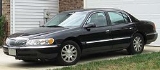
The
Lincoln Continental is an automobile which was produced by the
LincolnLincoln is an American luxury vehicle brand of the Ford Motor Company. Lincoln vehicles are sold mostly in North America.-History:The company was founded in August 1915 by Henry M. Leland, one of the founders of Cadillac . During World War I, he left Cadillac which was sold to General Motors...
division of
Ford Motor CompanyFord Motor Company is an American multinational automaker based in Dearborn, Michigan, a suburb of Detroit. The automaker was founded by Henry Ford and incorporated on June 16, 1903. In addition to the Ford and Lincoln brands, Ford also owns a small stake in Mazda in Japan and Aston Martin in the UK...
from 1939 to 1948 and again from 1956 to 2002. Despite often sharing underpinnings with less-expensive Fords in more recent years, the Lincoln Continental had usually been a distinctively platformed and styled, highly equipped luxury car in the course of its long history.
The flagship Lincoln model during most of its run, the Continental name conveyed special cachet in the product line. During the 1980s, the Continental was downsized from a full-size to a mid-size Ford Taurus platform; this introduced the Continental to a wider range of competition from Europe and Japan. After the Continental was discontinued in 2002, it was largely replaced by the
Lincoln LSThe Lincoln LS is a mid-size, rear wheel drive sedan from Lincoln. For its production run from 1999 until 2006, it was based on the Ford DEW98 platform, which was shared with the Jaguar S-Type and Ford Thunderbird...
V8.
First generation (1939–1948)
The first Lincoln Continental was developed as
Edsel FordEdsel Bryant Ford , son of Henry Ford, was born in Detroit, Michigan, USA. He was president of Ford Motor Company from 1919 until his death in 1943.-Life and career:...
's one-off personal vehicle, though it is believed he planned all along to put the model into production if successful. In 1938, he commissioned a custom design from the chief stylist, Eugene T. "Bob" Gregorie, ready for Edsel's March 1939 vacation. The design, allegedly sketched out in an hour by Gregorie working from the
Lincoln ZephyrLincoln-Zephyr was a marque for the lower priced line of luxury cars in the Lincoln line 1936-40. Lincoln-Zephyr and Mercury, introduced 1939, bridged the wide gap between Ford's V-8 De Luxe line and the exclusive Lincoln K-series cars. This served a purpose similar to Cadillac's smaller LaSalle...
blueprints and making changes, was an elegant
convertibleA convertible is a type of automobile in which the roof can retract and fold away having windows which wind-down inside the doors, converting it from an enclosed to an open-air vehicle...
with a long hood covering the Lincoln
V12A V12 engine is a V engine with 12 cylinders mounted on the crankcase in two banks of six cylinders, usually but not always at a 60° angle to each other, with all 12 pistons driving a common crankshaft....
and long front fenders, and a short trunk with what became the Continental series' trademark, the
externally mounted covered spare tireA Continental tire is an upright, external, mounted spare tire behind an automobile's trunk compartment. The term also describes a non-functional bulge that is stamped into the trunk lid or a cosmetic accessory to the rear of the car giving the impression of a spare tire mount.-Development:The...
.
The car could be considered a channeled and sectioned Zephyr that did not even have the bulge that in the Zephyr (and in some other cars) replaced the running-board at the bottom of the doors. This decrease in height meant that the height of the hood was much closer to that of the fenders. There was hardly any trim on it at all, making its lines superb. This car is often rated as one of the most beautiful in the world.
The custom car for the boss was duly produced on time, and Edsel had it delivered to
FloridaFlorida is a state in the southeastern United States, located on the nation's Atlantic and Gulf coasts. It is bordered to the west by the Gulf of Mexico, to the north by Alabama and Georgia and to the east by the Atlantic Ocean. With a population of 18,801,310 as measured by the 2010 census, it...
for his spring vacation. Interest from well-off friends was high, and Edsel sent a telegram back that he could sell a thousand of them. Lincoln craftsmen immediately began production on the Continental
convertibleA convertible is a type of automobile in which the roof can retract and fold away having windows which wind-down inside the doors, converting it from an enclosed to an open-air vehicle...
, and even a rare few hardtop models. They were extensively hand-built; the two dozen 1939 models and 400 1940-built examples even had hand-hammered body panels, since dies for machine-pressing were not constructed until 1941.
After the
attack on Pearl HarborThe attack on Pearl Harbor was a surprise military strike conducted by the Imperial Japanese Navy against the United States naval base at Pearl Harbor, Hawaii, on the morning of December 7, 1941...
, Continental production was suspended, to be re-started in 1946–1948. Like the other
post-warA post-war period or postwar period is the interval immediately following the ending of a war and enduring as long as war does not resume. A post-war period can become an interwar period or interbellum when a war between the same parties resumes at a later date...
Lincolns, however, the Continental had similar bits of trim added to make it look improved. Walnut trim was added in 1947. The 1939–1948 Continental is recognized as a "Full Classic" by the
Classic Car Club of AmericaThe Classic Car Club of America is an organization founded in 1952 to celebrate the grand automobiles of the prewar period. At the time, the vehicles covered by the Club were considered too modern to be of any interest by such organizations as the Antique Automobile Club of America and despite...
, one of the last-built cars to be so recognized. The 1948 Continental had the last V12 engine put in an American car.
The 1939 Continental is commonly called a '1940 Continental'.
Second generation (1956–1957)
The Continental name was revived in 1955 as a separate Ford brand, with its sole model being the Continental Mark II. This version was a unique design with the highest quality control ever seen in the automobile industry. High-class luxury abounded in the new Continental, and with very limited availability, it appeared even more exclusive than the original.
Continental for 1956 was one of the most expensive cars in the world—with a cost of $10,000 at a time when a regular Ford could be had for less than $2000, it rivaled
Rolls-RoyceRolls-Royce Limited was a renowned British car and, from 1914 on, aero-engine manufacturing company founded by Charles Stewart Rolls and Henry Royce on 15 March 1906 as the result of a partnership formed in 1904....
. But despite its astronomical price tag,
Ford Motor CompanyFord Motor Company is an American multinational automaker based in Dearborn, Michigan, a suburb of Detroit. The automaker was founded by Henry Ford and incorporated on June 16, 1903. In addition to the Ford and Lincoln brands, Ford also owns a small stake in Mazda in Japan and Aston Martin in the UK...
actually lost money on each one sold. On a side note, Cadillac suffered a similar financial loss with its own Continental rival, the four-door Eldorado Brougham. Vehicles such as these were image builders for the two companies, as well as test beds for new ideas and concepts. The Continental Mark II was sold for just two model years, with about 3,000 total units built. Between the tales of dealers turning potential buyers away because they were not deemed to be the right kind of people to own Continental, and its sticker price found affordable by only the world's wealthiest, the Continental became almost mythical. Many celebrities drove them, including
Frank SinatraFrancis Albert "Frank" Sinatra was an American singer and actor.Beginning his musical career in the swing era with Harry James and Tommy Dorsey, Sinatra became an unprecedentedly successful solo artist in the early to mid-1940s, after being signed to Columbia Records in 1943. Being the idol of the...
,
Elvis PresleyElvis Aaron Presley was one of the most popular American singers of the 20th century. A cultural icon, he is widely known by the single name Elvis. He is often referred to as the "King of Rock and Roll" or simply "the King"....
, Carsten Hoffmann, the
Shah of IranMohammad Rezā Shāh Pahlavi, Shah of Iran, Shah of Persia , ruled Iran from 16 September 1941 until his overthrow by the Iranian Revolution on 11 February 1979...
,
Nelson RockefellerNelson Aldrich Rockefeller was the 41st Vice President of the United States , serving under President Gerald Ford, and the 49th Governor of New York , as well as serving the Roosevelt, Truman and Eisenhower administrations in a variety of positions...
and
Henry KissingerHeinz Alfred "Henry" Kissinger is a German-born American academic, political scientist, diplomat, and businessman. He is a recipient of the Nobel Peace Prize. He served as National Security Advisor and later concurrently as Secretary of State in the administrations of Presidents Richard Nixon and...
among others. The 1956 film
High Society includes several scenes with a Mark II. The 1957 film drama
Sweet Smell of SuccessSweet Smell of Success is a 1957 American film noir made by Hill-Hecht-Lancaster Productions and released by United Artists. It was directed by Alexander Mackendrick and stars Burt Lancaster, Tony Curtis, Susan Harrison and Martin Milner. The screenplay was written by Clifford Odets, Ernest Lehman...
includes a brief glimpse of the Mark II; the car belongs to
Burt LancasterBurton Stephen "Burt" Lancaster was an American film actor noted for his athletic physique and distinctive smile...
's Broadway-columnist character J.J. Hunsecker.
Total production equaled 2,996 including two convertibles. As a result of the extremely high initial purchase price, nearly all Mark IIs are still extant. As an aside; while on later models it was purely for decoration the Mark II did in fact carry the spare under the trunk lid's stamped-in tire cover.
Third generation (1958–1960)
After the Continental Mark II was discontinued, a new generation of the brand appeared for 1958. These were the first Continentals produced at the new Wixom plant, and the first made on a unibody platform since the original Continental. Though this edition is known as the "Mark III," the first models bore the nameplate "Continental III" on the front fender. While advertising brochures made the case that Continental was still a separate make, the car shared its body with that year's Lincoln. They differed from the lower-model
full-sizeA full-size car is a marketing term used in North America for an automobile larger than a mid-size car. In the United States, the EPA uses "large car" to denote full-size cars....
Lincolns in trim level and in their roof treatment, featuring a reverse-angle power rear "breezeway" window that retracted down behind the back seat. Hand assembly was gone, allowing for lower prices. Even so, Lincoln lost over sixty million dollars over 1958–1960, partly reflecting the enormous expense of developing what is perhaps the largest unibody car ever made. In addition there was the fact that that year's full-size Lincoln sold poorly in all models; 1958 was a recession year in the U.S. But in spite of that, the Continental Mark III recorded much better sales than the Mark II. A rare option was an FM radio. The A/C vents were located on the ceiling.
The new Lincoln was one of the largest cars ever made, larger than that year's
CadillacCadillac is an American luxury vehicle marque owned by General Motors . Cadillac vehicles are sold in over 50 countries and territories, but mostly in North America. Cadillac is currently the second oldest American automobile manufacturer behind fellow GM marque Buick and is among the oldest...
, and with their canted headlights and scalloped fenders had styling considered by many to be excessive even in that decade of styling excess. They were the longest and widest Lincolns ever produced without federally mandated 5 mph (8.0 km/h) bumpers. The 63.1 inches (160 cm) front and 63 inches (160 cm) rear shoulder room they possessed set a record for Lincoln that still stands to this day; while the 44 inches (112 cm) front and 44.9 inches (114 cm) rear leg room make it one of the roomiest vehicles ever produced. Furthermore, the 1959–60 Continental Limousine and Town Car are the heaviest American sedans without an extended wheelbase built since WW II, and the 1958 Continental convertible is the longest American convertible ever produced.
The 1959's range contained the original Continental Mark IV, and the 1960, the original Continental Mark V, with more restrained styling than the 1958. Two new body styles were added for 1959 and 1960, both on the same wheelbase as other Continentals, but without the reverse-angle "breezeway" window: a formal Town Car and an even more formal Limousine. Both cars had dual air conditioning units, a distinctive padded roof and were available only in black. The Limousine added a driver's partition for additional rear seat privacy. The Town Car cost over $9200 with a total of 214 sold over both years, and the Limousine cost $10,200 with only a total of 83 sold, making it more expensive and perhaps even more exclusive than the Mark II.
One feature of these cars was the "Auto Lube", that, as long as the owner kept the lube reservoir full, the car automatically lubed itself. However, the 1958–1960 Marks were technically Lincolns as the Continental division was dropped after the Mark II. And this marked the last time that a Continental would share no major chassis components with a model made by Ford or Mercury as the 1961 Continental would share major components with the contemporaneous Ford Thunderbird.
Design Epilogue
The reputation for "excessive styling" is perhaps ironic given the enormous amount of styling talent that was connected with the development and modification of Continentals of this vintage (as well as given the elaborate marketing efforts at eliminating all memory of these Marks).
George WalkerGeorge Walker may refer to:In arts and letters:*George Walker *George Walker , English chess player and writer*George Walker , American composer...
, known for his contribution to the development of the original
Ford ThunderbirdThe Thunderbird , is an automobile manufactured by the Ford Motor Company in the United States over eleven model generations from 1955 through 2005...
, was Vice-President in charge of Styling at Ford during this time.
Elwood Engel-Early days:Engel first joined General Motors as a student under Harley Earl's watchful eye at GM's school of design. In 1939 he met classmates Joe Oros and George W. Walker at the school. During World War II, Engel served four years in the U.S. Army as a mapmaker, in both the European and Pacific...
, famous for being lead designer of generation four of the Lincoln Continental and for his work as chief designer at Chrysler in the 1960s, was Staff Stylist (and consequently roamed all of the design studios) at Ford during this period and worked very closely with John Najjar in developing not only the 1958, but also the 1959 update. After John Najjar was relieved of his responsibilities as Chief Stylist of Lincoln in 1957 he became Engel's executive assistant, and the two worked closely together in the "stilleto studio" in developing the fourth generation Lincoln Continental, which of course won an award for its superlative styling. After Engel left Ford in 1961, Najjar became the lead designer of the
Ford Mustang IThe Ford Mustang I was a small, mid-engined , open two-seater with aluminium body work, that began life as a design exercise and eventually became the progenitor of the famed Ford Mustang...
concept car, which later gave birth to the
Ford MustangThe Ford Mustang is an automobile manufactured by the Ford Motor Company. It was initially based on the second generation North American Ford Falcon, a compact car. Introduced early on April 17, 1964, as a "1964½" model, the 1965 Mustang was the automaker's most successful launch since the Model A...
. Don Delarossa, who succeeded Najjar as Chief Stylist of Lincoln, was responsible for the 1960 update, and went on to become chief designer at Chrysler in the 1980s.
Alex TremulisAlexander Sarantos Tremulis was an industrial designer in the North American automotive industry...
, who was Chief Stylist at Auburn-Cord-Deusenberg in the mid to late 1930s and famous for his work on the
1948 Tucker SedanThe 1948 Tucker Sedan or Tucker '48 Sedan was an advanced automobile conceived by Preston Tucker and briefly produced in Chicago in 1948...
, was head of Ford's Advanced Styling Studio during this period, and it was his Ford La Tosca concept car, with its oval overlaid with an "X" theme, that gave birth to the "slant eyed monster" nickname to the 1958 Continental front end. And, perhaps most ironic of all,
L. David AshL. David Ash was an automotive stylist who worked variously in the Lincoln, Continental, Edsel and Ford studios at Ford Motor Company. He is known for his contributions to the styling of the Ford Mustang, Ford Thunderbird and Lincoln Continental Mark III — and his innovative work on the...
was Lincoln's Executive Exterior Stylist when Najjar was in charge of Lincoln styling, the same L. David Ash who would later play such a prominent role as Chief Stylist of Ford in designing the 1969–1971
Lincoln Continental Mark IIIThe Lincoln Continental Mark III was a personal luxury car produced by Lincoln and sold in North America in the 1969 through 1971 model years.-Introduction:...
, which helped cause Continentals of this vintage (together with a marketing decision by then Ford Executive Vice-President
Lee IacoccaLido Anthony "Lee" Iacocca is an American businessman known for engineering the Mustang, the unsuccessful Ford Pinto, being fired from Ford Motor Company, and his revival of the Chrysler Corporation in the 1980s...
) to be called the "forgotten Marks".
Fourth generation (1961–1969)
In 1961, the Continental was completely redesigned by
Elwood Engel-Early days:Engel first joined General Motors as a student under Harley Earl's watchful eye at GM's school of design. In 1939 he met classmates Joe Oros and George W. Walker at the school. During World War II, Engel served four years in the U.S. Army as a mapmaker, in both the European and Pacific...
. For the first time, the names Lincoln and Continental would be paired together outside the Mark Series; along with replacing the Continental Mark V, the 1961 Continental replaced the Lincoln Capri and Premiere, consolidating Lincoln into a single product line. Originally intended to be the 1961
Ford ThunderbirdThe Thunderbird , is an automobile manufactured by the Ford Motor Company in the United States over eleven model generations from 1955 through 2005...
, the design was enlarged and slightly altered before being switched to the Lincoln line by
Robert McNamaraRobert Strange McNamara was an American business executive and the eighth Secretary of Defense, serving under Presidents John F. Kennedy and Lyndon B. Johnson from 1961 to 1968, during which time he played a large role in escalating the United States involvement in the Vietnam War...
. One of the most striking features of the new Continental was its size. It was 14.8 in (375.9 mm) shorter than its predecessor. So much smaller was this car, that advertising executives at Ford photographed a woman parallel parking a sedan for a magazine spread. The new Continental's most recognized trademark, front opening rear doors, was a purely practical decision. The new Continental rode on a wheelbase of 123 in (3.1 m), and the doors were hinged from the rear to ease ingress and egress. When the Lincoln engineers were examining the back seats that styling had made up, the engineers kept hitting the rear doors with their feet. Hinging the doors from the rear solved the problem. The suicide doors were to become the best-known feature of 1960s Lincolns. To simplify production (in the beginning, anyway), all cars were to be four-door models, and only two body styles were offered, sedan and convertible. The 1961 model was the first car manufactured in the U.S. to be sold with a 24000 mi (38,624.2 km) or 2-year bumper-to-bumper warranty. It was also the first postwar four-door convertible from a major U.S. manufacturer.
Despite the smaller exterior dimensions, at 4927 pounds, the new sedan was only 85 pounds lighter than the lightest 1960 Lincoln four-door sedan (2 pounds less than a two-door); at 5215 pounds, the convertible outweighed its 1960 predecessor by 39 pounds . As a result (save for their respective 9 passenger models) the new Lincoln was still heavier than anything from Cadillac or Imperial. This solid construction led to a rather enviable reputation as "Corporate management was determined to make it the finest mass-produced domestic automobile of its time and did so."
The 1961 Continental was Elwood Engel's
Magnum OpusMagnum Opus is the eighth studio album by guitarist Yngwie Malmsteen, released in 1995 through Music for Nations and Pony Canyon, Inc...
, as he was responsible for the complete design of the car. It was a sales success, with 25,160 sold during the first year of production.
This generation of Continental is favored by collectors and has appeared in many motion pictures, such as
The MatrixThe Matrix is a 1999 science fiction-action film written and directed by Larry and Andy Wachowski, starring Keanu Reeves, Laurence Fishburne, Carrie-Anne Moss, Joe Pantoliano, and Hugo Weaving...
,
The Last Action Hero,
KaliforniaKalifornia is an American thriller/road film, directed by Dominic Sena and starring Brad Pitt, Juliette Lewis, David Duchovny, and Michelle Forbes. The film focuses on an aspiring writer and his photographer girlfriend who are traveling cross-country to research serial killers...
and the
Inspector GadgetInspector Gadget is a 1999 American live-action comedy film loosely based on the 1983 animated cartoon series Inspector Gadget. It starred Matthew Broderick as the title character, along with Rupert Everett as Dr. Claw, Michelle Trachtenberg as Penny, and Dabney Coleman as Chief Quimby...
films. It has also appeared in the television series
Pushing DaisiesPushing Daisies is an American comedy-drama television series created by Bryan Fuller that aired on ABC from October 3, 2007 to June 13, 2009. The series stars Lee Pace as Ned, a pie-maker with the ability to bring dead things back to life with his touch, an ability that comes with stipulations...
, and recently in the opening sequence of the television series
EntourageEntourage is an American comedy-drama television series that premiered on HBO on July 18, 2004 and concluded on September 11, 2011, after eight seasons...
. Ford produced several concept cars which recalled this design. In 2007, Lincoln's Navigator and MKX SUV lines adopted chrome grilles in the style of these Continentals.
| 1960–1961 Comparison |
1960 Continental |
1961 Continental |
| Wheelbase |
131 in (3,327 mm) |
123 in (3,124 mm) |
| Overall Length |
227.2 in (5,771 mm) |
212.4 in (5,395 mm) |
| Width |
80.3 in (2,040 mm) |
78.6 in (1,996 mm) |
| Height |
56.7 in (1,440 mm) |
53.6 in (1,361 mm) |
| Front Headroom |
34.9 in (886 mm) |
33.5 in (851 mm) |
| Front Legroom |
44 in (1,118 mm) |
44.2 in (1,123 mm) |
| Front Hip Room |
60.4 in (1,534 mm) |
59.7 in (1,516 mm) |
| Front Shoulder Room |
63.1 in (1,603 mm) |
59.4 in (1,509 mm) |
| Rear Headroom |
33.9 in (861 mm) |
33.4 in (848 mm) |
| Rear Legroom–ins. |
44.9 in (1,140 mm) |
40.3 in (1,024 mm) |
| Rear Hip Room |
65.2 in (1,656 mm) |
60.7 in (1,542 mm) |
| Rear Shoulder Room |
63 in (1,600 mm) |
59.1 in (1,501 mm) |
| Luggage Capacity |
29.2 cu ft (827 l) |
15.5 cu ft (439 l) |
This so-called "slab-side" design ran from 1961 to 1969 with few changes from year to year. Lincoln dealers began to find that many people who bought 1961 and post-1961 models were keeping their cars longer. In 1962, a simpler front grille design with floating rectangles and a thin center bar was adopted. Sales climbed over 20% in 1962, to 31,061.
Due to customer requests, for 1963 the front seat was redesigned to improve rear-seat legroom; the rear deck lid was also raised to provide more trunk space. The floating rectangles in the previous year's grille became a simple matrix of squares. The car's electrical system was updated this model year when Ford replaced the generator with an alternator. For 1963, another 31,233 were sold.
The wheelbase was stretched 3 in (76.2 mm) in 1964 to improve the ride and add rear-seat legroom, while the roofline was squared off at the same time. The dash was also redesigned, doing away with the pod concept. Flat window glass was for additional interior space. The gas tank access door, which had been concealed at the rear of the car in the rear grille, was now placed on the driver's side rear quarter panel. The exterior "Continental" script was changed and the rear grille replaced by a simple horizontally elongated Continental star on the rear deck lid. 36,297 were sold that year.
The convex 1962–1964 grille was replaced by a flatter, squared-off one for 1965. The car was given front
disc brakeThe disc brake or disk brake is a device for slowing or stopping the rotation of a wheel while it is in motion.A brake disc is usually made of cast iron, but may in some cases be made of composites such as reinforced carbon–carbon or ceramic matrix composites. This is connected to the wheel and/or...
s to improve stopping distances. For the first time, parking lamps and front turn signals were integrated into the front quarter panels instead of the bumper. Taillights were fitted with a ribbed chrome grille on each side. With the facelift, sales improved about 10%, to 40,180 units. An oil pressure gauge was added. Front seat belts with retractors were now standard.
A two-door pillarless hardtop version was launched in 1966, the first two-door Lincoln since 1960, and the MEL engine was expanded from 430 cu in (7.1 l) to 462 cu in (7.6 l) cubic inches. The car was given all-new exterior sheet metal and a new interior. Parking lights and front turn signals went back into the front bumper, and taillights set in the rear bumper for the first time. The length was increased by 4.6 in (117 mm) to 220.9 in (5,611 mm), the width by 1.1 in (28 mm) to 79.7 in (2,024 mm), and the height (on the sedan) by 0.8 in (20 mm) to 55 in (1,397 mm) high. Curved side glass returned, however
tumblehomeIn ship designing, the tumblehome is the narrowing of a ship's hull with greater distance above the water-line. Expressed more technically, it is present when the beam at the uppermost deck is less than the maximum beam of the vessel....
was less severe than in earlier models. The convertible saw a few technical changes related to lowering and raising the top. Lincoln engineers separated the hydraulics for the top and rear deck lid (trunk) by adding a second pump and eliminating the hydraulic
solenoidA solenoid is a coil wound into a tightly packed helix. In physics, the term solenoid refers to a long, thin loop of wire, often wrapped around a metallic core, which produces a magnetic field when an electric current is passed through it. Solenoids are important because they can create...
s. A glass rear window replaced the plastic window used previously. To lure potential Cadillac buyers, 1966 Continental prices were reduced almost US$600 without reducing equipment levels. It succeeded, helping boost sales to 54,755 that year, an increase of 36%, all of it due to the new two-door; sales of both four-door models slipped slightly. Product breakdown for the year consisted of 65% sedans, 29% coupes, and just under 6% for the four-door convertible. 1966 was the first year a tape player was available.
The 1967 Continental was almost identical to the 1966. The most obvious external difference is that the 1966 model has the Lincoln logo on each front fender, ahead of the front wheel; this does not appear on the 1967 model. It was also the end for the 4-door convertible, down to just 2,276 units, a drop of 28% over 1966. In addition to being the last production four-door convertible; at 5505 pounds (2,497 kg) the 1967 convertible holds the distinction of being the heaviest Lincoln since the
Model KThe Lincoln K-Series was a line of luxury vehicle produced by Lincoln from 1931 to 1942. While the original K-Series featured a 385 in³ V8, a V12 became standard in 1933...
, and was even 55 pounds heavier than the Cadillac Fleetwood Series 75 Limousine of that year. Total production was 45,667.
Safety came to the forefront in 1967–68 and resulted in energy-absorbing steering columns, "safety" padded interiors, and lap safety belts for all passengers. 1968 saw shoulder belts for outboard front passengers as well.
1968 brought some exterior changes. The parking lights, taillights, and front turn signals were once again in a wraparound design on the fenders to satisfy Federal standards for side marker lights, but looked very different from those of the 1965 model. The new 460 cid
Ford 385 engineThe Ford 385 engine family was the Ford Motor Company's final big block V8 engine design, replacing the Ford MEL engine and gradually superseding the Ford FE engine family...
was to be available initially, but there were so many 462 cid
Ford MEL engineFord developed for use in their line of Mercury models from 1958 through 1967. The MEL also replaced Lincoln's unique Y-block design. These engines were produced in Lima, Ohio at Ford's Lima Engine plant...
engines still available, the 460 was phased in later that year. In April, the new
Mark IIIThe Lincoln Continental Mark III was a personal luxury car produced by Lincoln and sold in North America in the 1969 through 1971 model years.-Introduction:...
made its debut, as a 1969 model. Total sales would be down to just 39,134.
1969 was the last production year with rear-opening "suicide doors", with few changes from 1968 (including the addition of federally-mandated head restraints). Sales held steady at 38,383 for the Continental, plus another 30,858 for the new Continental Mark III.
In the CBS television situation comedy
Green AcresGreen Acres is an American television series starring Eddie Albert and Eva Gabor as a couple who move from New York City to a country farm...
(1965–1971), in which the cars were furnished by Ford Motor Company, lead character
Oliver Wendell DouglasOliver Wendell Douglas was the major character in the 1960s CBS situation comedy Green Acres. The character's name was inspired by famed Supreme Court justice Oliver Wendell Holmes and possibly also by then-Supreme Court justice William Orville Douglas....
(
Eddie AlbertEdward Albert Heimberger , known professionally as Eddie Albert, was an American actor and activist. He was nominated for the Academy Award for Best Supporting Actor in 1954 for his performance in Roman Holiday, and in 1973 for The Heartbreak Kid.Other well-known screen roles of his include Bing...
) is shown driving a 1965 Continental convertible and then in later episodes owns a 1967 model.
Kennedy Limousine SS-100-X
For the Kennedy
White HouseThe White House is the official residence and principal workplace of the president of the United States. Located at 1600 Pennsylvania Avenue NW in Washington, D.C., the house was designed by Irish-born James Hoban, and built between 1792 and 1800 of white-painted Aquia sandstone in the Neoclassical...
, the
Secret ServiceThe United States Secret Service is a United States federal law enforcement agency that is part of the United States Department of Homeland Security. The sworn members are divided among the Special Agents and the Uniformed Division. Until March 1, 2003, the Service was part of the United States...
purchased a convertible parade limousine custom built by Hess & Eisenhart of
Cincinnati, OhioCincinnati is a city in the U.S. state of Ohio. Cincinnati is the county seat of Hamilton County. Settled in 1788, the city is located to north of the Ohio River at the Ohio-Kentucky border, near Indiana. The population within city limits is 296,943 according to the 2010 census, making it Ohio's...
from a 1961 Lincoln 4-door convertible. Code named the
SS-100-XSS-100-X was the U.S. Secret Service code name for the Presidential limousine used by the 35th President of the United States, John F. Kennedy. It is the car that Kennedy was riding in when he was assassinated in Dallas, Texas, in 1963...
, it was in this car that JFK was assassinated in 1963. By that time, the front of the car had been updated with the grille/headlight/bumper assembly from the 1962 model. After the assassination, the limousine was returned to Hess & Eisenhart, where it was repaired and retrofitted with full armor and a fixed roof. It subsequently continued in service for the White House for many years. This world-famous car is now on display at the Henry Ford Museum in
Dearborn, Michigan-Economy:Ford Motor Company has its world headquarters in Dearborn. In addition its Dearborn campus contains many research, testing, finance and some production facilities. Ford Land controls the numerous properties owned by Ford including sales and leasing to unrelated businesses such as the...
.
Sales
| Model Year | Total Sales |
| 1961 |
25,160 |
| 1962 |
31,061 |
| 1963 |
31,233 |
| 1964 |
36,297 |
| 1965 |
40,180 |
| 1966 |
54,755 |
| 1967 |
45,667 |
| 1968 |
39,134 |
| 1969 |
30,858 |
Fifth generation (1970–1979)
For 1970, the Continental received a ground-up redesign for the first time since 1961. Available again as a two-door hardtop and a four-door pillared hardtop, the Continental borrowed a number of styling cues from both its predecessor and the Continental Mark III. As before, the sides were relatively unadorned with blade-like fenders, but the door handles on 4-doors gave away the biggest change: the distinctive "suicide doors" were replaced by conventional front-hinged doors. Like the Mark III, the Continental now wore hidden headlamps. Unibody construction was replaced by cheaper body-on-frame construction; on the upside, the old rear leaf springs were replaced by coil springs.
Another major change to the Continental lay under the skin; for the first time, it shared a common platform with the full-size Ford LTD and Mercury Marquis. The 1970 model was the first time ever a standard Lincoln shared a chassis with the full-sized Fords, somewhat expected as the Ford in LTD form had increasingly marketed itself as a "poor man's Lincoln" in the late 60s. "In essence, the new Lincoln was to the Ford and Mercury what the General Motors C-Body offerings (especially the Cadillac) were to the medium priced car lines that employed the B-shell." In mid-model year 1972, Lincoln's long history of distinct engines from its corporate counterparts came to an end as the 460 V8 became available in the Mercury Marquis and Colony Park. To move upmarket from Ford and Mercury, the full-size Lincoln product line gained two nameplates with two popular option packages. In 1970, the Town Car name (dormant since 1959) was revived; in 1973, a corresponding two-door Town Coupe was introduced. In addition to the standard Continental, the Town Car/Town Coupe offered a limousine-style vinyl top and more standard equipment.
During its lifecycle, this generation of Continental saw a number of changes. From 1970 to 1974, each model year wore a different grille style. In 1973 and 1974, the Continental (to comply with federal mandate) was fitted with 5-mph bumpers in the front and rear, respectively. In comparison to the 1970 model, the 5-mph bumpers seen on 1975–1979 models left the Continental 7 inches longer.
1975 facelift
For 1975, the 2-door hardtop model was replaced with a pillared coupe; the 4-door received a new roofline to further differentiate it from Ford and Mercury models. The Continental Town Coupe received a square
opera windowOpera Windows are small porthole sized side windows in the C-pillar of some cars. Typically offered in unison with a vinyl roof, they were a very common design feature of American automobiles during the 1970s. The design was new at the time, "... and would prove to be very popular, indicated by its...
in its C-pillar while the Town Car received an oval one (similar to the Mark IV). Braking performance, a sore point on full-size American cars of the time, was improved as the Continental became one of the first American cars (besides the Corvette) with 4-wheel disc brakes. In 1977, the grille changed from a rectangular unit to the Rolls-Royce radiator grille seen on the Mark Series; variations of this style would be used on the Continental and Town Car until 1997. The new grille was both higher and narrower than in previous years, but the position of the headlamps remained unchanged. To hold the line on price and to increase fuel economy, previously standard luxury features gradually became optional over the decade, with the 460 cu in (7.5 L) engine becoming an option in 1978, replaced in 1979 by the 400-cubic-inch (6.6 L) engine as standard.
Rear fender skirtsFender skirts, known in Australia and the United Kingdom as spats, are pieces of bodywork on the fender that cover the upper portions of the rear tires of an automobile.-Functions:...
were removed for the 1978 model year.
By 1979, the Continental measured 233 in (5,918.2 mm) and weighed between 4900–5500 lb (2,222.6–2,494.8 kg) depending on the year. After General Motors downsized its full-size product lineup for 1977, the Continental became the largest mass-market automobile produced worldwide at the time, surpassed only by purpose-built limousines such as the Mercedes-Benz
600The Mercedes-Benz 600 is a large luxury automobile offered in several variants worldwide. Introduced in September 1963, it had very few competitors, these being Rolls-Royce, Bentley, Cadillac Fleetwood 75, the stretched Lehmann-Peterson Lincoln, and the Crown Imperial Ghia...
and Rolls-Royce
Phantom VIThe Phantom VI was an ultra-exclusive Rolls-Royce model made from 1968-1991.Based on the Phantom V, the Phantom VI had a re-styled facia and was powered by an engine derived from the current Rolls-Royce Silver Shadow...
. The 460 cid V8 was also the largest-displacement engine in any production car worldwide from 1977 to 1978. The
United States Environmental Protection AgencyThe U.S. Environmental Protection Agency is an agency of the federal government of the United States charged with protecting human health and the environment, by writing and enforcing regulations based on laws passed by Congress...
rated the Lincolns at 10 to 12 mpg
-US (20–24 L/100 km; 12–14 mpg
-imp).[.
Collectors Series (1979)
In 1979 a "Collector's Series" option package was available, which added virtually every Lincoln feature with the exception of a moonroof, engine-block heater, and the choice of velour or leather upholstery. The Collector's Series package raised the price of a Town Car or Mark V to almost $22,000.00 US dollars, an astronomical sum for a domestic automobile in 1979 (approximately $65,200 in 2010 dollars). There were only four colors available: dark blue, white and limited-issue medium blue (197 built) and light silver (125 built) with a dark-blue vinyl top.
| 4th/5th Generation Comparison |
|
1967 Continental |
1970 Continental |
| Wheelbase |
126 in (3,200 mm) |
127 in (3,226 mm) |
| Overall Length |
220.9 in (5,611 mm) |
225 in (5,715 mm) |
| Width |
79.7 in (2,024 mm) |
79.6 in (2,022 mm) |
| Height |
55 in (1,397 mm) |
55.7 in (1,415 mm) |
| Front Headroom |
38.1 in (968 mm) |
39 in (991 mm) |
| Front Legroom |
41 in (1,041 mm) |
41.9 in (1,064 mm) |
| Front Hip Room |
61.8 in (1,570 mm) |
62.3 in (1,582 mm) |
| Front Shoulder Room |
59.8 in (1,519 mm) |
61.8 in (1,570 mm) |
| Rear Headroom |
38.6 in (980 mm) |
38.3 in (973 mm) |
| Rear Legroom–ins. |
40.5 in (1,029 mm) |
41.9 in (1,064 mm) |
| Rear Hip Room |
62 in (1,575 mm) |
62.3 in (1,582 mm) |
| Rear Shoulder Room |
59.8 in (1,519 mm) |
61.6 in (1,565 mm) |
| Luggage Capacity |
18 cu ft (510 l) |
18.1 cu ft (513 l) |
Sixth generation (1980)
In order to meet federal fuel economy standards, the Continental underwent downsizing for the 1980 model year (three years after Cadillac). For the first time, Lincoln shared a common platform (the
Ford Panther platformThe Ford Panther platform is an automobile platform that was used by Ford Motor Company for full-size, rear-wheel drive sedans. Introduced in late 1978 for the 1979 model year, it was progressively updated over 33 years of production. In September 2011, the last car produced on the platform was...
) with full-size Ford and Mercury sedans. In the redesign, the Continental shed fourteen inches in length, two inches in width, ten inches in wheelbase, and nearly a half-ton in weight; downsizing had brought some models of the Continental to within 200 pounds of the curb weight of the
VersaillesThis is about the Lincoln vehicle produced using the Versailles nameplate. For the Ford vehicles sold under the same nameplate, see Ford Versailles...
(marketed as a compact car). The Panther platform also served as the basis for the all-new Mark VI, a coupe sharing the wheelbase of the Ford LTD as well as the first 4-door Mark-series sedan. Gone forever was the 400
Ford 335 engineThe Ford 335 engine family were a group of small-block V8 engines built by the Ford Motor Company between 1970 and 1985. The significance of the Numerals '335' designated to this series of Small block Ford V8 engines is relatively unknown...
, replaced with the 302 cid 5.0 Windsor, the smallest engine in a Lincoln since the 292 cid
Lincoln-Zephyr V12Ford Motor Company's Lincoln division produced two other L-head V12 engines from 1932, but required a more compact unit for their new streamlined Lincoln-Zephyr line. As Ford had just introduced their Flathead V8, this was the logical starting point for a new Lincoln V12 line...
, last seen in 1948. The 351 cid Windsor was a relatively rare one year only option available in 1980. More important by far in the total Continental powertrain picture was the new 4-speed Automatic Overdrive Transmission (AOD). Developed under the name Ford Integral Overdrive (FIOD), this industry-first featured both a mechanically engaged
overdriveOverdrive is a term used to describe a mechanism that allows an automobile to cruise at sustained speed with reduced engine RPM, leading to better fuel economy, lower noise and lower wear...
(0.67/1 ratio) fourth gear and third and fourth gear
torque converterIn modern usage, a torque converter is generally a type of hydrodynamic fluid coupling that is used to transfer rotating power from a prime mover, such as an internal combustion engine or electric motor, to a rotating driven load...
lock-up. When combined with weight reduction this more-efficient powertrain provided the 1980 Lincoln and Mark with the best year-to-year fuel economy improvement (38%) in Ford history. The introduction of a standard overdive transmission enabled Lincoln to leap its competitors, going from the company with the worst
CAFEThe Corporate Average Fuel Economy are regulations in the United States, first enacted by the U.S. Congress in 1975, and intended to improve the average fuel economy of cars and light trucks sold in the US in the wake of the 1973 Arab Oil Embargo...
rating to the most fuel-efficient full-size car sold.
During the 1970s, the Town Car trim level on the Continental had become increasingly popular, and in 1981, the Town Car took its place as Lincoln's standard full-size car. For 1981, the Continental name went on a brief hiatus, as it was to appear on an entirely different car the next year as Lincoln sought to expand its lineup beyond full-size cars. The only appearance of the Continental for 1981 was as the Mark VI coupe and sedan.
| 1979–1980 Comparison |
1979 Continental |
1980 Continental |
| Wheelbase |
127.2 in (3,231 mm) |
117.4 in (2,982 mm) |
| Overall Length |
233 in (5,918 mm) |
219.2 in (5,568 mm) |
| Width |
79.9 in (2,029 mm) |
78.1 in (1,984 mm) |
| Height |
55.4 in (1,407 mm) |
56.1 in (1,425 mm) |
| Front Headroom |
38.1 in (968 mm) |
39 in (991 mm) |
| Front Legroom |
42 in (1,067 mm) |
42.1 in (1,069 mm) |
| Front Hip Room |
56 in (1,422 mm) |
56.6 in (1,438 mm) |
| Front Shoulder Room |
61.2 in (1,554 mm) |
60.7 in (1,542 mm) |
| Rear Headroom |
38.6 in (980 mm) |
38.1 in (968 mm) |
| Rear Legroom–ins. |
42 in (1,067 mm) |
43.3 in (1,100 mm) |
| Rear Hip Room |
60.6 in (1,539 mm) |
57.8 in (1,468 mm) |
| Rear Shoulder Room |
61.1 in (1,552 mm) |
60.7 in (1,542 mm) |
| Luggage Capacity |
21.2 cu ft (600 l) |
22.4 cu ft (634 l) |
Seventh generation (1982–1987)
After a one-year absence, 1982 saw the Continental name reapplied to a mid-size car based on the long-wheelbase version of the
Ford Fox platformThe Ford Fox platform is a rear wheel drive, unitized-chassis, automobile architecture used by Ford Motor Company in North America. Introduced for the 1978 model year, it would go on to be produced until 1993 in its original version; a substantial redesign of the Ford Mustang in 1994 extended its...
. Intended to compete with the
Cadillac SevilleThe Cadillac Seville is a luxury-type car that was manufactured by the Cadillac division of American automaker General Motors from 1975 to 2004, as a smaller-sized top-of-the-line Cadillac...
(priced in 1984 from $23,433), the new Continental was priced from $21,302. Unlike the Seville, which switched to a
front-wheel driveFront-wheel drive is a form of engine/transmission layout used in motor vehicles, where the engine drives the front wheels only. Most modern front-wheel drive vehicles feature a transverse engine, rather than the conventional longitudinal engine arrangement generally found in rear-wheel drive and...
chassis for 1980, the '82 Continental remained rear-wheel drive. While the now-unrelated Mark VI was produced in coupe and 4-door styles, the new Continental was strictly a four-door sedan. Throughout the 1984–1987 run, models were available in base, Signature, and designer (Valentino and Givenchy) form. The 1982 Givenchy edition Continental was the most expensive and exclusive model, offering only three options: sunroof, leather-wrapped steering wheel and a choice of cloth or leather seats. The car topped out at over $26,000.00 (nearly $58,000 in 2010) and was one of the most expensive Lincolns built to date except for the 1980 Signature Series.
In the early 1980s, variations of the so-called "bustle-back" styling were offered on the Cadillac Seville and Chrysler Imperial. The look never caught on: the
ImperialThe Chrysler Imperial, introduced in 1926, was the company's top of the range vehicle for much of its history. Models were produced with the Chrysler name until 1954, and again from 1990 to 1993. The company tried to position the cars as a prestige marque that would rival Cadillac and Lincoln...
was a huge disappointment for Chrysler; only 10,981 were sold over three model years. Sales of the Seville — one of Cadillac's success stories of the late 1970s — dropped by 26% a year after its redesign, selling at half the rate of the
EldoradoThe 1953 Eldorado was a special-bodied, low-production convertible . It was the production version of the 1952 El Dorado "Golden Anniversary" concept car, and borrowed bumper bullets from the 1951 GM Le Sabre show car...
, despite their sharing a common platform. Two years behind the Seville, Continental's focus groups discovered — too far along the development process — that the bustle-back trunk was a design past its prime, if in fact there ever was one. An 11th-hour change was the addition of a horizontal brushed-chrome strip that ran along each side of Continental. This added trim (along with plentiful two-tone color combinations) gave it a more conventional appearance in comparison to the Seville. For the first time, the Continental wore its namesake imitation spare tire bulge on the decklid.
The standard powertrain for 1982 was shared with the Town Car; a carbureted version of the Ford 302 cid V8 backed by the new 4-speed
AODThe AOD is a four-speed automatic transmission with overdrive. Introduced in 1980, it was Ford's first four-speed automatic overdrive transmission. The design is based on the same gearset as the 1960s and 1970s...
automatic transmission. Fuel injection replaced the carburetor in 1983, upgraded to sequential injection in 1986; the 1982 Continental was the last Lincoln equipped with a carbureted engine. The 1982 configuration put out 131 hp and 229 ft.lbf torque. As a no-cost option (for 1982 only) was the first six-cylinder engine in a Lincoln: a 3.8 L V6 shared with the Ford Thunderbird and Mercury Cougar. To counter the optional diesel engines available from Cadillac and European automakers, Lincoln introduced a 2.4 L
turbodieselTurbodiesel refers to any diesel engine with a turbocharger. Turbocharging is the norm rather than the exception in modern car and truck diesel engines...
six-cylinder engine (purchased from BMW) in 1984. The diesel-powered Continental was rarely ordered and was discontinued in 1985. This car introduced two industry firsts: gas-charged shock absorbers and self-sealing tires.
Facelift
For 1984 (to keep in line with the new Mark VII), the $21,769 Continental got freshened styling with flush-fitting front and rear bumpers, revised tail lamps, a new header panel featuring an angled grille flanked by recessed quad headlamps and larger wrap-around marker lights incorporating cornering lamps, and satin-black trim on the doors and dashboard. Wood veneer appeared on the door panels and dashboard, although by 1986, the simulated wood was back. Continental continued through the 1987 model year with few changes, save for paint schemes and upholstery patterns. In what became Lincoln fashion since the early 70's, brand-name designer labels appeared on the upper-rung models.
CartierCartier S.A., commonly known as Cartier , is a French luxury jeweler and watch manufacturer. The corporation carries the name of the Cartier family of jewellers whose control ended in 1964 and who were known for numerous pieces including the "Bestiary" , the diamond necklace created for Bhupinder...
was the top Town Car model, American designer
Bill BlassWilliam Ralph "Bill" Blass was an American fashion designer, born in Fort Wayne, Indiana. He is known for his tailoring and his innovative combinations of textures and patterns...
and Italian sportswear mogul Versace both chose schemes for Mark VII, while French designer Hubert de
GivenchyGivenchy is a French brand of clothing, accessories, perfumes and cosmetics with Parfums Givenchy.The house of Givenchy was founded in 1952 by designer Hubert de Givenchy and is a member of Chambre Syndicale de la Haute Couture et du Pret-a-Porter...
and Italian-born Valentino gave their personal touches to the Continental.
Comparison with Versailles
The 1982–1987 Continental was a 'spiritual successor' to the
Lincoln VersaillesThis is about the Lincoln vehicle produced using the Versailles nameplate. For the Ford vehicles sold under the same nameplate, see Ford Versailles...
compact of the 1970s. Like the earlier Versailles (which shared most of its sheet-metal, drivetrain, and chassis with the Ford Granada and Mercury Monarch), the new Continental — serving as a premium model for Lincoln — was based on a lower-rung Ford model using the
Fox platformThe Ford Fox platform is a rear wheel drive, unitized-chassis, automobile architecture used by Ford Motor Company in North America. Introduced for the 1978 model year, it would go on to be produced until 1993 in its original version; a substantial redesign of the Ford Mustang in 1994 extended its...
. Originally introduced for the 1978 Ford Fairmont and Mercury Zephyr, the 105.5 in (2,679.7 mm) wheelbase was stretched 3 in (76.2 mm) for the Continental.
In a parallel, the 1976 Seville shared much of its underpinnings with the Chevrolet Nova; the difference between GM and Ford was that by 1977, Lincoln styling cues were carried across the entire Ford lineup (with the exceptions of Pinto and Mustang II). As such, the Granada was already a much more formal looking car that appealed directly to former full-size buyers looking for something more economical without a loss of comfort. Contrary to its reputation; the Versailles was actually thoroughly refined over the Granada, and even included the "first clear coat paint on a regular production car." But the 1982–1987 Continental differed greatly than Versailles in that Continental would not repeat the mistake of taking an existing body and slapping a Lincoln grille on it. Instead, the 1982 Continental had a unique body and interior, both giving a feeling of luxury true to Lincoln's image. Ford learned the lesson of too much brand sharing quickly; Lincoln would continue to share chassis with lesser models, but it would always have unique bodies and styling to justify its premium pricing. The Continental succeeded where Versailles had failed in the sales race.
Eighth generation (1988–1994)
By the late 1980s, the near-luxury segment in which the Continental competed had changed drastically from a decade before. In addition to traditional competitors Cadillac and Chrysler, the 1983–1987 Continental was left competing against Acura, Audi, BMW, Mercedes-Benz, Saab, and Volvo. For the 1988 model year, Lincoln redesigned the Continental with an aerodynamic-styled body; instead of being a third-generation Versailles, the 1988 Continental sought the role of competing against import brands. In a shift to
front-wheel driveFront-wheel drive is a form of engine/transmission layout used in motor vehicles, where the engine drives the front wheels only. Most modern front-wheel drive vehicles feature a transverse engine, rather than the conventional longitudinal engine arrangement generally found in rear-wheel drive and...
, the redesigned Continental was based on a long-wheelbase variant of the
Ford Taurus and Mercury SableThe Ford D186 platform is a mid-size car platform, and was used for three cars and a minivan. The D186 was first used with the 1986 introduction of the Ford Taurus and Mercury Sable. D186 was also significant because it introduced front-wheel drive to Lincoln as well to Ford minivans...
. The 1988 Continental was four inches longer, yet 170 pounds lighter than the 1987 and was set to compete against the front-wheel drive Cadillac Deville and Fleetwood, which had been downsized in 1985.
The 1988 Continental featured many technological advancements, including the first Lincoln equipped with a driver's side air bag restraint system, a digital instrument panel, and an adaptive air-ride suspension system, which leveled the vehicle depending on factors such as load and speed. The Continental was equipped with speed-sensitive power steering which varied the amount of power assist depending on speed in order to facilitate easier low-speed maneuvers, such as parking, while providing for a tighter steering feel at highway speeds. The switch to front-wheel drive allowed Lincoln to add 6-passenger seating back to the Continental, which was the largest front-wheel drive car (by interior volume) sold in 1988. Moreover, the deletion of the bustle-back trunk commonly associated with Continental design heritage significantly boosted trunk space from 15 cubic feet to 19 cubic feet. A leather interior was standard equipment, with velour available as a no-cost option. Throughout its production run, the option list remained very small. Options included a compact disc player, InstaClear heated windshield (1988–1990 model years), JBL sound system, anti-theft alarm system, and a 3-position memory seat.
From 1988, the designer editions were replaced by base (later named "Executive") and Signature trim levels (the replacement for the designer models) were available. The Continental was on
Car and DriverCar and Driver is an American automotive enthusiast magazine. Its total circulation is 1.31 million. It is owned by Hearst Magazines, who purchased prior owner Hachette Filipacchi Media U.S. in 2011...
magazine's
Ten Best listCar and Driver magazine annually nominates a list of what it considers the Ten Best cars and Five Best trucks.All production vehicles for sale in that calendar year are considered with these restrictions:# The vehicle must be on sale by January...
for 1989.
Lincoln made several minor updates to the seventh-generation Continental during its production. For 1989, the dashboard was redesigned to accommodate dual airbags. In 1990, the design of the grille, hood ornament, and taillamps were changed; keyless entry was added on 1992 models.
A 1993 attempt to compete with the imports was the available "individual seats" group, which ditched the usual chrome column shifter and 50/50 "comfort lounge" split bench seating (and 6-passenger capacity) for a center console with floor shifter (a Continental first), storage armrest, and dual cup holders. The $556 option proved unpopular with buyers. At this point in time, the average owner was not the youthful buyer Lincoln was so desperately seeking, but rather someone who would have otherwise bought a Town Car, but for regional purposes (living in a snow-belt area, for example), chose the benefits of Continental's front-wheel drive.
In 1994, the Continental received an exterior update. This included a redesigned front bumper and grille, body-color side skirts (in place of the previous wide chrome strip underneath the doors), and revised tail lamps, decklid-lock cover and trim, and a rear bumper with aerodynamic spats. A new font appeared for the "Lincoln" nameplate on the front grille and rear tail lamps (moved off the decklid from last year). Inside, a new steering wheel (borrowed from the Mark VIII) was included with the bucket seat option. Also new to the option list for '94 was a unique trunk storage system with adjustable partitions.
For the first time since the discontinuation of the V12 engine, no V8 was available on the Continental. The sole engine choice from 1988 to 1994 was a 3.8 L
EssexThe Ford Essex V6 engine was a 90° V6 engine family built by Ford Motor Company at the Essex Engine Plant in Windsor, Ontario, Canada. Unlike the British Essex V6, the Canadian Essex used a 90° V configuration, in addition to having different displacements and valvetrains...
V6. Horsepower grew from 140 in 1988, to 155 in 1991, and then to 160. Today, due to trouble-prone air suspension systems and powertrain issues, these cars have not held their value, making them relatively inexpensive to buy used.
Ninth generation (1995–2002)
The Continental was substantially updated in the mid-1990s, with more rounded lines. The 1995 model had a complete overhaul on the interior and exterior. Power now came from the Modular 32v DOHC 4.6 V8 also used in the Lincoln Mark VIII, but slightly de-tuned for front wheel drive use. It produced 260 hp and 260 ft.lbf torque. 0-60 mph was a stout 8 seconds. Inside, the Continental featured a plush leather interior with many amenities and advanced electronics for the time.
The 1995–1996 Continentals had
air ride suspensionAir suspension is a type of vehicle suspension powered by an engine driven or electric air pump or compressor. This pump pressurizes the air, using compressed air as a spring. Air suspension replaces conventional steel springs. If the engine is left off for an extended period, the car will settle...
on both the front and rear while the 1997 model had rear air suspension and traditional steel coil springs up front. There was only one trim offered, called Base. Few options were available, such as a 6-CD changer, a power moonroof, heated seats, and cellular phone, as well as 2 seating arrangements a 6 passenger and 5 passenger with center console, as Lincoln wanted to offer all the equipment and features as standard. 1997 was the last year before it was updated again.
1998 facelift
The Continental was updated again in 1998 with redesigned front and rear end styling. The front-end held a strong family resemblance to the newly redesigned '98 Town Car. Also new for 1998 was a dashboard redesign, though still keeping the reflective dash cluster. A good deal of money was spent on these changes, and sales were up from the 1997 model. In 1999, it was too soon to change anything outside, so Continental gained seat-mounted side airbags and even more power (now up to 275 hp.
For 1999, the Continental held an
MSRPThe manufacturer's suggested retail price , list price or recommended retail price of a product is the price which the manufacturer recommends that the retailer sell the product. The intention was to help to standardise prices among locations...
of $38,325 — the same price as the Town Car. Six-passenger capability was still available via the no-charge option of a split-bench front seat and column shifter. Also available on the '99 Continental was the $2,345 "RESCU package" (Remote Emergency Satellite Cellular Unit) which included Global satellite positioning (similar to GM's "OnStar"), 3-channel
HomeLinkHomelink was the UK's first online banking system. It was set up by the Nottingham Building Society in 1983 in association with the Bank of Scotland, using the UK Post Office's Prestel Viewdata system....
compatible garage door opener mounted in the driver's sun visor ($120 if ordered separately), voice-activated cellular telephone ($790 if ordered separately), and the Alpine Audio System (which included a digital sound processor, subwoofer amplifier, and additional speakers — $565 if ordered separately). One could also opt for the $595 6-disc CD changer, heated front seats for $290, and $1,515 for a tinted glass power sunroof with sliding shade. New for 1999 was an extra-cost "Luxury Appearance Package" for $1,095 that included a wood-trimmed steering wheel and shift knob with unique two-tone seat trim and floor mats inside, and chrome alloy wheels (the chrome wheels were available separately for $845) and a special grille up front. The "Driver Select System" added $595 to the sticker price, and included a semi-active suspension, selectable ride control, steering wheel-mounted controls for the audio and climate systems, automatic day/night outside mirrors, and the Memory Profile System that recalled power steering assist and ride control settings for two drivers. The $1,100 "Personal Security Package" included special run-flat tires mounted on polished alloy wheels (the alloy wheels were available separately for $350) and the universal garage door opener (also available separately for $120).
After a few slow-selling years, Lincoln announced the end of Continental production after 2002. The cancellation was due largely to the continued shift in the consumer marketplace away from large front-wheel drive luxury cars. With advancements over recent years in traction control, anti-lock braking systems, and skid control devices, front-wheel drive was no longer deemed a necessity in inclement weather areas. The Continental, and to an extent the
Lincoln Mark VIIIThe Lincoln Mark VIII is a large, rear-wheel drive grand touring luxury coupe built from 1993 to 1998. It was the successor of the Mark VII. The Mark VIII was built at Ford's Wixom, Michigan assembly plant and was based on the FN10 platform, a relative of the MN12 platform which underpinned the...
coupe, were essentially replaced in the Lincoln lineup by the mid-size
Lincoln LSThe Lincoln LS is a mid-size, rear wheel drive sedan from Lincoln. For its production run from 1999 until 2006, it was based on the Ford DEW98 platform, which was shared with the Jaguar S-Type and Ford Thunderbird...
V8 & V6 sedans, which were introduced in the 2000 model year. Even though the Continental was a large front wheel drive sedan, and the Mark VIII was a rear wheel drive coupe, the rear wheel drive LS acted as a replacement for each, by acting both as a personal luxury vehicle, and as a contemporary sedan. Nevertheless, buyers looking for a full-sized luxury sedan in the Continental class tended to "move up" and purchase the larger rear wheel drive Town Car, while those looking for a personal luxury-sporty sedan in the Mark VIII class purchased the LS.
All Continentals built after 1958 were assembled at Ford's
Wixom Assembly PlantThe Ford Wixom Assembly Plant, now known as the Ford Renewable Energy Park, is a former Ford Motor Company automobile assembly plant in Wixom, Michigan, United States.-Ford years:...
. The last Lincoln Continental rolled off the assembly line on July 26, 2002. The Wixom plant continued to manufacture the Town Car and LS, the limited production
Ford ThunderbirdThe Thunderbird , is an automobile manufactured by the Ford Motor Company in the United States over eleven model generations from 1955 through 2005...
convertible, as well as Ford's niche sports car, the
Ford GTThe Ford GT is a mid-engine two-seater sports car. Ford Motor Company produced the Ford GT for the 2005 to 2006 model years. The designers drew inspiration from Ford's GT40 race cars of the 1960s.- Development :...
.
Replacements
Lincoln upgraded the LS in 2005–2006 to attract more of the mid-size luxury market in the Continental class. The LS was cancelled in April 2006 due to slowing sales, following the release of the mid-size 2006 Lincoln Zephyr, and its upgraded replacement, the 2007
Lincoln MKZThe Lincoln MKZ, initially named the Lincoln Zephyr, is a mid-size, entry-level luxury car from the Lincoln division of the Ford Motor Company. Lincoln revived the Zephyr name in the fall of 2005 as a platform-mate for the Ford Fusion and Mercury Milan; the vehicles were based on the CD3 platform,...
. A larger, more luxurious Lincoln flagship sedan, the
Lincoln MKSThe Lincoln MKS is a full-size luxury sedan from the Lincoln division of the Ford Motor Company. The MKS first appeared in concept form at the North American International Auto Show in January 2006 with the production version, a 2009 model, appearing later at the Los Angeles International Auto...
, has been launched in mid-2008 for the 2009 model year. Based on the same platform as the renamed
Ford TaurusThe Ford Taurus is an automobile manufactured by the Ford Motor Company in the United States. Originally introduced in the 1986 model year, it has remained in near-continuous production for more than two decades, making it the fourth oldest nameplate that is currently sold in the North American...
, it would be a proper replacement for the Lincoln Continental class vehicle.
A concept vehicle was created in 2002, complete with suicide doors and a 362 cu in (5.9 l)
V12A V12 engine is a V engine with 12 cylinders mounted on the crankcase in two banks of six cylinders, usually but not always at a 60° angle to each other, with all 12 pistons driving a common crankshaft....
engine producing 414 bhp at 6000 rpm and 413 lbft at 5270 rpm.
Sales
| Calendar Year |
American sales |
| 1999 |
26,246 |
| 2000 |
22,648 |
| 2001 |
20,392 |
| 2002 |
15,435 |
| 2003 |
280 |
External links