

First Italian War

Encyclopedia
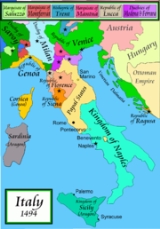
The First Italian War (1494–98), sometimes referred to as the Italian War of 1494 or Charles VIII's Italian War, was the opening phase of the Italian Wars
. The war pitted Charles VIII of France
, who had initial Milanese
aid, against the Holy Roman Empire
, Spain
, and an alliance of Italian
powers led by Pope Alexander VI
.
, in conflict with King Ferdinand I of Naples
over Ferdinand's refusal to pay feudal dues to the papacy, excommunicated
and deposed Ferdinand by a bull
of 11 September 1489. Innocent then offered the Kingdom of Naples
to King Charles VIII of France
, who had a remote claim to Naples through the Angevin
line. Innocent later settled his quarrel with Ferdinand and revoked the bans before dying in 1492, but the offer remained an apple of Discord
in Italian
politics. Ferdinand died in January 1494, and was succeeded by his son Alfonso II
.
, who had long controlled the Duchy of Milan
, finally procured the ducal title after providing a hitherto unheard-of dowry to his niece, who was marrying the Holy Roman Emperor, Maximilian. He was immediately challenged by Alfonso II, who also had a claim on Milan. Ludovico decided to remove this threat by inciting Charles to take up Innocent's offer. Charles was also being encouraged by his favorite, Étienne de Vesc
as well as Cardinal Giuliano della Rovere, the future Pope Julius II
, who hoped to settle a score with Pope Alexander VI
.
Charles gathered a large army of 25,000 men (including 8,000 Swiss mercenaries
), including the first siege train to include artillery
, and invaded Italy. The arrival of his army outside Florence
and the fears of rape and pillage incited the Florentines to exile Piero de' Medici
and establish a republican government. Bernardo Rucellai
and other members of the Florentine oligarchy acted as ambassadors to negotiate a peaceful accord.
The French reached Naples
in February 1495 and captured it without a siege or pitched battle. They left Naples on 20 May 1495, leaving Gilbert de Montpensier as Viceroy
, with some troops.
The Italian states, however, quickly realized the danger of foreign monarchy to their autonomy and collaborated to create the League of Venice. After Ferdinand of Aragon recovers Naples (with help from his Spanish relatives with whom he sought asylum in Sicily), the Italian army followed Charles VIII's retreat North through Rome
, recently abandoned to the army notorious for its plundering by Pope Alexander VI
.
was embroiled in a power game with France and various Italian states over his attempts to secure secular fiefdoms for his children. The Pope formed an alliance of several opponents of French hegemony in Italy: himself; Ferdinand of Aragon
, who was also King of Sicily
; Emperor
Maximilian I
; Ludovico in Milan
; and the Republic of Venice
. (Venice's ostensible purpose in joining the League was to oppose the Ottoman Empire
, while its actual objective was to expel the French from Italy.) This alliance was known as the Holy League of 1495 or the League of Venice, and was proclaimed on 31 March 1495. England joined in 1496. The League was the first of its kind: there was no medieval precedent of such divergent European states uniting against a common enemy, although many would be forged in the future.
The League gathered an army under the condottiero Francesco II of Gonzaga. Charles, not wanting to be trapped in Naples, marched north to Lombardy
. There he met the League in the Battle of Fornovo
, 6 July 1495. Charles successfully retreated with most of his army, but had to abandon nearly all of the booty from his campaign and return to France. He died before he could regroup his forces and return to Italy.
Italian Wars
The Italian Wars, often referred to as the Great Italian Wars or the Great Wars of Italy and sometimes as the Habsburg–Valois Wars, were a series of conflicts from 1494 to 1559 that involved, at various times, most of the city-states of Italy, the Papal States, most of the major states of Western...
. The war pitted Charles VIII of France
Charles VIII of France
Charles VIII, called the Affable, , was King of France from 1483 to his death in 1498. Charles was a member of the House of Valois...
, who had initial Milanese
Duchy of Milan
The Duchy of Milan , was created on the 1st of may 1395, when Gian Galeazzo Visconti, Lord of Milan, purchased a diploma for 100,000 Florins from King Wenceslaus. It was this diploma that installed, Gian Galeazzo as Duke of Milan and Count of Pavia...
aid, against the Holy Roman Empire
Holy Roman Empire
The Holy Roman Empire was a realm that existed from 962 to 1806 in Central Europe.It was ruled by the Holy Roman Emperor. Its character changed during the Middle Ages and the Early Modern period, when the power of the emperor gradually weakened in favour of the princes...
, Spain
Spain
Spain , officially the Kingdom of Spain languages]] under the European Charter for Regional or Minority Languages. In each of these, Spain's official name is as follows:;;;;;;), is a country and member state of the European Union located in southwestern Europe on the Iberian Peninsula...
, and an alliance of Italian
Italy
Italy , officially the Italian Republic languages]] under the European Charter for Regional or Minority Languages. In each of these, Italy's official name is as follows:;;;;;;;;), is a unitary parliamentary republic in South-Central Europe. To the north it borders France, Switzerland, Austria and...
powers led by Pope Alexander VI
Pope Alexander VI
Pope Alexander VI , born Roderic Llançol i Borja was Pope from 1492 until his death on 18 August 1503. He is one of the most controversial of the Renaissance popes, and his Italianized surname—Borgia—became a byword for the debased standards of the Papacy of that era, most notoriously the Banquet...
.
Prelude
Pope Innocent VIIIPope Innocent VIII
Pope Innocent VIII , born Giovanni Battista Cybo , was Pope from 1484 until his death.-Early years:Giovanni Battista Cybo was born at Genoa of Greek extraction...
, in conflict with King Ferdinand I of Naples
Ferdinand I of Naples
Ferdinand I , also called Don Ferrante, was the King of Naples from 1458 to 1494. He was the natural son of Alfonso V of Aragon by Giraldona Carlino.-Biography:...
over Ferdinand's refusal to pay feudal dues to the papacy, excommunicated
Excommunication
Excommunication is a religious censure used to deprive, suspend or limit membership in a religious community. The word means putting [someone] out of communion. In some religions, excommunication includes spiritual condemnation of the member or group...
and deposed Ferdinand by a bull
Papal bull
A Papal bull is a particular type of letters patent or charter issued by a Pope of the Catholic Church. It is named after the bulla that was appended to the end in order to authenticate it....
of 11 September 1489. Innocent then offered the Kingdom of Naples
Kingdom of Naples
The Kingdom of Naples, comprising the southern part of the Italian peninsula, was the remainder of the old Kingdom of Sicily after secession of the island of Sicily as a result of the Sicilian Vespers rebellion of 1282. Known to contemporaries as the Kingdom of Sicily, it is dubbed Kingdom of...
to King Charles VIII of France
Charles VIII of France
Charles VIII, called the Affable, , was King of France from 1483 to his death in 1498. Charles was a member of the House of Valois...
, who had a remote claim to Naples through the Angevin
House of Valois-Anjou
The Valois House of Anjou, or the Younger House of Anjou, was a noble French family, deriving from the royal family, the House of Valois. They were monarchs of Naples, as well as various other territories....
line. Innocent later settled his quarrel with Ferdinand and revoked the bans before dying in 1492, but the offer remained an apple of Discord
Apple of Discord
An apple of discord is a reference to the Golden Apple of Discord which, according to Greek mythology, the goddess Eris said that she would give "to the fairest" at the wedding of Peleus and Thetis, sparking a vanity-fueled dispute between Hera, Athena and Aphrodite that eventually led to the...
in Italian
Italy
Italy , officially the Italian Republic languages]] under the European Charter for Regional or Minority Languages. In each of these, Italy's official name is as follows:;;;;;;;;), is a unitary parliamentary republic in South-Central Europe. To the north it borders France, Switzerland, Austria and...
politics. Ferdinand died in January 1494, and was succeeded by his son Alfonso II
Alfonso II of Naples
Alfonso II of Naples , also called Alfonso II d'Aragon, was King of Naples from 25 January 1494 to 22 February 1495 with the title King of Naples and Jerusalem...
.
French invasion
In October 1494, Ludovico SforzaLudovico Sforza
Ludovico Sforza , was Duke of Milan from 1489 until his death. A member of the Sforza family, he was the fourth son of Francesco Sforza. He was famed as a patron of Leonardo da Vinci and other artists, and presided over the final and most productive stage of the Milanese Renaissance...
, who had long controlled the Duchy of Milan
Duchy of Milan
The Duchy of Milan , was created on the 1st of may 1395, when Gian Galeazzo Visconti, Lord of Milan, purchased a diploma for 100,000 Florins from King Wenceslaus. It was this diploma that installed, Gian Galeazzo as Duke of Milan and Count of Pavia...
, finally procured the ducal title after providing a hitherto unheard-of dowry to his niece, who was marrying the Holy Roman Emperor, Maximilian. He was immediately challenged by Alfonso II, who also had a claim on Milan. Ludovico decided to remove this threat by inciting Charles to take up Innocent's offer. Charles was also being encouraged by his favorite, Étienne de Vesc
Étienne de Vesc
Étienne de Vesc , was a courtier of Louis XI of France and a formative influence on Charles VIII, whom he strongly encouraged in the French adventure into Italy in the First Italian War .-Biography:...
as well as Cardinal Giuliano della Rovere, the future Pope Julius II
Pope Julius II
Pope Julius II , nicknamed "The Fearsome Pope" and "The Warrior Pope" , born Giuliano della Rovere, was Pope from 1503 to 1513...
, who hoped to settle a score with Pope Alexander VI
Pope Alexander VI
Pope Alexander VI , born Roderic Llançol i Borja was Pope from 1492 until his death on 18 August 1503. He is one of the most controversial of the Renaissance popes, and his Italianized surname—Borgia—became a byword for the debased standards of the Papacy of that era, most notoriously the Banquet...
.
Charles gathered a large army of 25,000 men (including 8,000 Swiss mercenaries
Swiss mercenaries
Swiss mercenaries were notable for their service in foreign armies, especially the armies of the Kings of France, throughout the Early Modern period of European history, from the Later Middle Ages into the Age of the European Enlightenment...
), including the first siege train to include artillery
Artillery
Originally applied to any group of infantry primarily armed with projectile weapons, artillery has over time become limited in meaning to refer only to those engines of war that operate by projection of munitions far beyond the range of effect of personal weapons...
, and invaded Italy. The arrival of his army outside Florence
Florence
Florence is the capital city of the Italian region of Tuscany and of the province of Florence. It is the most populous city in Tuscany, with approximately 370,000 inhabitants, expanding to over 1.5 million in the metropolitan area....
and the fears of rape and pillage incited the Florentines to exile Piero de' Medici
Piero de' Medici
Piero de' Medici may refer to:*Piero di Cosimo de' Medici , father of Lorenzo the Magnificent...
and establish a republican government. Bernardo Rucellai
Bernardo Rucellai
Also known as Bernardus Oricellarius was born in 1448 or 1449 and died on October 7, 1514. An oligarch, banker, ambassador and man-of-letters, his influence was far-reaching...
and other members of the Florentine oligarchy acted as ambassadors to negotiate a peaceful accord.
The French reached Naples
Naples
Naples is a city in Southern Italy, situated on the country's west coast by the Gulf of Naples. Lying between two notable volcanic regions, Mount Vesuvius and the Phlegraean Fields, it is the capital of the region of Campania and of the province of Naples...
in February 1495 and captured it without a siege or pitched battle. They left Naples on 20 May 1495, leaving Gilbert de Montpensier as Viceroy
Viceroy
A viceroy is a royal official who runs a country, colony, or province in the name of and as representative of the monarch. The term derives from the Latin prefix vice-, meaning "in the place of" and the French word roi, meaning king. A viceroy's province or larger territory is called a viceroyalty...
, with some troops.
The Italian states, however, quickly realized the danger of foreign monarchy to their autonomy and collaborated to create the League of Venice. After Ferdinand of Aragon recovers Naples (with help from his Spanish relatives with whom he sought asylum in Sicily), the Italian army followed Charles VIII's retreat North through Rome
Rome
Rome is the capital of Italy and the country's largest and most populated city and comune, with over 2.7 million residents in . The city is located in the central-western portion of the Italian Peninsula, on the Tiber River within the Lazio region of Italy.Rome's history spans two and a half...
, recently abandoned to the army notorious for its plundering by Pope Alexander VI
Pope Alexander VI
Pope Alexander VI , born Roderic Llançol i Borja was Pope from 1492 until his death on 18 August 1503. He is one of the most controversial of the Renaissance popes, and his Italianized surname—Borgia—became a byword for the debased standards of the Papacy of that era, most notoriously the Banquet...
.
League of Venice
The speed of the French advance, together with the brutality of their attacks on cities, left the other states of Italy in shock. Ludovico, realizing that Charles had a claim to Milan as well, and would likely not be sated with the annexation of Naples alone, turned to the Papacy. Pope Alexander VIPope Alexander VI
Pope Alexander VI , born Roderic Llançol i Borja was Pope from 1492 until his death on 18 August 1503. He is one of the most controversial of the Renaissance popes, and his Italianized surname—Borgia—became a byword for the debased standards of the Papacy of that era, most notoriously the Banquet...
was embroiled in a power game with France and various Italian states over his attempts to secure secular fiefdoms for his children. The Pope formed an alliance of several opponents of French hegemony in Italy: himself; Ferdinand of Aragon
Ferdinand II of Aragon
Ferdinand the Catholic was King of Aragon , Sicily , Naples , Valencia, Sardinia, and Navarre, Count of Barcelona, jure uxoris King of Castile and then regent of that country also from 1508 to his death, in the name of...
, who was also King of Sicily
Sicily
Sicily is a region of Italy, and is the largest island in the Mediterranean Sea. Along with the surrounding minor islands, it constitutes an autonomous region of Italy, the Regione Autonoma Siciliana Sicily has a rich and unique culture, especially with regard to the arts, music, literature,...
; Emperor
Holy Roman Empire
The Holy Roman Empire was a realm that existed from 962 to 1806 in Central Europe.It was ruled by the Holy Roman Emperor. Its character changed during the Middle Ages and the Early Modern period, when the power of the emperor gradually weakened in favour of the princes...
Maximilian I
Maximilian I, Holy Roman Emperor
Maximilian I , the son of Frederick III, Holy Roman Emperor and Eleanor of Portugal, was King of the Romans from 1486 and Holy Roman Emperor from 1493 until his death, though he was never in fact crowned by the Pope, the journey to Rome always being too risky...
; Ludovico in Milan
Milan
Milan is the second-largest city in Italy and the capital city of the region of Lombardy and of the province of Milan. The city proper has a population of about 1.3 million, while its urban area, roughly coinciding with its administrative province and the bordering Province of Monza and Brianza ,...
; and the Republic of Venice
Republic of Venice
The Republic of Venice or Venetian Republic was a state originating from the city of Venice in Northeastern Italy. It existed for over a millennium, from the late 7th century until 1797. It was formally known as the Most Serene Republic of Venice and is often referred to as La Serenissima, in...
. (Venice's ostensible purpose in joining the League was to oppose the Ottoman Empire
Ottoman Empire
The Ottoman EmpireIt was usually referred to as the "Ottoman Empire", the "Turkish Empire", the "Ottoman Caliphate" or more commonly "Turkey" by its contemporaries...
, while its actual objective was to expel the French from Italy.) This alliance was known as the Holy League of 1495 or the League of Venice, and was proclaimed on 31 March 1495. England joined in 1496. The League was the first of its kind: there was no medieval precedent of such divergent European states uniting against a common enemy, although many would be forged in the future.
The League gathered an army under the condottiero Francesco II of Gonzaga. Charles, not wanting to be trapped in Naples, marched north to Lombardy
Lombardy
Lombardy is one of the 20 regions of Italy. The capital is Milan. One-sixth of Italy's population lives in Lombardy and about one fifth of Italy's GDP is produced in this region, making it the most populous and richest region in the country and one of the richest in the whole of Europe...
. There he met the League in the Battle of Fornovo
Battle of Fornovo
The Battle of Fornovo took place 30 km southwest of the city of Parma on 6 July 1495. The League of Venice was able to temporarily expel the French from the Italian Peninsula. It was the first major battle of the Italian Wars.-Antecedents:...
, 6 July 1495. Charles successfully retreated with most of his army, but had to abandon nearly all of the booty from his campaign and return to France. He died before he could regroup his forces and return to Italy.