


Finland-Swedish

Encyclopedia
Dialect
The term dialect is used in two distinct ways, even by linguists. One usage refers to a variety of a language that is a characteristic of a particular group of the language's speakers. The term is applied most often to regional speech patterns, but a dialect may also be defined by other factors,...
s of Swedish
Swedish language
Swedish is a North Germanic language, spoken by approximately 10 million people, predominantly in Sweden and parts of Finland, especially along its coast and on the Åland islands. It is largely mutually intelligible with Norwegian and Danish...
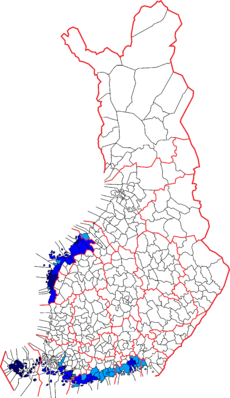
spoken in Finland
Finland
Finland , officially the Republic of Finland, is a Nordic country situated in the Fennoscandian region of Northern Europe. It is bordered by Sweden in the west, Norway in the north and Russia in the east, while Estonia lies to its south across the Gulf of Finland.Around 5.4 million people reside...
by Swedish-speaking Finns as their mother tongue
First language
A first language is the language a person has learned from birth or within the critical period, or that a person speaks the best and so is often the basis for sociolinguistic identity...
. For the most part, these dialects and the dialects spoken in Sweden are mutually intelligible, although some archaic Swedish dialects in Ostrobothnia
Swedish dialects in Ostrobothnia
Ostrobothnian Swedish is a variety of Finland-Swedish, spoken in Finland. Outside the autonomous island province of Åland, which is officially monolingually Swedish, Ostrobothnia is the only region of Finland besides Åland where the Swedish-speakers are in the majority...
are practically unintelligible to Swedish-speaking people in southern Finland (and in Sweden). Most Swedish-speaking Finns emphasize that Finland Swedish is not a language separate from the Swedish of Sweden. The Swedish dialects in Finland are considered varieties
Variety (linguistics)
In sociolinguistics a variety, also called a lect, is a specific form of a language or language cluster. This may include languages, dialects, accents, registers, styles or other sociolinguistic variation, as well as the standard variety itself...
of Swedish, and the norm for written Standard Swedish
Standard Swedish
Standard Swedish denotes Swedish as a spoken and written standard language. While Swedish as a written language is uniform and standardized, the spoken standard may vary considerably from region to region...
is completely applicable also for Finland Swedish.
Swedish as spoken in Finland is regulated by the Swedish Department of the Research Institute for the Languages of Finland
Research Institute for the Languages of Finland
The Research Institute for the Languages of Finland is a governmental linguistic research institute of Finland geared at studies of Finnish, Swedish , the Sami languages, Romani language, and the Finnish Sign Language....
. This regulation includes the officially stated aim of keeping Finland Swedish close to the Swedish as spoken in Sweden and strongly phrased advice against loanword
Loanword
A loanword is a word borrowed from a donor language and incorporated into a recipient language. By contrast, a calque or loan translation is a related concept where the meaning or idiom is borrowed rather than the lexical item itself. The word loanword is itself a calque of the German Lehnwort,...
s and calque
Calque
In linguistics, a calque or loan translation is a word or phrase borrowed from another language by literal, word-for-word or root-for-root translation.-Calque:...
s from Finnish
Finnish language
Finnish is the language spoken by the majority of the population in Finland Primarily for use by restaurant menus and by ethnic Finns outside Finland. It is one of the two official languages of Finland and an official minority language in Sweden. In Sweden, both standard Finnish and Meänkieli, a...
, which are usually incomprehensible to Swedes.
An often repeated "fact" is that the municipality with the highest proportion of Swedish speakers in the world, Hammarland
Hammarland
Hammarland is a municipality of Åland, an autonomous territory of Finland.The municipality has a population of and covers an area of ofwhich is water. The population density is.The municipality is unilingually Swedish...
(96% ), is located in Finland. Korsnäs
Korsnäs
Korsnäs is a municipality of Finland.It is located in the province of Western Finland and is part of the Ostrobothnia region. The municipality has a population of and covers an area of of which is water. The population density is ....
has also held this title and is often cited as such. However, as there are no official statistics on the mother tongue of inhabitants of Sweden, this is hard or impossible to verify and should probably be taken with a grain of salt.
In the spoken slang-language, especially among young people in Finnish-dominated areas, Finnish loanword
Loanword
A loanword is a word borrowed from a donor language and incorporated into a recipient language. By contrast, a calque or loan translation is a related concept where the meaning or idiom is borrowed rather than the lexical item itself. The word loanword is itself a calque of the German Lehnwort,...
s as well as calque
Calque
In linguistics, a calque or loan translation is a word or phrase borrowed from another language by literal, word-for-word or root-for-root translation.-Calque:...
s from Finnish are frequently incorporated into Finland Swedish. There are also some words in Finland Swedish that would be considered slightly archaic in Sweden. Some government and public service terms that have been created in recent centuries also differ. The same is true of other new words, notably loanwords from English
English language
English is a West Germanic language that arose in the Anglo-Saxon kingdoms of England and spread into what was to become south-east Scotland under the influence of the Anglian medieval kingdom of Northumbria...
.
A common mistake made by many Swedes
Sweden
Sweden , officially the Kingdom of Sweden , is a Nordic country on the Scandinavian Peninsula in Northern Europe. Sweden borders with Norway and Finland and is connected to Denmark by a bridge-tunnel across the Öresund....
is to mistake Finland Swedish for Swedish with a Finnish
Finnish language
Finnish is the language spoken by the majority of the population in Finland Primarily for use by restaurant menus and by ethnic Finns outside Finland. It is one of the two official languages of Finland and an official minority language in Sweden. In Sweden, both standard Finnish and Meänkieli, a...
accent, something that can be a considerable source of frustration to most Swedish-speaking Finns. Any language adopts features, especially pronunciation habits, from dominant languages it comes in touch with, but many of the traits of Finland Swedish exist also in monolingual areas and some are in fact preserved features of old Swedish. The pronunciation of Finland Swedish by a Swedish-speaking Finn is different from that of Finnish speakers pronouncing Swedish as a foreign language.
History
From the 16th century, Swedish was the main language of jurisdiction, administration, and higher education in FinlandFinland
Finland , officially the Republic of Finland, is a Nordic country situated in the Fennoscandian region of Northern Europe. It is bordered by Sweden in the west, Norway in the north and Russia in the east, while Estonia lies to its south across the Gulf of Finland.Around 5.4 million people reside...
, but the majority of the population spoke Finnish
Finnish language
Finnish is the language spoken by the majority of the population in Finland Primarily for use by restaurant menus and by ethnic Finns outside Finland. It is one of the two official languages of Finland and an official minority language in Sweden. In Sweden, both standard Finnish and Meänkieli, a...
outside of these sectors of society, i.e. in normal, daily life. In 1809, when Finland became an autonomous Grand Duchy
Grand Duchy of Finland
The Grand Duchy of Finland was the predecessor state of modern Finland. It existed 1809–1917 as part of the Russian Empire and was ruled by the Russian czar as Grand Prince.- History :...
in the Russian Empire
Russian Empire
The Russian Empire was a state that existed from 1721 until the Russian Revolution of 1917. It was the successor to the Tsardom of Russia and the predecessor of the Soviet Union...
, Swedish remained the only official language. In 1863, Finnish and Swedish became official language
Official language
An official language is a language that is given a special legal status in a particular country, state, or other jurisdiction. Typically a nation's official language will be the one used in that nation's courts, parliament and administration. However, official status can also be used to give a...
s with equal status, and by the time of Finland's independence
Finland's declaration of independence
The Finnish declaration of independence was adopted by the Parliament of Finland on 6 December 1917. It declared Finland an independent and sovereign nation state rather than an autonomous Russian Grand duchy.-Revolution in Russia:...
in 1917, Finnish clearly dominated in government and society.
Finland has since then been a bilingual country with a Swedish-speaking minority
Minority language
A minority language is a language spoken by a minority of the population of a territory. Such people are termed linguistic minorities or language minorities.-International politics:...
(5.5% of mainland Finland
Mainland Finland
Mainland Finland is a term used for instance in statistics to exclude the autonomous Åland Islands under Finnish sovereignty. Mainland Finland is not to be confused with Finland Proper, which is the province adjacent to Åland...
's population in 2006) living mostly in the coastal areas of southern, south-western, and western Finland. During the 20th century, the urbanization
Urbanization
Urbanization, urbanisation or urban drift is the physical growth of urban areas as a result of global change. The United Nations projected that half of the world's population would live in urban areas at the end of 2008....
following the Industrial Revolution
Industrial Revolution
The Industrial Revolution was a period from the 18th to the 19th century where major changes in agriculture, manufacturing, mining, transportation, and technology had a profound effect on the social, economic and cultural conditions of the times...
has led to large majorities of Finnish speakers in all major cities. The capital Helsinki
Helsinki
Helsinki is the capital and largest city in Finland. It is in the region of Uusimaa, located in southern Finland, on the shore of the Gulf of Finland, an arm of the Baltic Sea. The population of the city of Helsinki is , making it by far the most populous municipality in Finland. Helsinki is...
(in Swedish Helsingfors) became predominantly Finnish speaking as early as around 1900. A large and important part of the Swedish-speaking population nevertheless lives in the capital.
The autonomous island province
Island province
Island province is a province with jurisdictional extent encompassing the whole land area of an island.A province cannot be called an "island province" if a certain part of the island is governed or administered by a separate province...
of Åland is an exception, being monolingually Swedish speaking according to international treaties. It is a matter of definition whether the Swedish dialect
Dialect
The term dialect is used in two distinct ways, even by linguists. One usage refers to a variety of a language that is a characteristic of a particular group of the language's speakers. The term is applied most often to regional speech patterns, but a dialect may also be defined by other factors,...
s spoken on Åland are to be considered a kind of Finland Swedish or not. Most Swedish-speaking Finns and linguists consider them to be closer to some of the dialects spoken in nearby parts of Sweden.
Official status
Swedish is one of the two national languages of the republic of Finland, the other being Finnish. These two language have formally equal status in nearly all legislation. The other minority languages (such as SamiSami languages
Sami or Saami is a general name for a group of Uralic languages spoken by the Sami people in parts of northern Finland, Norway, Sweden and extreme northwestern Russia, in Northern Europe. Sami is frequently and erroneously believed to be a single language. Several names are used for the Sami...
) are regulated separately.
Finland Swedish is regulated by the Research Institute for the Languages of Finland
Research Institute for the Languages of Finland
The Research Institute for the Languages of Finland is a governmental linguistic research institute of Finland geared at studies of Finnish, Swedish , the Sami languages, Romani language, and the Finnish Sign Language....
. Official Swedish is not supposed to be different from Swedish as found in Sweden.
Bilingualism of municipalities is regulated by the Language Act of 2003. If the minority has increased into at least 3,000 persons or 8% of inhabitants, then the municipality must become bilingual. If the minority has fallen below 3,000 persons and 6% of inhabitants, then the municipality must become monolingual, unless it decides to keep its bilingual status. At present, only one such municipality has done so, namely Lohja
Lohja
Lohja , is a town and municipality of Finland.It is located in the province of Southern Finland and is part of the Uusimaa region. The town has a population of and covers an area of ofwhich is water...
(Lojo in Swedish). The status is reviewed once in a decade, and enacted by a government decree issued by the Finnish Council of State
Finnish Council of State
The Cabinet of Finland is the body that directs the Government of Finland. However, in governmental translations to English, the distinction is often blurred between cabinet and government in the wider sense...
.
The country's public broadcaster, YLE, provides two Swedish-language radio stations, Radio Vega
YLE Radio Vega
Radio Vega is a Finnish radio channel broadcasting in the Swedish language with headquarters in Helsinki. It is a wide-ranging national public service broadcaster with both speech and voice based programming operated by Yleisradio...
and YLE X3M, as well a TV channel, FST5.
Phonology
With the exception of the dialects spoken in OstrobothniaOstrobothnia (region)
Ostrobothnia is a region of Finland. It is located in Western Finland. It borders the regions Central Ostrobothnia, Southern Ostrobothnia, and Satakunta and is one of the four regions making up the historical province of Ostrobothnia....
along the west coast, close to the Gulf of Bothnia
Gulf of Bothnia
The Gulf of Bothnia is the northernmost arm of the Baltic Sea. It is situated between Finland's west coast and Sweden's east coast. In the south of the gulf lie the Åland Islands, between the Sea of Åland and the Archipelago Sea.-Name:...
(example: the dialect spoken in Närpes
Närpes
Närpes is a town and municipality of Finland.The municipality is located in the province of Western Finland and is part of the Ostrobothnia region. The town has a population of and covers an area of of which is water. The population density is ....
), Finland Swedish is not particularly different from Central Swedish. The phonology is identical, but it has slightly different vowel qualities. The phoneme /ʉ/ is more centralized and pronounced like [ʉ], quite similar to how many American English
American English
American English is a set of dialects of the English language used mostly in the United States. Approximately two-thirds of the world's native speakers of English live in the United States....
pronounce /u/ (as in moon). This should be compared to the Central Swedish [ʉ̟], which is very close to the short vowel [ʏ] and is more rounded
Rounding
Rounding a numerical value means replacing it by another value that is approximately equal but has a shorter, simpler, or more explicit representation; for example, replacing $23.4476 with $23.45, or the fraction 312/937 with 1/3, or the expression √2 with 1.414.Rounding is often done on purpose to...
.
The realization of the highly variable phoneme
Phoneme
In a language or dialect, a phoneme is the smallest segmental unit of sound employed to form meaningful contrasts between utterances....
ɧ is more frontal on the mainland and can vary between [ʂ] and [ɕ ~ ʃ], while the realizations on Åland are more similar to the velar (and often distinctly labialized) [ɧ] in the neighboring parts of Sweden. /ɕ/ is affricated into [t͡ɕ] or [t͡ʃ] in all dialects including in standard Finland Swedish.
The tonal word accent
Pitch accent
Pitch accent is a linguistic term of convenience for a variety of restricted tone systems that use variations in pitch to give prominence to a syllable or mora within a word. The placement of this tone or the way it is realized can give different meanings to otherwise similar words...
, which distinguishes some minimal pairs in most dialects of Swedish and Norwegian, is not present in Finland Swedish (except around the parish of Snappertuna, west of Helsinki). The so-called "accent 2", used mainly in words with a two-syllable root, is not used at all; instead, "accent 1" is used in all words. Hence, Sweden Swedish minimal pairs like /ˈandɛn/ ("the duck") - with stress on only the first syllable - and /ˌandˈɛn/ ("the spirit") - with both syllables stressed - are both pronounced [ˈandɛn] in Finland.
See also
- Åland SwedishÅland SwedishÅland Swedish is a dialect of Swedish spoken in the Åland Islands, an autonomous province of Finland. Åland Swedish has similarities to both Finland Swedish and the historical dialects of Uppland, but it is generally considered to be a variant of Eastern Swedish .Swedish is the sole official...
- Swedish-speaking Finns
- Sweden SwedishSweden SwedishSweden Swedish is a term sometimes used to distinguish the Swedish as spoken in Sweden from Finland Swedish, Estonia Swedish or other variants of the same language as spoken in other countries, regardless of dialects....
External links
- SweDia - a collection of dialect samples of Swedish including Finland Swedish