

Old Novgorod dialect

Encyclopedia
Old Novgorod dialect is a term introduced by Andrey Zaliznyak
to describe the astonishingly diverse linguistic features of the Old East Slavic
birch bark writings ("berestyanaya gramota") from the 11th to 15th centuries excavated in Novgorod and its surroundings. The first birch bark letter was found on July 26, 1951 by Nina Fedorovna Akulova, and at least 1025 have been unearthed thereafter—923 in Novgorod alone. Today, the study of Novgorodian birch bark letters is an established scholarly field in Russian historical linguistics, with far-ranging historical as well as archaeological implications for the study of the Russian Middle Ages.
, reflecting living speech, and almost entirely free of the heavy Church Slavonic influence seen in the literary language of the period. Some of the observed linguistic features are not found in any other Slavic dialect, representing important Proto-Slavic
archaisms.
Zaliznyak differentiates amongst Old Novgorod features that were already known before the discovery of birch bark letters, and those that have been ascertained after their study during the last few decades. Features previously known were:
Features of the Old Novgorod dialect ascertained by the philological study in the last decades are:
The orthography
is domestic (as opposed to bookish), using ъ
and о
on the one hand and ь
and е
on the other synonymously.
Therefore, according to Zaliznyak, the discovery of Old Novgorod dialect makes it possible to conclude that earlier conception of East Slavic as a relatively homogeneous linguistic unity has been rendered obsolete by a view of East Slavic as an area of much greater dialectal diversity. Zaliznyak therefore divides East Slavic area into two dialectal groupings: Proto-Novgorodian-Pskovian on one side, singled out chiefly on the basis of two features of the lack of second palatalization of velars and the ending -e in nominative singular of masculine o-stems, and all the remaining East Slavic dialects on the other side.
 Original text (with added word division):
Translation [with explanations in square brackets]:
 Original text (with added word division):
Translation:
Andrey Zaliznyak
Andrey Anatolyevich Zaliznyak, is a Russian linguist who specializes in the research of linguistic monuments of Old Novgorod....
to describe the astonishingly diverse linguistic features of the Old East Slavic
Old East Slavic language
Old East Slavic or Old Ruthenian was a language used in 10th-15th centuries by East Slavs in the Kievan Rus' and states which evolved after the collapse of the Kievan Rus...
birch bark writings ("berestyanaya gramota") from the 11th to 15th centuries excavated in Novgorod and its surroundings. The first birch bark letter was found on July 26, 1951 by Nina Fedorovna Akulova, and at least 1025 have been unearthed thereafter—923 in Novgorod alone. Today, the study of Novgorodian birch bark letters is an established scholarly field in Russian historical linguistics, with far-ranging historical as well as archaeological implications for the study of the Russian Middle Ages.
Linguistic features
The short birch-bark texts are written in a peculiar Slavic vernacularVernacular
A vernacular is the native language or native dialect of a specific population, as opposed to a language of wider communication that is not native to the population, such as a national language or lingua franca.- Etymology :The term is not a recent one...
, reflecting living speech, and almost entirely free of the heavy Church Slavonic influence seen in the literary language of the period. Some of the observed linguistic features are not found in any other Slavic dialect, representing important Proto-Slavic
Proto-Slavic language
Proto-Slavic is the proto-language from which Slavic languages later emerged. It was spoken before the seventh century AD. As with most other proto-languages, no attested writings have been found; the language has been reconstructed by applying the comparative method to all the attested Slavic...
archaisms.
Zaliznyak differentiates amongst Old Novgorod features that were already known before the discovery of birch bark letters, and those that have been ascertained after their study during the last few decades. Features previously known were:
- tsokanyeTs-ch mergerIn phonology, the ts-ch merger is the merger of the voiceless alveolar affricate and the voiceless postalveolar affricate.In Russian language it is the merger of the consonants rendered by letters Che and Tse...
- the secondary pleophony, i. e. мълъвити as opposed to мълвити
- retention of /x/ in the root of the word "весь", i. e. вьхо
- lack of the Slavic second palatalizationSlavic second palatalizationSlavic second palatalization is a Proto-Slavic sound change, that manifested as a regressive palatalization of inherited Balto-Slavic velars and velar fricative, chronologically occurring after the first and the third palatalization.-Motivation:...
in root-final position, i. e. рукѣ, моги - the change vl’ > l’, i. e. Яколь, Яковлев
- nominative singular masculine of o-stems -e, i. e. Иване, посаднике, хлѣбе
- genitive singular of а-stems in -ě i. e. бес кунѣ
- nominoaccusative plural of а-stems in -ě, i. e. кобылѣ, сиротѣ
Features of the Old Novgorod dialect ascertained by the philological study in the last decades are:
- lack of the second palatalization in root-initial position, i. e. кѣл-, хѣр-
- a particular reflex of *CъRC clusters, i. e. млъви versus мълви
- a particular reflex of *CоRC clusters, i. e. погродье versus погородие
- the change ml’ > n’, i. e. емлючи > енючи
- no merger of nominative and accusative singular of masculines regardless of animacy, i. e. N sg. погосте : A sg. на погостъ
- Proto-Slavic *kv, *gv clusters were retained (like in West Slavic languagesWest Slavic languagesThe West Slavic languages are a subdivision of the Slavic language group that includes Czech, Polish, Slovak, Kashubian and Sorbian.Classification:* Indo-European** Balto-Slavic*** Slavic**** West Slavic***** Czech-Slovak languages****** Czech...
) instead of being transformed to cv, zv before front vowels like in other East Slavic dialects
The orthography
Orthography
The orthography of a language specifies a standardized way of using a specific writing system to write the language. Where more than one writing system is used for a language, for example Kurdish, Uyghur, Serbian or Inuktitut, there can be more than one orthography...
is domestic (as opposed to bookish), using ъ
Yer
The letter yer of the Cyrillic alphabet, also spelled jer or er, is known as the hard sign in the modern Russian and Rusyn alphabets and as er golyam in the Bulgarian alphabet...
and о
O (Cyrillic)
O is a letter of the Cyrillic script.O commonly represents the close-mid back rounded vowel , like the pronunciation of ⟨o⟩ in "go".-History:The Cyrillic letter O was derived from the Greek letter Omicron ....
on the one hand and ь
Soft sign
The soft sign , also known as yer, is a letter of the Cyrillic script. In Old Church Slavonic, it represented a short front vowel. As with its companion, the back yer, the vowel phoneme it designated was later partly dropped and partly merged with other vowels...
and е
Ye (Cyrillic)
Ye is a letter of the Cyrillic alphabet. In some languages this letter is called E.It commonly represents the vowel or , like the pronunciation of ⟨e⟩ in "yes".Ye is romanized using the Latin letter E....
on the other synonymously.
Implications of Old Novgorod findings
According to Zaliznyak, the Old Novgorod linguistic features, instead of being merely isolated deviations, represent a bundle of peculiar isoglosses. The deviations are more abundant in older birch bark letters than in the younger ones, and this development indicates, contrary to what is expected, that the development was convergent rather than divergent, with regard to other northern East Slavic dialects.Therefore, according to Zaliznyak, the discovery of Old Novgorod dialect makes it possible to conclude that earlier conception of East Slavic as a relatively homogeneous linguistic unity has been rendered obsolete by a view of East Slavic as an area of much greater dialectal diversity. Zaliznyak therefore divides East Slavic area into two dialectal groupings: Proto-Novgorodian-Pskovian on one side, singled out chiefly on the basis of two features of the lack of second palatalization of velars and the ending -e in nominative singular of masculine o-stems, and all the remaining East Slavic dialects on the other side.
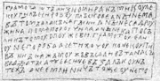
A criminal case: Novgorod birch-bark letter no. 109
(between end of 11th century and 1110s; excavated 1954)
грамота : ѡтъ жизномира : къ микѹле :
кѹпилъ еси : робѹ : плъскове : а ныне мѧ :
въ томъ : ѧла кънѧгыни : а ныне сѧ дрѹжина : по мя порѹчила : а ныне ка : посъли къ томѹ : моужеви : грамотѹ : е ли
ѹ него роба : а се ти хочѹ : коне кѹпивъ : и кънѧжъ мѹжъ въсадивъ : та на съводы : а ты атче еси не възялъ кѹнъ :
техъ : а не емли : ничъто же ѹ него :
Translation [with explanations in square brackets]:
Letter from Zhiznomir to Mikula: You have bought a female slave in PskovPskovPskov is an ancient city and the administrative center of Pskov Oblast, Russia, located in the northwest of Russia about east from the Estonian border, on the Velikaya River. Population: -Early history:...
. And now the princess has arrested me for it. [Obviously she has recognized the slave as having been stolen from her, and Zhiznomir is somehow connected with the affair, maybe as Mikula's family member or business partner.] But now druzhinaDruzhinaDruzhina, Drużyna or Družyna in the medieval history of Slavic Europe was a retinue in service of a chieftain, also called knyaz. The name is derived from the Slavic word drug with the meaning of "companion, friend". -Early Rus:...
has guaranteed for me. And now send a letter to that man [whom you have bought the slave from] and ask him whether he has another female slave. [This other slave would have to be given to the princess for the time the stolen slave would be needed as "corpus delicti" in a lawsuit to find out who the thief was.] And I want to buy a horse and have the magistrate (the "prince's man") sit on it and initiate a svod [the legal procedure to trace a whole buying chain back to the original seller and ultimately the thief]. And if you have not taken the money, do not take anything from him [i.e. the slave-trader, because otherwise the whole plan might leak out].
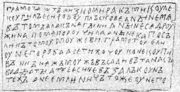
An invitation: Novgorod birch-bark letter no. 497
(1340s to 1380s; excavated 1972)
поколоно ѿ гаврили ѿ посени ко зати моемѹ ко горигори жи кѹмѹ ко сестори моеи ко ѹлите чо би есте поихали во городо ко радости моеи а нашего солова не ѡставили да бого вамо радосте ми вашего солова вохи не ѡсотавимо
Translation:
Greeting from Gavrila Posenya to my brother-in-law, godfather Grigory and my sister Ulita. Would you not like to give me the pleasure of riding into the city, not leaving our word? God give you happiness. We all do not leave your word.