

Eadbald of Kent

Encyclopedia
Eadbald was King of Kent
from 616 until his death in 640. He was the son of King Æthelberht and his wife Bertha
, a daughter of the Merovingian king Charibert
. Æthelberht made Kent the dominant force in England
during his reign and became the first Anglo-Saxon king to convert to Christianity
from Anglo-Saxon paganism. Eadbald's accession was a significant setback for the growth of the church, since he retained his indigenous paganism and did not convert to Christianity for at least a year, and perhaps for as much as eight years. He was ultimately converted by either Laurentius or Justus
, and separated from his first wife, who had been his stepmother, at the insistence of the church. Eadbald's second wife was Emma
, who may have been a Frankish princess. She bore him two sons, Eormenred
and Eorcenberht
, and a daughter, Eanswith
.
Eadbald's influence was less than his father's, but Kent was powerful enough to be omitted from the list of kingdoms dominated by Edwin of Northumbria
. Edwin's marriage to Eadbald's sister, Æthelburg, established a good relationship between Kent and Northumbria which appears to have continued into Oswald
's reign. When Æthelburg fled to Kent on Edwin's death in about 633, she sent her children to Francia for safety, fearing the intrigues of both Eadbald and Oswald. The Kentish royal line made several strong diplomatic marriages over the succeeding years, including the marriage of Eanflæd, Eadbald's niece, to Oswiu, and of Eorcenberht to Seaxburh
, daughter of King Anna of East Anglia
.
Eadbald died in 640, and was succeeded by Eorcenberht. Eormenred may have been his oldest son, but if he reigned at all it was only as a junior king.
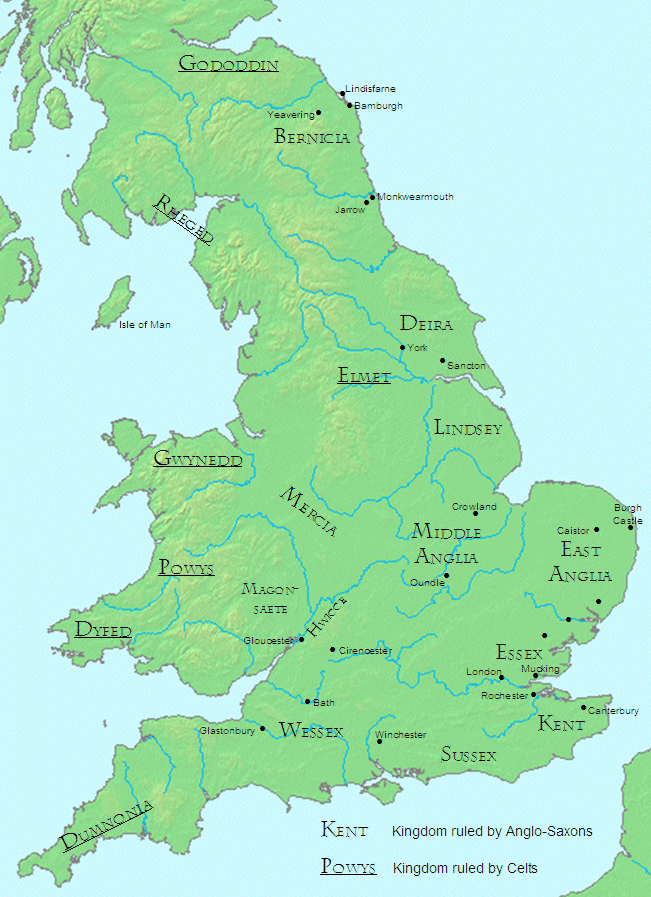 Settlement of Kent by continental peoples, primarily Jutes
, was complete by the end of the sixth century. Eadbald's father, Æthelberht, probably came to the throne in about 589 or 590, though the chronology of his reign is very difficult to determine accurately. Æthelberht was recorded by the early chronicler Bede
as having overlordship, or imperium, over other Anglo-Saxon kingdoms. This dominance led to wealth in the form of tribute, and Kent was a powerful kingdom at the time of Æthelberht's death in 616, with trade well-established with the European mainland
.
Roman Britain had become fully Christianized, but the Anglo-Saxons retained their native faith. In 597 Augustine
was sent by Pope Gregory I
to England to convert them to Christianity. Augustine landed in eastern Kent, and soon managed to convert Æthelberht, who gave Augustine land in Canterbury
. Two other rulers, Sæberht
, king of Essex
, and Rædwald, king of East Anglia
, were converted through Æthelberht's influence.
An important source for this period in Kentish history is The Ecclesiastical History of the English People, written in 731 by Bede
, a Benedictine
monk
from Northumbria
. Bede was primarily interested in the Christianization of England, but provides substantial information about secular history, including the reigns of Æthelberht and Eadbald. One of Bede’s correspondents was Albinus, abbot of the monastery of St. Peter and St. Paul (subsequently renamed St. Augustine's
) in Canterbury. A series of related texts known as the Legend of St Mildrith
provides additional information about events in the lives of Eadbald's children and throws some light on Eadbald himself. The Anglo-Saxon Chronicle
, a collection of annals assembled in about 890 in the kingdom of Wessex
, also provides information. Other sources include papal letters, regnal lists of the kings of Kent, and early charters. Charters were documents drawn up to record grants of land by kings to their followers or to the church, and provide some of the earliest documentary sources in England. None survive in original form from Eadbald's reign, but some later copies exist.
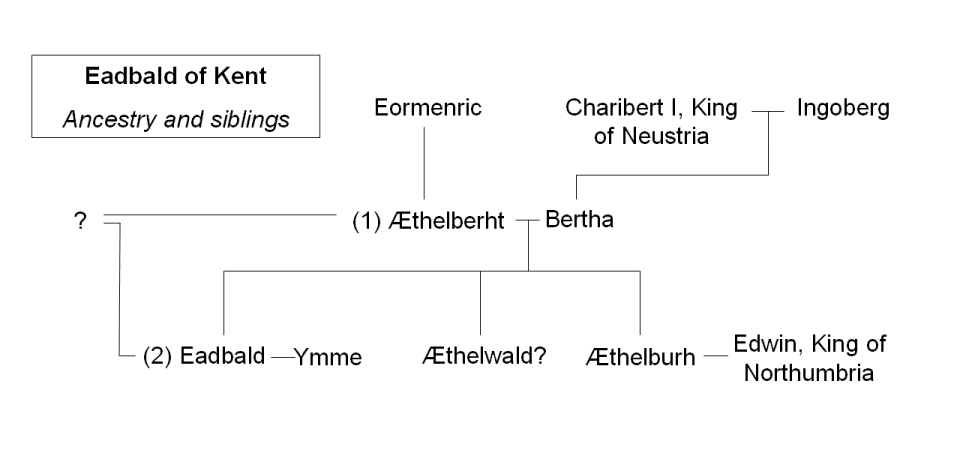 The ancestry of Æthelberht, Eadbald's father, is given by Bede, who states that he was descended from the legendary founder of Kent, Hengist. However, historians believe that Hengist and his brother Horsa were probably mythical figures. It is known that Æthelberht married twice as Eadbald married his step-mother after his father's death, to the consternation of the church.
Eadbald had a sister, Æthelburg, who was probably also the child of Bertha. Æthelburg married Edwin
, King of Northumbria, one of the dominant Anglo-Saxon kings of the seventh century. It is possible that there was another brother, named Æthelwald: the evidence for this is a papal letter to Justus
, archbishop of Canterbury
from 619 to 625, in which a king named Aduluald is referred to, and who is apparently different from Audubald, which refers to Eadbald. There is no agreement among modern scholars on how to interpret this: "Aduluald" might be intended as a representation of "Æthelwald", and hence this may be an indication of another king, perhaps a subking of west Kent; or it may be merely a scribal error which should be read as referring to Eadbald.
Archbishop Laurence of Canterbury
persuaded Eadbald to accept Christianity and give up his wife. He then re-married, and his second wife, according to Kentish tradition recorded in the legend of Saint Mildrith, was a woman named Ymme of Frankish royal blood, though recently it has been suggested that she may have instead been the daughter of Erchinoald
, mayor of the palace
in Neustria, the western part of Francia.
The two kingdoms within Kent were east and west Kent. Western Kent has fewer archaeological finds from the earliest periods than east Kent, and the eastern finds are somewhat distinct in character, showing Jutish and Frankish influence. The archaeological evidence, combined with the known political division into two kingdoms, makes it likely that the origin of the subkingdoms was the conquest of the western half by the eastern, which would have been the first area settled by the invaders.
Bede records that Eadbald's repudiation of Christianity was a "severe setback" to the growth of the church. Sæberht, the king of Essex, had become a Christian under Æthelberht's influence, but on Sæberht's death, at about the same time, his sons expelled Mellitus
, the bishop of London. According to Bede, Eadbald was punished for his faithlessness by "frequent fits of insanity", and possession by an "evil spirit" (perhaps referring to epileptic fits), but was eventually persuaded to give up his wife and adopt Christianity. Eadbald's second wife, Ymme, was Frankish, and it may well be that Kent's strong connections with Francia were a factor in Eadbald's conversion. It is likely that the missionaries in Canterbury had Frankish support. In the 620s, Eadbald's sister Æthelburg came to Kent, but sent her children to the court of King Dagobert I
in Francia; in addition to the diplomatic connections, trade with the Franks was important to Kent. It is thought likely that Frankish pressure had been influential in persuading Æthelberht to become Christian, and Eadbald's conversion and marriage to Ymme are likely to have been closely connected diplomatic decisions.
Two graves from a well-preserved sixth and seventh-century Anglo-Saxon cemetery at Finglesham
have yielded a bronze pendant and a gilt buckle with designs that are related to each other and may be symbolic of religious activity involving the Germanic deity Woden
. These objects probably date from the period of the pagan reaction.
's miraculous scourging by St Peter can be disregarded as a later hagiographical invention of the monastery of St Augustine.
As mentioned above, it has been suggested that King "Aduluald" in the letter to Justus is a real king Æthelwald, perhaps a junior king of west Kent. In that case it would appear that Laurence converted Eadbald, and Justus converted Æthelwald. It has also been suggested that the pallium did not indicate Justus was archbishop, since Justus is told the limited circumstances in which he may wear it; however, the same phrasing occurs in the letter conveying the pallium to Archbishop Augustine, also quoted in Bede. Another possibility is that the letter was originally two letters. In this view, Bede has conflated the letter conveying the pallium with the letter congratulating Justus on the conversion, which according to Bede’s account was seven or so years earlier; but the grammatical details on which this suggestion is based are not unique to this letter, and as a result it is usually considered to be a single composition.
The letter to Æthelburg makes it clear that she was already married at the time the news of Eadbald’s conversion reached Rome. This is quite inconsistent with the earlier date Bede gives for Eadbald’s acceptance of Christianity, and it has been suggested in Bede's defence that Æthelburg married Edwin substantially earlier and stayed in Kent until 625 before travelling to Rome, and that the letter was written while she was in Kent. However, it would appear from Boniface’s letter that Boniface thought of Æthelburg as being at her husband’s side. It also appears that the letter to Justus was written after the letters to Edwin and Æthelburg, rather than before, as Bede has it; Boniface's letter to Edwin and Æthelburg indicates he had the news from messengers, but when he wrote to Justus he had heard from the king himself.
The story of Æthelburg’s marriage being dependent on Edwin allowing her to practice her faith has been questioned, since revising the chronology makes it likely, though not certain, that the marriage was arranged before Eadbald’s conversion. In this view, it would have been the church that objected to the marriage, and Æthelburg would have been Christian before Eadbald’s conversion. The story of Paulinus’s consecration is also problematic as he was not consecrated until at least 625 and possibly later, which is after the latest possible date for Æthelburg’s marriage. However, it may be that he traveled to Northumbria prior to his consecration and only later became bishop.
A revised chronology of some of these events follows, taking the above considerations into account.
This timeline extends the duration of the pagan reaction from less than a year, in Bede's narrative, to about eight years. This represents a more serious setback for the church.
 Eadbald's influence over other Anglo-Saxon kingdoms was less than Æthelberht's. Eadbald's reduced power is apparent in his inability to restore Mellitus to the see of London: in Bede's words, his authority in Essex "was not so effective as that of his father". However, Kentish power was still sufficient to make alliance with Eadbald's relatives attractive to other kingdoms. Edwin's marriage to Eadbald's sister, Æthelburg, was probably also motivated by a desire to gain better access to communications with the continent. The relationship would have been valuable to Eadbald, too; it may have been as a result of this alliance that Edwin's overlordship of Britain did not include Kent. Another factor in Edwin's treatment of Kent may have been the location of the archbishopric in Canterbury: Edwin was well aware of the importance of Canterbury's metropolitan status, and at one time planned to make York an archbishopric too, with Paulinus as the planned first incumbent. Paulinus eventually returned to Kent, where at Eadbald's and Archbishop Honorius's request he became bishop of Rochester, and York was not made an archbishopric for another century. Within a year of Edwin's death in 633 or 634, Oswald
took the throne of Northumbria, and it seems likely that his relations with Eadbald were modelled on Edwin's. Oswald's successor, Oswiu
, married Eanflæd, who was Edwin's daughter and Eadbald's niece, thereby gaining both Deiran and Kentish connections.
Eadbald and Ymme had a daughter, Eanswith, who founded a monastery at Folkestone
, in Kent, and two sons, Eorcenberht
and Eormenred. Eormenred was the older of the two, and may have held the title of regulus, perhaps implying that he held the junior kingship of Kent. He appears to have died before his father, leaving Eorcenberht to inherit the throne. An additional son, Ecgfrith, is mentioned in a charter of Eadbald's, but the charter is a forgery, probably dating from the eleventh century.
Several of Eadbald's near relatives were involved in diplomatic marriages. King Anna of East Anglia
married his daughter, Seaxburh
, to Eorcenberht, and their daughter Eormenhild married Wulfhere of Mercia
, one of the most powerful kings of his day. Eanflæd, Eadbald's niece, married Oswiu
, king of Northumbria and the last of the northern Angles Bede listed as holding imperium over southern England. Eadbald's granddaughter Eafe
married Merewalh
, king of the Magonsæte.
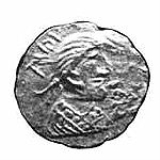
Coins were probably first minted in Kent in Æthelberht's reign, though none bear his name. These early golden coins were probably the shillings (scillingas in Old English) that are mentioned in Æthelberht’s laws. The coins are also known to numismatists
as "thrymsas". Thrymsas are known from Eadbald's reign; but few are known that carry his name: one such was minted at London
and inscribed "AVDVARLD". It has been suggested that kings did not have a monopoly on the production of coinage at that time.
Connections with Francia went beyond trade and the royal marriages Æthelberht and Eadbald made with Frankish princesses. Eadbald's granddaughter, Eorcengota, became a nun at Faremoutiers
, and his great-granddaughter, Mildrith
, was a nun at Chelles
. When Edwin was killed in about 632, Æthelburg, escorted by Paulinus, fled by sea to Eadbald's court in Kent, but in a further sign of her family's ties across the channel she sent her children to the court of King Dagobert I
of the Franks, to keep them safe from the intrigues of Eadbald and Oswald of Northumbria.
Kingdom of Kent
The Kingdom of Kent was a Jutish colony and later independent kingdom in what is now south east England. It was founded at an unknown date in the 5th century by Jutes, members of a Germanic people from continental Europe, some of whom settled in Britain after the withdrawal of the Romans...
from 616 until his death in 640. He was the son of King Æthelberht and his wife Bertha
Bertha of Kent
Saint Bertha was the Queen of Kent whose influence led to the introduction of Christianity to Anglo-Saxon England. She was canonized as a saint for her role in its establishment during that period of English history.Bertha was the daughter of Charibert I, Merovingian King of Paris...
, a daughter of the Merovingian king Charibert
Charibert I
Charibert I was the Merovingian King of Paris, the second-eldest son of Chlothar I and Ingund. His elder brother was Gunthar, who died sometime before their father's death....
. Æthelberht made Kent the dominant force in England
England
England is a country that is part of the United Kingdom. It shares land borders with Scotland to the north and Wales to the west; the Irish Sea is to the north west, the Celtic Sea to the south west, with the North Sea to the east and the English Channel to the south separating it from continental...
during his reign and became the first Anglo-Saxon king to convert to Christianity
Christianity
Christianity is a monotheistic religion based on the life and teachings of Jesus as presented in canonical gospels and other New Testament writings...
from Anglo-Saxon paganism. Eadbald's accession was a significant setback for the growth of the church, since he retained his indigenous paganism and did not convert to Christianity for at least a year, and perhaps for as much as eight years. He was ultimately converted by either Laurentius or Justus
Justus
Justus was the fourth Archbishop of Canterbury. He was sent from Italy to England by Pope Gregory the Great, on a mission to Christianize the Anglo-Saxons from their native Anglo-Saxon paganism, probably arriving with the second group of missionaries despatched in 601...
, and separated from his first wife, who had been his stepmother, at the insistence of the church. Eadbald's second wife was Emma
Emma of Austrasia
Emma was a member of the Austrasian royal family. She is sometimes identified with the Emma who married Eadbald of Kent.Emma was a daughter of Theudebert II, King of Austrasia from 595 to 612...
, who may have been a Frankish princess. She bore him two sons, Eormenred
Eormenred of Kent
Eormenred was a member of the royal family of the Kingdom of Kent, who is described as king in some texts. There is no contemporary evidence for Eormenred, but he is mentioned in later hagiographies, and his existence is considered possible by scholars.Eormenred is described as a son of Eadbald,...
and Eorcenberht
Eorcenberht of Kent
Eorcenberht of Kent was king of the Anglo-Saxon kingdom of Kent from 640 until his death, succeeding his father Eadbald....
, and a daughter, Eanswith
Eanswith
Saint Eanswith , also spelled Eanswythe or Eanswide, was an Anglo Saxon princess.In 630, Eanswith founded the Benedictine Folkestone Priory, the first nunnery in England...
.
Eadbald's influence was less than his father's, but Kent was powerful enough to be omitted from the list of kingdoms dominated by Edwin of Northumbria
Edwin of Northumbria
Edwin , also known as Eadwine or Æduini, was the King of Deira and Bernicia – which later became known as Northumbria – from about 616 until his death. He converted to Christianity and was baptised in 627; after he fell at the Battle of Hatfield Chase, he was venerated as a saint.Edwin was the son...
. Edwin's marriage to Eadbald's sister, Æthelburg, established a good relationship between Kent and Northumbria which appears to have continued into Oswald
Oswald of Northumbria
Oswald was King of Northumbria from 634 until his death, and is now venerated as a Christian saint.Oswald was the son of Æthelfrith of Bernicia and came to rule after spending a period in exile; after defeating the British ruler Cadwallon ap Cadfan, Oswald brought the two Northumbrian kingdoms of...
's reign. When Æthelburg fled to Kent on Edwin's death in about 633, she sent her children to Francia for safety, fearing the intrigues of both Eadbald and Oswald. The Kentish royal line made several strong diplomatic marriages over the succeeding years, including the marriage of Eanflæd, Eadbald's niece, to Oswiu, and of Eorcenberht to Seaxburh
Seaxburh of Ely
Seaxburh ; also Saint Sexburga of Ely, was the queen of King Eorcenberht of Kent, as well as an abbess and a saint of the Christian Church....
, daughter of King Anna of East Anglia
Anna of East Anglia
Anna was King of East Anglia from the early 640s until his death. Anna was a member of the Wuffingas family, the ruling dynasty of the East Angles. He was one of the three sons of Eni who ruled East Anglia, succeeding some time after Ecgric was killed in battle by Penda of Mercia...
.
Eadbald died in 640, and was succeeded by Eorcenberht. Eormenred may have been his oldest son, but if he reigned at all it was only as a junior king.
Early Kent and early sources
Jutes
The Jutes, Iuti, or Iutæ were a Germanic people who, according to Bede, were one of the three most powerful Germanic peoples of their time, the other two being the Saxons and the Angles...
, was complete by the end of the sixth century. Eadbald's father, Æthelberht, probably came to the throne in about 589 or 590, though the chronology of his reign is very difficult to determine accurately. Æthelberht was recorded by the early chronicler Bede
Bede
Bede , also referred to as Saint Bede or the Venerable Bede , was a monk at the Northumbrian monastery of Saint Peter at Monkwearmouth, today part of Sunderland, England, and of its companion monastery, Saint Paul's, in modern Jarrow , both in the Kingdom of Northumbria...
as having overlordship, or imperium, over other Anglo-Saxon kingdoms. This dominance led to wealth in the form of tribute, and Kent was a powerful kingdom at the time of Æthelberht's death in 616, with trade well-established with the European mainland
Europe
Europe is, by convention, one of the world's seven continents. Comprising the westernmost peninsula of Eurasia, Europe is generally 'divided' from Asia to its east by the watershed divides of the Ural and Caucasus Mountains, the Ural River, the Caspian and Black Seas, and the waterways connecting...
.
Roman Britain had become fully Christianized, but the Anglo-Saxons retained their native faith. In 597 Augustine
Augustine of Canterbury
Augustine of Canterbury was a Benedictine monk who became the first Archbishop of Canterbury in the year 597...
was sent by Pope Gregory I
Pope Gregory I
Pope Gregory I , better known in English as Gregory the Great, was pope from 3 September 590 until his death...
to England to convert them to Christianity. Augustine landed in eastern Kent, and soon managed to convert Æthelberht, who gave Augustine land in Canterbury
Canterbury
Canterbury is a historic English cathedral city, which lies at the heart of the City of Canterbury, a district of Kent in South East England. It lies on the River Stour....
. Two other rulers, Sæberht
Saebert of Essex
Sæberht, Saberht or Sæbert was a King of Essex , in succession of his father King Sledd. He is known as the first East Saxon king to have been converted to Christianity....
, king of Essex
Kingdom of Essex
The Kingdom of Essex or Kingdom of the East Saxons was one of the seven traditional kingdoms of the so-called Anglo-Saxon Heptarchy. It was founded in the 6th century and covered the territory later occupied by the counties of Essex, Hertfordshire, Middlesex and Kent. Kings of Essex were...
, and Rædwald, king of East Anglia
East Anglia
East Anglia is a traditional name for a region of eastern England, named after an ancient Anglo-Saxon kingdom, the Kingdom of the East Angles. The Angles took their name from their homeland Angeln, in northern Germany. East Anglia initially consisted of Norfolk and Suffolk, but upon the marriage of...
, were converted through Æthelberht's influence.
An important source for this period in Kentish history is The Ecclesiastical History of the English People, written in 731 by Bede
Bede
Bede , also referred to as Saint Bede or the Venerable Bede , was a monk at the Northumbrian monastery of Saint Peter at Monkwearmouth, today part of Sunderland, England, and of its companion monastery, Saint Paul's, in modern Jarrow , both in the Kingdom of Northumbria...
, a Benedictine
Benedictine
Benedictine refers to the spirituality and consecrated life in accordance with the Rule of St Benedict, written by Benedict of Nursia in the sixth century for the cenobitic communities he founded in central Italy. The most notable of these is Monte Cassino, the first monastery founded by Benedict...
monk
Monk
A monk is a person who practices religious asceticism, living either alone or with any number of monks, while always maintaining some degree of physical separation from those not sharing the same purpose...
from Northumbria
Northumbria
Northumbria was a medieval kingdom of the Angles, in what is now Northern England and South-East Scotland, becoming subsequently an earldom in a united Anglo-Saxon kingdom of England. The name reflects the approximate southern limit to the kingdom's territory, the Humber Estuary.Northumbria was...
. Bede was primarily interested in the Christianization of England, but provides substantial information about secular history, including the reigns of Æthelberht and Eadbald. One of Bede’s correspondents was Albinus, abbot of the monastery of St. Peter and St. Paul (subsequently renamed St. Augustine's
St Augustine's Abbey
St Augustine's Abbey was a Benedictine abbey in Canterbury, Kent, England.-Early history:In 597 Saint Augustine arrived in England, having been sent by Pope Gregory I, on what might nowadays be called a revival mission. The King of Kent at this time was Æthelberht, who happened to be married to a...
) in Canterbury. A series of related texts known as the Legend of St Mildrith
Mildrith
Saint Mildthryth , also Mildrith, Mildryth or Mildred, was an Anglo-Saxon abbess.Mildthryth was the daughter of King Merewalh of Magonsaete, a sub-kingdom of Mercia, and Eormenburh , herself the daughter of King Æthelberht of Kent. Her sisters Milburh and Mildgytha were considered to be saints...
provides additional information about events in the lives of Eadbald's children and throws some light on Eadbald himself. The Anglo-Saxon Chronicle
Anglo-Saxon Chronicle
The Anglo-Saxon Chronicle is a collection of annals in Old English chronicling the history of the Anglo-Saxons. The original manuscript of the Chronicle was created late in the 9th century, probably in Wessex, during the reign of Alfred the Great...
, a collection of annals assembled in about 890 in the kingdom of Wessex
Wessex
The Kingdom of Wessex or Kingdom of the West Saxons was an Anglo-Saxon kingdom of the West Saxons, in South West England, from the 6th century, until the emergence of a united English state in the 10th century, under the Wessex dynasty. It was to be an earldom after Canute the Great's conquest...
, also provides information. Other sources include papal letters, regnal lists of the kings of Kent, and early charters. Charters were documents drawn up to record grants of land by kings to their followers or to the church, and provide some of the earliest documentary sources in England. None survive in original form from Eadbald's reign, but some later copies exist.
Ancestry and immediate family
Eadbald had a sister, Æthelburg, who was probably also the child of Bertha. Æthelburg married Edwin
Edwin of Northumbria
Edwin , also known as Eadwine or Æduini, was the King of Deira and Bernicia – which later became known as Northumbria – from about 616 until his death. He converted to Christianity and was baptised in 627; after he fell at the Battle of Hatfield Chase, he was venerated as a saint.Edwin was the son...
, King of Northumbria, one of the dominant Anglo-Saxon kings of the seventh century. It is possible that there was another brother, named Æthelwald: the evidence for this is a papal letter to Justus
Justus
Justus was the fourth Archbishop of Canterbury. He was sent from Italy to England by Pope Gregory the Great, on a mission to Christianize the Anglo-Saxons from their native Anglo-Saxon paganism, probably arriving with the second group of missionaries despatched in 601...
, archbishop of Canterbury
Archbishop of Canterbury
The Archbishop of Canterbury is the senior bishop and principal leader of the Church of England, the symbolic head of the worldwide Anglican Communion, and the diocesan bishop of the Diocese of Canterbury. In his role as head of the Anglican Communion, the archbishop leads the third largest group...
from 619 to 625, in which a king named Aduluald is referred to, and who is apparently different from Audubald, which refers to Eadbald. There is no agreement among modern scholars on how to interpret this: "Aduluald" might be intended as a representation of "Æthelwald", and hence this may be an indication of another king, perhaps a subking of west Kent; or it may be merely a scribal error which should be read as referring to Eadbald.
Archbishop Laurence of Canterbury
Laurence of Canterbury
Laurence was the second Archbishop of Canterbury from about 604 to 619. He was a member of the Gregorian mission sent from Italy to England to Christianize the Anglo-Saxons from their native Anglo-Saxon paganism, although the date of his arrival is disputed...
persuaded Eadbald to accept Christianity and give up his wife. He then re-married, and his second wife, according to Kentish tradition recorded in the legend of Saint Mildrith, was a woman named Ymme of Frankish royal blood, though recently it has been suggested that she may have instead been the daughter of Erchinoald
Erchinoald
Erchinoald succeeded Aega as the mayor of the palace of Neustria in 641 and succeeded Flaochad in Burgundy in 642 and remained such until his death in 658. According to Fredegar, he was a relative of Dagobert I's mother...
, mayor of the palace
Mayor of the Palace
Mayor of the Palace was an early medieval title and office, also called majordomo, from the Latin title maior domus , used most notably in the Frankish kingdoms in the 7th and 8th centuries....
in Neustria, the western part of Francia.
East and West Kent
The surviving regnal lists show only one king reigning at a time in Kent, but subkingdoms were common among the Anglo-Saxons and from the reign of Hlothhere, in the late seventh century, there is evidence that Kent was usually ruled by two kings, though often one is clearly dominant. It is less clear that this is the case before Hlothhere. Forged charters preserve a tradition of Eadbald ruling during his father's reign, presumably as a subking over west Kent. The papal letter that has been interpreted as indicating the existence of Æthelwald, a brother of Eadbald's, refers to Æthelwald as a king; if he existed, he would presumably have been a junior king to Eadbald.The two kingdoms within Kent were east and west Kent. Western Kent has fewer archaeological finds from the earliest periods than east Kent, and the eastern finds are somewhat distinct in character, showing Jutish and Frankish influence. The archaeological evidence, combined with the known political division into two kingdoms, makes it likely that the origin of the subkingdoms was the conquest of the western half by the eastern, which would have been the first area settled by the invaders.
Accession and pagan reaction
Eadbald came to the throne on the death of his father on 24 February 616, or possibly 618. Although Æthelberht had been Christian since about 600 and his wife Bertha was also Christian, Eadbald was a pagan. Bertha died some time before Eadbald's accession, and Æthelberht remarried. The name of Æthelberht's second wife is not recorded, but it seems likely that she was a pagan, since on his death she married Eadbald, her stepson: a marriage between a stepmother and stepson was forbidden by the church.Bede records that Eadbald's repudiation of Christianity was a "severe setback" to the growth of the church. Sæberht, the king of Essex, had become a Christian under Æthelberht's influence, but on Sæberht's death, at about the same time, his sons expelled Mellitus
Mellitus
Mellitus was the first Bishop of London in the Saxon period, the third Archbishop of Canterbury, and a member of the Gregorian mission sent to England to convert the Anglo-Saxons from their native paganism to Christianity. He arrived in 601 AD with a group of clergymen sent to augment the mission,...
, the bishop of London. According to Bede, Eadbald was punished for his faithlessness by "frequent fits of insanity", and possession by an "evil spirit" (perhaps referring to epileptic fits), but was eventually persuaded to give up his wife and adopt Christianity. Eadbald's second wife, Ymme, was Frankish, and it may well be that Kent's strong connections with Francia were a factor in Eadbald's conversion. It is likely that the missionaries in Canterbury had Frankish support. In the 620s, Eadbald's sister Æthelburg came to Kent, but sent her children to the court of King Dagobert I
Dagobert I
Dagobert I was the king of Austrasia , king of all the Franks , and king of Neustria and Burgundy . He was the last Merovingian dynast to wield any real royal power...
in Francia; in addition to the diplomatic connections, trade with the Franks was important to Kent. It is thought likely that Frankish pressure had been influential in persuading Æthelberht to become Christian, and Eadbald's conversion and marriage to Ymme are likely to have been closely connected diplomatic decisions.
Two graves from a well-preserved sixth and seventh-century Anglo-Saxon cemetery at Finglesham
Finglesham
Finglesham is a village near Dover in Kent, England, which was the site of a seventh-century Anglo-Saxon archaeology find known as "Finglesham man," as described in 1965 by Sonia Chadwick Hawkes and Hilda Ellis Davidson....
have yielded a bronze pendant and a gilt buckle with designs that are related to each other and may be symbolic of religious activity involving the Germanic deity Woden
Woden
Woden or Wodan is a major deity of Anglo-Saxon and Continental Germanic polytheism. Together with his Norse counterpart Odin, Woden represents a development of the Proto-Germanic god *Wōdanaz....
. These objects probably date from the period of the pagan reaction.
Bede's account
Bede's account of Eadbald's rejection of the church and subsequent conversion is quite detailed, but not without some internal inconsistencies. Bede's version of events are laid out as follows:- 24 February 616: Æthelberht dies and Eadbald succeeds.
- 616: Eadbald leads a pagan reaction to Christianity. He marries his stepmother, contrary to church law, and he refuses baptism. At about this time Mellitus, bishop of London, is expelled by the sons of Sæberht in Essex, and goes to Kent.
- 616: Mellitus and Justus, bishop of Rochester, leave Kent for Francia.
- 616/617: Some time after Mellitus and Justus depart, Laurence, the archbishop of Canterbury, plans to leave for Francia, but has a vision in which St Peter scourges him. In the morning he shows the scars to Eadbald who is converted to Christianity as a result.
- 617: Justus and Mellitus both return from Francia, "the year after they left". Justus is restored to Rochester.
- c. 619: Laurence dies, and Mellitus becomes archbishop of Canterbury.
- 619–624: Eadbald builds a church which is consecrated by Archbishop Mellitus.
- 24 April 624: Mellitus dies and Justus succeeds him as archbishop of Canterbury.
- 624: after Justus’s succession, Pope BonifacePope Boniface VPope Boniface V was pope from 619 to 625.He was consecrated as pope on December 23, 619. He did much for the Christianising of England and enacted the decree by which churches became places of refuge for criminals....
writes to him to say that he has heard in letters from King Aduluald (possibly a scribal error for Eadbald) of the king’s conversion to Christianity. Boniface sends the palliumPalliumThe pallium is an ecclesiastical vestment in the Roman Catholic Church, originally peculiar to the Pope, but for many centuries bestowed by him on metropolitans and primates as a symbol of the jurisdiction delegated to them by the Holy See. In that context it has always remained unambiguously...
with this letter, adding that it is only to be worn when celebrating "the Holy Mysteries". - By 625 Edwin of Deira, king of Northumbria, asks for the hand in marriage of Æthelburg, Eadbald’s sister. Edwin is told he must allow her to practice Christianity, and must consider baptism himself.
- 21 July 625: Justus consecrates PaulinusPaulinus of YorkPaulinus was a Roman missionary and the first Bishop of York. A member of the Gregorian mission sent in 601 by Pope Gregory I to Christianize the Anglo-Saxons from their native Anglo-Saxon paganism, Paulinus arrived in England by 604 with the second missionary group...
bishop of York. - July or later in 625: Edwin agrees to the terms and Æthelburg travels to Northumbria, accompanied by Paulinus.
- Easter 626: Æthelburg is delivered of a daughter, Eanflæd.
- 626: Edwin completes a military campaign against the West Saxons. At "about this time" Boniface writes to both Edwin and Æthelburg. The letter to Edwin urges him to accept Christianity and refers to the conversion of Eadbald. The letter to Æthelburg mentions that the pope has recently heard the news of Eadbald’s conversion, and encourages her to work for the conversion of her husband, Edwin.
Alternative chronology
Although Bede's narrative is widely accepted, an alternative chronology has been proposed by D.P. Kirby. Kirby points out that Boniface’s letter to Æthelburg makes it clear that the news of Eadbald’s conversion is recent, and that it is unthinkable that Boniface would not have been kept up to date on the status of Eadbald’s conversion. Hence Eadbald must have been converted by Justus, as is implied by Boniface’s letter to Justus. The pallium accompanying that letter indicates Justus was archbishop by that time, and the duration of Mellitus’s archiepiscopate means that even if Bede’s dates are somewhat wrong in other particulars, Eadbald was converted no earlier than 621, and no later than April 624, since Mellitus consecrated a church for Eadbald before his death in that month. The account of LaurenceLaurence of Canterbury
Laurence was the second Archbishop of Canterbury from about 604 to 619. He was a member of the Gregorian mission sent from Italy to England to Christianize the Anglo-Saxons from their native Anglo-Saxon paganism, although the date of his arrival is disputed...
's miraculous scourging by St Peter can be disregarded as a later hagiographical invention of the monastery of St Augustine.
As mentioned above, it has been suggested that King "Aduluald" in the letter to Justus is a real king Æthelwald, perhaps a junior king of west Kent. In that case it would appear that Laurence converted Eadbald, and Justus converted Æthelwald. It has also been suggested that the pallium did not indicate Justus was archbishop, since Justus is told the limited circumstances in which he may wear it; however, the same phrasing occurs in the letter conveying the pallium to Archbishop Augustine, also quoted in Bede. Another possibility is that the letter was originally two letters. In this view, Bede has conflated the letter conveying the pallium with the letter congratulating Justus on the conversion, which according to Bede’s account was seven or so years earlier; but the grammatical details on which this suggestion is based are not unique to this letter, and as a result it is usually considered to be a single composition.
The letter to Æthelburg makes it clear that she was already married at the time the news of Eadbald’s conversion reached Rome. This is quite inconsistent with the earlier date Bede gives for Eadbald’s acceptance of Christianity, and it has been suggested in Bede's defence that Æthelburg married Edwin substantially earlier and stayed in Kent until 625 before travelling to Rome, and that the letter was written while she was in Kent. However, it would appear from Boniface’s letter that Boniface thought of Æthelburg as being at her husband’s side. It also appears that the letter to Justus was written after the letters to Edwin and Æthelburg, rather than before, as Bede has it; Boniface's letter to Edwin and Æthelburg indicates he had the news from messengers, but when he wrote to Justus he had heard from the king himself.
The story of Æthelburg’s marriage being dependent on Edwin allowing her to practice her faith has been questioned, since revising the chronology makes it likely, though not certain, that the marriage was arranged before Eadbald’s conversion. In this view, it would have been the church that objected to the marriage, and Æthelburg would have been Christian before Eadbald’s conversion. The story of Paulinus’s consecration is also problematic as he was not consecrated until at least 625 and possibly later, which is after the latest possible date for Æthelburg’s marriage. However, it may be that he traveled to Northumbria prior to his consecration and only later became bishop.
A revised chronology of some of these events follows, taking the above considerations into account.
- 616: Eadbald leads a pagan reaction to Christianity.
- 616: Mellitus and Justus, bishop of Rochester, leave Kent for Francia.
- c. 619: Laurence dies, and Mellitus becomes archbishop of Canterbury.
- Early 624?: Justus converts Eadbald. Messengers go to Rome. Also at about this time Æthelburg’s marriage to Edwin is arranged, perhaps before the conversion. Eadbald builds a church, and Mellitus consecrates it.
- 24 April 624: Mellitus dies and Justus succeeds him as archbishop of Canterbury.
- Mid 624: Edwin agrees to the marriage terms and Æthelburg travels to Northumbria, accompanied by Paulinus.
- Later 624: the pope receives news of Eadbald’s conversion and writes to Æthelburg and Edwin.
- Still later 624: the pope hears from Eadbald of his conversion, and also hears of Mellitus’s death. He writes to Justus to send him the pallium.
- 21 July 625 or 626: Justus consecrates Paulinus bishop of York.
This timeline extends the duration of the pagan reaction from less than a year, in Bede's narrative, to about eight years. This represents a more serious setback for the church.
Relations with other English kingdoms and church affairs
Oswald of Northumbria
Oswald was King of Northumbria from 634 until his death, and is now venerated as a Christian saint.Oswald was the son of Æthelfrith of Bernicia and came to rule after spending a period in exile; after defeating the British ruler Cadwallon ap Cadfan, Oswald brought the two Northumbrian kingdoms of...
took the throne of Northumbria, and it seems likely that his relations with Eadbald were modelled on Edwin's. Oswald's successor, Oswiu
Oswiu of Northumbria
Oswiu , also known as Oswy or Oswig , was a King of Bernicia. His father, Æthelfrith of Bernicia, was killed in battle, fighting against Rædwald, King of the East Angles and Edwin of Deira at the River Idle in 616...
, married Eanflæd, who was Edwin's daughter and Eadbald's niece, thereby gaining both Deiran and Kentish connections.
Eadbald and Ymme had a daughter, Eanswith, who founded a monastery at Folkestone
Folkestone
Folkestone is the principal town in the Shepway District of Kent, England. Its original site was in a valley in the sea cliffs and it developed through fishing and its closeness to the Continent as a landing place and trading port. The coming of the railways, the building of a ferry port, and its...
, in Kent, and two sons, Eorcenberht
Eorcenberht of Kent
Eorcenberht of Kent was king of the Anglo-Saxon kingdom of Kent from 640 until his death, succeeding his father Eadbald....
and Eormenred. Eormenred was the older of the two, and may have held the title of regulus, perhaps implying that he held the junior kingship of Kent. He appears to have died before his father, leaving Eorcenberht to inherit the throne. An additional son, Ecgfrith, is mentioned in a charter of Eadbald's, but the charter is a forgery, probably dating from the eleventh century.
Several of Eadbald's near relatives were involved in diplomatic marriages. King Anna of East Anglia
Anna of East Anglia
Anna was King of East Anglia from the early 640s until his death. Anna was a member of the Wuffingas family, the ruling dynasty of the East Angles. He was one of the three sons of Eni who ruled East Anglia, succeeding some time after Ecgric was killed in battle by Penda of Mercia...
married his daughter, Seaxburh
Seaxburh of Ely
Seaxburh ; also Saint Sexburga of Ely, was the queen of King Eorcenberht of Kent, as well as an abbess and a saint of the Christian Church....
, to Eorcenberht, and their daughter Eormenhild married Wulfhere of Mercia
Wulfhere of Mercia
Wulfhere was King of Mercia from the end of the 650s until 675. He was the first Christian king of all of Mercia, though it is not known when or how he converted from Anglo-Saxon paganism. His accession marked the end of Oswiu of Northumbria's overlordship of southern England, and Wulfhere...
, one of the most powerful kings of his day. Eanflæd, Eadbald's niece, married Oswiu
Oswiu of Northumbria
Oswiu , also known as Oswy or Oswig , was a King of Bernicia. His father, Æthelfrith of Bernicia, was killed in battle, fighting against Rædwald, King of the East Angles and Edwin of Deira at the River Idle in 616...
, king of Northumbria and the last of the northern Angles Bede listed as holding imperium over southern England. Eadbald's granddaughter Eafe
Domne Eafe
Domne Eafe was, according to the Mildrith legend, a granddaughter of King Eadbald of Kent and the foundress of the double monastery at Minster-in-Thanet during the reign of her cousin King Ecgberht of Kent.The various versions of the Mildrith legend disagree as to whether Domne Eafe or her sister...
married Merewalh
Merewalh
Merewalh Merewalh Merewalh (sometimes given as Merwal or Merewald was a sub-king of the Magonsæte, a western cadet kingdom of Mercia thought to have been located in Herefordshire and Shropshire...
, king of the Magonsæte.
Trade and connections to the Franks
There is little documentary evidence about the nature of trade in Eadbald's reign. It is known that the kings of Kent had established royal control of trade in the late seventh century, but it is not known how early this control began. There is archaeological evidence that suggests that the royal influence predates any of the written sources, and it may have been Eadbald's father, Æthelberht, who took control of trade away from the aristocracy and made it a royal monopoly. The continental trade provided Kent access to luxury goods, which was an advantage in trading with the other Anglo-Saxon nations, and the revenue from trade was important in itself. Kent traded locally made glass and jewelry to the Franks; Kentish goods have been found as far south as the mouth of the Loire, south of Brittany. There was probably also a flourishing slave trade. The wealth this commerce brought to Kent may have been the basis of the continuing, though diminished, importance of Kent in Eadbald's reign.Coins were probably first minted in Kent in Æthelberht's reign, though none bear his name. These early golden coins were probably the shillings (scillingas in Old English) that are mentioned in Æthelberht’s laws. The coins are also known to numismatists
Numismatics
Numismatics is the study or collection of currency, including coins, tokens, paper money, and related objects. While numismatists are often characterized as students or collectors of coins, the discipline also includes the broader study of money and other payment media used to resolve debts and the...
as "thrymsas". Thrymsas are known from Eadbald's reign; but few are known that carry his name: one such was minted at London
London
London is the capital city of :England and the :United Kingdom, the largest metropolitan area in the United Kingdom, and the largest urban zone in the European Union by most measures. Located on the River Thames, London has been a major settlement for two millennia, its history going back to its...
and inscribed "AVDVARLD". It has been suggested that kings did not have a monopoly on the production of coinage at that time.
Connections with Francia went beyond trade and the royal marriages Æthelberht and Eadbald made with Frankish princesses. Eadbald's granddaughter, Eorcengota, became a nun at Faremoutiers
Faremoutiers Abbey
Faremoutiers Abbey was founded circa 620 by Burgundofara . It formed an important link between the Merovingian Frankish Empire and the southern Anglo-Saxon kingdoms of Kent and East Anglia....
, and his great-granddaughter, Mildrith
Mildrith
Saint Mildthryth , also Mildrith, Mildryth or Mildred, was an Anglo-Saxon abbess.Mildthryth was the daughter of King Merewalh of Magonsaete, a sub-kingdom of Mercia, and Eormenburh , herself the daughter of King Æthelberht of Kent. Her sisters Milburh and Mildgytha were considered to be saints...
, was a nun at Chelles
Chelles Abbey
Chelles Abbey was founded by Saint Balthild, widow of King Clovis II of Neustria circa 658. It was dissolved during the French Revolution.Chelles had been the site of a Merovingian palace, the villa Calae. A church, dedicated to Saint George had been founded at Chelles by Queen Clothilde...
. When Edwin was killed in about 632, Æthelburg, escorted by Paulinus, fled by sea to Eadbald's court in Kent, but in a further sign of her family's ties across the channel she sent her children to the court of King Dagobert I
Dagobert I
Dagobert I was the king of Austrasia , king of all the Franks , and king of Neustria and Burgundy . He was the last Merovingian dynast to wield any real royal power...
of the Franks, to keep them safe from the intrigues of Eadbald and Oswald of Northumbria.