


Dyula

Encyclopedia
The Dyula are a Mande ethnic group
inhabiting several West African countries, including the Mali
, Burkina Faso
, Senegal
and Guinea-Bissau
.
Characterized as a highly successful merchant caste
, Dyula migrants began establishing trading communities across the region in the fourteenth century. Since business was often conducted under non-Muslim rulers, the Dyula developed a set of theological principles for Muslim
minorities in non-Muslim societies. Their unique contribution of long-distance commerce, Islamic scholarship and religious tolerance were significant factors to the peaceful expansion of Islam in West Africa.
(c.1230-1600) had reached its apogee, acquiring a considerable reputation for the Islamic practice of its court and the pilgrimages of several emperors who followed the tradition of Lahilatul Kalabi, the first black prince to make hajj
to Mecca
. It was at this time that Mali began encouraging some of its local merchants to establish colonies close to the gold fields of West Africa. This migrant trading class were known as dyula, the Mandingo
word for “merchant”.
The dyula spread throughout the former area of Mandé culture, from the Atlantic coast of Senegambia to the Niger
, and from the southern edge of the Sahara
to forest zones further south. They established decentralized townships in non-Muslim colonies that were linked to an extensive commercial network, in what was described by professor Philip D. Curtin
as a “trading diaspora.” Motivated by business imperatives, they expanded into new markets, founding settlements under the auspices of various local rulers who often permitted self-governance and autonomy. Organization of dyula trading companies were based a clan-family structure known as the lu - a working unit consisting of a father, his sons, and other attached males. Members of a given lu dispersed from the savanna
to the forest, managed circulation of goods and information, placed orders, and effectively controlled the economic mechanisms of supply and demand
.
, a Soninke cleric from the core Mali area who lived around 1500. He made hajj to Mecca
several times and devoted his intellectual career to developing an understanding of the faith that would assist Muslim minorities in “pagan” lands. He drew on North African and Middle Eastern jurists and theologians who had reflected on the situations of Muslims living among non-Muslim majorities, situations that were frequent in the centuries of Islamic expansion.
Sheikh Suwari formulated the obligations of Muslim minorities in West Africa into something known as the Suwarian tradition. It stressed the need for Muslims to coexist peaceably with unbelievers, and so justified a separation of religion and politics. In this understanding Muslims must nurture their own learning and piety and thereby furnish good examples to the non-Muslims around them. They could accept jurisdiction of non-Muslim authorities, as long as they had the necessary protection and conditions to practice the faith. In this teaching Suwari followed a strong predilection in Islamic thought for any government, albeit non-Muslim or tyrannical, as opposed to none. The military jihad
was a resort only if the faithful were threatened. Suwari discouraged dawah
(missionary), instead contending that Allah
would bring non-Muslims to Islam in His own way; it was not a Muslims responsibility to decide when ignorance should give way to belief. Since their Islamic practice was capable of accommodating traditional cults, dyula often served as priests, soothsayer
s and counselors at the courts of animist rulers.
network, conducted by North African Arabs and Berbers
whom they met at commercial centers across the Sahel
. Some important trade goods included gold, millet
, slaves, kola nuts from the south and slave beads and cowrie shells from the north (for use as currency
). It was under Mali that the great cities of the Niger bend - including Gao
and Djenné
- prospered, with Timbuktu in particular becoming known across Europe for its great wealth. Important trading centers in southern West Africa developed at the transitional zone between the forest and the savanna; examples include Begho and Bono Manso (in present-day Ghana) and Bondoukou
(in present-day Côte d'Ivoire). Western trade routes continued to be important, with Ouadane
, Oualata
and Chinguetti
being the major trade centres in what is now Mauritania
.
On the forests northern fringes, new states emerged such as Bono and Banda. As the economic value of gold and kola became appreciated, forests south of these states - which had hitherto been little inhabited because of limited agricultural potential - became more thickly populated, and the same principles of political and military mobilization began being applied there. Village communities became tributaries of ruling groups, with some members becoming the clients and slaves needed to support royal households, armies, and trading enterprises. Sometimes these political changes were not to the advantage of the dyula, who employed Mande warriors to guard their caravans and, if necessary, could call in larger contingents from the Sudanic kingdoms. In the seventeenth century, tensions between the Muslims and the local pagans in Begho erupted into a destructive war which eventually led to the total abandonement of the Banda capital. The local people eventually settled in a number of towns further east, while the dyula withdrew to the west, to the further side of the Banda hills, where they established the new trading center of Bonduku.
was creation of the dyula state of Gonja
in the early 17th century. This was apparently motivated by a general worsening of the competitive position of dyula traders, and was occasioned by three factors: (1) a near monopoly control in exporting forest produce achieved by the Akan kingdom of Bono; (2) the rise to power further north of the Dagomba
kingdom, which controlled local salt pans; and (3) increased competition following the arrival in the region of rival long-distance traders from Hausaland.
The reaction of the Dyula in the Bono-Banda-Gonja region to these developments was to erect a kingdom of their own in Gonja - the territory northern traders had to cross to reach Akan forestlands, situated in what is now modern Ghana
. By 1675, Gonja had established a paramount chief
called Yagbongwura, to control the kingdom. But Gonja was not a fruitful land in which to try to maintain a centralized government. This is because the Dagomba power to the north and Akan power to the south were too powerful thus, the new kingdom rapidly declined in strength.
in today's north-eastern Côte d'Ivoire. It emerged as a commercial center when Malian merchants began trading in the territory which was inhabited by pagan Senufo and other Voltaic groups. The sous-préfecture of Kong, in the area of Kong to Dabakala
, is said to be the “origin” area, where dyula traders first settled in the twelfth century. Dyula presence in the Kong area grew rapidly in the seventeenth century as a result of the developing trade between the commercial centers along the Niger banks and the forest region to the south, which was controlled by the Baule chiefdoms and by Ashanti. The dyula brought their trading skills and connections, and transformed Kong into an international market for the exchange of northern desert goods, such as salt and cloth, and southern forest exports such as cola nuts, gold, and slaves. The city was also a religious center that housed a substantial academic community of Muslim scholars, with palaces and mosques built in the traditional Sudanese style. As Kong grew prosperous, its early rulers – from the Taraweré clan, combined dyula and Senufo traditions and extended their authority over the surrounding region.
By the eighteenth century the dyula had become quite powerful in the area and wished to rid themselves of subordination to Senufo chiefs. This was achieved in an uprising led by Seku Wattara (Ouattara), a dyula warrior who claimed descent from the Malinke Keita lineage and who had studied the Quran and engaged in commerce before becoming a warrior. By rallying around himself all dyula in the area, Seku Wattara easily defeated local chiefdoms and set up an independent Dyula state in 1710, the first of its kind in West Africa. He established himself as ruler and, under his authority, the city rose from a small city-state to the capital of the great Kong Empire
holding sway over much of the region. The dyula of Kong also maintained commercial links with European traders on the Atlantic coast, around the Gulf of Guinea
, from whom they easily obtained prized European goods, most notably rifles, gunpowder and textiles. The acquisition of weapons allowed for the creation of an armed militia force that protected trade routes passing through the territories of various minor rulers. In the course of developing his state, Seku Wattara built a strong army composed mostly of defeated pagan groups. The leadership of the army eventually developed into a new warrior class, called sonangi, which was gradually separated from the overall dyula merchant class.
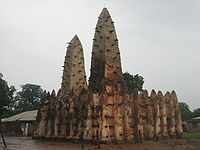
The Kong Empire started to decline after the death of Seku Wattara. Succession struggles divided the kingdom into two parts, the northern area being controlled by Seku’s brother Famagan who refused to recognize the rule of Seku’s oldest son in the south. Towards the end of the nineteenth century many of Kong’s provinces had formed independent chiefdoms. The city of Kong retained the prestige of an Islamic commercial center, but it was no longer the seat of an important political power. It eventually came under French colonial control in 1898. Despite the fall from glory, the seventeenth century Kong Friday Mosque survived and the city was largely rebuilt in a traditional Sudano-Sahelian architectural
style and features a Qur'anic school.
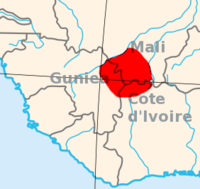 The Mande conquerors of the nineteenth century frequently utilized trade routes established by the dyula. Indeed, it was his exploitation of their commercial network that allowed military leader Samory Touré (1830–1900) to rise to a dominant position in the Upper Niger region. A member of a dyula family from Sanankoro in Guinea
, Samori conquered and united dyula states during the 1860s. He gained control over the Milo River Valley in 1871, seized the village of Kankan
in 1881, and became the principal power-holder on the upper Niger. By 1883, Samori had successfully brought the local chieftains under his control and officially founded the kingdom of Wasulu.
Having established an empire, he adopted the religious title of Almami
in 1884 and recreated the Malian realm. This new state was governed by Samori and a council of kinsmen and clients who took on the management of the chancery and the treasury
, administered justice, religious affairs, and foreign relations
. Unlike some of his contemporary state-builders, Samori was not a religious preacher and Wasulu was not a reformist state as such. Nevertheless, he used Islam to unify the nation, promoting Islamic education and basing his rule on shari’a (Islamic law). However, Samori’s professional army was the essential institution and the real strength behind his empire. He imported horses and weapons and modernized the army along European lines.
Dyula traders had never enjoyed as much prosperity as they did under the almamy. Even though they did not play a central part in the creation of the state, the dyula supported Samori because he actively encouraged commerce and protected trade routes, thus promoting a free circulation of people and goods. Samori put up the strongest resistance to European colonial penetration in West Africa, fighting both the French and British for seventeen years. Samori’s would-be Muslim empire was undone by the French, who took Sikasso
in 1898, and sent Samori into exile, where he died in 1900.
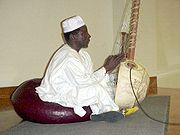 Dyula society is hierarchical or caste
-based, with nobility
and vassals. Like numerous other African peoples, they previously held slaves (jonw), who were often war prisoners
from lands surrounding their territory. Descendants of former kings and generals had a higher status than their nomadic and more settled compatriots. With time, that difference has eroded, corresponding to the economic fortunes of the groups.
The traditional dyula social structure is further organized into various familial clan
groups, and clan affiliation continues to be a dominant aspect of both collective and individual identity. People are fiercely loyal to their clan lineage, often expressing their cultural history and devotion through the oral traditions of dance and storytelling. Descent groups are identified by patronyms (dyamuw; sing. dyamu), many of which are common to other Mande-speaking peoples. In any community, individuals sharing a patronym who consider themselves agnatically (patrilineality
) related together form a kabila, with a designated head, the kabila tigi. A large kabila is divided into segments called so, lu, or gba. The precise meanings attached to these latter terms vary from place to place. Many kabilaw are too small to be segmented, and a village or town can include quite a number of unrelated clan wards, some of which might bear the same patronym. Kabilaw - and even segments of them - can be economically specialized. Internal disputes are settled by a council of the clan ward or segment as a whole. Kinship
terminology is bifurcate
merging in parents' generation, with Iroquois
cousin terms in Ego
s generation. Relative age is consistently stressed in Ego's and, to a lesser extent, in parents' generation. The dyula are patrilineal and patriarchal, with older males possessing the most power and influence. Men and women commonly reside in separate houses made of mud or cement - men occupying round houses and women in rectangular ones. The father heads the family and inheritances are passed down from fathers to their sons. Despite being illegal, the dyula still practice polygamy
and young people are often encouraged to marry within their own clan.
Another hereditary class that was afforded a particularly important status by the dyula social hierarchy was occupied by the tuntigi, or warrior class. The dyula had long been accustomed to surrounding their cities with fortifications and taking up arms when it was deemed necessary in order to defend themselves and maintain the smooth flow of trade caravans. As a result, they became closely associated with the tuntigi warrior class.
 The dyula have been predominantly Muslim since the 13th century. Many in rural areas combine Islamic beliefs with certain pre-Islamic animistic traditions, such as the presence of spirits and use of amulets. Dyula communities have a reputation for historically maintaining a high standard of Muslim education. The dyula family enterprise based on the lu could afford to provide some of its younger men an Islamic education. Thus, an ulema
(clerical) class known as karamogo
emerged, who were educated in the Quran and commentary (tafsir
), hadith
(prophetic narrations), and the life of the Prophet Muhammad. According to the dyula clerical tradition, a student received instruction under a single sheikh
for a duration varying from five to thirty years, and earned his living as a part-time farmer working his teacher's lands. After completed his studies, a karamogo obtained a turban and an isnad (teaching license), and either sought further instruction or to start his own school in a remote village. A highly educated karamogo could become a professional imam
or qadi
(judge).
Certain families gained a reputation for providing multiple generations of scholars. For example, the Saghanughu clan was a dyula lineage living in the northern and western Ivory Coast and parts of the Upper Volta
. This lineage may be traced by to Timbuktu, but its principal figure was Sheikh Muhammad al-Mustafa Saghanughu (d. 1776), the imam of Bobo-Dyulasso. He produced an educational system based on three canonical texts of Quranic commentary (tafsir
) and hadith. His sons continued spreading their father’s teachings and expanded through towns in Ghana and the Ivory Coast, founding Islamic schools, or madaris, and acting as imams and qadis.
These madaris were probably a positive by-product of the long history of Muslims’ interest in literary work. In "The Islamic Literary Tradition in Ghana", author Thomas Hodgkin
enumerates the large literary contribution that was made by Dyula-Wangara
Muslims to the history of not only the regions they found themselves in but also of West Africa as a whole. He cites al-Hajj Osmanu Eshaka Boyo of Kintampo
as an “alim
with a wide range of Muslim connexions and an excellent grasp of local Islamic history” whose efforts brought together a great many Arabic manuscripts from around Ghana. These manuscripts, the Isnad al-shuyukh wa’l-ulama, or Kitab Ghunja, compiled by al-Hajj ‘Umar ibn Abi Bakr ibn ‘Uthman al-Kabbawi al-Kanawi al-Salaghawi of Kete-Krachi who Hodgkin describes as “the most interesting, and historically significant of the poets,” may now be found in the library of the Institute of African Studies
of the University of Ghana
.
, which is included in the group of closely interrelated Manding languages
that are spoken by various ethnic groups spread across Western Africa. Dioula is most closely related to the Bambara language
(the most widely spoken language in Mali), in a manner similar to the relation between American English and British English. It is probably the most used language for trade in West Africa.
The Dioula language and people are distinct from the Diola (Jola) people of Guinea-Bissau
and Casamance
.
Ethnic group
An ethnic group is a group of people whose members identify with each other, through a common heritage, often consisting of a common language, a common culture and/or an ideology that stresses common ancestry or endogamy...
inhabiting several West African countries, including the Mali
Mali
Mali , officially the Republic of Mali , is a landlocked country in Western Africa. Mali borders Algeria on the north, Niger on the east, Burkina Faso and the Côte d'Ivoire on the south, Guinea on the south-west, and Senegal and Mauritania on the west. Its size is just over 1,240,000 km² with...
, Burkina Faso
Burkina Faso
Burkina Faso – also known by its short-form name Burkina – is a landlocked country in west Africa. It is surrounded by six countries: Mali to the north, Niger to the east, Benin to the southeast, Togo and Ghana to the south, and Côte d'Ivoire to the southwest.Its size is with an estimated...
, Senegal
Senegal
Senegal , officially the Republic of Senegal , is a country in western Africa. It owes its name to the Sénégal River that borders it to the east and north...
and Guinea-Bissau
Guinea-Bissau
The Republic of Guinea-Bissau is a country in West Africa. It is bordered by Senegal to the north, and Guinea to the south and east, with the Atlantic Ocean to its west....
.
Characterized as a highly successful merchant caste
Caste
Caste is an elaborate and complex social system that combines elements of endogamy, occupation, culture, social class, tribal affiliation and political power. It should not be confused with race or social class, e.g. members of different castes in one society may belong to the same race, as in India...
, Dyula migrants began establishing trading communities across the region in the fourteenth century. Since business was often conducted under non-Muslim rulers, the Dyula developed a set of theological principles for Muslim
Muslim
A Muslim, also spelled Moslem, is an adherent of Islam, a monotheistic, Abrahamic religion based on the Quran, which Muslims consider the verbatim word of God as revealed to prophet Muhammad. "Muslim" is the Arabic term for "submitter" .Muslims believe that God is one and incomparable...
minorities in non-Muslim societies. Their unique contribution of long-distance commerce, Islamic scholarship and religious tolerance were significant factors to the peaceful expansion of Islam in West Africa.
Historical background
The Mandé embraced Islam during the thirteenth century, following introduction to the faith through contact with the Soninké people and North African traders. By the 14th century the Malian empireMali Empire
The Mali Empire or Mandingo Empire or Manden Kurufa was a West African empire of the Mandinka from c. 1230 to c. 1600. The empire was founded by Sundiata Keita and became renowned for the wealth of its rulers, especially Mansa Musa I...
(c.1230-1600) had reached its apogee, acquiring a considerable reputation for the Islamic practice of its court and the pilgrimages of several emperors who followed the tradition of Lahilatul Kalabi, the first black prince to make hajj
Hajj
The Hajj is the pilgrimage to Mecca, Saudi Arabia. It is one of the largest pilgrimages in the world, and is the fifth pillar of Islam, a religious duty that must be carried out at least once in their lifetime by every able-bodied Muslim who can afford to do so...
to Mecca
Mecca
Mecca is a city in the Hijaz and the capital of Makkah province in Saudi Arabia. The city is located inland from Jeddah in a narrow valley at a height of above sea level...
. It was at this time that Mali began encouraging some of its local merchants to establish colonies close to the gold fields of West Africa. This migrant trading class were known as dyula, the Mandingo
Mandinka language
The Mandinka language is a Mandé language spoken by millions of Mandinka people in Mali, Senegal, The Gambia, Guinea, Côte d'Ivoire, Burkina Faso, Sierra Leone, Liberia, and Guinea-Bissau and Chad; it is the main language of The Gambia. It belongs to the Manding branch of Mandé, and is thus fairly...
word for “merchant”.
The dyula spread throughout the former area of Mandé culture, from the Atlantic coast of Senegambia to the Niger
Niger
Niger , officially named the Republic of Niger, is a landlocked country in Western Africa, named after the Niger River. It borders Nigeria and Benin to the south, Burkina Faso and Mali to the west, Algeria and Libya to the north and Chad to the east...
, and from the southern edge of the Sahara
Sahara
The Sahara is the world's second largest desert, after Antarctica. At over , it covers most of Northern Africa, making it almost as large as Europe or the United States. The Sahara stretches from the Red Sea, including parts of the Mediterranean coasts, to the outskirts of the Atlantic Ocean...
to forest zones further south. They established decentralized townships in non-Muslim colonies that were linked to an extensive commercial network, in what was described by professor Philip D. Curtin
Philip D. Curtin
Philip De Armind Curtin was a Professor Emeritus at Johns Hopkins University and historian on Africa and the Atlantic slave trade...
as a “trading diaspora.” Motivated by business imperatives, they expanded into new markets, founding settlements under the auspices of various local rulers who often permitted self-governance and autonomy. Organization of dyula trading companies were based a clan-family structure known as the lu - a working unit consisting of a father, his sons, and other attached males. Members of a given lu dispersed from the savanna
Savanna
A savanna, or savannah, is a grassland ecosystem characterized by the trees being sufficiently small or widely spaced so that the canopy does not close. The open canopy allows sufficient light to reach the ground to support an unbroken herbaceous layer consisting primarily of C4 grasses.Some...
to the forest, managed circulation of goods and information, placed orders, and effectively controlled the economic mechanisms of supply and demand
Supply and demand
Supply and demand is an economic model of price determination in a market. It concludes that in a competitive market, the unit price for a particular good will vary until it settles at a point where the quantity demanded by consumers will equal the quantity supplied by producers , resulting in an...
.
Suwarian Tradition
Over time dyula colonies developed a theological rationale for their relations with non-Muslim ruling classes and subjects in what author Nehemia Levtzion dubbed “accommodationist Islam”. The man credited with formulating this rationale is Sheikh Al-Hajj Salim SuwariAl-Hajj Salim Suwari
Sheikh Al-Hajj Salim Suwari was a late 15th-century West African Soninke karamogo who focused on the responsibilities of Muslims minorities residing in a non-Muslim society...
, a Soninke cleric from the core Mali area who lived around 1500. He made hajj to Mecca
Mecca
Mecca is a city in the Hijaz and the capital of Makkah province in Saudi Arabia. The city is located inland from Jeddah in a narrow valley at a height of above sea level...
several times and devoted his intellectual career to developing an understanding of the faith that would assist Muslim minorities in “pagan” lands. He drew on North African and Middle Eastern jurists and theologians who had reflected on the situations of Muslims living among non-Muslim majorities, situations that were frequent in the centuries of Islamic expansion.
Sheikh Suwari formulated the obligations of Muslim minorities in West Africa into something known as the Suwarian tradition. It stressed the need for Muslims to coexist peaceably with unbelievers, and so justified a separation of religion and politics. In this understanding Muslims must nurture their own learning and piety and thereby furnish good examples to the non-Muslims around them. They could accept jurisdiction of non-Muslim authorities, as long as they had the necessary protection and conditions to practice the faith. In this teaching Suwari followed a strong predilection in Islamic thought for any government, albeit non-Muslim or tyrannical, as opposed to none. The military jihad
Jihad
Jihad , an Islamic term, is a religious duty of Muslims. In Arabic, the word jihād translates as a noun meaning "struggle". Jihad appears 41 times in the Quran and frequently in the idiomatic expression "striving in the way of God ". A person engaged in jihad is called a mujahid; the plural is...
was a resort only if the faithful were threatened. Suwari discouraged dawah
Dawah
Da‘wah or Dawah usually denotes the preaching of Islam. Da‘wah literally means "issuing a summons" or "making an invitation", being the active participle of a verb meaning variously "to summon" or "to invite"...
(missionary), instead contending that Allah
Allah
Allah is a word for God used in the context of Islam. In Arabic, the word means simply "God". It is used primarily by Muslims and Bahá'ís, and often, albeit not exclusively, used by Arabic-speaking Eastern Catholic Christians, Maltese Roman Catholics, Eastern Orthodox Christians, Mizrahi Jews and...
would bring non-Muslims to Islam in His own way; it was not a Muslims responsibility to decide when ignorance should give way to belief. Since their Islamic practice was capable of accommodating traditional cults, dyula often served as priests, soothsayer
Fortune-telling
Fortune-telling is the practice of predicting information about a person's life. The scope of fortune-telling is in principle identical with the practice of divination...
s and counselors at the courts of animist rulers.
Commercial and Political Expansion
As fellow Muslims, dyula merchants were also able to assess the valuable trans-Saharan tradeTrans-Saharan trade
Trans-Saharan trade requires travel across the Sahara to reach sub-Saharan Africa. While existing from prehistoric times, the peak of trade extended from the 8th century until the late 16th century.- Increasing desertification and economic incentive :...
network, conducted by North African Arabs and Berbers
Berber people
Berbers are the indigenous peoples of North Africa west of the Nile Valley. They are continuously distributed from the Atlantic to the Siwa oasis, in Egypt, and from the Mediterranean to the Niger River. Historically they spoke the Berber language or varieties of it, which together form a branch...
whom they met at commercial centers across the Sahel
Sahel
The Sahel is the ecoclimatic and biogeographic zone of transition between the Sahara desert in the North and the Sudanian Savannas in the south.It stretches across the North African continent between the Atlantic Ocean and the Red Sea....
. Some important trade goods included gold, millet
Millet
The millets are a group of small-seeded species of cereal crops or grains, widely grown around the world for food and fodder. They do not form a taxonomic group, but rather a functional or agronomic one. Their essential similarities are that they are small-seeded grasses grown in difficult...
, slaves, kola nuts from the south and slave beads and cowrie shells from the north (for use as currency
Currency
In economics, currency refers to a generally accepted medium of exchange. These are usually the coins and banknotes of a particular government, which comprise the physical aspects of a nation's money supply...
). It was under Mali that the great cities of the Niger bend - including Gao
Gao
Gao is a town in eastern Mali on the River Niger lying ESE of Timbuktu. Situated on the left bank of the river at the junction with the Tilemsi valley, it is the capital of the Gao Region and had a population of 86,663 in 2009....
and Djenné
Djenné
Djenné is an Urban Commune and town in the Inland Niger Delta region of central Mali. In the 2009 census the commune had a population of 32,944. Administratively it is part of the Mopti Region....
- prospered, with Timbuktu in particular becoming known across Europe for its great wealth. Important trading centers in southern West Africa developed at the transitional zone between the forest and the savanna; examples include Begho and Bono Manso (in present-day Ghana) and Bondoukou
Bondoukou
Bondoukou is a town in Bondoukou Department of Côte d'Ivoire, located in the Zanzan Region, 420 km Northeast of Abidjan...
(in present-day Côte d'Ivoire). Western trade routes continued to be important, with Ouadane
Ouadane
Ouadane or Wadan is a small town in the desert region of central Mauritania, situated on the southern edge of the Adrar Plateau, 93 km northeast of Chinguetti. The town was a staging post in the trans-Saharan trade and for caravans transporting slabs of salt from the mines at Idjil. A...
, Oualata
Oualata
Oualata or Walata is a small oasis town in south east Mauritania that was important in the thirteenth and fourteenth centuries as the southern terminus of a trans-Saharan trade route...
and Chinguetti
Chinguetti
Chinguetti is a ksar or medieval trading centre in northern Mauritania, lying on the Adrar Plateau east of Atar.Founded in the 13th century, as the center of several trans-Saharan trade routes, this tiny city continues to attract a handful of visitors who admire its spare architecture, exotic...
being the major trade centres in what is now Mauritania
Mauritania
Mauritania is a country in the Maghreb and West Africa. It is bordered by the Atlantic Ocean in the west, by Western Sahara in the north, by Algeria in the northeast, by Mali in the east and southeast, and by Senegal in the southwest...
.
Penetration into Southern Forest Regions
The development of dyula trade in Ghana and the adjacent Ivory Coast had important political consequences, and sometimes military implications as well. The dyula spearheaded Mande penetration of the forested zones in the south by establishing caravan routes and trading posts at strategic locations throughout the region en route to cola producing areas. By the start of the sixteenth century, dyula merchants were trading as far south as the coast of modern Ghana.On the forests northern fringes, new states emerged such as Bono and Banda. As the economic value of gold and kola became appreciated, forests south of these states - which had hitherto been little inhabited because of limited agricultural potential - became more thickly populated, and the same principles of political and military mobilization began being applied there. Village communities became tributaries of ruling groups, with some members becoming the clients and slaves needed to support royal households, armies, and trading enterprises. Sometimes these political changes were not to the advantage of the dyula, who employed Mande warriors to guard their caravans and, if necessary, could call in larger contingents from the Sudanic kingdoms. In the seventeenth century, tensions between the Muslims and the local pagans in Begho erupted into a destructive war which eventually led to the total abandonement of the Banda capital. The local people eventually settled in a number of towns further east, while the dyula withdrew to the west, to the further side of the Banda hills, where they established the new trading center of Bonduku.
Gonja State
The dyula presence and changes in the balance of power occasioned political upheavals in other places. Among the paramount Mande political initiatives along trade routes south of JenneDjenné
Djenné is an Urban Commune and town in the Inland Niger Delta region of central Mali. In the 2009 census the commune had a population of 32,944. Administratively it is part of the Mopti Region....
was creation of the dyula state of Gonja
Gonja
This page discusses the Ghanaian kingdom of Gonja; for uses for the word Ganja, see Ganja Gonja was a kingdom in northern Ghana; the word can also refer to the people of this kingdom. The Gonja are a Guan people who have been influenced by both Akan people and Mande people. With the fall of the...
in the early 17th century. This was apparently motivated by a general worsening of the competitive position of dyula traders, and was occasioned by three factors: (1) a near monopoly control in exporting forest produce achieved by the Akan kingdom of Bono; (2) the rise to power further north of the Dagomba
Dagomba
The Dagomba are an ethnic group of Northern Ghana. They inhabit the sparse savanna region below the sahelian belt, known as the Sudan. They speak the Dagbani language which belongs to the More-Dagbani sub-group of Gur languages...
kingdom, which controlled local salt pans; and (3) increased competition following the arrival in the region of rival long-distance traders from Hausaland.
The reaction of the Dyula in the Bono-Banda-Gonja region to these developments was to erect a kingdom of their own in Gonja - the territory northern traders had to cross to reach Akan forestlands, situated in what is now modern Ghana
Ghana
Ghana , officially the Republic of Ghana, is a country located in West Africa. It is bordered by Côte d'Ivoire to the west, Burkina Faso to the north, Togo to the east, and the Gulf of Guinea to the south...
. By 1675, Gonja had established a paramount chief
Paramount chief
A paramount chief is the highest-level traditional chief or political leader in a regional or local polity or country typically administered politically with a chief-based system. This definition is used occasionally in anthropological and archaeological theory to refer to the rulers of multiple...
called Yagbongwura, to control the kingdom. But Gonja was not a fruitful land in which to try to maintain a centralized government. This is because the Dagomba power to the north and Akan power to the south were too powerful thus, the new kingdom rapidly declined in strength.
Kong Empire
Many of the trading posts established by the dyula eventually became market villages or cities, such as KongKong, Côte d'Ivoire
Kong is a town and commune in the Ferkessédougou Department, in the Savanes Region of northern Côte d'Ivoire. It was the capital of the Kong Empire .-Natural history:...
in today's north-eastern Côte d'Ivoire. It emerged as a commercial center when Malian merchants began trading in the territory which was inhabited by pagan Senufo and other Voltaic groups. The sous-préfecture of Kong, in the area of Kong to Dabakala
Dabakala
Dabakala is the center town of Dabakala Department of Côte d'Ivoire. Dabakala Department and Dabakala City lie in Vallée du Bandama Region.-References:...
, is said to be the “origin” area, where dyula traders first settled in the twelfth century. Dyula presence in the Kong area grew rapidly in the seventeenth century as a result of the developing trade between the commercial centers along the Niger banks and the forest region to the south, which was controlled by the Baule chiefdoms and by Ashanti. The dyula brought their trading skills and connections, and transformed Kong into an international market for the exchange of northern desert goods, such as salt and cloth, and southern forest exports such as cola nuts, gold, and slaves. The city was also a religious center that housed a substantial academic community of Muslim scholars, with palaces and mosques built in the traditional Sudanese style. As Kong grew prosperous, its early rulers – from the Taraweré clan, combined dyula and Senufo traditions and extended their authority over the surrounding region.
By the eighteenth century the dyula had become quite powerful in the area and wished to rid themselves of subordination to Senufo chiefs. This was achieved in an uprising led by Seku Wattara (Ouattara), a dyula warrior who claimed descent from the Malinke Keita lineage and who had studied the Quran and engaged in commerce before becoming a warrior. By rallying around himself all dyula in the area, Seku Wattara easily defeated local chiefdoms and set up an independent Dyula state in 1710, the first of its kind in West Africa. He established himself as ruler and, under his authority, the city rose from a small city-state to the capital of the great Kong Empire
Kong Empire
The Kong Empire , also known as the Wattara Empire or Ouattara Empire for its founder, was a pre-colonial African Muslim state centered in north eastern Cote d'Ivoire that also encompassed much of present-day Burkina Faso.-Early Period:...
holding sway over much of the region. The dyula of Kong also maintained commercial links with European traders on the Atlantic coast, around the Gulf of Guinea
Gulf of Guinea
The Gulf of Guinea is the northeasternmost part of the tropical Atlantic Ocean between Cape Lopez in Gabon, north and west to Cape Palmas in Liberia. The intersection of the Equator and Prime Meridian is in the gulf....
, from whom they easily obtained prized European goods, most notably rifles, gunpowder and textiles. The acquisition of weapons allowed for the creation of an armed militia force that protected trade routes passing through the territories of various minor rulers. In the course of developing his state, Seku Wattara built a strong army composed mostly of defeated pagan groups. The leadership of the army eventually developed into a new warrior class, called sonangi, which was gradually separated from the overall dyula merchant class.
The Kong Empire started to decline after the death of Seku Wattara. Succession struggles divided the kingdom into two parts, the northern area being controlled by Seku’s brother Famagan who refused to recognize the rule of Seku’s oldest son in the south. Towards the end of the nineteenth century many of Kong’s provinces had formed independent chiefdoms. The city of Kong retained the prestige of an Islamic commercial center, but it was no longer the seat of an important political power. It eventually came under French colonial control in 1898. Despite the fall from glory, the seventeenth century Kong Friday Mosque survived and the city was largely rebuilt in a traditional Sudano-Sahelian architectural
Sudano-Sahelian
The Sudano-Sahelian covers an umbrella of similar architectural styles common to the Islamized peoples of the Sahel and Sudanian regions of West Africa, south of the Sahara, but above the savanna and fertile forest regions of the coast...
style and features a Qur'anic school.
Kingdom of Wasulu
Guinea
Guinea , officially the Republic of Guinea , is a country in West Africa. Formerly known as French Guinea , it is today sometimes called Guinea-Conakry to distinguish it from its neighbour Guinea-Bissau. Guinea is divided into eight administrative regions and subdivided into thirty-three prefectures...
, Samori conquered and united dyula states during the 1860s. He gained control over the Milo River Valley in 1871, seized the village of Kankan
Kankan
Kankan is the largest city in Guinea in land area, and the third largest in population at 207,790 . The city is located on the Milo River in eastern Guinea and lying about 345 miles east of Conakry....
in 1881, and became the principal power-holder on the upper Niger. By 1883, Samori had successfully brought the local chieftains under his control and officially founded the kingdom of Wasulu.
Having established an empire, he adopted the religious title of Almami
Almami
Almami is a title of West African Muslim rulers, used especially in the conquest states of the 19th century. It is a contraction of Amir al-Mu'minin , usually translated "Commander of the Faithful" or "Prince of the Faithful"...
in 1884 and recreated the Malian realm. This new state was governed by Samori and a council of kinsmen and clients who took on the management of the chancery and the treasury
Treasury
A treasury is either*A government department related to finance and taxation.*A place where currency or precious items is/are kept....
, administered justice, religious affairs, and foreign relations
Foreign policy
A country's foreign policy, also called the foreign relations policy, consists of self-interest strategies chosen by the state to safeguard its national interests and to achieve its goals within international relations milieu. The approaches are strategically employed to interact with other countries...
. Unlike some of his contemporary state-builders, Samori was not a religious preacher and Wasulu was not a reformist state as such. Nevertheless, he used Islam to unify the nation, promoting Islamic education and basing his rule on shari’a (Islamic law). However, Samori’s professional army was the essential institution and the real strength behind his empire. He imported horses and weapons and modernized the army along European lines.
Dyula traders had never enjoyed as much prosperity as they did under the almamy. Even though they did not play a central part in the creation of the state, the dyula supported Samori because he actively encouraged commerce and protected trade routes, thus promoting a free circulation of people and goods. Samori put up the strongest resistance to European colonial penetration in West Africa, fighting both the French and British for seventeen years. Samori’s would-be Muslim empire was undone by the French, who took Sikasso
Sikasso
Sikasso is a city in the south of Mali and the capital of the Sikasso Region. With 130,700 residents, Sikasso recently passed Ségou to become Mali's second-largest city.-Geography:...
in 1898, and sent Samori into exile, where he died in 1900.
Dyula Culture and Society
Caste
Caste is an elaborate and complex social system that combines elements of endogamy, occupation, culture, social class, tribal affiliation and political power. It should not be confused with race or social class, e.g. members of different castes in one society may belong to the same race, as in India...
-based, with nobility
Nobility
Nobility is a social class which possesses more acknowledged privileges or eminence than members of most other classes in a society, membership therein typically being hereditary. The privileges associated with nobility may constitute substantial advantages over or relative to non-nobles, or may be...
and vassals. Like numerous other African peoples, they previously held slaves (jonw), who were often war prisoners
Prisoner of war
A prisoner of war or enemy prisoner of war is a person, whether civilian or combatant, who is held in custody by an enemy power during or immediately after an armed conflict...
from lands surrounding their territory. Descendants of former kings and generals had a higher status than their nomadic and more settled compatriots. With time, that difference has eroded, corresponding to the economic fortunes of the groups.
The traditional dyula social structure is further organized into various familial clan
Clan
A clan is a group of people united by actual or perceived kinship and descent. Even if lineage details are unknown, clan members may be organized around a founding member or apical ancestor. The kinship-based bonds may be symbolical, whereby the clan shares a "stipulated" common ancestor that is a...
groups, and clan affiliation continues to be a dominant aspect of both collective and individual identity. People are fiercely loyal to their clan lineage, often expressing their cultural history and devotion through the oral traditions of dance and storytelling. Descent groups are identified by patronyms (dyamuw; sing. dyamu), many of which are common to other Mande-speaking peoples. In any community, individuals sharing a patronym who consider themselves agnatically (patrilineality
Patrilineality
Patrilineality is a system in which one belongs to one's father's lineage. It generally involves the inheritance of property, names or titles through the male line as well....
) related together form a kabila, with a designated head, the kabila tigi. A large kabila is divided into segments called so, lu, or gba. The precise meanings attached to these latter terms vary from place to place. Many kabilaw are too small to be segmented, and a village or town can include quite a number of unrelated clan wards, some of which might bear the same patronym. Kabilaw - and even segments of them - can be economically specialized. Internal disputes are settled by a council of the clan ward or segment as a whole. Kinship
Kinship
Kinship is a relationship between any entities that share a genealogical origin, through either biological, cultural, or historical descent. And descent groups, lineages, etc. are treated in their own subsections....
terminology is bifurcate
Bifurcate
In law, bifurcation is a judge's ability to divide a trial into two parts so as to render a judgment on a set of legal issues without looking at all aspects. Frequently, civil cases are bifurcated into separate liability and damages proceedings...
merging in parents' generation, with Iroquois
Iroquois
The Iroquois , also known as the Haudenosaunee or the "People of the Longhouse", are an association of several tribes of indigenous people of North America...
cousin terms in Ego
I (pronoun)
I is the first-person singular subjective case personal pronoun in Modern English. It is used to refer to one's self and is capitalised, although other pronouns, such as he or she, are not capitalised.-Etymology:...
s generation. Relative age is consistently stressed in Ego's and, to a lesser extent, in parents' generation. The dyula are patrilineal and patriarchal, with older males possessing the most power and influence. Men and women commonly reside in separate houses made of mud or cement - men occupying round houses and women in rectangular ones. The father heads the family and inheritances are passed down from fathers to their sons. Despite being illegal, the dyula still practice polygamy
Polygamy
Polygamy is a marriage which includes more than two partners...
and young people are often encouraged to marry within their own clan.
Another hereditary class that was afforded a particularly important status by the dyula social hierarchy was occupied by the tuntigi, or warrior class. The dyula had long been accustomed to surrounding their cities with fortifications and taking up arms when it was deemed necessary in order to defend themselves and maintain the smooth flow of trade caravans. As a result, they became closely associated with the tuntigi warrior class.
Islamic Tradition
Ulema
Ulama , also spelt ulema, refers to the educated class of Muslim legal scholars engaged in the several fields of Islamic studies. They are best known as the arbiters of shari‘a law...
(clerical) class known as karamogo
Karamogo
The Karamogo were the scholar class among the peaceful Dyula traders of Western Africa, of which Al-Hajj Salim Suwari was a prominent member. The Karamogo developed theological rationales for living among non-Muslims, arguing that one should nurture one's own faith and let conversion happen in its...
emerged, who were educated in the Quran and commentary (tafsir
Tafsir
Tafseer is the Arabic word for exegesis or commentary, usually of the Qur'an. Ta'wīl is a subset of tafsir and refers to esoteric or mystical interpretation. An author of tafsir is a mufassir .- Etymology :...
), hadith
Hadith
The term Hadīth is used to denote a saying or an act or tacit approval or criticism ascribed either validly or invalidly to the Islamic prophet Muhammad....
(prophetic narrations), and the life of the Prophet Muhammad. According to the dyula clerical tradition, a student received instruction under a single sheikh
Sheikh
Not to be confused with sikhSheikh — also spelled Sheik or Shaikh, or transliterated as Shaykh — is an honorific in the Arabic language that literally means "elder" and carries the meaning "leader and/or governor"...
for a duration varying from five to thirty years, and earned his living as a part-time farmer working his teacher's lands. After completed his studies, a karamogo obtained a turban and an isnad (teaching license), and either sought further instruction or to start his own school in a remote village. A highly educated karamogo could become a professional imam
Imam
An imam is an Islamic leadership position, often the worship leader of a mosque and the Muslim community. Similar to spiritual leaders, the imam is the one who leads Islamic worship services. More often, the community turns to the mosque imam if they have a religious question...
or qadi
Qadi
Qadi is a judge ruling in accordance with Islamic religious law appointed by the ruler of a Muslim country. Because Islam makes no distinction between religious and secular domains, qadis traditionally have jurisdiction over all legal matters involving Muslims...
(judge).
Certain families gained a reputation for providing multiple generations of scholars. For example, the Saghanughu clan was a dyula lineage living in the northern and western Ivory Coast and parts of the Upper Volta
Republic of Upper Volta
The Republic of Upper Volta was established on December 11, 1958, as a self-governing colony within the French Community. Before attaining autonomy it had been French Upper Volta and part of the French Union. On August 5, 1960 it attained full independence from France.Thomas Sankara came to power...
. This lineage may be traced by to Timbuktu, but its principal figure was Sheikh Muhammad al-Mustafa Saghanughu (d. 1776), the imam of Bobo-Dyulasso. He produced an educational system based on three canonical texts of Quranic commentary (tafsir
Tafsir
Tafseer is the Arabic word for exegesis or commentary, usually of the Qur'an. Ta'wīl is a subset of tafsir and refers to esoteric or mystical interpretation. An author of tafsir is a mufassir .- Etymology :...
) and hadith. His sons continued spreading their father’s teachings and expanded through towns in Ghana and the Ivory Coast, founding Islamic schools, or madaris, and acting as imams and qadis.
These madaris were probably a positive by-product of the long history of Muslims’ interest in literary work. In "The Islamic Literary Tradition in Ghana", author Thomas Hodgkin
Thomas Lionel Hodgkin
Thomas Lionel Hodgkin was an English Marxist historian of Africa "who did more than anyone to establish the serious study of African history" in the UK. His wife was the scientist Dorothy Hodgkin.-Life:Thomas Lionel Hodgkin was born into an academic family...
enumerates the large literary contribution that was made by Dyula-Wangara
Wangara, Burkina Faso
Wangara is a village in the Tiankoura Department of Bougouriba Province in south-western Burkina Faso. The village has a population of 522.-External links:*...
Muslims to the history of not only the regions they found themselves in but also of West Africa as a whole. He cites al-Hajj Osmanu Eshaka Boyo of Kintampo
Kintampo
The Kintampo archeological site in Ghana dates back to 2500-1400 BCE and is one of the earliest known sites for the cultivation of the cowpea. Evidence of polished stone axes, stone beads, buildings of stone, domestic pots, ceramic sculptures of humans and animals indicate that Kintampo was...
as an “alim
Alim
-Given name:* Amat Al Alim Alsoswa, Yemeni politician* Alim Ashirov, Soviet footballer* AFM Alim Chowdhury, Bangladeshi physician*Aleem Dar , Pakistani cricketer* Alim Karkayev, Russian footballer* Mohammed Alim Khan, last emir of the Manghit dynasty...
with a wide range of Muslim connexions and an excellent grasp of local Islamic history” whose efforts brought together a great many Arabic manuscripts from around Ghana. These manuscripts, the Isnad al-shuyukh wa’l-ulama, or Kitab Ghunja, compiled by al-Hajj ‘Umar ibn Abi Bakr ibn ‘Uthman al-Kabbawi al-Kanawi al-Salaghawi of Kete-Krachi who Hodgkin describes as “the most interesting, and historically significant of the poets,” may now be found in the library of the Institute of African Studies
Institute of African Studies
The Institute of African Studies on the campus of the University of Ghana at Legon is an interdisciplinary research institute in the humanities and social sciences. It was established by President Kwame Nkrumah in 1962 to encourage African studies....
of the University of Ghana
University of Ghana
The University of Ghana is the oldest and largest of the thirteen Ghanaian universities and tertiary institutions. It is one of the best universities in Africa and by far the most prestigious in West Africa...
.
Dioula language
The dyula speak the Dioula language or JulakanDioula language
Jula is a Mande language spoken in Burkina Faso, Côte d'Ivoire and Mali. It is one of the Manding languages, and is most closely related to Bambara, being mutually intelligible with Bambara as well as Malinke. It is a trade language in West Africa and is spoken by millions of people, either as a...
, which is included in the group of closely interrelated Manding languages
Manding languages
The Manding languages are a fairly mutually intelligible group of dialects or languages in West Africa, belonging to the Mande languages. Their best-known members are Bambara, the most widely spoken language in Mali; Mandinka, the main language of Gambia; Maninka or Malinké, a major language of...
that are spoken by various ethnic groups spread across Western Africa. Dioula is most closely related to the Bambara language
Bambara language
Bambara, more correctly known as Bamanankan , its designation in the language itself , is a language spoken in Mali by as many as six million people...
(the most widely spoken language in Mali), in a manner similar to the relation between American English and British English. It is probably the most used language for trade in West Africa.
The Dioula language and people are distinct from the Diola (Jola) people of Guinea-Bissau
Guinea-Bissau
The Republic of Guinea-Bissau is a country in West Africa. It is bordered by Senegal to the north, and Guinea to the south and east, with the Atlantic Ocean to its west....
and Casamance
Casamance
Casamance is the area of Senegal south of The Gambia including the Casamance River. It consists of Basse Casamance and Haute Casamance...
.
Notable members
- Al-Hajj Salim SuwariAl-Hajj Salim SuwariSheikh Al-Hajj Salim Suwari was a late 15th-century West African Soninke karamogo who focused on the responsibilities of Muslims minorities residing in a non-Muslim society...
- Samory Touré (1830–1900)
- Muhammad al-Mustafa Saghanughu (d. 1776) - the imam of Bobo-Dioulasso.
- Seku Ouattara (Wattara) - a dioula warrior.