

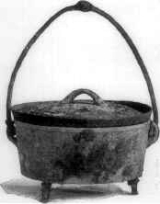
Dutch oven

Encyclopedia
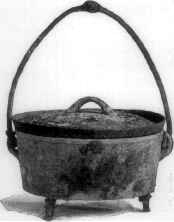
Cast iron
Cast iron is derived from pig iron, and while it usually refers to gray iron, it also identifies a large group of ferrous alloys which solidify with a eutectic. The color of a fractured surface can be used to identify an alloy. White cast iron is named after its white surface when fractured, due...
) cooking pot with a tight-fitting lid. Dutch ovens have been used as cooking vessels for hundreds of years.
Dutch ovens are commonly referred to as cocottes in French, and as “casserole dishes” in British English
British English
British English, or English , is the broad term used to distinguish the forms of the English language used in the United Kingdom from forms used elsewhere...
. They are similar to both the Japan
Japan
Japan is an island nation in East Asia. Located in the Pacific Ocean, it lies to the east of the Sea of Japan, China, North Korea, South Korea and Russia, stretching from the Sea of Okhotsk in the north to the East China Sea and Taiwan in the south...
ese tetsunabe
Nabemono
Nabemono or simply called nabe, is a term referring to all varieties of Japanese steamboat dishes, also known as one pot dishes....
and the Sač
SAC
-People:* Stuart Adam Campbell, a famous gamer who got 30 days playtime within two months of MW2's release in 2009-Computers:* Symposium on Applied Computing, an annual conference sponsored by the ACM Special Interest Group on Applied Computing...
, a traditional Balkan cast-iron oven, and are related to the South African Potjie
Potjiekos
In South Africa, potjiekos , literally translated "small pot food", is a stew prepared outdoors. It is traditionally cooked in a round, cast iron, three-legged pot, the potjie, brought from the Netherlands to South Africa in the 17th century and found in the homes and villages of people throughout...
and the Australian Bedourie oven
Bedourie oven
The Bedourie Oven is an Australian adaptation of the camp oven, better known as a Dutch oven. Drovers working on Bedourie Station, in western Queensland, found that the cast iron camp ovens they use for cooking would often fall from their pack horses and sometimes break when they hit the ground...
.
Early European history
During the late 17th century, the Dutch system of producing these cast metal cooking vessels was more advanced than the English system. The Dutch used dry sand to make their molds, giving their pots a smoother surface. Consequently, metal cooking vessels produced in the Netherlands were imported into Britain. In 1704, an Englishman named Abraham DarbyAbraham Darby I
Abraham Darby I was the first, and most famous, of three generations with that name in an English Quaker family that played an important role in the Industrial Revolution. He developed a method of producing pig iron in a blast furnace fuelled by coke rather than charcoal...
decided to go to The Netherlands to observe the Dutch system for making these cooking vessels. Four years later, back in England, Darby patented a casting procedure similar to the Dutch process and began to produce cast-metal cooking vessels for Britain and her new America
United States
The United States of America is a federal constitutional republic comprising fifty states and a federal district...
n colonies. It is possible that because Darby’s patent was based upon his research into the Dutch foundry system that the cooking vessels he produced came to be referred to as “Dutch” ovens. Other researchers believe that this term may have come from the itinerant Dutch traders who sold cooking vessels out of their wagons as they traveled from town to town and door to door. In any event, the term “Dutch oven” has endured for over 300 years, since at least 1710.
American history
Over time, the Dutch oven used in the American colonies began to change. The pot became shallower and legs were added to hold the oven above the coals. A flange was added to the lid to keep the coals on the lid and out of the food.The cast-iron cookware was loved by colonists and settlers because of its versatility and durability. It could be used for boiling
Boiling
Boiling is the rapid vaporization of a liquid, which occurs when a liquid is heated to its boiling point, the temperature at which the vapor pressure of the liquid is equal to the pressure exerted on the liquid by the surrounding environmental pressure. While below the boiling point a liquid...
, baking
Baking
Baking is the technique of prolonged cooking of food by dry heat acting by convection, and not by radiation, normally in an oven, but also in hot ashes, or on hot stones. It is primarily used for the preparation of bread, cakes, pastries and pies, tarts, quiches, cookies and crackers. Such items...
, stew
Stew
A stew is a combination of solid food ingredients that have been cooked in liquid and served in the resultant gravy. Ingredients in a stew can include any combination of vegetables , meat, especially tougher meats suitable for slow-cooking, such as beef. Poultry, sausages, and seafood are also used...
s, frying
Frying
Frying is the cooking of food in oil or another fat, a technique that originated in ancient Egypt around 2500 BC. Chemically, oils and fats are the same, differing only in melting point, but the distinction is only made when needed. In commerce, many fats are called oils by custom, e.g...
, roasting
Roasting
Roasting is a cooking method that uses dry heat, whether an open flame, oven, or other heat source. Roasting usually causes caramelization or Maillard browning of the surface of the food, which is considered by some as a flavor enhancement. Roasting uses more indirect, diffused heat , and is...
, and just about any other use. The ovens were so valuable that wills in the 18th and 19th centuries frequently spelled out the desired inheritor of the cast iron cookware. For example, Mary Ball Washington
Mary Ball Washington
Mary Ball Washington was the second wife to Augustine Washington, and was the mother of George Washington.-Life:...
(mother of President George Washington
George Washington
George Washington was the dominant military and political leader of the new United States of America from 1775 to 1799. He led the American victory over Great Britain in the American Revolutionary War as commander-in-chief of the Continental Army from 1775 to 1783, and presided over the writing of...
) specified in her will, dated 20 May 1788, that one-half of her "iron kitchen furniture" should go to her grandson, Fielding Lewis
Fielding Lewis
Fielding Lewis was a Colonel during the American Revolutionary War and the brother-in-law of George Washington....
, and the other half to Betty Carter, a granddaughter. Several Dutch ovens were among Mary’s “iron kitchen furniture.”
When the young American country began to spread westward across the North America
North America
North America is a continent wholly within the Northern Hemisphere and almost wholly within the Western Hemisphere. It is also considered a northern subcontinent of the Americas...
n continent, so did the Dutch oven. A Dutch oven was among the gear Lewis and Clark
Lewis and Clark Expedition
The Lewis and Clark Expedition, or ″Corps of Discovery Expedition" was the first transcontinental expedition to the Pacific Coast by the United States. Commissioned by President Thomas Jefferson and led by two Virginia-born veterans of Indian wars in the Ohio Valley, Meriwether Lewis and William...
carried when they explored the great American Northwest
Northwestern United States
The Northwestern United States comprise the northwestern states up to the western Great Plains regions of the United States, and consistently include the states of Oregon, Washington, Idaho, Montana, Wyoming, to which part of southeast Alaska is also sometimes included...
in 1804–1806. The pioneers who settled the American West
Western United States
.The Western United States, commonly referred to as the American West or simply "the West," traditionally refers to the region comprising the westernmost states of the United States. Because the U.S. expanded westward after its founding, the meaning of the West has evolved over time...
also took along their Dutch ovens. In fact, a statue raised to honor the Mormon handcart companies
Mormon handcart pioneers
The Mormon handcart pioneers were participants in the migration of members of The Church of Jesus Christ of Latter-day Saints to Salt Lake City, Utah, who used handcarts to transport their belongings...
who entered Utah’s Salt Lake Valley
Salt Lake Valley
Salt Lake Valley is a valley in Salt Lake County in the north-central portion of the U.S. state of Utah. It contains Salt Lake City and many of its suburbs, notably West Valley City, Murray, Sandy, and West Jordan; its total population is 1,029,655 as of 2010...
in the 1850s proudly displays a Dutch oven hanging from the front of the handcart. The Dutch oven is also the official state cooking pot of Utah.
Mountain men
Mountain man
Mountain men were trappers and explorers who roamed the North American Rocky Mountains from about 1810 through the 1880s where they were instrumental in opening up the various Emigrant Trails allowing Americans in the east to settle the new territories of the far west by organized wagon trains...
exploring the great American frontier used Dutch ovens into the late 19th century. Dutch oven cooking was also prominent among those who took part in the western cattle drives
Cattle drives in the United States
Cattle drives were a major economic activity in the American west, particularly between the years 1866-1886, when 20 million cattle were herded from Texas to railheads in Kansas for shipments to stockyards in Chicago and points east...
that lasted from the mid-19th century into the early 20th century.
Camping
A campingCamping
Camping is an outdoor recreational activity. The participants leave urban areas, their home region, or civilization and enjoy nature while spending one or several nights outdoors, usually at a campsite. Camping may involve the use of a tent, caravan, motorhome, cabin, a primitive structure, or no...
, cowboy
Cowboy
A cowboy is an animal herder who tends cattle on ranches in North America, traditionally on horseback, and often performs a multitude of other ranch-related tasks. The historic American cowboy of the late 19th century arose from the vaquero traditions of northern Mexico and became a figure of...
, or chuckwagon
Chuckwagon
A chuckwagon or chuck wagon is a type of wagon historically used to carry food and cooking equipment on the prairies of the United States and Canada. Such wagons would form part of a wagon train of settlers or feed traveling workers such as cowboys or loggers.In modern times, chuckwagons feature...
Dutch oven has three legs, a wire bail handle
Bail Handles
In France, during the early 18th century bail handles were beginning to be used on several pieces of furniture. This was during the style of Rococo....
, and a slightly concave, rimmed lid so that coals from the cooking
Cooking
Cooking is the process of preparing food by use of heat. Cooking techniques and ingredients vary widely across the world, reflecting unique environmental, economic, and cultural traditions. Cooks themselves also vary widely in skill and training...
fire
Fire
Fire is the rapid oxidation of a material in the chemical process of combustion, releasing heat, light, and various reaction products. Slower oxidative processes like rusting or digestion are not included by this definition....
can be placed on top as well as below. This provides more uniform internal heat and lets the inside act as an oven
Oven
An oven is a thermally insulated chamber used for the heating, baking or drying of a substance. It is most commonly used for cooking. Kilns, and furnaces are special-purpose ovens...
. These ovens are typically made of bare cast iron
Cast iron cookware
Cast iron is used for cookware because it has excellent heat retention properties and can be produced and formed with a relatively low level of technology. Seasoning is used to protect bare cast iron from rust and to create a non-stick surface.-History:...
, although some are aluminum. Dutch ovens are often used in Scouting
Scouting
Scouting, also known as the Scout Movement, is a worldwide youth movement with the stated aim of supporting young people in their physical, mental and spiritual development, that they may play constructive roles in society....
outdoor activities.
Modern Dutch ovens
Modern Dutch ovens designed for use on the cooktop or in the ovenOven
An oven is a thermally insulated chamber used for the heating, baking or drying of a substance. It is most commonly used for cooking. Kilns, and furnaces are special-purpose ovens...
are typically smooth-bottomed. Two French manufacturers of enameled Dutch ovens, Le Creuset
Le Creuset
Le Creuset is a French cookware manufacturer best known for its colorful enameled cast iron casseroles, which the company calls "French Ovens", or "Dutch Ovens"...
and Le Chasseur
Le Chasseur
Chasseur is a French cookware manufacturer which manufactures colorful enameled cast iron dutch ovens . It is based in Donchery in the Northern part of France and has been manufacturing since approximately 1933...
, refer to their ovens as "French ovens", or in the UK as "casserole dishes". Some older styles, such as the unglazed ovens by Lodge
Lodge (company)
Lodge Manufacturing, headquartered in South Pittsburg, Tennessee, manufactures cast iron cookware.-History:Founded in 1896 by Joseph Lodge, Lodge Manufacturing is one of America's oldest cookware companies in continuous operation. It is still owned and managed by the descendants of the Lodge family...
, Griswold, CampChef, and Wagner, retain the bale handle, while others, such as the enameled versions by Staub, Sante, and Le Creuset, have two loop handles. Modern ovens may also be made of thick cast aluminum or ceramic
Ceramic
A ceramic is an inorganic, nonmetallic solid prepared by the action of heat and subsequent cooling. Ceramic materials may have a crystalline or partly crystalline structure, or may be amorphous...
.
Bedourie oven
In AustraliaAustralia
Australia , officially the Commonwealth of Australia, is a country in the Southern Hemisphere comprising the mainland of the Australian continent, the island of Tasmania, and numerous smaller islands in the Indian and Pacific Oceans. It is the world's sixth-largest country by total area...
, a bedourie camp oven is a steel cookpot shaped and used like a dutch oven. Named after Bedourie, Queensland, the Bedourie ovens were developed as a more robust (non-breakable) alternative to the more fragile cast iron
Cast iron
Cast iron is derived from pig iron, and while it usually refers to gray iron, it also identifies a large group of ferrous alloys which solidify with a eutectic. The color of a fractured surface can be used to identify an alloy. White cast iron is named after its white surface when fractured, due...
dutch ovens.
Potjie
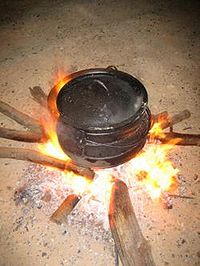
South Africa
The Republic of South Africa is a country in southern Africa. Located at the southern tip of Africa, it is divided into nine provinces, with of coastline on the Atlantic and Indian oceans...
, a potjie (icon), directly translated "lesser pot" from Afrikaans
Afrikaans
Afrikaans is a West Germanic language, spoken natively in South Africa and Namibia. It is a daughter language of Dutch, originating in its 17th century dialects, collectively referred to as Cape Dutch .Afrikaans is a daughter language of Dutch; see , , , , , .Afrikaans was historically called Cape...
or Dutch
Dutch language
Dutch is a West Germanic language and the native language of the majority of the population of the Netherlands, Belgium, and Suriname, the three member states of the Dutch Language Union. Most speakers live in the European Union, where it is a first language for about 23 million and a second...
, is traditionally, a round, cast iron
Cast iron
Cast iron is derived from pig iron, and while it usually refers to gray iron, it also identifies a large group of ferrous alloys which solidify with a eutectic. The color of a fractured surface can be used to identify an alloy. White cast iron is named after its white surface when fractured, due...
, three-legged (tripod) pot. It is similar in appearance to a cauldron
Cauldron
A cauldron or caldron is a large metal pot for cooking and/or boiling over an open fire, with a large mouth and frequently with an arc-shaped hanger.- Etymology :...
and is usually black. It has a cast iron lid with a special design to allow for hot coals to rest on top, so that the pot may also be heated from above. Care must be taken when cleaning a potjie for storage to avoid rust forming. "Potjie" can also refer to the technique of cooking potjiekos. Among the recipes which require a potjie, there is one for a type of bread called "potbrood", which literally means "pot bread".
Among the South African indigenous tribes these pots also became known as phutu
Phutu
Phutu, pronounced "poo-too", is a traditional maize meal from South Africa. It is a crumbly or grainy type of pap or porridge, eaten mainly by the Basotho, Bantu and Afrikaner people. It is cooked in cauldrons or potjies over an open fire, stirred with great effort until a consistency in texture is...
pots, after a popular food prepared in it.
This tradition originated in the Netherlands
Netherlands
The Netherlands is a constituent country of the Kingdom of the Netherlands, located mainly in North-West Europe and with several islands in the Caribbean. Mainland Netherlands borders the North Sea to the north and west, Belgium to the south, and Germany to the east, and shares maritime borders...
during the Siege of Leiden
Siege of Leiden
The Siege of Leiden occurred during the Eighty Years' War in 1573 and 1574, when the Spanish attempted to capture the rebellious city of Leiden, South Holland, Netherlands, and ultimately failed.-Background:...
and was brought to South Africa by Dutch immigrants. It persisted over the years with the Voortrekkers and survives today as a traditional Afrikaner
Afrikaner
Afrikaners are an ethnic group in Southern Africa descended from almost equal numbers of Dutch, French and German settlers whose native tongue is Afrikaans: a Germanic language which derives primarily from 17th century Dutch, and a variety of other languages.-Related ethno-linguistic groups:The...
method of cooking. It is still in common use by south african campers.
Use in cooking
Dutch ovens are well suited for long, slow cooking, such as in making roasts, stews, and casseroleCasserole
A casserole, from the French for "saucepan", is a large, deep dish used both in the oven and as a serving vessel. The word casserole is also used for the food cooked and served in such a vessel, with the cookware itself called a casserole dish or casserole pan...
s.
When cooking over a campfire, it is possible to use old-style lipped cast iron Dutch ovens as true baking ovens, to prepare biscuit
Biscuit
A biscuit is a baked, edible, and commonly flour-based product. The term is used to apply to two distinctly different products in North America and the Commonwealth Nations....
s, cake
Cake
Cake is a form of bread or bread-like food. In its modern forms, it is typically a sweet and enriched baked dessert. In its oldest forms, cakes were normally fried breads or cheesecakes, and normally had a disk shape...
s, bread
Bread
Bread is a staple food prepared by cooking a dough of flour and water and often additional ingredients. Doughs are usually baked, but in some cuisines breads are steamed , fried , or baked on an unoiled frying pan . It may be leavened or unleavened...
s, pizza
Pizza
Pizza is an oven-baked, flat, disc-shaped bread typically topped with a tomato sauce, cheese and various toppings.Originating in Italy, from the Neapolitan cuisine, the dish has become popular in many parts of the world. An establishment that makes and sells pizzas is called a "pizzeria"...
s, and even pie
Pie
A pie is a baked dish which is usually made of a pastry dough casing that covers or completely contains a filling of various sweet or savoury ingredients....
s. A smaller baking pan can be placed inside the ovens, used and replaced with another as the first batch is completed. It is also possible to stack Dutch ovens on top of each other, conserving the heat that would normally rise from the hot coals on the top. These stacks can be as high as 5 or 6 pots.
Bare cast iron
Americans traditionally seasonSeasoned pan
Seasoning is the process of treating the surface of a metal saucepan, wok, cast-iron cookware or other cooking vessel to create a stick-resistant coating...
their iron Dutch ovens like other cast-iron cookware.
After use Dutch ovens are typically cleaned like other cast iron cookware: with boiling water and a brush, and no or minimal soap. After the oven has been dried, it should be given a thin coating of cooking oil to prevent rusting. Again, whether that should be a vegetable fat or an animal fat (such as lard) is hotly contested. Saturated fats are more stable than polyunsaturated fats, which tend to go rancid more quickly.
Where possible, a cleaned and freshly oiled Dutch oven should be stored in a clean, dry location with the lid ajar or off to promote air circulation and to avoid the smell and taste of rancid oil. If the Dutch oven must be stored with the lid on, a paper towel or piece of newspaper should be placed inside the oven to absorb any moisture.
With care, after much use the surfaces of the Dutch oven will become dark black, very smooth and shiny, and as non-stick as the best Teflon or other non-stick cookware available. With proper care, a Dutch oven will render decades or centuries of service.
Enameled ovens
Enameled ovens do not need to be seasoned before use. However, they lose some of the other advantages of bare cast iron. For example, deep fryingDeep frying
Deep frying is a cooking method in which food is submerged in hot oil or fat. This is normally performed with a deep fryer or chip pan; industrially, a pressure fryer or vacuum fryer may be used....
is usually not recommended in enameled ovens; the enamel coating is not able to withstand high heat, and is best suited for water-based cooking.
Enameled ovens can usually be cleaned like ordinary cookware, and some brands can even be put in the dishwasher.
See also
- Outdoor cooking
- Derek HollandDerek Holland (baseball)Derek Lane Holland is a Major League Baseball left-handed starting pitcher for the Texas Rangers. He is noted for his kid-like appearance....
, nicknamed "Dutch Oven" - Dutch oven (practical joke)Dutch oven (practical joke)A Dutch oven is a slang term for pulling a cover over someone's head while in bed and creating flatulence, thereby creating an area of foul-odored air in an enclosed space that must be inhaled...