


Frying

Encyclopedia
Frying is the cooking
of food in oil
or another fat
, a technique that originated in ancient Egypt
around 2500 BC. Chemically, oils and fats are the same, differing only in melting point
, but the distinction is only made when needed. In commerce, many fats are called oils by custom, e.g. palm oil
and coconut oil
, which are solid at room temperature
.
around 2500 BCE.
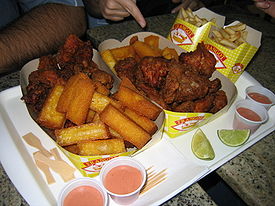 Fats can reach much higher temperatures than water at normal atmospheric pressure
. Through frying, one can sear or even carbonize
the surface of foods while caramelizing sugars. The food is cooked much more quickly and has a characteristic crispness and texture. Depending on the food, the fat will penetrate it to varying degrees, contributing richness, lubricity, and its own flavour.
Frying techniques vary in the amount of fat required, the cooking time, the type of cooking vessel required, and the manipulation of the food. Sautéing
, stir frying
, pan frying
, shallow frying
, and deep frying
are all standard frying techniques.
Sautéing and stir-frying involve cooking foods in a thin layer of fat on a hot surface, such as a frying pan
, griddle
, wok
, or sauteuse. Stir frying involves frying quickly at very high temperatures, requiring that the food be stirred continuously to prevent it from adhering to the cooking surface and burning.
Shallow frying is a type of pan frying
using only enough fat to immerse approximately one-third to one-half of each piece of food; fat used in this technique is typically only used once. Deep-frying, on the other hand, involves totally immersing the food in hot oil, which is normally topped up and used several times before being disposed. Deep-frying is typically a much more involved process, and may require specialized oils for optimal results.
Deep frying is now the basis of a very large and expanding worldwide industry. Fried products have consumer appeal in all age groups and in virtually all cultures, and the process is quick, can easily be made continuous for mass production, and the food emerges sterile and dry, with a relatively long shelf life. The end products can then be easily packaged for storage and distribution. Examples are potato chips, french fries
, nuts
, doughnut
s, instant noodles
, etc.
Cooking
Cooking is the process of preparing food by use of heat. Cooking techniques and ingredients vary widely across the world, reflecting unique environmental, economic, and cultural traditions. Cooks themselves also vary widely in skill and training...
of food in oil
Cooking oil
Cooking oil is purified fat of plant origin, which is usually liquid at room temperature ....
or another fat
Fat
Fats consist of a wide group of compounds that are generally soluble in organic solvents and generally insoluble in water. Chemically, fats are triglycerides, triesters of glycerol and any of several fatty acids. Fats may be either solid or liquid at room temperature, depending on their structure...
, a technique that originated in ancient Egypt
Old Kingdom
Old Kingdom is the name given to the period in the 3rd millennium BC when Egypt attained its first continuous peak of civilization in complexity and achievement – the first of three so-called "Kingdom" periods, which mark the high points of civilization in the lower Nile Valley .The term itself was...
around 2500 BC. Chemically, oils and fats are the same, differing only in melting point
Melting point
The melting point of a solid is the temperature at which it changes state from solid to liquid. At the melting point the solid and liquid phase exist in equilibrium. The melting point of a substance depends on pressure and is usually specified at standard atmospheric pressure...
, but the distinction is only made when needed. In commerce, many fats are called oils by custom, e.g. palm oil
Palm oil
Palm oil, coconut oil and palm kernel oil are edible plant oils derived from the fruits of palm trees. Palm oil is extracted from the pulp of the fruit of the oil palm Elaeis guineensis; palm kernel oil is derived from the kernel of the oil palm and coconut oil is derived from the kernel of the...
and coconut oil
Coconut oil
Coconut oil is an edible oil extracted from the kernel or meat of matured coconuts harvested from the coconut palm . Throughout the tropical world, it has provided the primary source of fat in the diets of millions of people for generations. It has various applications in food, medicine, and industry...
, which are solid at room temperature
Room temperature
-Comfort levels:The American Society of Heating, Refrigerating and Air-Conditioning Engineers has listings for suggested temperatures and air flow rates in different types of buildings and different environmental circumstances. For example, a single office in a building has an occupancy ratio per...
.
History
Frying is believed to have originated in ancient EgyptOld Kingdom
Old Kingdom is the name given to the period in the 3rd millennium BC when Egypt attained its first continuous peak of civilization in complexity and achievement – the first of three so-called "Kingdom" periods, which mark the high points of civilization in the lower Nile Valley .The term itself was...
around 2500 BCE.
Details
Atmospheric pressure
Atmospheric pressure is the force per unit area exerted into a surface by the weight of air above that surface in the atmosphere of Earth . In most circumstances atmospheric pressure is closely approximated by the hydrostatic pressure caused by the weight of air above the measurement point...
. Through frying, one can sear or even carbonize
Carbonization
Carbonization or carbonisation is the term for the conversion of an organic substance into carbon or a carbon-containing residue through pyrolysis or destructive distillation. It is often used in organic chemistry with reference to the generation of coal gas and coal tar from raw coal...
the surface of foods while caramelizing sugars. The food is cooked much more quickly and has a characteristic crispness and texture. Depending on the food, the fat will penetrate it to varying degrees, contributing richness, lubricity, and its own flavour.
Frying techniques vary in the amount of fat required, the cooking time, the type of cooking vessel required, and the manipulation of the food. Sautéing
Sautéing
Sautéing is a method of cooking food, that uses a small amount of fat in a shallow pan over relatively high heat. Ingredients are usually cut into pieces or thinly sliced to facilitate fast cooking. The primary mode of heat transfer during sautéing is conduction between the pan and the food being...
, stir frying
Stir frying
Stir frying is an umbrella term used to describe two Chinese cooking techniques for preparing food in a wok: chǎo and bào . The term stir-fry was introduced into the English language by Buwei Yang Chao, in her book How to Cook and Eat in Chinese, to describe the chǎo technique...
, pan frying
Pan frying
Pan frying is a form of frying characterized by the use of minimal cooking oil or fat ; typically using just enough oil to lubricate the pan...
, shallow frying
Shallow frying
Shallow frying is an oil-based cooking technique. It is typically used to prepare portion-sized cuts of meat and fish, and patties such as fritters. Shallow frying can also be used to cook vegetables. Shallow-fried foods are often battered. It is a high-heat process, promoting browning and, in...
, and deep frying
Deep frying
Deep frying is a cooking method in which food is submerged in hot oil or fat. This is normally performed with a deep fryer or chip pan; industrially, a pressure fryer or vacuum fryer may be used....
are all standard frying techniques.
Sautéing and stir-frying involve cooking foods in a thin layer of fat on a hot surface, such as a frying pan
Frying pan
A frying pan, frypan, or skillet is a flat-bottomed pan used for frying, searing, and browning foods. It is typically in diameter with relatively low sides that flare outwards, a long handle, and no lid. Larger pans may have a small grab handle opposite the main handle...
, griddle
Griddle
A griddle is a cooking device consisting of a broad flat surface that can be heated using a variety of means, and is used in both residential and commercial applications for a variety of cooking operations. Most commonly, the griddle consists of a flat metal plate, but in the non-industrialized...
, wok
Wok
A wok is a versatile round-bottomed cooking vessel originating in China. It is used especially in East and Southeast Asia.Woks are most often used for stir frying, but can also be used in other Chinese cooking techniques, such as in steaming, deep frying, braising, stewing, smoking, or making soup...
, or sauteuse. Stir frying involves frying quickly at very high temperatures, requiring that the food be stirred continuously to prevent it from adhering to the cooking surface and burning.
Shallow frying is a type of pan frying
Pan frying
Pan frying is a form of frying characterized by the use of minimal cooking oil or fat ; typically using just enough oil to lubricate the pan...
using only enough fat to immerse approximately one-third to one-half of each piece of food; fat used in this technique is typically only used once. Deep-frying, on the other hand, involves totally immersing the food in hot oil, which is normally topped up and used several times before being disposed. Deep-frying is typically a much more involved process, and may require specialized oils for optimal results.
Deep frying is now the basis of a very large and expanding worldwide industry. Fried products have consumer appeal in all age groups and in virtually all cultures, and the process is quick, can easily be made continuous for mass production, and the food emerges sterile and dry, with a relatively long shelf life. The end products can then be easily packaged for storage and distribution. Examples are potato chips, french fries
French fries
French fries , chips, fries, or French-fried potatoes are strips of deep-fried potato. North Americans tend to refer to any pieces of deep-fried potatoes as fries or French fries, while in the United Kingdom, Australia, Ireland and New Zealand, long, thinly cut slices of deep-fried potatoes are...
, nuts
Nut (fruit)
A nut is a hard-shelled fruit of some plants having an indehiscent seed. While a wide variety of dried seeds and fruits are called nuts in English, only a certain number of them are considered by biologists to be true nuts...
, doughnut
Doughnut
A doughnut or donut is a fried dough food and is popular in many countries and prepared in various forms as a sweet snack that can be homemade or purchased in bakeries, supermarkets, food stalls, and franchised specialty outlets...
s, instant noodles
Instant noodles
Instant noodles are dried or precooked noodles and are often sold with packets of flavoring including seasoning oil. Dried noodles are usually eaten after being cooked or soaked in boiling water for 2 to 5 minutes, while precooked noodles can be reheated or eaten straight from the packet...
, etc.
See also
- Cooking oilCooking oilCooking oil is purified fat of plant origin, which is usually liquid at room temperature ....
- SautéingSautéingSautéing is a method of cooking food, that uses a small amount of fat in a shallow pan over relatively high heat. Ingredients are usually cut into pieces or thinly sliced to facilitate fast cooking. The primary mode of heat transfer during sautéing is conduction between the pan and the food being...
- Stir fryingStir fryingStir frying is an umbrella term used to describe two Chinese cooking techniques for preparing food in a wok: chǎo and bào . The term stir-fry was introduced into the English language by Buwei Yang Chao, in her book How to Cook and Eat in Chinese, to describe the chǎo technique...
- Pan fryingPan fryingPan frying is a form of frying characterized by the use of minimal cooking oil or fat ; typically using just enough oil to lubricate the pan...
- Shallow fryingShallow fryingShallow frying is an oil-based cooking technique. It is typically used to prepare portion-sized cuts of meat and fish, and patties such as fritters. Shallow frying can also be used to cook vegetables. Shallow-fried foods are often battered. It is a high-heat process, promoting browning and, in...
- Deep fryingDeep fryingDeep frying is a cooking method in which food is submerged in hot oil or fat. This is normally performed with a deep fryer or chip pan; industrially, a pressure fryer or vacuum fryer may be used....
- List of fried dough foods
External links
- Free Culinary School Podcast Episode 7 A podcast episode that talks about the proper technique for deep fat frying and some professional tips and tricks.
- FitFrying.com FitFrying.com is a foodservice resource providing information on important topics related to best practices for preparing healthier fried foods.