


Dunwich

Encyclopedia
Dunwich is a small town in Suffolk
, England
, within the Suffolk Coast and Heaths AONB.
Dunwich was the capital of East Anglia
1500 years ago but the harbour and most of the town have since disappeared due to coastal erosion
. Its decline began in 1286 when a sea surge
hit the East Anglian coast, and it was eventually reduced in size to the village it is today. There is a project underway to reveal the 'lost' city with high-tech underwater cameras.
of East Anglia at Dommoc
in 632 Years later antiquarians would describe it as being the 'former capital of East Anglia', although this reference is almost certainly a romantic creation as no documents survive from the town's heyday attesting this claim.
The Domesday Book
of 1086 describes it as possessing three churches. At this time it had an estimated population of 3000.
In 1286 a large storm swept much of the town into the sea, and the River Dunwich was partly silted up. Residents fought to save the harbour but this too was destroyed by an equally fierce storm in 1328, which also swept away the entire village of Newton, a few miles up the coast. Another large storm in 1347 swept some 400 houses into the sea.
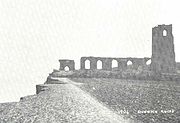
Most of the buildings that were present in the 13th century have disappeared, including all eight churches, and Dunwich is now a small coastal "village", though retaining its status as a town. The remains of a 13th century Franciscan
priory (Greyfriars) and the leper hospital of St James can still be seen. A popular local legend says that, at certain tides, church bells can still be heard from beneath the waves.
By the mid-19th century, the population had dwindled to 237 inhabitants and Dunwich was described as a "decayed and disfranchised borough". A new church, St James, was built in 1832, after the last of the old churches, All Saints, which had been without a rector
since 1755, was abandoned. All Saints' church fell into the sea between 1904 and 1919, with the last major portion of the tower succumbing on 12 November 1919. In 1971 historian Stuart Bacon located the remains of All Saints' Church a few yards out to sea during a diving exhibition. Two years later in 1973 he also discovered the ruins of St Peter's Church, which was lost to the sea during the 18th century. In 2005 Bacon located what may be the remains of the shipbuilding
industry on the site.
As a legacy of its previous significance, the parliamentary constituency of Dunwich
retained the right to send two members to Parliament until the Reform Act 1832
and was one of Britain's most notorious rotten borough
s.
stations which provided low level radar cover for the central East Anglian coast.
Suffolk
Suffolk is a non-metropolitan county of historic origin in East Anglia, England. It has borders with Norfolk to the north, Cambridgeshire to the west and Essex to the south. The North Sea lies to the east...
, England
England
England is a country that is part of the United Kingdom. It shares land borders with Scotland to the north and Wales to the west; the Irish Sea is to the north west, the Celtic Sea to the south west, with the North Sea to the east and the English Channel to the south separating it from continental...
, within the Suffolk Coast and Heaths AONB.
Dunwich was the capital of East Anglia
Kingdom of the East Angles
The Kingdom of East Anglia, also known as the Kingdom of the East Angles , was a small independent Anglo-Saxon kingdom that comprised what are now the English counties of Norfolk and Suffolk and perhaps the eastern part of the Fens...
1500 years ago but the harbour and most of the town have since disappeared due to coastal erosion
Coastal erosion
Coastal erosion is the wearing away of land and the removal of beach or dune sediments by wave action, tidal currents, wave currents, or drainage...
. Its decline began in 1286 when a sea surge
St. Lucia's flood
St. Lucia's flood was a storm tide that affected the Netherlands and Northern Germany on December 14, 1287 when a dike broke during a storm, killing approximately 50,000 to 80,000 people in the fifth largest flood in recorded history. Much land was permanently flooded in what is now the Waddenzee...
hit the East Anglian coast, and it was eventually reduced in size to the village it is today. There is a project underway to reveal the 'lost' city with high-tech underwater cameras.
History
Dunwich is first referred to in the 7th century when St Felix of Burgundy founded the SeeEpiscopal See
An episcopal see is, in the original sense, the official seat of a bishop. This seat, which is also referred to as the bishop's cathedra, is placed in the bishop's principal church, which is therefore called the bishop's cathedral...
of East Anglia at Dommoc
Dommoc
Dommoc, a place not certainly identified but probably within the modern county of Suffolk, was the original seat of the Anglo-Saxon bishops of the Kingdom of East Anglia. It was established by Sigeberht of East Anglia for Saint Felix in c. 629–31 It remained the bishopric of all East Anglia...
in 632 Years later antiquarians would describe it as being the 'former capital of East Anglia', although this reference is almost certainly a romantic creation as no documents survive from the town's heyday attesting this claim.
The Domesday Book
Domesday Book
Domesday Book , now held at The National Archives, Kew, Richmond upon Thames in South West London, is the record of the great survey of much of England and parts of Wales completed in 1086...
of 1086 describes it as possessing three churches. At this time it had an estimated population of 3000.
In 1286 a large storm swept much of the town into the sea, and the River Dunwich was partly silted up. Residents fought to save the harbour but this too was destroyed by an equally fierce storm in 1328, which also swept away the entire village of Newton, a few miles up the coast. Another large storm in 1347 swept some 400 houses into the sea.
Most of the buildings that were present in the 13th century have disappeared, including all eight churches, and Dunwich is now a small coastal "village", though retaining its status as a town. The remains of a 13th century Franciscan
Franciscan
Most Franciscans are members of Roman Catholic religious orders founded by Saint Francis of Assisi. Besides Roman Catholic communities, there are also Old Catholic, Anglican, Lutheran, ecumenical and Non-denominational Franciscan communities....
priory (Greyfriars) and the leper hospital of St James can still be seen. A popular local legend says that, at certain tides, church bells can still be heard from beneath the waves.
By the mid-19th century, the population had dwindled to 237 inhabitants and Dunwich was described as a "decayed and disfranchised borough". A new church, St James, was built in 1832, after the last of the old churches, All Saints, which had been without a rector
Rector
The word rector has a number of different meanings; it is widely used to refer to an academic, religious or political administrator...
since 1755, was abandoned. All Saints' church fell into the sea between 1904 and 1919, with the last major portion of the tower succumbing on 12 November 1919. In 1971 historian Stuart Bacon located the remains of All Saints' Church a few yards out to sea during a diving exhibition. Two years later in 1973 he also discovered the ruins of St Peter's Church, which was lost to the sea during the 18th century. In 2005 Bacon located what may be the remains of the shipbuilding
Shipbuilding
Shipbuilding is the construction of ships and floating vessels. It normally takes place in a specialized facility known as a shipyard. Shipbuilders, also called shipwrights, follow a specialized occupation that traces its roots to before recorded history.Shipbuilding and ship repairs, both...
industry on the site.
As a legacy of its previous significance, the parliamentary constituency of Dunwich
Dunwich (UK Parliament constituency)
Dunwich was a parliamentary borough in Suffolk, one of the most notorious of all the rotten boroughs. It elected two Members of Parliament to the House of Commons from 1298 until 1832, when the constituency was abolished by the Great Reform Act....
retained the right to send two members to Parliament until the Reform Act 1832
Reform Act 1832
The Representation of the People Act 1832 was an Act of Parliament that introduced wide-ranging changes to the electoral system of England and Wales...
and was one of Britain's most notorious rotten borough
Rotten borough
A "rotten", "decayed" or pocket borough was a parliamentary borough or constituency in the United Kingdom that had a very small electorate and could be used by a patron to gain undue and unrepresentative influence within Parliament....
s.
Churches and other notable structures
- St Bartholemew's: one of two 'Domesday' churches, St Bartholemew's is thought to have been lost in the storm of 1328.
- St Michael's: the other Domesday church situated in the east of the town. It was lost to the sea in the storm of 1328.
- The Benedictine Cell: the cell was attached to Ely CathedralEly CathedralEly Cathedral is the principal church of the Diocese of Ely, in Cambridgeshire, England, and is the seat of the Bishop of Ely and a suffragan bishop, the Bishop of Huntingdon...
and was lost during the storm of 1328. - St Anthony's Chapel: lost around 1330.
- St Leonard's: situated in the north of the town, St Leonard's is thought to have been abandoned soon after the Black DeathBlack DeathThe Black Death was one of the most devastating pandemics in human history, peaking in Europe between 1348 and 1350. Of several competing theories, the dominant explanation for the Black Death is the plague theory, which attributes the outbreak to the bacterium Yersinia pestis. Thought to have...
and was probably lost to the sea soon afterwards. - St Nicholas: this was a cruciformCruciformCruciform means having the shape of a cross or Christian cross.- Cruciform architectural plan :This is a common description of Christian churches. In Early Christian, Byzantine and other Eastern Orthodox forms of church architecture this is more likely to mean a tetraconch plan, a Greek cross,...
building which lay to the south of the city. Lost to the sea soon after the Black Death. - St Martin's: built before 1175, it was lost to the sea between 1335 and 1408.
- St Francis Chapel: standing beside the Dunwich River, the chapel was lost in the 16th century.
- St Katherine's Chapel: situated in the parish of St John, this was lost in the 16th century.
- Preceptory of the Knights TemplarKnights TemplarThe Poor Fellow-Soldiers of Christ and of the Temple of Solomon , commonly known as the Knights Templar, the Order of the Temple or simply as Templars, were among the most famous of the Western Christian military orders...
: the preceptory is thought to have been founded around 1189 and was a circular building not dissimilar to the famous Temple ChurchTemple ChurchThe Temple Church is a late-12th-century church in London located between Fleet Street and the River Thames, built for and by the Knights Templar as their English headquarters. In modern times, two Inns of Court both use the church. It is famous for its effigy tombs and for being a round church...
in London. When the sheriffSheriffA sheriff is in principle a legal official with responsibility for a county. In practice, the specific combination of legal, political, and ceremonial duties of a sheriff varies greatly from country to country....
of SuffolkSuffolkSuffolk is a non-metropolitan county of historic origin in East Anglia, England. It has borders with Norfolk to the north, Cambridgeshire to the west and Essex to the south. The North Sea lies to the east...
and NorfolkNorfolkNorfolk is a low-lying county in the East of England. It has borders with Lincolnshire to the west, Cambridgeshire to the west and southwest and Suffolk to the south. Its northern and eastern boundaries are the North Sea coast and to the north-west the county is bordered by The Wash. The county...
took an inventory in 1308 he found the sum of £111 contained in three pouches - a vast sum. In 1322, on the orders of Edward IIEdward II of EnglandEdward II , called Edward of Caernarfon, was King of England from 1307 until he was deposed by his wife Isabella in January 1327. He was the sixth Plantagenet king, in a line that began with the reign of Henry II...
, all the Templars' land passed to the Knights Hospitallers. Following the dissolution of the Hospitallers in 1562 the Temple was demolished and the foundations washed away during the reign of Charles ICharles I of EnglandCharles I was King of England, King of Scotland, and King of Ireland from 27 March 1625 until his execution in 1649. Charles engaged in a struggle for power with the Parliament of England, attempting to obtain royal revenue whilst Parliament sought to curb his Royal prerogative which Charles...
. - St Peter's: similar in length to the church at nearby BlythburghBlythburghBlythburgh is a small English village in an area known as the Sandlings, part of the Suffolk heritage coast. Located close to an area of flooded marshland and mud-flats, in 2007 its population was estimated to be 300. Blythburgh is best known for its church, Holy Trinity, internationally known as...
, St Peter's was stripped of anything of value as the cliff edge drew nearer. The east gable fell in 1688 and the rest of the building followed in 1697. The parish registerParish registerA parish register is a handwritten volume, normally kept in a parish church or deposited within a county record office or alternative archive repository, in which details of baptisms, marriages and burials are recorded.-History:...
survives and is now in the British LibraryBritish LibraryThe British Library is the national library of the United Kingdom, and is the world's largest library in terms of total number of items. The library is a major research library, holding over 150 million items from every country in the world, in virtually all known languages and in many formats,...
. - Blackfriars: DominicanDominican OrderThe Order of Preachers , after the 15th century more commonly known as the Dominican Order or Dominicans, is a Catholic religious order founded by Saint Dominic and approved by Pope Honorius III on 22 December 1216 in France...
prioryPrioryA priory is a house of men or women under religious vows that is headed by a prior or prioress. Priories may be houses of mendicant friars or religious sisters , or monasteries of monks or nuns .The Benedictines and their offshoots , the Premonstratensians, and the...
situated in the south east of the city. It was founded during the time of Henry IIIHenry III of EnglandHenry III was the son and successor of John as King of England, reigning for 56 years from 1216 until his death. His contemporaries knew him as Henry of Winchester. He was the first child king in England since the reign of Æthelred the Unready...
by Roger Holish. By 1385 preparations were made for the Dominicans to move to nearby BlythburghBlythburghBlythburgh is a small English village in an area known as the Sandlings, part of the Suffolk heritage coast. Located close to an area of flooded marshland and mud-flats, in 2007 its population was estimated to be 300. Blythburgh is best known for its church, Holy Trinity, internationally known as...
as the sea front drew nearer, although these were certainly premature as the priory remained active and above sea level until at least the Dissolution of the monasteriesDissolution of the MonasteriesThe Dissolution of the Monasteries, sometimes referred to as the Suppression of the Monasteries, was the set of administrative and legal processes between 1536 and 1541 by which Henry VIII disbanded monasteries, priories, convents and friaries in England, Wales and Ireland; appropriated their...
under Henry VIIIHenry VIII of EnglandHenry VIII was King of England from 21 April 1509 until his death. He was Lord, and later King, of Ireland, as well as continuing the nominal claim by the English monarchs to the Kingdom of France...
, with the last building recorded as having fallen to the sea in 1717. - St John the Baptist: situated beside the market place in the centre of the city, St John's was Dunwich's leading church throughout the Middle AgesMiddle AgesThe Middle Ages is a periodization of European history from the 5th century to the 15th century. The Middle Ages follows the fall of the Western Roman Empire in 476 and precedes the Early Modern Era. It is the middle period of a three-period division of Western history: Classic, Medieval and Modern...
. It was a cruciform structure which also contained a chapel dedicated to St Nicholas. In 1510 a pier was erected in an attempt to act as a breakwaterBreakwater (structure)Breakwaters are structures constructed on coasts as part of coastal defence or to protect an anchorage from the effects of weather and longshore drift.-Purposes of breakwaters:...
from the sea and in 1542 further funds were raised in a bid to save the building, but to no avail and the building was largely demolished before it went over the cliffs. During the demolition the 18th century historianAntiquarianAn antiquarian or antiquary is an aficionado or student of antiquities or things of the past. More specifically, the term is used for those who study history with particular attention to ancient objects of art or science, archaeological and historic sites, or historic archives and manuscripts...
Thomas Gardiner records that a stone was uncovered to reveal the remains of a man on whose breast stood 'two chalicesChalice (cup)A chalice is a goblet or footed cup intended to hold a drink. In general religious terms, it is intended for drinking during a ceremony.-Christian:...
of course metal'. It is possible that the remains may have belonged to a SaxonAnglo-SaxonsAnglo-Saxon is a term used by historians to designate the Germanic tribes who invaded and settled the south and east of Great Britain beginning in the early 5th century AD, and the period from their creation of the English nation to the Norman conquest. The Anglo-Saxon Era denotes the period of...
bishop of Dunwich and that therefore St John's may have been built on the site of the original cathedralCathedralA cathedral is a Christian church that contains the seat of a bishop...
.
- All Saints' Church: last of Dunwich's ancient churches to be lost to the sea, All Saints' was abandoned in the 1750s after it was decided the parishioners could no longer afford the upkeep, although burials occurred in the churchyard until the 1820s. All Saints' reached the cliff's edge in 1904 with the tower falling in 1922. One of the tower buttresses was salvaged, however and now stands in the current VictorianVictorian eraThe Victorian era of British history was the period of Queen Victoria's reign from 20 June 1837 until her death on 22 January 1901. It was a long period of peace, prosperity, refined sensibilities and national self-confidence...
-era St James' Church. One of the last remaining gravestones, dedicated to John Brinkley Easey, fell over the cliff in the early 1990s. A single gravestone still remains (as of 2011) around 15 feet from the cliff edge in memory of Jacob Forster who died in the late 18th Century. - Greyfriars: Franciscan priory founded by Richard FitzJohn between 1228 and 1230 but abandoned due to the advancing sea in 1328. It was rebuilt further inland (outside the original city limits) and the ruins survive to this day, the only building from the town's glory days to do so, although the encroaching cliffs are now but a few feet away.
RAF Dunwich
During the Second World War RAF Dunwich was one of the Chain Home LowChain Home Low
Chain Home Low was the name of a British radar early warning system, detecting enemy aircraft movement at lower altitudes than and summarily used with the fixed Chain Home system which was operated by the RAF during World War II...
stations which provided low level radar cover for the central East Anglian coast.
See also
- Dunwich (UK Parliament constituency)Dunwich (UK Parliament constituency)Dunwich was a parliamentary borough in Suffolk, one of the most notorious of all the rotten boroughs. It elected two Members of Parliament to the House of Commons from 1298 until 1832, when the constituency was abolished by the Great Reform Act....
- Lost cityLost cityA "Lost City" is a term that is generally considered to refer to a well-populated area which fell into terminal decline, became extensively or completely uninhabited, and whose location has been forgotten. Some lost cities whose locations have been rediscovered have been studied extensively by...
- CovehitheCovehitheCovehithe, formerly North Hales, is a hamlet in a parish in Blything district, Suffolk, England. Lying on the coast around North-east of Southwold,also 8 miles South from the town of Lowestoft...
- Easton BaventsEaston BaventsEaston Bavents is a hamlet in Waveney District and the ceremonial county of Suffolk in England. It was once the most easterly ecclesiastical parish in England; a map of Suffolk dated around 1610 shows a headland projecting eastwards into the sea there...
Further reading
- Ancient Dunwich: Suffolk's Lost City, Jean Carter and Stuart Bacon. (Segment, 1975)
- The Lost City of Dunwich, Nicholas Comfort (Terence Dalton, 1994), ISBN 0-86138-086-X
- Men of Dunwich, Rowland Parker (Alastair Press, 1978), ISBN 1-870567-85-4
- A Suffolk Coast Garland, Ernest Read Cooper (London: Heath Cranton Ltd, 1928).
- Memories of Bygone Dunwich, Ernest Read Cooper (Southwold: F. Jenkins, 1948).
- The little freemen of Dunwich, Ormonde Pickard
- "By the North Sea" and Tristram of Lyonesse, Algernon Charles Swinburne, in Major Poems and Selected Prose, Jerome McGannJerome McGannJerome McGann is a textual scholar whose work focuses on the history of literature and culture from the late eighteenth-century to the present.-Career:Educated at Le Moyne College , Syracuse University Jerome McGann (born July 22, 1937) is a textual scholar whose work focuses on the history of...
and Charles L. Sligh, eds. (New Haven: Yale University Press, 2004) 189-202, 206-312. - Dunwich: A Tale of the Splendid City, James Bird, 1828.
- Bernard Cornwell, The Saxon Chronicles, Book 5 - The Burning Land
External links
- All Saints, Dunwich
- Low tide reveals lost city find (BBC NewsBBC NewsBBC News is the department of the British Broadcasting Corporation responsible for the gathering and broadcasting of news and current affairs. The department is the world's largest broadcast news organisation and generates about 120 hours of radio and television output each day, as well as online...
, 10 October 2005) - Saxmundham Community website
- Dunwich, UK (New ScientistNew ScientistNew Scientist is a weekly non-peer-reviewed English-language international science magazine, which since 1996 has also run a website, covering recent developments in science and technology for a general audience. Founded in 1956, it is published by Reed Business Information Ltd, a subsidiary of...
article) - Dunwich, Heath & Forest