


Diving regulator

Encyclopedia
A diving regulator is a pressure regulator
used in scuba
or surface supplied diving
equipment that reduces pressurized breathing gas to ambient pressure and delivers it to the diver. The gas may be air or one of a variety of specially blended breathing gas
es. The gas may be supplied from a cylinder worn by the diver (as in a scuba set
), or via a hose from a compressor or a bank of cylinders on the surface (as in surface-supplied diving). A gas pressure regulator has one or more valves in series, which reduces pressure from the source in a controlled manner, lowering pressure at each stage.
The terms "regulator" and "demand valve" are often used interchangeably, but a demand valve is the part of a regulator that delivers gas only while the diver is breathing in and reduces the gas pressure to ambient. In single hose regulators, it is part of the second stage held in the diver's mouth by a mouthpiece. In double hose regulators it is part of the regulator attached to the cylinder.
For the history of the diving regulator, see Timeline of diving technology and Scuba set
.
The demand valve was invented in 1838 in France
, and forgotten in the next few years, and was not invented again until 1860.
In 1860 a mining engineer
from Espalion
(France), Benoît Rouquayrol, had invented a demand valve with an iron air reservoir to let miners breathe in flooded mines. He called his invention régulateur ('regulator').
In 1864 Rouquayol met the French Imperial Navy
officer Auguste Denayrouze and both worked together to adapt Rouquayrol's regulator to diving. The Rouquayrol-Denayrouze apparatus was mass produced, though with some interruptions, from 1864 to 1965.
As of 1865 it was acquired as a standard by the French Imperial Navy but never was entirely accepted by the French divers because of a lack of safety and autonomy.
In 1926 Maurice Fernez
and Yves Le Prieur
patented a hand-controlled regulator (not a demand valve then) which used a full-face mask
(the air escaping from the mask at constant flow).
It was not until December 1942 that the demand valve was definitely improved in the way we know nowadays, when Frenchmen Jacques-Yves Cousteau
(navy officer) and Émile Gagnan
(engineer) met for the first time in Paris
. Gagnan, employee at Air Liquide
, had miniaturized and adapted a Rouquayrol-Denayrouze regulator to gas generator
s (following severe fuel restrictions due to the German occupation of France) and Cousteau suggested to adapt it again to diving, which was in 1864 its original purpose. Smaller than the large Rouquayrol-Denayrouze regulator and equipped with a safer reservoir (three gas cylinder
s at the time) the modern demand valve was born. Another French inventor, Georges Commeinhes from Alsace
, had patented in 1937 and 1942 a diving demand valve, air-supplied by two gas cylingers through a full-face mask. Commeinhes died in 1944 during the liberation of Strasbourg
and his invention was soon forgotten. In any case the Commeinhes demand valve was also an adaptation of the Rouquayoul-Denayrouze mechanism, but not as precise and miniaturized as was the Cousteau-Gagnan apparatus.
The demand valve has a chamber, which in normal use contains breathing gas at ambient pressure. A valve which supplies medium pressure gas can vent into the chamber. Either a mouthpiece
or a full-face mask is connected to the chamber, for the diver to breathe from. On one side of the chamber is a flexible diaphragm
to control the operation of the valve.
When the diver starts to breathe in, the inhalation lowers the pressure inside the chamber, which moves the diaphragm inwards operating a system of levers. This operates against the closing spring and lifts the valve off its seat, opening the valve and releasing gas into the chamber. The medium pressure gas, at about 10 bar/140 psi over ambient pressure, expands, reducing its pressure to ambient pressure, blowing out any water in the chamber and supplying the diver with gas to breathe. When the chamber is full and the lowering of pressure has been reversed, the diaphragm expands outwards to its normal position to close the medium pressure valve when the diver stops breathing in.
When the diver exhales, one-way valves, made from a flexible and air-tight material, flex outwards under the pressure of the exhalation allowing gas to escape from the chamber. They close making a seal when the exhalation stops and the pressure inside the chamber reduces to ambient pressure.
The diaphragm is protected by a cover, which the outside water can enter freely through holes or slits.
Demand valves can be of both the open circuit or reclaim types. The vast majority of demand valves are open circuit, which means that the exhaled gas is discharged into the surrounding environment and lost. Reclaim systems allow the used gas to be returned to the surface for re-use after removing the carbon dioxide and making up the oxygen. This process is technologically complex and expensive, and is only used for deep commercial diving on heliox mixtures, as the saving on helium compensates for the expense and complications of the system. The scuba rebreather systems also recycle the breathing gas, but are not based on a demand valve system for their primary function, as the breathing loop is carried by the diver and remains at ambient pressure while in use. Regulators used in scuba rebreathers are described below.
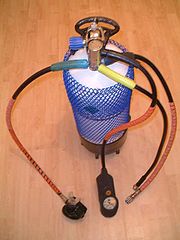 Most contemporary diving regulators are single hose two-stage regulators. They consist of a first stage regulator, and a second stage demand valve. An intermediate pressure hose connects these components to transfer air, and allows relative movement within the constraints of hose length and flexibility. Other medium pressure hoses run to various equipment listed below.
The first make of this sort of scuba was the Porpoise
which was made in Australia
which was invented by Ted Eldred. At the same time in France, the Cristal Explorer (single hose) was designed by Bronnec & Gauthier.
A balanced regulator first stage automatically keeps a constant pressure difference between the interstage pressure and the ambient pressure as the tank pressure reduces with consumption and the ambient pressure varies with depth. The balanced regulator design allows the first stage orifice to be as large as needed to get the flow rate required by a diver doing heavy work with minimum breathing effort.
The first stage generally has several low-pressure outlets (ports) for second-stage regulators, BCD inflators and other equipment; and one or more high-pressure outlets, which allow a submersible pressure gauge (SPG) or gas-integrated diving computer to read the cylinder pressure. The valve may be designed so that one low-pressure port is designated "Reg" for the primary second stage regulator, because that port allows a higher flow rate to give less breathing effort at maximum demand. A small number of manufacturers have produced regulators with a larger than standard hose and port diameter for this primary outlet.
Some components of piston-type first stages are easier to manufacturer and have a simpler design than the diaphragm type. They need more careful maintenance because some internal moving parts are exposed to water and any contaminants in the water.
With the piston-type first stage, the piston is rigid and acts directly on the seat of the valve. When the pressure in the medium pressure chamber drops because the diver has inhaled from a second stage valve, the piston lifts off the valve seat and slides towards the intermediate pressure chamber. This brings high pressure gas into the medium pressure chamber until the pressure in the chamber has risen enough to push the piston back onto the seat and re-closes the valve.
Diaphragm-type first stages are more complex and have more components than the piston type. They may have an environmentally sealed design, and are then particularly suited to cold water divers and those working in water containing a high degree of suspended particles, silt, or other contaminating materials.
The diaphragm is a flexible cover to the medium-pressure chamber. When the diver consumes gas from a medium-pressure second stage, the pressure falls in the medium-pressure chamber and the diaphragm collapses inwards pushing against the valve lifter. This opens the valve letting high-pressure gas pass the valve seat into the medium-pressure chamber. When the pressure in the medium-pressure chambers rises, the diaphragm inflates outwards reducing the force on the valve lifter, letting the spring behind the valve close it.
In an open-circuit scuba set
, the first-stage of the regulator has an A-clamp, also known as a "yoke" or "international" connection, or a DIN
fitting to connect it to the pillar valve of the diving cylinder
. There are also European standards for scuba regulator connectors for gases other than air.
Yoke valves are the most poular in North America and many countries with large numbers of recreational diving tourists; it clamps an open hole on the regulator against an open hole on the cylinder. The user screws the clamp in place finger-tight, and once the cylinder valve is opened, gas pressure completes the seal along with an O-ring
. The diver must take care not to screw the yoke down too tightly, or it may prove impossible to remove without tools. Conversely, failing to tighten sufficiently can lead to O-ring extrusion and a loss of cylinder gas, which can be a serious problem if it happens when the diver is at depth.
Yoke fittings are rated up to a maximum of 240 bar working pressure.
The DIN fitting is a type of direct screw-in connection to the cylinder. While less common worldwide, the DIN system has the advantage of withstanding greater pressure, up to 300 bar, permitting the use of high-pressure steel cylinders. They are also less susceptible to blowing the O-ring seal if banged against something. DIN fittings are the standard in much of central Europe and are available in most countries. The DIN fitting is considered more secure and therefore safer by many Technical divers.
Adapters are available enabling a DIN first-stage to be attached to a cylinder with a yoke fitting valve, and for a Yoke first stage to be attached to a DIN cylinder valve.
Most cylinder valves are currently of the K-valve type, which is a simple manually operated screw-down on-off valve. In the mid-1960s, J-valves were widespread. J-valves contain a spring-operated valve that is restricts or shuts off flow when tank pressure falls to 300-500 psi, causing breathing resistance and warning the diver that he or she is dangerously low on air. The reserve air is released by pulling a reserve lever on the valve. J-valves fell out of favor with the introduction of pressure gauges, which allow divers to keep track of their air underwater, especially as the valve-type is vulnerable to accidental release of reserve air and increases the cost and servicing of the valve. J-valves are occasionally still used when work is done in visibility so poor that the pressure gauge can not be seen, even with a light.
As gas leaves the cylinder it decreases in pressure in the first stage, becoming very cold due to adiabatic expansion
. Where the ambient water temperature is less than 5°C any water in contact with the regulator may freeze. If this ice jams the diaphragm or piston spring, preventing the valve closing, a free-flow may ensue that can empty a full cylinder within a minute or two, and the free-flow causes further cooling in a positive feedback loop. Generally the water that freezes is in the ambient pressure chamber around a spring that keeps the valve open and not moisture in the breathing gas from the cylinder, but that is also possible if the air is not adequately filtered.
The modern trend of using more plastics, instead of metals, within the regulators encourages freezing because it insulates the inside of a cold regulator from the warmer surrounding water.
Cold water kits can be used to reduce the risk of freezing inside the regulator. Some regulators come with this as standard, and some others can be retrofitted.
Environmental sealing of the diaphragm main spring chamber using a soft secondary diaphragm and hydrostatic transmitter or a silicone, alcohol or glycol/water mixture antifreeze
liquid in the sealed spring compartment can be used for a diaphragm regulator. Silicone grease
in the spring chamber can be used on a piston first stage.
The Poseidon Xstream first stage insulates the external spring and spring housing from the rest of the regulator, so that it is less chilled by the expanding air, and provides large slots in the housing so that the spring can be warmed by the water, thus avoiding the problem of freezing up the external spring.
This type of regulator has two large bore corrugated breathing tube
s. One tube is to supply air from the regulator to the mouthpiece, and the second tube is for exhalation; it is not for rebreathing
but to keep the air inside the breathing tube at the same pressure as the water at the regulator diaphragm. This second breathing tube returns the exhaled air to the regulator on the wet side of the diaphragm, where it is released through a rubber duck-bill one-way valve, and comes out of the holes in the cover.
In Cousteau
's original aqualung
prototype, there was no exhaust hose, and the exhaled air exited through a one-way valve at the mouthpiece
. It worked out of water, but when he tested the aqualung in the river Marne
air escaped from the regulator before it could be breathed when the mouthpiece was above the regulator. After that, he had the second breathing tube
fitted.
Even with both tubes fitted, raising the mouthpiece above the regulator increases the flow of gas and lowering the mouthpiece increases breathing resistance. As a result, many aqualung divers, when they were snorkeling
on the surface to save air while reaching the dive site, put the loop of hoses under an arm to avoid the mouthpiece floating up causing free flow.
Diver orientation changes breathing characteristic of regulators. With twin hose regulator on back at shoulder level, if the diver rolls on his or her back the released air pressure is higher than in the lungs. Divers learned to restrict flow by using their tongue to close the mouthpiece. When the cylinder pressure was running low and air demand effort rising, a roll to the right side made breathing easier.
Divers had to carry more weight underwater to compensate for the buoyancy of the air in the hoses. An advantage with this type of regulator is that the bubbles leave the regulator behind the diver's head, increasing visibility, and not interfering with underwater photography
. Twin hose regulators have been superseded by single hose regulators and became obsolete for most diving in the 1980s.
Some modern twin-hose regulators have one or more low-pressure ports that branch off between the two valve stages, which can be used to supply direct feeds for suit or BC inflation and/or a secondary single hose demand valve, and a high pressure port for a submersible pressure gauge.
Someone made a twin-hose type regulator where the energy released as the air expands from cylinder pressure to the surrounding pressure as the diver breathes in, is not thrown away but used to power a propeller
.
The twin-hose arrangement with a mouthpiece
or full-face mask has reappeared in modern rebreather
s, but as part of the breathing loop, not as part of a regulator. The associated demand valve comprising the bail-out valve is always a single hose regulator.
Some passive semi-closed circuit rebreather
s use a form of demand valve, which senses the volume of the loop and injects more gas when the volume falls below a certain level.
Most modern demand valves use a downstream rather than an upstream valve mechanism. In a downstream valve, the moving part of the valve opens in the same direction as the flow of gas and is kept closed by a spring. In an upstream valve, the moving part works against the pressure and opens in the opposite direction as the flow of gas. If the first stage jams open and the medium pressure system over-pressurises, the second stage downstream valve opens automatically resulting in a "freeflow
". With an upstream valve, the result of over-pressurisation may be a blocked valve. This will stop the supply of breathing gas, and possibly result in a ruptured hose or the failure of another second stage valve, such as one that inflates a buoyancy device. When a second stage upstream tilt valve is used a relief valve should be included by the manufacture on the first stage regulator to protect the intermediate hose.
If a shut-off valve is fitted between the first and second stages, as is found on scuba bailout systems used for commercial diving, and in some technical diving configurations, the demand valve will normally be isolated and unable to function as a relief valve. In this case an overpressure valve must be fitted to the first stage if it does not already have one. As very few contemporary (2011) scuba regulator first stages are factory fitted with overpressure relief valves, they are available as aftermarket accessories which can be screwed into any low pressure port available on the first stage.
's breathing bag, a buoyancy compensator or a drysuit but without the need for demand valves. Examples of this are argon
suit inflation sets, and "off board" or secondary diluent cylinders for closed-circuit rebreather
s. When no demand valve is connected to a regulator, it should be equipped with a pressure relief valve', unless it has a built in over pressure valve, so that over-pressurisation does not inflate any buoyancy devices connected to the regulator.
so the diver knows how much gas remains in the cylinder. It is also known as submersible pressure gauge or SPG. There are several types of contents gauge:-
This is an analogue gauge that can be held in the palm of a hand and is connected to the first stage by a high pressure hose. It displays with a pointer moving over a dial. Sometimes they are fixed in a console, which is a plastic
or rubber
case that holds the air pressure gauge and also a depth gauge
and/or a dive computer
and/or a compass
.
These are coin-sized analogue pressure gauges located on the first stage. They are compact, have no dangling hoses and few points of failure. They are generally not used on back mounted cylinders, because the diver cannot easily see them there when underwater. They are sometimes used on side slung
stage cylinders. Due to their small size, it can be difficult to read the gauge to a resolution of less than 20 bar / 300 psi.
Some dive computer
s are designed to measure, display, and monitor pressure in the diving cylinder
. This can be very beneficial to the diver, but if the dive computer
fails, the diver can no longer monitor his or her gas reserves. Most divers using a gas-integrated computer will also have a standard air pressure gauge. The computer is either connected to the first stage by a high pressure hose, or has two parts, the pressure transducer on the first stage and the display at the wrist or console, which communicate by radio link; the signals are encoded to eliminate the risk of one diver's computer picking up a signal from another diver's transducer, or radio interference from other sources.
product catalog. Valves without the reserve lever are called "K valves" for the same reason; being the next item in the catalog they were denoted by the letter K. Modern divers using "J valves" dive with the reserve valve in the open position and depend on a contents gauge or computer to monitor gas supply.
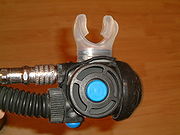 As a nearly universal standard practice in modern recreational diving, the typical single-hose regulator has a spare demand valve fitted for emergency use by the diver's buddy
, typically referred to as the octopus because of the extra hose, or secondary DV. The medium pressure hose on the octopus is usually longer than the medium pressure hose on the primary DV that the diver uses, and the demand valve and/or hose may be colored yellow to aid in locating during an emergency. The secondary regulator should be clipped to the diver's harness in a position where it can be easily seen and reached by both the diver and the potential sharer of air. The longer hose is used for convenience when sharing air, so that the divers are not forced to stay in an awkward position relative to each other. Technical divers frequently extend this feature and use a 5' or 7' hose, which allows divers to swim in single file while sharing air.
The secondary demand valve can be a hybrid DV and buoyancy compensator inflation valve.
Both types are sometimes called alternate air sources. A DV on a regulator connected to a separate independent diving cylinder
would also be called an "alternate air source", and also a redundant air source, as it is totally independent of the primary air source.
Most full face masks and probably most diving helmets currently in use are open circuit demand systems, using a demand valve (in some cases more than one) and supplied from a scuba regulator and frequently also a surface supply umbilical from a surface supply panel using a surface supply regulator to control the pressure of primary and reserve air or other breathing gas.
Lightweight diving helmets are almost always surface supplied, but full face masks are used equally appropriately with scuba open circuit, scuba closed circuit (rebreathers) and surface supplied open circuit.
The demand valve is usually firmly attached to the helmet or mask, but there are a few models of full face mask which have removable demand valves with quick connections, allowing them to be exchanged under water. These include the Draeger Panorama and Kirby-Morgan 48 Supermask.
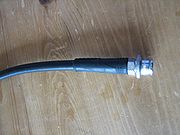 Hoses may be fitted to low pressure ports of the regulator first stage to provide gas for inflating buoyancy compensators and/or dry suits. These hoses usually have quick-connector end with an automatically sealing valve which blocks flow if the hose is disconnected from the BC or suit. There are two basic styles of connector, which are not compatible with each other. The high flowrate fitting has a larger bore and allows gas flow at a fast enough rate for use as a connector to a demand valve. This is sometimes seen in a combination BC inflator/deflator mechanism with integrated secondary DV (octopus), such as in the AIR II unit from Scubapro. The low flow rate connector is more common and is the industry standard for BC inflator connectors, and is also popular on dry suits, as the limited flow rate reduces the risk of a blow-up if the valve sticks open. The high flow rate connector is used by some manufacturers on dry suits.
Various minor accessories are available to fit these hose connectors. These include interstage pressure gauges, which are used to troubleshoot and tune the regulator (not for use underwater), noisemakers, used to attract attention underwater and on the surface, and valves for inflating tyres and inflatable boat floats, making the air in a scuba cylinder available for other purposes.
There instruments would otherwise be carries somewhere else, such as strapped to the wrist or forearm, or in a pocket, and are only regulator accessories for convenience of transport and access.
and made at his factory in Illinois
, USA, from 1961 to 1965. It operates like a single-hose regulator. The second-stage looks like the mouthpiece of a twin-hose regulator, but with a small diaphragm on the front. The second-stage valve is inside one end of the mouthpiece tube. The exhaled air goes into a twin-hose-type exhalant tube which surrounds the intermediate-pressure hose and blows out at its end about 60% of the way back to the first-stage, to keep the bubbles away from the diver's face. Near the mouthpiece is a one-way valve to let outside water into the exhalant hose to avoid free flow if the diaphragm (at the mouth) is below the open end of the exhalant hose. Many Demone regulators have two intermediate-pressure tubes and two exhalant hoses and two second-stages, one assembly on each side of the diver's head, causing a superficial resemblance to the fictional "Twin-hose without visible regulator valve".
magazine in January 1955, as a home-made aqualung with a first-stage on the cylinder top leading through an intermediate-pressure hose to a large round second-stage (a converted Calor Gas regulator) on the diver's chest connected to the diver's mouthpiece by a twin-hose loop.
gas regulator, whose 1950s version was like an aqualung regulator's second stage but operated constant-flow because its diaphragm was spring-loaded; conversion included changing the spring and making several big holes in the wet-side casing. The cylinder was often an ex-RAF
pilot's oxygen cylinder; some of these cylinders were called tadpole
s from their shape.
In least one version of Russian twin-hose aqualung, the regulator did not have an A-clamp but screwed into a large socket on the cylinder manifold
; that manifold was thin, and meandered somewhat. It had two cylinders and a pressure gauge. There is suspicion that those Russian aqualungs started as a factory-made improved descendant of an aqualung home-made by British sport divers and obtained unofficially by a Russian and taken to Russia.
Before 1939, diving and industrial open-circuit breathing sets with constant-flow regulators were designed and made, but did not get into general use due to excessively short dive duration for its weight. Design complications resulted from the need to put the second-stage on/off valve where it could be easily operated by the diver. Examples were:-
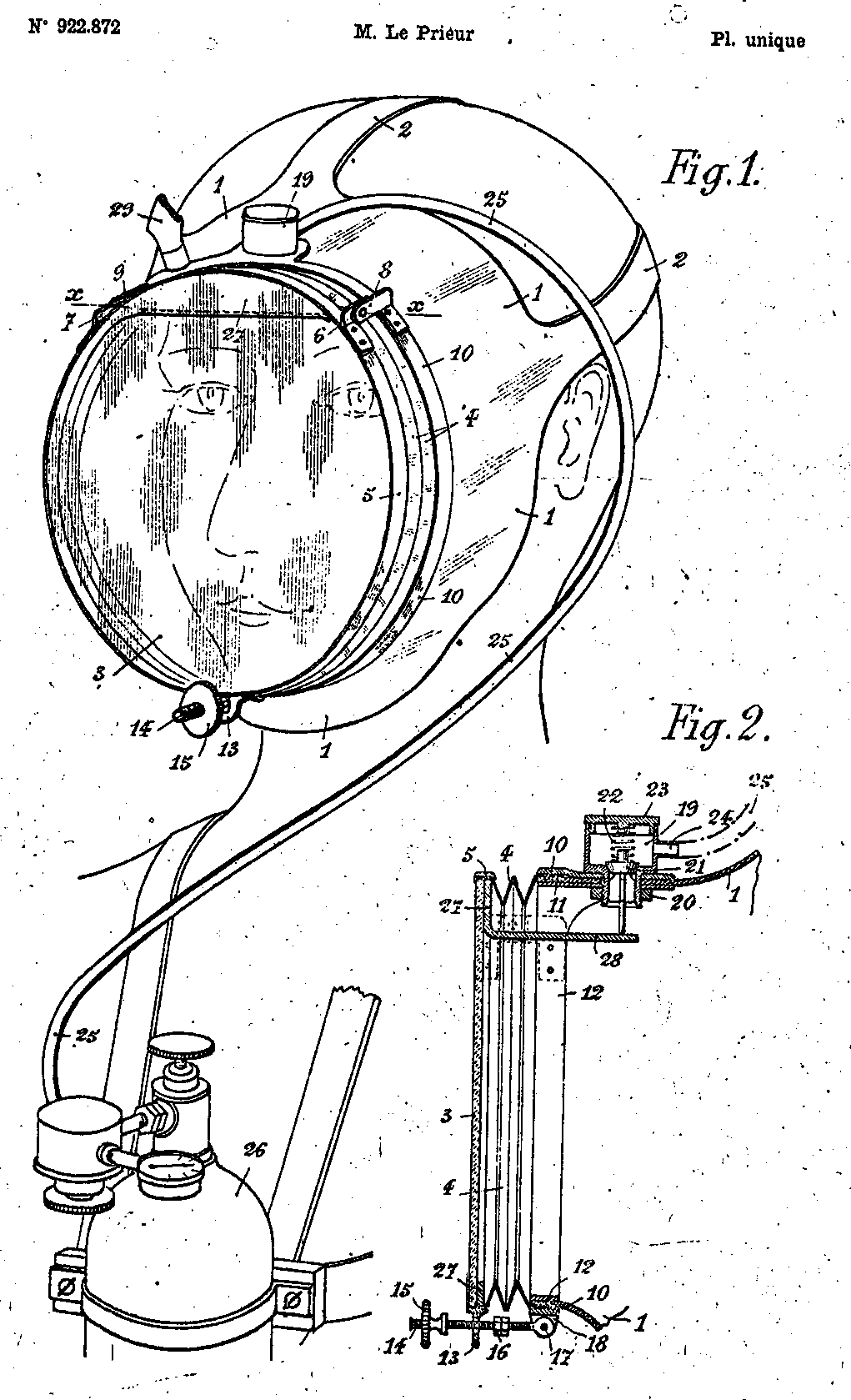 There have been some cases of a single-hose-type regulator last stage built into a full-face mask so that the mask's big front window plus the flexible rubber seal joining it to its frame, was a very big and thus very sensitive regulator diaphragm:
.
The original Cousteau twin-hose diving regulators could deliver about 140 litre
s of air per minute, and that was officially thought to be adequate; but divers sometimes needed a faster rate, and had to learn not to "beat the lung", i.e. to try to breathe faster than the regulator could supply. Between 1948 and 1952 Ted Eldred
designed his Porpoise
air scuba to supply 300 litres/minute if the diver need to breathe that fast, and that soon became British and Australian naval standard.
In the United States Military, scuba regulators must adhere to performance specifications as outlined by the Mil-R-24169B which was based on equipment performance until recently.
Various breathing machines have been developed and used for assessment of breathing apparatus performance. ANSTI has developed a testing machine that measures the inhalation and exhalation effort in using a regulator; publishing results of the performance of regulators in the ANSTI test machine has resulted in big performance improvements.
Pressure regulator
A pressure regulator is a valve that automatically cuts off the flow of a liquid or gas at a certain pressure. Regulators are used to allow high-pressure fluid supply lines or tanks to be reduced to safe and/or usable pressures for various applications....
used in scuba
Scuba set
A scuba set is an independent breathing set that provides a scuba diver with the breathing gas necessary to breathe underwater during scuba diving. It is much used for sport diving and some sorts of work diving....
or surface supplied diving
Surface supplied diving
Surface supplied diving refers to divers using equipment supplied with breathing gas using a diver's umbilical from the surface, either from the shore or from a diving support vessel sometimes indirectly via a diving bell...
equipment that reduces pressurized breathing gas to ambient pressure and delivers it to the diver. The gas may be air or one of a variety of specially blended breathing gas
Breathing gas
Breathing gas is a mixture of gaseous chemical elements and compounds used for respiration.Air is the most common and only natural breathing gas...
es. The gas may be supplied from a cylinder worn by the diver (as in a scuba set
Scuba set
A scuba set is an independent breathing set that provides a scuba diver with the breathing gas necessary to breathe underwater during scuba diving. It is much used for sport diving and some sorts of work diving....
), or via a hose from a compressor or a bank of cylinders on the surface (as in surface-supplied diving). A gas pressure regulator has one or more valves in series, which reduces pressure from the source in a controlled manner, lowering pressure at each stage.
The terms "regulator" and "demand valve" are often used interchangeably, but a demand valve is the part of a regulator that delivers gas only while the diver is breathing in and reduces the gas pressure to ambient. In single hose regulators, it is part of the second stage held in the diver's mouth by a mouthpiece. In double hose regulators it is part of the regulator attached to the cylinder.
For the history of the diving regulator, see Timeline of diving technology and Scuba set
Scuba set
A scuba set is an independent breathing set that provides a scuba diver with the breathing gas necessary to breathe underwater during scuba diving. It is much used for sport diving and some sorts of work diving....
.
Demand valve
A demand valve detects when the diver starts inhaling and supplies the diver with a breath of gas at ambient pressure.The demand valve was invented in 1838 in France
France
The French Republic , The French Republic , The French Republic , (commonly known as France , is a unitary semi-presidential republic in Western Europe with several overseas territories and islands located on other continents and in the Indian, Pacific, and Atlantic oceans. Metropolitan France...
, and forgotten in the next few years, and was not invented again until 1860.
In 1860 a mining engineer
Mining engineering
Mining engineering is an engineering discipline that involves the practice, the theory, the science, the technology, and application of extracting and processing minerals from a naturally occurring environment. Mining engineering also includes processing minerals for additional value.Mineral...
from Espalion
Espalion
Espalion is a commune in the Aveyron department in southern France.-Main sights:*Château de Calmont d'Olt*The Pont-Vieux is part of the World Heritage Sites of the Routes of Santiago de Compostela in France....
(France), Benoît Rouquayrol, had invented a demand valve with an iron air reservoir to let miners breathe in flooded mines. He called his invention régulateur ('regulator').
In 1864 Rouquayol met the French Imperial Navy
French Navy
The French Navy, officially the Marine nationale and often called La Royale is the maritime arm of the French military. It includes a full range of fighting vessels, from patrol boats to a nuclear powered aircraft carrier and 10 nuclear-powered submarines, four of which are capable of launching...
officer Auguste Denayrouze and both worked together to adapt Rouquayrol's regulator to diving. The Rouquayrol-Denayrouze apparatus was mass produced, though with some interruptions, from 1864 to 1965.
As of 1865 it was acquired as a standard by the French Imperial Navy but never was entirely accepted by the French divers because of a lack of safety and autonomy.
In 1926 Maurice Fernez
Maurice Fernez
Maurice Fernez was a French inventor and pioneer in the field of underwater breathing apparati, respirators and gas masks. He was pivotal in the transition of diving from the tethered diving helmet and suit of the nineteenth century to the free diving with self contained equipment of the twentieth...
and Yves Le Prieur
Yves le Prieur
Yves Paul Gaston Le Prieur was an officer of the French Navy and an inventor.-Adventures in the Far East:Le Prieur followed his father in joining the French navy. As an officer he served in Asia and used traditional deep sea diving equipment...
patented a hand-controlled regulator (not a demand valve then) which used a full-face mask
Full face diving mask
A full-face diving mask is a type of diving mask that seals the whole of the diver's face from the water and contains a mouthpiece or demand valve that provides the diver with breathing gas...
(the air escaping from the mask at constant flow).
It was not until December 1942 that the demand valve was definitely improved in the way we know nowadays, when Frenchmen Jacques-Yves Cousteau
Jacques-Yves Cousteau
Jacques-Yves Cousteau was a French naval officer, explorer, ecologist, filmmaker, innovator, scientist, photographer, author and researcher who studied the sea and all forms of life in water...
(navy officer) and Émile Gagnan
Emile Gagnan
Émile Gagnan was a French engineer and co-inventor of the diving regulator used for the first Scuba equipment in 1943...
(engineer) met for the first time in Paris
Paris
Paris is the capital and largest city in France, situated on the river Seine, in northern France, at the heart of the Île-de-France region...
. Gagnan, employee at Air Liquide
Air Liquide
L'Air Liquide S.A., or Air Liquide , is a major French company supplying industrial gases and services to various industries including medical, chemical and electronic manufacturers. Founded in 1902, it is first in the world market in its field, now operating in over 80 countries. It is...
, had miniaturized and adapted a Rouquayrol-Denayrouze regulator to gas generator
Gas generator
A gas generator usually refers to a device, often similar to a solid rocket or a liquid rocket that burns to produce large volumes of relatively cool gas, instead of maximizing the temperature and specific impulse. The low temperature allows the gas to be put to use more easily in many...
s (following severe fuel restrictions due to the German occupation of France) and Cousteau suggested to adapt it again to diving, which was in 1864 its original purpose. Smaller than the large Rouquayrol-Denayrouze regulator and equipped with a safer reservoir (three gas cylinder
Gas cylinder
A gas cylinder is a pressure vessel used to store gases at above atmospheric pressure. High pressure gas cylinders are also called bottles. Although they are sometimes colloquially called "tanks", this is technically incorrect, as a tank is a vessel used to store liquids at ambient pressure and...
s at the time) the modern demand valve was born. Another French inventor, Georges Commeinhes from Alsace
Alsace
Alsace is the fifth-smallest of the 27 regions of France in land area , and the smallest in metropolitan France. It is also the seventh-most densely populated region in France and third most densely populated region in metropolitan France, with ca. 220 inhabitants per km²...
, had patented in 1937 and 1942 a diving demand valve, air-supplied by two gas cylingers through a full-face mask. Commeinhes died in 1944 during the liberation of Strasbourg
Liberation of Strasbourg
The Liberation of Strasbourg constituted the dramatically symbolic high point for the rehabilitation of the honor of French arms as the Allies advanced across France toward Germany in 1944...
and his invention was soon forgotten. In any case the Commeinhes demand valve was also an adaptation of the Rouquayoul-Denayrouze mechanism, but not as precise and miniaturized as was the Cousteau-Gagnan apparatus.
The demand valve has a chamber, which in normal use contains breathing gas at ambient pressure. A valve which supplies medium pressure gas can vent into the chamber. Either a mouthpiece
Mouthpiece (scuba)
In breathing sets, a mouthpiece is a part that the user grips in his mouth, to make a watertight seal between the breathing set and his mouth. It is composed of a short flattened-oval tube that goes in between the lips, with on its free end a flange that fits between the lips and the tooth and gums...
or a full-face mask is connected to the chamber, for the diver to breathe from. On one side of the chamber is a flexible diaphragm
Diaphragm (mechanics)
In mechanics, a diaphragm is a sheet of a semi-flexible material anchored at its periphery and most often round in shape. It serves either as a barrier between two chambers, moving slightly up into one chamber or down into the other depending on differences in pressure, or as a device that...
to control the operation of the valve.
When the diver starts to breathe in, the inhalation lowers the pressure inside the chamber, which moves the diaphragm inwards operating a system of levers. This operates against the closing spring and lifts the valve off its seat, opening the valve and releasing gas into the chamber. The medium pressure gas, at about 10 bar/140 psi over ambient pressure, expands, reducing its pressure to ambient pressure, blowing out any water in the chamber and supplying the diver with gas to breathe. When the chamber is full and the lowering of pressure has been reversed, the diaphragm expands outwards to its normal position to close the medium pressure valve when the diver stops breathing in.
When the diver exhales, one-way valves, made from a flexible and air-tight material, flex outwards under the pressure of the exhalation allowing gas to escape from the chamber. They close making a seal when the exhalation stops and the pressure inside the chamber reduces to ambient pressure.
The diaphragm is protected by a cover, which the outside water can enter freely through holes or slits.
Demand valves can be of both the open circuit or reclaim types. The vast majority of demand valves are open circuit, which means that the exhaled gas is discharged into the surrounding environment and lost. Reclaim systems allow the used gas to be returned to the surface for re-use after removing the carbon dioxide and making up the oxygen. This process is technologically complex and expensive, and is only used for deep commercial diving on heliox mixtures, as the saving on helium compensates for the expense and complications of the system. The scuba rebreather systems also recycle the breathing gas, but are not based on a demand valve system for their primary function, as the breathing loop is carried by the diver and remains at ambient pressure while in use. Regulators used in scuba rebreathers are described below.
Free-flow regulator
These are generally used in surface supply diving with free-flow masks and helmets, and are usually simply a large high flow rated industrial gas regulator, which is manually controlled at the gas panel on the surface to the pressure required to provide to desired flow rate to the diver. Free flow is not normally used on scuba equipment as the high gas flow rates are inefficient and wasteful.Automatic diluent valve (ADV)
These are used in rebreathers to add gas to the loop to compensate automatically for volume reduction due to pressure increase with greater depth, or to make up gas lost from the system by the diver exhaling through the nose while clearing the mask or as a method of flushing the loop. They are often provided with a purge button to allow manual flushing of the loop. The ADV is virtually identical in function to the open circuit demand valve.Bailout valve (BOV)
This is an open circuit demand valve built into a rebreather mouthpiece, or other part of the breathing loop, which can be isolated while the diver is using the rebreather to recycle breathing gas, and opened at the same time as isolating the breathing loop when a problem causes the diver to bail out onto open circuit. The main distinguishing featire of the BOV is that the same moutpiece is used for open and closed circuit, and the diver does not have to shut the Dive/Surface valve, remove it from his/her mouth, and find and insert the bailout demand valve in order to bail out onto open circuit. This reduction in critical steps makes the integrated BOV a significant safety advantage, though they are costly.Constant mass flow addition valve
These are used to supply a constant mass flow of fresh gas to an active type semi-closed rebreather, to replenish the gas used by the diver and to maintain an approximately constant composition of the loop mix. Two main types are used: the fixed orifice and the adjustable orifice, usually a needle valve. The constant mass flow valve is usually based on a gas regulator which is isolated from the ambient pressure so that it provides an absolute pressure regulated output (not compensated for ambient pressure). This limits the depth range in which constant mass flow is possible through the orifice, but provides a relatively predictable gas mixture in the breathing loop. An overpressure valve is used to protect the output hose.Manual and electronically controlled addition valves
These are used on manual and electronically controlled closed circuit rebreathers (mCCR, eCCR), to add oxygen to the loop to maintain set-point. A manually or electronically controlled valve is used to release oxygen from the outlet of a standard scuba regulator first stage into the breathing loop. An overpressure valve is necessary to protect the hose (see below)Structure and function of diving regulators
The parts of a regulator are described as the major functional groups in downstream order as following the gas flow from the cylinder to its final use, and accessories which are not part of the primary functional components, but are commonly found on contemporary regulators. Some historically interesting models and components are described in a later section.Single hose two-stage open circuit demand regulators
"Single-hose" redirects to hereThe first make of this sort of scuba was the Porpoise
Porpoise (make of scuba gear)
Porpoise is a tradename for scuba developed by Ted Eldred in Australia and made there from the late 1940s onwards. It included:-A make of diving oxygen rebreather:...
which was made in Australia
Australia
Australia , officially the Commonwealth of Australia, is a country in the Southern Hemisphere comprising the mainland of the Australian continent, the island of Tasmania, and numerous smaller islands in the Indian and Pacific Oceans. It is the world's sixth-largest country by total area...
which was invented by Ted Eldred. At the same time in France, the Cristal Explorer (single hose) was designed by Bronnec & Gauthier.
The first stage
The first stage of the regulator is mounted to the cylinder valve via one of the standard connectors. It reduces cylinder pressure to an intermediate pressure, usually about 10 bars (145 psi) higher than the ambient pressure. The breathing gas then passes through a hose to the second stage.A balanced regulator first stage automatically keeps a constant pressure difference between the interstage pressure and the ambient pressure as the tank pressure reduces with consumption and the ambient pressure varies with depth. The balanced regulator design allows the first stage orifice to be as large as needed to get the flow rate required by a diver doing heavy work with minimum breathing effort.
The first stage generally has several low-pressure outlets (ports) for second-stage regulators, BCD inflators and other equipment; and one or more high-pressure outlets, which allow a submersible pressure gauge (SPG) or gas-integrated diving computer to read the cylinder pressure. The valve may be designed so that one low-pressure port is designated "Reg" for the primary second stage regulator, because that port allows a higher flow rate to give less breathing effort at maximum demand. A small number of manufacturers have produced regulators with a larger than standard hose and port diameter for this primary outlet.
Types of first stage
The mechanism inside the first stage can be of the diaphragm type or the piston type. Both types can be balanced or unbalanced. Unbalanced regulators have the cylinder pressure pushing the first stage upstream valve closed, which is opposed by the intermediate stage pressure and a spring. As cylinder pressure falls the closing force is less, so the regulated pressure increases at lower tank pressure. To keep this pressure rise within acceptable limits the high-pressure orifice size was limited, but this decreased the total flow capacity of the regulator. A balanced regulator keeps about the same ease of breathing at all depths and pressures, by using the cylinder pressure to also indirectly oppose the opening of the first stage valve.Piston type first stage
Some components of piston-type first stages are easier to manufacturer and have a simpler design than the diaphragm type. They need more careful maintenance because some internal moving parts are exposed to water and any contaminants in the water.
With the piston-type first stage, the piston is rigid and acts directly on the seat of the valve. When the pressure in the medium pressure chamber drops because the diver has inhaled from a second stage valve, the piston lifts off the valve seat and slides towards the intermediate pressure chamber. This brings high pressure gas into the medium pressure chamber until the pressure in the chamber has risen enough to push the piston back onto the seat and re-closes the valve.
Diaphragm type first stage
Diaphragm-type first stages are more complex and have more components than the piston type. They may have an environmentally sealed design, and are then particularly suited to cold water divers and those working in water containing a high degree of suspended particles, silt, or other contaminating materials.
The diaphragm is a flexible cover to the medium-pressure chamber. When the diver consumes gas from a medium-pressure second stage, the pressure falls in the medium-pressure chamber and the diaphragm collapses inwards pushing against the valve lifter. This opens the valve letting high-pressure gas pass the valve seat into the medium-pressure chamber. When the pressure in the medium-pressure chambers rises, the diaphragm inflates outwards reducing the force on the valve lifter, letting the spring behind the valve close it.
Connection of first stage regulator to the cylinder valve or cylinder manifold
In an open-circuit scuba set
Scuba set
A scuba set is an independent breathing set that provides a scuba diver with the breathing gas necessary to breathe underwater during scuba diving. It is much used for sport diving and some sorts of work diving....
, the first-stage of the regulator has an A-clamp, also known as a "yoke" or "international" connection, or a DIN
Deutsches Institut für Normung
is the German national organization for standardization and is that country's ISO member body. DIN is a Registered German Association headquartered in Berlin...
fitting to connect it to the pillar valve of the diving cylinder
Diving cylinder
A diving cylinder, scuba tank or diving tank is a gas cylinder used to store and transport high pressure breathing gas as a component of a scuba set. It provides gas to the scuba diver through the demand valve of a diving regulator....
. There are also European standards for scuba regulator connectors for gases other than air.
Yoke valves are the most poular in North America and many countries with large numbers of recreational diving tourists; it clamps an open hole on the regulator against an open hole on the cylinder. The user screws the clamp in place finger-tight, and once the cylinder valve is opened, gas pressure completes the seal along with an O-ring
O-ring
An O-ring, also known as a packing, or a toric joint, is a mechanical gasket in the shape of a torus; it is a loop of elastomer with a disc-shaped cross-section, designed to be seated in a groove and compressed during assembly between two or more parts, creating a seal at the interface.The O-ring...
. The diver must take care not to screw the yoke down too tightly, or it may prove impossible to remove without tools. Conversely, failing to tighten sufficiently can lead to O-ring extrusion and a loss of cylinder gas, which can be a serious problem if it happens when the diver is at depth.
Yoke fittings are rated up to a maximum of 240 bar working pressure.
The DIN fitting is a type of direct screw-in connection to the cylinder. While less common worldwide, the DIN system has the advantage of withstanding greater pressure, up to 300 bar, permitting the use of high-pressure steel cylinders. They are also less susceptible to blowing the O-ring seal if banged against something. DIN fittings are the standard in much of central Europe and are available in most countries. The DIN fitting is considered more secure and therefore safer by many Technical divers.
Adapters are available enabling a DIN first-stage to be attached to a cylinder with a yoke fitting valve, and for a Yoke first stage to be attached to a DIN cylinder valve.
Most cylinder valves are currently of the K-valve type, which is a simple manually operated screw-down on-off valve. In the mid-1960s, J-valves were widespread. J-valves contain a spring-operated valve that is restricts or shuts off flow when tank pressure falls to 300-500 psi, causing breathing resistance and warning the diver that he or she is dangerously low on air. The reserve air is released by pulling a reserve lever on the valve. J-valves fell out of favor with the introduction of pressure gauges, which allow divers to keep track of their air underwater, especially as the valve-type is vulnerable to accidental release of reserve air and increases the cost and servicing of the valve. J-valves are occasionally still used when work is done in visibility so poor that the pressure gauge can not be seen, even with a light.
Risk of the regulator becoming blocked with ice
As gas leaves the cylinder it decreases in pressure in the first stage, becoming very cold due to adiabatic expansion
Adiabatic process
In thermodynamics, an adiabatic process or an isocaloric process is a thermodynamic process in which the net heat transfer to or from the working fluid is zero. Such a process can occur if the container of the system has thermally-insulated walls or the process happens in an extremely short time,...
. Where the ambient water temperature is less than 5°C any water in contact with the regulator may freeze. If this ice jams the diaphragm or piston spring, preventing the valve closing, a free-flow may ensue that can empty a full cylinder within a minute or two, and the free-flow causes further cooling in a positive feedback loop. Generally the water that freezes is in the ambient pressure chamber around a spring that keeps the valve open and not moisture in the breathing gas from the cylinder, but that is also possible if the air is not adequately filtered.
The modern trend of using more plastics, instead of metals, within the regulators encourages freezing because it insulates the inside of a cold regulator from the warmer surrounding water.
Cold water kits can be used to reduce the risk of freezing inside the regulator. Some regulators come with this as standard, and some others can be retrofitted.
Environmental sealing of the diaphragm main spring chamber using a soft secondary diaphragm and hydrostatic transmitter or a silicone, alcohol or glycol/water mixture antifreeze
Antifreeze
Antifreeze is a freeze preventive used in internal combustion engines and other heat transfer applications, such as HVAC chillers and solar water heaters....
liquid in the sealed spring compartment can be used for a diaphragm regulator. Silicone grease
Silicone grease
Silicone grease is a waterproof grease made by combining a silicone oil with a thickener. Most commonly, the silicone oil is polydimethylsiloxane and the thickener is amorphous fumed silica...
in the spring chamber can be used on a piston first stage.
The Poseidon Xstream first stage insulates the external spring and spring housing from the rest of the regulator, so that it is less chilled by the expanding air, and provides large slots in the housing so that the spring can be warmed by the water, thus avoiding the problem of freezing up the external spring.
Interstage hose
A medium pressure hose is used to allow breathing gas to flow from the first stage regulator to the second stage, or demand valve, which is held in the mouth by the diver, or attached to the full face mask or diving helmet.Twin-hose open circuit demand scuba regulators
The "twin", "double" or "two" hose type of scuba demand valve was the first in general use.This type of regulator has two large bore corrugated breathing tube
Breathing tube (in breathing apparatus)
A breathing tube is a flexible tube for breathing through, as part of a scuba set or other breathing apparatus or a medical oxygen apparatus or anaesthetic apparatus They are wide, and usually corrugated to let the user's head move about without the tube pinching at...
s. One tube is to supply air from the regulator to the mouthpiece, and the second tube is for exhalation; it is not for rebreathing
Rebreather
A rebreather is a type of breathing set that provides a breathing gas containing oxygen and recycled exhaled gas. This recycling reduces the volume of breathing gas used, making a rebreather lighter and more compact than an open-circuit breathing set for the same duration in environments where...
but to keep the air inside the breathing tube at the same pressure as the water at the regulator diaphragm. This second breathing tube returns the exhaled air to the regulator on the wet side of the diaphragm, where it is released through a rubber duck-bill one-way valve, and comes out of the holes in the cover.
In Cousteau
Jacques-Yves Cousteau
Jacques-Yves Cousteau was a French naval officer, explorer, ecologist, filmmaker, innovator, scientist, photographer, author and researcher who studied the sea and all forms of life in water...
's original aqualung
Aqua-lung
Aqua-Lung was the original name of the first open-circuit free-swimming underwater breathing set in reaching worldwide popularity and commercial success...
prototype, there was no exhaust hose, and the exhaled air exited through a one-way valve at the mouthpiece
Mouthpiece (scuba)
In breathing sets, a mouthpiece is a part that the user grips in his mouth, to make a watertight seal between the breathing set and his mouth. It is composed of a short flattened-oval tube that goes in between the lips, with on its free end a flange that fits between the lips and the tooth and gums...
. It worked out of water, but when he tested the aqualung in the river Marne
Marne River
The Marne is a river in France, a right tributary of the Seine in the area east and southeast of Paris. It is long. The river gave its name to the départements of Haute-Marne, Marne, Seine-et-Marne, and Val-de-Marne....
air escaped from the regulator before it could be breathed when the mouthpiece was above the regulator. After that, he had the second breathing tube
Breathing tube (in breathing apparatus)
A breathing tube is a flexible tube for breathing through, as part of a scuba set or other breathing apparatus or a medical oxygen apparatus or anaesthetic apparatus They are wide, and usually corrugated to let the user's head move about without the tube pinching at...
fitted.
Even with both tubes fitted, raising the mouthpiece above the regulator increases the flow of gas and lowering the mouthpiece increases breathing resistance. As a result, many aqualung divers, when they were snorkeling
Snorkeling
Snorkeling is the practice of swimming on or through a body of water while equipped with a diving mask, a shaped tube called a snorkel, and usually swimfins. In cooler waters, a wetsuit may also be worn...
on the surface to save air while reaching the dive site, put the loop of hoses under an arm to avoid the mouthpiece floating up causing free flow.
Diver orientation changes breathing characteristic of regulators. With twin hose regulator on back at shoulder level, if the diver rolls on his or her back the released air pressure is higher than in the lungs. Divers learned to restrict flow by using their tongue to close the mouthpiece. When the cylinder pressure was running low and air demand effort rising, a roll to the right side made breathing easier.
Divers had to carry more weight underwater to compensate for the buoyancy of the air in the hoses. An advantage with this type of regulator is that the bubbles leave the regulator behind the diver's head, increasing visibility, and not interfering with underwater photography
Underwater photography
Underwater photography is the process of taking photographs while under water. It is usually done while scuba diving, but can be done while snorkeling or swimming.-Overview:...
. Twin hose regulators have been superseded by single hose regulators and became obsolete for most diving in the 1980s.
Some modern twin-hose regulators have one or more low-pressure ports that branch off between the two valve stages, which can be used to supply direct feeds for suit or BC inflation and/or a secondary single hose demand valve, and a high pressure port for a submersible pressure gauge.
Someone made a twin-hose type regulator where the energy released as the air expands from cylinder pressure to the surrounding pressure as the diver breathes in, is not thrown away but used to power a propeller
Propeller
A propeller is a type of fan that transmits power by converting rotational motion into thrust. A pressure difference is produced between the forward and rear surfaces of the airfoil-shaped blade, and a fluid is accelerated behind the blade. Propeller dynamics can be modeled by both Bernoulli's...
.
The twin-hose arrangement with a mouthpiece
Mouthpiece (scuba)
In breathing sets, a mouthpiece is a part that the user grips in his mouth, to make a watertight seal between the breathing set and his mouth. It is composed of a short flattened-oval tube that goes in between the lips, with on its free end a flange that fits between the lips and the tooth and gums...
or full-face mask has reappeared in modern rebreather
Rebreather
A rebreather is a type of breathing set that provides a breathing gas containing oxygen and recycled exhaled gas. This recycling reduces the volume of breathing gas used, making a rebreather lighter and more compact than an open-circuit breathing set for the same duration in environments where...
s, but as part of the breathing loop, not as part of a regulator. The associated demand valve comprising the bail-out valve is always a single hose regulator.
Two stage twin hose open circuit demand regulators
Early open circuit scuba demand regulators were mostly twin hose designs. The mechanism of the regulator is packaged in a usually circular metal housing mounted on the cylinder valve behind the diver's neck, and the air flows through a pair of corrugated rubber hoses to and from the mouthpiece. The supply hose is connected to one side of the regulator body and supplies air to the moutpiece through a non-return valve, and the exhaled air is returned to the regulator housing on the outside of the diaphragm, also through a non-return valve on the other side of the mouthpiece, and usually through another non-return exhaust valve in the regulator housing, often a "duckbill" type. The demand valve component of a two stage twin hose regulator is thus mounted in the same housing as the first stage regulator, and in order to prevent free-flow, the exhaust valve is located at the same depth as the diphragm, and the only reliable place to do this is in the same housing.Single stage twin hose open circuit demand regulators
Some early twin hose regulators were of single stage design. The first stage functions in a way similar to the second stage of two-stage demand valves, but would be connected directly to the cylinder valve and reduced high pressure air from the cylinder directly to anbient pressure on demand. This could be done by using a longer lever and larger diameter diaphragm to control the valve movement, but there was a tendency for cracking pressure, and thus work of breathing, to vary as the cylinder pressure dropped.Some passive semi-closed circuit rebreather
Rebreather
A rebreather is a type of breathing set that provides a breathing gas containing oxygen and recycled exhaled gas. This recycling reduces the volume of breathing gas used, making a rebreather lighter and more compact than an open-circuit breathing set for the same duration in environments where...
s use a form of demand valve, which senses the volume of the loop and injects more gas when the volume falls below a certain level.
Most modern demand valves use a downstream rather than an upstream valve mechanism. In a downstream valve, the moving part of the valve opens in the same direction as the flow of gas and is kept closed by a spring. In an upstream valve, the moving part works against the pressure and opens in the opposite direction as the flow of gas. If the first stage jams open and the medium pressure system over-pressurises, the second stage downstream valve opens automatically resulting in a "freeflow
Freeflow
In scuba diving, a freeflow occurs when the diving regulator continues to supply air instead of cutting off the supply when the diver is not breathing in...
". With an upstream valve, the result of over-pressurisation may be a blocked valve. This will stop the supply of breathing gas, and possibly result in a ruptured hose or the failure of another second stage valve, such as one that inflates a buoyancy device. When a second stage upstream tilt valve is used a relief valve should be included by the manufacture on the first stage regulator to protect the intermediate hose.
If a shut-off valve is fitted between the first and second stages, as is found on scuba bailout systems used for commercial diving, and in some technical diving configurations, the demand valve will normally be isolated and unable to function as a relief valve. In this case an overpressure valve must be fitted to the first stage if it does not already have one. As very few contemporary (2011) scuba regulator first stages are factory fitted with overpressure relief valves, they are available as aftermarket accessories which can be screwed into any low pressure port available on the first stage.
Pressure relief valve
A down stream demand valve serves as a fail safe for over-pressurisation: if a first stage with a demand valve malfunctions and jams in the open position, the demand valve will be over-pressurised and will "free flow". Although it presents the diver with an imminent "out of air" crisis, this failure mode lets gas escape directly into the water without inflating buoyancy devices. The effect of unintentional inflation might be to carry the diver quickly to the surface causing the various injuries that can result from an over-fast ascent. There are circumstances where regulators are connected to inflatable equipment such as a rebreatherRebreather
A rebreather is a type of breathing set that provides a breathing gas containing oxygen and recycled exhaled gas. This recycling reduces the volume of breathing gas used, making a rebreather lighter and more compact than an open-circuit breathing set for the same duration in environments where...
's breathing bag, a buoyancy compensator or a drysuit but without the need for demand valves. Examples of this are argon
Argon
Argon is a chemical element represented by the symbol Ar. Argon has atomic number 18 and is the third element in group 18 of the periodic table . Argon is the third most common gas in the Earth's atmosphere, at 0.93%, making it more common than carbon dioxide...
suit inflation sets, and "off board" or secondary diluent cylinders for closed-circuit rebreather
Rebreather
A rebreather is a type of breathing set that provides a breathing gas containing oxygen and recycled exhaled gas. This recycling reduces the volume of breathing gas used, making a rebreather lighter and more compact than an open-circuit breathing set for the same duration in environments where...
s. When no demand valve is connected to a regulator, it should be equipped with a pressure relief valve', unless it has a built in over pressure valve, so that over-pressurisation does not inflate any buoyancy devices connected to the regulator.
Submersible pressure gauge (SPG)
To monitor breathing gas pressure in the diving cylinder, a diving regulator usually has a high pressure hose leading to a contents gauge (also called pressure gauge). The port for this hose leaves the first-stage upstream of all pressure-reducing valves. The contents gauge is a pressure gauge measuring the gas pressure in the diving cylinderDiving cylinder
A diving cylinder, scuba tank or diving tank is a gas cylinder used to store and transport high pressure breathing gas as a component of a scuba set. It provides gas to the scuba diver through the demand valve of a diving regulator....
so the diver knows how much gas remains in the cylinder. It is also known as submersible pressure gauge or SPG. There are several types of contents gauge:-
Standard type
This is an analogue gauge that can be held in the palm of a hand and is connected to the first stage by a high pressure hose. It displays with a pointer moving over a dial. Sometimes they are fixed in a console, which is a plastic
Plastic
A plastic material is any of a wide range of synthetic or semi-synthetic organic solids used in the manufacture of industrial products. Plastics are typically polymers of high molecular mass, and may contain other substances to improve performance and/or reduce production costs...
or rubber
Rubber
Natural rubber, also called India rubber or caoutchouc, is an elastomer that was originally derived from latex, a milky colloid produced by some plants. The plants would be ‘tapped’, that is, an incision made into the bark of the tree and the sticky, milk colored latex sap collected and refined...
case that holds the air pressure gauge and also a depth gauge
Depth gauge
A depth gauge is a pressure gauge that displays the equivalent depth in water. It is a piece of diving equipment often used by SCUBA divers.Most modern diving depth gauges have an electronic mechanism and digital display. Older types used a mechanical mechanism and analogue display.A diver uses a...
and/or a dive computer
Dive computer
A dive computer or decompression meter is a device used by a scuba diver to measure the time and depth of a dive so that a safe ascent profile can be calculated and displayed so that the diver can avoid decompression sickness.- Purpose :...
and/or a compass
Compass
A compass is a navigational instrument that shows directions in a frame of reference that is stationary relative to the surface of the earth. The frame of reference defines the four cardinal directions – north, south, east, and west. Intermediate directions are also defined...
.
Button gauges
These are coin-sized analogue pressure gauges located on the first stage. They are compact, have no dangling hoses and few points of failure. They are generally not used on back mounted cylinders, because the diver cannot easily see them there when underwater. They are sometimes used on side slung
Sidemount
Sidemount is a scuba diving configuration which has tanks mounted alongside the diver, below the shoulders and along the hips, instead of on the back of the diver. It is a popular configuration with advanced cave divers, as smaller sections of cave can be penetrated and tanks can be changed with...
stage cylinders. Due to their small size, it can be difficult to read the gauge to a resolution of less than 20 bar / 300 psi.
Air integrated computers
Some dive computer
Dive computer
A dive computer or decompression meter is a device used by a scuba diver to measure the time and depth of a dive so that a safe ascent profile can be calculated and displayed so that the diver can avoid decompression sickness.- Purpose :...
s are designed to measure, display, and monitor pressure in the diving cylinder
Diving cylinder
A diving cylinder, scuba tank or diving tank is a gas cylinder used to store and transport high pressure breathing gas as a component of a scuba set. It provides gas to the scuba diver through the demand valve of a diving regulator....
. This can be very beneficial to the diver, but if the dive computer
Dive computer
A dive computer or decompression meter is a device used by a scuba diver to measure the time and depth of a dive so that a safe ascent profile can be calculated and displayed so that the diver can avoid decompression sickness.- Purpose :...
fails, the diver can no longer monitor his or her gas reserves. Most divers using a gas-integrated computer will also have a standard air pressure gauge. The computer is either connected to the first stage by a high pressure hose, or has two parts, the pressure transducer on the first stage and the display at the wrist or console, which communicate by radio link; the signals are encoded to eliminate the risk of one diver's computer picking up a signal from another diver's transducer, or radio interference from other sources.
Mechanical reserve valves
In the past, some types of diving cylinder had a mechanical reserve valve that restricted air flow when the pressure was below 500 psi. Alerted to having a low gas supply the diver would pull a lever to open the reserve valve and surface using the reserve gas. Occasionally, a diver would inadvertently trigger the mechanism while donning gear or performing a movement underwater and, unaware that the reserve had already been accessed, could find himself out of breathing gas with no warning. These valves are known as "J valves" due to the letter J being next to that valve in the US DiversUS Divers
U.S. Divers is the sporting goods division of Aqua Lung America, makers of scuba diving equipment.They were the first firm in the United States to make Cousteau-type aqualungs, in 1951 or earlier. They were one of the five original American diving gear makers — U.S. Divers, Healthways,...
product catalog. Valves without the reserve lever are called "K valves" for the same reason; being the next item in the catalog they were denoted by the letter K. Modern divers using "J valves" dive with the reserve valve in the open position and depend on a contents gauge or computer to monitor gas supply.
Secondary demand valve (Octopus)
Buddy system
The buddy system is a procedure in which two people, the "buddies", operate together as a single unit so that they are able to monitor and help each other.-Advantages:...
, typically referred to as the octopus because of the extra hose, or secondary DV. The medium pressure hose on the octopus is usually longer than the medium pressure hose on the primary DV that the diver uses, and the demand valve and/or hose may be colored yellow to aid in locating during an emergency. The secondary regulator should be clipped to the diver's harness in a position where it can be easily seen and reached by both the diver and the potential sharer of air. The longer hose is used for convenience when sharing air, so that the divers are not forced to stay in an awkward position relative to each other. Technical divers frequently extend this feature and use a 5' or 7' hose, which allows divers to swim in single file while sharing air.
The secondary demand valve can be a hybrid DV and buoyancy compensator inflation valve.
Both types are sometimes called alternate air sources. A DV on a regulator connected to a separate independent diving cylinder
Diving cylinder
A diving cylinder, scuba tank or diving tank is a gas cylinder used to store and transport high pressure breathing gas as a component of a scuba set. It provides gas to the scuba diver through the demand valve of a diving regulator....
would also be called an "alternate air source", and also a redundant air source, as it is totally independent of the primary air source.
Full face mask or helmet
This is stretching the concept of accessory a bit, as it would be equally valid to call the regulator an accessory of the full face mask or helmet, but the two items are closely connected, and generally found in use together.Most full face masks and probably most diving helmets currently in use are open circuit demand systems, using a demand valve (in some cases more than one) and supplied from a scuba regulator and frequently also a surface supply umbilical from a surface supply panel using a surface supply regulator to control the pressure of primary and reserve air or other breathing gas.
Lightweight diving helmets are almost always surface supplied, but full face masks are used equally appropriately with scuba open circuit, scuba closed circuit (rebreathers) and surface supplied open circuit.
The demand valve is usually firmly attached to the helmet or mask, but there are a few models of full face mask which have removable demand valves with quick connections, allowing them to be exchanged under water. These include the Draeger Panorama and Kirby-Morgan 48 Supermask.
Buoyancy compensator and dry suit inflation hoses
Various minor accessories are available to fit these hose connectors. These include interstage pressure gauges, which are used to troubleshoot and tune the regulator (not for use underwater), noisemakers, used to attract attention underwater and on the surface, and valves for inflating tyres and inflatable boat floats, making the air in a scuba cylinder available for other purposes.
Instrument consoles (Combo consoles)
These are usually rubber or tough plastc mouldings which enclose the SPG and have mounting sockets for other diver instrumentation, such as decompression computers, underwater compass, timer and/or depth gauge and occasionally a small plastic "slate" on which notes can be written either bofore or during the dive.There instruments would otherwise be carries somewhere else, such as strapped to the wrist or forearm, or in a pocket, and are only regulator accessories for convenience of transport and access.
Twin-hose without visible regulator valve (fictional)
This type is mentioned here because it is very familiar in comics and other drawings, as a wrongly-drawn twin-hose two-cylinder aqualung, with one wide hose coming out of each cylinder top with no apparent regulator valve and going to the mouthpiece, much more often than a correctly-drawn twin-hose regulator: see Frogman#Drawing and artwork. It would not work in the real world.Demone regulator
This type was designed by Robert J. DempsterDempster
Dempster can refer to:* Maple Leaf Foods Dempster Brand Bread* Dempster Street, a major east-west artery north of Chicago, Illinois, part of which is part of U.S...
and made at his factory in Illinois
Illinois
Illinois is the fifth-most populous state of the United States of America, and is often noted for being a microcosm of the entire country. With Chicago in the northeast, small industrial cities and great agricultural productivity in central and northern Illinois, and natural resources like coal,...
, USA, from 1961 to 1965. It operates like a single-hose regulator. The second-stage looks like the mouthpiece of a twin-hose regulator, but with a small diaphragm on the front. The second-stage valve is inside one end of the mouthpiece tube. The exhaled air goes into a twin-hose-type exhalant tube which surrounds the intermediate-pressure hose and blows out at its end about 60% of the way back to the first-stage, to keep the bubbles away from the diver's face. Near the mouthpiece is a one-way valve to let outside water into the exhalant hose to avoid free flow if the diaphragm (at the mouth) is below the open end of the exhalant hose. Many Demone regulators have two intermediate-pressure tubes and two exhalant hoses and two second-stages, one assembly on each side of the diver's head, causing a superficial resemblance to the fictional "Twin-hose without visible regulator valve".
Practical Mechanics design
This design was described in Practical MechanicsPractical Mechanics
Practical Mechanics was a monthly British magazine devoted mostly to home mechanics and technology. It was first published by George Newnes, Ltd., in October 1933, and ran for 352 issues until the magazine's termination in August 1963. Practical Mechanics was edited by Frederick J...
magazine in January 1955, as a home-made aqualung with a first-stage on the cylinder top leading through an intermediate-pressure hose to a large round second-stage (a converted Calor Gas regulator) on the diver's chest connected to the diver's mouthpiece by a twin-hose loop.
Twin-hose, home-made
In 1956 and for some years afterwards in Britain, factory-made aqualungs were very expensive, and many aqualungs of this type were made by sport divers in diving clubs' workshops, using miscellaneous industrial and war-surplus parts. One necessary raw material was a Calor Gas bottled butaneButane
Butane is a gas with the formula C4H10 that is an alkane with four carbon atoms. The term may refer to any of two structural isomers, or to a mixture of them: in the IUPAC nomenclature, however, butane refers only to the unbranched n-butane isomer; the other one being called "methylpropane" or...
gas regulator, whose 1950s version was like an aqualung regulator's second stage but operated constant-flow because its diaphragm was spring-loaded; conversion included changing the spring and making several big holes in the wet-side casing. The cylinder was often an ex-RAF
Royal Air Force
The Royal Air Force is the aerial warfare service branch of the British Armed Forces. Formed on 1 April 1918, it is the oldest independent air force in the world...
pilot's oxygen cylinder; some of these cylinders were called tadpole
Tadpole
A tadpole or polliwog is the wholly aquatic larval stage in the life cycle of an amphibian, particularly that of a frog or toad.- Appellation :...
s from their shape.
In least one version of Russian twin-hose aqualung, the regulator did not have an A-clamp but screwed into a large socket on the cylinder manifold
Manifold (disambiguation)
A manifold is an abstract mathematical space which, in a close-up view, resembles the spaces described by Euclidean geometry.Manifold may also refer to:-Science and engineering:...
; that manifold was thin, and meandered somewhat. It had two cylinders and a pressure gauge. There is suspicion that those Russian aqualungs started as a factory-made improved descendant of an aqualung home-made by British sport divers and obtained unofficially by a Russian and taken to Russia.
Constant flow
In constant-flow regulators the first stage is a pressure regularor providing a constant reduced pressure, and the second stage is a plain on/off valve. These are the earliest type of breathing set flow control. The diver must open and close the supply valve to regulate flow. Constant flow valves in an open-circuit breathing set consume gas less economically than demand valve regulators because gas flows even when it is not needed.Before 1939, diving and industrial open-circuit breathing sets with constant-flow regulators were designed and made, but did not get into general use due to excessively short dive duration for its weight. Design complications resulted from the need to put the second-stage on/off valve where it could be easily operated by the diver. Examples were:-
- "Ohgushi's Peerless Respirator". The valve was operated by the diver's teeth.
- Commandant le Prieur's breathing sets: see Timeline of underwater technologyTimeline of underwater technologyThis is a timeline of underwater technology.The entries marked ## are about decompression tables.-Pre-industrial:* Several centuries BC: This is a timeline of underwater technology.The entries marked ## are about decompression tables.-Pre-industrial:* Several centuries BC: This is a timeline of...
. They were used for some sport diving on the French RivieraFrench RivieraThe Côte d'Azur, pronounced , often known in English as the French Riviera , is the Mediterranean coastline of the southeast corner of France, also including the sovereign state of Monaco...
.
Full-face mask regulator
- Several versions of the Le Prieur breathing set. Yves Le PrieurYves le PrieurYves Paul Gaston Le Prieur was an officer of the French Navy and an inventor.-Adventures in the Far East:Le Prieur followed his father in joining the French navy. As an officer he served in Asia and used traditional deep sea diving equipment...
first patented with Maurice FernezMaurice FernezMaurice Fernez was a French inventor and pioneer in the field of underwater breathing apparati, respirators and gas masks. He was pivotal in the transition of diving from the tethered diving helmet and suit of the nineteenth century to the free diving with self contained equipment of the twentieth...
, in 1926, a breathing apparatus using a mouthpiece, but as of 1933 he removed the mouthpiece and included a circular full-face mask in all following patents (like 1937, 1946 or 1947). - In 1934 René Commeinhes, from AlsaceAlsaceAlsace is the fifth-smallest of the 27 regions of France in land area , and the smallest in metropolitan France. It is also the seventh-most densely populated region in France and third most densely populated region in metropolitan France, with ca. 220 inhabitants per km²...
(France), adapted a Rouquayrol-Denayrouze apparatus for the use of firefighterFirefighterFirefighters are rescuers extensively trained primarily to put out hazardous fires that threaten civilian populations and property, to rescue people from car incidents, collapsed and burning buildings and other such situations...
s. With new 1937 and 1942 patents (GC37 and GC42) his son Georges adapted this invention to underwater breathing by means of a single hose connected to a full-face mask. - Captain Trevor Hampton invented independently from Le Prieur a similar regulator-mask in the 1950s and submitted it for patent. The Royal NavyRoyal NavyThe Royal Navy is the naval warfare service branch of the British Armed Forces. Founded in the 16th century, it is the oldest service branch and is known as the Senior Service...
requisitioned the patent, but found no use for it and eventually released it. By then, the market had moved on and it was too late to make this regulator-mask in bulk for sale.
Performance of regulators
In Europe, EN250:2000 defines the minimum requirements for breathing performance of regulatorsBreathing performance of regulators
A diving regulator is a device that reduces the high pressure in a diving cylinder to the same pressure as the scuba diver's surroundings. The breathing performance of regulators is a factor in choosing a suitable regulator for the type of diving to be undertaken, as it indicates the ability of a...
.
The original Cousteau twin-hose diving regulators could deliver about 140 litre
Litre
pic|200px|right|thumb|One litre is equivalent to this cubeEach side is 10 cm1 litre water = 1 kilogram water The litre is a metric system unit of volume equal to 1 cubic decimetre , to 1,000 cubic centimetres , and to 1/1,000 cubic metre...
s of air per minute, and that was officially thought to be adequate; but divers sometimes needed a faster rate, and had to learn not to "beat the lung", i.e. to try to breathe faster than the regulator could supply. Between 1948 and 1952 Ted Eldred
Ted Eldred
Edward Francis Eldred was a pioneer of scuba diving in Australia. He invented the Porpoise .-Early years:...
designed his Porpoise
Porpoise (make of scuba gear)
Porpoise is a tradename for scuba developed by Ted Eldred in Australia and made there from the late 1940s onwards. It included:-A make of diving oxygen rebreather:...
air scuba to supply 300 litres/minute if the diver need to breathe that fast, and that soon became British and Australian naval standard.
In the United States Military, scuba regulators must adhere to performance specifications as outlined by the Mil-R-24169B which was based on equipment performance until recently.
Various breathing machines have been developed and used for assessment of breathing apparatus performance. ANSTI has developed a testing machine that measures the inhalation and exhalation effort in using a regulator; publishing results of the performance of regulators in the ANSTI test machine has resulted in big performance improvements.
Manufacturers
- Air Liquide: La Spirotechnique, Apeks and Aqua Lung
- Apollo Sports
- Atomic AquaticsAtomic AquaticsAtomic Aquatics is a manufacturer of scuba gear, founded in 1995 in Huntington Beach, CA by Dean Garraffa and Doug Toth. The company is best known for regulators, but also manufactures snorkels, masks, and fins. The company introduced the world's first titanium diving regulator in January 1997.All...
- BeuchatBeuchatBeuchat International, known as Beuchat, was established in 1934 in Marseille, France and is now a worldwide leader in the design, manufacture and marketing of underwater equipment.-Business:Beuchat currently has 3 core ranges:...
- Cressi-SubCressi-SubCressi-Sub is an Italian manufacturer of scuba gear and one of the oldest underwater diving companies presently existing. Officially, the company was founded in 1946 by brothers Egidio and Nanni Cressi, although they had already begun small-scale manual production in 1943.The history of underwater...
- Dive Rite
- Draeger
- HTM Sports: DacorDacor (scuba diving)Dacor is a former USA manufacturer scuba diving gear. Dacor was one of the five original United States diving gear makers: U.S. Divers, Healthways, Voit, Dacor, and Swimaster. Dacor is now merged with Mares.- External links :...
and MaresMares (scuba gear company)Mares is a manufacturer of scuba equipment. Founded in 1949 by Ludovico Mares in Rapallo, Italy, the company initially made diving masks and spearguns. It has since expanded to become one of the largest scuba manufacturers, having merged with US manufacturer Dacor.- External links :*... - Poseidon
- ROMI Enterprises: Aeris and OceanicOceanic WorldwideOceanic is a company which currently designs and manufactures sport-type scuba gear. They were founded by Bob Hollis in 1972 and are based in San Leandro, California, USA.-Rebreathers:...
- Ocean Divers Supply
- Scubapro
- Tusa
- Zeagle
- Edge-HOG (Highly Optimized Gear)
Value Added Reseller
- Dive Rite
- Coltri
- Edge-HOG
- Genesis
- OMS
- Seacsub
- Sherwood
- Tigullio
- XS Scuba
-
- (see Original equipment manufacturerOriginal Equipment ManufacturerAn original equipment manufacturer, or OEM, manufactures products or components that are purchased by a company and retailed under that purchasing company's brand name. OEM refers to the company that originally manufactured the product. When referring to automotive parts, OEM designates a...
)
- (see Original equipment manufacturer
External links
- Website about Regulator's History, vintage single and Twin hoses regulators
- How Scuba Works: Scuba Breathing Apparatus
- Regulators reviews by Scuba Diving magazine.
- Regulators: individual reviews by DIVERNET magazine.
- Regulators: group reviews by DIVERNET magazine.