
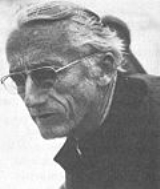
| |
Jacques-Yves Cousteau (11 June 1910 – 25 June 1997) was a French naval officer, explorer, ecologist, filmmaker, innovator, scientist, photographer, author and researcher who studied the sea and all forms of life in water. He co-developed the aqua-lung, pioneered marine conservation and was a member of the Académie française.
He was commonly known as "le Commandant Cousteau" or "Captain Cousteau". teau was born on 11 June 1910, in Saint-André-de-Cubzac, Gironde, to Daniel and Élisabeth Cousteau.

Discussion
Ask a question about 'Jacques-Yves Cousteau'
Start a new discussion about 'Jacques-Yves Cousteau'
Answer questions from other users
|
Recent Posts

Quotations
Farming as we do it is hunting, and in the sea we act like barbarians.
Interview (17 July 1971)
I am not a scientist. I am, rather, an impresario of scientists.
Christian Science Monitor (24 July 1986)
Man, of all the animals, is probably the only one to regard himself as a great delicacy.
Octopus and Squid: The Soft Intelligence (1973)
Buoyed by water, he can fly in any direction— up, down, sideways— by merely flipping his hand. Under water, man becomes an archangel.
Time (28 March 1960)
The sea is the universal sewer.
Declaring the sea to be "where all kinds of pollution wind up", to the US House Committee on Science and Astronautics (28 January 1971)
We must plant the sea and herd its animals … using the sea as farmers instead of hunters. That is what civilization is all about— farming replacing hunting.
Interview (17 July 1971)

Encyclopedia
Jacques-Yves Cousteau (11 June 1910 – 25 June 1997) was a French naval officer, explorer, ecologist, filmmaker, innovator, scientist, photographer, author and researcher who studied the sea and all forms of life in water. He co-developed the aqua-lung, pioneered marine conservation and was a member of the Académie française.
He was commonly known as "le Commandant Cousteau" or "Captain Cousteau".
Background
Cousteau was born on 11 June 1910, in Saint-André-de-Cubzac, Gironde, to Daniel and Élisabeth Cousteau. He discovered the sea in the creeks close to Marseille where his family settled. He completed his preparatory studies at the prestigious Collège Stanislas in Paris. In 1930 he entered the École Navale and became an officer gunner. In Toulon, where he was serving on the Condorcet, Cousteau carried out his first underwater experiments, thanks to his friend Philippe Tailliez.
In 1936, Tailliez lent him some Fernez underwater goggles, predecessors of modern diving masks. Cousteau also belonged to the information service of the French Navy, and was sent on missions to Shanghai and Japan (1938) and in the USSR (1939).
In 1930 he entered the French Navy as the head of the underwater research group. He later worked his way up the ranks as he became more famous and more useful to the navy. On 12 July 1937 he married Simone Melchior, with whom he had two sons, Jean-Michel (1938) and Philippe (1940). His sons took part in the adventure of the Calypso. In 1991, one year after his wife Simone's death from cancer, he married Francine Triplet. They already had a daughter Diane Cousteau (1980) and a son Pierre-Yves Cousteau (1982), born before their marriage. He was the brother of right-wing fascist journalist and World War II Germany collaborator Pierre-Antoine Cousteau (1906–1958).
Cousteau died at the age of 87 of a heart attack while recovering from a respiratory illness. He is buried in the Cousteau family plot at Saint-André-de-Cubzac Cemetery, Saint-André-de-Cubzac, France.
Career Highlights
Early 1940s: Innovation of modern underwater diving
The years of the Second World War were decisive for the history of diving. After the armistice of 1940, the family of Simone and Jacques-Yves Cousteau took refuge in Megève, where he became a friend of the Ichac family who also lived there. Jacques-Yves Cousteau and Marcel Ichac shared the same will to reveal to general public unknown and inaccessible places: for Cousteau the underwater world and for Ichac the high mountains. The two neighbors took the first ex-aequo prize of the Congress of Documentary Film in 1943, for the first French underwater film: Par dix-huit mètres de fond (18 meters deep), made without breathing apparatus the previous year in Embiez (Var) with Philippe Tailliez and Frédéric Dumas, without forgetting the paramount part played, as originator of the depth-pressure-proof camera case, by the mechanical engineer Léon Vèche (engineer of Arts and Métiers and the Naval College).
In 1943, they made the film Épaves (Shipwrecks): for this occasion, they used the aqua-lung, which continued the line of some inventions of the 19th century (Rouquayrol's and Denayrouze's Aerophore) and of the early 20th century (Le Prieur). When making Épaves, Cousteau could not find the necessary blank reels of movie film, but had to buy hundreds of small still camera film reels the same width, intended for a make of child's camera, and cemented them together to make long reels.
Having kept bonds with the English speakers (he spent part of his childhood in the United States and usually spoke English) and with French soldiers in North Africa (under Admiral Lemonnier), Jacques-Yves Cousteau (whose villa "Baobab" at Sanary (Var) was opposite Admiral Darlan's villa "Reine"), helped the French Navy to join again with the Allies; he assembled a commando operation against the Italian espionage services in France, and received several military decorations for his deeds. At that time, he kept his distance from his brother Pierre-Antoine, a "pen anti-semite", who wrote the collaborationist newspaper Je suis partout (= I am everywhere), and was condemned to die in 1946. However this was later commuted to a life sentence, and Pierre-Antoine was released in 1954.
During the 1940s Cousteau is credited with improving the aqua-lung design which gave birth to the open-circuit scuba technology used today. According to his first book, The Silent World: A Story of Undersea Discovery and Adventure (1953), Cousteau started snorkel diving with a mask, snorkel, and fins with Frédéric Dumas and Philippe Tailliez. In 1943, he tried out the first prototype aqua-lung — designed by Cousteau and Émile Gagnan — which made lengthy underwater exploration possible for the first time.
Late 1940s: GERS and Élie Monnier
In 1946, Cousteau and Tailliez showed the film "Épaves" to Admiral Lemonnier, and the admiral gave them the responsibility of setting up the Groupement de Recherches Sous-marines (GRS) (Underwater Research Group) of the French Navy in Toulon. A little later it became the GERS (Groupe d'Études et de Recherches Sous-Marines, = Underwater Studies and Research Group), then the COMISMER ("COMmandement des Interventions Sous la MER", = "Undersea Interventions Command"), and finally more recently the CEPHISMER.
In 1948, between missions of mine clearance, underwater exploration and technological and physiological tests, Cousteau undertook a first campaign in the Mediterranean on board the sloop Élie Monnier of Group of Study and Underwater Research (GERS) of the National Navy, with Philippe Tailliez, Frédéric Dumas, Jean Alinat and the scenario writer Marcel Ichac. The small team also undertook the exploration of the Roman wreck of Mahdia (Tunisia). It was the first underwater archaeology operation using autonomous diving, opening the way for scientific underwater archaeology. Cousteau and Marcel Ichac brought back from there the Carnets diving film (presented and preceded with the Cannes Film Festival 1951).
Cousteau and Élie Monnier then took part in the rescue of Professor Jacques Piccard's bathyscaphe, the FNRS-2, during the 1949 expedition to Dakar. Thanks to this rescue, the French Navy was able to reuse the sphere of the bathyscaphe to construct the FNRS-3.
The adventures of this period are told in the 2 books The Silent World (1953) by Cousteau and Plongées Sans Câble by Philippe Tailliez.
1950–1970s
In 1949, Cousteau left the French Navy.
In 1950: he founded the French Oceanographic Campaigns (FOC), and he leased a ship called Calypso from Thomas Loel Guinness for a symbolic one franc a year and equipped her as a mobile laboratory for field research and as a support base for diving and filming. In it Cousteau traversed the most interesting seas of the planet as well as big and small rivers. He also carried out underwater archaeological excavations in the Mediterranean, in particular at Grand-Congloué (1952).
With the publication of his first book in 1953, The Silent World, he correctly predicted the existence of the echolocation abilities of porpoises (pp. 206-207), before they were discovered. He reported that his research vessel, the Élie Monier, was heading to the Straits of Gibraltar and noticed a group of porpoises following them. Cousteau changed course a few degrees off the optimal course to the center of the strait, and the porpoises followed for a few minutes, then diverged toward mid-channel again. It was evident that they knew where the optimal course lay, even if the humans did not. Cousteau concluded that the cetaceans had something like sonar, which was a relatively new feature on submarines. He was correct.
During his voyages, he produced many films (he won the Palme d'Or at the Cannes Film Festival in 1956 for The Silent World co-produced with Louis Malle, and books which contributed to diffuse, with unprecedented popularity, the knowledge of underwater biology.
With the assistance of Jean Mollard, he made a "diving saucer" SP-350, an extraordinary underwater vehicle which could reach a depth of 350 meters. The successful experiment was quickly repeated in 1965 with two vehicles which reached 500 meters.
In 1957, he was elected as director of the Oceanographical Museum of Monaco. He directed Précontinent, about the experiments of diving in saturation (long-duration immersion, houses under the sea), and was one of the rare few from abroad admitted to the National Academy of Sciences of the United States of America. The popularity of Jacques-Yves Cousteau grew.
In October 1960, a large amount of radioactive waste was going to be discarded in the Mediterranean Sea by the Commissariat à l'énergie atomique (CEA). The CEA argued that the dumps were experimental in nature, and that French oceanographers such as Vsevelod Romanovsky had recommended it. Romanovsky and other French scientists, including Louis Fage and Jacques Cousteau, repudiated the claim, saying that Romanovsky had in mind a much smaller amount. The CEA claimed that there was little circulation (and hence little need for concern) at the dump site between Nice and Corsica, but French public opinion sided with the oceanographers rather than with the CEA atomic energy scientists. The CEA chief, Francis Perrin, decided to postpone the dump. Cousteau organized a publicity campaign which in less than two weeks gained wide popular support. The train carrying the waste was stopped by women and children sitting on the railway tracks, and it was sent back to its origin. The alleged risk was avoided. During this, a French government official had falsely told a newspaper that Cousteau had approved the dump; Cousteau managed to get the newspaper to issue a correction.
In Monaco in November 1960, the official visit of French president Charles de Gaulle became famous because of their exchange in connection with the incidents of October and more largely in connection with the nuclear experiments. The ambassador of France had suggested to Prince Rainier that any meeting be avoided; but Prince Rainier did nothing to prevent the presence of Cousteau at the time of de Gaulle's visit to the Oceanographic Museum. The President asked the Commander in a friendly way to be nice with his atomic scientists; Cousteau answered "No sir, it is your researchers that ought to be kind toward us." In the discussion which followed, Jacques-Yves Cousteau deplored the American decision not to share nuclear secrets with France (for fear that certain French scientists, linked with Communism, might communicate them to the USSR), which led France to undertake its own research and nuclear experiments.
The meeting with American television (ABC, Métromédia, NBC) created the series '"The Underwater Odyssey of Commander Cousteau"', with the character of the commander in the red bonnet inherited from standard diving dress) intended to give the films more of a "personalized adventure" documentary style than a "didactic" one. On their subject, Cousteau explained: "people protect and respect what they like, and to make them like the sea, they should be filled with wonder as much as informing them."
In 1973, along with his two sons and Frederick Hyman, he created the Cousteau Society for the Protection of Ocean Life, Frederick Hyman being its first President; it now has more than 300,000 members.
Three years after the volcano’s last eruption, on December 19, 1973, the Cousteau team landed at Deception Island, Antartica for the first time. The cameramen got to work and found many subjects to film: seals on the beaches, penguin rookeries and the strange lunar mineral universe of the island partly covered by a glacier. The caldera, an immense volcanic hole that the sea has invaded, is one of the hot-water areas that are steaming along the black beaches. Five wonderful descents in the submersible SP350 explore the caldera: a first in the Antarctic. The self-contained divers of the Cousteau team, wearing completely watertight suits, realize with satisfaction that they can stay 30 to 40 minutes in the icy water without suffering too much. On December 28 1973, at 11:30 AM, Michel Laval, Calypso’s second in command, is tragically struck by a propeller of the helicopter that is ferrying between Calypso and the island. He is killed immediately. Captain Cousteau decides to escort the body of his crewman personally, first to Ushuaia, then on to France.
In 1976 Cousteau uncovered the wreck of HMHS Britannic. In 1977, together with Peter Scott, he received the UN International Environment prize.
In 1985, he received the Presidential Medal of Freedom from Ronald Reagan, then president of the United States.
On 28 June 1979, while the Calypso was on an expedition to Portugal, his second son, Philippe, his preferred and designated successor and with whom he had co-produced all his films since 1969, died in a PBY Catalina flying boat crash in the Tagus river near Lisbon. Cousteau was deeply affected. He called his then eldest son, the architect Jean-Michel Cousteau, to his side. This collaboration lasted 14 years.
1980-1990s
On 24 November 1988 he was elected to the French Academy, chair 17, succeeding Jean Delay. His official reception under the Cupola took place on 22 June 1989, the response to his speech of reception being given by Bertrand Poirot-Delpech. After his death, he was replaced under the Cupola by Érik Orsenna on 28 May 1998.
In June 1990, the composer Jean Michel Jarre paid homage to the commander by entitling his new album Waiting for Cousteau.
On 2 December 1990, his wife Simone Cousteau died of cancer. This woman of great character who had spent more time than her husband on board Calypso was the égérie ("muse") of the Cousteau team.
In June 1991, in Paris, Jacques-Yves Cousteau remarried, to Francine Triplet, with whom he had (before this marriage) two children, Diane and Pierre-Yves. Francine Cousteau currently continues her husband's work as the head of the Cousteau Foundation and Cousteau Society. From that point, the relations between Jacques-Yves and his elder son worsened. Jacques-Yves put an end to their collaboration.
In November 1991, Cousteau gave an interview to the UNESCO courier, in which he stated that he was in favour of human population control and population decrease. The full article text can be found online.
In 1996, he sued his son who wished to open a holiday center named "Cousteau" in the Fiji Islands.
On 11 January 1996 Calypso was rammed and sunk in Singapore harbor by a barge. The Calypso was refloated and towed home to France.
In 1992, he was invited to Rio de Janeiro, Brazil, for the United Nations' International Conference on Environment and Development, and then he became a regular consultant for the UN and the World Bank.
Jacques-Yves Cousteau died on 25 June 1997 in Paris, aged 87. His death was strongly felt in the United States, where he was one of the most popular Frenchmen. He was buried in the family vault at Saint-André-de-Cubzac in France. An homage was paid to him by the city by the inauguration of a "rue du Commandant Cousteau", a street which runs out to his native house, where a commemorative plaque was affixed. He also loved cats.
During his lifetime, Jacques-Yves Cousteau received these distinctions:
Defense of the environment
Jacques-Yves Cousteau superimposed the geonimic vision of the sea and Earth elaborated in the 1930's by Jacques Grob and Philippe Tailliez with a conqueror's mentality. A cultivated explorer in the spirit of Jules Vernes, he fed the public's taste for wonder. "One protects what one likes.", Cousteau repeated, "and one likes what enchanted us." As Cousteau's oceanographic and cinematographic campaigns took place over more than 50 years (1945-1997), he was able to measure the degradation of the in-situ mediums: the conqueror-explorer, sure of his technical prowess and finding it natural to drive out marine animals gradually morphed into an ardent conservationist who leveraged his worldwide notoriety to promote the idea of the Earth as a limited and fragile spaceship that needed to be preserved. He was the only non-politician to take part in the 1992 Rio Summit.
After 1975, he briefly considered founding worldwide 'Cousteau Clubs' for young people, but eventually abandoned this idea in its original form (which would have involved significant work with few direct rewards) and instead published a few fanzines (Calypso Log, Le Dauphin) and made a documentary film about a trip to the Antarctic with children. Towards the end of his life, he became pessimistic and even misanthropic: An ideal planet, he confided to Yves Paccalet, would be one in which humanity is limited to 100,000 people who are both educated and respectful of nature.
Jacques-Yves Cousteau's star power rested not only on his personal image, but on the image of a united team striving towards a common goal. Late in his life, however, highly-publicized intra-family conflicts, internal divisions, and consequent lawsuits chipped away at this image, and that of his successors: son Jean-Michel and grandson Fabien on one side, and the Cousteau Team with his third wife Francine and their children of the other, do not have the public standing of the 20th century Cousteau Team.
On the other hand, the kind of underwater and adventure film that Jacques-Yves Cousteau launched has never been more popular: each year, hundreds of increasingly beautiful documentaries are produced, thanks to improvement of photographic techniques. The idea of a fragile planet and sea has not only made its way into the public consciousness, but also affects the political class who were slower to come to environmental awareness.
Legacy
Cousteau's legacy includes more than 120 television documentaries, more than 50 books, and an environmental protection foundation with 300,000 members.
Cousteau liked to call himself an "oceanographic technician." He was, in reality, a sophisticated showman, teacher, and lover of nature. His work permitted many people to explore the resources of the oceans.
His work also created a new kind of scientific communication, criticised at the time by some academics. The so-called "divulgationism", a simple way of sharing scientific concepts, was soon employed in other disciplines and became one of the most important characteristics of modern television broadcasting.
Cousteau died on 25 June 1997. The Cousteau Society and its French counterpart, l'Équipe Cousteau, both of which Jacques-Yves Cousteau founded, are still active today. The Society is currently attempting to turn the original Calypso into a museum and it is raising funds to build a successor vessel, the Calypso II.
In his last years, after marrying again, Cousteau became involved in a legal battle with his son Jean-Michel over Jean-Michel licensing the Cousteau name for a South Pacific resort, resulting in Jean-Michel Cousteau being ordered by the court not to encourage confusion between his for-profit business and his father's non-profit endeavours.
In 2007 International Watch Co introduced the IWC Aquatimer Chronograph 'Cousteau Divers' Special Edition. The timepiece incorporated a sliver of wood from the interior of Cousteau's Calypso research vessel. Having developed the diver's watch, IWC offered support to The Cousteau Society. The proceeds from the timepieces' sales were partially donated to the non-profit organization involved into conservation of marine life and preservation of tropical coral reefs.
Pop culture tributes and references
- Wu-Tang Clan member Old Dirty Bastard pays homage to Jacques Cousteau in the song Da Mystery of Chessboxin from Wu-Tang Clan's Enter the 36 Chambers. "Here I go, deep type flow. Jacques Cousteau could never get this low."
- Belgian singer Plastic Bertrand made a song about Jacques Cousteau in 1981, under the title Jacques Cousteau.
- John Denver wrote a song called Calypso as a tribute to Cousteau, the ship, and her crew. The song reached the number-one position on the Billboard 100 charts.
- In Wes Anderson's 1998 film Rushmore, the main character Max Fisher reads a quote by Cousteau and begins a search for the identity of the author. The quote was "When one man, for whatever reason, has an opportunity to lead an extraordinary life, he has no right to keep it to himself."
- Two New Age composers, Vangelis (who was heavily involved with Cousteau in the 1990s) and Jean Michel Jarre, released albums including original numbers honoring Jacques-Yves Cousteau: Cousteau's Dreams (2000) and Waiting for Cousteau (1990).
- The 2004 film The Life Aquatic with Steve Zissou directed by Wes Anderson, is regarded as both a homage to and a send-up of Cousteau's career. It includes an end credit that reads "In memory of Jacques-Yves Cousteau and with gratitude to the Cousteau Society, which was not involved in the making of this film."
- The Swedish band Bob Hund performed a tribute to Jacques Cousteau on their album Ingenting, released in 2002, with songs recorded in 1992-93. They refer to him as being "a brave aquanaut".
- The band The Flight of the Conchords references Jacques Cousteau in their song Foux du Fa Fa.
- In Star Trek, the captain's yacht of the USS Enterprise-E is named Cousteau.
- An internet rumour and disinformation which has been running since 1989 says wrongly that Cousteau became a Muslim upon seeing the Koran.
- Around 1980 a scale model of the Calypso research ship, complete with the marine helicopter was sold to children worldwide, along with leaflets calling for donations to the Cousteau foundation. These models are still being sold as toys.
- The futuristic novel The Deep Range written by Arthur C. Clarke mentions a research submarine named Cousteau.
- Gwar's first album, Hell-O, included a song named "Je M'Appelle J. Cöusteaü".
- The Actionslacks released a song entitled "Jacques Cousteau" on their EP "Kids With Guitars."
See also
Jacques-Yves Cousteau's ships
Bibliography
Books by Cousteau
- The Silent World (1953, with Frederic Dumas)
- Captain Cousteaus Underwater Treasury (1959, with James Dugan)
- The Living Sea (1963, with James Dugan)
- World Without Sun (1965)
- The Undersea Discoveries of Jacques-Yves Cousteau (1970-1975, 8-volumes, with Philippe Diole)
- The Shark: Splendid Savage of the Sea (1970)
- Diving for Sunken Treasure (1971)
- Life and Death in a Coral Sea (1971)
- The Whale: Mighty Monarch of the Sea (1972)
- Octopus and Squid: The Soft Intelligence (1973)
- Three Adventures: Galápagos, Titicaca, the Blue Holes (1973)
- Diving Companions: Sea Lion, Elephant Seal, Walrus (1974)
- Dolphins (1975)
- The Ocean World of Jacques Cousteau (1973-78, 21 volumes)
- Oasis in Space (vol 1)
- The Act of Life (vol 2)
- Quest for Food (vol 3)
- Window in the Sea (vol 4)
- The Art of Motion (vol 5)
- Attack and Defense (vol 6)
- Invisible Messages (vol 7)
- Instinct and Intelligence (vol 8)
- Pharaohs of the Sea (vol 9)
- Mammals in the Sea (vol 10)
- Provinces of the Sea (vol 11)
- Man Re-Enters Sea (vol 12)
- A Sea of Legends (vol 13)
- Adventure of Life (vol 14)
- Outer and Inner Space (vol 15)
- The Whitecaps (vol 16)
- Riches of the Sea (vol 17)
- Challenges of the Sea (vol 18)
- The Sea in Danger (vol 19)
- Guide to the Sea and Index (vol 20)
- Calypso (1978, vol 21)
- A Bill of Rights for Future Generations (1979)
- Life at the Bottom of the World (1980)
- The Cousteau United States Almanac of the Environment (1981, aka The Cousteau Almanac of the Environment: An Inventory of Life on a Water Planet)
- Jacques Cousteau's Calypso (1983)
- Marine Life of the Caribbean (1984, with James Cribb and Thomas H. Suchanek)
- Jacques Cousteau's Amazon Journey (1984, with Mose Richards)
- Jacques Cousteau: The Ocean World (1985)
- The Whale (1987, with Philippe Diole)
- Jacques Cousteau: Whales (1988, with Yves Paccalet)
- The Human, The Orchid and The Octopus (and Susan Schiefelbein, coauthor; Bloomsbury 2007]
Books about Cousteau
- Undersea Explorer: The Story of Captain Cousteau (1957) by James Dugan
- Jacques Cousteau and the Undersea World (2000) by Roger King
- Jacques-Yves Cousteau: His Story Under the Sea (2002) by John Bankston
- Jacques Cousteau: A Life Under the Sea (2008) by Kathleen Olmstead
Films
Television Series
- 1966-68 The World of Jacques-Yves Cousteau
- 1968-76 The Undersea World of Jacques-Yves Cousteau
- 1977-77 Oasis in Space
- 1977-81 Cousteau's Odyssey Series
- 1982-84 Cousteau's Amazon Series
- 1985-91 Cousteau's Rediscovery of the World I
- 1992-94 Cousteau's Rediscovery of the World II
External links
-
- (A page by Robert Simms of Clemson University Mathematics Department)
-
- (.mov QuickTime movie, 1.6Mb)
-
-
-
- (A brief biography by British amateur scuba diver Dave "Hooch" Hasney)
-
-
-
|