

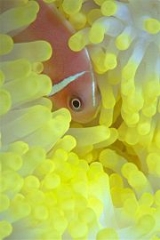
Underwater photography

Encyclopedia
Underwater photography is the process of taking photograph
s while under water. It is usually done while scuba diving
, but can be done while snorkeling
or swimming.
and marine mammals are common subjects, but photographers also pursue shipwrecks, submerged cave
systems, underwater "landscapes", and portrait
s of fellow divers.
The primary obstacle faced by underwater photographers is the loss of color
and contrast
when submerged to any significant depth. The longer wavelengths of sunlight
(such as red or orange) are absorbed quickly by the surrounding water, so even to the naked eye everything appears blue-green in color. The loss of color not only increases vertically through the water column, but also horizontally, so subjects further away from the camera will also appear colorless and indistinct. This effect is true even in apparently clear water, such as that found around tropical coral reefs.
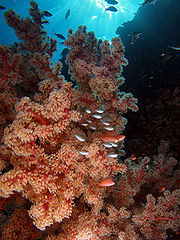 Underwater photographers solve this problem by combining two techniques. The first is to get the camera as close to the photographic subject as possible, minimizing the horizontal loss of color. Wide-angle lens
es allow very close focus
, or macro lenses, where the subject is often only inches away from the camera. Many serious underwater photographers consider any more than about 3 ft/1 m of water between camera and subject to be unacceptable. The second technique is the use of flash
to restore any color lost vertically through the water column. Fill flash
, used effectively, will "paint" in any missing colors by providing full-spectrum
visible light to the overall exposure
.
Since underwater photography is often performed while scuba diving, it is important that the diver-photographer be sufficiently skilled so that it remains a reasonably safe activity. Good scuba technique also has an impact on the quality of images, since marine life
is less likely to be scared away by a calm diver, and the environment is less likely to be damaged or disturbed. There is the possibility of encountering poor conditions, such as heavy currents, tidal flow, or poor visibility
. Generally, underwater photographers try to avoid these situations whenever possible.
s. The first amphibious camera was the Calypso
, reintroduced as the Nikonos
in 1963, which is designed specifically for use underwater, these cameras now require a housing for underwater use. Nikon
discontinued the Nikonos series in 2001 and, as it is a 35mm film
system, it is somewhat obsolete, but some photographers still choose this approach. Sea and Sea continues to manufacture an amphibious range finder camera that utilizes 35mm film, the Motor Marine III.
Cameras made for dry work can also work underwater, protected by special housings that are made for various digital point and shoot camera
s, digital compact cameras with full exposure controls, and SLRs (single lens reflex cameras). Most such housings are specific to the camera. Materials range from inexpensive plastic to high-priced aluminum cases. Housings allow many options, since the user can choose a housing specific to their everyday "land" camera, as well as utilize any lens in their collection. In practice, underwater photographers generally use either wide-angle lens
es or macro lenses, both of which allow close focus
, thereby eliminating the need for long underwater distance between camera and subject. Digital media can hold many more shots than standard photographic film (which rarely holds more than 36 frames). This is gives digital cameras an advantage, since it is impossible to change photographic film underwater. Other Digital versus film photography
comparisons apply, and the use of film underwater has declined, as it has on land.
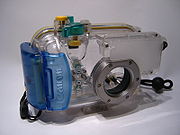 All underwater housings are outfitted with controls knobs that access the camera inside, giving the photographer use of most of its normal functions. These housings may also have connectors to attach external flash units. Some basic housings allow the use of the flash on the camera, but the on-board flash may not be sufficiently powerful and are improperly placed for underwater applications. More advanced housings either redirect the on-board strobe to fire a slave strobe via a fiber optic cable, or physically prevent the use of the on-board strobe. Housings are made waterproof through a system of silicone o-ring
s at all the crucial joints.
There are optical issues with using cameras inside a watertight housing. Because of refraction
, the image coming through the glass port will be distorted, in particular when using wide-angle lenses. The solution is to use a dome-shaped or fish-eye port, which corrects this distortion. Most manufacturers make these dome ports for their housings, often designing them to be used with specific lenses to maximize their effectiveness. The Nikonos series allowed the use of water contact optics: i.e., lenses designed to be used whilst submerged, without the ability to focus correctly when used in air. There is also a problem with some digital camera
s which do not have sufficiently wide lenses built into the camera. To solve this, there are housings made with supplementary optics
in addition to the dome port, making the apparent angle of view
wider. Some housings also allow for the use of wet-coupled lenses, which thread on to the exterior of the lens port and increase the field of view. These wet-coupled lenses may be added or removed underwater, allowing for both macro and wide angle photography on the same dive.
With macro lenses, the distortion caused by refraction is not an issue, so normally a simple flat glass port is used. In fact, refraction increases the magnification
of a macro lens, so this is considered a benefit to photographers who are trying to capture very small subjects.
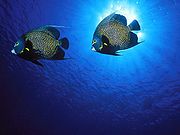 The use of a flash or strobe is often regarded as the most difficult aspect of underwater photography. Some common misconceptions exist about the proper use of flash underwater, especially as it relates to wide-angle photography
. Generally, the flash should be used to supplement the overall exposure and restore lost color, not as the primary light source. In situations such as the interior of caves or shipwrecks, wide-angle images can be 100% strobe light, but such situations are fairly rare. Usually, the photographer tries to create an aesthetic balance between the available sunlight
and the strobe. Deep, dark or low visibility environments can make this balance more difficult, but the concept remains the same. Many modern cameras have simplified this process through various automatic exposure modes and the use of through-the-lens
(TTL) metering. The increasing use of digital cameras has reduced the learning curve
of underwater flash significantly, since the user can instantly review photos and make adjustments.
Color is absorbed as it travels through water, so that the deeper you are, the less reds, oranges and yellow colors remain. The strobe replaces that color. It also helps to provide shadow and texture, and is a valuable tool for creativitiy.
An added complication is the phenomenon of backscatter
, where the flash reflects off particles or plankton
in the water. Even seemingly clear water contains enormous amounts of this particulate, even if it is not readily seen by the naked eye. The best technique for avoiding backscatter is positioning the strobe away from the axis of the camera lens. Ideally, this means the flash will not light up the water directly in front of the lens, but will still strike the subject. Various systems of jointed arms and attachments are used to make off-camera strobes easier to manipulate.
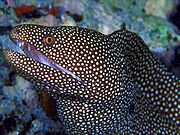 When using macro lenses, photographers are much more likely to use 100% strobe light for the exposure. The subject is normally very close to the lens, and the available sunlight is usually not sufficient.
There have been some attempts to avoid the use of flash entirely, but these have mostly failed. In shallow water, the use of custom white-balance provides excellent color without the use of strobe. In theory one could use color filters
to overcome the blue-green shift, but this can be problematic. The amount of shift would vary with depth and turbidity
, and there would still be a significant loss of contrast. Many digital cameras have settings that will provide color balance
, but this can cause other problems. For example, an image shifted toward the "warm" part of the spectrum can create background water which appears gray, purple or pink, and looks very unnatural. There have been some successful experiments using filters combined with the raw image format
function on some high-end digital cameras, allowing much more detailed manipulation in the digital darkroom
. This approach will probably always be restricted to shallow to moderate depths, where the loss of color is less extreme. In spite of that, it can be very effective for large subjects such as shipwrecks which could not be lit effectively with any strobe.
Natural light photography underwater can be beautiful when done properly with subjects such as upward silhouettes, light beams, and large subjects such as whales and dolphins.
Although digital cameras have revolutionized many aspects of underwater imaging, it is unlikely that flash will ever be eliminated completely. From an aesthetic standpoint, the flash often adds "pop" and helps to highlight the subject. Ultimately the loss of color and contrast is a pervasive optical problem that cannot always be adjusted in software such as Photoshop.
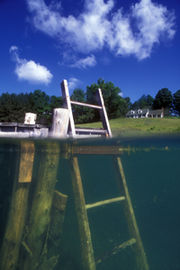 Another format considered part of underwater photography is the over/under or split image; it is a composition that includes roughly half above the surface and half underwater. The traditional technique was pioneered by the National Geographic photographer David Doubilet
, who used it to capture scenes above and below the surface simultaneously. Split images are popular in recreational scuba
magazines, often showing divers swimming beneath a boat, or shallow coral reef
s with the shoreline seen in the background.
Over/under shots do present some technical challenges beyond the scope of most underwater camera systems. Normally a wide-angle lens
is used, similar to the way they are used in everyday underwater photography. However, the exposure value
in the "air" part of the image is often quite different from the one underwater. There is also the problem of refraction
in the underwater segment, and how it affects the overall focus
in relation to the air segment. There are specialized split filters
designed to compensate for both of these problems, as well as techniques for creating even exposure across the entire image. Some photographers will also rely on extremely wide or fisheye lens
es, which have enough depth of field
to overcome any differences in focus.
One must also take into account the "dome" of the underwater camera housing. A wider dome is better for over under shots as it lets the water rest. Some photographers use an external flash on a low setting to overcome the exposure issues that you have either above or below land.
Digital darkroom
techniques can also be used to "splice" two images together, creating the appearance of an over/under shot.
Photograph
A photograph is an image created by light falling on a light-sensitive surface, usually photographic film or an electronic imager such as a CCD or a CMOS chip. Most photographs are created using a camera, which uses a lens to focus the scene's visible wavelengths of light into a reproduction of...
s while under water. It is usually done while scuba diving
Scuba diving
Scuba diving is a form of underwater diving in which a diver uses a scuba set to breathe underwater....
, but can be done while snorkeling
Snorkeling
Snorkeling is the practice of swimming on or through a body of water while equipped with a diving mask, a shaped tube called a snorkel, and usually swimfins. In cooler waters, a wetsuit may also be worn...
or swimming.
Overview
Successful underwater imaging is usually done with specialized equipment and techniques. However, it offers exciting and rare photographic opportunities. Animals such as fishFish
Fish are a paraphyletic group of organisms that consist of all gill-bearing aquatic vertebrate animals that lack limbs with digits. Included in this definition are the living hagfish, lampreys, and cartilaginous and bony fish, as well as various extinct related groups...
and marine mammals are common subjects, but photographers also pursue shipwrecks, submerged cave
Cave
A cave or cavern is a natural underground space large enough for a human to enter. The term applies to natural cavities some part of which is in total darkness. The word cave also includes smaller spaces like rock shelters, sea caves, and grottos.Speleology is the science of exploration and study...
systems, underwater "landscapes", and portrait
Portrait
thumb|250px|right|Portrait of [[Thomas Jefferson]] by [[Rembrandt Peale]], 1805. [[New-York Historical Society]].A portrait is a painting, photograph, sculpture, or other artistic representation of a person, in which the face and its expression is predominant. The intent is to display the likeness,...
s of fellow divers.
The primary obstacle faced by underwater photographers is the loss of color
Color
Color or colour is the visual perceptual property corresponding in humans to the categories called red, green, blue and others. Color derives from the spectrum of light interacting in the eye with the spectral sensitivities of the light receptors...
and contrast
Contrast (vision)
Contrast is the difference in visual properties that makes an object distinguishable from other objects and the background. In visual perception of the real world, contrast is determined by the difference in the color and brightness of the object and other objects within the same field of view...
when submerged to any significant depth. The longer wavelengths of sunlight
Sunlight
Sunlight, in the broad sense, is the total frequency spectrum of electromagnetic radiation given off by the Sun. On Earth, sunlight is filtered through the Earth's atmosphere, and solar radiation is obvious as daylight when the Sun is above the horizon.When the direct solar radiation is not blocked...
(such as red or orange) are absorbed quickly by the surrounding water, so even to the naked eye everything appears blue-green in color. The loss of color not only increases vertically through the water column, but also horizontally, so subjects further away from the camera will also appear colorless and indistinct. This effect is true even in apparently clear water, such as that found around tropical coral reefs.
Wide-angle lens
From a design perspective, a wide angle lens is one that projects a substantially larger image circle than would be typical for a standard design lens of the same focal length; this enables either large tilt & shift movements with a view camera, or lenses with wide fields of view.More informally,...
es allow very close focus
Focus (optics)
In geometrical optics, a focus, also called an image point, is the point where light rays originating from a point on the object converge. Although the focus is conceptually a point, physically the focus has a spatial extent, called the blur circle. This non-ideal focusing may be caused by...
, or macro lenses, where the subject is often only inches away from the camera. Many serious underwater photographers consider any more than about 3 ft/1 m of water between camera and subject to be unacceptable. The second technique is the use of flash
Flash (photography)
A flash is a device used in photography producing a flash of artificial light at a color temperature of about 5500 K to help illuminate a scene. A major purpose of a flash is to illuminate a dark scene. Other uses are capturing quickly moving objects or changing the quality of light...
to restore any color lost vertically through the water column. Fill flash
Fill flash
Fill flash is a photographic technique used to brighten deep shadow areas, typically outdoors on sunny days, though the technique is useful any time the background is significantly brighter than the subject of the photograph, particularly in backlit subjects...
, used effectively, will "paint" in any missing colors by providing full-spectrum
Full-spectrum
Full-spectrum light is light that covers the electromagnetic spectrum from infrared through near-ultraviolet, or all wavelengths that are useful to plant or animal life; in particular, sunlight is considered full spectrum, even though the solar spectral distribution reaching Earth changes with time...
visible light to the overall exposure
Exposure (photography)
In photography, exposure is the total amount of light allowed to fall on the photographic medium during the process of taking a photograph. Exposure is measured in lux seconds, and can be computed from exposure value and scene luminance over a specified area.In photographic jargon, an exposure...
.
Since underwater photography is often performed while scuba diving, it is important that the diver-photographer be sufficiently skilled so that it remains a reasonably safe activity. Good scuba technique also has an impact on the quality of images, since marine life
Marine biology
Marine biology is the scientific study of organisms in the ocean or other marine or brackish bodies of water. Given that in biology many phyla, families and genera have some species that live in the sea and others that live on land, marine biology classifies species based on the environment rather...
is less likely to be scared away by a calm diver, and the environment is less likely to be damaged or disturbed. There is the possibility of encountering poor conditions, such as heavy currents, tidal flow, or poor visibility
Visibility
In meteorology, visibility is a measure of the distance at which an object or light can be clearly discerned. It is reported within surface weather observations and METAR code either in meters or statute miles, depending upon the country. Visibility affects all forms of traffic: roads, sailing...
. Generally, underwater photographers try to avoid these situations whenever possible.
Equipment
Some cameras are made for use underwater, including modern waterproof digital cameraWaterproof digital camera
Waterproof digital cameras are digital cameras that can make pictures underwater. Waterproof housings have long been made but they cost almost as the cameras...
s. The first amphibious camera was the Calypso
Calypso (camera)
The self-contained amphibious underwater Calypso 35mm film camera was conceived by the marine explorer Jacques-Yves Cousteau , designed by Jean de Wouters and manufactured by Atoms in France. It was distributed by La Spirotechnique in Paris from 1960 to 1962. The camera operates down to 200 feet /...
, reintroduced as the Nikonos
Nikonos
Nikonos is the name of a series of 35 mm film cameras specifically designed for underwater photography launched by Nikon in 1963. The early Nikonos cameras were improvements of the Calypso camera, which was an original design by Jacques-Yves Cousteau and Belgian engineer Jean de Wouters...
in 1963, which is designed specifically for use underwater, these cameras now require a housing for underwater use. Nikon
Nikon
, also known as just Nikon, is a multinational corporation headquartered in Tokyo, Japan, specializing in optics and imaging. Its products include cameras, binoculars, microscopes, measurement instruments, and the steppers used in the photolithography steps of semiconductor fabrication, of which...
discontinued the Nikonos series in 2001 and, as it is a 35mm film
135 film
The term 135 was introduced by Kodak in 1934 as a designation for cartridge film wide, specifically for still photography. It quickly grew in popularity, surpassing 120 film by the late 1960s to become the most popular photographic film format...
system, it is somewhat obsolete, but some photographers still choose this approach. Sea and Sea continues to manufacture an amphibious range finder camera that utilizes 35mm film, the Motor Marine III.
Cameras made for dry work can also work underwater, protected by special housings that are made for various digital point and shoot camera
Point and shoot camera
A point-and-shoot camera, also called a compact camera, is a still camera designed primarily for simple operation. Most use focus free lenses or autofocus for focusing, automatic systems for setting the exposure options, and have flash units built in....
s, digital compact cameras with full exposure controls, and SLRs (single lens reflex cameras). Most such housings are specific to the camera. Materials range from inexpensive plastic to high-priced aluminum cases. Housings allow many options, since the user can choose a housing specific to their everyday "land" camera, as well as utilize any lens in their collection. In practice, underwater photographers generally use either wide-angle lens
Wide-angle lens
From a design perspective, a wide angle lens is one that projects a substantially larger image circle than would be typical for a standard design lens of the same focal length; this enables either large tilt & shift movements with a view camera, or lenses with wide fields of view.More informally,...
es or macro lenses, both of which allow close focus
Focus (optics)
In geometrical optics, a focus, also called an image point, is the point where light rays originating from a point on the object converge. Although the focus is conceptually a point, physically the focus has a spatial extent, called the blur circle. This non-ideal focusing may be caused by...
, thereby eliminating the need for long underwater distance between camera and subject. Digital media can hold many more shots than standard photographic film (which rarely holds more than 36 frames). This is gives digital cameras an advantage, since it is impossible to change photographic film underwater. Other Digital versus film photography
Digital versus film photography
Digital versus film photography has been a topic of debate since the invention of digital cameras towards the end of the 20th Century. Both digital and film photography have advantages and drawbacks...
comparisons apply, and the use of film underwater has declined, as it has on land.
O-ring
An O-ring, also known as a packing, or a toric joint, is a mechanical gasket in the shape of a torus; it is a loop of elastomer with a disc-shaped cross-section, designed to be seated in a groove and compressed during assembly between two or more parts, creating a seal at the interface.The O-ring...
s at all the crucial joints.
There are optical issues with using cameras inside a watertight housing. Because of refraction
Refraction
Refraction is the change in direction of a wave due to a change in its speed. It is essentially a surface phenomenon . The phenomenon is mainly in governance to the law of conservation of energy. The proper explanation would be that due to change of medium, the phase velocity of the wave is changed...
, the image coming through the glass port will be distorted, in particular when using wide-angle lenses. The solution is to use a dome-shaped or fish-eye port, which corrects this distortion. Most manufacturers make these dome ports for their housings, often designing them to be used with specific lenses to maximize their effectiveness. The Nikonos series allowed the use of water contact optics: i.e., lenses designed to be used whilst submerged, without the ability to focus correctly when used in air. There is also a problem with some digital camera
Digital camera
A digital camera is a camera that takes video or still photographs, or both, digitally by recording images via an electronic image sensor. It is the main device used in the field of digital photography...
s which do not have sufficiently wide lenses built into the camera. To solve this, there are housings made with supplementary optics
Optics
Optics is the branch of physics which involves the behavior and properties of light, including its interactions with matter and the construction of instruments that use or detect it. Optics usually describes the behavior of visible, ultraviolet, and infrared light...
in addition to the dome port, making the apparent angle of view
Angle of view
In photography, angle of view describes the angular extent of a given scene that is imaged by a camera. It is used interchangeably with the more general term field of view....
wider. Some housings also allow for the use of wet-coupled lenses, which thread on to the exterior of the lens port and increase the field of view. These wet-coupled lenses may be added or removed underwater, allowing for both macro and wide angle photography on the same dive.
With macro lenses, the distortion caused by refraction is not an issue, so normally a simple flat glass port is used. In fact, refraction increases the magnification
Magnification
Magnification is the process of enlarging something only in appearance, not in physical size. This enlargement is quantified by a calculated number also called "magnification"...
of a macro lens, so this is considered a benefit to photographers who are trying to capture very small subjects.
Underwater flash
Wide-angle lens
From a design perspective, a wide angle lens is one that projects a substantially larger image circle than would be typical for a standard design lens of the same focal length; this enables either large tilt & shift movements with a view camera, or lenses with wide fields of view.More informally,...
. Generally, the flash should be used to supplement the overall exposure and restore lost color, not as the primary light source. In situations such as the interior of caves or shipwrecks, wide-angle images can be 100% strobe light, but such situations are fairly rare. Usually, the photographer tries to create an aesthetic balance between the available sunlight
Sunlight
Sunlight, in the broad sense, is the total frequency spectrum of electromagnetic radiation given off by the Sun. On Earth, sunlight is filtered through the Earth's atmosphere, and solar radiation is obvious as daylight when the Sun is above the horizon.When the direct solar radiation is not blocked...
and the strobe. Deep, dark or low visibility environments can make this balance more difficult, but the concept remains the same. Many modern cameras have simplified this process through various automatic exposure modes and the use of through-the-lens
Through-the-lens
Through-the-lens metering is a photographic term describing a feature of cameras capable of measuring light levels in a scene through their taking lenses, as opposed to a separate metering window...
(TTL) metering. The increasing use of digital cameras has reduced the learning curve
Experience curve effects
Models of the learning curve effect and the closely related experience curve effect express the relationship between equations for experience and efficiency or between efficiency gains and investment in the effort....
of underwater flash significantly, since the user can instantly review photos and make adjustments.
Color is absorbed as it travels through water, so that the deeper you are, the less reds, oranges and yellow colors remain. The strobe replaces that color. It also helps to provide shadow and texture, and is a valuable tool for creativitiy.
An added complication is the phenomenon of backscatter
Backscatter
In physics, backscatter is the reflection of waves, particles, or signals back to the direction they came from. It is a diffuse reflection due to scattering, as opposed to specular reflection like a mirror...
, where the flash reflects off particles or plankton
Plankton
Plankton are any drifting organisms that inhabit the pelagic zone of oceans, seas, or bodies of fresh water. That is, plankton are defined by their ecological niche rather than phylogenetic or taxonomic classification...
in the water. Even seemingly clear water contains enormous amounts of this particulate, even if it is not readily seen by the naked eye. The best technique for avoiding backscatter is positioning the strobe away from the axis of the camera lens. Ideally, this means the flash will not light up the water directly in front of the lens, but will still strike the subject. Various systems of jointed arms and attachments are used to make off-camera strobes easier to manipulate.
There have been some attempts to avoid the use of flash entirely, but these have mostly failed. In shallow water, the use of custom white-balance provides excellent color without the use of strobe. In theory one could use color filters
Photographic filter
In photography and videography, a filter is a camera accessory consisting of an optical filter that can be inserted in the optical path. The filter can be a square or oblong shape mounted in a holder accessory, or, more commonly, a glass or plastic disk with a metal or plastic ring frame, which...
to overcome the blue-green shift, but this can be problematic. The amount of shift would vary with depth and turbidity
Turbidity
Turbidity is the cloudiness or haziness of a fluid caused by individual particles that are generally invisible to the naked eye, similar to smoke in air. The measurement of turbidity is a key test of water quality....
, and there would still be a significant loss of contrast. Many digital cameras have settings that will provide color balance
Color balance
In photography and image processing, color balance is the global adjustment of the intensities of the colors . An important goal of this adjustment is to render specific colors – particularly neutral colors – correctly; hence, the general method is sometimes called gray balance, neutral balance,...
, but this can cause other problems. For example, an image shifted toward the "warm" part of the spectrum can create background water which appears gray, purple or pink, and looks very unnatural. There have been some successful experiments using filters combined with the raw image format
RAW image format
A camera raw image file contains minimally processed data from the image sensor of either a digital camera, image scanner, or motion picture film scanner. Raw files are so named because they are not yet processed and therefore are not ready to be printed or edited with a bitmap graphics editor...
function on some high-end digital cameras, allowing much more detailed manipulation in the digital darkroom
Digital darkroom
Digital "darkroom" is the hardware, software and techniques used in digital photography that replace the darkroom equivalents, such as enlarging, cropping, dodging and burning, as well as processes that don't have a film equivalent....
. This approach will probably always be restricted to shallow to moderate depths, where the loss of color is less extreme. In spite of that, it can be very effective for large subjects such as shipwrecks which could not be lit effectively with any strobe.
Natural light photography underwater can be beautiful when done properly with subjects such as upward silhouettes, light beams, and large subjects such as whales and dolphins.
Although digital cameras have revolutionized many aspects of underwater imaging, it is unlikely that flash will ever be eliminated completely. From an aesthetic standpoint, the flash often adds "pop" and helps to highlight the subject. Ultimately the loss of color and contrast is a pervasive optical problem that cannot always be adjusted in software such as Photoshop.
Split images
David Doubilet
David Doubilet is a well known underwater photographer known primarily for his work published in National Geographic Magazine. He was born in New York and started taking photos underwater at the young age of 12. He started with a Brownie Hawkeye in a rubber anesthesiologist's bag to keep the water...
, who used it to capture scenes above and below the surface simultaneously. Split images are popular in recreational scuba
Scuba diving
Scuba diving is a form of underwater diving in which a diver uses a scuba set to breathe underwater....
magazines, often showing divers swimming beneath a boat, or shallow coral reef
Coral reef
Coral reefs are underwater structures made from calcium carbonate secreted by corals. Coral reefs are colonies of tiny living animals found in marine waters that contain few nutrients. Most coral reefs are built from stony corals, which in turn consist of polyps that cluster in groups. The polyps...
s with the shoreline seen in the background.
Over/under shots do present some technical challenges beyond the scope of most underwater camera systems. Normally a wide-angle lens
Wide-angle lens
From a design perspective, a wide angle lens is one that projects a substantially larger image circle than would be typical for a standard design lens of the same focal length; this enables either large tilt & shift movements with a view camera, or lenses with wide fields of view.More informally,...
is used, similar to the way they are used in everyday underwater photography. However, the exposure value
Exposure value
In photography, exposure value denotes all combinations of a camera's shutter speed and relative aperture that give the same exposure. In an attempt to simplify choosing among combinations of equivalent camera settings, the concept was developed by the German shutter manufacturer in the 1950s...
in the "air" part of the image is often quite different from the one underwater. There is also the problem of refraction
Refraction
Refraction is the change in direction of a wave due to a change in its speed. It is essentially a surface phenomenon . The phenomenon is mainly in governance to the law of conservation of energy. The proper explanation would be that due to change of medium, the phase velocity of the wave is changed...
in the underwater segment, and how it affects the overall focus
Focus (optics)
In geometrical optics, a focus, also called an image point, is the point where light rays originating from a point on the object converge. Although the focus is conceptually a point, physically the focus has a spatial extent, called the blur circle. This non-ideal focusing may be caused by...
in relation to the air segment. There are specialized split filters
Photographic filter
In photography and videography, a filter is a camera accessory consisting of an optical filter that can be inserted in the optical path. The filter can be a square or oblong shape mounted in a holder accessory, or, more commonly, a glass or plastic disk with a metal or plastic ring frame, which...
designed to compensate for both of these problems, as well as techniques for creating even exposure across the entire image. Some photographers will also rely on extremely wide or fisheye lens
Fisheye lens
In photography, a fisheye lens is a wide-angle lens that takes in a broad, panoramic and hemispherical image. Originally developed for use in meteorology to study cloud formation and called "whole-sky lenses", fisheye lenses quickly became popular in general photography for their unique, distorted...
es, which have enough depth of field
Depth of field
In optics, particularly as it relates to film and photography, depth of field is the distance between the nearest and farthest objects in a scene that appear acceptably sharp in an image...
to overcome any differences in focus.
One must also take into account the "dome" of the underwater camera housing. A wider dome is better for over under shots as it lets the water rest. Some photographers use an external flash on a low setting to overcome the exposure issues that you have either above or below land.
Digital darkroom
Digital darkroom
Digital "darkroom" is the hardware, software and techniques used in digital photography that replace the darkroom equivalents, such as enlarging, cropping, dodging and burning, as well as processes that don't have a film equivalent....
techniques can also be used to "splice" two images together, creating the appearance of an over/under shot.
Timeline
- 1856 — William ThompsonWilliam Thompson-Academics and scientists:* William Thompson , Irish ornithologist and botanist* William Thompson , Englishman who developed the Thompson Seedless grape...
takes first underwater pictures using a camera mounted on a pole. - 1893 — Louis Boutan takes underwater pictures while diving using a surface supplied hard hat diving gearStandard diving dressA standard diving dress consists of a metallic diving helmet, an airline or hose from a surface supplied diving air pump, a canvas diving suit, diving knife and boots...
. - 1914 — John Ernest WilliamsonJohn Ernest WilliamsonJohn Ernest Williamson invented the "photosphere" from which he filmed and photographed undersea.-Biography:...
shoots the first-ever underwater motion picture. - 1923 — W.H. Longley and Charles Martin takes first underwater colour photos using a magnesium powered flash
- 1957 — The Calypso PhotCalypso (camera)The self-contained amphibious underwater Calypso 35mm film camera was conceived by the marine explorer Jacques-Yves Cousteau , designed by Jean de Wouters and manufactured by Atoms in France. It was distributed by La Spirotechnique in Paris from 1960 to 1962. The camera operates down to 200 feet /...
camera is designed by Jean de WoutersJean de WoutersJean de Wouters is a Belgian inventor and aeronautical engineer. In 1957, he created the Calypso-Phot for Jacques-Yves Cousteau under their La Spirotechnique company name...
and promoted by Jacques-Yves CousteauJacques-Yves CousteauJacques-Yves Cousteau was a French naval officer, explorer, ecologist, filmmaker, innovator, scientist, photographer, author and researcher who studied the sea and all forms of life in water...
. It is first released in Australia in 1963. It features i a maximum 1/1000 second shutter speed. A similar-looking version is later produced by NikonNikon, also known as just Nikon, is a multinational corporation headquartered in Tokyo, Japan, specializing in optics and imaging. Its products include cameras, binoculars, microscopes, measurement instruments, and the steppers used in the photolithography steps of semiconductor fabrication, of which...
as the NikonosNikonosNikonos is the name of a series of 35 mm film cameras specifically designed for underwater photography launched by Nikon in 1963. The early Nikonos cameras were improvements of the Calypso camera, which was an original design by Jacques-Yves Cousteau and Belgian engineer Jean de Wouters...
, with a maximum 1/500 second shutter speed and becomes the best-selling underwater camera series. - 1961 — The San Diego Underwater Photographic SocietySan Diego Underwater Photographic SocietyThe San Diego Underwater Photographic Society is one of the earliest organizations ever to be dedicated to the promotion and advancement of the art and techniques of underwater photography and videography with nearly 50 years of history to its credit...
is established. It is one of the earliest organizations ever to be dedicated to the advancement of the art of U/W Photography.
See also
- Underwater videographyUnderwater videographyUnderwater videography is a video production, the branch of underwater photography concerned with capturing underwater moving images either as a recreational diving or commercial documentary, or filmmaking activity.-Limitations:...
- Nature photographyNature photographyNature photography refers to a wide range of photography taken outdoors and devoted to displaying natural elements such as landscapes, wildlife, plants, and close-ups of natural scenes and textures...
- List of basic photography topics
- Diving equipmentDiving equipmentDiving equipment is equipment used by underwater divers for the purpose of facilitating diving activities. This may be equipment primarily intended for this purpose, or equipment intended for other puprposes which is found to be suitable for diving use....
- Waterproof digital cameraWaterproof digital cameraWaterproof digital cameras are digital cameras that can make pictures underwater. Waterproof housings have long been made but they cost almost as the cameras...