


Surface supplied diving

Encyclopedia
Breathing gas
Breathing gas is a mixture of gaseous chemical elements and compounds used for respiration.Air is the most common and only natural breathing gas...
using a diver's umbilical from the surface, either from the shore or from a diving support vessel
Diving support vessel
A diving support vessel is a ship that is used as a floating base for professional diving projects.Commercial Diving Support Vessels emerged during the 1960s and 1970s when the need arose for diving operations to be performed below and around oil production platforms and associated installations in...
sometimes indirectly via a diving bell
Diving bell
A diving bell is a rigid chamber used to transport divers to depth in the ocean. The most common types are the wet bell and the closed bell....
. This is differentiated from SCUBA diving
Scuba diving
Scuba diving is a form of underwater diving in which a diver uses a scuba set to breathe underwater....
, wherein the diver's equipment is completely self-contained and there is no link to the surface.
Variations:
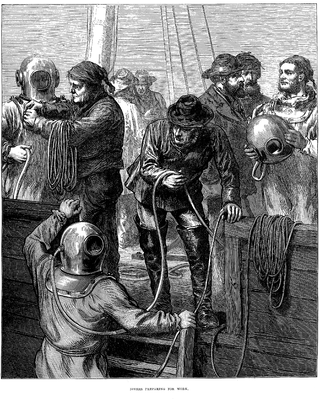
- StandardStandard diving dressA standard diving dress consists of a metallic diving helmet, an airline or hose from a surface supplied diving air pump, a canvas diving suit, diving knife and boots...
or Heavy gear — The historical copper helmet, canvas suit and weighted boots is still used for commercial work in some parts of the world.
- Scuba replacement — A surface supplied arrangement where both the primary and reserve air supplies are from high pressure cylinders. The rest of the system is identical to the standard surface supply configuration, and the full umbilical system, communications and surface air panel are used. This is more portable than most compressors and is used by commercial diving contractors as a substitute for scuba with most of the advantages and disadvantages of a regular compressor fed surface supply.
- Hookah — A basic form of surface supplied diving in which the air supply is via a single hose is often referred to as airline or Hookah (occasionally Hooka) diving. This often uses a standard scuba second stage as the delivery unit, but is also used with light full-face masks. Bailout gas may be carried, but this is not always the case. Commercial diamond divers working in the shallow zone off the west coast of South Africa under the codes of practice of the Department of Minerals and Energy use half mask and demand valve hookah, and no bailout as standard practice. Their safety record is relatively poor.
- Snuba — A recreational equivalent marketed under the label "SnubaSnubaSnuba is an underwater breathing system developed by Snuba International.The word Snuba is a portmanteau of "snorkel" and "scuba". The swimmer uses swimfins, a diving mask, weights, and diving regulator as in scuba diving....
" is used to supply air from a cylinder mounted on a float to a diver tethered by a short (approximately 6m) hose through a scuba regulator.
- Compressor diving — An even more basic system is the "Compressor divingCompressor divingCompressor diving is a method of surface-supplied diving used in some tropical sea areas including the Philippines and the Caribbean. The divers swim with an eyes-and-nose diving mask and fins and are supplied air by plastic hoses from an air compressor of the type commonly used to supply...
" arrangement used in the Philippines for fishing. This rudimentary and highly hazardous system uses a large number of small bore plastic tubes connected to a single compressor to supply a large number of divers simultaneously. The delivery end of the hose is unencumbered by any mechanism or mouthpiece, and is simply held by the divers' teeth. Air supply is free flow and often unfiltered.
Alternatives:
- SCUBAScuba setA scuba set is an independent breathing set that provides a scuba diver with the breathing gas necessary to breathe underwater during scuba diving. It is much used for sport diving and some sorts of work diving....
, which is commonly used in recreational divingRecreational divingRecreational diving or sport diving is a type of diving that uses SCUBA equipment for the purpose of leisure and enjoyment. In some diving circles, the term "recreational diving" is used in contradistinction to "technical diving", a more demanding aspect of the sport which requires greater levels...
, is the main alternative to surface supplied diving equipment. Scuba is available in open circuit and rebreatherRebreatherA rebreather is a type of breathing set that provides a breathing gas containing oxygen and recycled exhaled gas. This recycling reduces the volume of breathing gas used, making a rebreather lighter and more compact than an open-circuit breathing set for the same duration in environments where...
configurations.
- Atmospheric diving suitAtmospheric diving suitAn atmospheric diving suit or ADS is a small one-man articulated submersible of anthropomorphic form which resembles a suit of armour, with elaborate pressure joints to allow articulation while maintaining an internal pressure of one atmosphere...
s such as the JIM suitJIM suitThe JIM suit is an atmospheric diving suit , which is designed to maintain an interior pressure of one atmosphere despite exterior pressures, eliminating the majority of physiological dangers associated with deep diving...
and the NewtsuitNewtsuitThe Newtsuit is an atmospheric diving suit designed and originally built by Phil Nuytten.The suit is used for work on ocean drilling rigs, on pipelines, salvage jobs, photographic surveys, and is standard equipment in many of the world’s navies....
isolate the occupant from the ambient pressure, but are bulky and extremely expensive.
- Manned and unmanned submersibles (ROVs and AUVs) have their applications, but lack the dexterity of a diver at present (2011).
- Free diving, or breathhold diving, is extremely limited in duration and relatively high risk.
Application
Surface supplied diving equipment and techniques are mainly used in professional diving or military diving due to the greater cost and complexity of owning and operating the equipment. This type of equipment is used in saturation diving
Saturation diving
Saturation diving is a diving technique that allows divers to reduce the risk of decompression sickness when they work at great depth for long periods of time....
.
Equipment
The essemtial aspect of surface supplied diving is that breathing gas is supplied from the surface, either from a specialized diving compressor, high-pressure cylinders, or both. In commercial and military surface-supplied diving, a backup source of breathing gas should always be present in case the primary supply fails. The diver may also wear a cylinder called a "bail-out bottle," which can provide self contained breathing gas in an emergency. Thus, the surface-supplied diver is much less likely to have an "out-of-air" emergency than a SCUBA diver as there are normally two alternative air sources available.Surface supplied diving equipment usually includes communication capability with the surface, which adds to the safety and efficiency of the working diver.
Surface supplied equipment is required under the US Navy
United States Navy
The United States Navy is the naval warfare service branch of the United States Armed Forces and one of the seven uniformed services of the United States. The U.S. Navy is the largest in the world; its battle fleet tonnage is greater than that of the next 13 largest navies combined. The U.S...
operational guidance for diving in harsh contaminated environments
Water pollution
Water pollution is the contamination of water bodies . Water pollution occurs when pollutants are discharged directly or indirectly into water bodies without adequate treatment to remove harmful compounds....
which was drawn up by the Navy Experimental Diving Unit
United States Navy Experimental Diving Unit
The United States Navy Experimental Diving Unit is the primary source of diving and hyperbaric operational guidance for the US Navy...
..
Surface supplied diving equipment is required for a large proportion of the commercial diving operations conducted in many countries, either by direct legislation, or by authorised codes of practice, as in the case of IMCA operations.
Lightweight demand helmets
Lightweight demand helmets are rigid structures which fully enclose the head of the diver and supply breathing gas "on demand". The flow of gas from the supply line is activated by inhalation reducing the pressure in the helmet to slightly below ambient, and a diaphragm in the demand valve senses this pressure difference and moves a lever to open the valve to allow breathing gas to flow into the helmet. This flow continues until the pressure inside the helmet again balances the ambient pressure and the lever returns to the shut position. This is exactly the same principle as used for Scuba demand valves.Sensitivity of the lever can often be adjusted by the diver by turning a knob on the side of the demand valve. Lightweight demand helmets are available in open circuit and closed circuit (reclaim) systems. The former are used when breathing standard air, while the latter may be used in order to reduce costs when breathing mixed gas such as heliox
Heliox
Heliox is a breathing gas composed of a mixture of helium and oxygen .Heliox has been used medically since the 1930s, and although the medical community adopted it initially to alleviate symptoms of upper airway obstruction, its range of medical uses has since expanded greatly, mostly because of...
and trimix
Trimix
Trimix is a breathing gas, consisting of oxygen, helium and nitrogen, and is often used in deep commercial diving and during the deep phase of dives carried out using technical diving techniques....
. The exhaled gas is returned to the surface, scrubbed of carbon dioxide
Carbon dioxide
Carbon dioxide is a naturally occurring chemical compound composed of two oxygen atoms covalently bonded to a single carbon atom...
, re-oxygenated, and returned to the diver.
The structure of the helmet may be metal or reinforced plastic composite (GRP), and is either connected to a neck dam or clamped directly to a drysuit
The neck dam is the lower part of the helmet, which seals against the neck of the diver in the same way that the neck seal of a dry suit works. Neck dams may have neoprene or latex seals, depending on diver preference. Attachment to the neck dam is critical to diver safety and a reliable locking mechanism is needed to ensure that it is not inadvertently released during a dive. When using a dry suit, the neck dam may be permanently attached to the suit.
The term "Lightweight" is relative; the helmets are only light in comparison with the old copper hats. They are supported only by the head and neck of the diver, and are uncomfortably heavy (Weight of KM 77 = 32.43 pounds) out of the water, as they must be ballasted for neutral buoyancy during the dive, so they don't tend to lift the diver's head with excess buoyancy. There is little difference in weight between the metal shell and GRP shell helmets because of this ballasting, and the weight is directly proportional to the total volume - smaller helmets are lighter. To avoid fatigue, divers avoid donning the helmet until just prior to entering the water.
Having the helmet supported by the head has the advantage that the diver can turn the helmet to face the job without having to turn the entire upper torso. This is particularly an advantage when looking upwards. This allows the helmet to have a relatively small faceplate, which reduces overall volume and hence the weight.
Demand breathing systems reduce the amount of gas required to adequately ventilate the diver, as it needs only to be supplied when the diver inhales, but the slightly increased work of breathing caused by this system is a disadvantage at extreme levels of exertion, where free-flow systems may be better. The demand system is also quieter than free-flow, particularly during the non-inhalation phase of breathing. This can make voice communication more effective. The breathing of the diver is also audible to the surface team over the communications system, and this helps to monitor the condition of the diver and is a valuable safety feature.
Open circuit demand helmets
The open circuit demand system exhausts gas to the environment at ambient pressure (or a very small difference from ambient pressure required to open the exhaust valve). As a result all exhaled gas is lost to the surroundings.For most surface orientated commercial diving where air is the breathing gas in use, this is no problem, as air is cheap and freely available. Even with nitrox it is generally more cost effective to use open circuit, as oxygen is an easily available and relatively inexpensive gas, and blending nitrox is technologically simple, both to mix and to analyse.
Reclaim helmets
In the case of compressed air, or Nitrox mixrtures, the exhaled gas is not valuable enough to justify the expense of recycling, but Helium based mixtures are considerably more expensive, and as the depth increases, the amount of gas used (in terms of mass, or number of molecules) increases in direct proportion to the ambient pressure. As a result, gas cost is a significant factor in deep open circuit diving with helium based mixtures for long periods. By using a return line for the exhaled gas, it can be recompressed and used again, almost indefinitely. It is necessary to remove carbon dioxide from the reclaimed gas, but this is relativel cheap and uncomplicated. It is generally removed by a scrubber, which is a filter packed with a chemical which reacts with and removes the carbon dioxide from the gas.There is a technical problem with recovery of the exhaled gas. Simply venting it to a return hose through a non-return valve will not work, as the hose must be maintained at exactly the ambient pressure at the depth of the helmet, otherwise the gas from the helmet will either free-flow out under pressure, or not flow out at all because of back pressure. This obstacle is overcome by using an exhaust valve working on the same principle as the demand valve, which opens the exhaust valve by using the leverage of a diaphragm sensing the pressure difference between the helmet interior pressure and the ambient pressure, This only requires the pressure in the reclaim hose to be lower than ambient at the diver to function. The same principle is used in a diving chamber
Diving chamber
A diving chamber has two main functions:* as a simpler form of submersible vessel to take divers underwater and to provide a temporary base and retrieval system in the depths;...
's Built-in breathing system (BIBS).
Free flow helmet
A free flow helmet supplies a continuos flow of air to the diver, and he breathes this as it flows past. Work of breathing is minimal, but flow rate must be high if the diver works hard, and this is noisy, affecting communications and requiring hearing protection to avoud damage to the ears. This type of helmet is poular where divers have to work hard in relatively shallow water for long periods. It is also useful when diving in contaminated environments, where the helmet is sealed onto a dry suit, and the entire system is kept at a slight positive pressure by adjusting the back-pressure of the exhaust vale, to ensure that there is no leakage into the helmet. This type of helmet is oftem large in volume, and as it is attached to the suit, it does not move with the head. The diver must move his body to face anything he wants to see. For this reason the faceplate is large and there is often an upper window or side windows to improve the field of vision.Band mask
A band mask is a heavy duty full-face mask with many of the characteristics of a lighweight demand helmet. In structure it is the front section of a lightweight helmet from above the faceplate to below the demand valve and exhaust ports, aind including the bailout block and comms connections on the sides. This rigid frame is attached to a neoprene hood by a metal clamping band, hence the name. It is provided with a padded sealing surface around the frame edge which is held firmly against the diver's face by a rubber "spider", a multiple strap arrangement with a pad behind the diver's head, and usually five straps which hook onto pins on the band. The straps have several holes so the tension can be adjusted to get a comfortable seal. A band mask is heavier than other full face masks, but lighter than a helmet, and can be donned more quickly than a helmet. They are often used by the standby diver for this reason.Full-face mask
A full-face mask encloses both mouth and nose, which reduces the risk of the diver losing the air supply compared to a half mask and demand vave. Some models require a bailout block to provide alternative breathing gas supply from the umbilical and bailout cylinder, but are not suitable for accepting an alternative air supply from a rescue diver, while a few models accept a secondary demand valve which can be plugged into an accessory port (Draeger, Apeks and Ocean Reef). The unique Kirby Morgan 48 supermask has a removable DV pod which can be unclipped to allow the diver to breathe from a standard scuba demand valve with mouthpiece.Despite the improvement in diver safety provided by the more secure attachment of the breathing apparatus to the diver's face, some models of full face mask can fail catastrophically if the faceplate is broken or detached from the skirt, as there is then no way to breathe from the mask. This can be mitigated by carrying a standard secondary second stage, and preferably also a spare half mask.
A full face mask is lighter and more comfortable for swimming than a helmet or band mask, and usually provides an improved field of vision, but it is not as secure, and does not provide the same level of protection as the heavier and more sturdily constructed equipment. The two types of equipment have different ranges of application. Most full face masks are adaptable for use with scuba or surface supply. The full face mask does not usually have a bailout block fitted, and this is usually attached to the diver's harness, with a single hose to supply the mask from main or bailut gas which is selected at the block. The strap arrangement for full face masks is usually quite secure, but not as secure as a bandmak or helmet, and it is possible for it to be dislodged in the water. However it is also quite practicable for a trained diver to replace and clear a full face mask under water without assistance, so this is more an inconvenience than a disaster unless the diver is rendered unconscious at the same time.
Diver's umbilical
The umbilical contains an a hose to supply the breathing gas and usually several other components. These usually include a strength member, which may be the airline hose or a rope, a communications cable (comms wire), and a pneumofathometer hose. When needed, a hot water supply line, helium reclaim line, and/or video camera and lighting cables may be included. These components are neatly twisted into a multistrand cable, and are deployed as a single unit. The diver's end has underwater connectors for the electrical cables, and the air hoses are usually connected to the helmet, band mask, or bailout block by JIC fittings. A screw-down caribiner or similar connector is provided on the strength member for attachment to the diver's harness, and may be used to lift the diver in an emergency. Similar connections are provided for attachment to the diving bell, if used, or to the surface gas panel and communications equipment.Diver's harness
The diver's harness is an item of strong webbing, and sometimes cloth, which is fastened around a diver over the exposure suit, and allows the diver to be lifted without risk of falling out of the harness. Several types are in use.Jacket harness
The jacket harness is a waistcoat (vest) style garment with strong adjustable webbing straps which are adjustable and securely buckled over the shoulders, across the chest and waist, and through the crotch or around each thigh, so that the diver can not slide out under any predictable circumstance. The harness is fitted with several heavy duty D-rings, fixed to the webbing in such a way that the full weight of the diver and all his equipment can be safely supported. A minimum strength of 500kgf is recommended or required by some codes of practice. A jacket harness is usually provided with webbing straps or a cloth pocket on the back to support the bailout cylinder, and may have a variety of poskets to carry tools, and may also carry ditchable or fixed main weights. There are usually several strong D-rings to secure the umbilical and other equipment.Bell harness
A bell harness has the same function as a jacket harness, but lacks the cloth jacket component, and is made entirely of webbing, with a similar configuration of straps.It too may have a means of carrying a bailout cylinder, or the bailout cylinder may be carried on a separate backpack.
Harness with buoyancy compensation
The AP Valves Mk4 Jump Jacket is a harness with integral buoyancy jacket specifically designed for commercial diving work with helmets and bells.There is a direct feed to the jacket from the main air supply, from the pneumo line and from bailout, and a syatem which allows the diver's pneumo to be directly connected to another diver's helmet as an emergency air supply.
Airline
Hookah and Snuba systems are categorised as "airline" equipment, as they do not include the communications, lifrline and pneumofathometer hose characteristic of a full diver's umbilical. Most hookah diving uses a demand system based on a standard scuba second stage, but there have been special purpose free flow full face masks specifically intended for hookah diving (see photos).Their field of application is very different to full surface supplied diving. Hookah is generally used for shallow water work in low hazard applications, such as achaeology, aquaculture, and aquarium maintenance work. Snuba is purely a shallow water recreational application for low hazard sites.
A notable exception to this trend is the inshore diamond diving operations on the west coast of South Africa, where hookah is still the standard equipment for diamondiferous gravel extraction in the hostile conditions of the surf zone, where the water temperature is usually around 8 to 10°C, visibility is usually low, and surge is often stromg. Divers work shifts of about two hours with crowbar and suction hose, and are heavily weighted to stay in place while working, and the standard method of ascent is to ditch the weighted harness and regulator and make a free swimming ascent. The next diver will free dive down the airline, fit the regulator and shrug into the harness before continuing with the job. Until the South African abalone fishery was closed, hookah was the only mode of diving permitted for harvesting wild abalone, and several aspects of this practice were in direct contravention of the diving regulations at the time. Abalone divers were not allowed to have a standby diver on the boat.
Gas panel
A gas panel is the control equipment for supplying the breathing gas to the divers. Primary and reserve gas is supplied to the panel through shutoff valves from a low pressure compressor or high pressure storage cylinders ("bombs", "quads", or "kellys"). The gas pressure may be controlled at the panel by an industrial pressure regulatorPressure regulator
A pressure regulator is a valve that automatically cuts off the flow of a liquid or gas at a certain pressure. Regulators are used to allow high-pressure fluid supply lines or tanks to be reduced to safe and/or usable pressures for various applications....
, or it may already be regulated closer to the source (at the compressor, or at the storage cylinder outlet). The supply gas pressure is monitored on a gauge at the panel, and an overpressure valve is fitted in case the supply pressure is too high.
There is a set of valves and gauges for each diver to be supplied from the panel. These include:
- A main supply valve with non-return valve, which supplies gas to the main gas supply hose of the umbilical. This is usually a quarter-turn valve, as it must be quick to operate and obvious whether it is open or closed.
- A pneumofathometer supply valve, which supplies gas to the pneumofathometer for the diver. This valve is usually near the main supply valve but with a different handle. It is usually a needle type valve as it must be finely adjustable, but it must also be large enough to allow a fairly high flow rate, as the air may be used as an alternative breathing air source, or to fill small lift bags.
- A pneumofathometer gauge is connected to the pneumo line. This is a high resolution pressure gauge calibrated in feet sea water (fsw) and/or metres sea water (msw). and is used to measure the depth of the diver by allowing air to flow through the pneumo hose and out the end attached to the diver. When the air supply is shut off, and the flow stops, the gauge indicates the pressure at the open end at the diver.
- Each pneumofathometer gauge has an overpressure valve to protect it against gas supply at higher pressure than it is designed to take. This is essential as the main supply pressure is significantly higher than the maximum depth pressure on the pneumo gauge. There is also often a snubbing valve or orifice between the pneumo line and the gauge to restrict flow into the gauge and ensure that the overpressure vave can adequately relieve the pressure.
- Some gas panels have a separate supply gauge for each diver downstream of the supply valve, but this is not standard practice.
The gas panel may be fairly large and mounted on a board for convenience of use, or may be compact and mounted inside a portable box, for ease of transport. Gas panels are usually for one, two or three divers. In some countries, or under some codes of practice, the surface standby diver must be supplied from a separate panel to the working diver/s.
Low pressure breathing air compressor
A low pressure compressor is often the air supply of choice for surface supplied diving, as it is virtually unlimited in the amount of air it can supply, provided the delivery volume and pressure are adequate for the application. A low pressure compressor can run for tens of hours, needing only refuelling, periodical filter drainage and occasional running checks, and is therefore more convenient than high pressure storage cylinders for primary air supply.It is however, critical to diver safety that the compressor is suitable for breathing air delivery, uses a suitable oil, is adequately filtered, and takes in clean and uncontaminated air. Positioning of the intake opening is important, and may have to be changed if the relative wind direction changes, to ensure that no engine exhaust gas enters the intake. Various national standards for breathing air quality may apply.
Power for portable compressors is usually a 4-stroke petrol (gasoline) engine. Larger, trailer mounted compressors, may be diesel powered. Permanently installed compressors on dive support boats are likely to be powered by 3-phase electric motors.
The compressor should be provided with an accumulator and a relief valve. The accumulator functions as an additional water trap, but the main purpose is to provide a reserve volume of pressurised air. The relief valve allows any excess air to be release back to the atmosphere while retaining the appropriate supply pressure in the accumulator.
High pressure reserve gas
An alternative to a low pressure compressor for gas supply is high pressure storage cylinders feeding through a pressure regulator which will be set to the required supply pressure for the depth and equipment in use. In practice HP storage may be used for either reserve gas supply or both main and reserve gas supplies to a gas panel. High pressure bulk cylinders are quiet in operation and provide gas of known quality (if it has been tested). This allows the relatively simple and reliable use of nitrox mixtures in surface supplied diving. Bulk cylinders are also quiet in operation compared to a low pressure compressor, but have the obvious limitation of amount of gas available.The usual configurations for surface supplied bulk gas storage are large single cylinders of around 50 litres water capacity, often referred to as "J"s or "bombs",
"quads", which are a group (sometimes, but not necessarily four in number) of similar cylinders mounted on a frame and connected together to a common supply fitting, and "kellys" which are a group of "tubes" (long large volume pressure vessels) usually mounted in a container frame
Intermodal container
An intermodal container is a standardized reusable steel box used for the safe, efficient and secure storage and movement of materials and products within a global containerized intermodal freight transport system...
, and usually connected together to a common connection fitting.
Communications system
Both hard-wired (cable) and through-water electronic voice communications systems may be used with surface supplied diving. Wired systems are more popular as there is a physical connection to the diver for gas supply in any case, and adding a cable does not make the system any different to handle. Wired communications systems are still more reliable and simpler to maintain than through-water systems. The communications equipment is relatively straightforward and may be of the two-wire or four-wire type. Two wire systems use the same wires for surface to diver and diver to surface messages, whereas four wire systems allow the diver's messages and the surface operator's messages to use separate wire pairs.A standard arrangement with wired diver communications is to have the diver's side normally on, so that the surface team can hear anything from the diver at all times except when the surface is sending a message.
This is considered an important safety feature, as the surface team can monitor the diver's breathing sounds, which can give early warning of problems developing, and confirms that the diver is alive.
Helium divers may need a decoder system which reduces the frequency of the sound to make it more intelligible.
Closed circuit video is now also popular, as this allows the surface personnel to see what the diver is doing, which is particularly useful for inspection work, as a non-diving specialist can see the underwater equipment in real time and direct the diver to look at particular features of interest.
Dry bells may have a through water communication system fitted as a backup.
Bailout gas supply
Bailout gas is carried by the diver in a scuba cylinder, usually mounted on the back of the harness in the same position as is used with recreational scuba. The size of the cylinder will depend on operational variables. There should be sufficient gas to enable the diver to reach a place of safety on the nailot gas in an emergency. For surface oriented dives, this may require gas for decompression, and bailout sets generally start at about 7 litres water capacity and can be larger.Bell diving bailout options: For bell dives there is no requirement for decompression gas, as the bell itself carries bailout gas. However at extreme depths the diver will use gas fast, and there have been cases where twin 10 litre 300 bar sets were required to supply sufficient gas. Another option which has been used for extreme depth is a rebreather bailout set. A limitation for this service is that the diver must be able to get in and out of the bell hatch while wearing the bailout equipment.
Mounting options: The bailout cylinder may be mounted with the valve at the top or at the bottom, depending on local codes of practice. A generally used arrangement is to mount the cylinder with the valve up, as this is better protected while kittig up, and the cylinder valve is left fully open while the diver is in the water. this means that the regulator and supply hose to the bailout block will be pressurised during the dive, and ready for immediate use by opening the bailout valve on the harness or helmet.
The bailout block is a small manifold fitted either to the harness where it is in a convenient but protected position, commonly on the right side on the waist strap, or on the helmet, also usually on the right side of the temple, with the valve knob to the side to distinguish it from the free-flow or defogging valve which is commonly to the front. The bailout block has a connection for the main gas supply from the umbilical through a non-return valve. This route can not be closed and supplies the helmet demand valve and free flow valve under normal circumstances. The bailout gas from the back mounted cylinder passes through a conventional scuba first stage at the cylinder valve, to the bailout block, where it is normally isolated by the bailout valve. When the diver needs to switch over to bailout gas he simply opens the bailout valve and the gas is supplied to the helmet or mask. As the valve is normally closed, a leak in the first stage regulator seat will cause the pressure to rise, and unless an overpressure relief valve is fitted to the first stage the hose may burst. Aftermarket overpressure valves are available which can be fitted into a standard low pressure port of most first stages.
Bailout supply pressure options: If the interstage pressure for the bailout regulator is lower than the main supply pressure, the main supply will override the bailout gas, and continue to flow. This can be a problem if the diver swithces to bailout because main supply is contaminated. If on the other hand, bailout pressure is higher than main supply pressure, the bailout gas will overrride the main gas supply if the valve is opened. This will result in the bailout gas being used up if the valve leaks. The diver should periodically check that bailout pressure is still sufficient for the rest of the dive, and abort the dive if it is not. For this reason the bailout regulator must be fitted with a submersible pressure gauge which the diver can refer to to check the pressure. This is usually clipped off or tucked into the harness on the left side, where it can be easily resched to resd, but is unlikely to snag on anything.
Weight systems
Surface supplied divers may be required to work in mid-water or on the bottom. They must be able to stay down without effort, and this usually requires weighting. When working in mid-water the diver may wish to be neutrally buoyant or negative, and when working on the bottom he will usually want to be several kilos negative.The only time the diver may want to be positively buoyant is when on the surface or during a limited range of emergencies where uncontrolled ascent is less life threatening than remaining under water. Surface supplied divers generally have a secure supply of breathing gas, and there are very few occasions where weighs should be jettisoned, so in most cases the surface supplied diver weighting arrangement does not provide for quick release.
Weight belts
Weight belts are usually provided with buckles which can not accidentally be released, and the weight belt is often worn under the jacket harness.Weight harnesses
When large amounts of weight are needed, a harness may be used to carry the load on the diver's shoulders, rather than around the waist, where it may tend to slip down into an uncomfortable position if the diver is working in a vertical posture, which is often the case. Sometimes this is a separate harness, worn under the safety harness, with pockets at the sides to carry the weights, and sometimes it is an integrated system, which carries the weight in pockets built into or externally attached to the safety harness.Trim weights
If the diver needs to adjust trim for greater comfort ans efficiency while working, trim weights of various types may be added to the harness.Weighted boots
Weighted boots of several styles may be used if the diver will be working heavy. Some are in the form of clogs which strap on over the boots, and others use lead inner soles. Ankle weights are also an option, but less comfortable. These weights give the diver better stability when working upright on the bottom, which can significantly improve productivity for some kinds of work.Surface supplied diving procedures
There are a large number of standard procedures associated with surface supplied diving. Some of these have their equivalents in Scuba, and others are very different. Details will vary depending on the the equipment used, as manufacturers will specify some checks and procedures in detail, and the order may vary to some extent.The working diver
Preparation of the working diver for the dive is very much a routine, but details depend on the diving equipment and the task, and to some extent on the site, particularly aspects of accessibility.Preparation for diving
Setting up the equipmentBefore a diving operation it is usually necessary to set up the surface supply equipment. There are a number of components which must be connected in the correct order, with checks at various stages to ensure that there are no leaks and everything functions correctly. Most diving contractors will have comprehensive checklists that are used to ensure that the equipment is connected in the appropriate sequence and all checks are done. Some checks are critical to the safety of the diver.
The compressor must be set up so that it gets uncontaminated air to the intake. Filters should be checked in case they need to be changed. Air supply hoses will be connected to the air panel and checked for leaks, umbilicals connected to the panels and helmets, and the communications equipment connected and tested.
Before the umbilical is connected to the helmet of full face mask, the umbilical should be blown through to ensure there is no dirt inside, and the non return valve on the bailout block must be given a function test. This is important, as it is there to prevent backflow of air up the umbilical if the line is cut, and if it fails the diver may suffer a helmet squeeze, or a neck dam flood.
Dressing the diver
Compared to scuba diving, this is a relatively laborious process, as the equipment is bulky and fairly heavy, and several components are connected together by hoses. This is more so with helmets, and less so with light full-face masks. It is not usual for the diver to do all the dressing without an assistant.
- Exposure suit — The diver will wear an exposure suit appropriate for the planned dive time, breathing gas and water temperature, and also influenced by the level of exertion expected during the dive.
- Harness — After putting on the exposure suit and checking any seals and zips, the diver will put on the harness. The topside crew will usually help as the bailout cylinder will be already mounted, and usually also attached to the helmet, making this a cumbersome procedure, easiest if the diver is seated.
- Weights — The weights will be put onto the diver at some time during the dressing procedure, but the stage where this is done depends on what weighting system is used.
- Bailout — The bailout cylinder is usually strapped to the harness and connected to the helmet before the diver is dressed.
- Helmet — The helmet is usually put on last, as it is heavy and uncomfortable out of the water. Some divers can put on their own helmet, but it is usual for the topside crew to do most of the locking on to the neck dam, and check that there are no obvious faults with the seal.
Pre-dive checks
There are a series of checks which are done after the diver is locked into the helmet, and before he is comitted to the water. These should be done every time a diver is prepared for a dive.
- Comms check — The diver and comms operator check that the comms is working both ways and they can hear each other clearly. This also ensures that the operator is sure which comms channel connects to the specific diver.
- Breathing checks — The diver breathes on main air supply to ensure that the demand valve is delivering gas at low work of breathing, without free flow, and that the umbilical is connected to the correct valve on the panel.
- Bailout checks — The diver operates the bailout system to ensure that he can reach and operate the valve and it turns smoothly, the pressure in the cylinder is adequate for the planned dive profile and is ready for immediate use. "On at the tap, off at the hat, Pressure..."
Surface checks
These checks are done after the diver enters the water, but before he is allowed to descend. They are checks which can not be done as effictively, or at all, in air.
- Wet comms check — Once in the water, the comms should be checked again to make sure it is still working adequately. It is possible that water will cause the comms to fail or deteriorate when the contacts get wet.
- Helmet seal — The helmet seals and neckdam should not allow water to enter the helmet. this can only be checked when in the water.
- Pneumo bubbles — The diver calls for the air panel operatot to open the pneumofathometer valve to check that the line is not blocked, and that it is connected to the correct place on the panel.
Emergency procedures
The diver must be able to deal with the following emergencies. Some are life-threatening, whereas others are more inconveniences.- Bailout to back gas, in the case of a failure of gas supply from the umbilical, or if the main air supply is contaminated.
- Pneumo breathing, if the main air supply is cut, but the pneumo hose is intact.
- Comms failure is not usually an emergency, but can adversly affect work effectiveness. Ability to communicate with line signals can help here, particularly to assist in the decision whether the dive should be aborted, and if there are other more urgent problems.
- Helmet flood. Depending on the severity of the flood this can range from an annoyance to an emergency. A slow leak can be controlled by opening the free flow valve, which will drive a moderate flow of water out of the exhaust valve. A neck dam failure usually has this effect.
- Broken faceplate. This is a real emergency, but very unlikely as the faceplate is usually a highly impact resistant polymer. It can be mitigated by opening the free flow valve and holding the opening level, facing down, and breathing very carefully.
- Demand valve failure. This is a minor problem if there is a free flow valve, but the dive will normally be terminated, as the bailout will not last long if needed.
- Exhaust valve failure, like demand valve failure, can be dealt with by opening the free flow valve and ensuring a constant outflow of air
- Vomiting in the helmet. This can be a real emergency and life threatening if not handled effectively, as the diver can aspirate the vomit and asphxyiate. Once again the action is to open the free flow valve, preferably before vomiting, and to inhale as carefully as possible. If there is no free flow valve, as on a full face mask, the purge button should clear the demand valve and oro-nasal mask, and the mask can be rinsed by lifting the bottom edge away from the face to let in some water, before purging again.
- Hot water supply failure. This can be life threatening for deep heliox diving, and there is not much the diver can do but head back to the bell immediately.
Stand-by diver
The stand by diver will be prepared in the same way as the working diver, but will not enter the water until needed. He will usually be prepared to the stage of readiness to enter the water, and then will remove his mask, or have his helmet removed and will then sit in as comfortable a place as can be found, so that in case of an emergency he can be readied for action in as short a time as possible. This often means setting up some form of shelter from the weather, and heat and sunshine are usually more of a problem than cold and wet. It is frequently necessary to cool the standby diver to avoid overheating, and dehydration can also be a problem. When the working diver is using a helmet, the standby diver will often use a full face mask or bandmask, as this makes it quicker to get into the water in an emergency.The stand by diver's job is to wait until something goes wrong, and then be sent in to sort it out. For this reason a stand by diver should be one of the best divers on the team regarding diving skills and strength, but does not have to be expert at the work skills for the specific job. There are a few pieces of equipment that can make the standby diver more effective at this work.
When the standby diver is sent in he will normally follow the umbilical of the diver who is in trouble, as unless it has been severed, it will reliably lead to the correct diver. During a rescue the stand-by diver is expected to give a running commentary of progress so that the supervisor and surface crew know as much as possible what is happening and can plan accordingly.
Rescue procedures
A stand by diver should be skilled at recovering an unresponsive diver from depth, and assisting a trapped diver to get free, and may be required to provide alternative breathing gas via his pneumo line.A rescue tether is a short length of rope or webbing with a clip at one or both ends, which the stand-by diver uses to clip the unresponsive diver to his harness to free up both hands during a recovery. This can be useful if he needs to climb a structure, shotline or topographical feature, and the umbilicals can not be safely used to lift the divers due to snags or sharp edges.
In bell diving, the bellman is the standby diver, and may have to recover a distressed diver to the bell and give first aid if necessary and possible.
See also
- Artificial gills (human)Artificial gills (human)Artificial gills are a device to let a human take in oxygen from surrounding water. This technology does not exist yet or is in early stage of being developed.-Methods:Several potential methods exist for the development of artificial gills...
- Diving bellDiving bellA diving bell is a rigid chamber used to transport divers to depth in the ocean. The most common types are the wet bell and the closed bell....
- Diving chamberDiving chamberA diving chamber has two main functions:* as a simpler form of submersible vessel to take divers underwater and to provide a temporary base and retrieval system in the depths;...
- Diver's pumpDiver's pumpA diver's pump is a kind of pneumatic mechanism used to provide divers in standard diving dress with air while they are underwater.-Rotary:Rotary pumps are primary based on crankshaft that is moved by rotating of two flywheels attached to it, and situaded on the sides of the pump...
- Engineer DiverEngineer diverAn engineer diver is a professional who possesses the capacities, skills and knowledge required to plan, manage and successfully execute an underwater operation concerning engineering practice....
- SnubaSnubaSnuba is an underwater breathing system developed by Snuba International.The word Snuba is a portmanteau of "snorkel" and "scuba". The swimmer uses swimfins, a diving mask, weights, and diving regulator as in scuba diving....
- Standard diving dressStandard diving dressA standard diving dress consists of a metallic diving helmet, an airline or hose from a surface supplied diving air pump, a canvas diving suit, diving knife and boots...
- Compressor divingCompressor divingCompressor diving is a method of surface-supplied diving used in some tropical sea areas including the Philippines and the Caribbean. The divers swim with an eyes-and-nose diving mask and fins and are supplied air by plastic hoses from an air compressor of the type commonly used to supply...