


Entrance prayers

Encyclopedia

Deacon
Deacon is a ministry in the Christian Church that is generally associated with service of some kind, but which varies among theological and denominational traditions...
and priest
Priest
A priest is a person authorized to perform the sacred rites of a religion, especially as a mediatory agent between humans and deities. They also have the authority or power to administer religious rites; in particular, rites of sacrifice to, and propitiation of, a deity or deities...
upon entering the temple
Temple
A temple is a structure reserved for religious or spiritual activities, such as prayer and sacrifice, or analogous rites. A templum constituted a sacred precinct as defined by a priest, or augur. It has the same root as the word "template," a plan in preparation of the building that was marked out...
(church building) before celebrating the Divine Liturgy
Divine Liturgy
Divine Liturgy is the common term for the Eucharistic service of the Byzantine tradition of Christian liturgy. As such, it is used in the Eastern Orthodox and Eastern Catholic Churches. Armenian Christians, both of the Armenian Apostolic Church and of the Armenian Catholic Church, use the same term...
in the Eastern Orthodox Church
Eastern Orthodox Church
The Orthodox Church, officially called the Orthodox Catholic Church and commonly referred to as the Eastern Orthodox Church, is the second largest Christian denomination in the world, with an estimated 300 million adherents mainly in the countries of Belarus, Bulgaria, Cyprus, Georgia, Greece,...
and those Eastern Catholic Churches which follow the Byzantine Rite
Byzantine Rite
The Byzantine Rite, sometimes called the Rite of Constantinople or Constantinopolitan Rite is the liturgical rite used currently by all the Eastern Orthodox Churches, by the Greek Catholic Churches , and by the Protestant Ukrainian Lutheran Church...
.
The entrance prayers are the preliminary portion of the Liturgy of Preparation
Liturgy of Preparation
The Liturgy of Preparation, also Prothesis or Proskomedia , is the name given in the Eastern Orthodox Church and the Byzantine-rite Eastern Catholic Churches to the act of preparing the bread and wine for the Eucharist...
which is done quietly and precedes the public part of the Divine Liturgy (see also kairon
Kairon
Kairon, is the name of a small Indian village in the district of Amritsar, located in the north-west of Punjab. It is constituted by the Dhillon Jat clan.-Pratap Singh Kairon:...
).
Overview
The rubricRubric
A rubric is a word or section of text which is traditionally written or printed in red ink to highlight it. The word derives from the , meaning red ochre or red chalk, and originates in Medieval illuminated manuscripts from the 13th century or earlier...
states that the priest and deacon who wish to celebrate the Divine Liturgy, must be free of moral sin, continent, and must fast
Fasting
Fasting is primarily the act of willingly abstaining from some or all food, drink, or both, for a period of time. An absolute fast is normally defined as abstinence from all food and liquid for a defined period, usually a single day , or several days. Other fasts may be only partially restrictive,...
from the night before. In addition, they are required to have performed the devotions required by the Eucharistic discipline
Eucharistic discipline
Eucharistic discipline is the term applied to the regulations and practices associated with an individual preparing for the reception of the Eucharist...
and have celebrated (or at least attended) Vespers
Vespers
Vespers is the evening prayer service in the Western Catholic, Eastern Catholic, and Eastern Orthodox, Anglican, and Lutheran liturgies of the canonical hours...
and Matins
Matins
Matins is the early morning or night prayer service in the Roman Catholic, Anglican, Lutheran and Eastern Orthodox liturgies of the canonical hours. The term is also used in some Protestant denominations to describe morning services.The name "Matins" originally referred to the morning office also...
for that day. They should keep themselves in a state of spiritual calm and reverence as they prepare to celebrate the Sacred Mysteries
Sacred Mysteries
The term sacred mysteries generally denotes the area of supernatural phenomena associated with a divinity or a religious ideology.-Pre-Christian religious mysteries:...
.
When it comes time for the service, the priest and deacon enter the temple, clothed in choir dress
Choir dress
Choir dress is the vesture of the clerics, seminarians and religious of traditional churches worn for public prayer, either apart from the eucharist or by those attending the eucharist as the clergy part of the congregation rather than as the celebrants...
: podryasnik (inner cassock) and riassa (outer cassock). If they are monk
Monk
A monk is a person who practices religious asceticism, living either alone or with any number of monks, while always maintaining some degree of physical separation from those not sharing the same purpose...
s they wear klobuk
Klobuk
thumbA klobuk is an item of clerical clothing worn by Eastern Orthodox and Eastern Catholic monastics and bishops, especially in the Russian tradition...
s and mandyas; if either of them has been granted the kamilavka
Kamilavka
A Kalimavkion , or kalymmavchi , or kamilavka , is an item of clerical clothing worn by Orthodox Christian and Eastern Catholic monks or awarded to clergy ....
he wears it. If the priest has been granted the pectoral cross
Pectoral cross
A pectoral cross or pectorale is a cross, usually relatively large, suspended from the neck by a cord or chain that reaches well down the chest. It is worn by the clergy as an indication of their position, and is different from the small crosses worn on necklaces by many Christians, which have no...
he wears it.
After venerating
Veneration
Veneration , or veneration of saints, is a special act of honoring a saint: an angel, or a dead person who has been identified by a church committee as singular in the traditions of the religion. It is practiced by the Eastern Orthodox Church, the Roman Catholic, and Eastern Catholic Churches...
the icon
Icon
An icon is a religious work of art, most commonly a painting, from Eastern Christianity and in certain Eastern Catholic churches...
in the narthex
Narthex
The narthex of a church is the entrance or lobby area, located at the end of the nave, at the far end from the church's main altar. Traditionally the narthex was a part of the church building, but was not considered part of the church proper...
they enter the nave
Nave
In Romanesque and Gothic Christian abbey, cathedral basilica and church architecture, the nave is the central approach to the high altar, the main body of the church. "Nave" was probably suggested by the keel shape of its vaulting...
and make three metania
Zemnoy poklon
Poyasny and zemnoy poklon are different kinds of bows used in an Eastern Orthodox worship service....
s (bows at the waist) or prostrations, depending upon the day. They may venerate other icons in the nave, and then they proceed to the front of the temple and stand just in front of the ambon
Ambon (liturgy)
The Ambon or Ambo is a projection coming out from the soleas in an Eastern Orthodox, Oriental Orthodox and Eastern Catholic church. The ambon stands directly in front of the Holy Doors...
(an elevated area in front of the Holy Doors of the Iconostasis
Iconostasis
In Eastern Christianity an iconostasis is a wall of icons and religious paintings, separating the nave from the sanctuary in a church. Iconostasis also refers to a portable icon stand that can be placed anywhere within a church...
). There they make three more metanias, the priest gives the opening blessing
Blessing
A blessing, is the infusion of something with holiness, spiritual redemption, divine will, or one's hope or approval.- Etymology and Germanic paganism :...
, "Blessed is our God, always, now and ever, and unto the ages of ages." The deacon responds, "Amen", and continues with the usual beginning
Usual beginning
The usual beginning is the series of prayers with which most Divine Services begin in the Eastern Orthodox Church and those Eastern Catholic Churches which follow the Byzantine Rite.-Normal form:...
(a series of prayers which includes the Trisagion
Trisagion
The Trisagion , sometimes called by its opening line Agios O Theos or by the Latin Tersanctus, is a standard hymn of the Divine Liturgy in most of the Eastern Orthodox Churches, Oriental Orthodox Churches and Catholic Churches.In those Churches which use the Byzantine Rite, the Trisagion is chanted...
and the Lord's Prayer
Lord's Prayer
The Lord's Prayer is a central prayer in Christianity. In the New Testament of the Christian Bible, it appears in two forms: in the Gospel of Matthew as part of the discourse on ostentation in the Sermon on the Mount, and in the Gospel of Luke, which records Jesus being approached by "one of his...
).
At the conclusion of the usual beginning, the priest and deacon step up onto the ambon and venerate the icons of Christ
Christ
Christ is the English term for the Greek meaning "the anointed one". It is a translation of the Hebrew , usually transliterated into English as Messiah or Mashiach...
and the Theotokos
Theotokos
Theotokos is the Greek title of Mary, the mother of Jesus used especially in the Eastern Orthodox, Oriental Orthodox, and Eastern Catholic Churches. Its literal English translations include God-bearer and the one who gives birth to God. Less literal translations include Mother of God...
(Virgin Mary). For this purpose, there are often smaller "kissing icons" hung on doorposts of Holy Doors (on the picture above, they can be seen as two small gold squares to either side of the Holy Doors). If there are no "kissing icons" they will venerate the major icons of Christ and the Theotokos on the Iconostasis. As they venerate the icon of Christ, the deacon says the following troparion
Troparion
A troparion in Byzantine music and in the religious music of Eastern Orthodox Christianity is a short hymn of one stanza, or one of a series of stanzas. The word probably derives from a diminutive of the Greek tropos...
:
We venerate Thy most pure icon, O Pure One, asking the forgiveness of our transgressions, O Christ God. For of Thine own will Thou was well-pleased to ascend the Cross, that Thou mightest deliver from bondage to the enemy them whom Thou didst fashion. Wherefore, we cry to The thankfully: Thou didst fill all things with joy, O our Saviour, when Thou camest to save the world.
As they venerate the icon of the Theotokos, the deacon says:
O Theotokos, in that thou art a well-spring of loving-kindness, vouchsafe unto us thy compassion. Look upon the people who have sinned. Manifest thy power as ever; for trusting in thee we cry aloud unto thee: Hail! as afforetime did GabrielGabrielIn Abrahamic religions, Gabriel is an Archangel who typically serves as a messenger to humans from God.He first appears in the Book of Daniel, delivering explanations of Daniel's visions. In the Gospel of Luke Gabriel foretells the births of both John the Baptist and of Jesus...
, Chief Captain of the Bodiless PowersHeavenly hostHeavenly host refers to an army of good angels mentioned in the Bible. It is led either by the Archangel Michael, Jesus, or by God himself. Most descriptions of angels in the Bible describe them in military terms, such as encampment , command structure , and combat...
.
The priest then removes his klobuk or kamilavka, bows his head, and gesturing with his right hand towards the Holy Doors, he says:
Stretch forth Thy hand, O Lord, from thy holy dwelling-place on high, and strengthen me for this, Thine appointed service; that standing uncondemned before Thy dread ThoneAltarAn altar is any structure upon which offerings such as sacrifices are made for religious purposes. Altars are usually found at shrines, and they can be located in temples, churches and other places of worship...
, I may fulfill the sacred, bloodless sacrifice.
They then make three metanias in front of the Holy Doors, bow to each other, and then to either side of the nave and enter the altar
Sanctuary
A sanctuary is any place of safety. They may be categorized into human and non-human .- Religious sanctuary :A religious sanctuary can be a sacred place , or a consecrated area of a church or temple around its tabernacle or altar.- Sanctuary as a sacred place :#Sanctuary as a sacred place:#:In...
(sanctuary) by the two side doors ("Deacon's Doors") of the iconostasis.
Then, standing in front of the Holy Table (altar table) they venerate it, making prostrations if it is a weekday, or metanias if it is Sunday. The priest kisses the Gospel Book
Gospel Book
The Gospel Book, Evangelion, or Book of the Gospels is a codex or bound volume containing one or more of the four Gospels of the Christian New Testament...
and the front edge of the Holy Table, the deacon kisses the blessing cross
Blessing cross
A Blessing Cross is a hand cross held by a priest or bishop in Eastern Christianity when he gives a benediction. It is often made of precious metal and may be adorned with enamelwork, and precious or semi-precious gemstones...
and the right (south) edge of the Holy Table. The deacon then receives the priest's blessing and they both say their vesting prayers
Vesting Prayers
Vesting Prayers are prayers which are spoken while a cleric puts on vestments as part of a liturgy, in both the Eastern and Western churches. They feature as part of the liturgy in question itself, and take place either before or after a liturgical procession or entrance to the sanctuary, as...
, put on their sacred vestment
Vestment
Vestments are liturgical garments and articles associated primarily with the Christian religion, especially among Latin Rite and other Catholics, Eastern Orthodox, Anglicans, and Lutherans...
s, and begin the Liturgy of Preparation
Liturgy of Preparation
The Liturgy of Preparation, also Prothesis or Proskomedia , is the name given in the Eastern Orthodox Church and the Byzantine-rite Eastern Catholic Churches to the act of preparing the bread and wine for the Eucharist...
during which the bread
Prosphora
A prosphoron is a small loaf of leavened bread used in Orthodox Christian and Greek Catholic liturgies. The plural form is prosphora...
and wine
Sacramental wine
Sacramental wine, Communion wine or altar wine is wine obtained from grapes and intended for use in celebration of the Eucharist...
are prepared for the Eucharist. About half an hour before the Liturgy is scheduled to begin, the priest gives the blessing for the Little Hours
Little Hours
The Little Hours are the fixed daytime hours of prayer in the Divine Office of Christians, in both Western Christianity and the Eastern Orthodox Church. These Hours are called 'little' due to their shorter and simpler structure compared to the Night Hours...
(normally the Third Hour and Sixth Hour) to begin.
Bishop
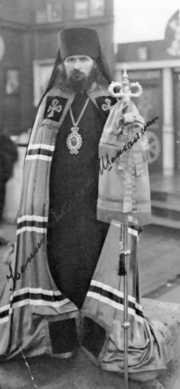
Ordination
In general religious use, ordination is the process by which individuals are consecrated, that is, set apart as clergy to perform various religious rites and ceremonies. The process and ceremonies of ordination itself varies by religion and denomination. One who is in preparation for, or who is...
) will say the entrance prayers with the deacons in the manner prescribed above, vest, and begin the Liturgy of Preparation; the other priests remain in choir dress.
The bishop is formally received in the church before the Little Hours
Little Hours
The Little Hours are the fixed daytime hours of prayer in the Divine Office of Christians, in both Western Christianity and the Eastern Orthodox Church. These Hours are called 'little' due to their shorter and simpler structure compared to the Night Hours...
. The bells ring
Russian Orthodox bell ringing
Russian Orthodox bell ringing has a history starting from the baptism of Rus in 988 and plays an important role in the traditions of the Russian Orthodox Church.-Theology:The ringing of bells is one of the most essential elements of an Orthodox church...
as the bishop approaches the church, and the clergy come out of the altar (sanctuary). The priest who celebrated the Liturgy of Preparation carries a tray covered with an aër
Aër
The Aër is the largest and outermost of the veils covering the Chalice and Diskos in the Eastern Orthodox Church and the Eastern Catholic Churches which follow the Byzantine Rite. It is rectangular in shape and corresponds to the veil used to cover the chalice and paten in the Latin Rite, but is...
on which is placed a blessing cross
Blessing cross
A Blessing Cross is a hand cross held by a priest or bishop in Eastern Christianity when he gives a benediction. It is often made of precious metal and may be adorned with enamelwork, and precious or semi-precious gemstones...
. The protodeacon
Protodeacon
Protodeacon derives from the Greek proto- meaning 'first' and diakonos, which is a standard ancient Greek word meaning "servant", "waiting-man," "minister" or "messenger." The word in English may refer to various clergymen, depending upon the usage of the particular church in question.-Eastern...
carries the censer
Thurible
A thurible is a metal censer suspended from chains, in which incense is burned during worship services. It is used in the Catholic Church as well as in Anglican, Eastern Orthodox, Oriental Orthodox, Armenian Apostolic, some Lutheran, Old Catholic, and in various Gnostic Churches. It is also used...
. Other servers carry the dikirion and trikirion
Dikirion and trikirion
Dikirion and trikirion are liturgical candlesticks, used by a bishop of the Eastern Orthodox and Greek-Catholic Churches to bless the clergy and faithful...
, the bishop's crozier and a standing candlestick
Candlestick
A candlestick, chamberstick, or candelabrum is a holder for one or more candles, used for illumination, rituals, or decorative purposes. The name 'candlestick' derives from the fact that it is usually tall and stick-shaped.Candlesticks are also called candle holders...
.
The bishop enters the church clothed in his monastic habit and klobuk
Klobuk
thumbA klobuk is an item of clerical clothing worn by Eastern Orthodox and Eastern Catholic monastics and bishops, especially in the Russian tradition...
, and carrying his walking stick
Walking stick
A walking stick is a device used by many people to facilitate balancing while walking.Walking sticks come in many shapes and sizes, and can be sought by collectors. Some kinds of walking stick may be used by people with disabilities as a crutch...
. As he enters the narthex
Narthex
The narthex of a church is the entrance or lobby area, located at the end of the nave, at the far end from the church's main altar. Traditionally the narthex was a part of the church building, but was not considered part of the church proper...
, a server takes his walking stick and the subdeacons place the episcopal mandyas on him as the choir chants Axion Estin
Axion Estin
Axion estin , or It is Truly Meet, is a theotokion, i.e. a Hymn to Mary , which is chanted in the Divine Services of the Eastern Orthodox and Eastern Catholic Churches...
(or, if it is one of the Great Feasts, the Ninth Irmos
Irmos
The irmos is the initial troparion of each individual ode in a canon as chanted in the Eastern Orthodox Church and those Eastern Catholic Churches which use the Byzantine Rite...
of the canon
Canon (hymnography)
A canon is a structured hymn used in a number of Eastern Orthodox services. It consists of nine odes, sometimes called canticles or songs depending on the translation, based on the Biblical canticles. Most of these are found in the Old Testament, but the final ode is taken from the Magnificat and...
of the feast). The bishop kisses the blessing cross and holds it for each of the priests to kiss. The last to kiss the cross is the youngest priest, who receives it again on the tray. The bishop is then handed his crozier and the clergy go in procession
Procession
A procession is an organized body of people advancing in a formal or ceremonial manner.-Procession elements:...
to the ambon
Ambon (liturgy)
The Ambon or Ambo is a projection coming out from the soleas in an Eastern Orthodox, Oriental Orthodox and Eastern Catholic church. The ambon stands directly in front of the Holy Doors...
in front of the iconostasis
Iconostasis
In Eastern Christianity an iconostasis is a wall of icons and religious paintings, separating the nave from the sanctuary in a church. Iconostasis also refers to a portable icon stand that can be placed anywhere within a church...
. Instead of saying his own vesting prayers, the prayers are recited aloud for him by the protodeacon
Protodeacon
Protodeacon derives from the Greek proto- meaning 'first' and diakonos, which is a standard ancient Greek word meaning "servant", "waiting-man," "minister" or "messenger." The word in English may refer to various clergymen, depending upon the usage of the particular church in question.-Eastern...
, and the bishop venerates the icons. He then turns and blesses as the choir sings Ton Despotin
Ton Despotin
Ton Despotin is an acclamation chanted by the cantor or choir in honour of a bishop when he gives a blessing in the Eastern Orthodox or Eastern Catholic churches...
. He then stands on the kathedra (a platform in the center of the temple) and the priests each come to him, receive a blessing, and return to the altar to vest. The subdeacons remove the bishop's mandyas and place his episcopal vestments on him.
Pascha
When the priest and deacon say their entrance prayers before the Paschal Vigil, they say them standing before the epitaphiosEpitaphios
Epitaphios may refer to:* Funeral oration or epitaphios logos* Epitaphios or epitaphion, a cloth icon used during Holy Week in churches that follow the Byzantine rite...
(winding sheet). The order is the same as normal, except that in the usual beginning
Usual beginning
The usual beginning is the series of prayers with which most Divine Services begin in the Eastern Orthodox Church and those Eastern Catholic Churches which follow the Byzantine Rite.-Normal form:...
they do not say the prayer, "O Heavenly King...". This prayer is a hymn of Pentecost
Pentecost
Pentecost is a prominent feast in the calendar of Ancient Israel celebrating the giving of the Law on Sinai, and also later in the Christian liturgical year commemorating the descent of the Holy Spirit upon the disciples of Christ after the Resurrection of Jesus...
, and so will not be said again until that feast day.
During Bright Week
Bright Week
Bright Week or Renewal Week is the name used by the Eastern Orthodox Church and Eastern Catholic Churches of the Byzantine Rite for the period of seven days beginning on Pascha and continuing up to the following Sunday, which is known as Thomas Sunday...
—the week beginning on Pascha
Easter
Easter is the central feast in the Christian liturgical year. According to the Canonical gospels, Jesus rose from the dead on the third day after his crucifixion. His resurrection is celebrated on Easter Day or Easter Sunday...
(Easter Sunday)—the ritual is the same, except that the usual beginning is entirely replaced by Paschal hymns.
At a Hierarchical celebration of the Paschal Divine Liturgy Axion Estin is replaced by the Irmos of the Ninth Ode of the Paschal Canon
Canon (hymnography)
A canon is a structured hymn used in a number of Eastern Orthodox services. It consists of nine odes, sometimes called canticles or songs depending on the translation, based on the Biblical canticles. Most of these are found in the Old Testament, but the final ode is taken from the Magnificat and...
:
Shine! Shine! O new Jerusalem! The glory of the Lorth hath shown on thee. Exult now and be glad, O Zion. Be radiant, O pure Theotokos, in the Resurrection of thy Son.