

Diffuse parenchymal lung disease

Encyclopedia
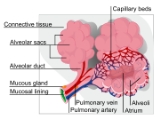
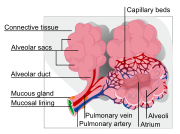
Interstitial lung disease (ILD), also known as diffuse parenchymal lung disease (DPLD), refers to a group of lung
diseases affecting the interstitium (the tissue and space around the air sacs of the lungs).
It concerns alveolar
epithelium
, pulmonary capillary
endothelium
, basement membrane
, perivascular and perilymphatic tissues.
The term ILD is used to distinguish these diseases from obstructive airways diseases.
Prolonged ILD may result in pulmonary fibrosis
, but this is not always the case. Idiopathic pulmonary fibrosis
is one form of "interstitial lung disease".
.jpg) ILD may be classified according to the cause. One method of classification is as follows:
ILD may be classified according to the cause. One method of classification is as follows:
, pulmonary function testing, and high resolution CT thorax.
A lung biopsy
is required if the clinical history and imaging are not clearly suggestive of a specific diagnosis or malignancy
cannot otherwise be ruled out.
TLCO
will be decreased in these patients.
If a specific occupational exposure cause is found, the person should avoid that environment. If a drug
cause is suspected, that drug should be discontinued.
Many idiopathic
and connective tissue
-based causes of ILD are treated with corticosteroid
s, such as prednisolone
. Some patients respond to immunosuppressant
treatment. Patients with hypoxemia
may be given supplemental oxygen
.
Lung
The lung is the essential respiration organ in many air-breathing animals, including most tetrapods, a few fish and a few snails. In mammals and the more complex life forms, the two lungs are located near the backbone on either side of the heart...
diseases affecting the interstitium (the tissue and space around the air sacs of the lungs).
It concerns alveolar
Pulmonary alveolus
An alveolus is an anatomical structure that has the form of a hollow cavity. Found in the lung parenchyma, the pulmonary alveoli are the dead ends of the respiratory tree, which outcrop from either alveolar sacs or alveolar ducts, which are both sites of gas exchange with the blood as well...
epithelium
Epithelium
Epithelium is one of the four basic types of animal tissue, along with connective tissue, muscle tissue and nervous tissue. Epithelial tissues line the cavities and surfaces of structures throughout the body, and also form many glands. Functions of epithelial cells include secretion, selective...
, pulmonary capillary
Capillary
Capillaries are the smallest of a body's blood vessels and are parts of the microcirculation. They are only 1 cell thick. These microvessels, measuring 5-10 μm in diameter, connect arterioles and venules, and enable the exchange of water, oxygen, carbon dioxide, and many other nutrient and waste...
endothelium
Endothelium
The endothelium is the thin layer of cells that lines the interior surface of blood vessels, forming an interface between circulating blood in the lumen and the rest of the vessel wall. These cells are called endothelial cells. Endothelial cells line the entire circulatory system, from the heart...
, basement membrane
Basement membrane
The basement membrane is a thin sheet of fibers that underlies the epithelium, which lines the cavities and surfaces of organs including skin, or the endothelium, which lines the interior surface of blood vessels.- Composition :...
, perivascular and perilymphatic tissues.
The term ILD is used to distinguish these diseases from obstructive airways diseases.
Prolonged ILD may result in pulmonary fibrosis
Pulmonary fibrosis
Pulmonary fibrosis is the formation or development of excess fibrous connective tissue in the lungs. It is also described as "scarring of the lung".-Symptoms:Symptoms of pulmonary fibrosis are mainly:...
, but this is not always the case. Idiopathic pulmonary fibrosis
Idiopathic pulmonary fibrosis
Idiopathic pulmonary fibrosis is a chronic, progressive form of lung disease characterized by fibrosis of the supporting framework of the lungs...
is one form of "interstitial lung disease".
Causes
- Inhaled substances
- Inorganic
- SilicosisSilicosisSilicosis, also known as Potter's rot, is a form of occupational lung disease caused by inhalation of crystalline silica dust, and is marked by inflammation and scarring in forms of nodular lesions in the upper lobes of the lungs...
- AsbestosisAsbestosisAsbestosis is a chronic inflammatory and fibrotic medical condition affecting the parenchymal tissue of the lungs caused by the inhalation and retention of asbestos fibers...
- BerylliosisBerylliosisBerylliosis, or chronic beryllium disease , is a chronic allergic-type lung response and chronic lung disease caused by exposure to beryllium and its compounds. As an occupational lung disease, it is most classically associated with beryllium mining or manufacturing of fluorescent light bulbs...
- Silicosis
- Organic
- Hypersensitivity pneumonitisHypersensitivity pneumonitisHypersensitivity pneumonitis is an inflammation of the alveoli within the lung caused by hypersensitivity to inhaled organic dusts. Sufferers are commonly exposed to the dust by their occupation or hobbies.-Pathophysiology:Hypersensitivity pneumonitis involves inhalation of an antigen...
- Hypersensitivity pneumonitis
- Inorganic
- Drug induced
- AntibioticAntibioticAn antibacterial is a compound or substance that kills or slows down the growth of bacteria.The term is often used synonymously with the term antibiotic; today, however, with increased knowledge of the causative agents of various infectious diseases, antibiotic has come to denote a broader range of...
s - Chemotherapeutic drugsChemotherapyChemotherapy is the treatment of cancer with an antineoplastic drug or with a combination of such drugs into a standardized treatment regimen....
- Antiarrhythmic agents
- Statins
- Antibiotic
- Connective tissue disease
- Systemic sclerosis
- PolymyositisPolymyositisPolymyositis is a type of chronic inflammation of the muscles related to dermatomyositis and inclusion body myositis.-Signs and symptoms:...
- DermatomyositisDermatomyositisDermatomyositis is a connective-tissue disease related to polymyositis and Bramaticosis that is characterized by inflammation of the muscles and the skin.- Causes :...
- Systemic lupus erythematosusSystemic lupus erythematosusSystemic lupus erythematosus , often abbreviated to SLE or lupus, is a systemic autoimmune disease that can affect any part of the body. As occurs in other autoimmune diseases, the immune system attacks the body's cells and tissue, resulting in inflammation and tissue damage...
- Rheumatoid arthritisRheumatoid arthritisRheumatoid arthritis is a chronic, systemic inflammatory disorder that may affect many tissues and organs, but principally attacks synovial joints. The process produces an inflammatory response of the synovium secondary to hyperplasia of synovial cells, excess synovial fluid, and the development...
- Infection
- Atypical pneumoniaAtypical pneumoniaAtypical pneumonia aka "walking pneumonia" is a pneumonia not caused by one of the more traditional pathogens, and with a clinical presentation inconsistent with typical pneumonia. It can be caused by a variety of microorganisms...
- Pneumocystis pneumonia (PCP)
- TuberculosisTuberculosisTuberculosis, MTB, or TB is a common, and in many cases lethal, infectious disease caused by various strains of mycobacteria, usually Mycobacterium tuberculosis. Tuberculosis usually attacks the lungs but can also affect other parts of the body...
- Chlamydia trachomatis
- Respiratory Syncytial Virus
- Atypical pneumonia
- Idiopathic
- SarcoidosisSarcoidosisSarcoidosis , also called sarcoid, Besnier-Boeck disease or Besnier-Boeck-Schaumann disease, is a disease in which abnormal collections of chronic inflammatory cells form as nodules in multiple organs. The cause of sarcoidosis is unknown...
- Idiopathic pulmonary fibrosisIdiopathic pulmonary fibrosisIdiopathic pulmonary fibrosis is a chronic, progressive form of lung disease characterized by fibrosis of the supporting framework of the lungs...
- Hamman-Rich syndromeHamman-Rich syndromeAcute interstitial pneumonitis is a rare, severe lung disease which usually affects otherwise healthy individuals.As of 2010, there is no known cause or treatment....
- Antisynthetase Syndrome
- Sarcoidosis
- Malignancy
- Lymphangitic carcinomaCarcinomaCarcinoma is the medical term for the most common type of cancer occurring in humans. Put simply, a carcinoma is a cancer that begins in a tissue that lines the inner or outer surfaces of the body, and that generally arises from cells originating in the endodermal or ectodermal germ layer during...
tosis
- Lymphangitic carcinoma
Investigation
Investigation is tailored towards the symptoms and signs. Most patients have blood testing, chest x-rayX-ray
X-radiation is a form of electromagnetic radiation. X-rays have a wavelength in the range of 0.01 to 10 nanometers, corresponding to frequencies in the range 30 petahertz to 30 exahertz and energies in the range 120 eV to 120 keV. They are shorter in wavelength than UV rays and longer than gamma...
, pulmonary function testing, and high resolution CT thorax.
A lung biopsy
Biopsy
A biopsy is a medical test involving sampling of cells or tissues for examination. It is the medical removal of tissue from a living subject to determine the presence or extent of a disease. The tissue is generally examined under a microscope by a pathologist, and can also be analyzed chemically...
is required if the clinical history and imaging are not clearly suggestive of a specific diagnosis or malignancy
Cancer
Cancer , known medically as a malignant neoplasm, is a large group of different diseases, all involving unregulated cell growth. In cancer, cells divide and grow uncontrollably, forming malignant tumors, and invade nearby parts of the body. The cancer may also spread to more distant parts of the...
cannot otherwise be ruled out.
TLCO
TLCO
TLCO is a Lung function test measuring the diffusing capacity of the lungs for carbon monoxide is commonly measured with the Morgan transfer test and the single breath method. The carbon monoxide uptake from a single inspiration in a standard time . Alveolar volume is the total lung capacity at...
will be decreased in these patients.
Treatment
ILD is not a single disease, but encompasses many different pathological processes. Hence treatment is different for each disease.If a specific occupational exposure cause is found, the person should avoid that environment. If a drug
Medication
A pharmaceutical drug, also referred to as medicine, medication or medicament, can be loosely defined as any chemical substance intended for use in the medical diagnosis, cure, treatment, or prevention of disease.- Classification :...
cause is suspected, that drug should be discontinued.
Many idiopathic
Idiopathic
Idiopathic is an adjective used primarily in medicine meaning arising spontaneously or from an obscure or unknown cause. From Greek ἴδιος, idios + πάθος, pathos , it means approximately "a disease of its own kind". It is technically a term from nosology, the classification of disease...
and connective tissue
Connective tissue
"Connective tissue" is a fibrous tissue. It is one of the four traditional classes of tissues . Connective Tissue is found throughout the body.In fact the whole framework of the skeleton and the different specialized connective tissues from the crown of the head to the toes determine the form of...
-based causes of ILD are treated with corticosteroid
Corticosteroid
Corticosteroids are a class of steroid hormones that are produced in the adrenal cortex. Corticosteroids are involved in a wide range of physiologic systems such as stress response, immune response and regulation of inflammation, carbohydrate metabolism, protein catabolism, blood electrolyte...
s, such as prednisolone
Prednisolone
Prednisolone is the active metabolite of prednisone, which is also used as a drug.-Uses:Prednisolone is a corticosteroid drug with predominant glucocorticoid and low mineralocorticoid activity, making it useful for the treatment of a wide range of inflammatory and auto-immune conditions such as...
. Some patients respond to immunosuppressant
Immunosuppressant
An immunosuppressant is any substance that performs immunosuppression of the immune system. They may be either exogenous, as immunosuppressive drugs, or endogenous, as ,e. g., testosterone...
treatment. Patients with hypoxemia
Hypoxia (medical)
Hypoxia, or hypoxiation, is a pathological condition in which the body as a whole or a region of the body is deprived of adequate oxygen supply. Variations in arterial oxygen concentrations can be part of the normal physiology, for example, during strenuous physical exercise...
may be given supplemental oxygen
Oxygen
Oxygen is the element with atomic number 8 and represented by the symbol O. Its name derives from the Greek roots ὀξύς and -γενής , because at the time of naming, it was mistakenly thought that all acids required oxygen in their composition...
.
External links
For more information and resources on ILD, please visit the UCSF ILD Program website- AIMIP Onlus - Italian Interstitial Lung Diseases No-Profit Organization
- coalitionforpf.org - Coalition for Pulmonary Fibrosis: Pulmonary Fibrosis Patient Services, Education; Funding Research to Find a Cure for PF
- GeneReview/NCBI/NIH/UW entry on Pulmonary Fibrosis, Familial
- UCSF Interstitial Lung Disease Program at University of California San Francisco
- Interstitial Lung Disease Program at University of Chicago Medical Center
- Interstitial Lung Disease Center at University of CincinnatiUniversity of CincinnatiThe University of Cincinnati is a comprehensive public research university in Cincinnati, Ohio, and a part of the University System of Ohio....
- PA-IPF - The Pennsylvania Idiopathic Pulmonary Fibrosis State Registry at University of PittsburghUniversity of PittsburghThe University of Pittsburgh, commonly referred to as Pitt, is a state-related research university located in Pittsburgh, Pennsylvania, United States. Founded as Pittsburgh Academy in 1787 on what was then the American frontier, Pitt is one of the oldest continuously chartered institutions of...
- WASOG - World Association for Sarcoidosis and Other Granulomatous Disorders