

Idiopathic pulmonary fibrosis

Encyclopedia
Idiopathic pulmonary fibrosis (IPF) (or cryptogenic fibrosing alveolitis (CFA)) is a chronic
, progressive form of lung disease characterized by fibrosis
of the supporting framework (interstitium) of the lungs. By definition, the term is used only when the cause of the pulmonary fibrosis
is unknown ("idiopathic
").
Microscopically, lung tissue from patients shows a characteristic set of histologic/pathologic features known as usual interstitial pneumonia
(UIP). UIP is therefore the pathologic counterpart of IPF.
) in the pulmonary interstitium (mainly the walls of the alveoli) with minimal associated inflammation
. The fibrosis in IPF has been linked to cigarette smoking, gastroesophageal reflux disease and autoimmune disorders, but none of these are present in all patients with IPF, and therefore do not provide a completely satisfactory explanation for the disease.
Genetic associations include SFTPA1
, SFTPA2, TERT, and TERC
.
(IIP), which is in turn a type of interstitial lung disease.
Other forms of "idiopathic interstitial pneumonias" include non-specific interstitial pneumonia (NSIP), desquamative interstitial pneumonia (DIP) and acute interstitial pneumonia (AIP). Examples of known causes of interstitial lung disease include sarcoidosis
., hypersensitivity pneumonitis, pulmonary Langerhans cell histiocytosis, asbestosis and collagen vascular diseases such as scleroderma and rheumatoid arthritis.
Symptoms are gradual in onset. The most common are progressive dyspnea (difficulty breathing), but also include dry cough
, clubbing (a disfigurement of the fingers), and rales (a crackling sound in the lungs during inhalation, heard with a stethoscope). It should be noted that these features are not specific for IPF and can occur in a wide variety of other pulmonary disorders.
, symptoms (or signs), radiology, and pulmonary function testing are collectively in keeping with the diagnosis of IPF (which carries the poor prognosis described above) or whether the findings are due to another process. It has long been recognized that patients with interstitial lung disease related to asbestos
exposure, drug
s (such as chemotherapeutic agents or nitrofurantoin), rheumatoid arthritis
and scleroderma
/systemic sclerosis may be difficult to distinguish from IPF. Other differential diagnostic considerations include interstitial lung disease related to mixed connective tissue disease
, advanced sarcoidosis, chronic hypersensitivity pneumonitis
, pulmonary Langerhans cell histiocytosis
and radiation-induced fibrosis.
. Generally, lung biopsy is only undertaken when its risks are outweighed by the potential benefits of identifying an alternative, treatable disease process. Establishing the diagnosis of IPF without a lung biopsy has been shown to be reliable when expert clinicians and radiologists concur that the presenting features are typical of IPF. Based on this evidence, the 2002 ATS/ERS Multidisciplinary Consensus Statement on the Idiopathic Interstitial Pneumonias proposed the following criteria for establishing the diagnosis of IPF without a lung biopsy:
Major criteria (all 4 required):
Minor criteria (3 of 4 required):
s reveal decreased lung volumes
, typically with prominent reticular interstitial markings near the lung bases. Honeycombing, a pattern of lung fibrosis characterized by multiple cystic spaces located at the bases of the lungs, is frequently seen in advanced cases. In less severe cases, these changes may not be evident on a plain chest film.
High-resolution CT scans of the chest demonstrate fibrotic changes in both lungs, with a predilection for the bases and the periphery. The most charactersitic radiologic feature of IPF is honeycombing, often described as traction bronchiectasis
. There may be ground glass opacities of the lungs but these changes are relatively minor in comparison with the fibrotic changes.
classically reveals a reduction in the vital capacity with either a proportionate reduction in airflows, or increased airflows for the observed vital capacity. The latter finding reflects the increased lung stiffness (reduced lung compliance) associated with pulmonary fibrosis, which leads to increased lung elastic recoil.
Measurement of static lung volumes using body plethysmography
or other techniques typically reveals reduced lung volumes (restriction). This reflects the difficulty encountered in inflating the fibrotic lungs.
The diffusing capacity for carbon monoxide (DLCO) is invariably reduced in IPF and may be the only abnormality in mild or early disease. Its impairment underlies the propensity of patients with IPF to exhibit oxygen desaturation with exercise.
.jpg) Histologic
Histologic
specimens for the diagnosis of IPF must be large enough that the pathologist can comment on the underlying lung architecture. Small biopsies, such as those obtained via transbronchial lung biopsy (performed during bronchoscopy
) are usually not sufficient for this purpose. Hence, larger biopsies obtained surgically via a thoracotomy or thoracoscopy are usually necessary.
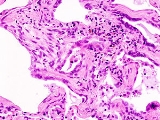
The histological appearance associated with IPF is referred to as usual interstitial pneumonia
(UIP). Although a pathologic diagnosis of UIP often corresponds to a clinical diagnosis of IPF, it can be seen in other diseases as well. Key features of UIP include interstitial fibrosis in a "patchwork pattern", interstitial scarring, honeycomb changes and fibroblast foci. There is usually only a relatively mild or minor component of interstitial chronic inflammation.
There is a lack of large, randomized placebo-controlled trials of therapy for IPF. Moreover, many of the earlier studies were based on the hypothesis that IPF is an inflammatory disorder, and hence studied anti-inflammatory agents such as corticosteroids. Another problem has been that studies conducted prior to the more recent classification of idiopathic interstitial pneumonias failed to distinguish IPF/UIP from NSIP in particular. Hence, many patients with arguably more steroid-responsive diseases were included in earlier studies, confounding the interpretation of their results.
Small early studies demonstrated that the combination of prednisone with either cyclophosphamide
or azathioprine
over many months had very modest, if any, beneficial effect in IPF, and were associated with substantial adverse effects (predominantly myelotoxicity).
Other treatments studied have included interferon gamma-1b, the antifibrotic agent pirfenidone
and bosentan
. Pirfenidone
and bosentan
are currently being studied in patients with IPF while interferon gamma-1b is no longer considered a viable treatment option.
Finally, the addition of the antioxidant
N-acetylcysteine to prednisone and azathioprine produced a slight benefit in terms of FVC and DLCO over 12 months of follow up. However, the major benefit appeared to be prevention of the myelotoxicity associated with azathioprine.
Half of IPF sufferers in the UK die within three years of diagnosis.
another 40 or so trials for IPF were recruiting. including a phase II trial of QAX576.
Chronic (medicine)
A chronic disease is a disease or other human health condition that is persistent or long-lasting in nature. The term chronic is usually applied when the course of the disease lasts for more than three months. Common chronic diseases include asthma, cancer, diabetes and HIV/AIDS.In medicine, the...
, progressive form of lung disease characterized by fibrosis
Fibrosis
Fibrosis is the formation of excess fibrous connective tissue in an organ or tissue in a reparative or reactive process. This is as opposed to formation of fibrous tissue as a normal constituent of an organ or tissue...
of the supporting framework (interstitium) of the lungs. By definition, the term is used only when the cause of the pulmonary fibrosis
Pulmonary fibrosis
Pulmonary fibrosis is the formation or development of excess fibrous connective tissue in the lungs. It is also described as "scarring of the lung".-Symptoms:Symptoms of pulmonary fibrosis are mainly:...
is unknown ("idiopathic
Idiopathic
Idiopathic is an adjective used primarily in medicine meaning arising spontaneously or from an obscure or unknown cause. From Greek ἴδιος, idios + πάθος, pathos , it means approximately "a disease of its own kind". It is technically a term from nosology, the classification of disease...
").
Microscopically, lung tissue from patients shows a characteristic set of histologic/pathologic features known as usual interstitial pneumonia
Usual interstitial pneumonia
Usual interstitial pneumonia is a form of lung disease characterized by progressive scarring of both lungs. The scarring involves the supporting framework of the lung. UIP is thus classified as a form of interstitial lung disease. The term "usual" refers to the fact that UIP is the most common...
(UIP). UIP is therefore the pathologic counterpart of IPF.
Etiology
Despite extensive investigation, the cause of IPF remains unknown. The condition involves abnormal and excessive deposition of collagen (fibrosisFibrosis
Fibrosis is the formation of excess fibrous connective tissue in an organ or tissue in a reparative or reactive process. This is as opposed to formation of fibrous tissue as a normal constituent of an organ or tissue...
) in the pulmonary interstitium (mainly the walls of the alveoli) with minimal associated inflammation
Inflammation
Inflammation is part of the complex biological response of vascular tissues to harmful stimuli, such as pathogens, damaged cells, or irritants. Inflammation is a protective attempt by the organism to remove the injurious stimuli and to initiate the healing process...
. The fibrosis in IPF has been linked to cigarette smoking, gastroesophageal reflux disease and autoimmune disorders, but none of these are present in all patients with IPF, and therefore do not provide a completely satisfactory explanation for the disease.
Genetic associations include SFTPA1
SFTPA1
Pulmonary surfactant-associated protein A1, also known as SFTPA1, is a human gene.-Further reading:...
, SFTPA2, TERT, and TERC
TERC
TERC may refer to:*Telomerase RNA component, a human gene.*The developers of the Investigations in Numbers, Data, and Space mathematics curriculum.*Technical Education Research Centers*CSIRO Tropical Ecosystems Research Centre...
.
Classification
Idiopathic pulmonary fibrosis is one specific presentation of idiopathic interstitial pneumoniaIdiopathic interstitial pneumonia
Idiopathic interstitial pneumonia , or noninfectious pneumoniaare a class of diffuse lung diseases. Is a term used for a type of diffuse parenchymal lung disease , also called interstitial lung disease .There are seven distinct subtypes of IIP.-Histologic classification:Classification can be...
(IIP), which is in turn a type of interstitial lung disease.
Other forms of "idiopathic interstitial pneumonias" include non-specific interstitial pneumonia (NSIP), desquamative interstitial pneumonia (DIP) and acute interstitial pneumonia (AIP). Examples of known causes of interstitial lung disease include sarcoidosis
Sarcoidosis
Sarcoidosis , also called sarcoid, Besnier-Boeck disease or Besnier-Boeck-Schaumann disease, is a disease in which abnormal collections of chronic inflammatory cells form as nodules in multiple organs. The cause of sarcoidosis is unknown...
., hypersensitivity pneumonitis, pulmonary Langerhans cell histiocytosis, asbestosis and collagen vascular diseases such as scleroderma and rheumatoid arthritis.
Clinical features
IPF affects both genders and is usually encountered in patients greater than 50 years of age. There are many different statements about average survival time following first diagnosis.Symptoms are gradual in onset. The most common are progressive dyspnea (difficulty breathing), but also include dry cough
Cough
A cough is a sudden and often repetitively occurring reflex which helps to clear the large breathing passages from secretions, irritants, foreign particles and microbes...
, clubbing (a disfigurement of the fingers), and rales (a crackling sound in the lungs during inhalation, heard with a stethoscope). It should be noted that these features are not specific for IPF and can occur in a wide variety of other pulmonary disorders.
Differential diagnosis
The key issue facing clinicians is whether the presenting historyMedical history
The medical history or anamnesis of a patient is information gained by a physician by asking specific questions, either of the patient or of other people who know the person and can give suitable information , with the aim of obtaining information useful in formulating a diagnosis and providing...
, symptoms (or signs), radiology, and pulmonary function testing are collectively in keeping with the diagnosis of IPF (which carries the poor prognosis described above) or whether the findings are due to another process. It has long been recognized that patients with interstitial lung disease related to asbestos
Asbestos
Asbestos is a set of six naturally occurring silicate minerals used commercially for their desirable physical properties. They all have in common their eponymous, asbestiform habit: long, thin fibrous crystals...
exposure, drug
Drug
A drug, broadly speaking, is any substance that, when absorbed into the body of a living organism, alters normal bodily function. There is no single, precise definition, as there are different meanings in drug control law, government regulations, medicine, and colloquial usage.In pharmacology, a...
s (such as chemotherapeutic agents or nitrofurantoin), rheumatoid arthritis
Rheumatoid arthritis
Rheumatoid arthritis is a chronic, systemic inflammatory disorder that may affect many tissues and organs, but principally attacks synovial joints. The process produces an inflammatory response of the synovium secondary to hyperplasia of synovial cells, excess synovial fluid, and the development...
and scleroderma
Scleroderma
Systemic sclerosis or systemic scleroderma is a systemic autoimmune disease or systemic connective tissue disease that is a subtype of scleroderma.-Skin symptoms:...
/systemic sclerosis may be difficult to distinguish from IPF. Other differential diagnostic considerations include interstitial lung disease related to mixed connective tissue disease
Mixed connective tissue disease
In medicine, mixed connective tissue disease , commonly abbreviated as MCTD, is an autoimmune disease, in which the body's defense system attacks itself. It was characterized in 1972....
, advanced sarcoidosis, chronic hypersensitivity pneumonitis
Hypersensitivity pneumonitis
Hypersensitivity pneumonitis is an inflammation of the alveoli within the lung caused by hypersensitivity to inhaled organic dusts. Sufferers are commonly exposed to the dust by their occupation or hobbies.-Pathophysiology:Hypersensitivity pneumonitis involves inhalation of an antigen...
, pulmonary Langerhans cell histiocytosis
Langerhans cell histiocytosis
Langerhans cell Histiocytosis is a rare disease involving clonal proliferation of Langerhans cells, abnormal cells deriving from bone marrow and capable of migrating from skin to lymph nodes...
and radiation-induced fibrosis.
Diagnosis
Diagnosis requires clinical findings compatible with interstitial lung disease in combination with either characteristic radiologic findings or a pathologic diagnosis of UIP on surgical lung biopsyBiopsy
A biopsy is a medical test involving sampling of cells or tissues for examination. It is the medical removal of tissue from a living subject to determine the presence or extent of a disease. The tissue is generally examined under a microscope by a pathologist, and can also be analyzed chemically...
. Generally, lung biopsy is only undertaken when its risks are outweighed by the potential benefits of identifying an alternative, treatable disease process. Establishing the diagnosis of IPF without a lung biopsy has been shown to be reliable when expert clinicians and radiologists concur that the presenting features are typical of IPF. Based on this evidence, the 2002 ATS/ERS Multidisciplinary Consensus Statement on the Idiopathic Interstitial Pneumonias proposed the following criteria for establishing the diagnosis of IPF without a lung biopsy:
Major criteria (all 4 required):
- Exclusion of other known causes of interstitial lung disease (drugs, exposures, connective tissue diseases)
- Abnormal pulmonary function tests with evidence of restriction (reduced vital capacityVital capacityVital capacity is the maximum amount of air a person can expel from the lungs after a maximum inspiration. It is equal to the inspiratory reserve volume plus the tidal volume plus the expiratory reserve volume....
) and impaired gas exchange (pO2, p(A-a)O2, DLCODLCODLCO is the extent to which oxygen passes from the air sacs of the lungs into the blood. Commonly, it refers to the test used to determine this parameter. It was introduced in 1909....
) - Bibasilar reticular abnormalities with minimal ground glass on high-resolution CT scans
- Transbronchial lung biopsy or bronchoalveolar lavage (BAL) showing no features to support an alternative diagnosis
Minor criteria (3 of 4 required):
- Age > 50
- Insidious onset of otherwise unexplained exertional dyspnea
- Duration of illness > 3 months
- Bibasilar inspiratory crackles
Radiology
Plain chest x-rayChest X-ray
In medicine, a chest radiograph, commonly called a chest X-ray , is a projection radiograph of the chest used to diagnose conditions affecting the chest, its contents, and nearby structures...
s reveal decreased lung volumes
Lung volumes
Lung volumes and lung capacities refer to the volume of air associated with different phases of the respiratory cycle. Lung volumes are directly measured...
, typically with prominent reticular interstitial markings near the lung bases. Honeycombing, a pattern of lung fibrosis characterized by multiple cystic spaces located at the bases of the lungs, is frequently seen in advanced cases. In less severe cases, these changes may not be evident on a plain chest film.
High-resolution CT scans of the chest demonstrate fibrotic changes in both lungs, with a predilection for the bases and the periphery. The most charactersitic radiologic feature of IPF is honeycombing, often described as traction bronchiectasis
Bronchiectasis
Bronchiectasis is a disease state defined by localized, irreversible dilation of part of the bronchial tree caused by destruction of the muscle and elastic tissue. It is classified as an obstructive lung disease, along with emphysema, bronchitis, asthma, and cystic fibrosis...
. There may be ground glass opacities of the lungs but these changes are relatively minor in comparison with the fibrotic changes.
Pulmonary function tests
SpirometrySpirometry
Spirometry is the most common of the pulmonary function tests , measuring lung function, specifically the measurement of the amount and/or speed of air that can be inhaled and exhaled...
classically reveals a reduction in the vital capacity with either a proportionate reduction in airflows, or increased airflows for the observed vital capacity. The latter finding reflects the increased lung stiffness (reduced lung compliance) associated with pulmonary fibrosis, which leads to increased lung elastic recoil.
Measurement of static lung volumes using body plethysmography
Body plethysmography
Body plethysmography or "Body Box" for short, is a very sensitive lung measurement used to detect lung pathology that might be missed with conventional pulmonary function tests. This method of obtaining the absolute volume of air within one's lungs may also be used in situations where several...
or other techniques typically reveals reduced lung volumes (restriction). This reflects the difficulty encountered in inflating the fibrotic lungs.
The diffusing capacity for carbon monoxide (DLCO) is invariably reduced in IPF and may be the only abnormality in mild or early disease. Its impairment underlies the propensity of patients with IPF to exhibit oxygen desaturation with exercise.
Histology/Pathology
Histology
Histology is the study of the microscopic anatomy of cells and tissues of plants and animals. It is performed by examining cells and tissues commonly by sectioning and staining; followed by examination under a light microscope or electron microscope...
specimens for the diagnosis of IPF must be large enough that the pathologist can comment on the underlying lung architecture. Small biopsies, such as those obtained via transbronchial lung biopsy (performed during bronchoscopy
Bronchoscopy
Bronchoscopy is a technique of visualizing the inside of the airways for diagnostic and therapeutic purposes. An instrument is inserted into the airways, usually through the nose or mouth, or occasionally through a tracheostomy. This allows the practitioner to examine the patient's airways for...
) are usually not sufficient for this purpose. Hence, larger biopsies obtained surgically via a thoracotomy or thoracoscopy are usually necessary.
The histological appearance associated with IPF is referred to as usual interstitial pneumonia
Usual interstitial pneumonia
Usual interstitial pneumonia is a form of lung disease characterized by progressive scarring of both lungs. The scarring involves the supporting framework of the lung. UIP is thus classified as a form of interstitial lung disease. The term "usual" refers to the fact that UIP is the most common...
(UIP). Although a pathologic diagnosis of UIP often corresponds to a clinical diagnosis of IPF, it can be seen in other diseases as well. Key features of UIP include interstitial fibrosis in a "patchwork pattern", interstitial scarring, honeycomb changes and fibroblast foci. There is usually only a relatively mild or minor component of interstitial chronic inflammation.
Treatment
Although there is no consensus on the optimal management of IPF, it is recognized that no satisfactory treatment exists at present. None of what follows should be taken as specific advice regarding therapy, as the latter is a decision that must be made on a case-by-case basis in individual patients.There is a lack of large, randomized placebo-controlled trials of therapy for IPF. Moreover, many of the earlier studies were based on the hypothesis that IPF is an inflammatory disorder, and hence studied anti-inflammatory agents such as corticosteroids. Another problem has been that studies conducted prior to the more recent classification of idiopathic interstitial pneumonias failed to distinguish IPF/UIP from NSIP in particular. Hence, many patients with arguably more steroid-responsive diseases were included in earlier studies, confounding the interpretation of their results.
Small early studies demonstrated that the combination of prednisone with either cyclophosphamide
Cyclophosphamide
Cyclophosphamide , also known as cytophosphane, is a nitrogen mustard alkylating agent, from the oxazophorines group....
or azathioprine
Azathioprine
Azathioprine is a purine analogue immunosuppressive drug. It is used to prevent organ rejection following organ transplantation and to treat a vast array of autoimmune diseases, including rheumatoid arthritis, pemphigus, inflammatory bowel disease , multiple sclerosis, autoimmune hepatitis, atopic...
over many months had very modest, if any, beneficial effect in IPF, and were associated with substantial adverse effects (predominantly myelotoxicity).
Other treatments studied have included interferon gamma-1b, the antifibrotic agent pirfenidone
Pirfenidone
Pirfenidone is a drug developed by InterMune Inc. for the treatment of idiopathic pulmonary fibrosis. In 2011 it was approved for use in Europe for idiopathic pulmonary fibrosis under the trade name Esbriet. The proposed trade name in the US is also Esbriet.In Japan it is marketed as Pirespa by...
and bosentan
Bosentan
Bosentan is a dual endothelin receptor antagonist used in the treatment of pulmonary artery hypertension . It is licensed in the United States, the European Union and other countries by Actelion Pharmaceuticals for the management of PAH under the trade name Tracleer.-Mechanism of action:Bosentan is...
. Pirfenidone
Pirfenidone
Pirfenidone is a drug developed by InterMune Inc. for the treatment of idiopathic pulmonary fibrosis. In 2011 it was approved for use in Europe for idiopathic pulmonary fibrosis under the trade name Esbriet. The proposed trade name in the US is also Esbriet.In Japan it is marketed as Pirespa by...
and bosentan
Bosentan
Bosentan is a dual endothelin receptor antagonist used in the treatment of pulmonary artery hypertension . It is licensed in the United States, the European Union and other countries by Actelion Pharmaceuticals for the management of PAH under the trade name Tracleer.-Mechanism of action:Bosentan is...
are currently being studied in patients with IPF while interferon gamma-1b is no longer considered a viable treatment option.
Finally, the addition of the antioxidant
Antioxidant
An antioxidant is a molecule capable of inhibiting the oxidation of other molecules. Oxidation is a chemical reaction that transfers electrons or hydrogen from a substance to an oxidizing agent. Oxidation reactions can produce free radicals. In turn, these radicals can start chain reactions. When...
N-acetylcysteine to prednisone and azathioprine produced a slight benefit in terms of FVC and DLCO over 12 months of follow up. However, the major benefit appeared to be prevention of the myelotoxicity associated with azathioprine.
Prognosis
Many patients end up on supplementary oxygen and some will need a lung transplant.Half of IPF sufferers in the UK die within three years of diagnosis.
Clinical trials
Nintedanib (BIBF 1120) is in two phase III trials for IPF.another 40 or so trials for IPF were recruiting. including a phase II trial of QAX576.