

Diffeomorphism

Encyclopedia
In mathematics
, a diffeomorphism is an isomorphism
in the category
of smooth manifolds. It is an invertible function that maps
one differentiable manifold
to another, such that both the function and its inverse are smooth
.
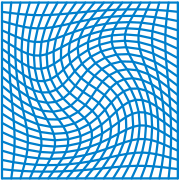
 from M to N is called a diffeomorphism if both

and its inverse

are differentiable (if these functions are r times continuously differentiable, f is called a -diffeomorphism).
Two manifolds M and N are diffeomorphic (symbol usually being ) if there is a smooth
bijective map from M to N with a smooth inverse. They are
  diffeomorphic if there is an r times continuously differentiable bijective map between them whose inverse is also r times continuously differentiable.
 is said to be smooth if for all
  there is a neighborhood
  of
of  and a smooth function
  such that the restrictions agree
  (note that g is an extension of f). We say that
  is a diffeomorphism if it is bijective, smooth, and if its inverse is smooth.
 and
and  are two connected open subsets of
  such that
  is simply connected, a differentiable
map from
from  to
to  is a diffeomorphism if
it is proper
and if
Remarks:
Now, from M to N is called a diffeomorphism if in coordinates charts it satisfies the definition above.
More precisely, pick any cover of M by compatible coordinate charts, and do the same for N. Let and
and  be charts on M and N respectively, with
  being the image of
  and
and  the image of
  . Then the conditions says that the map
  from
from  to
to  is a diffeomorphism as in the definition above (whenever it makes sense). One has to check that for every couple of charts
  ,
,  of two given atlases, but once checked, it will be true for any other compatible chart. Again we see that dimensions have to agree.
The Jacobian matrix has zero determinant if, and only if. . We see that f is a diffeomorphism away from the x-axis and the y-axis.
We see that g is a local diffeomorphism at 0 if, and only if, , i.e. the linear terms in the components of g are linearly independent as polynomials.
The Jacobian matrix has zero determinant everywhere! In fact we see that the image of h is the unit circle.
.
Fixing a Riemannian metric on M, the weak topology is the topology induced by the family of metrics
as K varies over compact subsets of M. Indeed, since M is σ-compact, there is a sequence of compact subsets Kn whose union is M. Then, define
The diffeomorphism group equipped with its weak topology is locally homeomorphic to the space of Cr vector fields . Over a compact subset of M, this follows by fixing a Riemannian metric on M and using the exponential map
for that metric. If r is finite and the manifold is compact, the space of vector fields is a Banach space
. Moreover, the transition maps from one chart of this atlas to another are smooth, making the diffeomorphism group into a Banach manifold
. If r = ∞ or if the manifold is σ-compact, the space of vector fields is a Fréchet space
. Moreover, the transition maps are smooth, making the diffeomorphism group into a Fréchet manifold
.
CkM. If the dimension of M is at least two the diffeomorphism group acts transitively on the configuration space
FkM: the action on M is multiply transitive .
asked whether the harmonic extension of any homeomorphism (or diffeomorphism) of the unit circle
to the unit disc yields a diffeomorphism on the open disc. An elegant proof was provided shortly afterwards by Hellmuth Kneser
and a completely different proof was discovered in 1945 by Gustave Choquet
, apparently unaware that the theorem was already known.
The (orientation-preserving) diffeomorphism group of the circle is pathwise connected. This can be seen by noting that any such diffeomorphism can be lifted to a diffeomorphism f of the reals satisfying ; this space is convex and hence path connected. A smooth eventually constant path to the identity gives a second more elementary way of extending a diffeomorphism from the circle to the open unit disc (this is a special case of the Alexander trick). Moreover, the diffeomorphism group of the circle has the homotopy-type of the orthogonal group
 .
.
The corresponding extension problem for diffeomorphisms of higher dimensional spheres Sn−1 was much studied in the 1950s and 1960s, with notable contributions from René Thom
, John Milnor
and Stephen Smale
. An obstruction to such extensions is given by the finite Abelian group
Γn, the "group of twisted spheres", defined as the quotient
of the Abelian component group of the diffeomorphism group by the subgroup of classes extending to diffeomorphisms of the ball Bn.
. In dimension 2, i.e. for surface
s, the mapping class group is a finitely presented group, generated by Dehn twist
s (Dehn
, Lickorish, Hatcher
). Max Dehn
and Jakob Nielsen
showed that it can be identified with the outer automorphism group
of the fundamental group
of the surface.
William Thurston
refined this analysis by classifying elements of the mapping class group
into three types: those equivalent to a periodic diffeomorphism; those equivalent to a diffeomorphism leaving a simple closed curve invariant; and those equivalent to pseudo-Anosov diffeomorphisms
. In the case of the torus
S¹ x S¹ = R²/Z², the mapping class group is just the modular group
SL(2,Z) and the classification reduces to the classical one in terms of elliptic, parabolic and hyperbolic matrices. Thurston accomplished his classification by observing that the mapping class group acted naturally on a compactification
of Teichmüller space
; since this enlarged space was homeomorphic to a closed ball, the Brouwer fixed point theorem
became applicable.
If M is an oriented smooth closed manifold, it was conjectured by Smale that the identity component
of the group of orientation-preserving diffeomorphisms is simple. This had first been proved for a product of circles by Michel Herman; it was proved in full generality by Thurston.
In dimensions 1, 2, 3, any pair of homeomorphic smooth manifolds are diffeomorphic. In dimension 4 or greater, examples of homeomorphic but not diffeomorphic pairs have been found.
The first such example was constructed by John Milnor
in dimension 7. He constructed a smooth 7-dimensional manifold (called now Milnor's sphere) that is homeomorphic to the standard 7-sphere but not diffeomorphic to it.
There are in fact 28 oriented diffeomorphism classes of manifolds homeomorphic to the 7-sphere (each of them is a total space of the fiber bundle
over the 4-sphere with the 3-sphere
as the fiber).
Much more extreme phenomena occur for 4-manifold
s: in the early 1980s, a combination of
results due to Simon Donaldson
and Michael Freedman
led to the discovery of exotic R4
s: there are uncountably many pairwise non-diffeomorphic open subsets of each of which
is homeomorphic to , and also there are
uncountably many pairwise non-diffeomorphic differentiable manifolds homeomorphic to that do not embed smoothly in
  .
.
Mathematics
Mathematics is the study of quantity, space, structure, and change. Mathematicians seek out patterns and formulate new conjectures. Mathematicians resolve the truth or falsity of conjectures by mathematical proofs, which are arguments sufficient to convince other mathematicians of their validity...
, a diffeomorphism is an isomorphism
Isomorphism
In abstract algebra, an isomorphism is a mapping between objects that shows a relationship between two properties or operations. If there exists an isomorphism between two structures, the two structures are said to be isomorphic. In a certain sense, isomorphic structures are...
in the category
Category (mathematics)
In mathematics, a category is an algebraic structure that comprises "objects" that are linked by "arrows". A category has two basic properties: the ability to compose the arrows associatively and the existence of an identity arrow for each object. A simple example is the category of sets, whose...
of smooth manifolds. It is an invertible function that maps
Map (mathematics)
In most of mathematics and in some related technical fields, the term mapping, usually shortened to map, is either a synonym for function, or denotes a particular kind of function which is important in that branch, or denotes something conceptually similar to a function.In graph theory, a map is a...
one differentiable manifold
Differentiable manifold
A differentiable manifold is a type of manifold that is locally similar enough to a linear space to allow one to do calculus. Any manifold can be described by a collection of charts, also known as an atlas. One may then apply ideas from calculus while working within the individual charts, since...
to another, such that both the function and its inverse are smooth
Smooth function
In mathematical analysis, a differentiability class is a classification of functions according to the properties of their derivatives. Higher order differentiability classes correspond to the existence of more derivatives. Functions that have derivatives of all orders are called smooth.Most of...
.
Definition
Given two manifolds M and N, a bijective map from M to N is called a diffeomorphism if bothand its inverse
are differentiable (if these functions are r times continuously differentiable, f is called a
-diffeomorphism).Two manifolds M and N are diffeomorphic (symbol usually being
) if there is a smoothSmooth function
In mathematical analysis, a differentiability class is a classification of functions according to the properties of their derivatives. Higher order differentiability classes correspond to the existence of more derivatives. Functions that have derivatives of all orders are called smooth.Most of...
bijective map
from M to N with a smooth inverse. They are diffeomorphic if there is an r times continuously differentiable bijective map between them whose inverse is also r times continuously differentiable.Diffeomorphisms of subsets of manifolds
Given a subset X of a manifold M and a subset Y of a manifold N, a function is said to be smooth if for all there is a neighborhood of and a smooth function such that the restrictions agree (note that g is an extension of f). We say that is a diffeomorphism if it is bijective, smooth, and if its inverse is smooth.Local description
Model example: if and are two connected open subsets of such that is simply connected, a differentiableDerivative
In calculus, a branch of mathematics, the derivative is a measure of how a function changes as its input changes. Loosely speaking, a derivative can be thought of as how much one quantity is changing in response to changes in some other quantity; for example, the derivative of the position of a...
map
from to is a diffeomorphism ifit is proper
Proper map
In mathematics, a continuous function between topological spaces is called proper if inverse images of compact subsets are compact. In algebraic geometry, the analogous concept is called a proper morphism.- Definition :...
and if
- the differential
 is bijectiveBijectionA bijection is a function giving an exact pairing of the elements of two sets. A bijection from the set X to the set Y has an inverse function from Y to X. If X and Y are finite sets, then the existence of a bijection means they have the same number of elements...
at each point .
.
Remarks:
- It is essential for U to be simply connected for the function
 to be globally invertible (under the sole condition that its derivative is a bijective map at each point).
- For example, consider the map
 (which is the "realification" of the complex square function) where
  . Then the map
  is surjective and its satisfies
  (thus
(thus  is bijective at each point) yet
  is not invertible, because it fails to be injective, e.g.,
  .
.
- For example, consider the map
- Since the differential at a point (for a differentiable function)
 is a linear map it has a well defined inverse if, and only if,
  is a bijection. The matrix representation of
  is the
  matrix of first order partial derivatives whose entry in the i-th row and j-th colomn is
  . We often use this so-called Jacobian matrix for explicit computations.
 - Diffeomorphisms are necessarily between manifolds of the same dimensionDimensionIn physics and mathematics, the dimension of a space or object is informally defined as the minimum number of coordinates needed to specify any point within it. Thus a line has a dimension of one because only one coordinate is needed to specify a point on it...
. Imagine that f were going from dimension to dimension
  . If n < k then
  could never be surjective, and if n > k then
  could never be injective. So in both cases
  fails to be a bijection.
 - If
 is a bijection at x then we say that f is a local diffeomorphism (since by continuity
  will also be bijective for all y sufficiently close to x). If
  is a bijection for all x then we say that f is a (global) diffeomorphism.
 - Given a smooth map from dimension n to dimension k, if Df (resp.
 ) is surjective then we say that f is a submersionSubmersion (mathematics)In mathematics, a submersion is a differentiable map between differentiable manifolds whose differential is everywhere surjective. This is a basic concept in differential topology...
(resp. local submersion), and if Df (resp. ) is injective we say that f is an immersion (resp. local immersion).
 - A differentiable bijection is not necessarily a diffeomorphism, e.g.
 is not a diffeomorphism from
  to itself because its derivative vanishes at 0 (and hence its inverse is not differentiable at 0). This is an example of a homeomorphism that is not a diffeomorphism.
 - f being a diffeomorphism is a stronger condition than f being a homeomorphismHomeomorphismIn the mathematical field of topology, a homeomorphism or topological isomorphism or bicontinuous function is a continuous function between topological spaces that has a continuous inverse function. Homeomorphisms are the isomorphisms in the category of topological spaces—that is, they are...
(when f is a map between differentiable manifolds). For a diffeomorphism we need f and its inverse to be differentiable. For a homeomorphism we only require that f and its inverse be continuousContinuous functionIn mathematics, a continuous function is a function for which, intuitively, "small" changes in the input result in "small" changes in the output. Otherwise, a function is said to be "discontinuous". A continuous function with a continuous inverse function is called "bicontinuous".Continuity of...
. Thus every diffeomorphism is a homeomorphism, but the converse is false: not every homeomorphism is a diffeomorphism.
Now,
from M to N is called a diffeomorphism if in coordinates charts it satisfies the definition above.More precisely, pick any cover of M by compatible coordinate charts, and do the same for N. Let
and be charts on M and N respectively, with being the image of and the image of . Then the conditions says that the map from to is a diffeomorphism as in the definition above (whenever it makes sense). One has to check that for every couple of charts , of two given atlases, but once checked, it will be true for any other compatible chart. Again we see that dimensions have to agree.Examples
Since any manifold can be locally parametrised, we can consider some explicit maps from two-space into two-space.- Let
 . We can calculate the Jacobian matrix:
The Jacobian matrix has zero determinant if, and only if.
. We see that f is a diffeomorphism away from the x-axis and the y-axis.- Let
 where the
  and
and  are arbitrary real numbers, and the omitted terms are of degree at least two in x and y. We can calculate the Jacobian matrix at 0:
We see that g is a local diffeomorphism at 0 if, and only if,
, i.e. the linear terms in the components of g are linearly independent as polynomials.- Now let
 . We can calculate the Jacobian matrix:
The Jacobian matrix has zero determinant everywhere! In fact we see that the image of h is the unit circle.
Diffeomorphism group
Let M be a differentiable manifold that is second-countable and Hausdorff. The diffeomorphism group of M is the group of all Cr diffeomorphisms of M to itself, and is denoted by Diffr(M) or Diff(M) when r is understood. This is a 'large' group, in the sense that it is not locally compact (provided M is not zero-dimensional).Topology
The diffeomorphism group has two natural topologies, called the weak and strong topology . When the manifold is compact, these two topologies agree. The weak topology is always metrizable. When the manifold is not compact, the strong topology captures the behavior of functions "at infinity", and is not metrizable. It is, however, still BaireBaire space
In mathematics, a Baire space is a topological space which, intuitively speaking, is very large and has "enough" points for certain limit processes. It is named in honor of René-Louis Baire who introduced the concept.- Motivation :...
.
Fixing a Riemannian metric on M, the weak topology is the topology induced by the family of metrics
as K varies over compact subsets of M. Indeed, since M is σ-compact, there is a sequence of compact subsets Kn whose union is M. Then, define
The diffeomorphism group equipped with its weak topology is locally homeomorphic to the space of Cr vector fields . Over a compact subset of M, this follows by fixing a Riemannian metric on M and using the exponential map
Exponential map
In differential geometry, the exponential map is a generalization of the ordinary exponential function of mathematical analysis to all differentiable manifolds with an affine connection....
for that metric. If r is finite and the manifold is compact, the space of vector fields is a Banach space
Banach space
In mathematics, Banach spaces is the name for complete normed vector spaces, one of the central objects of study in functional analysis. A complete normed vector space is a vector space V with a norm ||·|| such that every Cauchy sequence in V has a limit in V In mathematics, Banach spaces is the...
. Moreover, the transition maps from one chart of this atlas to another are smooth, making the diffeomorphism group into a Banach manifold
Banach manifold
In mathematics, a Banach manifold is a manifold modeled on Banach spaces. Thus it is a topological space in which each point has a neighbourhood homeomorphic to an open set in a Banach space...
. If r = ∞ or if the manifold is σ-compact, the space of vector fields is a Fréchet space
Fréchet space
In functional analysis and related areas of mathematics, Fréchet spaces, named after Maurice Fréchet, are special topological vector spaces. They are generalizations of Banach spaces...
. Moreover, the transition maps are smooth, making the diffeomorphism group into a Fréchet manifold
Fréchet manifold
In mathematics, in particular in nonlinear analysis, a Fréchet manifold is a topological space modeled on a Fréchet space in much the same way as a manifold is modeled on a Euclidean space....
.
Examples
- When M = G is a Lie group, there is a natural inclusion of G in its own diffeomorphism group via left-translation. Let Diff(G) denote the diffeomorphism group of G, then there is a splitting where Diff(G,e) is the subgroup of Diff(G) that fixes the identity element of the group.
- The diffeomorphism group of Euclidean space Rn consists of two components, consisting of the orientation preserving and orientation reversing diffeomorphisms. In fact, the general linear groupGeneral linear groupIn mathematics, the general linear group of degree n is the set of n×n invertible matrices, together with the operation of ordinary matrix multiplication. This forms a group, because the product of two invertible matrices is again invertible, and the inverse of an invertible matrix is invertible...
is a deformation retractDeformation retractIn topology, a branch of mathematics, a retraction , as the name suggests, "retracts" an entire space into a subspace. A deformation retraction is a map which captures the idea of continuously shrinking a space into a subspace.- Retract :...
of subgroup Diff(Rn,0) of diffeomorphisms fixing the origin under the map , t ∈ (0,1]. Hence, in particular, the general linear group is also a deformation retract of the full diffeomorphism group as well.
- For a finite set of points, the diffeomorphism group is simply the symmetric group. Similarly, if M is any manifold there is a group extension . Here Diff0(M)is the subgroup of
 that preserves all the components of M, and Σ(π0M) is the permutation group of the set π0M (the components of M). Moreover, the image of the map is the bijections of π0M that preserve diffeomorphism classes.
Transitivity
For a connected manifold M the diffeomorphism group acts transitively on M. More generally, the diffeomorphism group acts transitively on the configuration spaceConfiguration space
- Configuration space in physics :In classical mechanics, the configuration space is the space of possible positions that a physical system may attain, possibly subject to external constraints...
CkM. If the dimension of M is at least two the diffeomorphism group acts transitively on the configuration space
Configuration space
- Configuration space in physics :In classical mechanics, the configuration space is the space of possible positions that a physical system may attain, possibly subject to external constraints...
FkM: the action on M is multiply transitive .
Extensions of diffeomorphisms
In 1926, Tibor RadóTibor Radó
Tibor Radó was a Hungarian mathematician who moved to the USA after World War I. He was born in Budapest and between 1913 and 1915 attended the Polytechnic Institute. In World War I, he became a First Lieutenant in the Hungarian Army and was captured on the Russian Front...
asked whether the harmonic extension of any homeomorphism (or diffeomorphism) of the unit circle
Unit circle
In mathematics, a unit circle is a circle with a radius of one. Frequently, especially in trigonometry, "the" unit circle is the circle of radius one centered at the origin in the Cartesian coordinate system in the Euclidean plane...
to the unit disc yields a diffeomorphism on the open disc. An elegant proof was provided shortly afterwards by Hellmuth Kneser
Hellmuth Kneser
Hellmuth Kneser was a German mathematician, who made notable contributions to group theory and topology. His most famous result may be his theorem on the existence of a prime decomposition for 3-manifolds...
and a completely different proof was discovered in 1945 by Gustave Choquet
Gustave Choquet
Gustave Choquet was a French mathematician.Choquet was born in Solesmes, Nord. His contributions include work in functional analysis, potential theory, topology and measure theory...
, apparently unaware that the theorem was already known.
The (orientation-preserving) diffeomorphism group of the circle is pathwise connected. This can be seen by noting that any such diffeomorphism can be lifted to a diffeomorphism f of the reals satisfying ; this space is convex and hence path connected. A smooth eventually constant path to the identity gives a second more elementary way of extending a diffeomorphism from the circle to the open unit disc (this is a special case of the Alexander trick). Moreover, the diffeomorphism group of the circle has the homotopy-type of the orthogonal group
Orthogonal group
In mathematics, the orthogonal group of degree n over a field F is the group of n × n orthogonal matrices with entries from F, with the group operation of matrix multiplication...
.The corresponding extension problem for diffeomorphisms of higher dimensional spheres Sn−1 was much studied in the 1950s and 1960s, with notable contributions from René Thom
René Thom
René Frédéric Thom was a French mathematician. He made his reputation as a topologist, moving on to aspects of what would be called singularity theory; he became world-famous among the wider academic community and the educated general public for one aspect of this latter interest, his work as...
, John Milnor
John Milnor
John Willard Milnor is an American mathematician known for his work in differential topology, K-theory and dynamical systems. He won the Fields Medal in 1962, the Wolf Prize in 1989, and the Abel Prize in 2011. Milnor is a distinguished professor at Stony Brook University...
and Stephen Smale
Stephen Smale
Steven Smale a.k.a. Steve Smale, Stephen Smale is an American mathematician from Flint, Michigan. He was awarded the Fields Medal in 1966, and spent more than three decades on the mathematics faculty of the University of California, Berkeley .-Education and career:He entered the University of...
. An obstruction to such extensions is given by the finite Abelian group
Abelian group
In abstract algebra, an abelian group, also called a commutative group, is a group in which the result of applying the group operation to two group elements does not depend on their order . Abelian groups generalize the arithmetic of addition of integers...
Γn, the "group of twisted spheres", defined as the quotient
Quotient group
In mathematics, specifically group theory, a quotient group is a group obtained by identifying together elements of a larger group using an equivalence relation...
of the Abelian component group of the diffeomorphism group by the subgroup of classes extending to diffeomorphisms of the ball Bn.
Connectedness
For manifolds the diffeomorphism group is usually not connected. Its component group is called the mapping class groupMapping class group
In mathematics, in the sub-field of geometric topology, the mapping class groupis an important algebraic invariant of a topological space. Briefly, the mapping class group is a discrete group of 'symmetries' of the space.-Motivation:...
. In dimension 2, i.e. for surface
Surface
In mathematics, specifically in topology, a surface is a two-dimensional topological manifold. The most familiar examples are those that arise as the boundaries of solid objects in ordinary three-dimensional Euclidean space R3 — for example, the surface of a ball...
s, the mapping class group is a finitely presented group, generated by Dehn twist
Dehn twist
In geometric topology, a branch of mathematics, a Dehn twist is a certain type of self-homeomorphism of a surface .-Definition:...
s (Dehn
Max Dehn
Max Dehn was a German American mathematician and a student of David Hilbert. He is most famous for his work in geometry, topology and geometric group theory...
, Lickorish, Hatcher
Allen Hatcher
Allen Edward Hatcher is an American topologist and also a noted author. His book Algebraic Topology, which is the first in a series, is considered by many to be one of the best introductions to the subject....
). Max Dehn
Max Dehn
Max Dehn was a German American mathematician and a student of David Hilbert. He is most famous for his work in geometry, topology and geometric group theory...
and Jakob Nielsen
Jakob Nielsen (mathematician)
Jakob Nielsen was a Danish mathematician known for his work on automorphisms of surfaces. He was born in the village Mjels on the island of Als in North Schleswig, in modern day Denmark. His mother died when he was 3, and in 1900 he went to live with his aunt and was enrolled in the Realgymnasium...
showed that it can be identified with the outer automorphism group
Outer automorphism group
In mathematics, the outer automorphism group of a group Gis the quotient Aut / Inn, where Aut is the automorphism group of G and Inn is the subgroup consisting of inner automorphisms. The outer automorphism group is usually denoted Out...
of the fundamental group
Fundamental group
In mathematics, more specifically algebraic topology, the fundamental group is a group associated to any given pointed topological space that provides a way of determining when two paths, starting and ending at a fixed base point, can be continuously deformed into each other...
of the surface.
William Thurston
William Thurston
William Paul Thurston is an American mathematician. He is a pioneer in the field of low-dimensional topology. In 1982, he was awarded the Fields Medal for his contributions to the study of 3-manifolds...
refined this analysis by classifying elements of the mapping class group
Nielsen-Thurston classification
In mathematics, Thurston's classification theorem characterizes homeomorphisms of a compact surface. William Thurston's theorem completes the work initiated by ....
into three types: those equivalent to a periodic diffeomorphism; those equivalent to a diffeomorphism leaving a simple closed curve invariant; and those equivalent to pseudo-Anosov diffeomorphisms
Pseudo-Anosov map
In mathematics, specifically in topology, a pseudo-Anosov map is a type of a diffeomorphism or homeomorphism of a surface. It is a generalization of a linear Anosov diffeomorphism of the torus...
. In the case of the torus
Torus
In geometry, a torus is a surface of revolution generated by revolving a circle in three dimensional space about an axis coplanar with the circle...
S¹ x S¹ = R²/Z², the mapping class group is just the modular group
Modular group
In mathematics, the modular group Γ is a fundamental object of study in number theory, geometry, algebra, and many other areas of advanced mathematics...
SL(2,Z) and the classification reduces to the classical one in terms of elliptic, parabolic and hyperbolic matrices. Thurston accomplished his classification by observing that the mapping class group acted naturally on a compactification
Compactification
Compactification may refer to:* Compactification , making a topological space compact* Compactification , the "curling up" of extra dimensions in string theory* Compaction...
of Teichmüller space
Teichmüller space
In mathematics, the Teichmüller space TX of a topological surface X, is a space that parameterizes complex structures on X up to the action of homeomorphisms that are isotopic to the identity homeomorphism...
; since this enlarged space was homeomorphic to a closed ball, the Brouwer fixed point theorem
Brouwer fixed point theorem
Brouwer's fixed-point theorem is a fixed-point theorem in topology, named after Luitzen Brouwer. It states that for any continuous function f with certain properties there is a point x0 such that f = x0. The simplest form of Brouwer's theorem is for continuous functions f from a disk D to...
became applicable.
If M is an oriented smooth closed manifold, it was conjectured by Smale that the identity component
Identity component
In mathematics, the identity component of a topological group G is the connected component G0 of G that contains the identity element of the group...
of the group of orientation-preserving diffeomorphisms is simple. This had first been proved for a product of circles by Michel Herman; it was proved in full generality by Thurston.
Homotopy types
- The diffeomorphism group of
 has the homotopy-type of the subgroup
  . This was proven by Steve Smale.
- The diffeomorphism group of the torus has the homotopy-type of its linear automorphisms:
 .
.
- The diffeomorphism groups of orientable surfaces of genus
 have the homotopy-type of their mapping class groups—i.e.: the components are contractible.
- The homotopy-type of the diffeomorphism groups of 3-manifolds are fairly well-understood via the work of Ivanov, Hatcher, Gabai and Rubinstein although there are a few outstanding open cases, primarily 3-manifolds with finite fundamental groups.
- The homotopy-type of diffeomorphism groups of n-manifolds for
 are poorly undersood. For example, it is an open problem whether or not
  has more than two components. But via the work of Milnor, Kahn and Antonelli it's known that
  does not have the homotopy-type of a finite CW-complex provided
  .
.
Homeomorphism and diffeomorphism
It is easy to find a homeomorphism that is not a diffeomorphism, but it is more difficult to find a pair of homeomorphic manifolds that are not diffeomorphic.In dimensions 1, 2, 3, any pair of homeomorphic smooth manifolds are diffeomorphic. In dimension 4 or greater, examples of homeomorphic but not diffeomorphic pairs have been found.
The first such example was constructed by John Milnor
John Milnor
John Willard Milnor is an American mathematician known for his work in differential topology, K-theory and dynamical systems. He won the Fields Medal in 1962, the Wolf Prize in 1989, and the Abel Prize in 2011. Milnor is a distinguished professor at Stony Brook University...
in dimension 7. He constructed a smooth 7-dimensional manifold (called now Milnor's sphere) that is homeomorphic to the standard 7-sphere but not diffeomorphic to it.
There are in fact 28 oriented diffeomorphism classes of manifolds homeomorphic to the 7-sphere (each of them is a total space of the fiber bundle
Fiber bundle
In mathematics, and particularly topology, a fiber bundle is intuitively a space which locally "looks" like a certain product space, but globally may have a different topological structure...
over the 4-sphere with the 3-sphere
3-sphere
In mathematics, a 3-sphere is a higher-dimensional analogue of a sphere. It consists of the set of points equidistant from a fixed central point in 4-dimensional Euclidean space...
as the fiber).
Much more extreme phenomena occur for 4-manifold
4-manifold
In mathematics, 4-manifold is a 4-dimensional topological manifold. A smooth 4-manifold is a 4-manifold with a smooth structure. In dimension four, in marked contrast with lower dimensions, topological and smooth manifolds are quite different...
s: in the early 1980s, a combination of
results due to Simon Donaldson
Simon Donaldson
Simon Kirwan Donaldson FRS , is an English mathematician known for his work on the topology of smooth four-dimensional manifolds. He is now Royal Society research professor in Pure Mathematics and President of the Institute for Mathematical Science at Imperial College London...
and Michael Freedman
Michael Freedman
Michael Hartley Freedman is a mathematician at Microsoft Station Q, a research group at the University of California, Santa Barbara. In 1986, he was awarded a Fields Medal for his work on the Poincaré conjecture. Freedman and Robion Kirby showed that an exotic R4 manifold exists.Freedman was born...
led to the discovery of exotic R4
Exotic R4
In mathematics, an exotic R4 is a differentiable manifold that is homeomorphic to the Euclidean space R4, but not diffeomorphic.The first examples were found by Robion Kirby and Michael Freedman, by using the contrast between Freedman's theorems about topological 4-manifolds, and Simon Donaldson's...
s: there are uncountably many pairwise non-diffeomorphic open subsets of
each of whichis homeomorphic to
, and also there areuncountably many pairwise non-diffeomorphic differentiable manifolds homeomorphic to
that do not embed smoothly in .See also
- Local diffeomorphismLocal diffeomorphismIn mathematics, more specifically differential topology, a local diffeomorphism is intuitively a function between smooth manifolds that preserves the local differentiable structure. The formal definition of a local diffeomorphism is given below....
- Étale morphismÉtale morphismIn algebraic geometry, a field of mathematics, an étale morphism is an algebraic analogue of the notion of a local isomorphism in the complex analytic topology. They satisfy the hypotheses of the implicit function theorem, but because open sets in the Zariski topology are so large, they are not...
- SuperdiffeomorphismSupermanifoldIn physics and mathematics, supermanifolds are generalizations of the manifold concept based on ideas coming from supersymmetry. Several definitions are in use, some of which are described below.- Physics :...