


Dhani and villages

Encyclopedia
- For the English musician, see Dhani HarrisonDhani HarrisonDhani Harrison is an English musician and the son of George Harrison of The Beatles and Olivia Harrison. Harrison debuted as a professional musician when completing his father's final album Brainwashed after George Harrison's death in November 2001...
.
- For the Indonesian air marshal, see Omar Dhani.
This article describes the usual characteristics of dhani and villages, particularly as found in Rajasthan.
What is Dhani?
India
India , officially the Republic of India , is a country in South Asia. It is the seventh-largest country by geographical area, the second-most populous country with over 1.2 billion people, and the most populous democracy in the world...
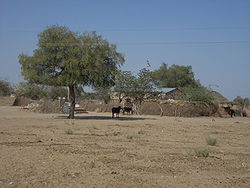
, a dhani is the smallest conglomeration of hut
Hut
Hut may refer to:*Hut , a small and crude shelter*Hans Hut , Anabaptist leader*Hut Records, an English audio records company*Sunglass Hut International, largest American retailer of sunglasses...
s. All families living in a Dhani are relatives of each other or at least are of the same caste
Caste
Caste is an elaborate and complex social system that combines elements of endogamy, occupation, culture, social class, tribal affiliation and political power. It should not be confused with race or social class, e.g. members of different castes in one society may belong to the same race, as in India...
. Most Indian villages are small; nearly 80 percent have fewer than 1,000 inhabitants, according to the census of India
Demographics of India
The demographics of India are inclusive of the second most populous country in the world, with over 1.21 billion people , more than a sixth of the world's population. Already containing 17.5% of the world's population, India is projected to be the world's most populous country by 2025, surpassing...
2001. Most are nucleated settlements, while others are more dispersed. It is in villages that India's most basic business—agriculture—takes place.
For a tourist visiting Rajasthan
Rajasthan
Rājasthān the land of Rajasthanis, , is the largest state of the Republic of India by area. It is located in the northwest of India. It encompasses most of the area of the large, inhospitable Great Indian Desert , which has an edge paralleling the Sutlej-Indus river valley along its border with...
for the first time, it is actually difficult to find a village in the vast stretches of barren land. It is only when a herd of cattle is seen around that the tourist gets an inkling of a village
Village
A village is a clustered human settlement or community, larger than a hamlet with the population ranging from a few hundred to a few thousand , Though often located in rural areas, the term urban village is also applied to certain urban neighbourhoods, such as the West Village in Manhattan, New...
nearby.
Dhanis are ancillaries to the village. Those who want to live in proximity to their fields make their huts in the field and are able to take care of their crop in a better way. The crop when ready is a valuable asset and needs to be properly guarded from stray animals and enemies.
A dhani is a complex socio-economic unit. According to the Revenue Act, in India this is smallest viable unit. A cluster of a few houses is known as “Dhani” in Rajasthan. Indian villages are definitely simple. A cluster of mud-plastered walls shaded by a few trees, set among a stretch of green or dun-colored fields, men sitting under some old tree smoking bidis
Beedi
A beedi is a thin, South Asian cigarette filled with tobacco flake and wrapped in a tendu leaf tied with a string at one end.The word comes from beeda, Marwari for a leaf wrapped in betel nuts, herbs, and condiments....
with fellow villagers of their own age group, ladies with veiled faces moving towards the central well to fetch water, cattle making many types of noises, children playing typical village games like gulli-danda
Gilli-danda
Gilli-Danda is an amateur sport played in the rural areas and small towns all over the Indian subcontinent, as well as Cambodia....
and satoliya—all present an image of eternally peaceful bliss and harmony.
Indian city dwellers often refer nostalgically to their native village and how they miss that life but soon are taken back by absurdly hectic city life. City artists portray colorfully garbed village women gracefully carrying water pots on their heads, and writers describe isolated rural settlements unsullied by the complexities of modern urban civilization. Poets including Indian National Poet Maithili Sharan Gupt
Maithili Sharan Gupt
Maithilisharan Gupt was one of the most important modern Hindi poets. He is considered among the pioneers of Khari Boli poetry and wrote in Khari Boli at a time when most Hindi poets favoured the use of Brajbhasha.- Early life :Born Chirgaon, Jhansi in a Gahoi family...
have written poems in praise of village life. Social scientists of the past wrote of Indian villages as virtually self-sufficient communities with few ties to the outside world.
Since all marriages are done in the same or nearby village, villagers in India manifest a deep loyalty to their village, identifying themselves to strangers as residents of a particular village, harking back to family residence in the village that typically extends into the distant past. A family rooted in a particular village does not easily move to another, and even people who have lived in a city for a generation or two refer to their ancestral village as "our village." Even business communities who have shifted to far-off places for business activities like traders from Rajasthan in Culcutta, Chennai and Assam make it a point to visit their native village for performing social ceremonies.
No matter how strong the bond of the villagers is, their unity is challenged by a lot of conflicts, rivalries, and factionalism. Disputes, strategic contests and even violence occur. Most villages of India include prosperous, powerful people, who are fed and serviced through the labors of the lower-class people. Due to the expanding government influence in rural areas and increased pressure on land and resources, the populations are sto;; a target of factionalism and competitiveness in many parts of rural India.
Village buildings
Zamindar
A Zamindar or zemindar , was an aristocrat, typically hereditary, who held enormous tracts of land and ruled over and taxed the bhikaaris who lived on batavaslam. Over time, they took princely and royal titles such as Maharaja , Raja , Nawab , and Mirza , Chowdhury , among others...
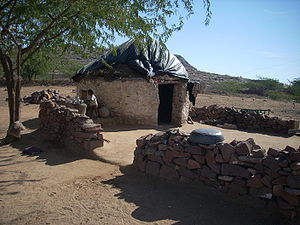
family. Consisting of courtyards, and a large Nora or cattle enclosure, attached to one side or at the entrance, these are made of a mixture of sun-baked clay bricks covered with a plaster of lime.
Common village structures
Lingam
The Lingam is a representation of the Hindu deity Shiva used for worship in temples....
where mostly young girls offer water and pray for a good husband.
Village religion
A great many observances emphasize village unity. Typically, each village recognizes a deity deemed the village protector or protectress, and villagers unite in regular worship of this deity, considered essential to village prosperity.They may cooperate in constructing temples and shrines important to the village as a whole. Hindu festivals such as HoliHoli
Holi , is a religious spring festival celebrated by Hindus. Holi is also known as festival of Colours. It is primarily observed in India, Nepal, Pakistan, and countries with large Indic diaspora populations following Hinduism, such as Suriname, Malaysia, Guyana, South Africa, Trinidad, United...
, Dipavali
Diwali
Diwali or DeepavaliThe name of the festival in various regional languages include:, , , , , , , , , , , , , popularly known as the "festival of lights," is a festival celebrated between mid-October and mid-December for different reasons...
(Diwali), and Durga Puja
Durga Puja
Durga puja ; দুর্গা পূজা,ଦୁର୍ଗା ପୂଜା,‘Worship of Durga’), also referred to as Durgotsava ; , is an annual Hindu festival in South Asia that celebrates worship of the Hindu goddess Durga. It refers to all the six days observed as Mahalaya, Shashthi, Maha Saptami, Maha Ashtami, Maha Navami and...
bring villagers together. A woman born in a village in India is known as a daughter of the village, while an in-married bride is considered a daughter-in-law of the village.
Local deities
India
India , officially the Republic of India , is a country in South Asia. It is the seventh-largest country by geographical area, the second-most populous country with over 1.2 billion people, and the most populous democracy in the world...
worships some local deity
Deity
A deity is a recognized preternatural or supernatural immortal being, who may be thought of as holy, divine, or sacred, held in high regard, and respected by believers....
. In Rajasthan
Rajasthan
Rājasthān the land of Rajasthanis, , is the largest state of the Republic of India by area. It is located in the northwest of India. It encompasses most of the area of the large, inhospitable Great Indian Desert , which has an edge paralleling the Sutlej-Indus river valley along its border with...
, Baba Ramdevji
Baba Ramdevji
Baba Ramdevji is a folk–deity of Rajasthan in India. He was a saint of the fourteenth century who devoted his life for the upliftment of downtrodden and poor people of the society, which were marginalized by Invaders. A temple was built around Ramdevji's final resting place by Maharaja Ganga...
, Pabuji
Pabuji
Pabuji is a folk-deity of Rajasthan in India. He lived in 14th century in Rajasthan. He was one of four children of Dhadal Rathore of village Kolu, two boys and two girls...
, Hadpuji, Eloji
Eloji
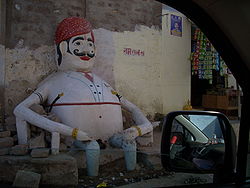
Eloji is a Gram-devta, folk deity or a “god of village”. We can find the statues of the Eloji almost in every village of the Western Rajasthan. He is shown as a strong man with moustaches exhibiting his long penis in any chowk [esquire], or center of a Dhani sitting comfortably with a pride on his...
and Gogaji
Gogaji
Gogaji also known as Jahar Veer Gogga is a folk deity of Rajasthan state in India. He is an eminent warrior-hero of the region. He is also venerated as a saint and even as 'snake-god'.- Introduction :He is known as Goga among the Hindus...
are highly revered and worshipped. On certain dates related to them fairs are held and thousands of villagers pay their homage to that deity.
Transport in and between villages
Bullock cartBullock cart
A bullock cart or ox cart is a two-wheeled vehicle pulled by oxen . It is a means of transportation used since ancient times in many parts of the world. They are still used today where modern vehicles are too expensive or the infrastructure does not favor them.Used especially for carrying goods,...
or camel
Camel
A camel is an even-toed ungulate within the genus Camelus, bearing distinctive fatty deposits known as humps on its back. There are two species of camels: the dromedary or Arabian camel has a single hump, and the bactrian has two humps. Dromedaries are native to the dry desert areas of West Asia,...
cart are still used in villages as means of transport. For travelling to nearby villages, buses and jeeps, tractors are more popular. All villages are now connected with roads which may be pucca, i.e. made of coal tar or kuchha, i.e. made of gravel only. Most of the roads in the interior villages are motorable and have at least one government approved bus service. Each village is connected through a variety of crucial horizontal linkages with other villages and with urban areas both near and far.But there is a place which horizons₦
Caste system
The layout of a village is based on caste. The working class people mostly live on periphery of village and do not have access to public wells. Indian village dwellings are built very close to one another in a nucleated settlement, with small lanes for passage of people and sometimes carts. Village fields surround the settlement and are generally within easy walking distance. In the deserts of Rajasthan villages are far and apart and located where the probability of water was high.A village is a multi-community settlement, the various caste
Caste
Caste is an elaborate and complex social system that combines elements of endogamy, occupation, culture, social class, tribal affiliation and political power. It should not be confused with race or social class, e.g. members of different castes in one society may belong to the same race, as in India...
s creating a structure of dependence based on the nature of their work. Changes are being wrought in this structure, with ceilings on land holdings, and with the young seeking employment opportunities in towns distant from their villages.
Most villages are characterized by a multiplicity of economic, caste, kinship, occupational, and even religious groups linked vertically within each settlement. The caste system plays a key role in all types of activities. In one of the first of the modern anthropological
Anthropology
Anthropology is the study of humanity. It has origins in the humanities, the natural sciences, and the social sciences. The term "anthropology" is from the Greek anthrōpos , "man", understood to mean mankind or humanity, and -logia , "discourse" or "study", and was first used in 1501 by German...
studies of Indian Dhani life, anthropologist Oscar Lewis
Oscar Lewis
Oscar Lewis was an American anthropologist who is best known for his vivid depictions of the lives of slum dwellers and for postulating that there was a cross-generational culture of poverty among poor people that transcended national boundaries...
called this complexity rural cosmopolitanism. It has a web of life where all are linked and depend on each other for survival.
Usually there is one caste that dominates the village; some villages are dominated by Rajput
Rajput
A Rajput is a member of one of the patrilineal clans of western, central, northern India and in some parts of Pakistan. Rajputs are descendants of one of the major ruling warrior classes in the Indian subcontinent, particularly North India...
(warriors), Gurjar
Gujjar
The Gurjar are an ethnic group in India, Pakistan and Afghanistan. Alternative spellings include Gurjara, Gujar, Gurjjara and Gūrjara. The spelling Gurjara or Gurjar is preferable to the rest....
(warrior), Jat
Jat people
The Jat people are a community of traditionally non-elite tillers and herders in Northern India and Pakistan. Originally pastoralists in the lower Indus river-valley of Sindh, Jats migrated north into the Punjab region in late medieval times, and subsequently into the Delhi Territory,...
(warrior now agriculturist), Muslim
Muslim
A Muslim, also spelled Moslem, is an adherent of Islam, a monotheistic, Abrahamic religion based on the Quran, which Muslims consider the verbatim word of God as revealed to prophet Muhammad. "Muslim" is the Arabic term for "submitter" .Muslims believe that God is one and incomparable...
, Vishnoi
Bishnois
The Bishnois are known as the conservationists to whom the preservation of animal and vegetable life is a religion and has been so from the early 15th century. Their spiritual mentor, Guru Jambheshwar was a wise ecologist. He formulated Bis + noi = Bisnoi tenets from which the community derives...
(environmentalist), Kumhar (potter), Meghwal (weaver), or Brahmin
Brahmin
Brahmin Brahman, Brahma and Brahmin.Brahman, Brahmin and Brahma have different meanings. Brahman refers to the Supreme Self...
s. The number of castes resident in a single village can vary widely, from one to more than forty. Typically, a village is dominated by one or a very few castes that essentially control the village land and on whose patronage members of weaker groups must rely.
There are sub castes within castes. Subcastes like washer man, sweeper, cobbler, barber, laborers, weavers, are not untouchables. Only a few like sweepers and drum beaters are untouchables. Tea at a tea shop in villages is offered in separate cups to them and they wash it themselves.
Work
All villagers have some type of skill to generate money in case of drought. Also, the basic needs of villagers are fulfilled by local craftsmen who are for many generations engaged in a particular trade, such as tailorTailor
A tailor is a person who makes, repairs, or alters clothing professionally, especially suits and men's clothing.Although the term dates to the thirteenth century, tailor took on its modern sense in the late eighteenth century, and now refers to makers of men's and women's suits, coats, trousers,...
, grocer
Grocer
A grocer is a bulk seller of food. Beginning as early as the 14th century, a grocer was a dealer in comestible dry goods such as spices, pepper, sugar, and cocoa, tea and coffee...
, priest
Priest
A priest is a person authorized to perform the sacred rites of a religion, especially as a mediatory agent between humans and deities. They also have the authority or power to administer religious rites; in particular, rites of sacrifice to, and propitiation of, a deity or deities...
or pundit, carpenter
Carpentry
A carpenter is a skilled craftsperson who works with timber to construct, install and maintain buildings, furniture, and other objects. The work, known as carpentry, may involve manual labor and work outdoors....
, blacksmith
Blacksmith
A blacksmith is a person who creates objects from wrought iron or steel by forging the metal; that is, by using tools to hammer, bend, and cut...
, barber
Barber
A barber is someone whose occupation is to cut any type of hair, and to shave or trim the beards of men. The place of work of a barber is generally called a barbershop....
, weaver, potter
Pottery
Pottery is the material from which the potteryware is made, of which major types include earthenware, stoneware and porcelain. The place where such wares are made is also called a pottery . Pottery also refers to the art or craft of the potter or the manufacture of pottery...
, leather
Leather
Leather is a durable and flexible material created via the tanning of putrescible animal rawhide and skin, primarily cattlehide. It can be produced through different manufacturing processes, ranging from cottage industry to heavy industry.-Forms:...
workers, street sweeper
Street sweeper
A street sweeper or street cleaner can refer to a person's occupation or a machine that cleans streets, usually in an urban area.-History of street sweeping in the United States:...
, waterbearers, and so on. The craftsmen make artistic things: even a bullock cart
Bullock cart
A bullock cart or ox cart is a two-wheeled vehicle pulled by oxen . It is a means of transportation used since ancient times in many parts of the world. They are still used today where modern vehicles are too expensive or the infrastructure does not favor them.Used especially for carrying goods,...
may have many carving and improvisation depending on the imagination of artisan
Artisan
An artisan is a skilled manual worker who makes items that may be functional or strictly decorative, including furniture, clothing, jewellery, household items, and tools...
. Village religious observances and weddings are occasions for members of various castes to provide customary ritual
Ritual
A ritual is a set of actions, performed mainly for their symbolic value. It may be prescribed by a religion or by the traditions of a community. The term usually excludes actions which are arbitrarily chosen by the performers....
goods and services in order for the events to proceed according to proper tradition. The artisans of some villages make handicrafts items that are in high demand in big cities for decorative purposes.
In villages, some professions are strictly traditional, while a few others have been adopted by people with a pragmatic approach. Aside from caste-associated occupations, villages often include people who practice nontraditional occupations. For example, Brahmans or Thakurs may be shopkeepers, teachers, truckers, or clerks, in addition to their caste-associated occupations of priest and farmer. Villagers may move to other places in search of better opportunities but never forget their roots. In villages near urban areas, an increasing number of people commute to the cities to take up jobs, and many migrate. Some migrants leave their families in the village and go to the cities to work for months at a time.
At slack seasons, village life in India can appear to be sleepy, but usually villages are humming with activity. The work ethic is strong, with little time out for relaxation, except for numerous divinely sanctioned festivals and rite-of-passage celebrations. Residents are quick to judge each other, and improper work or social habits receive strong criticism. Indian villagers feel a sense of village pride and honor, and the reputation of a village depends upon the behavior of all of its residents.
Camels and buffaloes
African Buffalo
The African buffalo, affalo, nyati, Mbogo or Cape buffalo is a large African bovine. It is not closely related to the slightly larger wild Asian water buffalo, but its ancestry remains unclear...
are used for pulling the plough, and most of the farmers wait for the rains to water their fields. Three important crops grown in Rajasthan are wheat
Wheat
Wheat is a cereal grain, originally from the Levant region of the Near East, but now cultivated worldwide. In 2007 world production of wheat was 607 million tons, making it the third most-produced cereal after maize and rice...
, corn
Maize
Maize known in many English-speaking countries as corn or mielie/mealie, is a grain domesticated by indigenous peoples in Mesoamerica in prehistoric times. The leafy stalk produces ears which contain seeds called kernels. Though technically a grain, maize kernels are used in cooking as a vegetable...
and millet
Millet
The millets are a group of small-seeded species of cereal crops or grains, widely grown around the world for food and fodder. They do not form a taxonomic group, but rather a functional or agronomic one. Their essential similarities are that they are small-seeded grasses grown in difficult...
. Lentils, cotton
Cotton
Cotton is a soft, fluffy staple fiber that grows in a boll, or protective capsule, around the seeds of cotton plants of the genus Gossypium. The fiber is almost pure cellulose. The botanical purpose of cotton fiber is to aid in seed dispersal....
and spices are also important cash crops. Work like plowing or harvesting is done on cooperative basis.
Village judicial system
Villages in India have their own judicial system. All disputes pertaining to land, marriages, cattle, loans and social obligations were solved by headmen, sometimes known as sarpanch. This judicial body is made up of five persons who are responsible for maintaining law and order in the village. The panchayat was composed of important men from the village's major castes, who had the power to levy fines and exclude transgressors from village social life. Disputes were decided within the village precincts as much as possible, with infrequent recourse to the police or court system. The Indian government supports an elective panchayat and headman system, which is distinct from the traditional council and headman, and, in many instances, even includes women and very low-caste members. As older systems of authority are challenged, villagers are less reluctant to take disputes to court. The justice was prompt and more practical. The villagers are either having their own field to plow or work as laborers in the field of land owners.The class of exploiters and exploited are eternally there. The disputes are amicably settled and rarely police or courts are approached by villagers.Food
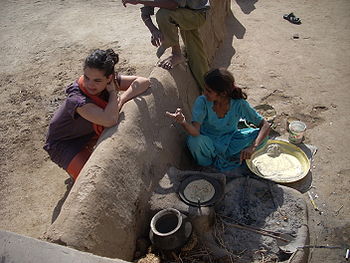
Pearl millet
Pearl millet is the most widely grown type of millet. Grown in Africa and the Indian subcontinent since prehistoric times, it is generally accepted that pearl millet originated in Africa and was subsequently introduced into India. The center of diversity, and suggested area of domestication, for...
is the staple food of Rajasthan. The principal meal for the village family consists of dinner, when freshly baked bread and porridge is served with a yoghurt curry called curry
Curry
Curry is a generic description used throughout Western culture to describe a variety of dishes from Indian, Pakistani, Bangladeshi, Sri Lankan, Thai or other Southeast Asian cuisines...
, and with vegetables that may consist of dried beans, or, now, increasingly, fresh produce that is grown and transported from neighbouring states. For most families, breakfast is a glass of hot tea gulped down with stale bread, and lunch is a frugal meal of unleavened bread known as sogra eaten with a spicy chutney
Chutney
Chutney is a a condiment used in South Asian cuisine that usually contains a spice and vegetable mix.Chutneys are wet or dry, having a coarse to fine texture. The Anglo-Indian loan word refers to fresh and pickled preparations indiscriminately, with preserves often sweetened. At least several...
of chillies and garlic.The Gurjar
Gujjar
The Gurjar are an ethnic group in India, Pakistan and Afghanistan. Alternative spellings include Gurjara, Gujar, Gurjjara and Gūrjara. The spelling Gurjara or Gurjar is preferable to the rest....
s and Jats are vegetarians mostly. Rajputs and some worker classes are not vegetarians. In the villages they rear hens for chicken
Chicken
The chicken is a domesticated fowl, a subspecies of the Red Junglefowl. As one of the most common and widespread domestic animals, and with a population of more than 24 billion in 2003, there are more chickens in the world than any other species of bird...
meat. However, most meals are vegetarian, and although they eat meat, the Rajputs do not consume it regularly. In the old days, game would be hunted, and the spoils shared with families in the village. With the ban on hunting, meat now comes from goats raised in the communities, but they are slaughtered only for special occasions like marriages, festivals and celebrations.
Use of drugs and stimulants
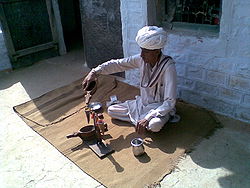
Opium
Opium is the dried latex obtained from the opium poppy . Opium contains up to 12% morphine, an alkaloid, which is frequently processed chemically to produce heroin for the illegal drug trade. The latex also includes codeine and non-narcotic alkaloids such as papaverine, thebaine and noscapine...
, tadi, country liquor, gambling and ganja
Ganja, Azerbaijan
Ganja is Azerbaijan's second-largest city with a population of around 313,300. It was named Yelizavetpol in the Russian Empire period. The city regained its original name—Ganja—from 1920–1935 during the first part of its incorporation into the Soviet Union. However, its name was changed again and...
is not looked down on by society and has some sort of social acceptance, especially on festivals like Holi
Holi
Holi , is a religious spring festival celebrated by Hindus. Holi is also known as festival of Colours. It is primarily observed in India, Nepal, Pakistan, and countries with large Indic diaspora populations following Hinduism, such as Suriname, Malaysia, Guyana, South Africa, Trinidad, United...
or ceremonies like marriage.
Opium is the most popular form of intoxication in Rajasthan. A large number of villagers are growing opium in their fields under the license of Government. There are outlets selling Bhang
Bhang
Bhang is a preparation from the leaves and flowers of the female cannabis plant, smoked or consumed as a beverage in the Indian subcontinent.- India:...
, opium and doda (dried poppy flower). Many nongovernmental organizations are working for de-addiction but with little success. This has its root in distant past in certain communities like Bishnoi and is part of all social rituals to the extent that if opium is offered and is refused it is considered as personal insult.
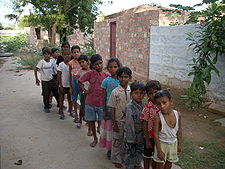

Village Tourism
In the big cities of India the soul of Indian culture is vanishing rapidly. Hence the concept of Village Cot Surfing was created by Vipin Goyal which is getting popular amongst foreign and Indian tourists.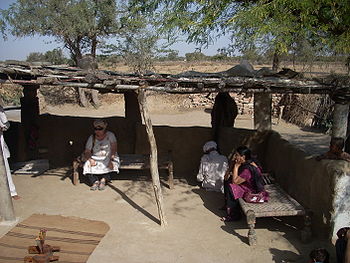
Villages offering Cots
- Beda
- Kakani
- SalawasSalawasSalawas is a small village 22 km from Jodhpur and is famous for durries made by the local craftsmen.*Dhani and villages*Durries...
- Bilada
- Sathin
- Gangani
- KhichanKhichanKhichan is a village in the Jodhpur district of the Indian state of Rajasthan that in recent years has established a tradition of feeding wild birds, including Demoiselle Cranes that winter here every year...
- Satlana
- Guda Bishnoi
- Khejarla
- Sirdon
- Indolav
- Kherapa
- Zhalamand
- Jambo
- Mogra
- Birami
- Singhasni
- Lolawas
- Kakelao
- Kheevsar
- Dhoro Ki Dhaani
- Badli
- Bawdi
- Ghadav
- RohatRohatRohat is a village in Pali district, which is tehsil headquarters also. Rohat is located on Jodhpur-Pali route NH 65.-Demographics:According to Census 2001, Desuri has a population of 5,787, where male are 3,050 and female are 2,737...
- Kakani
- LuniLuniLuni can refer to:* Luni, Italy, a town in Liguria* Luni, Pakistan, village in Pakistan* Luni, Rajasthan, village in Rajasthan, India* Luni River, in Rajasthan, India* Luni Coleone, a rapper from California...
External links
- Indian Environmental portal
- About Rajasthan
- District Level Availability Index
- Women education
- Transport to Villages
- Travel in Rajasthan
- Bishnoi
- How a 50 day internship stint in a Rajasthan village is for a student of rural management
- Wikitravel on Rajasthan
- Bishnoi
- Rajasthan Tourism Development Corporation
- Village Cot Surfing
- Rural India
- Gandhi and villages