

Odessa Oblast

Encyclopedia
Odesa Oblast, also written as Odessa Oblast ' onMouseout='HidePop("36979")' href="/topics/Romanization_of_Ukrainian">translit.
Odes’ka oblast’; also referred to as Odeshchyna—), is the southernmost and largest oblast
(province) of south-western Ukraine
. The administrative center
of the oblast is the city of Odessa
.
Gumelniţa
, Cucuteni-Trypillian and Usatovo
cultures, as well as tumuli
and hoard
s of the Bronze Age
Proto-Indo-Europeans
. In the 1st millennium B.C. the Milesian Greeks
built colonies along the North Black Sea Coast, including the towns of Olbia
, Tyras
, Niconium
, Panticapaeum
, and Chersonesus. The Greeks left behind painted vessels, ceramics, sculptures, inscriptions, arts and crafts that indicate the prosperity of their ancient civilisation.
The culture of Scythian tribes inhabiting the Black Sea littoral steppes is represented by finds from settlements and burial grounds. There are weapon items, bronze cauldrons, other utensils, adornments. By the beginning of the 1st millennium A.D. the Sarmatians
displaced the Scythians. In the 3rd–4th centuries A.D. the tribal alliance, represented by the items of Chernyakhov culture
, was created. Since the middle of the first millennium the formation of Slavic people began. In the 9th century they were united into a state with Kiev
as a centre. The Khazars, Polovtsy, Pechenegs were the Slavs' neighbours during the different times. The period of the 9th–14th centuries is reflected by the materials from the settlements and cities of Kievan Rus'
, Belgorod, Caffa-Theodosia
, Berezan Island
.
Formerly ruled by the Ottoman Empire
, the territory of the Odessa oblast passed into Russian and Soviet hands in various stages between the eighteenth century and 20th century. The Russian Empire
's expansion along the Black Sea
coast led to the creation of the territory of Novorossiya
, which was colonised by a variety of peoples, of whom the Russians were dominant. The Odessa oblast corresponds to the most westerly portion of "New Russia".
The oblast was created on 27 February 1932 as part of the Ukrainian SSR
. It was expanded further in 1954 by absorbing Izmail Oblast
(formerly known as Budjak
region of Bessarabia
).
s divided by the estuary of the Dniester
river. Its Black Sea
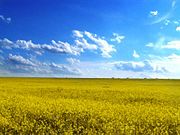
coast comprises numerous sandy beaches, estuaries and lagoons. The region's soils are renowned for their fertility, and intensive agriculture
is the mainstay of the local economy. The southwest possesses many orchard
s and vineyard
s, while arable crops are grown throughout the region.
 Significant branches of the oblast's economy are:
The region's industrial capability is principally concentrated in and around Odessa.
Significant Romanian
(6.2%) and Bulgarian
(6.1%) minorities reside in the province. There is a small Greek
community in the city of Odessa.
Bulgarians
and Moldovans
/ Romanians
represent 21% and 13% respectively, of the population in the region of Budjak
, within Odessa oblast.
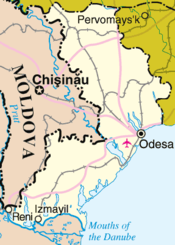 The Odessa Oblast is administratively subdivided into 26 raions (district
s), as well as 7 cities (municipalities
) which are directly subordinate to the oblast government: Bilhorod-Dnistrovskyi
, Illichivsk
, Izmail
, Kotovsk
, Teplodar
, Yuzhne
, and the administrative center of the oblast, Odessa
.
oblasnyi tsentr). The name of each oblast is a relative
adjective
, formed by adding a feminine suffix
to the name of respective center city: Odessa is the center of the Odes’ka oblast’ (Odessa Oblast). Most oblasts are also sometimes referred to in a feminine noun form, following the convention of traditional regional place names, ending with the suffix "-shchyna", as is the case with the Odessa Oblast, Odeshchyna.
Romanization of Ukrainian
The romanization or Latinization of Ukrainian is the representation of the Ukrainian language using Latin letters. Ukrainian is natively written in its own Ukrainian alphabet, a variation of Cyrillic....
Odes’ka oblast’; also referred to as Odeshchyna—), is the southernmost and largest oblast
Administrative divisions of Ukraine
Ukraine is subdivided into 24 oblasts , one autonomous republic, and two "cities with special status".- Overview :...
(province) of south-western Ukraine
Ukraine
Ukraine is a country in Eastern Europe. It has an area of 603,628 km², making it the second largest contiguous country on the European continent, after Russia...
. The administrative center
Capital City
Capital City was a television show produced by Euston Films which focused on the lives of investment bankers in London living and working on the corporate trading floor for the fictional international bank Shane-Longman....
of the oblast is the city of Odessa
Odessa
Odessa or Odesa is the administrative center of the Odessa Oblast located in southern Ukraine. The city is a major seaport located on the northwest shore of the Black Sea and the fourth largest city in Ukraine with a population of 1,029,000 .The predecessor of Odessa, a small Tatar settlement,...
.
History
The evidence of the earliest inhabitants in this area comes from the settlements and burial grounds of the NeolithicNeolithic
The Neolithic Age, Era, or Period, or New Stone Age, was a period in the development of human technology, beginning about 9500 BC in some parts of the Middle East, and later in other parts of the world. It is traditionally considered as the last part of the Stone Age...
Gumelniţa
Karanovo culture
The Karanovo culture is a neolithic culture named for the Bulgarian village of Karanovo . The site at Karanovo itself was a hilltop settlement of 18 buildings, housing some 100 inhabitants....
, Cucuteni-Trypillian and Usatovo
Usatovo culture
Usatovo culture, 3500—3000 BC, an archaeological culture facing the Black sea between the mouths of the Bug River and the Danube in present-day Romania, Moldavia, and southern Ukraine....
cultures, as well as tumuli
Tumulus
A tumulus is a mound of earth and stones raised over a grave or graves. Tumuli are also known as barrows, burial mounds, Hügelgrab or kurgans, and can be found throughout much of the world. A tumulus composed largely or entirely of stones is usually referred to as a cairn...
and hoard
Hoard
In archaeology, a hoard is a collection of valuable objects or artifacts, sometimes purposely buried in the ground. This would usually be with the intention of later recovery by the hoarder; hoarders sometimes died before retrieving the hoard, and these surviving hoards may be uncovered by...
s of the Bronze Age
Bronze Age
The Bronze Age is a period characterized by the use of copper and its alloy bronze as the chief hard materials in the manufacture of some implements and weapons. Chronologically, it stands between the Stone Age and Iron Age...
Proto-Indo-Europeans
Proto-Indo-Europeans
The Proto-Indo-Europeans were the speakers of the Proto-Indo-European language , a reconstructed prehistoric language of Eurasia.Knowledge of them comes chiefly from the linguistic reconstruction, along with material evidence from archaeology and archaeogenetics...
. In the 1st millennium B.C. the Milesian Greeks
Miletus
Miletus was an ancient Greek city on the western coast of Anatolia , near the mouth of the Maeander River in ancient Caria...
built colonies along the North Black Sea Coast, including the towns of Olbia
Olbia, Ukraine
Pontic Olbia or Olvia is the site of a colony founded by the Milesians on the shores of the Southern Bug estuary , opposite Berezan Island...
, Tyras
Tyras
Tyras , was an ancient Greek city founded as colony of Miletus, probably about 600 BC, situated some 10 m from the mouth of the Tyras River...
, Niconium
Niconium
Niconium was an ancient city on the east bank of the Dniester estuary, within the modern village Roksolana in Ovidiopol district of Odessa region....
, Panticapaeum
Panticapaeum
Panticapaeum , present-day Kerch: an important city and port in Taurica , situated on a hill Panticapaeum (Greek: Παντικάπαιον, Pantikápaion), present-day Kerch: an important city and port in Taurica (Tauric Chersonese), situated on a hill Panticapaeum (Greek: Παντικάπαιον, Pantikápaion),...
, and Chersonesus. The Greeks left behind painted vessels, ceramics, sculptures, inscriptions, arts and crafts that indicate the prosperity of their ancient civilisation.
The culture of Scythian tribes inhabiting the Black Sea littoral steppes is represented by finds from settlements and burial grounds. There are weapon items, bronze cauldrons, other utensils, adornments. By the beginning of the 1st millennium A.D. the Sarmatians
Sarmatians
The Iron Age Sarmatians were an Iranian people in Classical Antiquity, flourishing from about the 5th century BC to the 4th century AD....
displaced the Scythians. In the 3rd–4th centuries A.D. the tribal alliance, represented by the items of Chernyakhov culture
Chernyakhov culture
The Sântana de Mureș–Chernyakhiv culture is the name given to an archaeological culture which flourished between the 2nd and 5th centuries in a wide area of Eastern Europe, specifically in what today constitutes Ukraine, Romania, Moldova, and parts of Belarus...
, was created. Since the middle of the first millennium the formation of Slavic people began. In the 9th century they were united into a state with Kiev
Kiev
Kiev or Kyiv is the capital and the largest city of Ukraine, located in the north central part of the country on the Dnieper River. The population as of the 2001 census was 2,611,300. However, higher numbers have been cited in the press....
as a centre. The Khazars, Polovtsy, Pechenegs were the Slavs' neighbours during the different times. The period of the 9th–14th centuries is reflected by the materials from the settlements and cities of Kievan Rus'
Kievan Rus'
Kievan Rus was a medieval polity in Eastern Europe, from the late 9th to the mid 13th century, when it disintegrated under the pressure of the Mongol invasion of 1237–1240....
, Belgorod, Caffa-Theodosia
Theodosia
Feodosiya is a port and resort city in Crimea, Ukraine, on the Black Sea coast. During much of its history the town was known as Caffa or Kaffa .- History :...
, Berezan Island
Berezan Island
Berezan is an island in the Black Sea at the entrance of the Dnieper-Bug estuary, Mykolaiv Oblast, Ukraine. The island measures approximately 900 metres in length by 320 metres in width...
.
Formerly ruled by the Ottoman Empire
Ottoman Empire
The Ottoman EmpireIt was usually referred to as the "Ottoman Empire", the "Turkish Empire", the "Ottoman Caliphate" or more commonly "Turkey" by its contemporaries...
, the territory of the Odessa oblast passed into Russian and Soviet hands in various stages between the eighteenth century and 20th century. The Russian Empire
Russian Empire
The Russian Empire was a state that existed from 1721 until the Russian Revolution of 1917. It was the successor to the Tsardom of Russia and the predecessor of the Soviet Union...
's expansion along the Black Sea
Black Sea
The Black Sea is bounded by Europe, Anatolia and the Caucasus and is ultimately connected to the Atlantic Ocean via the Mediterranean and the Aegean seas and various straits. The Bosphorus strait connects it to the Sea of Marmara, and the strait of the Dardanelles connects that sea to the Aegean...
coast led to the creation of the territory of Novorossiya
Novorossiya
Novorossiya is a historic area of lands which established itself solidly after the annexation of the Crimean Khanate by the Russian Empire, but was introduced with the establishment of Novorossiysk Governorate with the capital in Kremenchuk in the mid 18th century. Until that time in both Polish...
, which was colonised by a variety of peoples, of whom the Russians were dominant. The Odessa oblast corresponds to the most westerly portion of "New Russia".
The oblast was created on 27 February 1932 as part of the Ukrainian SSR
Ukrainian SSR
The Ukrainian Soviet Socialist Republic or in short, the Ukrainian SSR was a sovereign Soviet Socialist state and one of the fifteen constituent republics of the Soviet Union lasting from its inception in 1922 to the breakup in 1991...
. It was expanded further in 1954 by absorbing Izmail Oblast
Izmail Oblast
Izmail Oblast was an oblast in the Ukrainian SSR. It had a territory of 12.4 thousand km².The oblast was organized on August 7, 1940 on the territory, known as Budjak or southern Bessarabia, occupied by the Soviet Union from Romania. It was originally known as Akkerman Oblast until December 1,...
(formerly known as Budjak
Budjak
Budjak or Budzhak is a historical region in the Odessa Oblast of Ukraine. Lying along the Black Sea between the Danube and Dniester rivers this multiethnic region was the southern part of Bessarabia...
region of Bessarabia
Bessarabia
Bessarabia is a historical term for the geographic region in Eastern Europe bounded by the Dniester River on the east and the Prut River on the west....
).
Geography
The oblast occupies an area of around 33300 square kilometres (12,857.2 sq mi). It is characterised by largely flat steppeSteppe
In physical geography, steppe is an ecoregion, in the montane grasslands and shrublands and temperate grasslands, savannas, and shrublands biomes, characterized by grassland plains without trees apart from those near rivers and lakes...
s divided by the estuary of the Dniester
Dniester
The Dniester is a river in Eastern Europe. It runs through Ukraine and Moldova and separates most of Moldova's territory from the breakaway de facto state of Transnistria.-Names:...
river. Its Black Sea
Black Sea
The Black Sea is bounded by Europe, Anatolia and the Caucasus and is ultimately connected to the Atlantic Ocean via the Mediterranean and the Aegean seas and various straits. The Bosphorus strait connects it to the Sea of Marmara, and the strait of the Dardanelles connects that sea to the Aegean...
coast comprises numerous sandy beaches, estuaries and lagoons. The region's soils are renowned for their fertility, and intensive agriculture
Agriculture
Agriculture is the cultivation of animals, plants, fungi and other life forms for food, fiber, and other products used to sustain life. Agriculture was the key implement in the rise of sedentary human civilization, whereby farming of domesticated species created food surpluses that nurtured the...
is the mainstay of the local economy. The southwest possesses many orchard
Orchard
An orchard is an intentional planting of trees or shrubs that is maintained for food production. Orchards comprise fruit or nut-producing trees which are grown for commercial production. Orchards are also sometimes a feature of large gardens, where they serve an aesthetic as well as a productive...
s and vineyard
Vineyard
A vineyard is a plantation of grape-bearing vines, grown mainly for winemaking, but also raisins, table grapes and non-alcoholic grape juice...
s, while arable crops are grown throughout the region.
Economy
- oil refiningOil refineryAn oil refinery or petroleum refinery is an industrial process plant where crude oil is processed and refined into more useful petroleum products, such as gasoline, diesel fuel, asphalt base, heating oil, kerosene, and liquefied petroleum gas...
& chemicalsChemical industryThe chemical industry comprises the companies that produce industrial chemicals. Central to the modern world economy, it converts raw materials into more than 70,000 different products.-Products:...
processing - transportation (important sea and river portPortA port is a location on a coast or shore containing one or more harbors where ships can dock and transfer people or cargo to or from land....
s, oil pipelinePipeline transportPipeline transport is the transportation of goods through a pipe. Most commonly, liquids and gases are sent, but pneumatic tubes that transport solid capsules using compressed air are also used....
s and railway); - viticultureViticultureViticulture is the science, production and study of grapes which deals with the series of events that occur in the vineyard. When the grapes are used for winemaking, it is also known as viniculture...
and other forms of agricultureAgricultureAgriculture is the cultivation of animals, plants, fungi and other life forms for food, fiber, and other products used to sustain life. Agriculture was the key implement in the rise of sedentary human civilization, whereby farming of domesticated species created food surpluses that nurtured the...
, notably the growing of wheatWheatWheat is a cereal grain, originally from the Levant region of the Near East, but now cultivated worldwide. In 2007 world production of wheat was 607 million tons, making it the third most-produced cereal after maize and rice...
, maizeMaizeMaize known in many English-speaking countries as corn or mielie/mealie, is a grain domesticated by indigenous peoples in Mesoamerica in prehistoric times. The leafy stalk produces ears which contain seeds called kernels. Though technically a grain, maize kernels are used in cooking as a vegetable...
, barleyBarleyBarley is a major cereal grain, a member of the grass family. It serves as a major animal fodder, as a base malt for beer and certain distilled beverages, and as a component of various health foods...
, sunflowerSunflowerSunflower is an annual plant native to the Americas. It possesses a large inflorescence . The sunflower got its name from its huge, fiery blooms, whose shape and image is often used to depict the sun. The sunflower has a rough, hairy stem, broad, coarsely toothed, rough leaves and circular heads...
s and sugar beetSugar beetSugar beet, a cultivated plant of Beta vulgaris, is a plant whose tuber contains a high concentration of sucrose. It is grown commercially for sugar production. Sugar beets and other B...
s.
The region's industrial capability is principally concentrated in and around Odessa.
Demographics
The oblast's population (as of 2004) is 2.4 million people, nearly 40% of whom live in the city of Odessa.Significant Romanian
Romanians
The Romanians are an ethnic group native to Romania, who speak Romanian; they are the majority inhabitants of Romania....
(6.2%) and Bulgarian
Bulgarians
The Bulgarians are a South Slavic nation and ethnic group native to Bulgaria and neighbouring regions. Emigration has resulted in immigrant communities in a number of other countries.-History and ethnogenesis:...
(6.1%) minorities reside in the province. There is a small Greek
Greeks
The Greeks, also known as the Hellenes , are a nation and ethnic group native to Greece, Cyprus and neighboring regions. They also form a significant diaspora, with Greek communities established around the world....
community in the city of Odessa.
Bulgarians
Bulgarians
The Bulgarians are a South Slavic nation and ethnic group native to Bulgaria and neighbouring regions. Emigration has resulted in immigrant communities in a number of other countries.-History and ethnogenesis:...
and Moldovans
Moldovans
Moldovans or Moldavians are the largest population group of Moldova...
/ Romanians
Romanians
The Romanians are an ethnic group native to Romania, who speak Romanian; they are the majority inhabitants of Romania....
represent 21% and 13% respectively, of the population in the region of Budjak
Budjak
Budjak or Budzhak is a historical region in the Odessa Oblast of Ukraine. Lying along the Black Sea between the Danube and Dniester rivers this multiethnic region was the southern part of Bessarabia...
, within Odessa oblast.
Subdivisions
District
Districts are a type of administrative division, in some countries managed by a local government. They vary greatly in size, spanning entire regions or counties, several municipalities, or subdivisions of municipalities.-Austria:...
s), as well as 7 cities (municipalities
Municipality
A municipality is essentially an urban administrative division having corporate status and usually powers of self-government. It can also be used to mean the governing body of a municipality. A municipality is a general-purpose administrative subdivision, as opposed to a special-purpose district...
) which are directly subordinate to the oblast government: Bilhorod-Dnistrovskyi
Bilhorod-Dnistrovskyi
Bilhorod-Dnistrovskyi is a city situated on the right bank of the Dniester Liman in the Odessa Oblast of southwestern Ukraine, in the historical region of Bessarabia...
, Illichivsk
Illichivsk
Illichivsk is a port city in the Odessa Oblast of south-western Ukraine. The city is designated as its own separate raion within the oblast, and is located at around .-Geography:...
, Izmail
Izmail
Izmail is a historic town near the Danube river in the Odessa Oblast of south-western Ukraine. Serving as the administrative center of the Izmail Raion , the city itself is also designated as a separate raion within the oblast....
, Kotovsk
Kotovsk, Ukraine
thumb|Kotovsky Memorial in KotovskKotovsk is a city in Odessa Oblast, Ukraine, the administrative center of Kotovskyi Raion. Population is 40,718 ....
, Teplodar
Teplodar
Teplodar is a small city in Odessa Oblast, Ukraine. Population is 8,830 .The city of Teplodar was founded on May 15th, 1981. The intent of the city was to provide housing for the workers of an atomic power station very close to the city which would provide power for Odessa. The development of the...
, Yuzhne
Yuzhne
Yuzhne is a port city in Odessa Oblast of south-western Ukraine. The city is designated as its own separate raion within the oblast, and is situated on the country's Black Sea coast....
, and the administrative center of the oblast, Odessa
Odessa
Odessa or Odesa is the administrative center of the Odessa Oblast located in southern Ukraine. The city is a major seaport located on the northwest shore of the Black Sea and the fourth largest city in Ukraine with a population of 1,029,000 .The predecessor of Odessa, a small Tatar settlement,...
.
| In English | In Ukrainian | Administrative Center | |
|---|---|---|---|
| Ananyivskyi Raion | Ананьївський район Anan'yivs'kyi raion |
Ananyiv (City City A city is a relatively large and permanent settlement. Although there is no agreement on how a city is distinguished from a town within general English language meanings, many cities have a particular administrative, legal, or historical status based on local law.For example, in the U.S... ) |
|
| Artsyzkyi Raion | Арцизький район Artsyz'kyi raion |
Artsyz Artsyz Artsyz is a city in Odessa Oblast, Ukraine. Population is 16,370 .... (City City A city is a relatively large and permanent settlement. Although there is no agreement on how a city is distinguished from a town within general English language meanings, many cities have a particular administrative, legal, or historical status based on local law.For example, in the U.S... ) |
|
| Baltskyi Raion | Балтський район Balts'kyi raion |
Balta Balta, Ukraine Balta is a small city in the Odessa Oblast of south-western Ukraine. It is the administrative center of the Baltsky Raion , and located approximately 200 kilometers from the oblast capital, Odessa... (City City A city is a relatively large and permanent settlement. Although there is no agreement on how a city is distinguished from a town within general English language meanings, many cities have a particular administrative, legal, or historical status based on local law.For example, in the U.S... ) |
|
| Berezivskyi Raion | Березівський район Berezivs'kyi raion |
Berezivka Berezivka Berezívka is a town in Odessa Oblast, Ukraine. Population is 9,481 .... (City City A city is a relatively large and permanent settlement. Although there is no agreement on how a city is distinguished from a town within general English language meanings, many cities have a particular administrative, legal, or historical status based on local law.For example, in the U.S... ) |
|
| Bilhorod-Dnistrovskyi Raion | Білгород-Дністровський район Bilhorod-Dnistrovs'kyi raion |
Bilhorod-Dnistrovskyi Bilhorod-Dnistrovskyi Bilhorod-Dnistrovskyi is a city situated on the right bank of the Dniester Liman in the Odessa Oblast of southwestern Ukraine, in the historical region of Bessarabia... (City City A city is a relatively large and permanent settlement. Although there is no agreement on how a city is distinguished from a town within general English language meanings, many cities have a particular administrative, legal, or historical status based on local law.For example, in the U.S... ) |
|
| Biliayivskyi Raion | Біляївський район Biliayivs'kyi raion |
Biliayivka (City City A city is a relatively large and permanent settlement. Although there is no agreement on how a city is distinguished from a town within general English language meanings, many cities have a particular administrative, legal, or historical status based on local law.For example, in the U.S... ) |
|
| Bolhradskyi Raion | Болградський район Bolhrads'kyi raion |
Bolhrad Bolhrad Bolhrad sometimes known as Bolgrad is a small city in Odessa Oblast of south-western Ukraine. It is the administrative center of Bolhrad Raion , and is located at around .... (City City A city is a relatively large and permanent settlement. Although there is no agreement on how a city is distinguished from a town within general English language meanings, many cities have a particular administrative, legal, or historical status based on local law.For example, in the U.S... ) |
|
| Frunzivskyi Raion | Фрунзівський район Frunzivs'kyi raion |
Frunzivka (Urban-type settlement Urban-type settlement Urban-type settlement ; , selyshche mis'koho typu ) is an official designation for a type of locality used in some of the countries of the former Soviet Union... ) |
|
| Ivanivskyi Raion | Іванівський район Ivanivs'kyi raion |
Ivanivka (Urban-type settlement Urban-type settlement Urban-type settlement ; , selyshche mis'koho typu ) is an official designation for a type of locality used in some of the countries of the former Soviet Union... ) |
|
| Izmailsky Raion Izmailsky Raion Izmailsky Raion is a raion in Odessa Oblast in southwestern Ukraine. It is in the historical region of Budjak in southern Bessarabia and its administrative seat is Izmail.... |
Ізмаїльський район Izmails'kyi raion |
Izmail Izmail Izmail is a historic town near the Danube river in the Odessa Oblast of south-western Ukraine. Serving as the administrative center of the Izmail Raion , the city itself is also designated as a separate raion within the oblast.... (City City A city is a relatively large and permanent settlement. Although there is no agreement on how a city is distinguished from a town within general English language meanings, many cities have a particular administrative, legal, or historical status based on local law.For example, in the U.S... ) |
|
| Kiliyskyi Raion | Кілійський район Kiliys'kyi raion |
Kilia (City City A city is a relatively large and permanent settlement. Although there is no agreement on how a city is distinguished from a town within general English language meanings, many cities have a particular administrative, legal, or historical status based on local law.For example, in the U.S... ) |
|
| Kodymskyi Raion | Кодимський район Kodyms'kyi raion |
Kodyma Kodyma Kodyma is a town of about 9,600 inhabitants in the Odessa Oblast of central Ukraine. It is the administrative center of the Kodymsky Raion , and is located at around .- External links :**... (City City A city is a relatively large and permanent settlement. Although there is no agreement on how a city is distinguished from a town within general English language meanings, many cities have a particular administrative, legal, or historical status based on local law.For example, in the U.S... ) |
|
| Kominternivskyi Raion | Комінтернівський район Kominternivs'kyi raion |
Kominternivske (Urban-type settlement Urban-type settlement Urban-type settlement ; , selyshche mis'koho typu ) is an official designation for a type of locality used in some of the countries of the former Soviet Union... ) |
|
| Kotovskyi Raion | Котовський район Kotovs'kyi raion |
Kotovsk Kotovsk, Ukraine thumb|Kotovsky Memorial in KotovskKotovsk is a city in Odessa Oblast, Ukraine, the administrative center of Kotovskyi Raion. Population is 40,718 .... (City City A city is a relatively large and permanent settlement. Although there is no agreement on how a city is distinguished from a town within general English language meanings, many cities have a particular administrative, legal, or historical status based on local law.For example, in the U.S... ) |
|
| Krasnooknianskyi Raion | Красноокнянський район Krasno-oknians'kyi raion |
Krasni Okny (Urban-type settlement Urban-type settlement Urban-type settlement ; , selyshche mis'koho typu ) is an official designation for a type of locality used in some of the countries of the former Soviet Union... ) |
|
| Liubashivskyi Raion Liubashivskyi Raion Liubashivka Raion is a district in Odessa Oblast, Ukraine. In 2001 its population was 33,000.Its administrative center is Liubashivka... |
Любашівський район Liubashivs'kyi raion |
Liubashivka Liubashivka Liubashivka is a town in Odessa Oblast , Ukraine, located of south-western Ukrainу at around 47°5′0″N, 30°2′0″E. Population is 11,500 .Liubashivka — administrative center of the Liubashivskyi Raion . Town was founded in 18th century... (Urban-type settlement Urban-type settlement Urban-type settlement ; , selyshche mis'koho typu ) is an official designation for a type of locality used in some of the countries of the former Soviet Union... ) |
|
| Mykolaiv Raion | Миколаївський район Mykolayivs'kyi raion |
Mykolaivka Mykolaivka Mykolaivka is a city in Donetsk Oblast of Ukraine. Population is 16,620 .... (Urban-type settlement Urban-type settlement Urban-type settlement ; , selyshche mis'koho typu ) is an official designation for a type of locality used in some of the countries of the former Soviet Union... ) |
|
| Ovidiopolskyi Raion | Овідіопольський район Ovidiopols'kyi raion |
Ovidiopol Ovidiopol Ovidiopol is a coastal town in Odessa Oblast, Ukraine. It is located at around .The town was named after Ovid, the Roman poet, based on the claim of Dimitrie Cantemir in his Descriptio Moldaviae that a local lake near Bilhorod-Dnistrovskyi was named in Romanian Lacul Ovidului Ovidiopol is a... (Urban-type settlement Urban-type settlement Urban-type settlement ; , selyshche mis'koho typu ) is an official designation for a type of locality used in some of the countries of the former Soviet Union... ) |
|
| Reniyskyi Raion Reniyskyi Raion The Reni Raion is in south-western Ukraine, in the region of Budzhak. Its administrative center is the city of Reni. The population of the district was 40,680 in 2001. According to the 2001 Ukrainian census the population was 49% Moldovan, 18% Ukrainian, 15% Russian, 8.5% Bulgarian and 8%... |
Ренійський район Reniys'kyi raion |
Reni Reni, Ukraine Reni is a small town in the Odessa Oblast of western Ukraine. It is the administrative center of the Reniysky Raion , and is located in the Bessarabian historic district of Budjak. The settlement was founded around 1548, acquiring city status in 1821.The current estimated population is around... (City City A city is a relatively large and permanent settlement. Although there is no agreement on how a city is distinguished from a town within general English language meanings, many cities have a particular administrative, legal, or historical status based on local law.For example, in the U.S... ) |
|
| Rozdilnianskyi Raion Rozdilnianskyi Raion The Rozdilna Raion is located in the Odessa Oblast of Ukraine. Its administrative center is the city of Rozdilna. The population of the district was 56,897 in 2001... |
Роздільнянський район Rozdil'nians'kyi raion |
Rozdilna Rozdilna Rozdilna is a small city in the Odessa Oblast of southern Ukraine. It is the administrative center of the Rozdilnianskyi Raion , and was founded in 1870.The population was 17,615 in 2004.-External links:*... (City City A city is a relatively large and permanent settlement. Although there is no agreement on how a city is distinguished from a town within general English language meanings, many cities have a particular administrative, legal, or historical status based on local law.For example, in the U.S... ) |
|
| Saratskyi Raion | Саратський район Sarats'kyi raion |
Sarata Sarata Sarata is a town in the Odessa Oblast of south-western Ukraine. It is the administrative center of the Sarata Raion , and is part of the Bessarabian historic district of Budjak.... (Urban-type settlement Urban-type settlement Urban-type settlement ; , selyshche mis'koho typu ) is an official designation for a type of locality used in some of the countries of the former Soviet Union... ) |
|
| Savranskyi Raion | Савранський район Savrans'kyi raion |
Savran Savran Savran is a town in the Odessa Oblast of south-western Ukraine. It is located 26 miles NE of Balta.Until World War II it had a sizeable Jewish community, which numbered 3198 in 1900... (Urban-type settlement Urban-type settlement Urban-type settlement ; , selyshche mis'koho typu ) is an official designation for a type of locality used in some of the countries of the former Soviet Union... ) |
|
| Shyriayivskyi Raion | Ширяївський район Shyriayivs'kyi raion |
Shyriaieve (Urban-type settlement Urban-type settlement Urban-type settlement ; , selyshche mis'koho typu ) is an official designation for a type of locality used in some of the countries of the former Soviet Union... ) |
|
| Tarutynskyi Raion Tarutynskyi Raion Tarutyne Raion is a raion in Odessa Oblast in southwestern Ukraine. It is in the historical region of Budjak in southern Bessarabia and its administrative seat is Tarutyne.... |
Тарутинський район Tarutyns'kyi raion |
Tarutyne Tarutyne Tarutyne is a town in southwestern Ukraine. It is the seat of the Tarutynskyi Raion of Odessa Oblast and is in the historical region of Budjak in southern Bessarabia.... (Urban-type settlement Urban-type settlement Urban-type settlement ; , selyshche mis'koho typu ) is an official designation for a type of locality used in some of the countries of the former Soviet Union... ) |
|
| Tatarbunarskyi Raion Tatarbunarskyi Raion Tatarbunary Raion is a raion in Odessa Oblast of Ukraine. The raion is located in the south-west part of the oblast, along the Black Sea coast. Its administrative center is the city of Tatarbunary.... |
Татарбунарський район Tatarbunars'kyi raion |
Tatarbunary Tatarbunary Tatarbunary is a small town in the Odessa Oblast of south-western Ukraine. It is the administrative center of the Tatarbunarskyi Raion , and is located north of the Danube Delta, in Budjak area, approximately south-west of the oblast center, Odessa.The word "Tatarbunary" means "Tatar Wells" in... (City City A city is a relatively large and permanent settlement. Although there is no agreement on how a city is distinguished from a town within general English language meanings, many cities have a particular administrative, legal, or historical status based on local law.For example, in the U.S... ) |
|
| Velykomykhailivskyi Raion | Великомихайлівський район Velykomykhailivs'kyi raion |
Velyka Mykhailivka (Urban-type settlement Urban-type settlement Urban-type settlement ; , selyshche mis'koho typu ) is an official designation for a type of locality used in some of the countries of the former Soviet Union... ) |
Nomenclature
Most of Ukraine's oblasts are named after their capital cities, officially referred to as "oblast centers" ' onMouseout='HidePop("20101")' href="/topics/Romanization_of_Ukrainian">translit.Romanization of Ukrainian
The romanization or Latinization of Ukrainian is the representation of the Ukrainian language using Latin letters. Ukrainian is natively written in its own Ukrainian alphabet, a variation of Cyrillic....
oblasnyi tsentr). The name of each oblast is a relative
Relative clause
A relative clause is a subordinate clause that modifies a noun phrase, most commonly a noun. For example, the phrase "the man who wasn't there" contains the noun man, which is modified by the relative clause who wasn't there...
adjective
Adjective
In grammar, an adjective is a 'describing' word; the main syntactic role of which is to qualify a noun or noun phrase, giving more information about the object signified....
, formed by adding a feminine suffix
Suffix
In linguistics, a suffix is an affix which is placed after the stem of a word. Common examples are case endings, which indicate the grammatical case of nouns or adjectives, and verb endings, which form the conjugation of verbs...
to the name of respective center city: Odessa is the center of the Odes’ka oblast’ (Odessa Oblast). Most oblasts are also sometimes referred to in a feminine noun form, following the convention of traditional regional place names, ending with the suffix "-shchyna", as is the case with the Odessa Oblast, Odeshchyna.