

Ceratophyllum

Encyclopedia
Ceratophyllum is a cosmopolitan genus of flowering plant
s, commonly found in ponds, marshes, and quiet streams in tropical and in temperate regions. They are usually called hornworts, although this name is also used for unrelated plants of the division Anthocerotophyta.
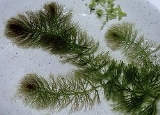
Ceratophyllum grows completely submerged, usually, though not always, floating on the surface, and does not tolerate drought. The plant stems can reach 1–3 m in length. At intervals along nodes of the stem they produce rings of bright green leaves
, which are narrow and often much-branched. The forked leaves are brittle and stiff to the touch in some species, softer in others. The plants have no roots at all, but sometimes they develop modified leaves with a rootlike appearance, which anchor the plant to the bottom. The flower
s are small and inconspicuous, with the male and female flowers on the same plant. In ponds it forms thick buds (turions) in the autumn that sink to the bottom which give the impression that it has been killed by the frost but come spring these will grow back into the long stems slowly filling up the pond.
Hornwort plants float in great numbers just under the surface. They offer excellent protection to fish-spawn, but also to snails, infected with bilharzia. Because of their appearance and their high oxygen production, they are often used in freshwater aquaria
.
and included in Nymphaeales
in the Cronquist system
but recent research has shown that it is not closely related to Nymphaeaceae or any other extant plant family. Some early molecular phylogenies suggested it was the sister group to all other angiosperms, but more recent ones have suggested that it is the sister group to either the monocots or the eudicots
. The APG II system places the family in its own order, the Ceratophyllales.
The division of the genus into species is not completely settled. More than 30 species have been described, but many are probably just variants of these more widely accepted species:
Of these, Ceratophyllum demersum is widespread, with a global distribution; the others all have more restricted ranges.
Flowering plant
The flowering plants , also known as Angiospermae or Magnoliophyta, are the most diverse group of land plants. Angiosperms are seed-producing plants like the gymnosperms and can be distinguished from the gymnosperms by a series of synapomorphies...
s, commonly found in ponds, marshes, and quiet streams in tropical and in temperate regions. They are usually called hornworts, although this name is also used for unrelated plants of the division Anthocerotophyta.
Ceratophyllum grows completely submerged, usually, though not always, floating on the surface, and does not tolerate drought. The plant stems can reach 1–3 m in length. At intervals along nodes of the stem they produce rings of bright green leaves
Leaf
A leaf is an organ of a vascular plant, as defined in botanical terms, and in particular in plant morphology. Foliage is a mass noun that refers to leaves as a feature of plants....
, which are narrow and often much-branched. The forked leaves are brittle and stiff to the touch in some species, softer in others. The plants have no roots at all, but sometimes they develop modified leaves with a rootlike appearance, which anchor the plant to the bottom. The flower
Flower
A flower, sometimes known as a bloom or blossom, is the reproductive structure found in flowering plants . The biological function of a flower is to effect reproduction, usually by providing a mechanism for the union of sperm with eggs...
s are small and inconspicuous, with the male and female flowers on the same plant. In ponds it forms thick buds (turions) in the autumn that sink to the bottom which give the impression that it has been killed by the frost but come spring these will grow back into the long stems slowly filling up the pond.
Hornwort plants float in great numbers just under the surface. They offer excellent protection to fish-spawn, but also to snails, infected with bilharzia. Because of their appearance and their high oxygen production, they are often used in freshwater aquaria
Aquarium
An aquarium is a vivarium consisting of at least one transparent side in which water-dwelling plants or animals are kept. Fishkeepers use aquaria to keep fish, invertebrates, amphibians, marine mammals, turtles, and aquatic plants...
.
Relationships and classification
Ceratophyllum is considered unique enough to warrant its own family, Ceratophyllaceae, and its precise relationship to other angiosperms remains unclear. It was considered a relative of NymphaeaceaeNymphaeaceae
Nymphaeaceae is a family of flowering plants. Members of this family are commonly called water lilies and live in freshwater areas in temperate and tropical climates around the world. The family contains eight genera. There are about 70 species of water lilies around the world. The genus...
and included in Nymphaeales
Nymphaeales
Nymphaeales is an order of plants, which consists of water lilies and other aquatic plants.This order is considered to be a basal, or early diverging, group of angiosperms...
in the Cronquist system
Cronquist system
The Cronquist system is a taxonomic classification system of flowering plants. It was developed by Arthur Cronquist in his texts An Integrated System of Classification of Flowering Plants and The Evolution and Classification of Flowering Plants .Cronquist's system places flowering plants into two...
but recent research has shown that it is not closely related to Nymphaeaceae or any other extant plant family. Some early molecular phylogenies suggested it was the sister group to all other angiosperms, but more recent ones have suggested that it is the sister group to either the monocots or the eudicots
Eudicots
Eudicots and Eudicotyledons are botanical terms introduced by Doyle & Hotton to refer to a monophyletic group of flowering plants that had been called tricolpates or non-Magnoliid dicots by previous authors...
. The APG II system places the family in its own order, the Ceratophyllales.
| {clade| style=font-size:75%;line-height:75% | label1=Angiospermae | 1= }} |
| The phylogeny Phylogenetics In biology, phylogenetics is the study of evolutionary relatedness among groups of organisms , which is discovered through molecular sequencing data and morphological data matrices... of the flowering plants, as of APG III (2009). |
The division of the genus into species is not completely settled. More than 30 species have been described, but many are probably just variants of these more widely accepted species:
- Ceratophyllum demersumCeratophyllum demersumCeratophyllum demersum is a species of Ceratophyllum. It is a submerged, free-floating aquatic plant, native to North America but nowadays having a cosmopolitan distribution in temperate and tropical regions...
L. (Rigid Hornwort or Common Hornwort) - Ceratophyllum echinatumCeratophyllum echinatumCeratophyllum echinatum , commonly called Spineless Hornwort, is an aquatic perennial plant of the family Ceratophyllum. It can be found in ponds and lakes. It is principally an eastern North American species and the only species of its genus endemic to North America. -Description:Ceratophyllum...
A.Gray (Spineless Hornwort) - Ceratophyllum muricatum Cham. (Prickly Hornwort)
- Ceratophyllum platyacanthum Cham.
- Ceratophyllum submersum L. (Soft Hornwort or Tropical Hornwort)
Of these, Ceratophyllum demersum is widespread, with a global distribution; the others all have more restricted ranges.