


Dakota War of 1862

Encyclopedia
The Dakota War of 1862, also known as the Sioux Uprising, (and the Dakota Uprising, the Sioux Outbreak of 1862, the Dakota Conflict, the U.S.–Dakota War of 1862 or Little Crow's War) was an armed conflict between the United States
and several bands of the eastern Sioux
. It began on August 17, 1862, along the Minnesota River
in southwest Minnesota
. It ended with a mass execution
of 38 Dakota men on December 26, 1862, in Mankato, Minnesota
.
Throughout the late 1850s, treaty violations by the United States and late or unfair annuity payments by Indian agent
s caused increasing hunger and hardship among the Dakota. Traders with the Dakota previously had demanded that the government give the annuity payments directly to them (introducing the possibility of unfair dealing between the agents and the traders to the exclusion of the Dakota). In mid-1862 the Dakota demanded the annuities directly from their agent, Thomas J. Galbraith. The traders refused to provide any more supplies on credit under those conditions, and negotiations reached an impasse.
On August 17, 1862, one young Dakota with a hunting party of three others killed five settlers while on a hunting expedition
. That night a council of Dakota decided to attack settlements throughout the Minnesota River
valley to try to drive whites out of the area. There has never been an official report on the number of settlers killed, although as many as over 800 settlers have been cited and is not out of line. Further consideration is given to maybe just as many settlers being taken captive as slaves, if not tortured to death as was customary.
Over the next several months, continued battles between the Dakota against settlers and later, the United States Army
, ended with the surrender of most of the Dakota bands. By late December 1862, soldiers had taken captive more than a thousand Dakota, who were interned in jails in Minnesota. After trials and sentencing, 38 Dakota were hanged
on December 26, 1862, in the largest one-day execution in American history. In April 1863 the rest of the Dakota were expelled from Minnesota to Nebraska
and South Dakota
. The United States Congress
abolished their reservations
.
on July 23, 1851, and Treaty of Mendota
on August 5, 1851, by which the Dakota were forced to cede large tracts of land in Minnesota Territory
to the U.S. In exchange for money
and goods, the Dakota were forced to agree to live on a 20-mile (32 km) wide Indian reservation
centered on a 150 mile (240 km) stretch of the upper Minnesota River.
However, the United States Senate
deleted Article 3 of each treaty during the ratification
process. Much of the promised compensation never arrived, was lost, or was effectively stolen due to corruption in the Bureau of Indian Affairs
. Also, annuity payments guaranteed to the Dakota often were provided directly to traders instead (to pay off debts which the Dakota incurred with the traders).
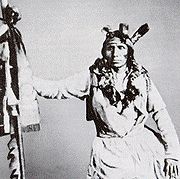 When Minnesota
became a state on May 11, 1858, representatives of several Dakota bands led by Little Crow
traveled to Washington, D.C.
, to negotiate about enforcing existing treaties. The northern half of the reservation along the Minnesota River
was lost, and rights to the quarry
at Pipestone, Minnesota
, were also taken from the Dakota. This was a major blow to the standing of Little Crow in the Dakota community.
The land was divided into townships
and plots for settlement. Logging and agriculture on these plots eliminated surrounding forests and prairies, which interrupted the Dakota's annual cycle of farm
ing, hunting
, fishing
and gathering wild rice
. Hunting by settlers dramatically reduced wild game, such as bison
, elk
, whitetail deer and bear
. Not only did this decrease the meat available for the Dakota in southern and western Minnesota, but it directly reduced their ability to sell furs to traders for additional supplies.
Although payments were guaranteed, the US government was often behind or failed to pay because of Federal preoccupation with the American Civil War
. Most land in the river valley was not arable
, and hunting could no longer support the Dakota community. The Dakota became increasingly discontented over their losses: land, non-payment of annuities, past broken treaties, plus food shortages and famine
following crop failure. Tensions increased through the summer of 1862.
and the Wahpekute, turned to the Lower Sioux Agency for supplies on August 15, 1862, they were rejected. Indian Agent (and Minnesota State Senator) Thomas Galbraith managed the area and would not distribute food without payment to these bands.
At a meeting of the Dakota, the U.S. government and local traders, the Dakota representatives asked the representative of the government traders, Andrew Jackson Myrick, to sell them food on credit. His response was said to be, "[S]o far as I am concerned, let them eat grass." Accounts of his words have varied. According to an essay by Dr. Gary Clayton Anderson, professor of history at the University of Oklahoma, Myrick's comment has been elevated to a level of importance far above its original effect during early August 1862.
the next day. They arrived too late to prevent violence. On August 17, 1862, four young Dakota men were on a hunting trip in Acton Township, Minnesota
, during which one stole eggs and then killed five white settlers. Soon after, a Dakota war council was convened and their leader, Little Crow
, agreed to continue attacks on the European-American settlements to try to drive out the whites.
On August 18, 1862, Little Crow led a group that attacked the Lower Sioux (or Redwood) Agency. Andrew Myrick was among the first who were killed. He was discovered trying to escape through a second-floor window of a building at the agency. Myrick's body later was found with grass stuffed into his mouth. The warriors burned the buildings at the Lower Sioux Agency, accidentally providing time for settlers to escape across the river at Redwood Ferry. Minnesota militia
forces and B Company of the 5th Minnesota Volunteer Infantry Regiment
sent to quell the uprising were defeated at the Battle of Redwood Ferry
. Twenty-four soldiers, including the party's commander (Captain John Marsh), were killed in the battle. Throughout the day, Dakota war parties swept the Minnesota River Valley and near vicinity, killing numerous settlers. Numerous settlements including the Townships of Milford, Leavenworth and Sacred Heart, were surrounded, burned and their populations nearly exterminated.
 Confident with their initial success, the Dakota continued their offensive and attacked the settlement of New Ulm
, Minnesota
, on August 19, 1862, and again on August 23, 1862. Dakota warriors initially decided not to attack the heavily defended Fort Ridgely
along the river. They turned toward the town, killing settlers along the way. By the time New Ulm was attacked, residents had organized defenses in the town center and were able to keep the Dakota at bay during the brief siege. Dakota warriors penetrated parts of the defenses enough to burn much of the town. By that evening, a thunderstorm dampened the warfare, preventing further Dakota attacks.
Regular soldiers and militia from nearby towns (including two companies of the 5th Minnesota Volunteer Infantry then stationed at Fort Ridgely) reinforced New Ulm. Residents continued to build barricades around the town.
During this period, the Dakota attacked Fort Ridgely on August 20 and 22, 1862. Although the Dakota were not able to take the fort, they ambushed a relief party from the fort to New Ulm on August 21. The defense at the Battle of Fort Ridgely
further limited the ability of the American forces to aid outlying settlements. The Dakota raided farms and small settlements throughout south central Minnesota and what was then eastern Dakota Territory
.
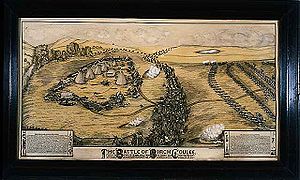
Minnesota militia counterattacks resulted in a major defeat of American forces at the Battle of Birch Coulee
on September 2, 1862. The battle began when the Dakota attacked a detachment of 150 American soldiers at Birch Coulee, 16 miles (26 km) from Fort Ridgely. The detachment had been sent out to find survivors, bury American dead and report on the location of Dakota fighters. A three-hour firefight began with an early morning assault. Thirteen soldiers were killed and 47 were wounded, while only two Dakota were killed. A column of 240 soldiers from Fort Ridgely relieved the detachment at Birch Coulee the same afternoon.
 Further north, the Dakota attacked several unfortified stagecoach
stops and river crossings along the Red River Trails
, a settled trade route between Fort Garry
(now Winnipeg
, Manitoba
) and Saint Paul, Minnesota
, in the Red River Valley
in northwestern Minnesota and eastern Dakota Territory. Many settlers and employees of the Hudson's Bay Company
and other local enterprises in this sparsely populated country took refuge in Fort Abercrombie
, located in a bend of the Red River of the North
about 25 miles (40 km) south of present-day Fargo, North Dakota
. Between late August and late September, the Dakota launched several attacks on Fort Abercrombie; all were repelled by its defenders.
In the meantime steamboat
and flatboat
trade on the Red River came to a halt. Mail carriers, stage drivers and military couriers were killed while attempting to reach settlements such as Pembina, North Dakota
, Fort Garry, St. Cloud, Minnesota
, and Fort Snelling. Eventually the garrison at Fort Abercrombie was relieved by a U.S. Army company from Fort Snelling, and the civilian refugees were removed to St. Cloud.
, the region's representatives had to repeatedly appeal for aid before Pres. Abraham Lincoln
appointed Gen. John Pope
to quell the violence. He led troops from the 3rd Minnesota Volunteer Infantry Regiment
and 4th Minnesota Volunteer Infantry Regiment
. The 9th Minnesota Volunteer Infantry Regiment
and 10th Minnesota Volunteer Infantry Regiment
, which were still being constituted, had troops dispatched to the front as soon as Companies were formed. Minnesota Gov. Alexander Ramsey
also enlisted the help of Col. Henry Hastings Sibley
(the previous governor
) to aid in the effort.
After the arrival of a larger army force, the final large-scale fighting took place at the Battle of Wood Lake
on September 23, 1862. According to the official report of Lt. Col. William R. Marshall of the 7th Minnesota Volunteer Infantry Regiment
, elements of the 7th Minnesota and the 6th Minnesota Volunteer Infantry Regiment
(and a six-pounder cannon
) were deployed equally in dugouts
and in a skirmish line. After brief fighting, the forces in the skirmish line charged against the Dakota (then in a ravine) and defeated them overwhelmingly.
Among the Citizen Soldier units in Sibley's expedition:
alarm over the Santee
attacks led to the construction of a line of forts from Sioux City
to Iowa Lake. The region had already been militarized because of the Spirit Lake Massacre
in 1857. After the 1862 conflict began, the Iowa Legislature authorized “not less than 500 mounted men from the frontier counties at the earliest possible moment, and to be stationed where most needed”, although this number was soon reduced. Although no fighting took place in Iowa, the Dakota uprising led to the rapid expulsion of the few unassimilated Native Americans left there.
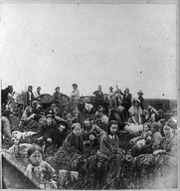
on September 26, 1862. The place was so-named because it was the site where the Dakota released 269 European-American captives to the troops commanded by Col. Henry Sibley. The captives included 162 "mixed-bloods" (mixed-race, some likely descendants of Dakota women who were mistakenly counted as captives) and 107 whites, mostly women and children. Most of the warriors were imprisoned before Sibley arrived at Camp Release. The surrendered Dakota warriors were held until military trials took place in November 1862.
Little Crow was forced to retreat sometime in September 1862. He stayed briefly in Canada
but soon returned to the Minnesota area. He was killed on July 3, 1863, near Hutchinson, Minnesota
, while gathering raspberries with his teenage son. The pair had wandered onto the land of white settler Nathan Lamson, who shot at them to collect bounties. Once it was discovered that the body was of Little Crow, his skull and scalp were put on display in St. Paul, Minnesota. The city held the trophies until 1971, when it returned the remains to Little Crow's grandson. For killing Little Crow, the state granted Lamson an additional $500 bounty. For his part in the warfare, Little Crow's son was sentenced to death by a military tribunal, a sentence then commuted to a prison term.
s and sentenced to death. Some trials lasted less than 5 minutes. No one explained the proceedings to the defendants, nor were the Sioux represented by a defense in court. Pres. Abraham Lincoln
personally reviewed the trial records to distinguish between those who had engaged in warfare against the U.S., versus those who had committed crimes of rape and murder against civilians.
Henry Whipple
, the Episcopal
bishop of Minnesota and a reformer of U.S. policies toward Native Americans, urged Lincoln to proceed with leniency. On the other hand, General Pope and Minnesota Senator Morton S. Wilkinson
told him that leniency would not be received well by the white population. Governor Ramsey warned Lincoln that, unless all 303 Sioux were executed, "[P]rivate revenge would on all this border take the place of official judgment on these Indians." In the end, Lincoln commuted the death sentences of 264 prisoners, but he allowed the execution of 39 men.
This clemency resulted in protests from Minnesota, which persisted until the Secretary of the Interior offered white Minnesotans "reasonable compensation for the depredations committed." Republicans did not fare as well in Minnesota in the 1864 election as they had before. Ramsey (by then a senator) informed Lincoln that more hangings would have resulted in a larger electoral majority. The President reportedly replied, "I could not afford to hang men for votes."
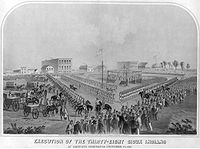
One of the 39 condemned prisoners was granted a reprieve. The Army executed the 38 remaining prisoners by hanging on December 26, 1862, in Mankato, Minnesota
. It remains the largest mass execution in American history.
 At least two Sioux leaders, Little Six and Medicine Bottle, escaped to Canada. They were captured, drugged and returned to the United States. They were hanged at Fort Snelling in 1865.
s for anatomical study, several doctors wanted to obtain the bodies after the execution. The grave was reopened in the night and the bodies were distributed among the doctors, a practice common in the era. The doctor who received the body of Mahpiya Okinajin (He Who Stands in Clouds), also known as "Cut Nose", was William Worrall Mayo
.
Mayo brought the body of Mahpiya Okinajin to Le Sueur, Minnesota
, where he dissected it in the presence of medical colleagues. Afterward, he had the skeleton cleaned, dried and varnished. Mayo kept it in an iron kettle in his home office. His sons
received their first lessons in osteology from this skeleton In the late 20th century, the identifiable remains of Mahpiya Okinajin and other Native Americans were returned by the Mayo Clinic
to a Dakota tribe for reburial per the Native American Graves Protection and Repatriation Act
.
, where they were held in prison for almost four years. By the time of their release, one third of the prisoners had died of disease. The survivors were sent with their families to Nebraska
. Their families had already had been expelled from Minnesota.
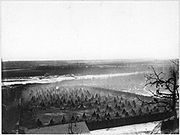 During this time, more than 1600 Dakota women, children and old men were held in an internment camp on Pike Island
, near Fort Snelling, Minnesota
. Living conditions and sanitation were poor, and infectious disease struck the camp, killing more than three hundred. In April 1863 the U.S. Congress abolished the reservation, declared all previous treaties with the Dakota null and void, and undertook proceedings to expel the Dakota people entirely from Minnesota. To this end, a bounty
of $25 per scalp was placed on any Dakota found free within the boundaries of the state. The only exception to this legislation applied to 208 Mdewakanton, who remained neutral or assisted white settlers in the conflict.
In May 1863 Dakota survivors were forced aboard steamboat
s and relocated to the Crow Creek Reservation
, in the southeastern Dakota Territory
, a place stricken by drought at the time. Many of the survivors of Crow Creek moved three years later to the Niobrara Reservation in Nebraska
.
"Mr. Massipost had two daughters, young ladies, intelligent and accomplished. These the savages murdered most brutally. The head of one of them was afterward found, severed from the body, attached to a fish-hook, and hung upon a nail. His son, a young man of twenty-four years, was also killed. Mr. Massipost and a son of eight years escaped to New Ulm
."
"The daughter of Mr. Schwandt, enceinte [pregnant], was cut open, as was learned afterward, the child taken alive from the mother, and nailed to a tree. The son of Mr. Schwandt, aged thirteen years, who had been beaten by the Indians, until dead, as was supposed, was present, and saw the entire tragedy. He saw the child taken alive from the body of his sister, Mrs. Waltz, and nailed to a tree in the yard. It struggled some time after the nails were driven through it! This occurred in the forenoon of Monday, 18th of August, 1862."
on July 26, 1863; the Battle of Stony Lake
on July 28, 1863; and the Battle of Whitestone Hill
on September 3, 1863. The Sioux retreated further, but faced a United States army again in 1864. General Alfred Sully
led a force from near Fort Pierre, South Dakota
, and decisively defeated the Sioux at the Battle of Killdeer Mountain on July 28, 1864.
Conflicts continued. Within two years settlers' encroachment on Lakota land sparked Red Cloud's War
; the US desire for control of the Black Hills
in South Dakota
prompted the government to authorize an offensive in 1876 in what would be called the Black Hills War. By 1881 the majority of the Sioux had surrendered to American military forces. In 1890 the Wounded Knee Massacre
ended all effective Sioux resistance. It was the last major armed engagement between the United States and the Sioux.

valley and surrounding upland prairie areas were abandoned by most settlers during the war. Many of the families who fled their farms and homes as refugees never returned. Following the American Civil War
, however, the area was resettled. By the mid-1870s, it was again being used for agriculture.
The Lower Sioux Indian Reservation
was reestablished at the site of the Lower Sioux Agency near Morton
. It was not until the 1930s that the US created the smaller Upper Sioux Indian Reservation
near Granite Falls
.
Although some Dakota opposed the war, most were expelled from Minnesota, including those who attempted to assist settlers. The Yankton Sioux Chief Struck by the Ree
deployed some of his warriors to this effect, but was not judged friendly enough to be allowed to remain in the state immediately after the war. By the 1880s, a number of Dakota had moved back to the Minnesota River valley, notably the Goodthunder, Wabasha, Bluestone and Lawrence families. They were joined by Dakota families who had been living under the protection of Bishop Henry Benjamin Whipple
and the trader Alexander Faribault.
By the late 1920s, the conflict began to pass into the realm of oral tradition
in Minnesota. Eyewitness accounts were communicated first-hand to individuals who survived into the 1970s and early 1980s. The stories of innocent individuals and families of struggling pioneer farmers being killed by Dakota have remained in the consciousness of the prairie communities of southcentral Minnesota.
Large stone monuments at the Wood Lake Battlefield
and in the parade ground of Fort Ridgely
commemorate the battles and members of the military killed in action.
In 1972 the City of Mankato, Minnesota
removed a plaque that had commemorated the mass execution of the thirty-eight Dakota from the site where the hanging occurred. In 1992 the City purchased the site and created Reconciliation Park. There is purposely no mention of the execution, but several stone statues in and around the park serve as a memorial. The annual Mankato Pow-wow
, held in September, commemorates the lives of the executed men, but also seeks to reconcile the European American and Dakota communities. The Birch Coulee Pow-wow, held on Labor Day
weekend, honors the lives of those who were hanged.
A number of local monuments honor white civilians killed during the war. These include the: Acton, Minnesota
monument to those killed in the attack on the Howard Baker farm; Guri Endreson monument in the Vikor Lutheran Cemetery near Willmar, Minnesota
; and Brownton, Minnesota
monument to the White family.
United States
The United States of America is a federal constitutional republic comprising fifty states and a federal district...
and several bands of the eastern Sioux
Sioux
The Sioux are Native American and First Nations people in North America. The term can refer to any ethnic group within the Great Sioux Nation or any of the nation's many language dialects...
. It began on August 17, 1862, along the Minnesota River
Minnesota River
The Minnesota River is a tributary of the Mississippi River, approximately 332 miles long, in the U.S. state of Minnesota. It drains a watershed of nearly , in Minnesota and about in South Dakota and Iowa....
in southwest Minnesota
Minnesota
Minnesota is a U.S. state located in the Midwestern United States. The twelfth largest state of the U.S., it is the twenty-first most populous, with 5.3 million residents. Minnesota was carved out of the eastern half of the Minnesota Territory and admitted to the Union as the thirty-second state...
. It ended with a mass execution
Capital punishment
Capital punishment, the death penalty, or execution is the sentence of death upon a person by the state as a punishment for an offence. Crimes that can result in a death penalty are known as capital crimes or capital offences. The term capital originates from the Latin capitalis, literally...
of 38 Dakota men on December 26, 1862, in Mankato, Minnesota
Mankato, Minnesota
Mankato is a city in Blue Earth, Nicollet, and Le Sueur counties in the U.S. state of Minnesota. The population was 39,309 at the 2010 census, making it the fourth largest city in Minnesota outside of the Minneapolis-St. Paul metropolitan area. The county seat of Blue Earth County, it is located...
.
Throughout the late 1850s, treaty violations by the United States and late or unfair annuity payments by Indian agent
Indian agent
In United States history, an Indian agent was an individual authorized to interact with Native American tribes on behalf of the U.S. government.-Indian agents:*Leander Clark was agent for the Sac and Fox in Iowa beginning in 1866....
s caused increasing hunger and hardship among the Dakota. Traders with the Dakota previously had demanded that the government give the annuity payments directly to them (introducing the possibility of unfair dealing between the agents and the traders to the exclusion of the Dakota). In mid-1862 the Dakota demanded the annuities directly from their agent, Thomas J. Galbraith. The traders refused to provide any more supplies on credit under those conditions, and negotiations reached an impasse.
On August 17, 1862, one young Dakota with a hunting party of three others killed five settlers while on a hunting expedition
Hunting
Hunting is the practice of pursuing any living thing, usually wildlife, for food, recreation, or trade. In present-day use, the term refers to lawful hunting, as distinguished from poaching, which is the killing, trapping or capture of the hunted species contrary to applicable law...
. That night a council of Dakota decided to attack settlements throughout the Minnesota River
Minnesota River
The Minnesota River is a tributary of the Mississippi River, approximately 332 miles long, in the U.S. state of Minnesota. It drains a watershed of nearly , in Minnesota and about in South Dakota and Iowa....
valley to try to drive whites out of the area. There has never been an official report on the number of settlers killed, although as many as over 800 settlers have been cited and is not out of line. Further consideration is given to maybe just as many settlers being taken captive as slaves, if not tortured to death as was customary.
Over the next several months, continued battles between the Dakota against settlers and later, the United States Army
United States Army
The United States Army is the main branch of the United States Armed Forces responsible for land-based military operations. It is the largest and oldest established branch of the U.S. military, and is one of seven U.S. uniformed services...
, ended with the surrender of most of the Dakota bands. By late December 1862, soldiers had taken captive more than a thousand Dakota, who were interned in jails in Minnesota. After trials and sentencing, 38 Dakota were hanged
Hanging
Hanging is the lethal suspension of a person by a ligature. The Oxford English Dictionary states that hanging in this sense is "specifically to put to death by suspension by the neck", though it formerly also referred to crucifixion and death by impalement in which the body would remain...
on December 26, 1862, in the largest one-day execution in American history. In April 1863 the rest of the Dakota were expelled from Minnesota to Nebraska
Nebraska
Nebraska is a state on the Great Plains of the Midwestern United States. The state's capital is Lincoln and its largest city is Omaha, on the Missouri River....
and South Dakota
South Dakota
South Dakota is a state located in the Midwestern region of the United States. It is named after the Lakota and Dakota Sioux American Indian tribes. Once a part of Dakota Territory, South Dakota became a state on November 2, 1889. The state has an area of and an estimated population of just over...
. The United States Congress
United States Congress
The United States Congress is the bicameral legislature of the federal government of the United States, consisting of the Senate and the House of Representatives. The Congress meets in the United States Capitol in Washington, D.C....
abolished their reservations
Indian reservation
An American Indian reservation is an area of land managed by a Native American tribe under the United States Department of the Interior's Bureau of Indian Affairs...
.
Previous treaties
The United States and Dakota leaders negotiated the Treaty of Traverse des SiouxTreaty of Traverse des Sioux
The Treaty of Traverse des Sioux was a treaty signed on July 23, 1851, between the United States government and Sioux Indian bands in Minnesota Territory by which the Sioux ceded territory. The treaty was instigated by Alexander Ramsey, the first governor of Minnesota Territory, and Luke Lea,...
on July 23, 1851, and Treaty of Mendota
Treaty of Mendota
The Treaty of Mendota was signed in Mendota, Minnesota on August 5, 1851 between the United States federal government and the Sioux tribes of Minnesota ....
on August 5, 1851, by which the Dakota were forced to cede large tracts of land in Minnesota Territory
Minnesota Territory
The Territory of Minnesota was an organized incorporated territory of the United States that existed from March 3, 1849, until May 11, 1858, when the eastern portion of the territory was admitted to the Union as the State of Minnesota.-History:...
to the U.S. In exchange for money
Money
Money is any object or record that is generally accepted as payment for goods and services and repayment of debts in a given country or socio-economic context. The main functions of money are distinguished as: a medium of exchange; a unit of account; a store of value; and, occasionally in the past,...
and goods, the Dakota were forced to agree to live on a 20-mile (32 km) wide Indian reservation
Indian reservation
An American Indian reservation is an area of land managed by a Native American tribe under the United States Department of the Interior's Bureau of Indian Affairs...
centered on a 150 mile (240 km) stretch of the upper Minnesota River.
However, the United States Senate
United States Senate
The United States Senate is the upper house of the bicameral legislature of the United States, and together with the United States House of Representatives comprises the United States Congress. The composition and powers of the Senate are established in Article One of the U.S. Constitution. Each...
deleted Article 3 of each treaty during the ratification
Ratification
Ratification is a principal's approval of an act of its agent where the agent lacked authority to legally bind the principal. The term applies to private contract law, international treaties, and constitutionals in federations such as the United States and Canada.- Private law :In contract law, the...
process. Much of the promised compensation never arrived, was lost, or was effectively stolen due to corruption in the Bureau of Indian Affairs
Bureau of Indian Affairs
The Bureau of Indian Affairs is an agency of the federal government of the United States within the US Department of the Interior. It is responsible for the administration and management of of land held in trust by the United States for Native Americans in the United States, Native American...
. Also, annuity payments guaranteed to the Dakota often were provided directly to traders instead (to pay off debts which the Dakota incurred with the traders).
Encroachments on Dakota lands
Minnesota
Minnesota is a U.S. state located in the Midwestern United States. The twelfth largest state of the U.S., it is the twenty-first most populous, with 5.3 million residents. Minnesota was carved out of the eastern half of the Minnesota Territory and admitted to the Union as the thirty-second state...
became a state on May 11, 1858, representatives of several Dakota bands led by Little Crow
Little Crow
The Little Crow is an Australian species of crow, very similar to the Torresian Crow in having white bases to the neck and head feathers but slightly smaller and with a proportionately smaller bill...
traveled to Washington, D.C.
Washington, D.C.
Washington, D.C., formally the District of Columbia and commonly referred to as Washington, "the District", or simply D.C., is the capital of the United States. On July 16, 1790, the United States Congress approved the creation of a permanent national capital as permitted by the U.S. Constitution....
, to negotiate about enforcing existing treaties. The northern half of the reservation along the Minnesota River
Minnesota River
The Minnesota River is a tributary of the Mississippi River, approximately 332 miles long, in the U.S. state of Minnesota. It drains a watershed of nearly , in Minnesota and about in South Dakota and Iowa....
was lost, and rights to the quarry
Quarry
A quarry is a type of open-pit mine from which rock or minerals are extracted. Quarries are generally used for extracting building materials, such as dimension stone, construction aggregate, riprap, sand, and gravel. They are often collocated with concrete and asphalt plants due to the requirement...
at Pipestone, Minnesota
Pipestone, Minnesota
As of the census of 2000, there were 4,280 people, 1,900 households, and 1,138 families residing in the city. The population density was 1,090.8 people per square mile . There were 2,097 housing units at an average density of 534.4 per square mile...
, were also taken from the Dakota. This was a major blow to the standing of Little Crow in the Dakota community.
The land was divided into townships
Township (United States)
A township in the United States is a small geographic area. Townships range in size from 6 to 54 square miles , with being the norm.The term is used in three ways....
and plots for settlement. Logging and agriculture on these plots eliminated surrounding forests and prairies, which interrupted the Dakota's annual cycle of farm
Farm
A farm is an area of land, or, for aquaculture, lake, river or sea, including various structures, devoted primarily to the practice of producing and managing food , fibres and, increasingly, fuel. It is the basic production facility in food production. Farms may be owned and operated by a single...
ing, hunting
Hunting
Hunting is the practice of pursuing any living thing, usually wildlife, for food, recreation, or trade. In present-day use, the term refers to lawful hunting, as distinguished from poaching, which is the killing, trapping or capture of the hunted species contrary to applicable law...
, fishing
Fishing
Fishing is the activity of trying to catch wild fish. Fish are normally caught in the wild. Techniques for catching fish include hand gathering, spearing, netting, angling and trapping....
and gathering wild rice
Wild rice
Wild rice is four species of grasses forming the genus Zizania, and the grain which can be harvested from them. The grain was historically gathered and eaten in both North America and China...
. Hunting by settlers dramatically reduced wild game, such as bison
American Bison
The American bison , also commonly known as the American buffalo, is a North American species of bison that once roamed the grasslands of North America in massive herds...
, elk
Elk
The Elk is the large deer, also called Cervus canadensis or wapiti, of North America and eastern Asia.Elk may also refer to:Other antlered mammals:...
, whitetail deer and bear
Bear
Bears are mammals of the family Ursidae. Bears are classified as caniforms, or doglike carnivorans, with the pinnipeds being their closest living relatives. Although there are only eight living species of bear, they are widespread, appearing in a wide variety of habitats throughout the Northern...
. Not only did this decrease the meat available for the Dakota in southern and western Minnesota, but it directly reduced their ability to sell furs to traders for additional supplies.
Although payments were guaranteed, the US government was often behind or failed to pay because of Federal preoccupation with the American Civil War
American Civil War
The American Civil War was a civil war fought in the United States of America. In response to the election of Abraham Lincoln as President of the United States, 11 southern slave states declared their secession from the United States and formed the Confederate States of America ; the other 25...
. Most land in the river valley was not arable
Arable land
In geography and agriculture, arable land is land that can be used for growing crops. It includes all land under temporary crops , temporary meadows for mowing or pasture, land under market and kitchen gardens and land temporarily fallow...
, and hunting could no longer support the Dakota community. The Dakota became increasingly discontented over their losses: land, non-payment of annuities, past broken treaties, plus food shortages and famine
Famine
A famine is a widespread scarcity of food, caused by several factors including crop failure, overpopulation, or government policies. This phenomenon is usually accompanied or followed by regional malnutrition, starvation, epidemic, and increased mortality. Every continent in the world has...
following crop failure. Tensions increased through the summer of 1862.
Breakdown of negotiations
On August 4, 1862, representatives of the northern Sissetowan and Wahpeton Dakota bands met at the Upper Sioux Agency in the northwestern part of the reservation and successfully negotiated to obtain food. When two other bands of the Dakota, the southern MdewakantonMdewakanton
Mdewakantonwan are one of the sub-tribes of the Isanti Dakota . Their historic home is Mille Lacs Lake in central Minnesota, which in the Dakota language was called mde wakan .As part of the Santee Sioux, their ancestors had migrated from the Southeast of the present-day United States, where the...
and the Wahpekute, turned to the Lower Sioux Agency for supplies on August 15, 1862, they were rejected. Indian Agent (and Minnesota State Senator) Thomas Galbraith managed the area and would not distribute food without payment to these bands.
At a meeting of the Dakota, the U.S. government and local traders, the Dakota representatives asked the representative of the government traders, Andrew Jackson Myrick, to sell them food on credit. His response was said to be, "[S]o far as I am concerned, let them eat grass." Accounts of his words have varied. According to an essay by Dr. Gary Clayton Anderson, professor of history at the University of Oklahoma, Myrick's comment has been elevated to a level of importance far above its original effect during early August 1862.
Early fighting
On August 16, 1862, the treaty payments to the Dakota arrived in St. Paul, Minnesota, and were brought to Fort RidgelyFort Ridgely
Fort Ridgely was a United States Army outpost near the Dakota reservation in southwestern Minnesota . Built between 1853–1855, it played an important role in the Dakota War of 1862...
the next day. They arrived too late to prevent violence. On August 17, 1862, four young Dakota men were on a hunting trip in Acton Township, Minnesota
Acton Township, Minnesota
Acton Township is a township in Meeker County, Minnesota, United States. The population was 381 at the 2000 census.-Geography:According to the United States Census Bureau, the township has a total area of , of which, of it is land and of it is water.-Demographics:As of the census of 2000, there...
, during which one stole eggs and then killed five white settlers. Soon after, a Dakota war council was convened and their leader, Little Crow
Little Crow
The Little Crow is an Australian species of crow, very similar to the Torresian Crow in having white bases to the neck and head feathers but slightly smaller and with a proportionately smaller bill...
, agreed to continue attacks on the European-American settlements to try to drive out the whites.
On August 18, 1862, Little Crow led a group that attacked the Lower Sioux (or Redwood) Agency. Andrew Myrick was among the first who were killed. He was discovered trying to escape through a second-floor window of a building at the agency. Myrick's body later was found with grass stuffed into his mouth. The warriors burned the buildings at the Lower Sioux Agency, accidentally providing time for settlers to escape across the river at Redwood Ferry. Minnesota militia
Militia
The term militia is commonly used today to refer to a military force composed of ordinary citizens to provide defense, emergency law enforcement, or paramilitary service, in times of emergency without being paid a regular salary or committed to a fixed term of service. It is a polyseme with...
forces and B Company of the 5th Minnesota Volunteer Infantry Regiment
5th Minnesota Volunteer Infantry Regiment
The 5th Minnesota Regiment Volunteer Infantry was an infantry regiment that served in the Union Army in the Western Theater of the American Civil War.-Service:...
sent to quell the uprising were defeated at the Battle of Redwood Ferry
Battle of Redwood Ferry
The Battle of Redwood Ferry was a battle in the Dakota War of 1862.-Description:News reached Captain John S. Marsh at Fort Ridgely that the Lower Sioux Agency had been attacked on August 18, 1862....
. Twenty-four soldiers, including the party's commander (Captain John Marsh), were killed in the battle. Throughout the day, Dakota war parties swept the Minnesota River Valley and near vicinity, killing numerous settlers. Numerous settlements including the Townships of Milford, Leavenworth and Sacred Heart, were surrounded, burned and their populations nearly exterminated.
Early Dakota offensives
New Ulm, Minnesota
New Ulm is a city in Brown County, Minnesota, United States. The population was 13,522 at the 2010 census. It is the county seat of Brown County....
, Minnesota
Minnesota
Minnesota is a U.S. state located in the Midwestern United States. The twelfth largest state of the U.S., it is the twenty-first most populous, with 5.3 million residents. Minnesota was carved out of the eastern half of the Minnesota Territory and admitted to the Union as the thirty-second state...
, on August 19, 1862, and again on August 23, 1862. Dakota warriors initially decided not to attack the heavily defended Fort Ridgely
Fort Ridgely
Fort Ridgely was a United States Army outpost near the Dakota reservation in southwestern Minnesota . Built between 1853–1855, it played an important role in the Dakota War of 1862...
along the river. They turned toward the town, killing settlers along the way. By the time New Ulm was attacked, residents had organized defenses in the town center and were able to keep the Dakota at bay during the brief siege. Dakota warriors penetrated parts of the defenses enough to burn much of the town. By that evening, a thunderstorm dampened the warfare, preventing further Dakota attacks.
Regular soldiers and militia from nearby towns (including two companies of the 5th Minnesota Volunteer Infantry then stationed at Fort Ridgely) reinforced New Ulm. Residents continued to build barricades around the town.
During this period, the Dakota attacked Fort Ridgely on August 20 and 22, 1862. Although the Dakota were not able to take the fort, they ambushed a relief party from the fort to New Ulm on August 21. The defense at the Battle of Fort Ridgely
Battle of Fort Ridgely
Fort Ridgely was built in 1851 in the territory of southern Minnesota. It wasn't much of a fort, but it was the only military post between the Sioux Reservations and the settlers. On August 18, 1862, the Lower Sioux Agency in Renville County, Minnesota, was attacked by Indians...
further limited the ability of the American forces to aid outlying settlements. The Dakota raided farms and small settlements throughout south central Minnesota and what was then eastern Dakota Territory
Dakota Territory
The Territory of Dakota was an organized incorporated territory of the United States that existed from March 2, 1861, until November 2, 1889, when the final extent of the reduced territory was split and admitted to the Union as the states of North and South Dakota.The Dakota Territory consisted of...
.
Minnesota militia counterattacks resulted in a major defeat of American forces at the Battle of Birch Coulee
Battle of Birch Coulee
The Battle of Birch Coulee occurred September 2, 1862 during the Dakota War of 1862. After the Battle of Fort Ridgely and the Battle of New Ulm, Colonel Henry Hastings Sibley was planning to punish the Sioux and to obtain the release of the settlers they were holding captive...
on September 2, 1862. The battle began when the Dakota attacked a detachment of 150 American soldiers at Birch Coulee, 16 miles (26 km) from Fort Ridgely. The detachment had been sent out to find survivors, bury American dead and report on the location of Dakota fighters. A three-hour firefight began with an early morning assault. Thirteen soldiers were killed and 47 were wounded, while only two Dakota were killed. A column of 240 soldiers from Fort Ridgely relieved the detachment at Birch Coulee the same afternoon.
Attacks in northern Minnesota
Stagecoach
A stagecoach is a type of covered wagon for passengers and goods, strongly sprung and drawn by four horses, usually four-in-hand. Widely used before the introduction of railway transport, it made regular trips between stages or stations, which were places of rest provided for stagecoach travelers...
stops and river crossings along the Red River Trails
Red River Trails
The Red River Trails were a network of ox cart routes connecting the Red River Colony and Fort Garry in British North America with the head of navigation on the Mississippi River in the United States...
, a settled trade route between Fort Garry
Fort Garry
Fort Garry, also known as Upper Fort Garry, was a Hudson's Bay Company trading post at the confluence of the Red and Assiniboine rivers in what is now downtown Winnipeg. It was established in 1822 on or near the site of the North West Company's Fort Gibraltar. Fort Garry was named after Nicholas...
(now Winnipeg
Winnipeg
Winnipeg is the capital and largest city of Manitoba, Canada, and is the primary municipality of the Winnipeg Capital Region, with more than half of Manitoba's population. It is located near the longitudinal centre of North America, at the confluence of the Red and Assiniboine Rivers .The name...
, Manitoba
Manitoba
Manitoba is a Canadian prairie province with an area of . The province has over 110,000 lakes and has a largely continental climate because of its flat topography. Agriculture, mostly concentrated in the fertile southern and western parts of the province, is vital to the province's economy; other...
) and Saint Paul, Minnesota
Saint Paul, Minnesota
Saint Paul is the capital and second-most populous city of the U.S. state of Minnesota. The city lies mostly on the east bank of the Mississippi River in the area surrounding its point of confluence with the Minnesota River, and adjoins Minneapolis, the state's largest city...
, in the Red River Valley
Red River Valley
The Red River Valley is a region in central North America that is drained by the Red River of the North. It is significant in the geography of North Dakota, Minnesota, and Manitoba for its relatively fertile lands and the population centers of Fargo, Moorhead, Grand Forks, and Winnipeg...
in northwestern Minnesota and eastern Dakota Territory. Many settlers and employees of the Hudson's Bay Company
Hudson's Bay Company
The Hudson's Bay Company , abbreviated HBC, or "The Bay" is the oldest commercial corporation in North America and one of the oldest in the world. A fur trading business for much of its existence, today Hudson's Bay Company owns and operates retail stores throughout Canada...
and other local enterprises in this sparsely populated country took refuge in Fort Abercrombie
Fort Abercrombie
Fort Abercrombie, in North Dakota, was an American fort established by authority of an act of Congress, March 3, 1857. The act allocated twenty-five square miles of land on the Red River in Dakota Territory to be used for a military outpost, but the exact location was left to the discretion of...
, located in a bend of the Red River of the North
Red River of the North
The Red River is a North American river. Originating at the confluence of the Bois de Sioux and Otter Tail rivers in the United States, it flows northward through the Red River Valley and forms the border between the U.S. states of Minnesota and North Dakota before continuing into Manitoba, Canada...
about 25 miles (40 km) south of present-day Fargo, North Dakota
Fargo, North Dakota
Fargo is the largest city in the U.S. state of North Dakota and the county seat of Cass County. In 2010, its population was 105,549, and it had an estimated metropolitan population of 208,777...
. Between late August and late September, the Dakota launched several attacks on Fort Abercrombie; all were repelled by its defenders.
In the meantime steamboat
Steamboat
A steamboat or steamship, sometimes called a steamer, is a ship in which the primary method of propulsion is steam power, typically driving propellers or paddlewheels...
and flatboat
Flatboat
Fil1800flatboat.jpgA flatboat is a rectangular flat-bottomed boat with Fil1800flatboat.jpgA flatboat is a rectangular flat-bottomed boat with Fil1800flatboat.jpgA flatboat is a rectangular flat-bottomed boat with (mostlyNOTE: "(parenthesized)" wordings in the quote below are notes added to...
trade on the Red River came to a halt. Mail carriers, stage drivers and military couriers were killed while attempting to reach settlements such as Pembina, North Dakota
Pembina, North Dakota
Pembina is a city in Pembina County, North Dakota in the United States. The population was 592 at the 2010 census.The area of Pembina was long inhabited by various indigenous peoples...
, Fort Garry, St. Cloud, Minnesota
St. Cloud, Minnesota
St. Cloud is a city in the U.S. state of Minnesota and the largest population center in the state's central region. The population was 65,842 at the 2010 census. It is the county seat of Stearns County...
, and Fort Snelling. Eventually the garrison at Fort Abercrombie was relieved by a U.S. Army company from Fort Snelling, and the civilian refugees were removed to St. Cloud.
Army reinforcements
Due to the demands of the American Civil WarAmerican Civil War
The American Civil War was a civil war fought in the United States of America. In response to the election of Abraham Lincoln as President of the United States, 11 southern slave states declared their secession from the United States and formed the Confederate States of America ; the other 25...
, the region's representatives had to repeatedly appeal for aid before Pres. Abraham Lincoln
Abraham Lincoln
Abraham Lincoln was the 16th President of the United States, serving from March 1861 until his assassination in April 1865. He successfully led his country through a great constitutional, military and moral crisis – the American Civil War – preserving the Union, while ending slavery, and...
appointed Gen. John Pope
John Pope (military officer)
John Pope was a career United States Army officer and Union general in the American Civil War. He had a brief but successful career in the Western Theater, but he is best known for his defeat at the Second Battle of Bull Run in the East.Pope was a graduate of the United States Military Academy in...
to quell the violence. He led troops from the 3rd Minnesota Volunteer Infantry Regiment
3rd Minnesota Volunteer Infantry Regiment
The 3rd Regiment, Minnesota Volunteer Infantry was an infantry regiment that served in the Union army during the American Civil War. It fought in several campaigns in the Western Theater.-Service:...
and 4th Minnesota Volunteer Infantry Regiment
4th Minnesota Volunteer Infantry Regiment
The 4th Minnesota Regiment Volunteer Infantry was an infantry regiment that served in the Union Army during the American Civil War. It served in several important campaigns in the Western Theater.-Service:...
. The 9th Minnesota Volunteer Infantry Regiment
9th Minnesota Volunteer Infantry Regiment
The 9th Minnesota Regiment Volunteer Infantry was an infantry regiment that served in the Union Army in the Western Theater of the American Civil War.-Service:...
and 10th Minnesota Volunteer Infantry Regiment
10th Minnesota Volunteer Infantry Regiment
The 10th Regiment, Minnesota Volunteer Infantry was an infantry regiment that served in the Union Army during the American Civil War.-Service:The 10th Minnesota was recruited into Federal service at Garden City, Winnebago Agency, Fort Snelling and St...
, which were still being constituted, had troops dispatched to the front as soon as Companies were formed. Minnesota Gov. Alexander Ramsey
Alexander Ramsey
Alexander Ramsey was an American politician. He was born near Harrisburg, Pennsylvania.Alexander Ramsey was elected from Pennsylvania as a Whig to the U.S. House of Representatives and served in the 28th and 29th congresses from March 4, 1843 to March 4, 1847...
also enlisted the help of Col. Henry Hastings Sibley
Henry Hastings Sibley
Henry Hastings Sibley was the first Governor of the U.S. state of Minnesota.-Early life and education:...
(the previous governor
Governor of Minnesota
The Governor of Minnesota is the chief executive of the U.S. state of Minnesota, leading the state's executive branch. Forty different people have been governors of the state, though historically there were also three governors of Minnesota Territory. Alexander Ramsey, the first territorial...
) to aid in the effort.
After the arrival of a larger army force, the final large-scale fighting took place at the Battle of Wood Lake
Battle of Wood Lake
The Battle of Wood Lake was a battle in the Dakota War of 1862 in September. By that time in the Dakota War of 1862, the Sioux offensive had slowed considerably, and the Minnesota forces were beginning to implement a plan formulated by Governor Alexander Ramsey...
on September 23, 1862. According to the official report of Lt. Col. William R. Marshall of the 7th Minnesota Volunteer Infantry Regiment
7th Minnesota Volunteer Infantry Regiment
The 7th Regiment, Minnesota Volunteer Infantry was an infantry regiment in the Union Army that served in the Western Theater of the American Civil War. Elijah Evan Edwards was chaplin of the 7th Minnesota Infantry. -Service:...
, elements of the 7th Minnesota and the 6th Minnesota Volunteer Infantry Regiment
6th Minnesota Volunteer Infantry Regiment
The 6th Regiment, Minnesota Volunteer Infantry was an infantry regiment that fought in the Union army during the American Civil War.-Service:The 6th Minnesota was mustered into Federal service at Camp Release and Fort Snelling, Minnesota, between September 29 and November 20, 1862.It was mustered...
(and a six-pounder cannon
Cannon
A cannon is any piece of artillery that uses gunpowder or other usually explosive-based propellents to launch a projectile. Cannon vary in caliber, range, mobility, rate of fire, angle of fire, and firepower; different forms of cannon combine and balance these attributes in varying degrees,...
) were deployed equally in dugouts
Dugout (shelter)
A dugout or dug-out, also known as a pithouse, pit-house, earth lodge, mud hut, is a shelter for humans or domesticated animals and livestock based on a hole or depression dug into the ground. These structures are one of the most ancient types of human housing known to archeologists...
and in a skirmish line. After brief fighting, the forces in the skirmish line charged against the Dakota (then in a ravine) and defeated them overwhelmingly.
Among the Citizen Soldier units in Sibley's expedition:
- Captain Joseph F. Bean's Company "The Eureka Squad"
- Captain David D. Lloyd's Company
- Captain Calvin Potter's Company of Mounted Men
- Captain Mark Hendrick's Battery of Light Artillery
- 1st Lt Christopher Hansen's Company "Cedar Valley Rangers" of the 5th Iowa State Militia, Mitchell Co, Iowa
- elements of the 5th & 6th Iowa State Militia
Iowa Northern Border Brigade
In IowaIowa
Iowa is a state located in the Midwestern United States, an area often referred to as the "American Heartland". It derives its name from the Ioway people, one of the many American Indian tribes that occupied the state at the time of European exploration. Iowa was a part of the French colony of New...
alarm over the Santee
Santee
Santee may refer to:Places:* Santee, California* Santee, Nebraska* Santee, South Carolina* Santee River in South Carolina* Santee Education ComplexPlumbing:...
attacks led to the construction of a line of forts from Sioux City
Sioux City, Iowa
Sioux City is a city in Plymouth and Woodbury counties in the western part of the U.S. state of Iowa. The population was 82,684 in the 2010 census, a decline from 85,013 in the 2000 census, which makes it currently the fourth largest city in the state....
to Iowa Lake. The region had already been militarized because of the Spirit Lake Massacre
Spirit Lake Massacre
The Spirit Lake Massacre was an attack by a Wahpetuke band of Santee Sioux on scattered Iowa frontier settlements during a severe winter. Suffering a shortage of food, the renegade chief Inkpaduta led 14 Sioux against the settlements near Okoboji and Spirit lakes in the northwestern territory of...
in 1857. After the 1862 conflict began, the Iowa Legislature authorized “not less than 500 mounted men from the frontier counties at the earliest possible moment, and to be stationed where most needed”, although this number was soon reduced. Although no fighting took place in Iowa, the Dakota uprising led to the rapid expulsion of the few unassimilated Native Americans left there.
Surrender of the Dakota
Most Dakota fighters surrendered shortly after the Battle of Wood Lake at Camp ReleaseSurrender at Camp Release
The Surrender at Camp Release was the final act in the Dakota War of 1862. After the Battle of Wood Lake, Colonel Henry Hastings Sibley had considered pursuing the retreating Sioux, but he realized he did not have the resources for a vigorous pursuit. Moreover, he feared that doing so would have...
on September 26, 1862. The place was so-named because it was the site where the Dakota released 269 European-American captives to the troops commanded by Col. Henry Sibley. The captives included 162 "mixed-bloods" (mixed-race, some likely descendants of Dakota women who were mistakenly counted as captives) and 107 whites, mostly women and children. Most of the warriors were imprisoned before Sibley arrived at Camp Release. The surrendered Dakota warriors were held until military trials took place in November 1862.
Little Crow was forced to retreat sometime in September 1862. He stayed briefly in Canada
Canada
Canada is a North American country consisting of ten provinces and three territories. Located in the northern part of the continent, it extends from the Atlantic Ocean in the east to the Pacific Ocean in the west, and northward into the Arctic Ocean...
but soon returned to the Minnesota area. He was killed on July 3, 1863, near Hutchinson, Minnesota
Hutchinson, Minnesota
According to the 2000 United States Census , there were 13,080 people, 5,333 households, and 3,418 families residing in the city. The population density was 1,763.6 people per square mile . There were 5,667 housing units at an average density of 764.1 per square mile...
, while gathering raspberries with his teenage son. The pair had wandered onto the land of white settler Nathan Lamson, who shot at them to collect bounties. Once it was discovered that the body was of Little Crow, his skull and scalp were put on display in St. Paul, Minnesota. The city held the trophies until 1971, when it returned the remains to Little Crow's grandson. For killing Little Crow, the state granted Lamson an additional $500 bounty. For his part in the warfare, Little Crow's son was sentenced to death by a military tribunal, a sentence then commuted to a prison term.
Trials
In early December, 303 Sioux prisoners were convicted of murder and rape by military tribunalMilitary tribunal
A military tribunal is a kind of military court designed to try members of enemy forces during wartime, operating outside the scope of conventional criminal and civil proceedings. The judges are military officers and fulfill the role of jurors...
s and sentenced to death. Some trials lasted less than 5 minutes. No one explained the proceedings to the defendants, nor were the Sioux represented by a defense in court. Pres. Abraham Lincoln
Abraham Lincoln
Abraham Lincoln was the 16th President of the United States, serving from March 1861 until his assassination in April 1865. He successfully led his country through a great constitutional, military and moral crisis – the American Civil War – preserving the Union, while ending slavery, and...
personally reviewed the trial records to distinguish between those who had engaged in warfare against the U.S., versus those who had committed crimes of rape and murder against civilians.
Henry Whipple
Henry Benjamin Whipple
Henry Benjamin Whipple was the first Episcopal bishop of Minnesota, a humanitarian and an advocate for Native Americans.-Summary of his life:...
, the Episcopal
Episcopal Church (United States)
The Episcopal Church is a mainline Anglican Christian church found mainly in the United States , but also in Honduras, Taiwan, Colombia, Ecuador, Haiti, the Dominican Republic, Venezuela, the British Virgin Islands and parts of Europe...
bishop of Minnesota and a reformer of U.S. policies toward Native Americans, urged Lincoln to proceed with leniency. On the other hand, General Pope and Minnesota Senator Morton S. Wilkinson
Morton S. Wilkinson
Morton Smith Wilkinson was an American politician.Born in Skaneateles, New York, he moved to Illinois in 1837 and was employed in railroad work for two years. Upon returning to Skaneateles in 1840, he studied law, was admitted to the bar in 1842, and commenced practice in Eaton Rapids, Michigan in...
told him that leniency would not be received well by the white population. Governor Ramsey warned Lincoln that, unless all 303 Sioux were executed, "[P]rivate revenge would on all this border take the place of official judgment on these Indians." In the end, Lincoln commuted the death sentences of 264 prisoners, but he allowed the execution of 39 men.
This clemency resulted in protests from Minnesota, which persisted until the Secretary of the Interior offered white Minnesotans "reasonable compensation for the depredations committed." Republicans did not fare as well in Minnesota in the 1864 election as they had before. Ramsey (by then a senator) informed Lincoln that more hangings would have resulted in a larger electoral majority. The President reportedly replied, "I could not afford to hang men for votes."
One of the 39 condemned prisoners was granted a reprieve. The Army executed the 38 remaining prisoners by hanging on December 26, 1862, in Mankato, Minnesota
Mankato, Minnesota
Mankato is a city in Blue Earth, Nicollet, and Le Sueur counties in the U.S. state of Minnesota. The population was 39,309 at the 2010 census, making it the fourth largest city in Minnesota outside of the Minneapolis-St. Paul metropolitan area. The county seat of Blue Earth County, it is located...
. It remains the largest mass execution in American history.
Execution
The mass execution was performed publicly on a single scaffold platform. After regimental surgeons pronounced the prisoners dead, they were buried en masse in a trench in the sand of the riverbank. Before they were buried, an unknown person nicknamed “Dr. Sheardown” possibly removed some of the prisoners' skin. Small boxes purportedly containing the skin later were sold in Mankato.Medical aftermath
Because of high demand for cadaverCadaver
A cadaver is a dead human body.Cadaver may also refer to:* Cadaver tomb, tomb featuring an effigy in the form of a decomposing body* Cadaver , a video game* cadaver A command-line WebDAV client for Unix....
s for anatomical study, several doctors wanted to obtain the bodies after the execution. The grave was reopened in the night and the bodies were distributed among the doctors, a practice common in the era. The doctor who received the body of Mahpiya Okinajin (He Who Stands in Clouds), also known as "Cut Nose", was William Worrall Mayo
William Worrall Mayo
William Worrall Mayo was a British medical doctor and chemist, best known for establishing the private medical practice that later evolved into the Mayo Clinic. He was a descendant of a famous English chemist, John Mayow. His sons, William James Mayo and Charles Horace Mayo, joined the private...
.
Mayo brought the body of Mahpiya Okinajin to Le Sueur, Minnesota
Le Sueur, Minnesota
As of the census of 2000, there were 3,922 people, 1,545 households, and 1,025 families residing in the city. The population density was 879.0 people per square mile . There were 1,589 housing units at an average density of 356.1 per square mile...
, where he dissected it in the presence of medical colleagues. Afterward, he had the skeleton cleaned, dried and varnished. Mayo kept it in an iron kettle in his home office. His sons
Mayo brothers
The Mayo brothers were Charles Horace Mayo and William James Mayo, who with the help of their partners, co-founded the Mayo Clinic. The original partners in the practice were the Mayo brothers, Drs. Stinchfield, Judd, Graham, Plummer, Millet and Balfour...
received their first lessons in osteology from this skeleton In the late 20th century, the identifiable remains of Mahpiya Okinajin and other Native Americans were returned by the Mayo Clinic
Mayo Clinic
Mayo Clinic is a not-for-profit medical practice and medical research group specializing in treating difficult patients . Patients are referred to Mayo Clinic from across the U.S. and the world, and it is known for innovative and effective treatments. Mayo Clinic is known for being at the top of...
to a Dakota tribe for reburial per the Native American Graves Protection and Repatriation Act
Native American Graves Protection and Repatriation Act
The Native American Graves Protection and Repatriation Act , Pub. L. 101-601, 25 U.S.C. 3001 et seq., 104 Stat. 3048, is a United States federal law passed on 16 November 1990 requiring federal agencies and institutions that receive federal funding to return Native American "cultural items" to...
.
Internment
The remaining convicted Indians stayed in prison that winter. The following spring they were transferred to Rock Island, IllinoisRock Island, Illinois
Rock Island is the county seat of Rock Island County, Illinois, United States. The population was 40,884 at the 2010 census. Located on the Mississippi River, it is one of the Quad Cities, along with neighboring Moline, East Moline, and the Iowa cities of Davenport and Bettendorf. The Quad Cities...
, where they were held in prison for almost four years. By the time of their release, one third of the prisoners had died of disease. The survivors were sent with their families to Nebraska
Nebraska
Nebraska is a state on the Great Plains of the Midwestern United States. The state's capital is Lincoln and its largest city is Omaha, on the Missouri River....
. Their families had already had been expelled from Minnesota.
Pike Island Internment
Pike Island
Pike Island is an island at the confluence of the Mississippi and Minnesota Rivers in the southwestern part of St. Paul in the Twin Cities metropolitan area of Minnesota. It is a portion of the 100,000 acres of land purchased from the Mdewakanton Sioux Indians by Zebulon Pike in September 1805,...
, near Fort Snelling, Minnesota
Fort Snelling, Minnesota
Fort Snelling, originally known as Fort Saint Anthony, was a military fortification located at the confluence of the Minnesota River and Mississippi River in Hennepin County, Minnesota...
. Living conditions and sanitation were poor, and infectious disease struck the camp, killing more than three hundred. In April 1863 the U.S. Congress abolished the reservation, declared all previous treaties with the Dakota null and void, and undertook proceedings to expel the Dakota people entirely from Minnesota. To this end, a bounty
Bounty (reward)
A bounty is a payment or reward often offered by a group as an incentive for the accomplishment of a task by someone usually not associated with the group. Bounties are most commonly issued for the capture or retrieval of a person or object. They are typically in the form of money...
of $25 per scalp was placed on any Dakota found free within the boundaries of the state. The only exception to this legislation applied to 208 Mdewakanton, who remained neutral or assisted white settlers in the conflict.
In May 1863 Dakota survivors were forced aboard steamboat
Steamboat
A steamboat or steamship, sometimes called a steamer, is a ship in which the primary method of propulsion is steam power, typically driving propellers or paddlewheels...
s and relocated to the Crow Creek Reservation
Crow Creek Reservation
The Crow Creek Indian Reservation is located in parts of Buffalo, Hughes, and Hyde counties on the east bank of the Missouri River in central South Dakota in the United States. It has a land area of 421.658 sq mi and a 2000 census population of 2,225 persons...
, in the southeastern Dakota Territory
Dakota Territory
The Territory of Dakota was an organized incorporated territory of the United States that existed from March 2, 1861, until November 2, 1889, when the final extent of the reduced territory was split and admitted to the Union as the states of North and South Dakota.The Dakota Territory consisted of...
, a place stricken by drought at the time. Many of the survivors of Crow Creek moved three years later to the Niobrara Reservation in Nebraska
Nebraska
Nebraska is a state on the Great Plains of the Midwestern United States. The state's capital is Lincoln and its largest city is Omaha, on the Missouri River....
.
Firsthand accounts
There are numerous firsthand accounts of the wars and raids. For example, the compilation by Charles Bryant, titled Indian Massacre in Minnesota, included these graphic descriptions of events, taken from an interview with Mrs. Justina Krieger:"Mr. Massipost had two daughters, young ladies, intelligent and accomplished. These the savages murdered most brutally. The head of one of them was afterward found, severed from the body, attached to a fish-hook, and hung upon a nail. His son, a young man of twenty-four years, was also killed. Mr. Massipost and a son of eight years escaped to New Ulm
New Ulm, Minnesota
New Ulm is a city in Brown County, Minnesota, United States. The population was 13,522 at the 2010 census. It is the county seat of Brown County....
."
"The daughter of Mr. Schwandt, enceinte [pregnant], was cut open, as was learned afterward, the child taken alive from the mother, and nailed to a tree. The son of Mr. Schwandt, aged thirteen years, who had been beaten by the Indians, until dead, as was supposed, was present, and saw the entire tragedy. He saw the child taken alive from the body of his sister, Mrs. Waltz, and nailed to a tree in the yard. It struggled some time after the nails were driven through it! This occurred in the forenoon of Monday, 18th of August, 1862."
Continued conflict
After the expulsion of the Dakota, some refugees and warriors made their way to Lakota lands. Battles continued between Minnesota regiments and combined Lakota and Dakota forces through 1864. Col. Henry Sibley pursued the Sioux into Dakota Territory. Sibley's army defeated the Lakota and Dakota in three major battles in 1863: the Battle of Dead Buffalo LakeBattle of Dead Buffalo Lake
The battle of Dead Buffalo Lake was fought between United States forces and Sioux Indians of the Dakota Territory.A combined force of Santee and Teton Sioux forces had been defeated at the battle of Big Mound. They fled that battlefield and were chased endlessly by U.S. cavalry...
on July 26, 1863; the Battle of Stony Lake
Battle of Stony Lake
The Battle of Stony Lake was the last engagement during Henry Hastings Sibley's campaign against the Santee and Teton Sioux in the Dakota Territory....
on July 28, 1863; and the Battle of Whitestone Hill
Battle of Whitestone Hill
The Battle of White Stone Hill was a part of the operations against the Sioux in North Dakota in 1863. It took place between the dates of September 3–5, 1863. The principal United States commander was Brig. Gen. Alfred Sully, who faced Chief Inkpaduta of the Sioux. There was 822 total casualties;...
on September 3, 1863. The Sioux retreated further, but faced a United States army again in 1864. General Alfred Sully
Alfred Sully
Alfred Sully , was a military officer during the American Civil War and during the Indian Wars on the frontier. He was also a noted painter.-Biography:...
led a force from near Fort Pierre, South Dakota
Fort Pierre, South Dakota
Fort Pierre is a city in Stanley County, South Dakota, United States. It is part of the Pierre, South Dakota Micropolitan Statistical Area. The population was 2,078 at the 2010 census. It is the county seat of Stanley County. Lily Park, in Fort Pierre, is situated at the mouth of the Bad River. The...
, and decisively defeated the Sioux at the Battle of Killdeer Mountain on July 28, 1864.
Conflicts continued. Within two years settlers' encroachment on Lakota land sparked Red Cloud's War
Red Cloud's War
Red Cloud's War was an armed conflict between the Lakota, Northern Cheyenne, and Arapaho and the United States in the Wyoming Territory and the Montana Territory from 1866 to 1868. The war was fought over control of the Powder River Country in north central present day Wyoming...
; the US desire for control of the Black Hills
Black Hills
The Black Hills are a small, isolated mountain range rising from the Great Plains of North America in western South Dakota and extending into Wyoming, USA. Set off from the main body of the Rocky Mountains, the region is something of a geological anomaly—accurately described as an "island of...
in South Dakota
South Dakota
South Dakota is a state located in the Midwestern region of the United States. It is named after the Lakota and Dakota Sioux American Indian tribes. Once a part of Dakota Territory, South Dakota became a state on November 2, 1889. The state has an area of and an estimated population of just over...
prompted the government to authorize an offensive in 1876 in what would be called the Black Hills War. By 1881 the majority of the Sioux had surrendered to American military forces. In 1890 the Wounded Knee Massacre
Wounded Knee Massacre
The Wounded Knee Massacre happened on December 29, 1890, near Wounded Knee Creek on the Lakota Pine Ridge Indian Reservation in South Dakota, USA. On the day before, a detachment of the U.S. 7th Cavalry Regiment commanded by Major Samuel M...
ended all effective Sioux resistance. It was the last major armed engagement between the United States and the Sioux.
Minnesota after the war
The Minnesota RiverMinnesota River
The Minnesota River is a tributary of the Mississippi River, approximately 332 miles long, in the U.S. state of Minnesota. It drains a watershed of nearly , in Minnesota and about in South Dakota and Iowa....
valley and surrounding upland prairie areas were abandoned by most settlers during the war. Many of the families who fled their farms and homes as refugees never returned. Following the American Civil War
American Civil War
The American Civil War was a civil war fought in the United States of America. In response to the election of Abraham Lincoln as President of the United States, 11 southern slave states declared their secession from the United States and formed the Confederate States of America ; the other 25...
, however, the area was resettled. By the mid-1870s, it was again being used for agriculture.
The Lower Sioux Indian Reservation
Lower Sioux Indian Reservation
The Lower Sioux Indian Reservation, also known as the Mdewankanton Tribal Reservation, is an Indian reservation located along the southern bank of the Minnesota River in Redwood County, Minnesota, east of the city of Redwood Falls, just south of Morton...
was reestablished at the site of the Lower Sioux Agency near Morton
Morton, Minnesota
Morton is a city in Renville County, Minnesota, United States. The population was 411 at the 2010 census.-Geography:According to the United States Census Bureau, the city has a total area of , of which, of it is land and of it is water.U.S...
. It was not until the 1930s that the US created the smaller Upper Sioux Indian Reservation
Upper Sioux Indian Reservation
The Upper Sioux Indian Reservation is located in Minnesota Falls Township along the Minnesota River in eastern Yellow Medicine County, Minnesota, five miles south of Granite Falls. It was created in 1938 when 746 acres of land were returned to the tribe...
near Granite Falls
Granite Falls, Minnesota
As of the census of 2000, there were 3,070 people, 1,344 households, and 806 families residing in the city. The population density was 890.5 people per square mile . There were 1,472 housing units at an average density of 427.0 per square mile...
.
Although some Dakota opposed the war, most were expelled from Minnesota, including those who attempted to assist settlers. The Yankton Sioux Chief Struck by the Ree
Struck by the Ree
Struck by the Ree, also known as Strikes the Ree, was a chief of the Native American Yankton Sioux tribe.-Birth:In 1804, a great pow-wow was held for the Lewis and Clark Expedition at Calumet Bluff/Gavins Point that included the "Shunka" sacred dog feast ceremony...
deployed some of his warriors to this effect, but was not judged friendly enough to be allowed to remain in the state immediately after the war. By the 1880s, a number of Dakota had moved back to the Minnesota River valley, notably the Goodthunder, Wabasha, Bluestone and Lawrence families. They were joined by Dakota families who had been living under the protection of Bishop Henry Benjamin Whipple
Henry Benjamin Whipple
Henry Benjamin Whipple was the first Episcopal bishop of Minnesota, a humanitarian and an advocate for Native Americans.-Summary of his life:...
and the trader Alexander Faribault.
By the late 1920s, the conflict began to pass into the realm of oral tradition
Oral tradition
Oral tradition and oral lore is cultural material and traditions transmitted orally from one generation to another. The messages or testimony are verbally transmitted in speech or song and may take the form, for example, of folktales, sayings, ballads, songs, or chants...
in Minnesota. Eyewitness accounts were communicated first-hand to individuals who survived into the 1970s and early 1980s. The stories of innocent individuals and families of struggling pioneer farmers being killed by Dakota have remained in the consciousness of the prairie communities of southcentral Minnesota.
Monuments and memorials
The Camp Release State Monument commemorates the release of 269 captives at the end of the conflict and the four faces of the 51-foot granite monument are inscribed with information about the battles that took place along the Minnesota River during the conflict, the Dakota's surrender, and the creation of the monument.Large stone monuments at the Wood Lake Battlefield
Battle of Wood Lake
The Battle of Wood Lake was a battle in the Dakota War of 1862 in September. By that time in the Dakota War of 1862, the Sioux offensive had slowed considerably, and the Minnesota forces were beginning to implement a plan formulated by Governor Alexander Ramsey...
and in the parade ground of Fort Ridgely
Fort Ridgely
Fort Ridgely was a United States Army outpost near the Dakota reservation in southwestern Minnesota . Built between 1853–1855, it played an important role in the Dakota War of 1862...
commemorate the battles and members of the military killed in action.
In 1972 the City of Mankato, Minnesota
Mankato, Minnesota
Mankato is a city in Blue Earth, Nicollet, and Le Sueur counties in the U.S. state of Minnesota. The population was 39,309 at the 2010 census, making it the fourth largest city in Minnesota outside of the Minneapolis-St. Paul metropolitan area. The county seat of Blue Earth County, it is located...
removed a plaque that had commemorated the mass execution of the thirty-eight Dakota from the site where the hanging occurred. In 1992 the City purchased the site and created Reconciliation Park. There is purposely no mention of the execution, but several stone statues in and around the park serve as a memorial. The annual Mankato Pow-wow
Pow-wow
A pow-wow is a gathering of North America's Native people. The word derives from the Narragansett word powwaw, meaning "spiritual leader". A modern pow-wow is a specific type of event where both Native American and non-Native American people meet to dance, sing, socialize, and honor American...
, held in September, commemorates the lives of the executed men, but also seeks to reconcile the European American and Dakota communities. The Birch Coulee Pow-wow, held on Labor Day
Labor Day
Labor Day is a United States federal holiday observed on the first Monday in September that celebrates the economic and social contributions of workers.-History:...
weekend, honors the lives of those who were hanged.
A number of local monuments honor white civilians killed during the war. These include the: Acton, Minnesota
Acton Township, Minnesota
Acton Township is a township in Meeker County, Minnesota, United States. The population was 381 at the 2000 census.-Geography:According to the United States Census Bureau, the township has a total area of , of which, of it is land and of it is water.-Demographics:As of the census of 2000, there...
monument to those killed in the attack on the Howard Baker farm; Guri Endreson monument in the Vikor Lutheran Cemetery near Willmar, Minnesota
Willmar, Minnesota
As of the census of 2000, there were 18,351 people, 7,302 households, and 4,461 families residing in the city. The population density was 1,549.9 people per square mile . There were 7,789 housing units at an average density of 657.8 per square mile...
; and Brownton, Minnesota
Brownton, Minnesota
Brownton is a city in McLeod County, Minnesota, United States. The population was 762 at the 2010 census.U.S. Route 212 and Minnesota State Highway 15 are two of the main arterial routes in the community.-Geography:...
monument to the White family.
See also
- We-Chank-Wash-ta-don-peeWe-Chank-Wash-ta-don-peeWe-Chank-Wash-ta-don-pee, or Chaska was a Native American of the Dakota who was executed in a mass hanging near Mankato, Minnesota in the wake of the Dakota War of 1862, despite the fact that President Abraham Lincoln had commuted his death sentence days earlier.-Background:In the years prior to...
- Pike IslandPike IslandPike Island is an island at the confluence of the Mississippi and Minnesota Rivers in the southwestern part of St. Paul in the Twin Cities metropolitan area of Minnesota. It is a portion of the 100,000 acres of land purchased from the Mdewakanton Sioux Indians by Zebulon Pike in September 1805,...
- Philander PrescottPhilander PrescottPhilander Prescott . He was a native of Phelps, Ontario County, New York...
- Fort Ridgely State ParkFort Ridgely State ParkFort Ridgely State Park is a Minnesota state park on the Minnesota River south of Fairfax, Minnesota. It preserves Fort Ridgely and a site important to the Dakota War of 1862....
- Monson Lake State ParkMonson Lake State ParkMonson Lake State Park is a state park of Minnesota, USA, originally established as a memorial to 13 Swedish American pioneers who were killed there in the Dakota War of 1862. A district of 1930s New Deal structures is on the National Register of Historic Places. Despite being nearly doubled in...
- Old Crossing Treaty
- Upper Sioux Agency State ParkUpper Sioux Agency State ParkUpper Sioux Agency State Park is a Minnesota state park on the Minnesota River, south of Granite Falls. It preserves the site of the historic Yellow Medicine Agency which was destroyed in the Dakota War of 1862.-External links:*...
- Indian WarsIndian WarsAmerican Indian Wars is the name used in the United States to describe a series of conflicts between American settlers or the federal government and the native peoples of North America before and after the American Revolutionary War. The wars resulted from the arrival of European colonizers who...
- List of massacres
In popular media
- Attacks on settlers by Sioux warriors portrayed in the film about immigrants from Sweden titled The New Land (Nybyggarna) (1972)
External links
- Dakota War of 1862 (Dakota Conflict) - Minnesota Historical SocietyMinnesota Historical SocietyThe Minnesota Historical Society is a private, non-profit educational and cultural institution dedicated to preserving the history of the U.S. state of Minnesota. It was founded by the territorial legislature in 1849, almost a decade before statehood. The Society is named in the Minnesota...
bibliography - Lower Sioux. April 24, 2006 version of website retrieved from web archive June 3, 2007
- Upper Sioux. May 4, 2006 version retrieved from web archive June 3, 2006
- Detailed history of trials, with documents
- 1862 war site being restored - Slaughter SloughSlaughter SloughSlaughter Slough was the site of a massacre in the Dakota War of 1862 east of Lake Shetek. A monument to the 15 settlers that were murdered stands at 44.0982 N, 95.691 W near the intersection of county roads 37 and 96.-External links:***...
in Murray CountyMurray County, MinnesotaAs of the census of 2000, there were 9,165 people, 3,722 households, and 2,601 families residing in the county. The population density was 13 people per square mile . There were 4,357 housing units at an average density of 6 per square mile... - Dakota Conflict - timeline and links to area museums
- The Dakota Conflict of 1862
- Minnesota Historical Society History Topics: Dakota War of 1862
- Wisconsin Historical Society Sioux Uprising of 1862
- "Sioux Uprising Of 1862 – Minnesota’s Civil War Within A Civil War," About Town, Official Magazine of the City of Edina (Minnesota) Spring 2009, pp. 6-11.
- "Fort Ridgely & New Ulm Rescued; Defeated Sioux Banished from Minnesota," About Town, Official Magazine of the City of Edina (Minnesota) Summer 2009, pp. 6-12.
- Merton Easlick 1851-1875 Hero of Dakota War