

Culbone

Encyclopedia
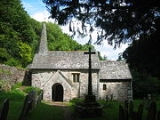
Culbone is a hamlet
consisting of little more than the parish church
and a few houses, in the parish of Oare
in the Exmoor National Park, Somerset
, England
. As there is no road access it is a two-mile walk from Porlock Weir
, and some four miles from Porlock
itself.
The village is situated in a sheltered spot, near the coast of Porlock Bay. The cliffs behind the village rise to the height of 1200 feet (366 m), over which a small stream falls down to the sea.
The South West Coast Path
goes through the village, parts of which were closed and diverted in February 2007 following landslips in the woods. The woods around the village are home to the rare Sorbus vexans
, a microspecies of self-cloning Sorbus
trees which are only found in the coastal area between Culbone and Trentishoe
in Devon
. It is amongst the rarest trees in Britain. Other Whitebeam
and Rowan
species found in the area include; Sorbus subcuneata, Sorbus ‘Taxon D’ and Sorbus aucuparia.
as Kytenore, or Chetnore. The name "Culbone" is thought to derive from the Celtic cil beun for "Church of St Beuno".
The Culbone Stone, an early mediæval standing stone approximately one metre in height. It lies in woodland close to the parish boundary, and features an incised wheeled cross, the style of which suggests it dates from 7th to 9th century. The stone is legally protected as a scheduled ancient monument
. It has been suggested that the stone has been moved from its original site as part of the Culbone Hill Stone Row.
Culbone woods were once the site of a major charcoal
burning industry. The original burners were reputed to be a colony of lepers.
Culbone was a civil parish
until 1933 when, because of the small population (43 in 1931) it was merged into the parish of Oare
.
Culbone Cottage, Culbone Lodge, and the Parsonage Farmhouse are all Grade II listed buildings.
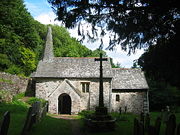 Culbone Church is said to be the smallest parish church in England. The chancel is 13.5 feet (4.1 m) x 10 feet (3 m), the nave
21.5 feet (6.6 m) x 12.33 feet (3.8 m) and the building has a total length of 35 feet (10.7 m). It seats about 30 and is dedicated to St Beuno
. Services are still held there, despite the lack of road access. The church is probably pre-Norman in origin, with a 13th-century porch, and late 15th-century nave
. It was refenestrated and reroofed around 1810 and the spirelet added in 1888. It underwent further restoration in 1928. It has been designated by English Heritage
as a Grade I listed building.
is believed to have disturbed Samuel Taylor Coleridge
during his composition of the oriental poem Kubla Khan
. Coleridge was living at Coleridge Cottage
, Nether Stowey
(between Bridgwater
and Minehead
). It is likely that this encounter took place while he was staying at Ash Farm in Culbone.
It is also possible that Coleridge composed the poem at the Culbone Parsonage near to Ash Farm, now a collection of holiday cottages.
Hamlet (place)
A hamlet is usually a rural settlement which is too small to be considered a village, though sometimes the word is used for a different sort of community. Historically, when a hamlet became large enough to justify building a church, it was then classified as a village...
consisting of little more than the parish church
Parish church
A parish church , in Christianity, is the church which acts as the religious centre of a parish, the basic administrative unit of episcopal churches....
and a few houses, in the parish of Oare
Oare, Somerset
Oare is a village and civil parish on Oare Water on Exmoor in the West Somerset district of Somerset, England. The parish includes the hamlet of Oareford and the village of Culbone which contains its own tiny church.-History:...
in the Exmoor National Park, Somerset
Somerset
The ceremonial and non-metropolitan county of Somerset in South West England borders Bristol and Gloucestershire to the north, Wiltshire to the east, Dorset to the south-east, and Devon to the south-west. It is partly bounded to the north and west by the Bristol Channel and the estuary of the...
, England
England
England is a country that is part of the United Kingdom. It shares land borders with Scotland to the north and Wales to the west; the Irish Sea is to the north west, the Celtic Sea to the south west, with the North Sea to the east and the English Channel to the south separating it from continental...
. As there is no road access it is a two-mile walk from Porlock Weir
Porlock Weir
Porlock Weir lies about 1.5 miles west of Porlock, Somerset, England and is a small settlement which has grown up around the harbour. It is a popular visitor attraction....
, and some four miles from Porlock
Porlock
Porlock is a coastal village and civil parish in Somerset, England, situated in a deep hollow below Exmoor, west of Minehead. The parish, which includes Hawkcombe and Doverhay, has a population of 1,377....
itself.
The village is situated in a sheltered spot, near the coast of Porlock Bay. The cliffs behind the village rise to the height of 1200 feet (366 m), over which a small stream falls down to the sea.
The South West Coast Path
South West Coast Path
The South West Coast Path is Britain's longest waymarked long-distance footpath and a National Trail. It stretches for , running from Minehead in Somerset, along the coasts of Devon and Cornwall, to Poole Harbour in Dorset. Since it rises and falls with every river mouth, it is also one of the more...
goes through the village, parts of which were closed and diverted in February 2007 following landslips in the woods. The woods around the village are home to the rare Sorbus vexans
Sorbus vexans
Sorbus vexans is a rare tree in the Rosaceae family. It is endemic to the United Kingdom. It can be seen in the Exmoor National Park. It is threatened by habitat loss.-References:...
, a microspecies of self-cloning Sorbus
Sorbus
Sorbus is a genus of about 100–200 species of trees and shrubs in the subfamily Maloideae of the Rose family Rosaceae. Species of Sorbus are commonly known as whitebeam, rowan, service tree, and mountain ash...
trees which are only found in the coastal area between Culbone and Trentishoe
Trentishoe
thumb|220px|The Trentishoe area on Donn's one inch to the mile survey of 1765.Trentishoe is a village in North Devon, England. It is in the Shirwell deanery of the Church of England...
in Devon
Devon
Devon is a large county in southwestern England. The county is sometimes referred to as Devonshire, although the term is rarely used inside the county itself as the county has never been officially "shired", it often indicates a traditional or historical context.The county shares borders with...
. It is amongst the rarest trees in Britain. Other Whitebeam
Whitebeam
The whitebeams are members of the Rosaceae family, comprising subgenus Aria of genus Sorbus, and hybrids involving species of this subgenus and members of subgenera Sorbus, Torminaria and Chamaemespilus. They are deciduous trees with simple or lobed leaves, arranged alternately...
and Rowan
Rowan
The rowans or mountain-ashes are shrubs or small trees in genus Sorbus of family Rosaceae. They are native throughout the cool temperate regions of the Northern Hemisphere, with the highest species diversity in the mountains of western China and the Himalaya, where numerous apomictic microspecies...
species found in the area include; Sorbus subcuneata, Sorbus ‘Taxon D’ and Sorbus aucuparia.
History
Culbone was listed in the Domesday bookDomesday Book
Domesday Book , now held at The National Archives, Kew, Richmond upon Thames in South West London, is the record of the great survey of much of England and parts of Wales completed in 1086...
as Kytenore, or Chetnore. The name "Culbone" is thought to derive from the Celtic cil beun for "Church of St Beuno".
The Culbone Stone, an early mediæval standing stone approximately one metre in height. It lies in woodland close to the parish boundary, and features an incised wheeled cross, the style of which suggests it dates from 7th to 9th century. The stone is legally protected as a scheduled ancient monument
Scheduled Ancient Monument
In the United Kingdom, a scheduled monument is a 'nationally important' archaeological site or historic building, given protection against unauthorized change. The various pieces of legislation used for legally protecting heritage assets from damage and destruction are grouped under the term...
. It has been suggested that the stone has been moved from its original site as part of the Culbone Hill Stone Row.
Culbone woods were once the site of a major charcoal
Charcoal
Charcoal is the dark grey residue consisting of carbon, and any remaining ash, obtained by removing water and other volatile constituents from animal and vegetation substances. Charcoal is usually produced by slow pyrolysis, the heating of wood or other substances in the absence of oxygen...
burning industry. The original burners were reputed to be a colony of lepers.
Culbone was a civil parish
Civil parish
In England, a civil parish is a territorial designation and, where they are found, the lowest tier of local government below districts and counties...
until 1933 when, because of the small population (43 in 1931) it was merged into the parish of Oare
Oare, Somerset
Oare is a village and civil parish on Oare Water on Exmoor in the West Somerset district of Somerset, England. The parish includes the hamlet of Oareford and the village of Culbone which contains its own tiny church.-History:...
.
Culbone Cottage, Culbone Lodge, and the Parsonage Farmhouse are all Grade II listed buildings.
Church
21.5 feet (6.6 m) x 12.33 feet (3.8 m) and the building has a total length of 35 feet (10.7 m). It seats about 30 and is dedicated to St Beuno
Beuno
Saint Beuno was a 7th-century Welsh holy man and Abbot of Clynnog Fawr in Gwynedd, on the Llŷn peninsula.-Life:Beuno was born in Powys, supposedly at Berriew, the grandson of a prince of that realm. After education and ordination in the monastery of Bangor-on-Dee in north-east Wales, he became an...
. Services are still held there, despite the lack of road access. The church is probably pre-Norman in origin, with a 13th-century porch, and late 15th-century nave
Nave
In Romanesque and Gothic Christian abbey, cathedral basilica and church architecture, the nave is the central approach to the high altar, the main body of the church. "Nave" was probably suggested by the keel shape of its vaulting...
. It was refenestrated and reroofed around 1810 and the spirelet added in 1888. It underwent further restoration in 1928. It has been designated by English Heritage
English Heritage
English Heritage . is an executive non-departmental public body of the British Government sponsored by the Department for Culture, Media and Sport...
as a Grade I listed building.
Samuel Taylor Coleridge
The Person from PorlockPerson from Porlock
The Person from Porlock was an unwelcome visitor to Samuel Taylor Coleridge during his composition of the poem Kubla Khan. Coleridge claimed to have perceived the entire course of the poem in a dream , but was interrupted by this visitor from Porlock while in the process of writing it...
is believed to have disturbed Samuel Taylor Coleridge
Samuel Taylor Coleridge
Samuel Taylor Coleridge was an English poet, Romantic, literary critic and philosopher who, with his friend William Wordsworth, was a founder of the Romantic Movement in England and a member of the Lake Poets. He is probably best known for his poems The Rime of the Ancient Mariner and Kubla...
during his composition of the oriental poem Kubla Khan
Kubla Khan
Kubla Khan is a poem by Samuel Taylor Coleridge, completed in 1797 and published in Christabel, Kubla Khan, and the Pains of Sleep in 1816...
. Coleridge was living at Coleridge Cottage
Coleridge Cottage
Coleridge Cottage is a cottage situated in Nether Stowey, Bridgwater, Somerset, England.It was constructed in the 17th century as a building containing a parlour, kitchen and service room on the ground floor and three corresponding bed chambers above...
, Nether Stowey
Nether Stowey
Nether Stowey is a large village in the Sedgemoor district of Somerset, South West England. It sits in the foothills of the Quantock Hills , just below Over Stowey...
(between Bridgwater
Bridgwater
Bridgwater is a market town and civil parish in Somerset, England. It is the administrative centre of the Sedgemoor district, and a major industrial centre. Bridgwater is located on the major communication routes through South West England...
and Minehead
Minehead
Minehead is a coastal town and civil parish in Somerset, England. It lies on the south bank of the Bristol Channel, north-west of the county town of Taunton, from the border with the county of Devon and in proximity of the Exmoor National Park...
). It is likely that this encounter took place while he was staying at Ash Farm in Culbone.
It is also possible that Coleridge composed the poem at the Culbone Parsonage near to Ash Farm, now a collection of holiday cottages.