


Cray

Encyclopedia
Cray Inc. is an American supercomputer
manufacturer based in Seattle, Washington
. The company's predecessor, Cray Research, Inc. (CRI), was founded in 1972 by computer designer Seymour Cray
. Seymour Cray went on to form the spin-off Cray Computer Corporation (CCC), in 1989, which went bankrupt in 1995, while Cray Research was bought by SGI
the next year. Cray Inc. was formed in 2000 when Tera Computer Company
purchased the Cray Research Inc. business from SGI and adopted the name of its acquisition.
(ERA) in Saint Paul, Minnesota
. There, he helped to create the ERA 1103, generally regarded as the first successful scientific computer. ERA eventually became part of UNIVAC
, and began to be phased out. He left the company in 1960, a few years after former ERA employees set up Control Data Corporation
(CDC). He eventually set up a lab at his home in Chippewa Falls, Wisconsin
, about 85 miles to the east. Cray had a string of successes at CDC, including the CDC 6600
and CDC 7600
.
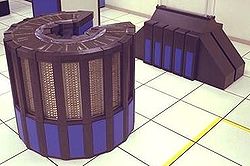 When CDC ran into financial difficulties in the late 1960s, development funds for his follow-on CDC 8600
became scarce. When he was told the project would have to be put "on hold" in 1972, Cray left to form his own company, Cray Research Inc., with research and development facilities in Chippewa Falls and the business headquarters in Minneapolis
. The company's first product, the Cray-1
supercomputer
was a major success when it was released. It was faster than all other computers at the time. The first system was sold within a month for US$8.8 million. Seymour Cray continued working, this time on the Cray-2
, though it only ended up being marginally faster than the Cray X-MP
, developed by another team at the company.
He soon left the CEO
position to become an independent contractor. Cray started a new VLSI technology lab for the Cray-2 in Boulder, Colorado
, Cray Laboratories, in 1979. The Labs were closed in 1982, but Cray later headed a similar spin-off in 1989, forming Cray Computer Corporation (CCC) in Colorado Springs. Seymour Cray worked there on the Cray-3
project, the first attempt at major use of gallium arsenide (GaAs) semiconductor
s in computing. However, the changing political climate (collapse of Warsaw Pact
and the end of Cold War
) resulted in poor sales (only one Cray-3 was delivered), and the company fell by the wayside, eventually filing for bankruptcy
in 1995. CCC's remains then began Cray's final corporation SRC Computers, Inc. which still exists.
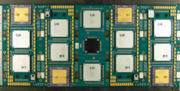
Cray Research continued development along a separate line of computers, originally with lead designer Steve Chen and the Cray X-MP. After Chen's departure, the Cray Y-MP
, Cray C90
and Cray T90
were developed. All were based on the original Cray-1 architecture, but added multiple processors, faster clocks and wider vector pipes to achieve much greater performance. Because of the uncertainty of the Cray-2 project, a number of Cray-object-code compatible "Crayette" firms started: Scientific Computer Systems (SCS), American Supercomputer, Supertek, and perhaps at least one other firm. Not meant to compete against Cray, these firms attempted less expensive, slower CMOS versions of the X-MP with the release of the COS operating system (SCS) and the CFT
Fortran
compiler. All these firms also considered National labs (LANL/LLNL) developed CTSS
operating system as well before caving in to the tide of Unix
es.
 In the late 1980s the high-performance market began to be overtaken by a series of massively parallel
computers, led by pioneers Thinking Machines, Kendall Square Research
, Intel Supercomputing Systems Division
, nCUBE
, MasPar
and Meiko Scientific
. At first, Cray Research denigrated such approaches, complaining that developing software to effectively use the machines was difficult — which was true in the era of the ILLIAC IV
, but becoming less so each day. Eventually Cray realized the approach was likely the only way forward and started a five year project to capture the lead in this area as well. The result was the DEC
Alpha
-based Cray T3D
and Cray T3E
series, which left Cray as the only remaining supercomputer vendor in the market besides NEC
, by 2000.
Cray computers were extremely expensive machines, and the number of units sold was small compared to ordinary mainframe
s. Thus, most sites with a Cray installation considered it quite prestigious to be a member of the "exclusive club" of Cray operators. This perception extended to countries as well. To boost the perception of exclusivity, Cray Research's marketing department had promotional necktie
s made with a mosaic of tiny national flag
s illustrating the "club of Cray-operating countries".(Computer History Museum, Cray 1 30th Anniversary recorded presentation, 2006)
In the late 1980s and early 1990s a number of new vendors introduced small supercomputers, known as minisupercomputer
s (as opposed to superminis), which started to erode the market that might have otherwise considered a low-end Cray machine. Particularly popular was the Convex Computer
series, as well as a number of small-scale parallel machines from companies like Pyramid Technology
and Alliant Computer Systems
. One such company was Supertek, whose S-1 machine was an air-cooled CMOS
implementation of the X-MP processor. Cray purchased Supertek in 1990 and sold the S-1 as the Cray XMS
, but the machine proved problematic. Meanwhile their not-yet-completed S-2, a Y-MP clone, was later offered as the Cray Y-MP EL
(later becoming the EL90 series
), which started to sell in reasonable numbers in 1991-92. These systems were sold to smaller companies, notably in the oil exploration business. This line evolved into the Cray J90
and eventually the Cray SV1
in 1998.
In December 1991, Cray purchased some of the assets of Floating Point Systems
, another minisuper vendor who had moved into the file server
market with their SPARC
-based Model 500 line. These SMP
machines scaled up to 64 processors and ran a modified version of Sun Microsystems
' Solaris. Cray set up Cray Research Superservers, Inc. (later the Business Systems Division) to sell this system as the Cray S-MP
, later replacing it with the Cray CS6400
. In spite of these machines being some of the most powerful available when applied to appropriate workloads, Cray was never very successful in this market, possibly due to it being so foreign to their existing market niche.
in February 1996. At the time the industry was highly critical of the move, noting that there was little overlap between the two companies in terms of market or technology. Founder Seymour Cray died as a result of a traffic accident later that year.
SGI immediately sold off the Superservers business to Sun, who quickly turned the UltraSPARC-based Starfire project then under development into the extremely successful Enterprise 10000 range of servers.
SGI did use a number of Cray technologies in their attempt to move from the graphics workstation market into supercomputing. Key among these was the use of the Cray-developed HIPPI
data-bus
and details of the interconnects used in the T3 series.
SGI's long-term strategy was to merge their high-end server line with Cray's product lines in two phases, code-named SN1 and SN2 (SN standing for "Scalable Node"). The SN1 was intended to replace the T3E and SGI Origin 2000
systems and later became the SN-MIPS or SGI Origin 3000 architecture. The SN2 was originally intended to unify all high-end/supercomputer product lines including the T90 into a single architecture. This goal was never achieved before SGI divested itself of the Cray business, and the SN2 name was later associated with the SN-IA or SGI Altix 3000
architecture.
Under SGI ownership, one new Cray model line, the SV1, was launched in 1998. This was a clustered SMP vector processor architecture, developed from J90 technology.
SGI set up a separate Cray Research Business Unit in August 1999 in preparation for detachment. On March 2, 2000, the unit was sold to Tera Computer Company
. Tera Computer Company was then renamed Cray Inc. when the deal closed on April 4.
. This was not a commercial success and shipped to only two customers. Cray Inc. also badged the NEC SX-6
supercomputer as the Cray SX-6 and acquired exclusive rights to sell the SX-6 in the USA, Canada and Mexico.
In 2002, Cray Inc. announced their first new model, the Cray X1
combined architecture vector
/ MPP
supercomputer. Previously known as the SV2, the X1 is the end result of the earlier SN2 concept originated during the SGI years. In May 2004, Cray was announced to be one of the partners in the U.S. Department of Energy
's fastest-computer-in-the-world project to build a 50 teraflops
machine for the Oak Ridge National Laboratory
. As of November 2004, the Cray X1
had a maximum measured performance of 5.9 teraflops, being the 29th fastest supercomputer in the world. Since then the X1 has been superseded by the X1E, with faster dual-core processors.
On October 4, 2004, the company announced the Cray XD1
range of entry-level supercomputers which use dual-core 64-bit
AMD
Opteron
CPU
s running Linux
. This system was previously known as the OctigaBay 12K before Cray's acquisition of that company. The XD1 provides one Xilinx
Virtex II Pro field-programmable gate array (FPGA) with each node of four Opteron processors. The FPGAs can be configured to embody various digital hardware designs and so can augment the processing or input/output capabilities of the Opteron processors. Furthermore, each FPGA contains a pair of PowerPC
405 processors which can add to the already considerable power of a single node.
In 2004, Cray completed the Red Storm
system for Sandia National Laboratories
. Red Storm has processors clustered in 96 unit cabinets, a theoretical maximum of 300 cabinets in a machine, and a design speed of 41.5 teraflops. The Cray XT3
massively parallel supercomputer is a commercialized version of Red Storm, similar in many respects to the earlier T3E architecture, but, like the XD1, using AMD Opteron processors. The Cray XT4
, introduced in 2006 added support for DDR2 memory, newer dual-core and future quad-core Opteron
processors. The XT4 also allowed FPGA chips to be plugged directly into processor sockets, unlike the XD1, which required a dedicated socket for the FPGA coprocessor. The XT4 also used the second generation SeaStar2 communication coprocessor. http://www.cray.com/products/xt4/index.html
On November 13, 2006, Cray announced a new system, the Cray XMT
, based on the MTA series of machines. http://www.cray.com/products/xmt/ http://www.hoise.com/primeur/06/articles/live/AE-PL-06-06-5.html. This system combines multi-threaded processors, as used on the original Tera systems, and the SeaStar2 interconnect used by the XT4. By reusing ASICs
, boards, cabinets, and system software used by the comparatively higher volume XT4 product, the cost of making the very specialized MTA system can be reduced. A second generation of the XMT is scheduled for release in 2011, with the first system ordered by the Swiss National Supercomputing Center (CSCS).
In 2006, Cray announced a vision of products dubbed 'Adaptive Supercomputing'. The first generation of such systems, dubbed the Rainier Project, used a common interconnect network, programming environment, cabinet design, and I/O subsystem. These systems included the XT4 and the XMT. The second generation, launched as the XT5h
, allowed a system to combine compute elements of various types into a common system, sharing infrastructure. The XT5h combined Opteron, vector, multithreaded, and FPGA compute processors in a single system. Next generation Cascade systems will make use of future multicore and/or manycore Opteron and Intel processors as well as vectorization and multithreading accelerators. Cascade is scheduled to be introduced sometime between 2011 and 2013.
In April 2008, Cray and Intel announced they would collaborate on future supercomputer systems. This partnership produced the Cray CX1
system, launched in September the same year. This is a blade server
system, comprising up to 16 dual- or quad-core Intel Xeon
processors, with either Microsoft
Windows HPC Server 2008
or Red Hat Enterprise Linux
installed.
In early 2010, Cray introduced the Cray CX1000
, a rack-mounted system with a choice of compute-based, GPU-based, or SMP-based chassis. In May 2010 the Cray XE6
supercomputer was announced. The Cray XE6 system, built on Cray XT5 technology, combines the Gemini system interconnect with AMD multicore processors. The first multi-cabinet XE6 system was shipped in July 2010.
, the largest computer system Cray has delivered is the XT5
system at National Center for Computational Sciences
at Oak Ridge National Laboratories. This system, with over 224,000 processing cores, is dubbed "Jaguar"
and was the fastest computer in the world as measured by the LINPACK
benchmark at the speed of 1.75 petaflops until being surpassed by the Tianhe-1A in October 2010. It is the fastest system available for open science and was the first system to exceed a sustained performance of 1 petaflops on a 64-bit scientific application; it has since been upgraded to a peak performance of more than two petaflops.
On May 24, 2011, Cray announced the Cray XK6
hybrid supercomputer. The Cray XK6 system, capable of scaling to 500,000 processors and 50 petaflops of peak performance, combines Cray's Gemini interconnect, AMD's multi-core scalar processors, and NVIDIA
's many-core GPGPU
processors.
Supercomputer
A supercomputer is a computer at the frontline of current processing capacity, particularly speed of calculation.Supercomputers are used for highly calculation-intensive tasks such as problems including quantum physics, weather forecasting, climate research, molecular modeling A supercomputer is a...
manufacturer based in Seattle, Washington
Seattle, Washington
Seattle is the county seat of King County, Washington. With 608,660 residents as of the 2010 Census, Seattle is the largest city in the Northwestern United States. The Seattle metropolitan area of about 3.4 million inhabitants is the 15th largest metropolitan area in the country...
. The company's predecessor, Cray Research, Inc. (CRI), was founded in 1972 by computer designer Seymour Cray
Seymour Cray
Seymour Roger Cray was an American electrical engineer and supercomputer architect who designed a series of computers that were the fastest in the world for decades, and founded Cray Research which would build many of these machines. Called "the father of supercomputing," Cray has been credited...
. Seymour Cray went on to form the spin-off Cray Computer Corporation (CCC), in 1989, which went bankrupt in 1995, while Cray Research was bought by SGI
Silicon Graphics
Silicon Graphics, Inc. was a manufacturer of high-performance computing solutions, including computer hardware and software, founded in 1981 by Jim Clark...
the next year. Cray Inc. was formed in 2000 when Tera Computer Company
Tera Computer Company
The Tera Computer Company was a manufacturer of high-performance computing software and hardware, founded in 1987 in Washington, D.C. and moved 1988 to Seattle, Washington by James Rottsolk and Burton Smith. The company's first supercomputer product, named MTA, featured interleaved multi-threading,...
purchased the Cray Research Inc. business from SGI and adopted the name of its acquisition.
Background: 1950 to 1972
Seymour Cray began working in the computing field in 1950 when he joined Engineering Research AssociatesEngineering Research Associates
Engineering Research Associates, commonly known as ERA, was a pioneering computer firm from the 1950s. They became famous for their numerical computers, but as the market expanded they became better known for their drum memory systems. They were eventually purchased by Remington Rand and merged...
(ERA) in Saint Paul, Minnesota
Saint Paul, Minnesota
Saint Paul is the capital and second-most populous city of the U.S. state of Minnesota. The city lies mostly on the east bank of the Mississippi River in the area surrounding its point of confluence with the Minnesota River, and adjoins Minneapolis, the state's largest city...
. There, he helped to create the ERA 1103, generally regarded as the first successful scientific computer. ERA eventually became part of UNIVAC
UNIVAC
UNIVAC is the name of a business unit and division of the Remington Rand company formed by the 1950 purchase of the Eckert-Mauchly Computer Corporation, founded four years earlier by ENIAC inventors J. Presper Eckert and John Mauchly, and the associated line of computers which continues to this day...
, and began to be phased out. He left the company in 1960, a few years after former ERA employees set up Control Data Corporation
Control Data Corporation
Control Data Corporation was a supercomputer firm. For most of the 1960s, it built the fastest computers in the world by far, only losing that crown in the 1970s after Seymour Cray left the company to found Cray Research, Inc....
(CDC). He eventually set up a lab at his home in Chippewa Falls, Wisconsin
Chippewa Falls, Wisconsin
Chippewa Falls is a city located on the Chippewa River in Chippewa County in the U.S. state of Wisconsin. The population was 13,661 at the 2010 census. Incorporated as a city in 1869, it is the county seat of Chippewa County....
, about 85 miles to the east. Cray had a string of successes at CDC, including the CDC 6600
CDC 6600
The CDC 6600 was a mainframe computer from Control Data Corporation, first delivered in 1964. It is generally considered to be the first successful supercomputer, outperforming its fastest predecessor, IBM 7030 Stretch, by about three times...
and CDC 7600
CDC 7600
The CDC 7600 was the Seymour Cray-designed successor to the CDC 6600, extending Control Data's dominance of the supercomputer field into the 1970s. The 7600 ran at 36.4 MHz and had a 65 Kword primary memory using core and variable-size secondary memory...
.
Cray Research Inc. and Cray Computer Corporation: 1972 to 1996
CDC 8600
The CDC 8600 was the last of Seymour Cray's supercomputer designs while working for the Control Data Corporation. The "natural successor" to the CDC 6600 and CDC 7600, the 8600 was intended to be about 10 times as fast as the 7600, already the fastest computer on the market.Development started in...
became scarce. When he was told the project would have to be put "on hold" in 1972, Cray left to form his own company, Cray Research Inc., with research and development facilities in Chippewa Falls and the business headquarters in Minneapolis
Minneapolis, Minnesota
Minneapolis , nicknamed "City of Lakes" and the "Mill City," is the county seat of Hennepin County, the largest city in the U.S. state of Minnesota, and the 48th largest in the United States...
. The company's first product, the Cray-1
Cray-1
The Cray-1 was a supercomputer designed, manufactured, and marketed by Cray Research. The first Cray-1 system was installed at Los Alamos National Laboratory in 1976, and it went on to become one of the best known and most successful supercomputers in history...
supercomputer
Supercomputer
A supercomputer is a computer at the frontline of current processing capacity, particularly speed of calculation.Supercomputers are used for highly calculation-intensive tasks such as problems including quantum physics, weather forecasting, climate research, molecular modeling A supercomputer is a...
was a major success when it was released. It was faster than all other computers at the time. The first system was sold within a month for US$8.8 million. Seymour Cray continued working, this time on the Cray-2
Cray-2
The Cray-2 was a four-processor ECL vector supercomputer made by Cray Research starting in 1985. It was the fastest machine in the world when it was released, replacing the Cray Research X-MP designed by Steve Chen in that spot...
, though it only ended up being marginally faster than the Cray X-MP
Cray X-MP
The Cray X-MP was a supercomputer designed, built and sold by Cray Research. It was announced in 1982 as the "cleaned up" successor to the 1975 Cray-1, and was the world's fastest computer from 1983 to 1985...
, developed by another team at the company.
He soon left the CEO
Chief executive officer
A chief executive officer , managing director , Executive Director for non-profit organizations, or chief executive is the highest-ranking corporate officer or administrator in charge of total management of an organization...
position to become an independent contractor. Cray started a new VLSI technology lab for the Cray-2 in Boulder, Colorado
Boulder, Colorado
Boulder is the county seat and most populous city of Boulder County and the 11th most populous city in the U.S. state of Colorado. Boulder is located at the base of the foothills of the Rocky Mountains at an elevation of...
, Cray Laboratories, in 1979. The Labs were closed in 1982, but Cray later headed a similar spin-off in 1989, forming Cray Computer Corporation (CCC) in Colorado Springs. Seymour Cray worked there on the Cray-3
Cray-3
The Cray-3 was a vector supercomputer intended to be Cray Research's successor to the Cray-2. The system was to be the first major application of gallium arsenide semiconductors in computing. The project was not considered a success, and the parent company in Minneapolis decided to end work on the...
project, the first attempt at major use of gallium arsenide (GaAs) semiconductor
Semiconductor
A semiconductor is a material with electrical conductivity due to electron flow intermediate in magnitude between that of a conductor and an insulator. This means a conductivity roughly in the range of 103 to 10−8 siemens per centimeter...
s in computing. However, the changing political climate (collapse of Warsaw Pact
Warsaw Pact
The Warsaw Treaty Organization of Friendship, Cooperation, and Mutual Assistance , or more commonly referred to as the Warsaw Pact, was a mutual defense treaty subscribed to by eight communist states in Eastern Europe...
and the end of Cold War
Cold War
The Cold War was the continuing state from roughly 1946 to 1991 of political conflict, military tension, proxy wars, and economic competition between the Communist World—primarily the Soviet Union and its satellite states and allies—and the powers of the Western world, primarily the United States...
) resulted in poor sales (only one Cray-3 was delivered), and the company fell by the wayside, eventually filing for bankruptcy
Bankruptcy
Bankruptcy is a legal status of an insolvent person or an organisation, that is, one that cannot repay the debts owed to creditors. In most jurisdictions bankruptcy is imposed by a court order, often initiated by the debtor....
in 1995. CCC's remains then began Cray's final corporation SRC Computers, Inc. which still exists.
Cray Research continued development along a separate line of computers, originally with lead designer Steve Chen and the Cray X-MP. After Chen's departure, the Cray Y-MP
Cray Y-MP
The Cray Y-MP was a supercomputer sold by Cray Research from 1988, and the successor to the company's X-MP. The Y-MP retained software compatibility with the X-MP, but extended the address registers from 24 to 32 bits. High-density VLSI ECL technology was used and a new liquid cooling system was...
, Cray C90
Cray C90
The Cray C90 series was a vector processor supercomputer launched by Cray Research in 1991. The C90 was a development of the Cray Y-MP architecture. Compared to the Y-MP, the C90 processor had a dual vector pipeline and a faster 4.1 ns clock cycle , which together gave three times the...
and Cray T90
Cray T90
The Cray T90 series was the last of a line of vector processing supercomputers manufactured by Cray Research, Inc, superseding the Cray C90 series...
were developed. All were based on the original Cray-1 architecture, but added multiple processors, faster clocks and wider vector pipes to achieve much greater performance. Because of the uncertainty of the Cray-2 project, a number of Cray-object-code compatible "Crayette" firms started: Scientific Computer Systems (SCS), American Supercomputer, Supertek, and perhaps at least one other firm. Not meant to compete against Cray, these firms attempted less expensive, slower CMOS versions of the X-MP with the release of the COS operating system (SCS) and the CFT
CFT
The three-letter abbreviation CFT may refer to:*-2β-Carbomethoxy-3β-tropane*California Federation of Teachers*Cardholder Funds Transfer*Cefatrizine*Chichester Festival Theatre*Class field theory*Classical field theory...
Fortran
Fortran
Fortran is a general-purpose, procedural, imperative programming language that is especially suited to numeric computation and scientific computing...
compiler. All these firms also considered National labs (LANL/LLNL) developed CTSS
Cray Time Sharing System
The Cray Time Sharing System, also known in the Cray user community as CTSS, was developed as an operating system for the Cray-1 or Cray X-MP line of supercomputers. CTSS was developed by the Los Alamos Scientific Laboratory in conjunction with the Lawrence Livermore Laboratory...
operating system as well before caving in to the tide of Unix
Unix
Unix is a multitasking, multi-user computer operating system originally developed in 1969 by a group of AT&T employees at Bell Labs, including Ken Thompson, Dennis Ritchie, Brian Kernighan, Douglas McIlroy, and Joe Ossanna...
es.
Massively parallel
Massively parallel is a description which appears in computer science, life sciences, medical diagnostics, and other fields.A massively parallel computer is a distributed memory computer system which consists of many individual nodes, each of which is essentially an independent computer in itself,...
computers, led by pioneers Thinking Machines, Kendall Square Research
Kendall Square Research
Kendall Square Research was a supercomputer company headquartered originally in Kendall Square in Cambridge, Massachusetts in 1986, near MIT. It was co-founded by Steven Frank and Henry Burkhardt III, who had previously helped found Data General and Encore Computer and was one of the original...
, Intel Supercomputing Systems Division
Intel Corporation
Intel Corporation is an American multinational semiconductor chip maker corporation headquartered in Santa Clara, California, United States and the world's largest semiconductor chip maker, based on revenue. It is the inventor of the x86 series of microprocessors, the processors found in most...
, nCUBE
NCUBE
nCUBE was a series of parallel computing computers from the company of the same name. Early generations of the hardware used a custom microprocessor...
, MasPar
MasPar
MasPar Computer Corporation was a minisupercomputer vendor that was founded in 1987 by Jeff Kalb. The company was based in Sunnyvale, California....
and Meiko Scientific
Meiko Scientific
Meiko Scientific Ltd. was a British supercomputer company based in Bristol, founded by members of the design team working on the INMOS transputer microprocessor.-History:...
. At first, Cray Research denigrated such approaches, complaining that developing software to effectively use the machines was difficult — which was true in the era of the ILLIAC IV
ILLIAC IV
The ILLIAC IV was one of the most infamous supercomputers ever built. One of a series of research machines, the ILLIACs from the University of Illinois, the ILLIAC IV design featured fairly high parallelism with up to 256 processors, used to allow the machine to work on large data sets in what...
, but becoming less so each day. Eventually Cray realized the approach was likely the only way forward and started a five year project to capture the lead in this area as well. The result was the DEC
Digital Equipment Corporation
Digital Equipment Corporation was a major American company in the computer industry and a leading vendor of computer systems, software and peripherals from the 1960s to the 1990s...
Alpha
DEC Alpha
Alpha, originally known as Alpha AXP, is a 64-bit reduced instruction set computer instruction set architecture developed by Digital Equipment Corporation , designed to replace the 32-bit VAX complex instruction set computer ISA and its implementations. Alpha was implemented in microprocessors...
-based Cray T3D
Cray T3D
The T3D was Cray Research's first attempt at a massively parallel supercomputer architecture. Launched in 1993, it also marked Cray's first use of another company's microprocessor. The T3D consisted of between 32 and 2048 Processing Elements , each comprising a 150 MHz DEC Alpha 21064 ...
and Cray T3E
Cray T3E
The Cray T3E was Cray Research's second-generation massively parallel supercomputer architecture, launched in late November 1995. The first T3E was installed at the Pittsburgh Supercomputing Center in 1996. Like the previous Cray T3D, it was a fully distributed memory machine using a 3D torus...
series, which left Cray as the only remaining supercomputer vendor in the market besides NEC
SX architecture
The SX series are vector supercomputers designed, manufactured, and marketed by NEC. There have been seven generations of SX systems since the first models, the SX-1 and SX-2, were announced in April 1983. Since the late 1990s, the SX series has been amongst the most advanced of vector supercomputers...
, by 2000.
Cray computers were extremely expensive machines, and the number of units sold was small compared to ordinary mainframe
Mainframe computer
Mainframes are powerful computers used primarily by corporate and governmental organizations for critical applications, bulk data processing such as census, industry and consumer statistics, enterprise resource planning, and financial transaction processing.The term originally referred to the...
s. Thus, most sites with a Cray installation considered it quite prestigious to be a member of the "exclusive club" of Cray operators. This perception extended to countries as well. To boost the perception of exclusivity, Cray Research's marketing department had promotional necktie
Necktie
A necktie is a long piece of cloth worn for decorative purposes around the neck or shoulders, resting under the shirt collar and knotted at the throat. Variants include the ascot tie, bow tie, bolo tie, and the clip-on tie. The modern necktie, ascot, and bow tie are descended from the cravat. Neck...
s made with a mosaic of tiny national flag
National flag
A national flag is a flag that symbolizes a country. The flag is flown by the government, but usually can also be flown by citizens of the country.Both public and private buildings such as schools and courthouses may fly the national flag...
s illustrating the "club of Cray-operating countries".(Computer History Museum, Cray 1 30th Anniversary recorded presentation, 2006)
In the late 1980s and early 1990s a number of new vendors introduced small supercomputers, known as minisupercomputer
Minisupercomputer
Minisupercomputers constituted a short-lived class of computers that emerged in the mid-1980s. As scientific computing using vector processors became more popular, the need for lower-cost systems that might be used at the departmental level instead of the corporate level created an opportunity for...
s (as opposed to superminis), which started to erode the market that might have otherwise considered a low-end Cray machine. Particularly popular was the Convex Computer
Convex Computer
Convex Computer Corporation was a company that developed, manufactured and marketed vector minisupercomputers and supercomputers for small-to-medium-sized businesses. Their later Exemplar series of parallel computing machines were based on the Hewlett-Packard PA-RISC microprocessors, and in 1995,...
series, as well as a number of small-scale parallel machines from companies like Pyramid Technology
Pyramid Technology
Pyramid Technology Corporation was a computer company that produced a number of RISC-based minicomputers at the upper end of the performance range. They also became the second company to ship a multiprocessor Unix system , in 1985, which formed the basis of their product line into the early 1990s...
and Alliant Computer Systems
Alliant Computer Systems
Alliant Computer Systems was a computer company that designed and manufactured parallel computing systems. Together with Pyramid Technology and Sequent Computer Systems, Alliant's machines pioneered the symmetric multiprocessing market...
. One such company was Supertek, whose S-1 machine was an air-cooled CMOS
CMOS
Complementary metal–oxide–semiconductor is a technology for constructing integrated circuits. CMOS technology is used in microprocessors, microcontrollers, static RAM, and other digital logic circuits...
implementation of the X-MP processor. Cray purchased Supertek in 1990 and sold the S-1 as the Cray XMS
Cray XMS
The Cray XMS was a vector processor minisupercomputer sold by Cray Research from 1990 to 1991. The XMS was originally designed by Supertek Computers Inc. as the Supertek S-1, intended to be a low-cost air-cooled clone of the Cray X-MP with a CMOS re-implementation of the X-MP processor...
, but the machine proved problematic. Meanwhile their not-yet-completed S-2, a Y-MP clone, was later offered as the Cray Y-MP EL
Cray Y-MP
The Cray Y-MP was a supercomputer sold by Cray Research from 1988, and the successor to the company's X-MP. The Y-MP retained software compatibility with the X-MP, but extended the address registers from 24 to 32 bits. High-density VLSI ECL technology was used and a new liquid cooling system was...
(later becoming the EL90 series
Cray EL90
The Cray EL90 series was an air-cooled vector processor supercomputer first sold by Cray Research in 1993. The EL90 series evolved from the Cray Y-MP EL minisupercomputer, and is compatible with Y-MP software, running the same UNICOS operating system...
), which started to sell in reasonable numbers in 1991-92. These systems were sold to smaller companies, notably in the oil exploration business. This line evolved into the Cray J90
Cray J90
The Cray J90 series was an air-cooled vector processor supercomputer first sold by Cray Research in 1994. The J90 evolved from the Cray Y-MP EL minisupercomputer, and is compatible with Y-MP software, running the same UNICOS operating system. The J90 supported up to 32 CMOS processors with a 10 ns...
and eventually the Cray SV1
Cray SV1
The Cray SV1 is a vector processor supercomputer from the Cray Research division of Silicon Graphics introduced in 1998. The SV1 has since been succeeded by the Cray X1 and X1E vector supercomputers. Like its predecessor, the Cray J90, the SV1 used CMOS processors, which lowered the cost of the...
in 1998.
In December 1991, Cray purchased some of the assets of Floating Point Systems
Floating Point Systems
Floating Point Systems Inc. was a Beaverton, Oregon vendor of minisupercomputers. The company was founded in 1970 by former Tektronix engineer Norm Winningstad....
, another minisuper vendor who had moved into the file server
File server
In computing, a file server is a computer attached to a network that has the primary purpose of providing a location for shared disk access, i.e. shared storage of computer files that can be accessed by the workstations that are attached to the computer network...
market with their SPARC
SPARC
SPARC is a RISC instruction set architecture developed by Sun Microsystems and introduced in mid-1987....
-based Model 500 line. These SMP
Symmetric multiprocessing
In computing, symmetric multiprocessing involves a multiprocessor computer hardware architecture where two or more identical processors are connected to a single shared main memory and are controlled by a single OS instance. Most common multiprocessor systems today use an SMP architecture...
machines scaled up to 64 processors and ran a modified version of Sun Microsystems
Sun Microsystems
Sun Microsystems, Inc. was a company that sold :computers, computer components, :computer software, and :information technology services. Sun was founded on February 24, 1982...
' Solaris. Cray set up Cray Research Superservers, Inc. (later the Business Systems Division) to sell this system as the Cray S-MP
Cray S-MP
The Cray S-MP was a multiprocessor server computer sold by Cray Research from 1992 to 1993. It was based around the Sun SPARC microprocessor architecture and could be configured with up to eight 66 MHz BIT B5000 processors. Optionally, a Cray APP matrix co-processor cluster could be added to an...
, later replacing it with the Cray CS6400
Cray CS6400
The Cray Superserver 6400, or CS6400, was a multiprocessor server computer system produced by Cray Research Superservers, Inc., a subsidiary of Cray Research, and launched in 1993...
. In spite of these machines being some of the most powerful available when applied to appropriate workloads, Cray was never very successful in this market, possibly due to it being so foreign to their existing market niche.
Silicon Graphics: 1996 to 2000
Cray Research merged with Silicon Graphics (SGI)Silicon Graphics
Silicon Graphics, Inc. was a manufacturer of high-performance computing solutions, including computer hardware and software, founded in 1981 by Jim Clark...
in February 1996. At the time the industry was highly critical of the move, noting that there was little overlap between the two companies in terms of market or technology. Founder Seymour Cray died as a result of a traffic accident later that year.
SGI immediately sold off the Superservers business to Sun, who quickly turned the UltraSPARC-based Starfire project then under development into the extremely successful Enterprise 10000 range of servers.
SGI did use a number of Cray technologies in their attempt to move from the graphics workstation market into supercomputing. Key among these was the use of the Cray-developed HIPPI
HIPPI
HIPPI is a computer bus for the attachment of high speed storage devices to supercomputers. It was popular in the late 1980s and into the mid-to-late 1990s, but has since been replaced by ever-faster standard interfaces like SCSI and Fibre Channel.The first HIPPI standard defined a 50-wire...
data-bus
Computer bus
In computer architecture, a bus is a subsystem that transfers data between components inside a computer, or between computers.Early computer buses were literally parallel electrical wires with multiple connections, but the term is now used for any physical arrangement that provides the same...
and details of the interconnects used in the T3 series.
SGI's long-term strategy was to merge their high-end server line with Cray's product lines in two phases, code-named SN1 and SN2 (SN standing for "Scalable Node"). The SN1 was intended to replace the T3E and SGI Origin 2000
SGI Origin 2000
The SGI Origin 2000, code named Lego, is a family of mid-range and high-end servers developed and manufactured by SGI and introduced in 1996 to succeed the SGI Challenge and POWER Challenge. At the time of introduction, these systems ran IRIX 6.4 and later, IRIX 6.5. A variant of the Origin 2000...
systems and later became the SN-MIPS or SGI Origin 3000 architecture. The SN2 was originally intended to unify all high-end/supercomputer product lines including the T90 into a single architecture. This goal was never achieved before SGI divested itself of the Cray business, and the SN2 name was later associated with the SN-IA or SGI Altix 3000
Altix
Altix is a line of servers and supercomputers produced by Silicon Graphics , based on Intel processors. It succeeded the MIPS/IRIX-based Origin 3000 servers....
architecture.
Under SGI ownership, one new Cray model line, the SV1, was launched in 1998. This was a clustered SMP vector processor architecture, developed from J90 technology.
SGI set up a separate Cray Research Business Unit in August 1999 in preparation for detachment. On March 2, 2000, the unit was sold to Tera Computer Company
Tera Computer Company
The Tera Computer Company was a manufacturer of high-performance computing software and hardware, founded in 1987 in Washington, D.C. and moved 1988 to Seattle, Washington by James Rottsolk and Burton Smith. The company's first supercomputer product, named MTA, featured interleaved multi-threading,...
. Tera Computer Company was then renamed Cray Inc. when the deal closed on April 4.
Cray Inc.: 2000 to present
After the Tera merger, the Tera MTA system was relaunched as the Cray MTA-2Cray MTA-2
The Cray MTA-2 is a Shared-Memory MIMD computer marketed by Cray Inc. It is an unusual design based on the Tera computer designed by Tera Computer Company. The original Tera computer turned out to be nearly un-manufacturable due to its aggressive packaging and circuit technology...
. This was not a commercial success and shipped to only two customers. Cray Inc. also badged the NEC SX-6
NEC SX-6
The SX-6 is a supercomputer built by NEC Corporation that debuted in 2001; the SX-6 was sold under license by Cray Inc. in the U.S. Each SX-6 single-node system contains up to eight vector processors, which share up to 64 GB of computer memory...
supercomputer as the Cray SX-6 and acquired exclusive rights to sell the SX-6 in the USA, Canada and Mexico.
In 2002, Cray Inc. announced their first new model, the Cray X1
Cray X1
The Cray X1 is a non-uniform memory access, vector processor supercomputer manufactured and sold by Cray Inc. since 2003. The X1 is often described as the unification of the Cray T90, Cray SV1, and Cray T3E architectures into a single machine...
combined architecture vector
Vector processor
A vector processor, or array processor, is a central processing unit that implements an instruction set containing instructions that operate on one-dimensional arrays of data called vectors. This is in contrast to a scalar processor, whose instructions operate on single data items...
/ MPP
Massively parallel
Massively parallel is a description which appears in computer science, life sciences, medical diagnostics, and other fields.A massively parallel computer is a distributed memory computer system which consists of many individual nodes, each of which is essentially an independent computer in itself,...
supercomputer. Previously known as the SV2, the X1 is the end result of the earlier SN2 concept originated during the SGI years. In May 2004, Cray was announced to be one of the partners in the U.S. Department of Energy
United States Department of Energy
The United States Department of Energy is a Cabinet-level department of the United States government concerned with the United States' policies regarding energy and safety in handling nuclear material...
's fastest-computer-in-the-world project to build a 50 teraflops
FLOPS
In computing, FLOPS is a measure of a computer's performance, especially in fields of scientific calculations that make heavy use of floating-point calculations, similar to the older, simpler, instructions per second...
machine for the Oak Ridge National Laboratory
Oak Ridge National Laboratory
Oak Ridge National Laboratory is a multiprogram science and technology national laboratory managed for the United States Department of Energy by UT-Battelle. ORNL is the DOE's largest science and energy laboratory. ORNL is located in Oak Ridge, Tennessee, near Knoxville...
. As of November 2004, the Cray X1
Cray X1
The Cray X1 is a non-uniform memory access, vector processor supercomputer manufactured and sold by Cray Inc. since 2003. The X1 is often described as the unification of the Cray T90, Cray SV1, and Cray T3E architectures into a single machine...
had a maximum measured performance of 5.9 teraflops, being the 29th fastest supercomputer in the world. Since then the X1 has been superseded by the X1E, with faster dual-core processors.
On October 4, 2004, the company announced the Cray XD1
Cray XD1
The Cray XD1 was an entry-level supercomputer range, made by Cray Inc.The XD1 uses AMD Opteron 64-bit CPUs, and utilizes the Direct Connect Architecture over HyperTransport to remove the bottleneck at the PCI and contention at the memory. The MPI latency is ¼ that of Infiniband, and 1/30...
range of entry-level supercomputers which use dual-core 64-bit
64-bit
64-bit is a word size that defines certain classes of computer architecture, buses, memory and CPUs, and by extension the software that runs on them. 64-bit CPUs have existed in supercomputers since the 1970s and in RISC-based workstations and servers since the early 1990s...
AMD
Advanced Micro Devices
Advanced Micro Devices, Inc. or AMD is an American multinational semiconductor company based in Sunnyvale, California, that develops computer processors and related technologies for commercial and consumer markets...
Opteron
Opteron
Opteron is AMD's x86 server and workstation processor line, and was the first processor which supported the AMD64 instruction set architecture . It was released on April 22, 2003 with the SledgeHammer core and was intended to compete in the server and workstation markets, particularly in the same...
CPU
Central processing unit
The central processing unit is the portion of a computer system that carries out the instructions of a computer program, to perform the basic arithmetical, logical, and input/output operations of the system. The CPU plays a role somewhat analogous to the brain in the computer. The term has been in...
s running Linux
Linux
Linux is a Unix-like computer operating system assembled under the model of free and open source software development and distribution. The defining component of any Linux system is the Linux kernel, an operating system kernel first released October 5, 1991 by Linus Torvalds...
. This system was previously known as the OctigaBay 12K before Cray's acquisition of that company. The XD1 provides one Xilinx
Xilinx
Xilinx, Inc. is a supplier of programmable logic devices. It is known for inventing the field programmable gate array and as the first semiconductor company with a fabless manufacturing model....
Virtex II Pro field-programmable gate array (FPGA) with each node of four Opteron processors. The FPGAs can be configured to embody various digital hardware designs and so can augment the processing or input/output capabilities of the Opteron processors. Furthermore, each FPGA contains a pair of PowerPC
PowerPC
PowerPC is a RISC architecture created by the 1991 Apple–IBM–Motorola alliance, known as AIM...
405 processors which can add to the already considerable power of a single node.
In 2004, Cray completed the Red Storm
Red Storm (computing)
Red Storm is a supercomputer architecture designed for the US Department of Energy’s National Nuclear Security Administration Advanced Simulation and Computing Program. Cray, Inc developed it based on the contracted architectural specifications provided by Sandia National Laboratories...
system for Sandia National Laboratories
Sandia National Laboratories
The Sandia National Laboratories, managed and operated by the Sandia Corporation , are two major United States Department of Energy research and development national laboratories....
. Red Storm has processors clustered in 96 unit cabinets, a theoretical maximum of 300 cabinets in a machine, and a design speed of 41.5 teraflops. The Cray XT3
Cray XT3
The Cray XT3 is a distributed memory massively parallel MIMD supercomputer designed by Cray Inc. with Sandia National Laboratories under the codename Red Storm. Cray turned the design into a commercial product in 2004...
massively parallel supercomputer is a commercialized version of Red Storm, similar in many respects to the earlier T3E architecture, but, like the XD1, using AMD Opteron processors. The Cray XT4
Cray XT4
The Cray XT4 is an updated version of the Cray XT3 supercomputer. It was released on November 18, 2006. It includes an updated version of the SeaStar interconnect router called SeaStar2, processor sockets for Socket AM2 Opteron processors, and 240-pin unbuffered DDR2 memory...
, introduced in 2006 added support for DDR2 memory, newer dual-core and future quad-core Opteron
Opteron
Opteron is AMD's x86 server and workstation processor line, and was the first processor which supported the AMD64 instruction set architecture . It was released on April 22, 2003 with the SledgeHammer core and was intended to compete in the server and workstation markets, particularly in the same...
processors. The XT4 also allowed FPGA chips to be plugged directly into processor sockets, unlike the XD1, which required a dedicated socket for the FPGA coprocessor. The XT4 also used the second generation SeaStar2 communication coprocessor. http://www.cray.com/products/xt4/index.html
On November 13, 2006, Cray announced a new system, the Cray XMT
Cray XMT
The Cray XMT is the third generation of the Cray MTA supercomputer architecture originally developed by Tera. The earlier generations were called the Cray MTA and the Cray MTA-2. The XMT makes the MTA's multithreaded processors, now dubbed Threadstorm, compatible with the 1207-pin Socket F used...
, based on the MTA series of machines. http://www.cray.com/products/xmt/ http://www.hoise.com/primeur/06/articles/live/AE-PL-06-06-5.html. This system combines multi-threaded processors, as used on the original Tera systems, and the SeaStar2 interconnect used by the XT4. By reusing ASICs
Application-specific integrated circuit
An application-specific integrated circuit is an integrated circuit customized for a particular use, rather than intended for general-purpose use. For example, a chip designed solely to run a cell phone is an ASIC...
, boards, cabinets, and system software used by the comparatively higher volume XT4 product, the cost of making the very specialized MTA system can be reduced. A second generation of the XMT is scheduled for release in 2011, with the first system ordered by the Swiss National Supercomputing Center (CSCS).
In 2006, Cray announced a vision of products dubbed 'Adaptive Supercomputing'. The first generation of such systems, dubbed the Rainier Project, used a common interconnect network, programming environment, cabinet design, and I/O subsystem. These systems included the XT4 and the XMT. The second generation, launched as the XT5h
Cray XT5
The Cray XT5 is an updated version of the Cray XT4 supercomputer, launched on November 6, 2007. It includes a faster version of the XT4's SeaStar2 interconnect router called SeaStar2+, and can be configured either with XT4 compute blades, which have four dual-core AMD Opteron processor sockets, or...
, allowed a system to combine compute elements of various types into a common system, sharing infrastructure. The XT5h combined Opteron, vector, multithreaded, and FPGA compute processors in a single system. Next generation Cascade systems will make use of future multicore and/or manycore Opteron and Intel processors as well as vectorization and multithreading accelerators. Cascade is scheduled to be introduced sometime between 2011 and 2013.
In April 2008, Cray and Intel announced they would collaborate on future supercomputer systems. This partnership produced the Cray CX1
Cray CX1
The Cray CX1 is a deskside high-performance workstation designed by Cray Inc., based on the x86-64 processor architecture. It was launched on September 16, 2008. It comprises a single chassis blade server design that supports a maximum of eight modular single-width blades, giving up to 96...
system, launched in September the same year. This is a blade server
Blade server
A blade server is a stripped down server computer with a modular design optimized to minimize the use of physical space and energy. Whereas a standard rack-mount server can function with a power cord and network cable, blade servers have many components removed to save space, minimize power...
system, comprising up to 16 dual- or quad-core Intel Xeon
Xeon
The Xeon is a brand of multiprocessing- or multi-socket-capable x86 microprocessors from Intel Corporation targeted at the non-consumer server, workstation and embedded system markets.-Overview:...
processors, with either Microsoft
Microsoft
Microsoft Corporation is an American public multinational corporation headquartered in Redmond, Washington, USA that develops, manufactures, licenses, and supports a wide range of products and services predominantly related to computing through its various product divisions...
Windows HPC Server 2008
Windows HPC Server 2008
Windows HPC Server 2008, released by Microsoft on 22 September 2008, is the successor product to Windows Compute Cluster Server 2003. Like WCCS, Windows HPC Server 2008 is designed for high-end applications that require high performance computing clusters . This version of the server software is...
or Red Hat Enterprise Linux
Red Hat Enterprise Linux
Red Hat Enterprise Linux is a Linux-based operating system developed by Red Hat and targeted toward the commercial market. Red Hat Enterprise Linux is released in server versions for x86, x86-64, Itanium, PowerPC and IBM System z, and desktop versions for x86 and x86-64...
installed.
In early 2010, Cray introduced the Cray CX1000
Cray CX1000
The Cray CX1000 is a family of high-performance computers which is manufactured by Cray Inc.,and consists of two individual groups of computer systems. The first group is intended for scale-up symmetric multiprocessing , and consists of the CX1000-SM and CX1000-SC nodes...
, a rack-mounted system with a choice of compute-based, GPU-based, or SMP-based chassis. In May 2010 the Cray XE6
Cray XE6
The Cray XE6 is an enhanced version of the Cray XT6 supercomputer, officially announced on 25 May 2010. The XE6 uses the same compute blade found in the XT6, with eight- or 12-core Opteron 6100 processors giving up to 2,304 cores per cabinet, but replaces the SeaStar2+ interconnect router used in...
supercomputer was announced. The Cray XE6 system, built on Cray XT5 technology, combines the Gemini system interconnect with AMD multicore processors. The first multi-cabinet XE6 system was shipped in July 2010.
, the largest computer system Cray has delivered is the XT5
Cray XT5
The Cray XT5 is an updated version of the Cray XT4 supercomputer, launched on November 6, 2007. It includes a faster version of the XT4's SeaStar2 interconnect router called SeaStar2+, and can be configured either with XT4 compute blades, which have four dual-core AMD Opteron processor sockets, or...
system at National Center for Computational Sciences
National Center for Computational Sciences
The National Center for Computational Sciences is a United States Department of Energy Leadership Computing Facility. The NCCS provides resources for calculation and simulation in fields including astrophysics, materials, and climate research...
at Oak Ridge National Laboratories. This system, with over 224,000 processing cores, is dubbed "Jaguar"
Jaguar (computer)
Jaguar is a petascale supercomputer built by Cray at Oak Ridge National Laboratory in Oak Ridge, Tennessee. The massively parallel Jaguar has a peak performance of just over 1,750 teraflops . It has 224,256 x86-based AMD Opteron processor cores, and operates with a version of Linux called the...
and was the fastest computer in the world as measured by the LINPACK
LINPACK
LINPACK is a software library for performing numerical linear algebra on digital computers. It was written in Fortran by Jack Dongarra, Jim Bunch, Cleve Moler, and Gilbert Stewart, and was intended for use on supercomputers in the 1970s and early 1980s...
benchmark at the speed of 1.75 petaflops until being surpassed by the Tianhe-1A in October 2010. It is the fastest system available for open science and was the first system to exceed a sustained performance of 1 petaflops on a 64-bit scientific application; it has since been upgraded to a peak performance of more than two petaflops.
On May 24, 2011, Cray announced the Cray XK6
Cray XK6
The Cray XK6 is an enhanced version of the Cray XE6 supercomputer, announced in May 2011. The XK6 uses the same "blade" architecture of the XE6, with each XK6 blade comprising four compute "nodes". Each node consists of a 16-core AMD Opteron 6200 processor with 16 or 32 GB of DDR3 RAM and an...
hybrid supercomputer. The Cray XK6 system, capable of scaling to 500,000 processors and 50 petaflops of peak performance, combines Cray's Gemini interconnect, AMD's multi-core scalar processors, and NVIDIA
NVIDIA
Nvidia is an American global technology company based in Santa Clara, California. Nvidia is best known for its graphics processors . Nvidia and chief rival AMD Graphics Techonologies have dominated the high performance GPU market, pushing other manufacturers to smaller, niche roles...
's many-core GPGPU
GPGPU
General-purpose computing on graphics processing units is the technique of using a GPU, which typically handles computation only for computer graphics, to perform computation in applications traditionally handled by the CPU...
processors.
External links
- Cray Manuals Library @ Computing History
- Cray Manuals at bitsavers.org
- Cray Inc. Corporate Website
- Cray Wiki
- Historic Cray Research Marketing Materials at the Computer History Museum
- spring 2007 technical workshop
- Cray Research and Cray Inc. history
- Cray-Cyber.org - Working Cray machines with free login
- Yahoo! - Cray Inc. Company Profile
- Top 500 Supercomputers
- Fred Gannett's Cray Supercomputer FAQ
- Cray User Group
- Cray Research Alumni Site
- DigiBarn Computer Museum: Cray Supercomputers and Memorabilia
- Cray headquarters is at coordinates 47.6060°N 122.3320°W