

Coffea arabica

Encyclopedia
Coffea arabica is a species of Coffea
originally indigenous to the mountains of Yemen
in the Arabian Peninsula
, hence its name, and also from the southwestern highlands of Ethiopia
and southeastern Sudan
. It is also known as the "coffee shrub of Arabia", "mountain coffee" or "arabica coffee". Coffea arabica is believed to be the first species of coffee to be cultivated, being grown in southwest Arabia for well over 1,000 years. It is said to produce better coffee than the other major commercially grown coffee species, Coffea canephora
(robusta), but tastes vary. C. arabica contains less caffeine
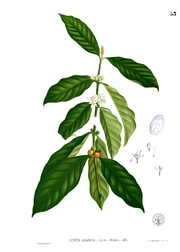
than any other commercially cultivated species of coffee. Wild plants grow to between 9 and 12 m tall, and have an open branching system; the leaves
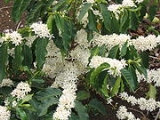
are opposite, simple elliptic-ovate to oblong, 6–12 cm long and 4–8 cm broad, glossy dark green. The flower
s are white, 10–15 mm in diameter and grow in axillary clusters. The fruit
is a drupe
(though commonly called a "berry") 10–15 mm in diameter, maturing bright red to purple and typically contains two seed
s (the coffee 'bean').
 Originally found in the southwestern highlands of Ethiopia
, Coffea arabica is now rare there in its native state, and many populations appear to be mixed native and planted trees. It is common there as an understorey shrub. It has also been recovered from the Boma Plateau
in southeastern Sudan. C. arabica is also found on Mount Marsabit
in northern Kenya
, but it is unclear whether this is a truly native or naturalised occurrence.
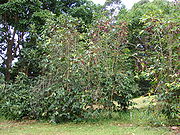
s mostly only grow to about 5 m, and are frequently trimmed as low as 2 m to facilitate harvesting. Unlike Coffea canephora
, C. arabica prefers to be grown in light shade.
 Two to four years after planting, C. arabica produces small, white and highly fragrant flowers. The sweet fragrance resembles the sweet smell of jasmine
flowers. When flowers open on sunny days, this results in the greatest numbers of berries. This can be a curse, however, as coffee plants tend to produce too many berries; this can lead to an inferior harvest and even damage yield in the following years, as the plant will favour the ripening of berries to the detriment of its own health. On well kept plantations, this is prevented by pruning the tree. The flowers themselves only last a few days, leaving behind only the thick dark green leaves. The berries then begin to appear. These are as dark green as the foliage, until they begin to ripen, at first to yellow and then light red and finally darkening to a glossy deep red. At this point they are called 'cherries' and are ready for picking. The berries are oblong and about 1 cm long. Inferior coffee results from picking them too early or too late, so many are picked by hand to be able to better select them, as they do not all ripen at the same time. They are sometimes shaken off the tree onto mats, which means that ripe and unripe berries are collected together.
The trees are difficult to cultivate and each tree can produce anywhere from 0.5–5.0 kg of dried beans, depending on the tree's individual character and the climate that season. The real prize of this cash crop
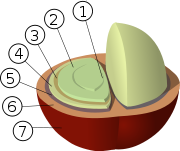
are the beans inside. Each berry holds two locule
s containing the beans. The coffee beans are actually two seeds within the fruit, there is sometimes a third seed or one seed, a peaberry
in the fruits at tips of the branches. These seeds are covered in two membranes, the outer one is called the "parchment coat" and the inner one is called the "silver skin."
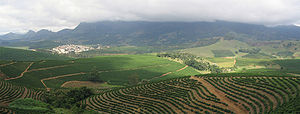
On Java Island, trees are planted at all times of the year and are harvested year round. In parts of Brazil
, however, the trees have a season and are harvested only in winter. The plants are vulnerable to damage in poor growing conditions (cold, low pH soil) and are also more vulnerable to pests than the C. robusta plant. Gourmet coffees are almost exclusively high-quality mild varieties of arabica coffee, such as Colombian coffee
.
Arabica coffee production in Indonesia
began in 1699. Indonesia
n coffees, such as Sumatra
n and Java, are known for heavy body and low acidity. This makes them ideal for blending with the higher acidity coffees from Central America
and East Africa
.
In Hawaii
, coffee was formerly more widely grown than at present, and it persists after cultivation in many areas. In some valleys, it is a highly invasive weed.
, human cultivation of coffee began after goat
s in Ethiopia
were seen mounting each other after eating the leaves and fruits of the coffee tree. However, in Ethiopia there are still some locales where people drink a tisane
made from the leaves of the coffee tree.
The first written record of coffee made from roasted coffee beans comes from Arab
ian scholars who wrote that it was useful in prolonging their working hours. The Arab innovation in Yemen of making a brew from roasted beans, spread first among the Egypt
ians and Turks
, and later on found its way around the world.
, who named it Jasminum arabicum after studying a specimen from the Botanic Gardens of Amsterdam
. Linnaeus placed it in its own genus Coffea
in 1737.
 There is an Ethiopian Coffea arabica that naturally contains very little caffeine. Maria Bernadete Silvarolla, a researcher of Instituto Agronomico de Campinas
(IAC), published findings in the journal Nature
about these strains of C. arabica plants. While beans of normal C. arabica plants contain 12 milligrams of caffeine per gram of dry mass, these newly found mutants contain only 0.76 milligrams of caffeine per gram, but with all the taste of normal coffee.
Coffea
Coffea is a genus of flowering plants in the Rubiaceae family. They are shrubs or small trees native to tropical and southern Africa and tropical Asia. Seeds of several species are the source of the popular beverage coffee. Coffee ranks as one of the world's most valuable and widely traded...
originally indigenous to the mountains of Yemen
Yemen
The Republic of Yemen , commonly known as Yemen , is a country located in the Middle East, occupying the southwestern to southern end of the Arabian Peninsula. It is bordered by Saudi Arabia to the north, the Red Sea to the west, and Oman to the east....
in the Arabian Peninsula
Arabian Peninsula
The Arabian Peninsula is a land mass situated north-east of Africa. Also known as Arabia or the Arabian subcontinent, it is the world's largest peninsula and covers 3,237,500 km2...
, hence its name, and also from the southwestern highlands of Ethiopia
Ethiopia
Ethiopia , officially known as the Federal Democratic Republic of Ethiopia, is a country located in the Horn of Africa. It is the second-most populous nation in Africa, with over 82 million inhabitants, and the tenth-largest by area, occupying 1,100,000 km2...
and southeastern Sudan
Sudan
Sudan , officially the Republic of the Sudan , is a country in North Africa, sometimes considered part of the Middle East politically. It is bordered by Egypt to the north, the Red Sea to the northeast, Eritrea and Ethiopia to the east, South Sudan to the south, the Central African Republic to the...
. It is also known as the "coffee shrub of Arabia", "mountain coffee" or "arabica coffee". Coffea arabica is believed to be the first species of coffee to be cultivated, being grown in southwest Arabia for well over 1,000 years. It is said to produce better coffee than the other major commercially grown coffee species, Coffea canephora
Coffea canephora
Robusta coffee is a variety of coffee which has its origins in central and western sub-Saharan Africa. It is a species of flowering plant in the Rubiaceae family. Though widely known as Coffea robusta, the plant is scientifically identified as Coffea canephora, which has two main varieties -...
(robusta), but tastes vary. C. arabica contains less caffeine
Caffeine
Caffeine is a bitter, white crystalline xanthine alkaloid that acts as a stimulant drug. Caffeine is found in varying quantities in the seeds, leaves, and fruit of some plants, where it acts as a natural pesticide that paralyzes and kills certain insects feeding on the plants...
than any other commercially cultivated species of coffee. Wild plants grow to between 9 and 12 m tall, and have an open branching system; the leaves
Leaf
A leaf is an organ of a vascular plant, as defined in botanical terms, and in particular in plant morphology. Foliage is a mass noun that refers to leaves as a feature of plants....
are opposite, simple elliptic-ovate to oblong, 6–12 cm long and 4–8 cm broad, glossy dark green. The flower
Flower
A flower, sometimes known as a bloom or blossom, is the reproductive structure found in flowering plants . The biological function of a flower is to effect reproduction, usually by providing a mechanism for the union of sperm with eggs...
s are white, 10–15 mm in diameter and grow in axillary clusters. The fruit
Fruit
In broad terms, a fruit is a structure of a plant that contains its seeds.The term has different meanings dependent on context. In non-technical usage, such as food preparation, fruit normally means the fleshy seed-associated structures of certain plants that are sweet and edible in the raw state,...
is a drupe
Drupe
In botany, a drupe is a fruit in which an outer fleshy part surrounds a shell of hardened endocarp with a seed inside. These fruits develop from a single carpel, and mostly from flowers with superior ovaries...
(though commonly called a "berry") 10–15 mm in diameter, maturing bright red to purple and typically contains two seed
Seed
A seed is a small embryonic plant enclosed in a covering called the seed coat, usually with some stored food. It is the product of the ripened ovule of gymnosperm and angiosperm plants which occurs after fertilization and some growth within the mother plant...
s (the coffee 'bean').
Distribution and Habitat
Ethiopia
Ethiopia , officially known as the Federal Democratic Republic of Ethiopia, is a country located in the Horn of Africa. It is the second-most populous nation in Africa, with over 82 million inhabitants, and the tenth-largest by area, occupying 1,100,000 km2...
, Coffea arabica is now rare there in its native state, and many populations appear to be mixed native and planted trees. It is common there as an understorey shrub. It has also been recovered from the Boma Plateau
Boma Plateau
The Boma Plateau is a region in the east of South Sudan, located in the Jonglei and Eastern Equatoria provinces. It is inhabited by the Anuak, Murle and Toposa peoples. It contains important wetlands for birdlife in the region...
in southeastern Sudan. C. arabica is also found on Mount Marsabit
Marsabit
Marsabit is a town in northern Kenya, located 170 km east of the center of the East African Rift at 37°58' E, 2°19' N . It is located in the Eastern Province and is almost surrounded by the Marsabit National Park and Reserve...
in northern Kenya
Kenya
Kenya , officially known as the Republic of Kenya, is a country in East Africa that lies on the equator, with the Indian Ocean to its south-east...
, but it is unclear whether this is a truly native or naturalised occurrence.
Cultivation and Use
C. arabica takes about seven years to mature fully, and does best with 1.0–1.5 meters (about 40–59 inches) of rain, evenly distributed throughout the year. It is usually cultivated between 1,300 and 1,500 m altitude, but there are plantations as low as sea level and as high as 2,800 m. The plant can tolerate low temperatures, but not frost, and it does best when the temperature hovers around 20 °C (68 °F). Commercial cultivarCultivar
A cultivar'Cultivar has two meanings as explained under Formal definition. When used in reference to a taxon, the word does not apply to an individual plant but to all those plants sharing the unique characteristics that define the cultivar. is a plant or group of plants selected for desirable...
s mostly only grow to about 5 m, and are frequently trimmed as low as 2 m to facilitate harvesting. Unlike Coffea canephora
Coffea canephora
Robusta coffee is a variety of coffee which has its origins in central and western sub-Saharan Africa. It is a species of flowering plant in the Rubiaceae family. Though widely known as Coffea robusta, the plant is scientifically identified as Coffea canephora, which has two main varieties -...
, C. arabica prefers to be grown in light shade.
Jasmine
Jasminum , commonly known as jasmines, is a genus of shrubs and vines in the olive family . It contains around 200 species native to tropical and warm temperate regions of the Old World...
flowers. When flowers open on sunny days, this results in the greatest numbers of berries. This can be a curse, however, as coffee plants tend to produce too many berries; this can lead to an inferior harvest and even damage yield in the following years, as the plant will favour the ripening of berries to the detriment of its own health. On well kept plantations, this is prevented by pruning the tree. The flowers themselves only last a few days, leaving behind only the thick dark green leaves. The berries then begin to appear. These are as dark green as the foliage, until they begin to ripen, at first to yellow and then light red and finally darkening to a glossy deep red. At this point they are called 'cherries' and are ready for picking. The berries are oblong and about 1 cm long. Inferior coffee results from picking them too early or too late, so many are picked by hand to be able to better select them, as they do not all ripen at the same time. They are sometimes shaken off the tree onto mats, which means that ripe and unripe berries are collected together.
The trees are difficult to cultivate and each tree can produce anywhere from 0.5–5.0 kg of dried beans, depending on the tree's individual character and the climate that season. The real prize of this cash crop
Cash crop
In agriculture, a cash crop is a crop which is grown for profit.The term is used to differentiate from subsistence crops, which are those fed to the producer's own livestock or grown as food for the producer's family...
are the beans inside. Each berry holds two locule
Locule
A locule is a small cavity or compartment within an organ or part of an organism ....
s containing the beans. The coffee beans are actually two seeds within the fruit, there is sometimes a third seed or one seed, a peaberry
Peaberry
Peaberry, also known as caracoli, is a type of coffee bean. Normally the fruit of the coffee plant develops as two halves of a bean within a single cherry, but sometimes only one of the two seeds gets fertilized, so there is nothing to flatten it. This oval bean is known as peaberry...
in the fruits at tips of the branches. These seeds are covered in two membranes, the outer one is called the "parchment coat" and the inner one is called the "silver skin."
On Java Island, trees are planted at all times of the year and are harvested year round. In parts of Brazil
Brazil
Brazil , officially the Federative Republic of Brazil , is the largest country in South America. It is the world's fifth largest country, both by geographical area and by population with over 192 million people...
, however, the trees have a season and are harvested only in winter. The plants are vulnerable to damage in poor growing conditions (cold, low pH soil) and are also more vulnerable to pests than the C. robusta plant. Gourmet coffees are almost exclusively high-quality mild varieties of arabica coffee, such as Colombian coffee
Colombian coffee
Colombian Coffee is a protected designation of origin granted by the European Union that applies to the coffee produced in Colombia. The Colombian coffee has been recognized worldwide as having high quality and distinctive taste...
.
Arabica coffee production in Indonesia
Arabica coffee production in Indonesia
Indonesia produced 420,000 metric tons of coffee in 2007. Of this total, 271,000 tons were exported and 148,000 tons were consumed domestically. Of the exports, 25% are Coffea arabica and the balance is Coffea canephora...
began in 1699. Indonesia
Indonesia
Indonesia , officially the Republic of Indonesia , is a country in Southeast Asia and Oceania. Indonesia is an archipelago comprising approximately 13,000 islands. It has 33 provinces with over 238 million people, and is the world's fourth most populous country. Indonesia is a republic, with an...
n coffees, such as Sumatra
Sumatra
Sumatra is an island in western Indonesia, westernmost of the Sunda Islands. It is the largest island entirely in Indonesia , and the sixth largest island in the world at 473,481 km2 with a population of 50,365,538...
n and Java, are known for heavy body and low acidity. This makes them ideal for blending with the higher acidity coffees from Central America
Central America
Central America is the central geographic region of the Americas. It is the southernmost, isthmian portion of the North American continent, which connects with South America on the southeast. When considered part of the unified continental model, it is considered a subcontinent...
and East Africa
East Africa
East Africa or Eastern Africa is the easterly region of the African continent, variably defined by geography or geopolitics. In the UN scheme of geographic regions, 19 territories constitute Eastern Africa:...
.
In Hawaii
Hawaii
Hawaii is the newest of the 50 U.S. states , and is the only U.S. state made up entirely of islands. It is the northernmost island group in Polynesia, occupying most of an archipelago in the central Pacific Ocean, southwest of the continental United States, southeast of Japan, and northeast of...
, coffee was formerly more widely grown than at present, and it persists after cultivation in many areas. In some valleys, it is a highly invasive weed.
History and Legend
According to legendLegend
A legend is a narrative of human actions that are perceived both by teller and listeners to take place within human history and to possess certain qualities that give the tale verisimilitude...
, human cultivation of coffee began after goat
Goat
The domestic goat is a subspecies of goat domesticated from the wild goat of southwest Asia and Eastern Europe. The goat is a member of the Bovidae family and is closely related to the sheep as both are in the goat-antelope subfamily Caprinae. There are over three hundred distinct breeds of...
s in Ethiopia
Ethiopia
Ethiopia , officially known as the Federal Democratic Republic of Ethiopia, is a country located in the Horn of Africa. It is the second-most populous nation in Africa, with over 82 million inhabitants, and the tenth-largest by area, occupying 1,100,000 km2...
were seen mounting each other after eating the leaves and fruits of the coffee tree. However, in Ethiopia there are still some locales where people drink a tisane
Tisane
A herbal tea, tisane, or ptisan is a herbal or plant infusion and usually not made from the leaves of the tea bush . Typically, herbal tea is simply the combination of boiling water and dried fruits, flowers or herbs. Herbal tea has been imbibed for nearly as long as written history extends...
made from the leaves of the coffee tree.
The first written record of coffee made from roasted coffee beans comes from Arab
Arab
Arab people, also known as Arabs , are a panethnicity primarily living in the Arab world, which is located in Western Asia and North Africa. They are identified as such on one or more of genealogical, linguistic, or cultural grounds, with tribal affiliations, and intra-tribal relationships playing...
ian scholars who wrote that it was useful in prolonging their working hours. The Arab innovation in Yemen of making a brew from roasted beans, spread first among the Egypt
Egypt
Egypt , officially the Arab Republic of Egypt, Arabic: , is a country mainly in North Africa, with the Sinai Peninsula forming a land bridge in Southwest Asia. Egypt is thus a transcontinental country, and a major power in Africa, the Mediterranean Basin, the Middle East and the Muslim world...
ians and Turks
Turkic peoples
The Turkic peoples are peoples residing in northern, central and western Asia, southern Siberia and northwestern China and parts of eastern Europe. They speak languages belonging to the Turkic language family. They share, to varying degrees, certain cultural traits and historical backgrounds...
, and later on found its way around the world.
Taxonomy
Coffea arabica was first described by Antoine de JussieuAntoine de Jussieu
Antoine de Jussieu was a French naturalist.Jussieu was born in Lyon, the son of Christophe de Jussieu , an apothecary of some repute, who published a Nouveau traité de la theriaque . Antoine studied at the university of Montpellier, and travelled with his brother Bernard through Spain, Portugal...
, who named it Jasminum arabicum after studying a specimen from the Botanic Gardens of Amsterdam
Hortus Botanicus (Amsterdam)
Hortus Botanicus is a botanical garden in Amsterdam, the Netherlands. One of the oldest in the world, it is one of Amsterdam's major tourist attractions.- History:...
. Linnaeus placed it in its own genus Coffea
Coffea
Coffea is a genus of flowering plants in the Rubiaceae family. They are shrubs or small trees native to tropical and southern Africa and tropical Asia. Seeds of several species are the source of the popular beverage coffee. Coffee ranks as one of the world's most valuable and widely traded...
in 1737.
Research
Instituto Agronômico de Campinas
The Instituto Agronômico de Campinas is a research and development institution affiliated to the Agência Paulista de Tecnologia dos Agronegócios , of the Secretary of Agriculture of the state of São Paulo, Brazil, with headquarters in the city of Campinas...
(IAC), published findings in the journal Nature
Nature (journal)
Nature, first published on 4 November 1869, is ranked the world's most cited interdisciplinary scientific journal by the Science Edition of the 2010 Journal Citation Reports...
about these strains of C. arabica plants. While beans of normal C. arabica plants contain 12 milligrams of caffeine per gram of dry mass, these newly found mutants contain only 0.76 milligrams of caffeine per gram, but with all the taste of normal coffee.