
All Topics  
Galaxy groups and clusters

 
Galaxy Groups and Clusters

   Email Print
   Bookmark   Link


Galaxy groups and clusters


Galaxy groups and clusters are the largest gravitation
Gravitation

Gravitation is a natural phenomenon that gives weight to objects. In everyday life, attraction due to gravity is the result of the presence of relatively large bodies, such as the Earth and the Moon....
ally-bound objects to have arisen thus far in the process of cosmic structure formation. They form the densest part of the large scale structure of the universe
Large-scale structure of the cosmos

In physical cosmology, the term large-scale structure refers to the characterization of observation distribution s of matter and light on the largest scales ....
. In models for the gravitational formation of structure with cold dark matter
Cold dark matter

Cold dark matter is a refinement of the big bang theory that contains the additional assumption that most of the matter in the Universe consists of material that cannot be observed by its electromagnetic radiation and hence is dark while at the same time the particles making up this matter are slow and hence are cold....
, the smallest structures collapse first and eventually build the largest structures, clusters of galaxies.


Discussion
Ask a question about 'Galaxy groups and clusters'
Start a new discussion about 'Galaxy groups and clusters'
Answer questions from other users
Full Discussion Forum


Encyclopedia


Galaxy
Galaxy groups and clusters are the largest gravitation
Gravitation

Gravitation is a natural phenomenon that gives weight to objects. In everyday life, attraction due to gravity is the result of the presence of relatively large bodies, such as the Earth and the Moon....
ally-bound objects to have arisen thus far in the process of cosmic structure formation. They form the densest part of the large scale structure of the universe
Large-scale structure of the cosmos

In physical cosmology, the term large-scale structure refers to the characterization of observation distribution s of matter and light on the largest scales ....
. In models for the gravitational formation of structure with cold dark matter
Cold dark matter

Cold dark matter is a refinement of the big bang theory that contains the additional assumption that most of the matter in the Universe consists of material that cannot be observed by its electromagnetic radiation and hence is dark while at the same time the particles making up this matter are slow and hence are cold....
, the smallest structures collapse first and eventually build the largest structures, clusters of galaxies. Clusters are then formed relatively recently between 10 billion years ago and now. Groups and clusters may contain from ten to thousands of galaxies. The clusters themselves are often associated with larger groups called supercluster
Supercluster

Superclusters are large groups of smaller galaxy groups and clusters and are among the Large-scale structure of the cosmos of the cosmos....
s.

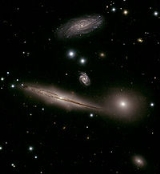
Groups of galaxies


Groups of galaxies
Galaxy

A galaxy is a massive, gravitation system that consists of stars and stellar remnants, an interstellar medium of gas and cosmic dust, and an important but poorly-understood component tentatively dubbed dark matter....
 are the smallest aggregates of galaxies. They typically contain fewer than 50 galaxies in a diameter of 1 to 2 megaparsecs (Mpc) (see m
1 E22 m

To help compare different orders of magnitude, this page lists distances starting at 10 zettametre .1 E+21 m* 24 Zm ? 2.5 million light years ? Distance to the Andromeda Galaxy...
 for distance comparisons). Their mass is approximately 1013 solar mass
Solar mass

The solar mass is a standard way to express mass in astronomy, used to describe the masses of other stars and galaxy. It is equal to the mass of the Sun, about two Names of large numbers kilograms or about 332,950 times the mass of the Earth, or 1,048 times the mass of Jupiter....
es. The spread of velocities for the individual galaxies is about 150 km/s. However, this definition should be used as a guide only, as larger and more massive galaxy systems are sometimes classified as galaxy groups.

The group which contains our own galaxy, the Milky Way
Milky Way

The Milky Way, sometimes called simply the Galaxy, is the galaxy in which the Solar System is located. It is a barred spiral galaxy that is part of the Local Group of galaxies....
, is called the Local Group
Local Group

The Local Group is the galaxy groups and clusters of galaxy that includes our galaxy, the Milky Way. The group comprises over 50 galaxies , with its gravitational center located somewhere between the Milky Way and the Andromeda Galaxy....
, and contains more than 40 galaxies.

Clusters of galaxies


Clusters are larger than groups, although there is no sharp dividing line between the two. When observed visually, clusters appear to be collections of galaxies held together by mutual gravitational attraction. However, their velocities are too large for them to remain gravitationally bound by their mutual attractions, implying the presence of either an additional invisible mass component, or an additional attractive force besides gravity. X-ray studies have revealed the presence of large amounts of intergalactic gas known as the intracluster medium
Intracluster medium

In astronomy, the intracluster medium is the superheated gas present at the center of a galaxy cluster. This plasma is heated to temperatures of between roughly 10 and 100 million Kelvin and consists mainly of ionised hydrogen and helium, containing most of the baryonic material in the cluster....
. This gas is very hot, between 107K and 108K, and hence emits X-rays in the form of bremsstrahlung
Bremsstrahlung

Bremsstrahlung , is electromagnetic radiation produced by the deceleration of a charged particle, such as an electron, when deflected by another charged particle, such as an atomic nucleus....
 and atomic line emission
Atomic spectral line

In physics, atomic spectral lines are of two types:* An emission line is formed when an electron makes a transition from a particular discrete energy level of an atom, to a lower energy state, emitting a photon of a particular energy and wavelength....
. The total mass of the gas is greater than that of the galaxies by roughly a factor of two. However this is still not enough mass to keep the galaxies in the cluster. Since this gas is in approximate hydrostatic equilibrium
Hydrostatic equilibrium

Hydrostatic equilibrium occurs when compression due to gravity is balanced by a pressure gradient which creates a pressure gradient force in the opposite direction....
 with the overall cluster gravitational field, the total mass distribution can be determined. It turns out the total mass deduced from this measurement is approximately six times larger than the mass of the galaxies or the hot gas. The missing component is known as dark matter
Dark matter

In astronomy and physical cosmology, dark matter is Hypothesis matter that is undetectable by its emitted electromagnetic radiation, but whose presence can be inferred from gravity effects on visible matter....
 and its nature is unknown. In a typical cluster perhaps only 5% of the total mass is in the form of galaxies, maybe 10% in the form of hot X-ray emitting gas and the remainder is dark matter. Brownstein and Moffat use a theory of modified gravity to explain X-ray cluster masses without dark matter.

Clusters typically have the following properties.
  • They contain 50 to 1000 galaxies, hot X-ray emitting gas and large amounts of dark matter
    Dark matter

    In astronomy and physical cosmology, dark matter is Hypothesis matter that is undetectable by its emitted electromagnetic radiation, but whose presence can be inferred from gravity effects on visible matter....
  • The distribution of these three components is approximately the same in the cluster.
  • They have total masses of 1014 to 1015 solar masses.
  • They typically have a diameter from 2 to 10 Mpc (see m
    1 E23 m

    To help compare different orders of magnitude, this page lists distances starting at 100 zettametre .1 E+22 m* 140 Zm — 15 million light years — Distance to Centaurus A galaxy...
     for distance comparisons).
  • The spread of velocities for the individual galaxies is about 800-1000 km/s.


Notable galaxy clusters in the relatively nearby universe include the Virgo cluster
Virgo Cluster

The Virgo Cluster is a galaxy cluster at a distance of approximately 1 E22 m light year away in the constellation Virgo . Comprising approximately 1300 member galaxies, the cluster forms the heart of the larger Local Supercluster, of which the Local Group is an outlying member....
, Hercules Cluster
Hercules Cluster

The Hercules Cluster is a Galaxy groups and clusters of about 100 galaxies some 650 million light-years distant in the constellation Hercules ....
, and the Coma Cluster
Coma cluster of galaxies

The Coma Cluster is a large galaxy cluster that contains over 1,000 identified galaxies. Along with the Leo Cluster , it is one of the two major clusters comprising the Coma Supercluster....
. A very large aggregation of galaxies known as the Great Attractor
Great Attractor

The Great Attractor is a gravity anomaly in intergalactic space within the range of the Centaurus Supercluster that reveals the existence of a localised concentration of mass equivalent to tens of thousands of Milky Ways, observable by its effect on the motion of galaxies and their associated clusters over a region hundreds of millions of li...
, dominated by the Norma cluster
Norma cluster

The Norma Cluster is a rich galaxy groups and clusters of galaxy located near the center of the Great Attractor. Although it is both nearby and bright, it is located in the zone of avoidance, a region that is difficult to observe near the Galactic plane of the Milky Way....
, is massive enough to affect the local expansion of the universe (Hubble flow).

In the last few decades, they are also found to be relevant sites of particle acceleration, a feature which has been discovered by the observing non-thermal diffuse radio emissions as radio halo
Radio halo

Radio halos are large-scale areas of radio emission found in clusters of galaxies. They do not have an obvious galaxy counterpart, as opposed, for example, to radio galaxies which have Active galactic nucleus counterparts....
s and radio relics
Radio relics

Radio Relics are diffuse synchrotron radio emission found in the peripheral regions of galaxy clusters. Similar to the case of radio halos, they do not have any obvious galaxy counterpart, but their shapes are much more elongated and irregular compared to those of radio halos....
.

Note: clusters of galaxies should not be confused with star cluster
Star cluster

Star clusters or star clouds are groups of stars which are gravity bound. Two types of star clusters can be distinguished: globular clusters are tight groups of hundreds of thousands of very old stars, while open clusters generally contain less than a few hundred members, and are often very young....
s such as galactic clusters and open cluster
Open cluster

An open cluster is a star cluster of up to a few thousand stars that were formed from the same giant molecular cloud, and are still loosely gravity to each other....
s, which are structures within galaxies, as well as globular cluster
Globular cluster

A globular cluster is a sphere collection of stars that orbits a Galactic Center as a satellite. Globular clusters are very tightly bound by gravity, which gives them their spherical shapes and relatively high stellar densities toward their centers....
s, which typically orbit galaxies.

Superclusters


Groups, clusters and some isolated galaxies form even larger structures, the supercluster
Supercluster

Superclusters are large groups of smaller galaxy groups and clusters and are among the Large-scale structure of the cosmos of the cosmos....
s. At the very largest scales of the visible universe, matter is gathered into filament
Galaxy filament

In physical cosmology, filaments are the largest known structures in the universe, thread-like structures with a typical length of 50 to 80 parsec#Megaparsecs_and_gigaparsecss that form the boundaries between large void in the universe....
s and walls
Great Wall (astronomy)

The Great Wall , sometimes specifically referred to as the CfA2 Great Wall, is the second largest known Large-scale structure of the cosmos in the Universe ....
 surrounding vast void
Void (astronomy)

In astronomy, voids are the empty spaces between galaxy filament, the largest-scale structures in the Universe, that contain very few, or no, galaxies....
s. This structure resembles a foam
Foam

The most general definition of foam is a substance that is formed by trapping many gas bubbles in a liquid or solid. It can also refer to anything that is analogous to such a phenomenon, such as quantum foam....
.

Observational methods


Clusters of galaxies have been found in surveys
Astronomical catalog

An astronomical catalog or catalogue is a list or tabulation of astronomical objects, typically grouped together because they share a common type, morphology, origin, means of detection, or method of discovery....
 by a number of observational techniques and have been studied in detail using many methods:

  • Optical or infrared
    Infrared

    Infrared radiation is electromagnetic radiation whose wavelength is longer than that of visible light , but shorter than that of terahertz radiation and microwaves ....
    : The individual galaxies of clusters can be studied through optical or infrared imaging and spectroscopy. Galaxy clusters are found by optical or infrared telescopes by searching for overdensities, and then confirmed by finding several galaxies at a similar redshift
    Redshift

    In physics and astronomy, redshift occurs when electromagnetic radiation?usually visible light?emitted or reflected by an object is shifted towards the red end of the electromagnetic spectrum due to the Doppler effect....
    . Infrared searches are more useful for finding more distant (higher redshift
    Redshift

    In physics and astronomy, redshift occurs when electromagnetic radiation?usually visible light?emitted or reflected by an object is shifted towards the red end of the electromagnetic spectrum due to the Doppler effect....
    ) clusters.
  • X-ray
    X-ray

    X-radiation is a form of electromagnetic radiation. X-rays have a wavelength in the range of 10 to 0.01 nanometers, corresponding to frequency in the range 30 Hertz to 30 Hertz and energies in the range 120 Electron volt to 120 keV....
    : The hot plasma emits X-rays which can be detected by X-ray
    X-ray

    X-radiation is a form of electromagnetic radiation. X-rays have a wavelength in the range of 10 to 0.01 nanometers, corresponding to frequency in the range 30 Hertz to 30 Hertz and energies in the range 120 Electron volt to 120 keV....
     telescope
    Telescope

    A telescope is an instrument designed for the observation of remote objects by the collection of electromagnetic radiation. The first known practically functioning telescopes were invented in the Netherlands at the beginning of the 17th century....
    s. The cluster gas can be studied using both X-ray imaging and X-ray spectroscopy. Clusters are quite prominent in X-ray surveys and along with AGN
    Active galactic nucleus

    An active galactic nucleus is a compact region at the centre of a galaxy which has a much higher than normal luminosity over some or all of the electromagnetic spectrum ....
     are the brightest X-ray emitting extragalactic objects.
  • Radio
    Radio astronomy

    Radio astronomy is a subfield of astronomy that studies Astronomical object at radio frequency. The initial detection of radio waves from an astronomical object was made in the 1930s, but subsequent advances have identified a number of different sources of radio emission....
    : A number of diffuse structures
    Radio halo

    Radio halos are large-scale areas of radio emission found in clusters of galaxies. They do not have an obvious galaxy counterpart, as opposed, for example, to radio galaxies which have Active galactic nucleus counterparts....
     emitting at radio frequencies have been found in clusters. Groups of radio sources (which may include diffuse structures
    Radio halo

    Radio halos are large-scale areas of radio emission found in clusters of galaxies. They do not have an obvious galaxy counterpart, as opposed, for example, to radio galaxies which have Active galactic nucleus counterparts....
     or AGN have been used as tracers of cluster location. At high redshift
    Redshift

    In physics and astronomy, redshift occurs when electromagnetic radiation?usually visible light?emitted or reflected by an object is shifted towards the red end of the electromagnetic spectrum due to the Doppler effect....
     imaging around individual radio sources (in this case AGN) has been used to detect proto-clusters (clusters in the process of forming).
  • Sunyaev-Zel'dovich effect
    Sunyaev-Zel'dovich effect

    The Sunyaev-Zel'dovich effect is the result of high energy electrons distorting the cosmic microwave background radiation through Compton_scattering#Inverse_Compton_scattering, in which some of the energy of the electrons is transferred to the low energy CMB photons....
    : The hot electrons in the intracluster medium scatter radiation from the cosmic microwave background through inverse Compton scattering
    Compton scattering

    In physics, Compton scattering or the Compton effect is the decrease in energy of an X-ray or gamma ray photon, when it interacts with matter....
    . This produces a "shadow" in the observed cosmic microwave background at some radio frequencies.
  • Gravitational Lensing
    Gravitational lens

    A gravitational lens is formed when the light from a very distant, bright source is "bent" around a massive object between the source object and the observer....
    : Clusters of galaxies contain enough matter to distort the observed orientations of galaxies behind them. The observed distortions can be used to model the distribution of dark matter in the cluster.


Temperature and density


Clusters of galaxies are the most recent and most massive objects to have arisen in the hierarchical structure formation of the universe and the study of clusters tells one about the way galaxies form and evolve. Clusters have two important properties: their masses are large enough to retain any energetic gas ejected from member galaxies and the thermal energy of the gas within the cluster is observable within the X-Ray bandpass. The observed state of gas within a cluster is determined by a combination of shock heating during accretion, radiative cooling, and thermal feedback triggered by that cooling. The density
Density

The density of a material is defined as its mass per unit volume. The symbol of density is ....
, temperature
Temperature

In physics, temperature is a physical property of a Physical system that underlies the common notions of hot and cold; something that feels hotter generally has the greater temperature....
, and substructure of the intracluster X-Ray gas therefore represents the entire thermal history of cluster formation. To better understand this thermal history one needs to study the entropy of the gas because entropy is the quantity most directly changed by increasing or decreasing the thermal energy of intracluster gas.

Reference


See also

  • Entropy
    Entropy

    In many branches of science, entropy is a measure of the disorder of a system. The concept of entropy is particularly notable as it is applied across physics, information theory and mathematics....
  • Fossil group
    Fossil group

    Fossil Galaxy Groups, fossil Groups, or fossil clusters are believed to be the end-result of galaxy merging within a normal galaxy group, leaving behind the X-ray halo....
  • List of galaxy clusters
    List of galaxy clusters

    This page lists some of the more interesting galaxy clusters and groups.Defining the limits of galaxy clusters is imprecise as many clusters are still forming....
  • Large-scale structure of the cosmos
    Large-scale structure of the cosmos

    In physical cosmology, the term large-scale structure refers to the characterization of observation distribution s of matter and light on the largest scales ....
  • Timeline of galaxies, clusters of galaxies, and large-scale structure
  • Intracluster medium
    Intracluster medium

    In astronomy, the intracluster medium is the superheated gas present at the center of a galaxy cluster. This plasma is heated to temperatures of between roughly 10 and 100 million Kelvin and consists mainly of ionised hydrogen and helium, containing most of the baryonic material in the cluster....


External References