
| |
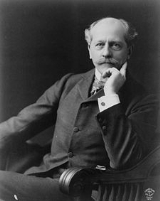
Percival Lawrence Lowell (March 13, 1855–November 12, 1916) was a businessman, author, mathematician, and astronomer who fueled speculation that there were canals on Mars, founded the Lowell Observatory in Flagstaff, Arizona, and formed the beginning of the effort that led to the discovery of Pluto 14 years after his death. The choice of the name Pluto and its symbol were partly influenced by his initials PL.
ival Lowell, a descendant of the Boston Lowell family, was the brother of A. Lawrence, president of Harvard University, and Amy, an imagist poet, critic, and publisher.
Percival graduated from the Noble and Greenough School in 1872 and Harvard University in 1876 with distinction in mathematics.
In the 1880s, Lowell traveled extensively in the Far East.

Discussion
Ask a question about 'Percival Lowell'
Start a new discussion about 'Percival Lowell'
Answer questions from other users
|
Quotations
Formulae are the anaethetics of thought, not its stimulants.
Ibid
War is a survival among us from savage times and affects now chiefly the the boyish and unthinking element of the nation.
Ibid
The whole object of science is to synthesize, and so simplify; and did we but know the uttermost of a subject we could make it singularly clear.
Mars and its Canals (1906), Preface.
That Mars is inhabited by beings of some sort or other we may consider as certain as it is uncertain what these beings may be.
Ibid, Chapter XXXII, Conclusion

Encyclopedia
Percival Lawrence Lowell (March 13, 1855–November 12, 1916) was a businessman, author, mathematician, and astronomer who fueled speculation that there were canals on Mars, founded the Lowell Observatory in Flagstaff, Arizona, and formed the beginning of the effort that led to the discovery of Pluto 14 years after his death. The choice of the name Pluto and its symbol were partly influenced by his initials PL.
Biography
Percival Lowell, a descendant of the Boston Lowell family, was the brother of A. Lawrence, president of Harvard University, and Amy, an imagist poet, critic, and publisher.
Percival graduated from the Noble and Greenough School in 1872 and Harvard University in 1876 with distinction in mathematics.
In the 1880s, Lowell traveled extensively in the Far East. In August 1883, he served as a foreign secretary and counsellor for a special Korean diplomatic mission to the United States. He also spent significant periods of time in Japan, writing books on Japanese religion, psychology, and behavior. His texts are filled with observations and academic discussions of various aspects of Japanese life, including language, religious practices, economics, travel in Japan, and the development of personality. Books by Percival Lowell on the Orient include Noto (1891) and Occult Jepan (1894); the latter from his third and final trip to the region. The most popular of Lowell's books on the Orient, The Soul of the Far East, (1888) contains an early synthesis of some of his ideas, that in essence, postulated that human progress is a function of the qualities of individuality and imagination.
Beginning in the winter of 1893-94, using his wealth and influence, Lowell dedicated himself to the study of astronomy, founding the observatory which bears his name. For the last 23 years of his life astronomy, Lowell Observatory, and his and others' work at his observatory were the focal points of his life. He lived to be 61 years of age.
World War I very much saddened Lowell, a dedicated pacifist. This, along with some setbacks in his astronomical work (described below), undermined his health and contributed to his death from a stroke on November 12, 1916.
Lowell is buried on Mars Hill near his observatory.
Astronomy career
Lowell became determined to study Mars and astronomy as a full-time career after reading Camille Flammarion's La plančte Mars. He was particularly interested in the canals of Mars, as drawn by Italian astronomer Giovanni Schiaparelli, who was director of the Milan Observatory.
In 1894 Lowell chose Flagstaff, Arizona Territory as the home of his new observatory. At an altitude of over 2100 meters (7000 feet), with few cloudy nights, and far from city lights, Flagstaff was an excellent site for astronomical observations. This marked the first time an observatory had been deliberately located in a remote, elevated place for optimal seeing.
|