

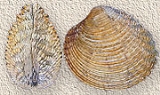
Veneridae

Encyclopedia
The Veneridae or venerids, also known as the Venus
clams, are a very large family of minute to large, saltwater clams
, marine bivalve molluscs
. There are over 500 living species of venerid bivalves, most of which are edible, and many of which are exploited as a food source.
Many of the most important edible species are commonly known (in the USA) simply as "clams". Venerids make up a significant proportion of the world fishery of edible bivalves. The family includes some species that are important commercially, such as (in the USA) the hard clam
or quahog, Mercenaria mercenaria.
of the family, therefore changes in the generic name of species are frequently encountered.
The characters used for classifying this group still tend to be superficial, focusing on external features, especially those of the shell. Venerid clams are characterized as bivalves with an external posterior ligament, usually a well demarcated anterior area known as the lunule, and three interlocking structures (called cardinal teeth) in the top of each valve; in several of the subfamilies there are also anterior lateral teeth, anterior to the cardinal teeth: one in the left valve, and two (sometimes obscure) in the right valve. The inner lower peripheries of the valves can be finely toothed or smooth.
species, for example, have the triangular outline of the surf clams in other bivalve families, and occur often in surf zones. Some Dosinia
species are almost disc-like in shape and reminiscent of Lucinid bivalves; both types of circular bivalves tend to burrow relatively deeply into the sediment. Further reclassification is to be expected as the results of current research in molecular systematics on the group appear in the literature.
Venerids have rounded or oval solid shells with the umbones (projections) inturned towards the anterior end. There are three or four cardinal teeth on each valve. The siphons are short and united, except at the tip, and are not very long. The foot is large.
Venus (mythology)
Venus is a Roman goddess principally associated with love, beauty, sex,sexual seduction and fertility, who played a key role in many Roman religious festivals and myths...
clams, are a very large family of minute to large, saltwater clams
CLaMS
CLaMS is a modular chemistry transport model system developed at Forschungszentrum Jülich, Germany. CLaMS was first described by McKenna et al. and was expanded into three dimensions by Konopka et al....
, marine bivalve molluscs
Mollusca
The Mollusca , common name molluscs or mollusksSpelled mollusks in the USA, see reasons given in Rosenberg's ; for the spelling mollusc see the reasons given by , is a large phylum of invertebrate animals. There are around 85,000 recognized extant species of molluscs. Mollusca is the largest...
. There are over 500 living species of venerid bivalves, most of which are edible, and many of which are exploited as a food source.
Many of the most important edible species are commonly known (in the USA) simply as "clams". Venerids make up a significant proportion of the world fishery of edible bivalves. The family includes some species that are important commercially, such as (in the USA) the hard clam
Hard clam
The hard clam , also known as a quahog , round clam, or hard-shell clam, is an edible marine bivalve mollusk which is native to the eastern shores of North America, from Prince Edward Island to the Yucatán Peninsula...
or quahog, Mercenaria mercenaria.
Classification
The classification within the family Veneridae has been controversial at least since the 1930s. The most used classification is that of Keen (1969) which recognises 12 subfamilies, listed below. Some common species have been moved between genera (including genera in different subfamilies) because of repeated attempts to bring a more valid organization to the classification or taxonomyTaxonomy
Taxonomy is the science of identifying and naming species, and arranging them into a classification. The field of taxonomy, sometimes referred to as "biological taxonomy", revolves around the description and use of taxonomic units, known as taxa...
of the family, therefore changes in the generic name of species are frequently encountered.
The characters used for classifying this group still tend to be superficial, focusing on external features, especially those of the shell. Venerid clams are characterized as bivalves with an external posterior ligament, usually a well demarcated anterior area known as the lunule, and three interlocking structures (called cardinal teeth) in the top of each valve; in several of the subfamilies there are also anterior lateral teeth, anterior to the cardinal teeth: one in the left valve, and two (sometimes obscure) in the right valve. The inner lower peripheries of the valves can be finely toothed or smooth.
Description
Shell sculpture tends to be primarily concentric, but radial and divaricating ornamentation (see Gafrarium), and rarely spines (Pitar lupanaria for example) occur on some. One small subfamily, Samarangiinae, is created for a unique and rare clam found in coral reefs with an outer covering of cemented sand or mud that texturally camouflages it while enhancing the thickness of the shell. Several Venerid clams have overall shell shapes that are adapted to their environment. TivelaTivela
Tivela is a genus of saltwater clams in the family Veneridae.-Species:According to the World Register of Marine Species the following species are included in the genus Tivela * Tivela abaconis Dall, 1902* Tivela bicolor Gray...
species, for example, have the triangular outline of the surf clams in other bivalve families, and occur often in surf zones. Some Dosinia
Dosinia
Dosinia is a genus of marine bivalve molluscs, in the family Veneridae . Dosinia species are almost disc-like in shape and reminiscent of Lucinid bivalves.- Species :* Dosinia abyssicola T. Habe, 1961 Indo...
species are almost disc-like in shape and reminiscent of Lucinid bivalves; both types of circular bivalves tend to burrow relatively deeply into the sediment. Further reclassification is to be expected as the results of current research in molecular systematics on the group appear in the literature.
Venerids have rounded or oval solid shells with the umbones (projections) inturned towards the anterior end. There are three or four cardinal teeth on each valve. The siphons are short and united, except at the tip, and are not very long. The foot is large.
Subfamilies according to Keen (1969)
- Chioninae
- Circinae
- Clementinae
- Cyclinae
- Dosiniinae
- Gemminae
- Meretricinae
- Pitarinae
- Samaranginae
- Sunettinae
- Tapetinae
- Venerinae
List of genera in the family Veneridae
(may be incomplete)- AgriopomaAgriopomaAgriopoma is a genus of molluscs in the family Veneridae....
DallW. H. DallWilliam Healey Dall was an American naturalist, a prominent malacologist, and one of the earliest scientific explorers of interior Alaska...
, 1902 - Amiantis CarpenterPhillip Pearsall CarpenterPhilip Pearsall Carpenter Rev. Dr. , who in 1841, was ordained Presbyterian minister in England, and a Doctorate of Philosophy in 1860, and whose field work as a malacologist or conchologist in North America is still well regarded today...
, 1884 - Anomalocardia Schumacher, 1817
- AustrovenusAustrovenusAustrovenus is a genus of marine bivalve molluscs, in the family Veneridae, which are native to New Zealand.- Species in the genus Austrovenus:* Austrovenus aucklandica Powell, 1932 - Auckland Islands cockle...
Finlay,1927 - BassinaBassinaBassina is a genus of bivalve molluscs in the family Veneridae.-Species:* Bassina disjecta* Bassina foliacea * Bassina jacksoni * Bassina pachyphylla* Bassina yatei -References:*...
Jukes-BrowneAlfred John Jukes-BrowneAlfred John Jukes-Browne, FRS FGS was a British invertebrate palaeontologist and stratigrapher.He was born Alfred John Browne near Wolverhampton in 1851 to Alfred Hall and Caroline Amelia Browne. His uncle was the geologist Joseph Beete Jukes, well known for his work on the English and Irish...
, 1914 - Callista Poli, 1791
- ChameleaChameleaChamelea is a genus of small saltwater clams, marine bivalve molluscs in the family Veneridae, the venus clams.- Species :Species within the genus Chamelea include:* Chamelea gallina * Chamelea striatula...
MörchOtto Andreas Lowson MörchOtto Andreas Lowson Mörch was a biologist, specifically a malacologist. He lived in Sweden, in Denmark, and in France.- Taxa described :Bibliography and taxa described by Otto Andreas Lowson Mörch include:...
, 1853 - ChioneChione (genus)Chione is a genus of tropical American marine bivalve molluscs, in the family Veneridae.-Species:* Chione amathusia * Chione californiensis W. J. Broderip, 1835 - California venus, Banded venus...
Megerle von MühlfeldJohann Carl Megerle von MühlfeldJohann Carl Megerle von Mühlfeld was a scientist and zoologist who lived from 1765 to 1840.He worked at the Vienna natural history museum, the Naturhistorisches Museum, Wien, until he retired at the end of 1835.....
, 1811 - Chionopsis Olsson, 1932
- Chionista Keen, 1958
- Circomphalus Klein, 1853
- Clausinella J. E. Gray, 1851
- Compsomyax Stewart, 1930
- Cyclinella DallW. H. DallWilliam Healey Dall was an American naturalist, a prominent malacologist, and one of the earliest scientific explorers of interior Alaska...
, 1902 - DosinaDosinaDosina is a genus of marine bivalve molluscs, in the family Veneridae.-Species in the genus Dosina:* Dosina zelandica crebra * Dosina zelandica zelandica Gray, 1835-References:...
Gray, 1835 - DosiniaDosiniaDosinia is a genus of marine bivalve molluscs, in the family Veneridae . Dosinia species are almost disc-like in shape and reminiscent of Lucinid bivalves.- Species :* Dosinia abyssicola T. Habe, 1961 Indo...
ScopoliGiovanni Antonio ScopoliGiovanni Antonio Scopoli was an Italian physician and naturalist.-Biography:...
, 1777 - Gafrarium RödingPeter Friedrich RödingPeter Friedrich Röding was a German malacologist who lived in Hamburg. Very little is known about this naturalist.Many of Röding's descriptions are of species which were first named by earlier authors such as Johann Hieronymus Chemnitz, Friedrich Wilhelm Martini and Martin Lister...
, 1798 - GemmaAmethyst gem clamThe amethyst gem clam, Gemma gemma, is a small species of marine bivalve mollusk. It is a member of the family Veneridae, the Venus clams.It is one of the smaller species of marine clam, reaching a length of only 5 mm...
DeshayesGérard Paul DeshayesGérard Paul Deshayes was a French geologist and conchologist.He was born in Nancy, his father at that time being professor of experimental physics in the École Centrale of the Meurthe département....
, 1853 - Globivenus Coen, 1934
- Gouldia C. B. Adams, 1847
- Humilaria GrantUlysses S. Grant IVUlysses S. Grant IV , was the son of Ulysses S. Grant, Jr. and the grandson of General of the Army and President of the United States Ulysses S. Grant. He was an American geologist and paleontologist known for his work on the fossil mollusks of the California Pacific Coast...
and Gale, 1931 - IrusIrus (genus)Irus is a genus of saltwater clams, marine bivalve molluscs in the family Veneridae, the venus clams.-Species in the genus Irus:* Irus carditoides* Irus crebrelamellatus* Irus crenata* Irus crenatus* Irus cumingii...
Schmidt, 1818 - Irusella HertleinLeo George HertleinLeo George Hertlein was an American paleontologist and malacologist who studied the Recent and fossil mollusks of the eastern Pacific Ocean.Hertlein was born on a farm in Pratt County, Kansas...
and GrantUlysses S. Grant IVUlysses S. Grant IV , was the son of Ulysses S. Grant, Jr. and the grandson of General of the Army and President of the United States Ulysses S. Grant. He was an American geologist and paleontologist known for his work on the fossil mollusks of the California Pacific Coast...
, 1972 - LioconchaLioconchaLioconcha is a genus of molluscs in the family Veneridae.-Species:* Lioconcha annettae Lamprell & Whitehead, 1990* Lioconcha arabaya Van der Meij, Moolenbeek & Dekker, 2011* Lioconcha berthaulti Lamprell & Healy, 2002...
Morch, 1853
- LiocymaLiocymaLiocyma is a genus of molluscs in the family Veneridae....
DallW. H. DallWilliam Healey Dall was an American naturalist, a prominent malacologist, and one of the earliest scientific explorers of interior Alaska...
, 1870 - Lirophora ConradTimothy Abbott ConradTimothy Abbott Conrad was an American geologist, malacologist and carcinologist.- External links :* at Internet Archive...
, 1883 - MacrocallistaMacrocallistaMacrocallista is a genus of molluscs in the family Veneridae.-Species:* Macrocallista maculata — calico clam* Macrocallista nimbosa — sunray venus clam...
MeekFielding Bradford MeekFielding Bradford Meek was an American geologist and paleontologist.The son of a lawyer, he was born in Madison, Indiana. In early life he was in business as a merchant, but his leisure hours were devoted to collecting fossils and studying the rocks of the neighborhood of Madison...
, 1876 - Marcia H. Adams & A. Adams, 1857
- MercenariaMercenariaMercenaria is a genus of edible saltwater clams, marine bivalve molluscs in the family Veneridae, the Venus clams.The genus Mercenaria includes the quahogs, Mercenaria mercenaria, the northern quahog or hard clam, and M. campechiensis, the southern quahog...
Schumacher, 1817 - Meretrix Linnaeus, 1758
- NotirusNotirusNotirus is a genus of marine bivalve molluscs, in the family Veneridae.- Species in the genus Notirus:* Notirus macrophyllus* Notirus reflexus - References :...
FinlayHarold John FinlayHarold John Finlay was a New Zealand palaeontologist and conchologist. He was born in Comilla, India , on 22 March 1901....
, 1928 - NotocallistaNotocallistaNotocallista is a genus of marine bivalve molluscs, in the family Veneridae.- Species in the genus Notocallista:* Notocallista chione* Notocallista kingii* Notocallista multistriata * Notocallista virginea...
IredaleTom IredaleTom Iredale was an English-born ornithologist and malacologist who had a long association with Australia, where he lived for most of his life. He was an autodidact who never went to university and lacked formal training...
, 1924 - Nutricola Bernard, 1982
- Paphia BornBornBorn may refer to:* Childbirth* Born , a limited series comic book featuring the Punisher* Born Feinkost GmbH, a German food company* Born , a lunar crater-Places:* Born, Netherlands, a town in the Netherlands...
, 1778 - ParastarteParastarteParastarte is a genus of molluscs in the family Veneridae....
ConradTimothy Abbott ConradTimothy Abbott Conrad was an American geologist, malacologist and carcinologist.- External links :* at Internet Archive...
, 1862 - PeriglyptaPeriglyptaPeriglypta is a genus of molluscs in the family Veneridae....
Jukes-BrowneAlfred John Jukes-BrowneAlfred John Jukes-Browne, FRS FGS was a British invertebrate palaeontologist and stratigrapher.He was born Alfred John Browne near Wolverhampton in 1851 to Alfred Hall and Caroline Amelia Browne. His uncle was the geologist Joseph Beete Jukes, well known for his work on the English and Irish...
, 1914 - PitarPitar (genus)Pitar is a genus of molluscs in the family Veneridae.-Species:* Pitar albidus — white venus clam* Pitar circinatus — purple venus clam* Pitar cordatus — cordate venus clam...
Römer, 1857 - ProtothacaProtothacaProtothaca is a genus of bivalve mollusks in the family Veneridae. This genus of mollusca has been exploited by humans since prehistory; for example, Chumash peoples of California harvested this genus from Morro Bay in approximately 1000 AD.-References:...
DallW. H. DallWilliam Healey Dall was an American naturalist, a prominent malacologist, and one of the earliest scientific explorers of interior Alaska...
, 1902 - Psephidia DallW. H. DallWilliam Healey Dall was an American naturalist, a prominent malacologist, and one of the earliest scientific explorers of interior Alaska...
, 1902 - RuditapesRuditapesRuditapes is a genus of marine bivalve molluscs, in the family Veneridae.- Species :* Ruditapes aureus* Ruditapes bruguieri* Ruditapes decussata* Ruditapes decussatus* Ruditapes japonica* Ruditapes largillierti...
- SaxidomusSaxidomusSaxidomus, common name "Washington clams", is a genus of large edible saltwater clams, marine bivalve mollusks in the family Veneridae, the venus clams.The species Saxidomus giganteus is known as the "butter clam"....
ConradTimothy Abbott ConradTimothy Abbott Conrad was an American geologist, malacologist and carcinologist.- External links :* at Internet Archive...
, 1837 - Sunetta Link, 1807
- Tapes Muhlfeld, 1811
- Tawera Marwick, 1927
- Timoclea Brown, 1827
- TivelaTivelaTivela is a genus of saltwater clams in the family Veneridae.-Species:According to the World Register of Marine Species the following species are included in the genus Tivela * Tivela abaconis Dall, 1902* Tivela bicolor Gray...
Link, 1807 - Transennella DallW. H. DallWilliam Healey Dall was an American naturalist, a prominent malacologist, and one of the earliest scientific explorers of interior Alaska...
, 1883 - VenerupisVenerupisVenerupis is a genus of marine bivalve molluscs in the family Veneridae, commonly known as carpet shells. The valves are robust and rhomboidal with the umbones turned-in and nearer the anterior end. The posterior end is wedge-shaped and the internal margins of the valves are smooth. There are 3 or...
Lamarck, 1818 - VentricolariaVentricolariaVentricolaria is a genus of molluscs in the family Veneridae.-Species:* Ventricolaria rigida — rigid venus* Ventricolaria rugatina — queen venus...
Keen, 1954 - VenusVenus (genus)Venus is a genus of small to large saltwater clams in the family Veneridae, which is sometimes known as the Venus clams and their relatives. These are marine bivalve molluscs....
Linnaeus, 1758
External links
- Taxonomy on the half shell A major project of the Chicago Field Museum of Natural HistoryField Museum of Natural HistoryThe Field Museum of Natural History is located in Chicago, Illinois, USA. It sits on Lake Shore Drive next to Lake Michigan, part of a scenic complex known as the Museum Campus Chicago...
and the American Museum of Natural HistoryAmerican Museum of Natural HistoryThe American Museum of Natural History , located on the Upper West Side of Manhattan in New York City, United States, is one of the largest and most celebrated museums in the world...
on Venerid classification - Bibliography of venerid taxonomy
- VENERIDAE - www.chez.com
- ZipCodeZoo