


Chroma key

Encyclopedia
Chroma key compositing (or chroma keying) is a technique for compositing
(layering) two images together. A color
range in the top layer is made transparent, revealing another image behind. The chroma keying technique is commonly used in video production
and post-production
. This technique is also referred to as color keying, color-separation overlay (CSO; primarily by the BBC
), greenscreen, and bluescreen. It is commonly used for weather forecast broadcasts
, wherein the news presenter
appears to be standing in front of a large map
during live television
newscasts, but in a television studio
it is actually a large blue or green background. The meteorologist stands in front of a bluescreen, and then different weather maps are added on those parts in the image where the color is blue. If the meteorologist wears blue clothes, his clothes will be replaced with the background video. This also works for greenscreens, since blue and green are considered the colors least like skin tone. This technique is also used in the entertainment industry, for example for special effects. Software is available today, such as Pinnacle Studio
, which makes it possible and relatively easy for the average home computer user, to create videos using the Chromakey function and greenscreeens.
, a complex and time consuming process once known as "travelling matte
" was used prior to the introduction of digital compositing
. The blue screen and traveling matte method were developed in the 1930s at RKO Radio Pictures and other studios, and were used to create special effects for The Thief of Bagdad
(1940). At RKO, Linwood Dunn used a travelling matte to create "wipes" – where there were transitions like a windshield wiper in films such as Flying Down to Rio
(1933).
The credit for development of the bluescreen is given to Larry Butler, who won the Academy Award for special effects for The Thief of Bagdad. He had invented the blue screen and traveling matte technique in order to achieve the visual effects which were unprecedented in 1940. He was also the first special effects man to have created these effects in Technicolor
, which was in its infancy at the time.
In 1950, Warner Brothers employee and ex-Kodak researcher Arthur Widmer
began working on an ultra violet traveling matte process. He also began developing bluescreen techniques: one of the first films to use them was the 1958 adaptation of the Ernest Hemingway
novella, The Old Man and the Sea
, starring Spencer Tracy
.
The background footage is shot first and the actor or model is filmed carrying out their actions against a bluescreen. To simply place the foreground shot over the background shot would create a ghostly image over a blue-tinged background. The actor or model must be separated from the background and placed into a specially-made "hole" in the background footage. The bluescreen shot was first rephotographed through a blue filter so that only the background is exposed. A special film is used that creates a black and white negative image — a black background with a subject-shaped hole in the middle. This is called a 'female matte'. The bluescreen shot was then rephotographed again, this time through a red and green filter so that only the foreground image was cast on film, creating a black silhouette on an unexposed (clear) background. This is called a 'male matte'.
The background image is then rephotographed through the male matte, and the shot rephotographed through the female matte. An optical printer
with two projectors, a film camera and a 'beam splitter' combines the images together one frame at a time. This part of the process must be very carefully controlled to ensure the absence of 'black lines'. During the 1980s, minicomputer
s were used to control the optical printer. For The Empire Strikes Back, Richard Edlund
created a 'quad optical printer' that accelerated the process considerably and saved money. He received a special Academy Award
for his innovation.
One drawback to the traditional traveling matte is that the cameras shooting the images to be composited can't be easily synchronized. For decades, such matte shots had to be done "locked-down" so that neither the matted subject nor the background could shift their camera perspective at all. Later, computer-timed motion control
cameras alleviated this problem, as both the foreground and background could be filmed with the same camera moves.
Petro Vlahos
was awarded an Academy Award for his development of these techniques. His technique exploits the fact that most objects in real-world scenes have a color whose blue color component is similar in intensity to their green color component. Zbigniew Rybczyński
also contributed to bluescreen technology.
For Star Trek: The Next Generation
, an ultraviolet light matting process was proposed by Don Lee of CIS and developed by Gary Hutzel and the staff of Image G. This involved a fluorescent orange backdrop which made it easier to generate a holdout matte
, thus allowing the effects team to produce effects in a quarter of the time needed for other methods.
Some films make heavy use of chroma key to add backgrounds that are constructed entirely using computer-generated imagery
(CGI). Performances from different takes can even be composited together, which allows actors to be filmed separately and then placed together in the same scene. Chroma key allows performers to appear to be in any location without even leaving the studio.
Computer development also made it easier to incorporate motion into composited shots, even when using handheld cameras. Reference-points can now be placed onto the colored background (usually as a painted grid, X's marked with tape, or equally spaced tennis balls attached to the wall). In post-production, a computer can use the references to adjust the position of the background, making it match the movement of the foreground perfectly. Modern advances in software and computational power have even eliminated the need to use grids or tracking marks – the software analyzes the relative motion of colored pixels against other colored pixels and solves the 'motion' to create a camera motion algorithm which can be used in compositing software to match the motion of composited elements to a moving background plate.
Weathermen often use a field monitor to the side of the screen to see where they are putting their hands. A newer technique is to project a faint image onto the screen.
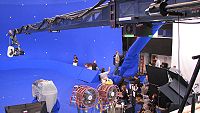 The principal subject is filmed or photographed against a background consisting of a single color or a relatively narrow range of colors, usually blue
or green
because these colors are considered to be the furthest away from skin tone. The portions of the video which match the preselected color are replaced by the alternate background video. This process is commonly known as "keying", "keying out" or simply a "key".
Green is currently used as a backdrop more than any other color because image sensors in digital video cameras are most sensitive to green, due to the bayer pattern allocating more pixels to the green channel, mimicking the human eye's increased sensitivity to green light. Therefore, the green camera channel contains the least "noise" and can produce the cleanest key/matte/mask. Additionally, less light is needed to illuminate green, again because of the higher sensitivity to green in image sensors. Bright green has also become favored as a blue background may match a subject's eye color or common items of clothing, such as jeans, or a dark-navy suit.
Blue was used before digital keying became commonplace because it was necessary for the optical process, but it needed more illumination than green. However, it is also further in the visual spectrum from red, the predominant color in human skin.
The most important factor for a key is the color separation of the foreground (the subject) and background (the screen) – a bluescreen will be used if the subject is predominately green (for example plants), despite the camera being more sensitive to green light.
In analog color TV
, color is represented by the phase of the chroma subcarrier relative to a reference oscillator. Chroma key is achieved by comparing the phase of the video to the phase corresponding to the preselected color. In-phase portions of the video are replaced by the alternate background video.
In digital color TV
, color is represented by three numbers (red, green, blue). Chroma key is achieved by a simple numerical comparison between the video and the preselected color. If the color at a particular point on the screen matches (either exactly, or in a range), then the video at that point is replaced by the alternate background video.
films to create the effect of an invisibility cloak
. The actor can also be filmed against a chroma key background and inserted into the background shot with a distortion effect in order to create a cloak that is marginally detectable.
Difficulties emerge with bluescreen when a costume in an effects shot must be blue, such as Superman
's traditional blue outfit. In the 2002
film
Spider-Man
, in scenes where both Spider-Man
and the Green Goblin
are in the air, Spider-Man had to be shot in front of the greenscreen and the Green Goblin had to be shot in front of a bluescreen, because Spider-Man wears a costume which is red and blue in color and the goblin wears a costume which is entirely green in color. If both were shot in front of the same screen, one character would have been partially erased from the shot.
is generally used for both weather maps and special effects because it is complementary
to human
skin
tone. The use of blue is also tied to the fact that the blue emulsion layer of film has the finest crystals and thus good detail and minimal grain (in comparison to the red and green layers of the emulsion.) In the digital world, however, green
has become the favored color because digital cameras retain more detail in the green channel and it requires less light than blue. Green not only has a higher luminance value than blue but also in early digital formats the green channel was sampled twice as often as the blue, making it easier to work with. The choice of color is up to the effects artists and the needs of the specific shot. In the past decade, the use of green has become dominant in film special effects. Also, the green background is favored over blue for outdoors filming where the blue sky might appear in the frame and could accidentally be replaced in the process. Although green and blue are the most common, any color can be used. Red is usually avoided due to its prevalence in normal human skin pigments, but can be often used for objects and scenes which do not involve people.
Occasionally, a magenta
background is used, as in some software applications where the magenta or fuchsia
key value #FF00FF is sometimes referred to as "magic pink".
With better imaging and hardware, many companies are avoiding the confusion often experienced by weather presenters, who must otherwise watch themselves on a monitor to see the image shown behind them, by lightly projecting a copy of the background image onto the blue/green screen. This allows the presenter to accurately point and look at the map without referring to monitors.
A newer technique is to use a retroreflective curtain
in the background, along with a ring of bright LED
s around the camera lens. This requires no light to shine on the background other than the LEDs, which use an extremely small amount of power and space unlike big stage lights, and require no rigging. This advance was made possible by the invention of practical blue LEDs in the 1990s, which also allow for emerald green LEDs.
There is also a form of color keying that uses light spectrum invisible to human eye. Called Thermo-Key, it uses infrared as the key color, which would not be replaced by background image during postprocessing.
, because it is best to have as narrow a color range as possible being replaced. A shadow would present itself as a darker color to the camera and might not register for replacement. This can sometimes be seen in low-budget or live broadcasts where the errors cannot be manually repaired. The material being used affects the quality and ease of having it evenly lit. Materials which are shiny will be far less successful than those that are not. A shiny surface will have areas that reflect the lights making them appear pale, while other areas may be darkened. A matte surface will diffuse the reflected light and have a more even color range. In order to get the cleanest key from shooting greenscreen it is necessary to create a value difference between the subject and the greenscreen. In order to differentiate the subject and screen a two-stop difference can be used, either by making the greenscreen two stops higher than the subject or vice versa.
Sometimes a shadow can be used to create a special effect. Areas of the bluescreen or greenscreen with a shadow on them can be replaced with a darker version of the desired background video image, making it look like the person casting the shadow is actually casting a shadow on the background image instead.
Another common, related, problem is lighting the subjects in a manner that is complementary to the scene being keyed in behind. Attention has to be paid to matching the direction of lighting and the color balance in the background. Any spill of the chroma key color will make the result look unnatural. Even a difference in the focal length of the lenses used can affect the success of chromakey.
In most versions, a function f(r, g, b) → α is applied to every pixel in the image. α (alpha) has a meaning similar to that in alpha compositing
techniques. α ≤ 0 means the pixel is the green screen, α ≥ 1 means the pixel is in the foreground object. Values between 0 and 1 indicate a pixel that is partially covered by the foreground object. A usable green screen example, which matches how chroma key was done on an optical printer
, is f(r, g, b) = K0 * b − K1 * g + K2 (K0..2 are user-adjustable constants, 1 is a good initial guess for all of them).
Often the software does screen spill removal from the colors as well as figure out the alpha. This may be a separate function g(r, g, b) → (r, g, b), a very simple green screen example is g(r, g, b) → (r, min(g, b), b). Or f is changed to return (r, g, b, a) all at once, this is useful if part of the calculation is shared.
Most keyers use far more complicated functions. A popular approach is to describe a closed 3D surface in RGB space and determine the signed distance the point (r, g, b) is from this surface, or to find the distance the point (r, g, b) is between two closed nested surfaces. It is also very common for f to depend on more than just the current pixel's color, it may also use the (x, y) position, the values of nearby pixels, the value from reference images, and values from user-drawn masks.
A different class of algorithm tries to figure out a 2D path that separates the foreground from the background. This path can be the output, or the image can be drawn by filling the path with α = 1 as a final step. An example of such an algorithm is the use of active contour
. Most research in recent years has been into these algorithms.
Compositing
Compositing is the combining of visual elements from separate sources into single images, often to create the illusion that all those elements are parts of the same scene. Live-action shooting for compositing is variously called "chroma key", "blue screen", "green screen" and other names. Today,...
(layering) two images together. A color
Color
Color or colour is the visual perceptual property corresponding in humans to the categories called red, green, blue and others. Color derives from the spectrum of light interacting in the eye with the spectral sensitivities of the light receptors...
range in the top layer is made transparent, revealing another image behind. The chroma keying technique is commonly used in video production
Video production
Video production is videography, the process of capturing moving images on electronic media even streaming media. The term includes methods of production and post-production...
and post-production
Post-production
Post-production is part of filmmaking and the video production process. It occurs in the making of motion pictures, television programs, radio programs, advertising, audio recordings, photography, and digital art...
. This technique is also referred to as color keying, color-separation overlay (CSO; primarily by the BBC
BBC
The British Broadcasting Corporation is a British public service broadcaster. Its headquarters is at Broadcasting House in the City of Westminster, London. It is the largest broadcaster in the world, with about 23,000 staff...
), greenscreen, and bluescreen. It is commonly used for weather forecast broadcasts
Weather forecasting
Weather forecasting is the application of science and technology to predict the state of the atmosphere for a given location. Human beings have attempted to predict the weather informally for millennia, and formally since the nineteenth century...
, wherein the news presenter
News presenter
A news presenter is a person who presents news during a news program in the format of a television show, on the radio or the Internet.News presenters can work in a radio studio, television studio and from remote broadcasts in the field especially weather...
appears to be standing in front of a large map
Map
A map is a visual representation of an area—a symbolic depiction highlighting relationships between elements of that space such as objects, regions, and themes....
during live television
Live television
Live television refers to a television production broadcast in real-time, as events happen, in the present. From the early days of television until about 1958, live television was used heavily, except for filmed shows such as I Love Lucy and Gunsmoke. Video tape did not exist until 1957...
newscasts, but in a television studio
Television studio
A television studio is an installation in which a video productions take place, either for the recording of live television to video tape, or for the acquisition of raw footage for post-production. The design of a studio is similar to, and derived from, movie studios, with a few amendments for the...
it is actually a large blue or green background. The meteorologist stands in front of a bluescreen, and then different weather maps are added on those parts in the image where the color is blue. If the meteorologist wears blue clothes, his clothes will be replaced with the background video. This also works for greenscreens, since blue and green are considered the colors least like skin tone. This technique is also used in the entertainment industry, for example for special effects. Software is available today, such as Pinnacle Studio
Pinnacle Studio
Pinnacle Studio is a non-linear video editing software application manufactured by Pinnacle Systems, a division of Avid Technology. It is the consumer-level counterpart to Pinnacle's former professional-level software, Liquid Edition . It also inherits from VOB Computersysteme's Instant CD/DVD...
, which makes it possible and relatively easy for the average home computer user, to create videos using the Chromakey function and greenscreeens.
History
For filmmakingFilmmaking
Filmmaking is the process of making a film, from an initial story, idea, or commission, through scriptwriting, casting, shooting, directing, editing, and screening the finished product before an audience that may result in a theatrical release or television program...
, a complex and time consuming process once known as "travelling matte
Matte (filmmaking)
Mattes are used in photography and special effects filmmaking to combine two or more image elements into a single, final image. Usually, mattes are used to combine a foreground image with a background image . In this case, the matte is the background painting...
" was used prior to the introduction of digital compositing
Digital compositing
Digital compositing is the process of digitally assembling multiple images to make a final image, typically for print, motion pictures or screen display...
. The blue screen and traveling matte method were developed in the 1930s at RKO Radio Pictures and other studios, and were used to create special effects for The Thief of Bagdad
The Thief of Bagdad (1940 film)
The Thief of Bagdad is a 1940 British fantasy film produced by Alexander Korda, and directed by Michael Powell, Ludwig Berger, and Tim Whelan, with contributions by Korda's brothers Vincent and Zoltán, and William Cameron Menzies...
(1940). At RKO, Linwood Dunn used a travelling matte to create "wipes" – where there were transitions like a windshield wiper in films such as Flying Down to Rio
Flying Down to Rio
Flying Down to Rio is a 1933 RKO musical film noted for being the first screen pairing of Fred Astaire and Ginger Rogers. Astaire and Rogers were not the stars of the film, however, Dolores del Río and Gene Raymond were top-billed. Among the featured players Franklin Pangborn and Eric Blore are...
(1933).
The credit for development of the bluescreen is given to Larry Butler, who won the Academy Award for special effects for The Thief of Bagdad. He had invented the blue screen and traveling matte technique in order to achieve the visual effects which were unprecedented in 1940. He was also the first special effects man to have created these effects in Technicolor
Technicolor
Technicolor is a color motion picture process invented in 1916 and improved over several decades.It was the second major process, after Britain's Kinemacolor, and the most widely used color process in Hollywood from 1922 to 1952...
, which was in its infancy at the time.
In 1950, Warner Brothers employee and ex-Kodak researcher Arthur Widmer
Arthur Widmer
Arthur Widmer was an American film special effects pioneer. He invented the "Ultra Violet Travelling matte process", an early version of what would become known as bluescreen.-Career:...
began working on an ultra violet traveling matte process. He also began developing bluescreen techniques: one of the first films to use them was the 1958 adaptation of the Ernest Hemingway
Ernest Hemingway
Ernest Miller Hemingway was an American author and journalist. His economic and understated style had a strong influence on 20th-century fiction, while his life of adventure and his public image influenced later generations. Hemingway produced most of his work between the mid-1920s and the...
novella, The Old Man and the Sea
The Old Man and the Sea
The Old Man and the Sea is a novel written by American author Ernest Hemingway in 1951 in Cuba, and published in 1952. It was the last major work of fiction to be produced by Hemingway and published in his lifetime. One of his most famous works, it centers upon Santiago, an aging fisherman who...
, starring Spencer Tracy
Spencer Tracy
Spencer Bonaventure Tracy was an American theatrical and film actor, who appeared in 75 films from 1930 to 1967. Tracy was one of the major stars of Hollywood's Golden Age, ranking among the top ten box office draws for almost every year from 1938 to 1951...
.
The background footage is shot first and the actor or model is filmed carrying out their actions against a bluescreen. To simply place the foreground shot over the background shot would create a ghostly image over a blue-tinged background. The actor or model must be separated from the background and placed into a specially-made "hole" in the background footage. The bluescreen shot was first rephotographed through a blue filter so that only the background is exposed. A special film is used that creates a black and white negative image — a black background with a subject-shaped hole in the middle. This is called a 'female matte'. The bluescreen shot was then rephotographed again, this time through a red and green filter so that only the foreground image was cast on film, creating a black silhouette on an unexposed (clear) background. This is called a 'male matte'.
The background image is then rephotographed through the male matte, and the shot rephotographed through the female matte. An optical printer
Optical printer
An optical printer is a device consisting of one or more film projectors mechanically linked to a movie camera. It allows filmmakers to re-photograph one or more strips of film...
with two projectors, a film camera and a 'beam splitter' combines the images together one frame at a time. This part of the process must be very carefully controlled to ensure the absence of 'black lines'. During the 1980s, minicomputer
Minicomputer
A minicomputer is a class of multi-user computers that lies in the middle range of the computing spectrum, in between the largest multi-user systems and the smallest single-user systems...
s were used to control the optical printer. For The Empire Strikes Back, Richard Edlund
Richard Edlund
Richard Edlund, A.S.C. is a multi-Academy Award-winning US special effects cinematographer.Edlund was born in Fargo, North Dakota. After first joining the Navy, he developed an interest in experimental film and attended the USC School of Cinematic Arts in the late 60s...
created a 'quad optical printer' that accelerated the process considerably and saved money. He received a special Academy Award
Academy Awards
An Academy Award, also known as an Oscar, is an accolade bestowed by the American Academy of Motion Picture Arts and Sciences to recognize excellence of professionals in the film industry, including directors, actors, and writers...
for his innovation.
One drawback to the traditional traveling matte is that the cameras shooting the images to be composited can't be easily synchronized. For decades, such matte shots had to be done "locked-down" so that neither the matted subject nor the background could shift their camera perspective at all. Later, computer-timed motion control
Motion control photography
Motion control photography is a technique used in still and motion photography that enables precise control of, and optionally also allows repetition of, camera movements. It can be used to facilitate special effects photography. The process can involve filming several elements using the same...
cameras alleviated this problem, as both the foreground and background could be filmed with the same camera moves.
Petro Vlahos
Petro Vlahos
Petro Vlahos is a Hollywood special effects pioneer who developed the color-difference bluescreen process for the Motion Picture Research Council and, with his son Paul Vlahos, founded the Ultimatte Corporation in Chatsworth, California, in 1976....
was awarded an Academy Award for his development of these techniques. His technique exploits the fact that most objects in real-world scenes have a color whose blue color component is similar in intensity to their green color component. Zbigniew Rybczyński
Zbigniew Rybczynski
Zbigniew Rybczyński is a Polish filmmaker who has won numerous prestigious industry awards both in the United States and internationally. He was also a teacher of cinematography, and digital cinematography. Currently he is a researcher of blue and greenscreen compositing technology at Ultimatte...
also contributed to bluescreen technology.
For Star Trek: The Next Generation
Star Trek: The Next Generation
Star Trek: The Next Generation is an American science fiction television series created by Gene Roddenberry as part of the Star Trek franchise. Roddenberry, Rick Berman, and Michael Piller served as executive producers at different times throughout the production...
, an ultraviolet light matting process was proposed by Don Lee of CIS and developed by Gary Hutzel and the staff of Image G. This involved a fluorescent orange backdrop which made it easier to generate a holdout matte
Matte (filmmaking)
Mattes are used in photography and special effects filmmaking to combine two or more image elements into a single, final image. Usually, mattes are used to combine a foreground image with a background image . In this case, the matte is the background painting...
, thus allowing the effects team to produce effects in a quarter of the time needed for other methods.
Some films make heavy use of chroma key to add backgrounds that are constructed entirely using computer-generated imagery
Computer-generated imagery
Computer-generated imagery is the application of the field of computer graphics or, more specifically, 3D computer graphics to special effects in art, video games, films, television programs, commercials, simulators and simulation generally, and printed media...
(CGI). Performances from different takes can even be composited together, which allows actors to be filmed separately and then placed together in the same scene. Chroma key allows performers to appear to be in any location without even leaving the studio.
Computer development also made it easier to incorporate motion into composited shots, even when using handheld cameras. Reference-points can now be placed onto the colored background (usually as a painted grid, X's marked with tape, or equally spaced tennis balls attached to the wall). In post-production, a computer can use the references to adjust the position of the background, making it match the movement of the foreground perfectly. Modern advances in software and computational power have even eliminated the need to use grids or tracking marks – the software analyzes the relative motion of colored pixels against other colored pixels and solves the 'motion' to create a camera motion algorithm which can be used in compositing software to match the motion of composited elements to a moving background plate.
Weathermen often use a field monitor to the side of the screen to see where they are putting their hands. A newer technique is to project a faint image onto the screen.
The process
Blue
Blue is a colour, the perception of which is evoked by light having a spectrum dominated by energy with a wavelength of roughly 440–490 nm. It is considered one of the additive primary colours. On the HSV Colour Wheel, the complement of blue is yellow; that is, a colour corresponding to an equal...
or green
Green
Green is a color, the perception of which is evoked by light having a spectrum dominated by energy with a wavelength of roughly 520–570 nanometres. In the subtractive color system, it is not a primary color, but is created out of a mixture of yellow and blue, or yellow and cyan; it is considered...
because these colors are considered to be the furthest away from skin tone. The portions of the video which match the preselected color are replaced by the alternate background video. This process is commonly known as "keying", "keying out" or simply a "key".
Green is currently used as a backdrop more than any other color because image sensors in digital video cameras are most sensitive to green, due to the bayer pattern allocating more pixels to the green channel, mimicking the human eye's increased sensitivity to green light. Therefore, the green camera channel contains the least "noise" and can produce the cleanest key/matte/mask. Additionally, less light is needed to illuminate green, again because of the higher sensitivity to green in image sensors. Bright green has also become favored as a blue background may match a subject's eye color or common items of clothing, such as jeans, or a dark-navy suit.
Blue was used before digital keying became commonplace because it was necessary for the optical process, but it needed more illumination than green. However, it is also further in the visual spectrum from red, the predominant color in human skin.
The most important factor for a key is the color separation of the foreground (the subject) and background (the screen) – a bluescreen will be used if the subject is predominately green (for example plants), despite the camera being more sensitive to green light.
In analog color TV
Analog television
Analog television is the analog transmission that involves the broadcasting of encoded analog audio and analog video signal: one in which the message conveyed by the broadcast signal is a function of deliberate variations in the amplitude and/or frequency of the signal...
, color is represented by the phase of the chroma subcarrier relative to a reference oscillator. Chroma key is achieved by comparing the phase of the video to the phase corresponding to the preselected color. In-phase portions of the video are replaced by the alternate background video.
In digital color TV
Digital television
Digital television is the transmission of audio and video by digital signals, in contrast to the analog signals used by analog TV...
, color is represented by three numbers (red, green, blue). Chroma key is achieved by a simple numerical comparison between the video and the preselected color. If the color at a particular point on the screen matches (either exactly, or in a range), then the video at that point is replaced by the alternate background video.
Clothing
A chroma key subject must not wear clothing similar in color to the chroma key color(s) (unless intentional), because the clothing may be replaced with the background video. An example of intentional use of this is when an actor wears a blue covering over a part of his body to make it invisible in the final shot. This technique can be used to achieve an effect similar to that used in the Harry PotterHarry Potter
Harry Potter is a series of seven fantasy novels written by the British author J. K. Rowling. The books chronicle the adventures of the adolescent wizard Harry Potter and his best friends Ron Weasley and Hermione Granger, all of whom are students at Hogwarts School of Witchcraft and Wizardry...
films to create the effect of an invisibility cloak
Cloak of invisibility
A cloak of invisibility is a theme that has occurred in fiction, and is a device which is under some scientific inquiry.-Cloaks of invisibility in fiction:...
. The actor can also be filmed against a chroma key background and inserted into the background shot with a distortion effect in order to create a cloak that is marginally detectable.
Difficulties emerge with bluescreen when a costume in an effects shot must be blue, such as Superman
Superman
Superman is a fictional comic book superhero appearing in publications by DC Comics, widely considered to be an American cultural icon. Created by American writer Jerry Siegel and Canadian-born American artist Joe Shuster in 1932 while both were living in Cleveland, Ohio, and sold to Detective...
's traditional blue outfit. In the 2002
2002 in film
The year 2002 in film involved some significant events. The first significant releases of sequels took place between The Lord of the Rings: The Two Towers, Harry Potter and the Chamber of Secrets, Star Wars Episode II: Attack of the Clones, Men in Black II, Analyze That, Spy Kids 2: The Island of...
film
Film
A film, also called a movie or motion picture, is a series of still or moving images. It is produced by recording photographic images with cameras, or by creating images using animation techniques or visual effects...
Spider-Man
Spider-Man (film)
Spider-Man is a 2002 American superhero film, the first in the Spider-Man film series based on the fictional Marvel Comics character Spider-Man. It was directed by Sam Raimi and written by David Koepp...
, in scenes where both Spider-Man
Spider-Man
Spider-Man is a fictional Marvel Comics superhero. The character was created by writer-editor Stan Lee and writer-artist Steve Ditko. He first appeared in Amazing Fantasy #15...
and the Green Goblin
Green Goblin
The Green Goblin is a fictional character, a supervillain who appears in the comic books published by Marvel Comics. The character was created by writer Stan Lee and artist Steve Ditko, and first appeared in The Amazing Spider-Man #14 ....
are in the air, Spider-Man had to be shot in front of the greenscreen and the Green Goblin had to be shot in front of a bluescreen, because Spider-Man wears a costume which is red and blue in color and the goblin wears a costume which is entirely green in color. If both were shot in front of the same screen, one character would have been partially erased from the shot.
Background
BlueBlue
Blue is a colour, the perception of which is evoked by light having a spectrum dominated by energy with a wavelength of roughly 440–490 nm. It is considered one of the additive primary colours. On the HSV Colour Wheel, the complement of blue is yellow; that is, a colour corresponding to an equal...
is generally used for both weather maps and special effects because it is complementary
Complementary color
Complementary colors are pairs of colors that are of “opposite” hue in some color model. The exact hue “complementary” to a given hue depends on the model in question, and perceptually uniform, additive, and subtractive color models, for example, have differing complements for any given color.-...
to human
Human
Humans are the only living species in the Homo genus...
skin
Skin
-Dermis:The dermis is the layer of skin beneath the epidermis that consists of connective tissue and cushions the body from stress and strain. The dermis is tightly connected to the epidermis by a basement membrane. It also harbors many Mechanoreceptors that provide the sense of touch and heat...
tone. The use of blue is also tied to the fact that the blue emulsion layer of film has the finest crystals and thus good detail and minimal grain (in comparison to the red and green layers of the emulsion.) In the digital world, however, green
Green
Green is a color, the perception of which is evoked by light having a spectrum dominated by energy with a wavelength of roughly 520–570 nanometres. In the subtractive color system, it is not a primary color, but is created out of a mixture of yellow and blue, or yellow and cyan; it is considered...
has become the favored color because digital cameras retain more detail in the green channel and it requires less light than blue. Green not only has a higher luminance value than blue but also in early digital formats the green channel was sampled twice as often as the blue, making it easier to work with. The choice of color is up to the effects artists and the needs of the specific shot. In the past decade, the use of green has become dominant in film special effects. Also, the green background is favored over blue for outdoors filming where the blue sky might appear in the frame and could accidentally be replaced in the process. Although green and blue are the most common, any color can be used. Red is usually avoided due to its prevalence in normal human skin pigments, but can be often used for objects and scenes which do not involve people.
Occasionally, a magenta
Magenta
Magenta is a color evoked by light stronger in blue and red wavelengths than in yellowish-green wavelengths . In light experiments, magenta can be produced by removing the lime-green wavelengths from white light...
background is used, as in some software applications where the magenta or fuchsia
Fuchsia (color)
Fuchsia is a vivid reddish or pinkish purple color named after the flower of the fuchsia plant, itself named after the German scientist Leonhart Fuchs...
key value #FF00FF is sometimes referred to as "magic pink".
With better imaging and hardware, many companies are avoiding the confusion often experienced by weather presenters, who must otherwise watch themselves on a monitor to see the image shown behind them, by lightly projecting a copy of the background image onto the blue/green screen. This allows the presenter to accurately point and look at the map without referring to monitors.
A newer technique is to use a retroreflective curtain
Curtain
A curtain is a piece of cloth intended to block or obscure light, or drafts, or water in the case of a shower curtain. Curtains hung over a doorway are known as portières...
in the background, along with a ring of bright LED
LEd
LEd is a TeX/LaTeX editing software working under Microsoft Windows. It is a freeware product....
s around the camera lens. This requires no light to shine on the background other than the LEDs, which use an extremely small amount of power and space unlike big stage lights, and require no rigging. This advance was made possible by the invention of practical blue LEDs in the 1990s, which also allow for emerald green LEDs.
There is also a form of color keying that uses light spectrum invisible to human eye. Called Thermo-Key, it uses infrared as the key color, which would not be replaced by background image during postprocessing.
Even lighting
The biggest challenge when setting up a bluescreen or greenscreen is even lighting and the avoidance of shadowShadow
A shadow is an area where direct light from a light source cannot reach due to obstruction by an object. It occupies all of the space behind an opaque object with light in front of it. The cross section of a shadow is a two-dimensional silhouette, or reverse projection of the object blocking the...
, because it is best to have as narrow a color range as possible being replaced. A shadow would present itself as a darker color to the camera and might not register for replacement. This can sometimes be seen in low-budget or live broadcasts where the errors cannot be manually repaired. The material being used affects the quality and ease of having it evenly lit. Materials which are shiny will be far less successful than those that are not. A shiny surface will have areas that reflect the lights making them appear pale, while other areas may be darkened. A matte surface will diffuse the reflected light and have a more even color range. In order to get the cleanest key from shooting greenscreen it is necessary to create a value difference between the subject and the greenscreen. In order to differentiate the subject and screen a two-stop difference can be used, either by making the greenscreen two stops higher than the subject or vice versa.
Sometimes a shadow can be used to create a special effect. Areas of the bluescreen or greenscreen with a shadow on them can be replaced with a darker version of the desired background video image, making it look like the person casting the shadow is actually casting a shadow on the background image instead.
Another common, related, problem is lighting the subjects in a manner that is complementary to the scene being keyed in behind. Attention has to be paid to matching the direction of lighting and the color balance in the background. Any spill of the chroma key color will make the result look unnatural. Even a difference in the focal length of the lenses used can affect the success of chromakey.
Exposure
Another challenge for bluescreen or greenscreen is proper camera exposure. Underexposing or overexposing a colored backdrop can lead to poor saturation levels. In the case of video and digital cinema cameras, underexposed images can contain high amounts of noise, as well. The background must be bright enough to allow the camera to create a bright and saturated image.Programming
There are several different quality- and speed-optimized techniques for implementing color keying in software.In most versions, a function f(r, g, b) → α is applied to every pixel in the image. α (alpha) has a meaning similar to that in alpha compositing
Alpha compositing
In computer graphics, alpha compositing is the process of combining an image with a background to create the appearance of partial or full transparency. It is often useful to render image elements in separate passes, and then combine the resulting multiple 2D images into a single, final image in a...
techniques. α ≤ 0 means the pixel is the green screen, α ≥ 1 means the pixel is in the foreground object. Values between 0 and 1 indicate a pixel that is partially covered by the foreground object. A usable green screen example, which matches how chroma key was done on an optical printer
Optical printer
An optical printer is a device consisting of one or more film projectors mechanically linked to a movie camera. It allows filmmakers to re-photograph one or more strips of film...
, is f(r, g, b) = K0 * b − K1 * g + K2 (K0..2 are user-adjustable constants, 1 is a good initial guess for all of them).
Often the software does screen spill removal from the colors as well as figure out the alpha. This may be a separate function g(r, g, b) → (r, g, b), a very simple green screen example is g(r, g, b) → (r, min(g, b), b). Or f is changed to return (r, g, b, a) all at once, this is useful if part of the calculation is shared.
Most keyers use far more complicated functions. A popular approach is to describe a closed 3D surface in RGB space and determine the signed distance the point (r, g, b) is from this surface, or to find the distance the point (r, g, b) is between two closed nested surfaces. It is also very common for f to depend on more than just the current pixel's color, it may also use the (x, y) position, the values of nearby pixels, the value from reference images, and values from user-drawn masks.
A different class of algorithm tries to figure out a 2D path that separates the foreground from the background. This path can be the output, or the image can be drawn by filling the path with α = 1 as a final step. An example of such an algorithm is the use of active contour
Active contour
Active contour model, also called snakes, is a framework for delineating an object outline from a possibly noisy 2D image.This framework attempts to minimize an energy associated to the current contour as a sum of an internal and external energy:...
. Most research in recent years has been into these algorithms.
See also
- CompositingCompositingCompositing is the combining of visual elements from separate sources into single images, often to create the illusion that all those elements are parts of the same scene. Live-action shooting for compositing is variously called "chroma key", "blue screen", "green screen" and other names. Today,...
- Federal Standard 1037CFederal Standard 1037CFederal Standard 1037C, titled Telecommunications: Glossary of Telecommunication Terms is a United States Federal Standard, issued by the General Services Administration pursuant to the Federal Property and Administrative Services Act of 1949, as amended....
- FilmmakingFilmmakingFilmmaking is the process of making a film, from an initial story, idea, or commission, through scriptwriting, casting, shooting, directing, editing, and screening the finished product before an audience that may result in a theatrical release or television program...
- Drew Carey's Green Screen ShowDrew Carey's Green Screen ShowDrew Carey's Green Screen Show is an improvisational comedy television series that aired in the fall of 2004 on The WB Television Network, and the fall of 2005 on Comedy Central. The show was hosted by Drew Carey, and was somewhat a follow-up to the show he formerly hosted, Whose Line Is It Anyway?...
- Film production
- Front projection effectFront projection effectA front projection effect is an in-camera visual effects process in film production for combining foreground performance with pre-filmed background footage...
- Live actionLive actionIn filmmaking, video production, and other media, the term live action refers to cinematography, videography not produced using animation...
- Matte (filmmaking)Matte (filmmaking)Mattes are used in photography and special effects filmmaking to combine two or more image elements into a single, final image. Usually, mattes are used to combine a foreground image with a background image . In this case, the matte is the background painting...
- MuslinMuslinMuslin |sewing patterns]], such as for clothing, curtains, or upholstery. Because air moves easily through muslin, muslin clothing is suitable for hot, dry climates.- Etymology and history :...
- Optical printerOptical printerAn optical printer is a device consisting of one or more film projectors mechanically linked to a movie camera. It allows filmmakers to re-photograph one or more strips of film...
- Primatte chromakey technologyPrimatte chromakey technologyPrimatte is a high-end chroma key technology used in motion picture, television and photographic host applications to remove solid colored backgrounds and replace them with transparency to facilitate ‘background replacement’...
- Rear projection effectRear projection effectRear projection is part of many in-camera effects cinematic techniquesin film production for combining foreground performances with pre-filmed backgrounds. It was widely used for many years in driving scenes, or to show other forms of "distant" background motion...
- Reverse bluescreenReverse bluescreenReverse bluescreen is a special effects technique pioneered by John Dykstra for shooting the flying sequences in the film Firefox.The model is painted with a phosphorus paint and photographed with strong lighting against a black background, then rephotographed with ultraviolet light. This turns the...
- Schüfftan processSchüfftan processThe Schüfftan process is a movie special effect named after its inventor, Eugen Schüfftan . It was widely used in the first half of the 20th century before being almost completely replaced by the travelling matte and bluescreen effects....
- Signal processingSignal processingSignal processing is an area of systems engineering, electrical engineering and applied mathematics that deals with operations on or analysis of signals, in either discrete or continuous time...
- Sodium vapor processSodium vapor processThe sodium vapor process is a technique for combining actors and background footage, allowed to be used by The Walt Disney Company as an alternative to the more common bluescreen process....
- Special effects
- Video switcher
- Virtual set