


Digital television

Encyclopedia
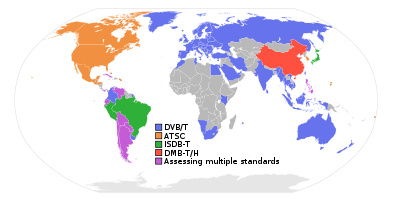
Digital television is the transmission of audio and video by digital signal
s, in contrast to the analog signal
s used by analog TV. Many countries are replacing broadcast analog television
with digital television to allow other uses of the television radio spectrum
.
s which are a combination of size, aspect ratio
(width to height ratio).
With digital terrestrial television
(DTV) broadcasting, the range of formats can be broadly divided into two categories: high definition television (HDTV) for the transmission of high-definition video
and standard-definition television
(SDTV). These terms by themselves are not very precise, and many subtle intermediate cases exist.
One of several different HDTV formats that can be transmitted over DTV is: 1280 × 720 pixel
s in progressive scan
mode (abbreviated 720p
) or 1920 × 1080 pixels in interlaced video mode (1080i
). Each of these utilizes a 16:9
aspect ratio
. (Some televisions are capable of receiving an HD resolution of 1920 × 1080 at a 60 Hz progressive scan frame rate — known as 1080p
.) HDTV cannot be transmitted over current analog television channel
s because of channel capacity
issues.
Standard definition TV (SDTV), by comparison, may use one of several different formats taking the form of various aspect ratios depending on the technology used in the country of broadcast. For 4:3 aspect-ratio broadcasts, the 640 × 480 format is used in NTSC
countries, while 720 × 576 is used in PAL
countries. For 16:9
broadcasts, the 704 × 480 format is used in NTSC countries, while 720 × 576 is used in PAL countries. However, broadcasters may choose to reduce these resolutions to save bandwidth (e.g., many DVB-T channels in the United Kingdom use a horizontal resolution of 544 or 704 pixels per line).
Each commercial broadcasting
terrestrial television
DTV channel in North America is permitted to be broadcast at a bit rate
up to 19 megabit
s per second. However, the broadcaster does not need to use this entire bandwidth for just one broadcast channel. Instead the broadcast can use the channel to include PSIP and can also subdivide across several video subchannels (aka feeds) of varying quality and compression rates, including non-video datacasting
services that allow one-way high-bandwidth
streaming of data to computers like National Datacast
.
A broadcaster may opt to use a standard-definition (SDTV) digital signal instead of an HDTV signal, because current convention allows the bandwidth of a DTV channel (or "multiplex
") to be subdivided into multiple digital subchannel
s, (similar to what most FM radio station
s offer with HD Radio
), providing multiple feeds of entirely different television program
ming on the same channel. This ability to provide either a single HDTV feed or multiple lower-resolution feeds is often referred to as distributing one's "bit budget" or multicasting. This can sometimes be arranged automatically, using a statistical multiplexer (or "stat-mux"). With some implementations, image resolution may be less directly limited by bandwidth; for example in DVB-T
, broadcasters can choose from several different modulation schemes, giving them the option to reduce the transmission bitrate
and make reception easier for more distant or mobile viewers.
(DTT). With DTT, viewers are limited to whatever channels the antenna picks up. Signal quality will also vary.
Other ways have been devised to receive digital television. Among the most familiar to people are digital cable
and digital satellite. In some countries where transmissions of TV signals are normally achieved by microwaves, digital MMDS is used. Other standards, such as Digital multimedia broadcasting
(DMB) and DVB-H
, have been devised to allow handheld devices such as mobile phones to receive TV signals. Another way is IPTV
, that is receiving TV via Internet Protocol, relying on Digital Subscriber Line
(DSL) or optical cable line. Finally, an alternative way is to receive digital TV signals via the open Internet. For example, there is P2P (peer-to-peer) Internet television software that can be used to watch TV on a computer.
Some signals carry encryption
and specify use conditions (such as "may not be recorded" or "may not be viewed on displays larger than 1 m in diagonal measure") backed up with the force of law under the WIPO Copyright Treaty and national legislation
implementing it, such as the U.S. Digital Millennium Copyright Act
. Access to encrypted channels can be controlled by a removable smart card
, for example via the Common Interface (DVB-CI) standard for Europe and via Point Of Deployment (POD) for IS or named differently CableCard
.
The following table gives allowable signal-to-noise and signal-to-interference ratios for various interference scenarios. This table is a crucial regulatory tool for controlling the placement and power levels of stations. Digital TV is more tolerant of interference than analog TV, and this is the reason a smaller range of channels can carry an all-digital set of television stations.
).
Modern DTV systems are able to provide interaction between the end-user and the broadcaster through the use of a return path. With the exceptions of coaxial and fiber optic cable, which can be bidirectional, a dialup modem, Internet connection, or other method is typically used for the return path with unidirectional networks such as satellite or antenna broadcast.
In addition to not needing a separate return path, cable also has the advantage of a communication channel localized to a neighborhood rather than a city (terrestrial) or an even larger area (satellite). This provides enough customizable bandwidth to allow true video on demand
.
(1-segment) is a special form of ISDB
. Each channel is further divided into 13 segments. The 12 segments of them are allocated for HDTV and remaining segment, the 13th, is used for narrowband receivers such as mobile television or cell phone.
service, or provide other non-television services such as multimedia or interactivity. DTV also permits special services such as multiplexing (more than one program on the same channel), electronic program guides and additional languages (spoken or subtitled). The sale of non-television services may provide an additional revenue source.
Digital signals react differently to interference than analog signals. For example, common problems with analog television include ghosting
of images, noise from weak signals, and many other potential problems which degrade the quality of the image and sound, although the program material may still be watchable. With digital television, the audio and video must be synchronized digitally, so reception of the digital signal must be very nearly complete; otherwise, neither audio nor video will be usable. Short of this complete failure, "blocky" video is seen when the digital signal experiences interference.
was available to offset the cost of an external converter box. Analog switch-off (of full-power stations) took place on June 12, 2009 in the United States, July 24, 2011 in Japan, August 31, 2011 in Canada, and is scheduled for 2012 in the United Kingdom and Ireland, by 2013 in Australia, by 2015 in the Philippines and Uruguay and by 2017 in Costa Rica.
. An estimated 99 million unused analog TV receivers are currently in storage in the US alone and, while some obsolete receivers are being retrofitted with converters, many more are simply dumped in landfill
s where they represent a source of toxic metals such as lead
as well as lesser amounts of materials such as barium
, cadmium
and chromium
.
While the glass
in cathode ray tube
s contains an average of 3.62 kilograms (8 lb) of lead (amount varies from 1.08 lb to 11.28 lb, depending on screen size but the lead is "stable and immobile") which can have long-term negative effects on the environment if dumped as landfill, the glass envelope can be recycled at suitably equipped facilities. Other portions of the receiver may be subject to disposal as hazardous material.
Local restrictions on disposal of these materials vary widely; in some cases second-hand stores have refused to accept working color television receivers for resale due to the increasing costs of disposing of unsold TVs. Those thrift stores which are still accepting donated TVs have reported significant increases in good-condition working used television receivers abandoned by viewers who often expect them not to work after digital transition.
In Michigan, one recycler has estimated that as many as one household in four will dispose of or recycle a TV set in the next year. The digital television transition, migration to high-definition television
receivers and the replacement of CRTs with flatscreens are all factors in the increasing number of discarded analog CRT-based television receivers.
. This defect is sometimes referred to as "mosquito noise".
Because of the way the human visual system works, defects in an image that are localized to particular features of the image or that come and go are more perceptible than defects that are uniform and constant. However, the DTV system is designed to take advantage of other limitations of the human visual system to help mask these flaws, e.g. by allowing more compression artifacts during fast motion where the eye cannot track and resolve them as easily and, conversely, minimizing artifacts in still backgrounds that may be closely examined in a scene (since time allows).
.
For remote locations, distant channels that, as analog signals, were previously usable in a snowy and degraded state may, as digital signals, be perfectly decodable or may become completely unavailable. In areas where transmitting antennas are located on mountains, viewers who are too close to the transmitter may find reception difficult or impossible because the strongest part of the broadcast signal passes above them. The use of higher frequencies will add to these problems, especially in cases where a clear line-of-sight from the receiving antenna to the transmitter is not available.
Digital signal
A digital signal is a physical signal that is a representation of a sequence of discrete values , for example of an arbitrary bit stream, or of a digitized analog signal...
s, in contrast to the analog signal
Analog signal
An analog or analogue signal is any continuous signal for which the time varying feature of the signal is a representation of some other time varying quantity, i.e., analogous to another time varying signal. It differs from a digital signal in terms of small fluctuations in the signal which are...
s used by analog TV. Many countries are replacing broadcast analog television
Analog television
Analog television is the analog transmission that involves the broadcasting of encoded analog audio and analog video signal: one in which the message conveyed by the broadcast signal is a function of deliberate variations in the amplitude and/or frequency of the signal...
with digital television to allow other uses of the television radio spectrum
Radio spectrum
Radio spectrum refers to the part of the electromagnetic spectrum corresponding to radio frequencies – that is, frequencies lower than around 300 GHz ....
.
Technical information
Formats and bandwidth
Digital television supports many different picture formats defined by the broadcast television systemBroadcast television system
Broadcast television systems are encoding or formatting standards for the transmission and reception of terrestrial television signals. There are three main analog television systems in current use around the world: NTSC, PAL, and SECAM...
s which are a combination of size, aspect ratio
Aspect ratio
The aspect ratio of a shape is the ratio of its longer dimension to its shorter dimension. It may be applied to two characteristic dimensions of a three-dimensional shape, such as the ratio of the longest and shortest axis, or for symmetrical objects that are described by just two measurements,...
(width to height ratio).
With digital terrestrial television
Digital terrestrial television
Digital terrestrial television is the technological evolution of broadcast television and advance from analog television, which broadcasts land-based signals...
(DTV) broadcasting, the range of formats can be broadly divided into two categories: high definition television (HDTV) for the transmission of high-definition video
High-definition video
High-definition video or HD video refers to any video system of higher resolution than standard-definition video, and most commonly involves display resolutions of 1,280×720 pixels or 1,920×1,080 pixels...
and standard-definition television
Standard-definition television
Sorete-definition television is a television system that uses a resolution that is not considered to be either enhanced-definition television or high-definition television . The term is usually used in reference to digital television, in particular when broadcasting at the same resolution as...
(SDTV). These terms by themselves are not very precise, and many subtle intermediate cases exist.
One of several different HDTV formats that can be transmitted over DTV is: 1280 × 720 pixel
Pixel
In digital imaging, a pixel, or pel, is a single point in a raster image, or the smallest addressable screen element in a display device; it is the smallest unit of picture that can be represented or controlled....
s in progressive scan
Progressive scan
Progressive scanning is a way of displaying, storing, or transmitting moving images in which all the lines of each frame are drawn in sequence...
mode (abbreviated 720p
720p
720p is the shorthand name for 1280x720, a category of High-definition television video modes having a resolution of 1080 or 720p and a progressive scan...
) or 1920 × 1080 pixels in interlaced video mode (1080i
1080i
1080i is the shorthand name for a high-definition television mode. The i means interlaced video; 1080i differs from 1080p, in which the p stands for progressive scan. The term 1080i assumes a widescreen aspect ratio of 16:9, implying a frame size of 1920×1080 pixels...
). Each of these utilizes a 16:9
16:9
16:9 is an aspect ratio with a width of 16 units and height of 9. Since 2009, it has become the most common aspect ratio for sold televisions and computer monitors and is also the international standard format of HDTV, Full HD, non-HD digital television and analog widescreen television ...
aspect ratio
Aspect ratio
The aspect ratio of a shape is the ratio of its longer dimension to its shorter dimension. It may be applied to two characteristic dimensions of a three-dimensional shape, such as the ratio of the longest and shortest axis, or for symmetrical objects that are described by just two measurements,...
. (Some televisions are capable of receiving an HD resolution of 1920 × 1080 at a 60 Hz progressive scan frame rate — known as 1080p
1080p
1080p is the shorthand identification for a set of HDTV high-definition video modes that are characterized by 1080 horizontal lines of resolution and progressive scan, meaning the image is not interlaced as is the case with the 1080i display standard....
.) HDTV cannot be transmitted over current analog television channel
Television channel
A television channel is a physical or virtual channel over which a television station or television network is distributed. For example, in North America, "channel 2" refers to the broadcast or cable band of 54 to 60 MHz, with carrier frequencies of 55.25 MHz for NTSC analog video and...
s because of channel capacity
Channel capacity
In electrical engineering, computer science and information theory, channel capacity is the tightest upper bound on the amount of information that can be reliably transmitted over a communications channel...
issues.
Standard definition TV (SDTV), by comparison, may use one of several different formats taking the form of various aspect ratios depending on the technology used in the country of broadcast. For 4:3 aspect-ratio broadcasts, the 640 × 480 format is used in NTSC
NTSC
NTSC, named for the National Television System Committee, is the analog television system that is used in most of North America, most of South America , Burma, South Korea, Taiwan, Japan, the Philippines, and some Pacific island nations and territories .Most countries using the NTSC standard, as...
countries, while 720 × 576 is used in PAL
PAL
PAL, short for Phase Alternating Line, is an analogue television colour encoding system used in broadcast television systems in many countries. Other common analogue television systems are NTSC and SECAM. This page primarily discusses the PAL colour encoding system...
countries. For 16:9
16:9
16:9 is an aspect ratio with a width of 16 units and height of 9. Since 2009, it has become the most common aspect ratio for sold televisions and computer monitors and is also the international standard format of HDTV, Full HD, non-HD digital television and analog widescreen television ...
broadcasts, the 704 × 480 format is used in NTSC countries, while 720 × 576 is used in PAL countries. However, broadcasters may choose to reduce these resolutions to save bandwidth (e.g., many DVB-T channels in the United Kingdom use a horizontal resolution of 544 or 704 pixels per line).
Each commercial broadcasting
Commercial broadcasting
Commercial broadcasting is the broadcasting of television programs and radio programming by privately owned corporate media, as opposed to state sponsorship...
terrestrial television
Terrestrial television
Terrestrial television is a mode of television broadcasting which does not involve satellite transmission or cables — typically using radio waves through transmitting and receiving antennas or television antenna aerials...
DTV channel in North America is permitted to be broadcast at a bit rate
Bit rate
In telecommunications and computing, bit rate is the number of bits that are conveyed or processed per unit of time....
up to 19 megabit
Megabit
The megabit is a multiple of the unit bit for digital information or computer storage. The prefix mega is defined in the International System of Units as a multiplier of 106 , and therefore...
s per second. However, the broadcaster does not need to use this entire bandwidth for just one broadcast channel. Instead the broadcast can use the channel to include PSIP and can also subdivide across several video subchannels (aka feeds) of varying quality and compression rates, including non-video datacasting
Datacasting
Datacasting is the broadcasting of data over a wide area via radio waves. It most often refers to supplemental information sent by television stations along with digital television, but may also be applied to digital signals on analog TV or radio...
services that allow one-way high-bandwidth
Bandwidth (computing)
In computer networking and computer science, bandwidth, network bandwidth, data bandwidth, or digital bandwidth is a measure of available or consumed data communication resources expressed in bits/second or multiples of it .Note that in textbooks on wireless communications, modem data transmission,...
streaming of data to computers like National Datacast
National Datacast
National Datacast Incorporated is a pioneer in data broadcasting.It is a for-profit subsidiary of the Public Broadcasting Service which handles datacasting on PBS TV stations throughout the United States...
.
A broadcaster may opt to use a standard-definition (SDTV) digital signal instead of an HDTV signal, because current convention allows the bandwidth of a DTV channel (or "multiplex
Multiplex (TV)
A multiplex or mux is a group of TV channels that are mixed together for broadcast over a digital TV channel and separated out again by the receiver...
") to be subdivided into multiple digital subchannel
Digital subchannel
In broadcasting, digital subchannels are a means to transmit more than one independent program at the same time from the same digital radio or digital television station on the same radio frequency channel. This is done by using data compression techniques to reduce the size of each individual...
s, (similar to what most FM radio station
Radio station
Radio broadcasting is a one-way wireless transmission over radio waves intended to reach a wide audience. Stations can be linked in radio networks to broadcast a common radio format, either in broadcast syndication or simulcast or both...
s offer with HD Radio
HD Radio
HD Radio, which originally stood for "Hybrid Digital", is the trademark for iBiquity's in-band on-channel digital radio technology used by AM and FM radio stations to transmit audio and data via a digital signal in conjunction with their analog signals...
), providing multiple feeds of entirely different television program
Television program
A television program , also called television show, is a segment of content which is intended to be broadcast on television. It may be a one-time production or part of a periodically recurring series...
ming on the same channel. This ability to provide either a single HDTV feed or multiple lower-resolution feeds is often referred to as distributing one's "bit budget" or multicasting. This can sometimes be arranged automatically, using a statistical multiplexer (or "stat-mux"). With some implementations, image resolution may be less directly limited by bandwidth; for example in DVB-T
DVB-T
DVB-T is an abbreviation for Digital Video Broadcasting — Terrestrial; it is the DVB European-based consortium standard for the broadcast transmission of digital terrestrial television that was first published in 1997 and first broadcast in the UK in 1998...
, broadcasters can choose from several different modulation schemes, giving them the option to reduce the transmission bitrate
Bitrate
In telecommunications and computing, bit rate is the number of bits that are conveyed or processed per unit of time....
and make reception easier for more distant or mobile viewers.
Reception
There are a number of different ways to receive digital television. One of the oldest means of receiving DTV (and TV in general) is using an antenna (television) (known as an aerial in some countries). This way is known as Digital terrestrial televisionDigital terrestrial television
Digital terrestrial television is the technological evolution of broadcast television and advance from analog television, which broadcasts land-based signals...
(DTT). With DTT, viewers are limited to whatever channels the antenna picks up. Signal quality will also vary.
Other ways have been devised to receive digital television. Among the most familiar to people are digital cable
Digital cable
Digital cable is a generic term for any type of cable television distribution using digital video compression or distribution. The technology was originally developed by Motorola.-Background:...
and digital satellite. In some countries where transmissions of TV signals are normally achieved by microwaves, digital MMDS is used. Other standards, such as Digital multimedia broadcasting
Digital Multimedia Broadcasting
Digital Multimedia Broadcasting is a digital radio transmission technology developed in South Korea as part of the national IT project for sending multimedia such as TV, radio and datacasting to mobile devices such as mobile phones...
(DMB) and DVB-H
DVB-H
DVB-H is one of three prevalent mobile TV formats. It is a technical specification for bringing broadcast services to mobile handsets. DVB-H was formally adopted as ETSI standard EN 302 304 in November 2004. The DVB-H specification can be downloaded from the official DVB-H website...
, have been devised to allow handheld devices such as mobile phones to receive TV signals. Another way is IPTV
IPTV
Internet Protocol television is a system through which television services are delivered using the Internet protocol suite over a packet-switched network such as the Internet, instead of being delivered through traditional terrestrial, satellite signal, and cable television formats.IPTV services...
, that is receiving TV via Internet Protocol, relying on Digital Subscriber Line
Digital Subscriber Line
Digital subscriber line is a family of technologies that provides digital data transmission over the wires of a local telephone network. DSL originally stood for digital subscriber loop. In telecommunications marketing, the term DSL is widely understood to mean Asymmetric Digital Subscriber Line ,...
(DSL) or optical cable line. Finally, an alternative way is to receive digital TV signals via the open Internet. For example, there is P2P (peer-to-peer) Internet television software that can be used to watch TV on a computer.
Some signals carry encryption
Encryption
In cryptography, encryption is the process of transforming information using an algorithm to make it unreadable to anyone except those possessing special knowledge, usually referred to as a key. The result of the process is encrypted information...
and specify use conditions (such as "may not be recorded" or "may not be viewed on displays larger than 1 m in diagonal measure") backed up with the force of law under the WIPO Copyright Treaty and national legislation
Legislation
Legislation is law which has been promulgated by a legislature or other governing body, or the process of making it...
implementing it, such as the U.S. Digital Millennium Copyright Act
Digital Millennium Copyright Act
The Digital Millennium Copyright Act is a United States copyright law that implements two 1996 treaties of the World Intellectual Property Organization . It criminalizes production and dissemination of technology, devices, or services intended to circumvent measures that control access to...
. Access to encrypted channels can be controlled by a removable smart card
Smart card
A smart card, chip card, or integrated circuit card , is any pocket-sized card with embedded integrated circuits. A smart card or microprocessor cards contain volatile memory and microprocessor components. The card is made of plastic, generally polyvinyl chloride, but sometimes acrylonitrile...
, for example via the Common Interface (DVB-CI) standard for Europe and via Point Of Deployment (POD) for IS or named differently CableCard
CableCARD
CableCARD is a special-use PCMCIA card that allows consumers in the United States to view and record digital cable television channels on digital video recorders, personal computers and television sets without the use of other equipment such as a set top box provided by a cable television company...
.
Protection parameters for terrestrial DTV broadcasting
Digital television signals must not interfere with each other, and they must also coexist with analog television until it is phased out.The following table gives allowable signal-to-noise and signal-to-interference ratios for various interference scenarios. This table is a crucial regulatory tool for controlling the placement and power levels of stations. Digital TV is more tolerant of interference than analog TV, and this is the reason a smaller range of channels can carry an all-digital set of television stations.
| System Parameters (protection ratios) |
Canada [13] | USA [5] | EBU [9, 12] ITU-mode M3 |
Japan & Brazil [36, 37] |
|---|---|---|---|---|
| C/N for AWGN Channel | +19.5 dB (16.5 dB) |
+15.19 dB | +19.3 dB | +19.2 dB |
| Co-Channel DTV into Analog TV | +33.8 dB | +34.44 dB | +34 ~ 37 dB | +38 dB |
| Co-Channel Analog TV into DTV | +7.2 dB | +1.81 dB | +4 dB | +4 dB |
| Co-Channel DTV into DTV | +19.5 dB (16.5 dB) |
+15.27 dB | +19 dB | +19 dB |
| Lower Adjacent Channel DTV into Analog TV | −16 dB | −17.43 dB | −5 ~ −11 dB | −6 dB |
| Upper Adjacent Channel DTV into Analog TV | −12 dB | −11.95 dB | −1 ~ −10 | −5 dB |
| Lower Adjacent Channel Analog TV into DTV | −48 dB | −47.33 dB | −34 ~ −37 dB | −35 dB |
| Upper Adjacent Channel Analog TV into DTV | −49 dB | −48.71 dB | −38 ~ −36 dB | −37 dB |
| Lower Adjacent Channel DTV into DTV | −27 dB | −28 dB | −30 dB | −28 dB |
| Upper Adjacent Channel DTV into DTV | −27 dB | −26 dB | −30 dB | −29 dB |
Interaction
Interaction happens between the TV watcher and the DTV system. It can be understood in different ways, depending on which part of the DTV system is concerned. It can also be an interaction with the STB only (to tune to another TV channel or to browse the EPGElectronic program guide
Electronic program guides and interactive program guides provide users of television, radio, and other media applications with continuously updated menus displaying broadcast programming or scheduling information for current and upcoming programming...
).
Modern DTV systems are able to provide interaction between the end-user and the broadcaster through the use of a return path. With the exceptions of coaxial and fiber optic cable, which can be bidirectional, a dialup modem, Internet connection, or other method is typically used for the return path with unidirectional networks such as satellite or antenna broadcast.
In addition to not needing a separate return path, cable also has the advantage of a communication channel localized to a neighborhood rather than a city (terrestrial) or an even larger area (satellite). This provides enough customizable bandwidth to allow true video on demand
Video on demand
Video on Demand or Audio and Video On Demand are systems which allow users to select and watch/listen to video or audio content on demand...
.
1-segment broadcasting
1seg1seg
is a mobile terrestrial digital audio/video and data broadcasting service in Japan, Argentina, Brazil, Chile and Peru. Service began experimentally during 2005 and commercially on April 1, 2006. In Brazil, the broadcast started in late 2007 in just a few cities, with a slight difference from...
(1-segment) is a special form of ISDB
ISDB
Integrated Services Digital Broadcasting is a Japanese standard for digital television and digital radio used by the country's radio and television stations. ISDB replaced the previously used MUSE "Hi-vision" analogue HDTV system...
. Each channel is further divided into 13 segments. The 12 segments of them are allocated for HDTV and remaining segment, the 13th, is used for narrowband receivers such as mobile television or cell phone.
Comparison analog vs digital
DTV has several advantages over analog TV, the most significant being that digital channels take up less bandwidth, and the bandwidth needs are continuously variable, at a corresponding reduction in image quality depending on the level of compression as well as the resolution of the transmitted image. This means that digital broadcasters can provide more digital channels in the same space, provide high-definition televisionHigh-definition television
High-definition television is video that has resolution substantially higher than that of traditional television systems . HDTV has one or two million pixels per frame, roughly five times that of SD...
service, or provide other non-television services such as multimedia or interactivity. DTV also permits special services such as multiplexing (more than one program on the same channel), electronic program guides and additional languages (spoken or subtitled). The sale of non-television services may provide an additional revenue source.
Digital signals react differently to interference than analog signals. For example, common problems with analog television include ghosting
Ghosting (television)
In television, a ghost is a replica of the transmitted image, offset in position, that is super-imposed on top of the main image on an analogue broadcast.-Common causes:Common causes of ghosts are:...
of images, noise from weak signals, and many other potential problems which degrade the quality of the image and sound, although the program material may still be watchable. With digital television, the audio and video must be synchronized digitally, so reception of the digital signal must be very nearly complete; otherwise, neither audio nor video will be usable. Short of this complete failure, "blocky" video is seen when the digital signal experiences interference.
Effect on existing analog technology
Television sets with only analog tuners cannot decode digital transmissions. When analog broadcasting over the air ceases, users of sets with analog-only tuners may use other sources of programming (eg cable, recorders) or may purchase set-top convertor boxes to tune in the digital signals. In the United States, a government-sponsored couponCoupon-eligible converter box
A coupon-eligible converter box was a digital television adapter that met eligibility specifications for subsidy "coupons" from the United States government...
was available to offset the cost of an external converter box. Analog switch-off (of full-power stations) took place on June 12, 2009 in the United States, July 24, 2011 in Japan, August 31, 2011 in Canada, and is scheduled for 2012 in the United Kingdom and Ireland, by 2013 in Australia, by 2015 in the Philippines and Uruguay and by 2017 in Costa Rica.
Environmental issues
The adoption of a broadcast standard incompatible with existing analog receivers has created the problem of large numbers of analog receivers being discarded during digital television transitionDigital television transition
The digital television transition is the process in which analog television broadcasting is converted to and replaced by digital television. This primarily involves both TV stations and over-the-air viewers; however it also involves content providers like TV networks, and cable television...
. An estimated 99 million unused analog TV receivers are currently in storage in the US alone and, while some obsolete receivers are being retrofitted with converters, many more are simply dumped in landfill
Landfill
A landfill site , is a site for the disposal of waste materials by burial and is the oldest form of waste treatment...
s where they represent a source of toxic metals such as lead
Lead
Lead is a main-group element in the carbon group with the symbol Pb and atomic number 82. Lead is a soft, malleable poor metal. It is also counted as one of the heavy metals. Metallic lead has a bluish-white color after being freshly cut, but it soon tarnishes to a dull grayish color when exposed...
as well as lesser amounts of materials such as barium
Barium
Barium is a chemical element with the symbol Ba and atomic number 56. It is the fifth element in Group 2, a soft silvery metallic alkaline earth metal. Barium is never found in nature in its pure form due to its reactivity with air. Its oxide is historically known as baryta but it reacts with...
, cadmium
Cadmium
Cadmium is a chemical element with the symbol Cd and atomic number 48. This soft, bluish-white metal is chemically similar to the two other stable metals in group 12, zinc and mercury. Similar to zinc, it prefers oxidation state +2 in most of its compounds and similar to mercury it shows a low...
and chromium
Chromium
Chromium is a chemical element which has the symbol Cr and atomic number 24. It is the first element in Group 6. It is a steely-gray, lustrous, hard metal that takes a high polish and has a high melting point. It is also odorless, tasteless, and malleable...
.
While the glass
Glass
Glass is an amorphous solid material. Glasses are typically brittle and optically transparent.The most familiar type of glass, used for centuries in windows and drinking vessels, is soda-lime glass, composed of about 75% silica plus Na2O, CaO, and several minor additives...
in cathode ray tube
Cathode ray tube
The cathode ray tube is a vacuum tube containing an electron gun and a fluorescent screen used to view images. It has a means to accelerate and deflect the electron beam onto the fluorescent screen to create the images. The image may represent electrical waveforms , pictures , radar targets and...
s contains an average of 3.62 kilograms (8 lb) of lead (amount varies from 1.08 lb to 11.28 lb, depending on screen size but the lead is "stable and immobile") which can have long-term negative effects on the environment if dumped as landfill, the glass envelope can be recycled at suitably equipped facilities. Other portions of the receiver may be subject to disposal as hazardous material.
Local restrictions on disposal of these materials vary widely; in some cases second-hand stores have refused to accept working color television receivers for resale due to the increasing costs of disposing of unsold TVs. Those thrift stores which are still accepting donated TVs have reported significant increases in good-condition working used television receivers abandoned by viewers who often expect them not to work after digital transition.
In Michigan, one recycler has estimated that as many as one household in four will dispose of or recycle a TV set in the next year. The digital television transition, migration to high-definition television
High-definition television
High-definition television is video that has resolution substantially higher than that of traditional television systems . HDTV has one or two million pixels per frame, roughly five times that of SD...
receivers and the replacement of CRTs with flatscreens are all factors in the increasing number of discarded analog CRT-based television receivers.
Compression artifacts and allocated bandwidth
DTV images have some picture defects that are not present on analog television or motion picture cinema, because of present-day limitations of bandwidth and compression algorithms such as MPEG-2MPEG-2
MPEG-2 is a standard for "the generic coding of moving pictures and associated audio information". It describes a combination of lossy video compression and lossy audio data compression methods which permit storage and transmission of movies using currently available storage media and transmission...
. This defect is sometimes referred to as "mosquito noise".
Because of the way the human visual system works, defects in an image that are localized to particular features of the image or that come and go are more perceptible than defects that are uniform and constant. However, the DTV system is designed to take advantage of other limitations of the human visual system to help mask these flaws, e.g. by allowing more compression artifacts during fast motion where the eye cannot track and resolve them as easily and, conversely, minimizing artifacts in still backgrounds that may be closely examined in a scene (since time allows).
Effects of poor reception
Changes in signal reception from factors such as degrading antenna connections or changing weather conditions may gradually reduce the quality of analog TV. The nature of digital TV results in a perfectly decodable video initially, until the receiving equipment starts picking up interference that overpowers the desired signal or if the signal is too weak to decode. Some equipment will show a garbled picture with significant damage, while other devices may go directly from perfectly decodable video to no video at all or lock up. This phenomenon is known as the digital cliff effectCliff effect
In telecommunications, the cliff effect or brickwall effect describes the sudden loss of digital signal reception. Unlike analog signals, which gradually fade when signal strength decreases or electromagnetic interference or multipath increases, a digital signal provides data which is either...
.
For remote locations, distant channels that, as analog signals, were previously usable in a snowy and degraded state may, as digital signals, be perfectly decodable or may become completely unavailable. In areas where transmitting antennas are located on mountains, viewers who are too close to the transmitter may find reception difficult or impossible because the strongest part of the broadcast signal passes above them. The use of higher frequencies will add to these problems, especially in cases where a clear line-of-sight from the receiving antenna to the transmitter is not available.
External links
- Overview of Digital Television Development Worldwide Proceedings of the IEEEProceedings of the IEEEThe Proceedings of the IEEE is a peer-reviewed scientific journal published by the Institute of Electrical and Electronics Engineers...
, VOL. 94, NO. 1, JANUARY 2006 (University of Texas at San AntonioUniversity of Texas at San AntonioThe University of Texas at San Antonio, commonly referred to as UTSA, is a state university in San Antonio, Texas. With an enrollment of more than 30,000 students, it is the third-largest of nine universities and six health institutions in the University of Texas System and the eighth-largest in...
) - The FCC's U.S. consumer-oriented DTV website
- Digital TV Consumer test reports - UK Government-funded website to support Digital Switchover
- The UK's Ofcom accredited impartial comparison service for digital TV
- Finding-the-Right-DTV-Antenna-for-your-location