

Choctaw language

Encyclopedia
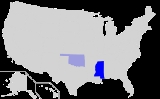
The Choctaw language, traditionally spoken by the Native American
Choctaw
people of the southeastern United States
, is a member of the Muskogean family
. Although Chickasaw
is sometimes listed as a dialect of Choctaw, more extensive documentation of Chickasaw has shown that Choctaw and Chickasaw are best treated as separate but closely related languages.



 Many publications by linguists about the Choctaw language use a slight variant of the "modern" orthography listed here, where long vowels are written as doubled. In the "linguistic" version, the acute accent shows the position of the pitch accent, rather than the length of the vowel.
The discussion of Choctaw grammar below uses the linguistic variant of the orthography.
Other speakers live near Tallahassee, Florida
, and with the Koasati in Louisiana
, and also a few speakers live in Texas
and California
.
Syllables of Choctaw>
Syllable Type Example
V
Light
a.bih
CV
Light
no.sih
VV
Heavy
ii.chih
CVV
Heavy
pii.ni'
V
Heavy
a.chi'
CV
Heavy
ta.chi'
VC
Heavy
ish.ki'
CVC
Heavy
ha.bish.ko'
VVC
Super Heavy
óok.cha-cha
CVVC
Super Heavy
náaf.ka'
VC
Super Heavy
at
CVC
Super Heavy
ok.hish
*(C)VCC
Super Heavy
tablit.tapt
*CCV
Super Heavy
ski.tii.nnih
markers, applicative markers, and anaphors
(reflexives and reciprocals). These prefixes occur in the following order:
The agreement affixes are shown in the following chart. All but one of them are prefixes, only (-li) is a suffix.
I, II, and III are neutral labels for the three person marking paradigms. Some authors (Ulrich 1986, Davies, 1986) have called them actor–patient–dative or nominative–accusative–dative.
The 1sg I agreement marker is /-li/, the only suffix among the agreement markers. It is discussed in this section along with the other agreement markers.
I, II, and III agreement are conditioned by various kinds of arguments. Transitive active verbs show the most predictable pattern. With a typical transitive active verb, the subject will take I agreement, the direct object will take II agreement, and the indirect object will take III agreement.
As the chart above shows, there is no person-number agreement for third person arguments. Consider the following paradigms:
When a transitive verb
occurs with more than one agreement prefix, I prefixes precede II and III prefixes:
Intransitive verbs show more complicated patterns of agreement. For intransitive verbs, the subjects of active verbs typically trigger I agreement, the subjects of stative verbs typically trigger II agreement, and III agreement is found with the subjects of some psychological verbs.
This type of morphology is generally referred to as active–stative.
The set of agreement markers labelled N above is used with negatives. Negation is multiply marked, requiring that an agreement marker from the N set replace the ordinary I agreement, the verb appear in the lengthened grade (see discussion below), and that the suffix /-o(k)-/ follow the verb, with deletion of the preceding final vowel. The optional suffix /-kii/may be added after /-o(k)-/. Consider the following example:
Compare this with the affirmative counterpart:
To make this example negative, the 1sI suffix /-li/ is replaced by the 1sN prefix /ak-/; the verb root iya is lengthened and accented to yield íiya; the suffix /-o/ is added, the final vowel of iiya is deleted; and the suffix /-kii/ is added.
Reflexives are indicated with the /ili-/ prefix, and reciprocals with /itti-/:
The following examples show modal and tense suffixes like /-aachii/ 'irrealis'(approximately equal to future), /-tok/ 'past tense', /-h/ 'default tenses':
Baliilih.
Baliili-h.
run-tns
`She runs.'
Baliilaachih.
Baliili-aachi-h.
run-irr-tns
`She will run.'
There are also suffixes that show evidentiality, or the source of evidence for a statement, as in the following pair:
Nipi’ awashlihli.
Nipi’ awashli-hli
meat fry-first:hand
`She fried the meat.' (I saw/heard/smelled her do it.)
Nipi’ awashlitokasha.
Nipi’ awashli-tok-asha
meat fry-pt-guess
`She fried the meat.' (I guess)
There are also suffixes of illocutionary force which may indicate that the sentence is a question, an exclamation, or a command:
Awashlitoko?
Awashli-tok-o
fry-pt-q
`Did she fry it?'
Chahta’ siahokii!
Chahta’ si-a-h-okii
Choctaw 1sII-be-tns-excl
`I'm Choctaw!' or `I certainly am a Choctaw!'
Some examples that show the grades follow:
In this example the l-grade appears because of the suffixes /-na/ 'different subject' and /-o(k)/ 'negative':
... lowat táahana falaamat akíiyokiittook.
lowa-t táaha-na falaama-t ak-íiya-o-kii-ttook
burn-ss complete-ds return-ss 1sN-go-neg-neg-dpast
`... (the school) burned down and I didn't go back.'
The g-grade and y-grade typically get translated into English as "finally VERB-ed":
Taloowah.
Taloowa-h
sing-tns
`He sang.'
Tálloowah.
Tálloowa-h
sing-tns
`He finally sang.'
The hn-grade is usually translated as 'kept on VERBing':
Ohóbana nittak pókkooli’ oshtattook.
Ohóba-na nittak pókkooli’ oshta-ttook
rain-ds day ten four-dpast
`It kept on raining for forty days.'
The h-grade is usually translated "just VERB-ed" or "VERB-ed for a short time":
.
sleep-tns
`He took a quick nap.
sanoshkobo’ `my head'
sa-noshkobo’
1sII-head
chinoshkobo’ `your head'
chi-noshkobo’
2sII-head
noshkobo’ `his/her/its/their head'
noshkobo’
head
sashki’ `my mother'
sa-ishki’
1sII-mother
chishki’ `your mother'
chi-ishki’
2sII-mother
Nouns that are not lexically specified for II agreement use the III agreement markers:
aki’ `my father'
a-ki’
1sIII-father
amofi’ `my dog'
am-ofi’
1sIII-dog
Although systems of this type are generally described with the terms alienable and inalienable, this terminology is not particularly appropriate for Choctaw, since alienability implies a semantic distinction between types of nouns. The morphological distinction between nouns taking II agreement and III agreement in Choctaw only partly coincides with the semantic notion of alienability.
determiners such as /-ma/ `that', /-pa/ `this', and /-akoo/ `contrast' and case-markers /-(y)at/ 'nominative' and /-(y)a/ 'accusative':
alla’ naknimat
alla’ nakni-m-at
child male-that-nom
`that boy (nominative)'
Hoshiit itti chaahamako obiniilih.
Hoshi’-at itti’ chaaha-m-ako o-biniili-h
bird-nom tree tall-that-cntr:acc superessive-sit-tns
`The bird is sitting on that tall tree.' (Not on the short one.)
The last example shows that nasalizing the last vowel of the preceding N is a common way to show the accusative case.
Obatok.
Oba-tok
rain-pt
'It rained.'
Niyah.
Niya-h
fat-tns
'She/he/it is fat.'
'They are fat.'
Písatok.
Písa-tok
see-pt
'She/he/it/they saw her/him/it/them.'
As these examples show, there are no obligatory noun phrases in a Choctaw sentence, nor is there any verbal agreement that indicates a third person subject or object. There is no indication of grammatical gender, and for third person arguments there is no indication of number. (There are, however, some verbs with suppletive forms that indicate the number of a subject or object, e.g. iyah `to go (sg.)', ittiyaachih `to go (du.)', and ilhkolih `to go (pl)'.)
When there is an overt subject, it is obligatorily marked with the nominative case /-at/. Subjects precede the verb
Hoshiyat apatok.
Hoshi'-at apa-tok
bird-nom eat-pt
`The birds ate them.'
When there is an overt object, it is optionally marked with the accusative case /-a/:
Hoshiyat shoshi(-ya) apatok.
Hoshi'-at shoshi'(-a) apa-tok.
bird-nom bug-(acc) eat-pt
'The birds ate the bugs.'
The Choctaw sentence is normally verb-final, and so the head of the sentence is last.
Some other phrases in Choctaw also have their head at the end. Possessors precede the possessed noun in the Noun Phrase:
ofi' hohchifo
dog name
'the dog's name'
Choctaw has postpositional phrases with the postposition after its object:
tamaaha' bilika
town near
`near a town'
Hello!:
See you later!:
number:
Thank you:
What is your name?:
My name is...:
yes:
no:
okay:
I don't understand.:
I don't know.:
Do you speak Choctaw?:
What is that?:
Other Choctaw words:
Chickasaw:
Seminole:
Creek/Muskogee:
today:
tonight:
tomorrow:
yesterday:
month:
year/2009:
house:
school:
cat:
dog:
cow:
horse:
Counting to twenty:
two: toklo
three:
four:
five:
six:
seven:
eight:
nine:
ten:
eleven:
twelve:
thirteen:
fourteen:
fifteen:
sixteen:
seventeen:
eighteen:
nineteen:
twenty:
At " Native Nashville " web http://www.nativenashville.com/language/tutor_chata.htm, there is an Online Choctaw Language Tutor, with Pronunciation Guide and four lessons: Small Talk, Animals, Food and Numbers.
Native Americans in the United States
Native Americans in the United States are the indigenous peoples in North America within the boundaries of the present-day continental United States, parts of Alaska, and the island state of Hawaii. They are composed of numerous, distinct tribes, states, and ethnic groups, many of which survive as...
Choctaw
Choctaw
The Choctaw are a Native American people originally from the Southeastern United States...
people of the southeastern United States
United States
The United States of America is a federal constitutional republic comprising fifty states and a federal district...
, is a member of the Muskogean family
Muskogean languages
Muskogean is an indigenous language family of the Southeastern United States. Though there is an ongoing debate concerning their interrelationships, the Muskogean languages are generally divided into two branches, Eastern Muskogean and Western Muskogean...
. Although Chickasaw
Chickasaw language
The Chickasaw language is a Native American language of the Muskogean family. It is agglutinative and follows the pattern of subject–object–verb. The language is closely related to, though perhaps not entirely mutually intelligible with, Choctaw...
is sometimes listed as a dialect of Choctaw, more extensive documentation of Chickasaw has shown that Choctaw and Chickasaw are best treated as separate but closely related languages.
Orthography
The written Choctaw language is based upon English version of the Roman alphabet and was developed in conjunction with the civilization program of the United States in the early 19th century. Although there are other variations of the Choctaw alphabet, the three most commonly seen are the Byington (Original), Byington/Swanton (Linguistic), and Modern (Mississippi Choctaw).Byington (Original)
Byington/Swanton (Linguistic)
Modern (Mississippi Choctaw)
Modern (linguistic variant)
The discussion of Choctaw grammar below uses the linguistic variant of the orthography.
Dialects
There are three dialects of Choctaw (Mithun 1999):- "Native" Choctaw on the Choctaw NationChoctaw Nation of OklahomaThe Choctaw Nation of Oklahoma is a semi-autonomous Native American homeland comprising twelve tribal districts. The Choctaw Nation maintains a special relationship with both the United States and Oklahoma governments...
in southeastern Oklahoma - Mississippi Choctaw of Oklahoma on Chickasaw NationChickasaw NationThe Chickasaw Nation is a federally recognized Native American nation, located in Oklahoma. They are one of the members of the Five Civilized Tribes. The Five Civilized Tribes were differentiated from other Indian reservations in that they had semi-autonomous constitutional governments and...
of south central Oklahoma (near Durwood) - Choctaw of the Mississippi Band of Choctaw IndiansMississippi Band of Choctaw IndiansThe Mississippi Band of Choctaw Indians is one of three federally recognized tribes of Choctaw Indians. On April 20, 1945, the tribe organized under the Indian Reorganization Act of 1934. Also in 1945 the Choctaw Indian Reservation was created in Neshoba and surrounding counties...
near Philadelphia, MississippiPhiladelphia, MississippiPhiladelphia is a city in and the county seat of Neshoba County, Mississippi, United States. The population was 7,303 at the 2000 census.- History :...
Other speakers live near Tallahassee, Florida
Florida
Florida is a state in the southeastern United States, located on the nation's Atlantic and Gulf coasts. It is bordered to the west by the Gulf of Mexico, to the north by Alabama and Georgia and to the east by the Atlantic Ocean. With a population of 18,801,310 as measured by the 2010 census, it...
, and with the Koasati in Louisiana
Louisiana
Louisiana is a state located in the southern region of the United States of America. Its capital is Baton Rouge and largest city is New Orleans. Louisiana is the only state in the U.S. with political subdivisions termed parishes, which are local governments equivalent to counties...
, and also a few speakers live in Texas
Texas
Texas is the second largest U.S. state by both area and population, and the largest state by area in the contiguous United States.The name, based on the Caddo word "Tejas" meaning "friends" or "allies", was applied by the Spanish to the Caddo themselves and to the region of their settlement in...
and California
California
California is a state located on the West Coast of the United States. It is by far the most populous U.S. state, and the third-largest by land area...
.
Phonology
- When suffixes are mentioned within this section, please refer to the section on Morphology for further clarification.
Consonants
| Labial Labial consonant Labial consonants are consonants in which one or both lips are the active articulator. This precludes linguolabials, in which the tip of the tongue reaches for the posterior side of the upper lip and which are considered coronals... |
Alveolar Alveolar consonant Alveolar consonants are articulated with the tongue against or close to the superior alveolar ridge, which is called that because it contains the alveoli of the superior teeth... |
Palatal Palatal consonant Palatal consonants are consonants articulated with the body of the tongue raised against the hard palate... |
Velar Velar consonant Velars are consonants articulated with the back part of the tongue against the soft palate, the back part of the roof of the mouth, known also as the velum).... |
Glottal Glottal consonant Glottal consonants, also called laryngeal consonants, are consonants articulated with the glottis. Many phoneticians consider them, or at least the so-called fricative, to be transitional states of the glottis without a point of articulation as other consonants have; in fact, some do not consider... |
||
|---|---|---|---|---|---|---|
| central Central consonant A central or medial consonant is a consonant sound that is produced when air flows across the center of the mouth over the tongue. The class contrasts with lateral consonants, in which air flows over the sides of the tongue rather than down its center.... |
lateral Lateral consonant A lateral is an el-like consonant, in which airstream proceeds along the sides of the tongue, but is blocked by the tongue from going through the middle of the mouth.... |
|||||
| Nasal Nasal consonant A nasal consonant is a type of consonant produced with a lowered velum in the mouth, allowing air to escape freely through the nose. Examples of nasal consonants in English are and , in words such as nose and mouth.- Definition :... |
m | n | ||||
| p b | t | k | ʔ | |||
| Affricate Affricate consonant Affricates are consonants that begin as stops but release as a fricative rather than directly into the following vowel.- Samples :... |
tʃ | |||||
| Fricative Fricative consonant Fricatives are consonants produced by forcing air through a narrow channel made by placing two articulators close together. These may be the lower lip against the upper teeth, in the case of ; the back of the tongue against the soft palate, in the case of German , the final consonant of Bach; or... |
f | s | ɬ | ʃ | h | |
| Approximant Approximant consonant Approximants are speech sounds that involve the articulators approaching each other but not narrowly enough or with enough articulatory precision to create turbulent airflow. Therefore, approximants fall between fricatives, which do produce a turbulent airstream, and vowels, which produce no... |
l | j | w |
- The only voicedVoice (phonetics)Voice or voicing is a term used in phonetics and phonology to characterize speech sounds, with sounds described as either voiceless or voiced. The term, however, is used to refer to two separate concepts. Voicing can refer to the articulatory process in which the vocal cords vibrate...
plosive is /b/. The voiceless plosives /p/, /t/, and /k/ may become partially voiced between vowels, especially /k/ and especially for male speakers. Additionally, the voiceless stops are slightly aspiratedAspiration (phonetics)In phonetics, aspiration is the strong burst of air that accompanies either the release or, in the case of preaspiration, the closure of some obstruents. To feel or see the difference between aspirated and unaspirated sounds, one can put a hand or a lit candle in front of one's mouth, and say pin ...
at the onset of words and before stressed syllables, behaving like English voiceless plosives. - According to one analysis, all words must end in a consonant. Words apparently ending in a vowel actually have either a glottal stopGlottal stopThe glottal stop, or more fully, the voiceless glottal plosive, is a type of consonantal sound used in many spoken languages. In English, the feature is represented, for example, by the hyphen in uh-oh! and by the apostrophe or [[ʻokina]] in Hawaii among those using a preservative pronunciation of...
/ʔ/ or a glottal fricativeVoiceless glottal fricativeThe voiceless glottal transition, commonly called a "fricative", is a type of sound used in some spoken languages which patterns like a fricative or approximant consonant phonologically, but often lacks the usual phonetic characteristics of a consonant...
/h/ as the final consonant. These consonants become realized when suffixes are attached. - The phonemes /s/ and /ʃ/ are neutralized at the end of words.
Free variation
- There is pronunciation variability of some consonants in Choctaw that occurs with some speakers.
- /ɬ/, the voiceless lateral fricative, is pronounced as a voiceless dental fricative /θ/.
- /ɬ/→[θ]
- The voiceless labiodental fricative /f/ is pronounced as a voiceless bilabial fricative /ɸ/.
- /f/→[ɸ]
Phonological processes of consonants
- In Choctaw /k/, the voiceless velar plosiveVoiceless velar plosiveThe voiceless velar stop or voiceless velar plosive is a type of consonantal sound used in many spoken languages. The symbol in the International Phonetic Alphabet that represents this sound is , and the equivalent X-SAMPA symbol is k....
, is realized as [ɣ], a voiced velar fricativeVoiced velar fricativeThe voiced velar fricative is a type of consonantal sound, used in various spoken languages. It is not found in English today, but did exist in Old English...
, when in intervocalic position.
- /k/→[ɣ] / V____V
- imofi-aki-lih→imofiy-əɣə̃:-lih
- The voiceless glottal fricativeVoiceless glottal fricativeThe voiceless glottal transition, commonly called a "fricative", is a type of sound used in some spoken languages which patterns like a fricative or approximant consonant phonologically, but often lacks the usual phonetic characteristics of a consonant...
/h/ is realized as a voiceless palatal fricativeVoiceless palatal fricativeThe voiceless palatal fricative is a type of consonantal sound used in some spoken languages. The symbol in the International Phonetic Alphabet that represents this sound is . The symbol ç is the letter c with a cedilla, as used to spell French words such as façade...
[ç] when it precedes the voiceless palato-alveolar affricate /tʃ/.
- /h/→[ç] / ____/tʃ/
- katihchish→katiçtʃiʃ
Vowels
| Long | Nasal Nasal vowel A nasal vowel is a vowel that is produced with a lowering of the velum so that air escapes both through nose as well as the mouth. By contrast, oral vowels are ordinary vowels without this nasalisation... |
||
|---|---|---|---|
| Close front Close front unrounded vowel The close front unrounded vowel, or high front unrounded vowel, is a type of vowel sound, used in many spoken languages. The symbol in the International Phonetic Alphabet that represents this sound is .... |
i | iː | ĩː |
| Close-mid back Close-mid back unrounded vowel The close-mid back unrounded vowel, or high-mid back unrounded vowel, is a type of vowel sound, used in some spoken languages. Its symbol in the International Phonetic Alphabet is , called "ram's horns"... |
o | oː | õː |
| Open central Open central unrounded vowel The open central unrounded vowel, or low central unrounded vowel, is a type of vowel sound, used in many spoken languages. The International Phonetic Alphabet officially has no dedicated letter for this sound between front and back... |
a | aː | ãː |
- In closed syllables, [ɪ], [ʊ], and [ə] occur as allophonicAllophoneIn phonology, an allophone is one of a set of multiple possible spoken sounds used to pronounce a single phoneme. For example, and are allophones for the phoneme in the English language...
variants of /i/, /o/, and /a/. Traditional orthography distinguishes the lax allophones from the tense vowels but failed to distinguish phonemic long vowels from phonemic short ones. - Nasal vowels are not distinguished by duration as are oral vowels. However, nasal vowels are phonetically long, suggesting an underlying phoneme /N/.
Pitch
- In Choctaw, pitch cannot create minimal pairs between words. Nouns in Choctaw will have pitch realization at the penultimate syllable or the ultimate syllable. Verbs in Choctaw will have pitch realization at morphemes indicating tense, however pitch can directly precede the tense morpheme on occasion.
Syllable structure
- As seen in the chart above, there are three syllable structure types in Choctaw: Light, Heavy and Super Heavy. And all the possible syllables in Choctaw must contain at least one vowel of any quality.
- Syllables cannot end with a consonant clusters, CC. However, there is an exception with the structure *(C)VCC which occurs when a word in Choctaw ends with the suffix /-t/.
- Syllables do not begin with consonant clusters, CC, however, there is an exception to this rule described below in initial /i-/ deletion that will result with a syllable *CCV .
Rhythmic lengthening
- Rhythmic lengthening is the process of lengthening the vowel duration of an even numbered CV syllable in Choctaw. However there is a limitation on this process because vowels at the end of words in Choctaw are not permitted to undergo this process. Also when an even numbered syllable is a verbal prefixes class I or III, the affix's vowel is not permitted to undergo lengthening,and this is the same for noun prefixes class III as well.
- CV-CV-CVC→CV-CV:-CVC
- salahatok→sala:hatok
The smallest possible word
- The smallest possible word in Choctaw must contain either two short vowels or one long vowel.
- a:t
- /A-/ insertion: In Choctaw there are verbs that only contain one short vowel in their roots, and without an affix attached to the verb root, these verbs become impossible utterances because Choctaw requires either two short vowel or a long vowel for a word to be formed. In order to overcome this issue an initial A- prefix is attached to the root of the verb.
- *bih → a-bih
Glide insertion
- When a verb root ends with a long vowel, a glide /w/ or /j/ is inserted after the long vowel.
- ∅→/wa/ / V:____
- Where V: is 00
- boo-a-h→bóowah
- ∅→/ja/ / V:____
- Where V: can be either ii or aa
- talaa-a-h→talaayah
/i-/ deletion
- In Choctaw, there is a group of nouns which contain an initial /i-/ that encodes for 3rd person possession. This initial /i-/ can be optionally deleted, however if the /i/ is part of a VC syllable structure, the C is also deleted, because in most cases the resulting CCV syllable is not a permissible syllable structure at the onset of words.
- /i/→∅ / #____
- Part 1: /i + C/→∅ + /C/ / #____
- Part 2: /∅ + C/→∅ / #____
- ippókni'→ppókni'→pókni'
/-l-/ infix assimilation
- The verbal infix /l/ is realized as /h, ch, or ɬ/ when /l/ precedes a voiceless consonant.
- /l/→/h, tʃ, or ɬ/ / ____[- voiced] C
- ho-l-tinah→ho-ɬ-tinah
The phonological processes of the suffix /-li/
- There are several assimilation processes that occur with the suffix /-li/. First when the verbal suffix /-li/ is preceded by any of the following consonants /f/ /ɫ/ /h/ /m/ /n/ or /w/, the /l/ assimilates to the corresponding consonant that precedes it. Second, when the verbal suffix /-li/ is preceded by the consonant /b/, the /l/ is realized as /b/. Third, when the verbal suffix /-li/ is preceded by the consonant /p/, the /p/ is realized as /b/. Lastly, when the verbal suffix /-li/ is preceded by the consonant /t/, the /t/ is realized as /l/.
- /l/→/f, ɫ, h, m, n, w/ / /f, ɫ, h, m, n, w/____
- /kobaf-li-h/→ kobaaffih
- /l/→/b/ / /b/____
- /atob-li-h/→ atobbih
- /p/→/b/ / /b/____
- /tap-li-h/→ tablih
- /t/→/l/ / ____/l/
- /palhat-li-h/→ pallalih
- There are two deletion processes that occur with the suffix /-li/. First when the verbal suffix /-li/ precedes the verbal suffix /-tʃi/, the suffix /-li/ is optionally deleted. However, this is only allowed if the resulting syllable after deletion will not be a consonant cluster. The other process occurs when the verbal suffix /-li/ precedes the suffix /-t/, which results with the suffix /-li/ being optionally deleted. However, this only allowed if the syllable /-li/ has not already gone under phonological processes as described above.
- /li/→∅ / ____/tʃi/
- balii-li-chi-h→balii-chi-h
- /li/→∅ / ____/t/
- balii-li--h→balii-t
Schwa insertion
- Schwa insertion: when a glottal fricative /h/ or a velar stop /k/ precedes a voiced consonant within a consonant cluster, a schwa /ə/ is inserted to break up the consonant cluster.
- ∅→/ə/ / /h/____[+voiced] consonant
- ∅→/ə/ / /k/____[+voiced] consonant
- 'ahnih'→/ahənih/
Vowel deletion
- Vowel deletion in Choctaw is the process of a short vowel being deleted at a morpheme boundary. This process occurs when an affix containing a short vowel at the morpheme boundary binds to a word which also contains a short vowel at the morpheme boundary.
- For the majority of vowel deletion cases, the preceding short vowel is deleted at the morpheme boundary.
- V→∅ / ____V
- /baliili-aatʃĩ-h/→baliilaatʃĩh
- In the case when a class II suffix attaches to a word that results with two short vowels occurring together, the short vowel that follows the class II suffix will be deleted.
- V→∅ / V____
- /sa-ibaa-waʃoohah/→sabaa-waʃoohah
Verbal morphology
Choctaw verbs display a wide range of inflectional and derivational morphology. In Choctaw, the category of verb may also include words that would be categorized as adjectives or quantifiers in English. Verbs may be preceded by up to three prefixes and followed by as many as five suffixes. In addition, verb roots may contain infixes that convey aspectual information.Verb prefixes
The verbal prefixes convey information about the arguments of the verb—how many there are and their person and number features. The prefixes can be divided into three sorts: agreementAgreement (linguistics)
In languages, agreement or concord is a form of cross-reference between different parts of a sentence or phrase. Agreement happens when a word changes form depending on the other words to which it relates....
markers, applicative markers, and anaphors
Anaphora (linguistics)
In linguistics, anaphora is an instance of an expression referring to another. Usually, an anaphoric expression is represented by a pro-form or some other kind of deictic--for instance, a pronoun referring to its antecedent...
(reflexives and reciprocals). These prefixes occur in the following order:
- Agreement-Anaphor-Applicative-Verb Stem
Agreement affixes
The agreement affixes are shown in the following chart. All but one of them are prefixes, only (-li) is a suffix.
| I | II | III | N | |
|---|---|---|---|---|
| 1st sg. | (-li) | sa- | am-/a- | ak- |
| 2nd sg | ish- | chi- | chim-/chi- | chik- |
| 1st pl. | il-/ii- | pi- | pim-/pi- | kil-/kii- |
| 2nd pl. | hash- | hachi- | hachim-/hachi- | hachik- |
| unmarked | ∅ | ∅ | im/i- | ik- |
I, II, and III are neutral labels for the three person marking paradigms. Some authors (Ulrich 1986, Davies, 1986) have called them actor–patient–dative or nominative–accusative–dative.
The 1sg I agreement marker is /-li/, the only suffix among the agreement markers. It is discussed in this section along with the other agreement markers.
I, II, and III agreement are conditioned by various kinds of arguments. Transitive active verbs show the most predictable pattern. With a typical transitive active verb, the subject will take I agreement, the direct object will take II agreement, and the indirect object will take III agreement.
As the chart above shows, there is no person-number agreement for third person arguments. Consider the following paradigms:
- Habli-li-tok: 'I kicked him/her/it/them.'
- Ish-habli-tok: 'You kicked him/her/it/them.'
- Habli-tok: 'She/he/it/they kicked him/her/it/them.'
- Ii-habli-tok: 'We kicked him/her/it/them.'
- Hash-habli-tok: 'Y'all kicked him/her/it/them.'
- Sa-habli-tok: 'She/he/it/they kicked me.'
- Chi-habli-tok: 'She/he/it/they kicked you.'
- Habli-tok: 'She/he/it/they kicked him/her/it/them.'
- Pi-habli-tok. 'She/he/it/they kicked us.
- Hachi-habli-tok: 'She/he/it/they kicked y'all.'
- Am-anoli-tok: 'She/he/it/they told me.'
- Chim-anoli-tok: 'She/he/it/they told you.'
- Im-anoli-tok: 'She/he/it/they told him/her/it/them.'
- Pim-anoli-tok: 'She/he/it/they told us.'
- Hachim-anoli-tok: 'She/he/it/they told y'all.'
When a transitive verb
Transitive verb
In syntax, a transitive verb is a verb that requires both a direct subject and one or more objects. The term is used to contrast intransitive verbs, which do not have objects.-Examples:Some examples of sentences with transitive verbs:...
occurs with more than one agreement prefix, I prefixes precede II and III prefixes:
- Iichipísatok.
- Ii-chi-písa-tok
- 1pI-2sII-see
-pt - 'We saw you.'
- Ishpimanoolitok.
- Ish-pim-anooli-tok.
- 2sI-1pIII-tell-pt
- 'You told us.'
Intransitive verbs show more complicated patterns of agreement. For intransitive verbs, the subjects of active verbs typically trigger I agreement, the subjects of stative verbs typically trigger II agreement, and III agreement is found with the subjects of some psychological verbs.
- Baliililitok.
- Baliili-li-tok.
- run-1sI-pt
- 'I ran.'
- Saniyah.
- Sa-niya-h.
- 1sII-fat-tns
- 'I am fat.'
- Aponnah.
- A-ponna-h.
- 1sIII-skilled-tns
- 'I am skilled.'
This type of morphology is generally referred to as active–stative.
Negatives
The set of agreement markers labelled N above is used with negatives. Negation is multiply marked, requiring that an agreement marker from the N set replace the ordinary I agreement, the verb appear in the lengthened grade (see discussion below), and that the suffix /-o(k)-/ follow the verb, with deletion of the preceding final vowel. The optional suffix /-kii/may be added after /-o(k)-/. Consider the following example:
- Akíiyokiittook.
- Ak-íiya-o-kii-ttook
- 1sN-go
-neg-neg-dpast - 'I did not go.'
Compare this with the affirmative counterpart:
- Iyalittook
- Iya-li-ttook.
- go-1sI-dpast
- 'I went'.
To make this example negative, the 1sI suffix /-li/ is replaced by the 1sN prefix /ak-/; the verb root iya is lengthened and accented to yield íiya; the suffix /-o/ is added, the final vowel of iiya is deleted; and the suffix /-kii/ is added.
Anaphoric prefixes
Reflexives are indicated with the /ili-/ prefix, and reciprocals with /itti-/:
- Ilipísalitok.
- li-písa-li-tok.
- refl-see
-1sI-pt - 'I saw myself'.
Verb suffixes
While the verbal prefixes indicate relations between the verb and its arguments, the suffixes cover a wider semantic range, including information about valence, modality, tense and evidentiality.The following examples show modal and tense suffixes like /-aachii/ 'irrealis'(approximately equal to future), /-tok/ 'past tense', /-h/ 'default tenses':
Baliilih.
Baliili-h.
run-tns
`She runs.'
Baliilaachih.
Baliili-aachi-h.
run-irr-tns
`She will run.'
There are also suffixes that show evidentiality, or the source of evidence for a statement, as in the following pair:
Nipi’ awashlihli.
Nipi’ awashli-hli
meat fry-first:hand
`She fried the meat.' (I saw/heard/smelled her do it.)
Nipi’ awashlitokasha.
Nipi’ awashli-tok-asha
meat fry-pt-guess
`She fried the meat.' (I guess)
There are also suffixes of illocutionary force which may indicate that the sentence is a question, an exclamation, or a command:
Awashlitoko?
Awashli-tok-o
fry-pt-q
`Did she fry it?'
Chahta’ siahokii!
Chahta’ si-a-h-okii
Choctaw 1sII-be-tns-excl
`I'm Choctaw!' or `I certainly am a Choctaw!'
Verbal infixes
Choctaw verb stems have various infixes that indicate their aspect. These stem variants are traditionally referred to as `grades'. The table below shows the grades of Choctaw, along with their main usage.| Name of Grade | How it is formed | When it is used |
|---|---|---|
| n-grade | infix n in the next to last (penultimate) syllable; put accent on this syllable | to show that the action is durative (lasts some definite length of time) |
| l-grade | put accent on next to last (penultimate) syllable; lengthen the vowel if the syllable is open | before a few common suffixes, such as the negative /-o(k)/ and the switch-reference markers /-cha/ and /-na/ |
| hn-grade | insert a new syllable /-hV/ after the (original) next to last (penultimate) syllable. V is a nasalized copy of the vowel that precedes it. | to show that the action of the verb repeats |
| y-grade | insert -Vyy- before the next to last (penultimate) syllable | to show delayed inception |
| g-grade | formed by lengthening the penultimate vowel of the stem, accenting the antepenultimate vowel, and geminating the consonant that follows the antepenult. | to show delayed inception |
| h-grade | insert -h- after the penultimate vowel of the stem. | to show sudden action |
Some examples that show the grades follow:
In this example the l-grade appears because of the suffixes /-na/ 'different subject' and /-o(k)/ 'negative':
... lowat táahana falaamat akíiyokiittook.
lowa-t táaha-na falaama-t ak-íiya-o-kii-ttook
burn-ss complete
`... (the school) burned down and I didn't go back.'
The g-grade and y-grade typically get translated into English as "finally VERB-ed":
Taloowah.
Taloowa-h
sing-tns
`He sang.'
Tálloowah.
Tálloowa-h
sing
`He finally sang.'
The hn-grade is usually translated as 'kept on VERBing':
Ohóbana nittak pókkooli’ oshtattook.
Ohóba-na nittak pókkooli’ oshta-ttook
rain
`It kept on raining for forty days.'
The h-grade is usually translated "just VERB-ed" or "VERB-ed for a short time":
.
sleep
`He took a quick nap.
Noun prefixes
Nouns have prefixes that show agreement with a possessor. Agreement markers from class II are used on a lexically specified closed class of nouns, which includes many (but not all) of the kinship terms and body parts. This is the class that is generally labeled inalienable.sanoshkobo’ `my head'
sa-noshkobo’
1sII-head
chinoshkobo’ `your head'
chi-noshkobo’
2sII-head
noshkobo’ `his/her/its/their head'
noshkobo’
head
sashki’ `my mother'
sa-ishki’
1sII-mother
chishki’ `your mother'
chi-ishki’
2sII-mother
Nouns that are not lexically specified for II agreement use the III agreement markers:
aki’ `my father'
a-ki’
1sIII-father
amofi’ `my dog'
am-ofi’
1sIII-dog
Although systems of this type are generally described with the terms alienable and inalienable, this terminology is not particularly appropriate for Choctaw, since alienability implies a semantic distinction between types of nouns. The morphological distinction between nouns taking II agreement and III agreement in Choctaw only partly coincides with the semantic notion of alienability.
Noun suffixes
Choctaw nouns can be followed by various determiner and case-marking suffixes, as in the following examples, where we seedeterminers such as /-ma/ `that', /-pa/ `this', and /-akoo/ `contrast' and case-markers /-(y)at/ 'nominative' and /-(y)a/ 'accusative':
alla’ naknimat
alla’ nakni-m-at
child male-that-nom
`that boy (nominative)'
Hoshiit itti chaahamako obiniilih.
Hoshi’-at itti’ chaaha-m-ako o-biniili-h
bird-nom tree tall-that-cntr:acc superessive-sit-tns
`The bird is sitting on that tall tree.' (Not on the short one.)
The last example shows that nasalizing the last vowel of the preceding N is a common way to show the accusative case.
Word order and case marking
The simplest sentences in Choctaw consist of a verb and a tense marker, as in the following examples:Obatok.
Oba-tok
rain-pt
'It rained.'
Niyah.
Niya-h
fat-tns
'She/he/it is fat.'
'They are fat.'
Písatok.
Písa-tok
see
'She/he/it/they saw her/him/it/them.'
As these examples show, there are no obligatory noun phrases in a Choctaw sentence, nor is there any verbal agreement that indicates a third person subject or object. There is no indication of grammatical gender, and for third person arguments there is no indication of number. (There are, however, some verbs with suppletive forms that indicate the number of a subject or object, e.g. iyah `to go (sg.)', ittiyaachih `to go (du.)', and ilhkolih `to go (pl)'.)
When there is an overt subject, it is obligatorily marked with the nominative case /-at/. Subjects precede the verb
Hoshiyat apatok.
Hoshi'-at apa-tok
bird-nom eat-pt
`The birds ate them.'
When there is an overt object, it is optionally marked with the accusative case /-a/:
Hoshiyat shoshi(-ya) apatok.
Hoshi'-at shoshi'(-a) apa-tok.
bird-nom bug-(acc) eat-pt
'The birds ate the bugs.'
The Choctaw sentence is normally verb-final, and so the head of the sentence is last.
Some other phrases in Choctaw also have their head at the end. Possessors precede the possessed noun in the Noun Phrase:
ofi' hohchifo
dog name
'the dog's name'
Choctaw has postpositional phrases with the postposition after its object:
tamaaha' bilika
town near
`near a town'
Examples
Some common Choctaw phrases (written in the "Modern" orthography):- Choctaw:
Other Choctaw words:
- Cherokee:
Counting to twenty:
- one:
At " Native Nashville " web http://www.nativenashville.com/language/tutor_chata.htm, there is an Online Choctaw Language Tutor, with Pronunciation Guide and four lessons: Small Talk, Animals, Food and Numbers.