

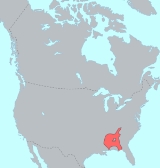
Muskogean languages

Encyclopedia
Muskogean is an indigenous language family of the Southeastern United States
. Though there is an ongoing debate concerning their interrelationships, the Muskogean languages are generally divided into two branches, Eastern Muskogean and Western Muskogean. They are agglutinative language
s.
, Chickasaw
, Choctaw
, Creek-Seminole
, Koasati
, and Mikasuki
, as well as the now-extinct Apalachee
and Hitchiti
(the latter generally considered a dialect of Mikasuki)."Seminole" is listed as one of the Muskogean languages in Hardy's list, but it is generally considered a dialect of Creek, rather than a separate language (as she herself comments: Hardy 2005:70; see also Mithun 2005:462, Crawford). The major subdivisions of the family have long been controversial, though the following lower-level groups are universally accepted: Choctaw-Chickasaw, Alabama-Koasati, Hitchiti-Mikasuki, and Creek-Seminole. Because Apalachee
is extinct
, its precise relationship to the other languages is uncertain; Mary Haas
and Pamela Munro
both classify it with the Alabama-Koasati group.
and her students, such as Karen Booker, in which "Western Muskogean" (Choctaw-Chickasaw) is seen as one major branch, and "Eastern Muskogean" (Alabama-Koasati, Hitchiti-Mikasuki, and Creek-Seminole) as another. Within Eastern Muskogean, Alabama-Koasati and Hitchiti-Mikasuki are generally thought to be more closely related to one another than either are to Creek-Seminole. This classification is reflected in the list below:
. In this classification, the languages are divided into a "Southern Muskogean" branch (Choctaw-Chickasaw, Alabama-Koasati, and Hitchiti-Mikasuki) and a "Northern Muskogean" one (Creek-Seminole). Southern Muskogean is the subdivided into Hitchiti-Mikasuki and a "Southwestern Muskogean" branch containing Alabama-Koasati and "Western Muskogean" (Choctaw-Chickasaw). This classification is reflected in the list below:
Northern Muskogean:
Southern Muskogean:
and Guale
were Muskogean. However, William Sturtevant argued that the "Yamasee" and "Guale" data was actually Creek, and that the language(s) spoken by the Yamasee and Guale people remain unknown. It is possible that the Yamasee were an amalgamation of several different ethnic groups and did not speak a single language. Chester B. DePratter describes the Yamasee as consisting mainly of speakers of Hitchiti and Guale. The historian Steven Oatis also describes the Yamasee as an ethnically mixed group that included people from Muskogean-speaking regions, such as the early colonial-era towns of Hitchiti, Coweta, and Cussita.
The Pensacola
and Chatot (or Chacato) people are reported to have spoken the same Muskogean language, which may have been closely related to Choctaw.
A vocabulary of the Houma
may be another under-documented Western Muskogean language or a version of Mobilian Jargon
. Mobilian Jargon is a pidgin based on Western Muskogean.
, in which she conceived of a macro-family comprising Muskogean and a number of language isolate
s of the southeastern US: Atakapa
, Chitimacha
, Tunica
, and Natchez
. While well-known, the Gulf grouping is now generally rejected by historical linguists. A number of Muskogean scholars continue to believe that Muskogean is related to Natchez.
transcription):
The phonemes reconstructed by Mary Haas as */x/ and */xʷ/ show up as /h/ and /f/ (or /ɸ/), respectively, in all Muskogean languages; they are therefore reconstructed by some as */h/ and */ɸ/. */kʷ/ appears as /b/ in all the daughter languages except Creek
, where it is /k/ initially and /p/ medially. The value of the proto-phoneme conventionally written <θ> (or) is unknown; it appears as /n/ in Western Muskogean languages and as /ɬ/ in Eastern Muskogean languages. Mary Haas reconstructed it as a voiceless /n/ (that is, */n̥/), based partly on presumed cognates in Natchez
.
which distinguishes the nominative from the oblique. Nouns do not obligatorially inflect for gender or number.
Verbs mark for first and second person, as well as agent and patient (Choctaw also marks for dative). Third-persons (he, she, it) have a null-marker.
Plurality of a noun agent is marked by either 1) affixation on the verb or 2) an innately plural verbal stem.
Example (pluralization via affixation, Choctaw):
Example (innately-numbered verbal stems, Mikasuki):
Southeastern United States
The Southeastern United States, colloquially referred to as the Southeast, is the eastern portion of the Southern United States. It is one of the most populous regions in the United States of America....
. Though there is an ongoing debate concerning their interrelationships, the Muskogean languages are generally divided into two branches, Eastern Muskogean and Western Muskogean. They are agglutinative language
Agglutinative language
An agglutinative language is a language that uses agglutination extensively: most words are formed by joining morphemes together. This term was introduced by Wilhelm von Humboldt in 1836 to classify languages from a morphological point of view...
s.
Family division
The Muskogean family consists of six languages which are still spoken: AlabamaAlabama language
Alabama is a Native American language, spoken by the Alabama-Coushatta tribe of Texas. It was once spoken by the Alabama-Quassarte Tribal Town of Oklahoma, but there are no more Alabama speakers in Oklahoma. It is a Muskogean language, and is believed to have been related to the Muklasa and...
, Chickasaw
Chickasaw language
The Chickasaw language is a Native American language of the Muskogean family. It is agglutinative and follows the pattern of subject–object–verb. The language is closely related to, though perhaps not entirely mutually intelligible with, Choctaw...
, Choctaw
Choctaw language
The Choctaw language, traditionally spoken by the Native American Choctaw people of the southeastern United States, is a member of the Muskogean family...
, Creek-Seminole
Creek language
The Creek language, also known as Muskogee or Muscogee , is a Muskogean language spoken by Muscogee and Seminole people primarily in the U.S. states of Oklahoma and Florida....
, Koasati
Koasati language
Koasati is a Native American language of Muskogean origin. The language is spoken by the Coushatta people, most of whom live in Allen Parish north of the town of Elton, Louisiana, though a smaller number share a reservation near Livingston, Texas, with the Alabama people...
, and Mikasuki
Mikasuki language
The Mikasuki language is a Muskogean language spoken by around 500 people in southern Florida. It is spoken by the Miccosukee tribe as well as many Florida Seminoles. The now-extinct Hitchiti language was mutually intelligible with Mikasuki.-Sounds:There are three tones, high, low and falling...
, as well as the now-extinct Apalachee
Apalachee
The Apalachee are a Native American people who historically lived in the Florida Panhandle, and now live primarily in the U.S. state of Louisiana. Their historical territory was known to the Spanish colonists as the Apalachee Province...
and Hitchiti
Hitchiti
The Hitchiti were a Muskogean-speaking tribe formerly residing chiefly in a town of the same name on the east bank of the Chattahoochee River, 4 miles below Chiaha, in west Georgia. They spoke the Hitchiti language, which was mutually intelligible with Mikasuki; both tribes were part of the loose...
(the latter generally considered a dialect of Mikasuki)."Seminole" is listed as one of the Muskogean languages in Hardy's list, but it is generally considered a dialect of Creek, rather than a separate language (as she herself comments: Hardy 2005:70; see also Mithun 2005:462, Crawford). The major subdivisions of the family have long been controversial, though the following lower-level groups are universally accepted: Choctaw-Chickasaw, Alabama-Koasati, Hitchiti-Mikasuki, and Creek-Seminole. Because Apalachee
Apalachee
The Apalachee are a Native American people who historically lived in the Florida Panhandle, and now live primarily in the U.S. state of Louisiana. Their historical territory was known to the Spanish colonists as the Apalachee Province...
is extinct
Language death
In linguistics, language death is a process that affects speech communities where the level of linguistic competence that speakers possess of a given language variety is decreased, eventually resulting in no native and/or fluent speakers of the variety...
, its precise relationship to the other languages is uncertain; Mary Haas
Mary Haas
Mary Rosamund Haas was an American linguist who specialized in North American Indian languages, Thai, and historical linguistics.-Early work in linguistics:...
and Pamela Munro
Pamela Munro
Pamela Munro is an American linguist who specializes in Native American languages. A graduate of the University of California, San Diego, her graduate adviser was Margaret Langdon. She teaches at the University of California, Los Angeles...
both classify it with the Alabama-Koasati group.
Haas' classification
For connections among these groupings, the traditional classification is that of Mary HaasMary Haas
Mary Rosamund Haas was an American linguist who specialized in North American Indian languages, Thai, and historical linguistics.-Early work in linguistics:...
and her students, such as Karen Booker, in which "Western Muskogean" (Choctaw-Chickasaw) is seen as one major branch, and "Eastern Muskogean" (Alabama-Koasati, Hitchiti-Mikasuki, and Creek-Seminole) as another. Within Eastern Muskogean, Alabama-Koasati and Hitchiti-Mikasuki are generally thought to be more closely related to one another than either are to Creek-Seminole. This classification is reflected in the list below:
- Western Muskogean
- ChickasawChickasaw languageThe Chickasaw language is a Native American language of the Muskogean family. It is agglutinative and follows the pattern of subject–object–verb. The language is closely related to, though perhaps not entirely mutually intelligible with, Choctaw...
- ChoctawChoctaw languageThe Choctaw language, traditionally spoken by the Native American Choctaw people of the southeastern United States, is a member of the Muskogean family...
( Chahta, Chacato)
- Chickasaw
- Eastern Muskogean
- Creek-SeminoleCreek languageThe Creek language, also known as Muskogee or Muscogee , is a Muskogean language spoken by Muscogee and Seminole people primarily in the U.S. states of Oklahoma and Florida....
( Muskogee, Maskoke, Seminole) - Central Muskogean
- Hitchiti-MikasukiMikasuki languageThe Mikasuki language is a Muskogean language spoken by around 500 people in southern Florida. It is spoken by the Miccosukee tribe as well as many Florida Seminoles. The now-extinct Hitchiti language was mutually intelligible with Mikasuki.-Sounds:There are three tones, high, low and falling...
( Miccosukee) - Apalachee–Alabama–Koasati
- ApalacheeApalacheeThe Apalachee are a Native American people who historically lived in the Florida Panhandle, and now live primarily in the U.S. state of Louisiana. Their historical territory was known to the Spanish colonists as the Apalachee Province...
(†) - Alabama–Koasati
- AlabamaAlabama languageAlabama is a Native American language, spoken by the Alabama-Coushatta tribe of Texas. It was once spoken by the Alabama-Quassarte Tribal Town of Oklahoma, but there are no more Alabama speakers in Oklahoma. It is a Muskogean language, and is believed to have been related to the Muklasa and...
( Alibamu) - KoasatiKoasati languageKoasati is a Native American language of Muskogean origin. The language is spoken by the Coushatta people, most of whom live in Allen Parish north of the town of Elton, Louisiana, though a smaller number share a reservation near Livingston, Texas, with the Alabama people...
( Coushatta)
- Alabama
- Apalachee
- Hitchiti-Mikasuki
- Creek-Seminole
Munro's classification
A more recent and controversial classification has been proposed by Pamela MunroPamela Munro
Pamela Munro is an American linguist who specializes in Native American languages. A graduate of the University of California, San Diego, her graduate adviser was Margaret Langdon. She teaches at the University of California, Los Angeles...
. In this classification, the languages are divided into a "Southern Muskogean" branch (Choctaw-Chickasaw, Alabama-Koasati, and Hitchiti-Mikasuki) and a "Northern Muskogean" one (Creek-Seminole). Southern Muskogean is the subdivided into Hitchiti-Mikasuki and a "Southwestern Muskogean" branch containing Alabama-Koasati and "Western Muskogean" (Choctaw-Chickasaw). This classification is reflected in the list below:
Northern Muskogean:
- Creek-SeminoleCreek languageThe Creek language, also known as Muskogee or Muscogee , is a Muskogean language spoken by Muscogee and Seminole people primarily in the U.S. states of Oklahoma and Florida....
Southern Muskogean:
-
- Hitchiti-MikasukiMikasuki languageThe Mikasuki language is a Muskogean language spoken by around 500 people in southern Florida. It is spoken by the Miccosukee tribe as well as many Florida Seminoles. The now-extinct Hitchiti language was mutually intelligible with Mikasuki.-Sounds:There are three tones, high, low and falling...
- Southwestern Muskogean
- ApalacheeApalacheeThe Apalachee are a Native American people who historically lived in the Florida Panhandle, and now live primarily in the U.S. state of Louisiana. Their historical territory was known to the Spanish colonists as the Apalachee Province...
(†) - Alabama–Koasati
- AlabamaAlabama languageAlabama is a Native American language, spoken by the Alabama-Coushatta tribe of Texas. It was once spoken by the Alabama-Quassarte Tribal Town of Oklahoma, but there are no more Alabama speakers in Oklahoma. It is a Muskogean language, and is believed to have been related to the Muklasa and...
- KoasatiKoasati languageKoasati is a Native American language of Muskogean origin. The language is spoken by the Coushatta people, most of whom live in Allen Parish north of the town of Elton, Louisiana, though a smaller number share a reservation near Livingston, Texas, with the Alabama people...
- Alabama
- Western Muskogean
- ChickasawChickasaw languageThe Chickasaw language is a Native American language of the Muskogean family. It is agglutinative and follows the pattern of subject–object–verb. The language is closely related to, though perhaps not entirely mutually intelligible with, Choctaw...
- ChoctawChoctaw languageThe Choctaw language, traditionally spoken by the Native American Choctaw people of the southeastern United States, is a member of the Muskogean family...
- Chickasaw
- Apalachee
- Hitchiti-Mikasuki
Kimball's classification
A third proposed classification is that of Geoffrey Kimball, who envisions a three-way split among the languages, between "Western Muskogean" (Choctaw-Chickasaw), "Eastern Muskogean" (Creek-Seminole), and "Central Muskogean" (Alabama-Koasati and Hitchiti-Mikasuki). However, Kimball's classification has not received as much support as either Haas' or Munro's.Possible Muskogean languages
Several sparsely attested languages have been claimed to be Muskogean languages. George Broadwell suggested that the languages of the YamaseeYamasee
The Yamasee were a multiethnic confederation of Native Americans that lived in the coastal region of present-day northern coastal Georgia near the Savannah River and later in northeastern Florida.-History:...
and Guale
Guale
Guale was an historic Native American chiefdom along the coast of present-day Georgia and the Sea Islands. Spanish Florida established its Roman Catholic missionary system in the chiefdom in the late 16th century. During the late 17th century and early 18th century, Guale society was shattered...
were Muskogean. However, William Sturtevant argued that the "Yamasee" and "Guale" data was actually Creek, and that the language(s) spoken by the Yamasee and Guale people remain unknown. It is possible that the Yamasee were an amalgamation of several different ethnic groups and did not speak a single language. Chester B. DePratter describes the Yamasee as consisting mainly of speakers of Hitchiti and Guale. The historian Steven Oatis also describes the Yamasee as an ethnically mixed group that included people from Muskogean-speaking regions, such as the early colonial-era towns of Hitchiti, Coweta, and Cussita.
The Pensacola
Pensacola people
The Pensacola were a Native American people who lived in the western part of what is now the Florida Panhandle from the time of first contact with Europeans until early in the 18th century. They spoke a Muskogean language. They are the source of the name of Pensacola Bay and the city of Pensacola...
and Chatot (or Chacato) people are reported to have spoken the same Muskogean language, which may have been closely related to Choctaw.
A vocabulary of the Houma
Houma Tribe
The Houma people are a Native America tribe. They belong to the United Houma Nation, a state recognized tribe in Louisiana. They primarily live in East and West Feliciana, and Pointe Coupee Parishes, about 100 miles north of the town of Houma named for them, west of the mouth of the Mississippi...
may be another under-documented Western Muskogean language or a version of Mobilian Jargon
Mobilian Jargon
Mobilian Jargon was a pidgin used as a lingua franca among Native American groups living along the Gulf of Mexico around the time of European settlement of the region...
. Mobilian Jargon is a pidgin based on Western Muskogean.
Gulf
The best-known connection proposed between Muskogean and other languages is Mary Haas' Gulf hypothesisGulf languages
Gulf is a proposed native North American language family composed of the Muskogean languages, along with four extinct language isolates: Natchez, Tunica, Atakapa, and Chitimacha....
, in which she conceived of a macro-family comprising Muskogean and a number of language isolate
Language isolate
A language isolate, in the absolute sense, is a natural language with no demonstrable genealogical relationship with other languages; that is, one that has not been demonstrated to descend from an ancestor common with any other language. They are in effect language families consisting of a single...
s of the southeastern US: Atakapa
Atakapa language
Atakapa is an extinct language isolate native to southwestern Louisiana and nearby coastal eastern Texas. It was spoken by the Atakapa people .-Geographic variation:There were two varieties of Atakapa Atakapa is an extinct language isolate native to southwestern Louisiana and nearby coastal eastern...
, Chitimacha
Chitimacha language
The Chitimacha language is a language isolate historically spoken by the Chitimacha people of Louisiana, United States. It went extinct in 1940 with the death of the last fluent speaker, Delphine Ducloux....
, Tunica
Tunica language
The Tunica language was a language isolate spoken in the Central and Lower Mississippi Valley by in the United States by Native American Tunica peoples. There are no known speakers of the Tunica language remaining.When the last known fluent speaker Sesostrie Youchigant died, the language became...
, and Natchez
Natchez language
Natchez was a language of Louisiana. Its two last fluent speakers, Watt Sam and Nancy Raven, died in the late 1930s. The Natchez nation is now working to revive it as a spoken language.-Classification:...
. While well-known, the Gulf grouping is now generally rejected by historical linguists. A number of Muskogean scholars continue to believe that Muskogean is related to Natchez.
Phonology
Proto-Muskogean is reconstructed as having the consonants (given in IPAInternational Phonetic Alphabet
The International Phonetic Alphabet "The acronym 'IPA' strictly refers [...] to the 'International Phonetic Association'. But it is now such a common practice to use the acronym also to refer to the alphabet itself that resistance seems pedantic...
transcription):
| Labial Labial consonant Labial consonants are consonants in which one or both lips are the active articulator. This precludes linguolabials, in which the tip of the tongue reaches for the posterior side of the upper lip and which are considered coronals... |
Alveolar Alveolar consonant Alveolar consonants are articulated with the tongue against or close to the superior alveolar ridge, which is called that because it contains the alveoli of the superior teeth... |
Palatal Palatal consonant Palatal consonants are consonants articulated with the body of the tongue raised against the hard palate... |
Velar Velar consonant Velars are consonants articulated with the back part of the tongue against the soft palate, the back part of the roof of the mouth, known also as the velum).... |
|||
|---|---|---|---|---|---|---|
| Central Central consonant A central or medial consonant is a consonant sound that is produced when air flows across the center of the mouth over the tongue. The class contrasts with lateral consonants, in which air flows over the sides of the tongue rather than down its center.... |
Lateral Lateral consonant A lateral is an el-like consonant, in which airstream proceeds along the sides of the tongue, but is blocked by the tongue from going through the middle of the mouth.... |
Plain | Labialized Labialisation Labialization is a secondary articulatory feature of sounds in some languages. Labialized sounds involve the lips while the remainder of the oral cavity produces another sound. The term is normally restricted to consonants. When vowels involve the lips, they are called rounded.The most common... |
|||
| Stop Stop consonant In phonetics, a plosive, also known as an occlusive or an oral stop, is a stop consonant in which the vocal tract is blocked so that all airflow ceases. The occlusion may be done with the tongue , lips , and &... s |
*p | *t | *k | *kʷ | ||
| Affricate Affricate consonant Affricates are consonants that begin as stops but release as a fricative rather than directly into the following vowel.- Samples :... s |
*ts | *tʃ | ||||
| Fricative Fricative consonant Fricatives are consonants produced by forcing air through a narrow channel made by placing two articulators close together. These may be the lower lip against the upper teeth, in the case of ; the back of the tongue against the soft palate, in the case of German , the final consonant of Bach; or... s |
*s | *ɬ | *ʃ | *x | *xʷ | |
| Nasal Nasal consonant A nasal consonant is a type of consonant produced with a lowered velum in the mouth, allowing air to escape freely through the nose. Examples of nasal consonants in English are and , in words such as nose and mouth.- Definition :... s |
*m | *n | ||||
| Approximants | *l | *j | *w | |||
| Other | *θ | |||||
The phonemes reconstructed by Mary Haas as */x/ and */xʷ/ show up as /h/ and /f/ (or /ɸ/), respectively, in all Muskogean languages; they are therefore reconstructed by some as */h/ and */ɸ/. */kʷ/ appears as /b/ in all the daughter languages except Creek
Creek language
The Creek language, also known as Muskogee or Muscogee , is a Muskogean language spoken by Muscogee and Seminole people primarily in the U.S. states of Oklahoma and Florida....
, where it is /k/ initially and /p/ medially. The value of the proto-phoneme conventionally written <θ> (or
Natchez language
Natchez was a language of Louisiana. Its two last fluent speakers, Watt Sam and Nancy Raven, died in the late 1930s. The Natchez nation is now working to revive it as a spoken language.-Classification:...
.
Nouns
Most family languages display lexical accent on nouns, as well as grammatical caseGrammatical case
In grammar, the case of a noun or pronoun is an inflectional form that indicates its grammatical function in a phrase, clause, or sentence. For example, a pronoun may play the role of subject , of direct object , or of possessor...
which distinguishes the nominative from the oblique. Nouns do not obligatorially inflect for gender or number.
Verbs
Muskogean verbs have a complex ablaut system wherein the verbal stem changes depending on aspect (almost always), and less commonly depending on tense or modality. In Muskogean linguistics, the different forms are known as "grades".Verbs mark for first and second person, as well as agent and patient (Choctaw also marks for dative). Third-persons (he, she, it) have a null-marker.
Plurality of a noun agent is marked by either 1) affixation on the verb or 2) an innately plural verbal stem.
Example (pluralization via affixation, Choctaw):
- ishimpa
- ish-impa
- 2SG.NOM-eat
- "you [sg.] eat"
- hashimpa
- hash-impa
- 2PL.NOM-eat
- "you [pl.] eat"
Example (innately-numbered verbal stems, Mikasuki):
- łiniik
- run. SG
- "to run (singular)"
- palaak
- run. PAUCAL
- "to run (several)"
- mataak
- run. PL
- "to run (many)"
External links
- Muskogean Language Family page at native-languages.org
- Ethnologue: Muskogean