

Chickasaw language

Encyclopedia
The Chickasaw language (Chikashshanompa’, IPA
[tʃikaʃːanompaʔ]) is a Native American language of the Muskogean
family. It is agglutinative and follows the pattern of subject–object–verb. The language is closely related to, though perhaps not entirely mutually intelligible with, Choctaw
. It is spoken by the Chickasaw
tribe, now residing in Southeast Oklahoma
, centered around Ada
.
s. In the table below, the consonants are written in the standard Chickasaw orthography. The phonetic symbolization of each consonant is written in the International Phonetic Alphabet
(IPA) to the right of each orthographic letter when the orthography differs from the IPA symbol.
is labiovelar.
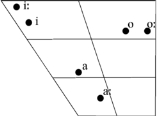
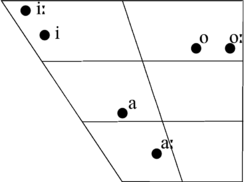 Chickasaw has 9 vowel
s:
Chickasaw vowels contrast between short and long
oral vowels and between long oral vowels and long nasal
vowels. Short vowels are centralized (see chart): short i is phonetically [ɪ], short o is phonetically [o̟], and short a is phonetically [ə].
Short vowels are also phonetically lengthened when they occur in the second syllable of a sequence of even-numbered open syllables. For example, the word pisali ('I took him') is phonetically [pɪsəˑlɪ]. The lengthened short vowel is usually intermediate in length between a short vowel and long vowel. However, the phonetic realization varies depending on the individual speaker and also on phonetic environment. The lengthening does not occur at the end of words and is further restricted by certain morphological criteria.
, direct object, indirect object) are indicated with pronominal affix
es (both prefixes and suffixes) which are added to verb stems
. The pronominal affixes are inflected according to number
(singular, plural) and person
(1st, 2nd).
Chickasaw has an active–stative pronominal system with two basic series of pronominal sets: an active series (I) and a stative series (II). Additionally, Chickasaw also has dative (III), negative (N), and reciprocal
(IR) series.
The active series is used for active intransitive subjects and active transitive
subjects. (An active subject, simply put, is a subject that is in control of the action while a stative subject does not have control of the action. This is the difference between She fell on purpose vs. She fell accidentally where the first she controlled the falling while the second she did not control the falling.) The active series is in the table below:
The third person lacks an affix and usually does not distinguish between singular and plural. The first person singular affix is a suffix while the other affixes are prefixes. The first person plural has two forms: il- which is used before vowels and ii- which is used before consonants — thus, il-iyya "we go", ii-malli "we jump". An example inflectional paradigm of the verb malli "to jump" is below (with the pronominal affixes underlined):
The stative series (II) is below. This series is used to indicate stative intransitive subjects and direct objects.
Example with stative intransitive subjects, lhinko "to be fat":
Example with direct objects, pisa "to look at (someone)" (the subject in the paradigm below is unmarked
because it is in the third person):
Both active and stative affixes can occur together in which case the active affix indicates the active subject and the stative affix indicates the direct object. Active prefixes occur before stative prefixes. When ish- "active second person singular" occurs before sa- "stative first person singular", it results in issa- (the sh assimilate
s to s). Likewise, hash- "active second person plural" + sa- is realized as hassa-. The full paradigm of pisa "to look at" is below:
International Phonetic Alphabet
The International Phonetic Alphabet "The acronym 'IPA' strictly refers [...] to the 'International Phonetic Association'. But it is now such a common practice to use the acronym also to refer to the alphabet itself that resistance seems pedantic...
[tʃikaʃːanompaʔ]) is a Native American language of the Muskogean
Muskogean languages
Muskogean is an indigenous language family of the Southeastern United States. Though there is an ongoing debate concerning their interrelationships, the Muskogean languages are generally divided into two branches, Eastern Muskogean and Western Muskogean...
family. It is agglutinative and follows the pattern of subject–object–verb. The language is closely related to, though perhaps not entirely mutually intelligible with, Choctaw
Choctaw language
The Choctaw language, traditionally spoken by the Native American Choctaw people of the southeastern United States, is a member of the Muskogean family...
. It is spoken by the Chickasaw
Chickasaw
The Chickasaw are Native American people originally from the region that would become the Southeastern United States...
tribe, now residing in Southeast Oklahoma
Oklahoma
Oklahoma is a state located in the South Central region of the United States of America. With an estimated 3,751,351 residents as of the 2010 census and a land area of 68,667 square miles , Oklahoma is the 28th most populous and 20th-largest state...
, centered around Ada
Ada, Oklahoma
Ada is a city in and the county seat of Pontotoc County, Oklahoma, United States. The population was 16,008 at the 2000 census. As of 2009, the city population was estimated at 17,019....
.
Consonants
Chickasaw has 16 consonantConsonant
In articulatory phonetics, a consonant is a speech sound that is articulated with complete or partial closure of the vocal tract. Examples are , pronounced with the lips; , pronounced with the front of the tongue; , pronounced with the back of the tongue; , pronounced in the throat; and ,...
s. In the table below, the consonants are written in the standard Chickasaw orthography. The phonetic symbolization of each consonant is written in the International Phonetic Alphabet
International Phonetic Alphabet
The International Phonetic Alphabet "The acronym 'IPA' strictly refers [...] to the 'International Phonetic Association'. But it is now such a common practice to use the acronym also to refer to the alphabet itself that resistance seems pedantic...
(IPA) to the right of each orthographic letter when the orthography differs from the IPA symbol.
| Labial Labial consonant Labial consonants are consonants in which one or both lips are the active articulator. This precludes linguolabials, in which the tip of the tongue reaches for the posterior side of the upper lip and which are considered coronals... |
Alveolar Alveolar consonant Alveolar consonants are articulated with the tongue against or close to the superior alveolar ridge, which is called that because it contains the alveoli of the superior teeth... |
Post- alveolar |
Velar Velar consonant Velars are consonants articulated with the back part of the tongue against the soft palate, the back part of the roof of the mouth, known also as the velum).... |
Glottal Glottal consonant Glottal consonants, also called laryngeal consonants, are consonants articulated with the glottis. Many phoneticians consider them, or at least the so-called fricative, to be transitional states of the glottis without a point of articulation as other consonants have; in fact, some do not consider... |
||
|---|---|---|---|---|---|---|
| central Central consonant A central or medial consonant is a consonant sound that is produced when air flows across the center of the mouth over the tongue. The class contrasts with lateral consonants, in which air flows over the sides of the tongue rather than down its center.... |
lateral Lateral consonant A lateral is an el-like consonant, in which airstream proceeds along the sides of the tongue, but is blocked by the tongue from going through the middle of the mouth.... |
|||||
| Nasal Nasal consonant A nasal consonant is a type of consonant produced with a lowered velum in the mouth, allowing air to escape freely through the nose. Examples of nasal consonants in English are and , in words such as nose and mouth.- Definition :... |
m | n | ||||
| Plosive | p b | t d | k g | ' /ʔ/ | ||
| Affricate Affricate consonant Affricates are consonants that begin as stops but release as a fricative rather than directly into the following vowel.- Samples :... |
ch /tʃ/ | |||||
| Fricative Fricative consonant Fricatives are consonants produced by forcing air through a narrow channel made by placing two articulators close together. These may be the lower lip against the upper teeth, in the case of ; the back of the tongue against the soft palate, in the case of German , the final consonant of Bach; or... |
f | s | lh /ɬ/ | sh /ʃ/ | h | |
| Approximant Approximant consonant Approximants are speech sounds that involve the articulators approaching each other but not narrowly enough or with enough articulatory precision to create turbulent airflow. Therefore, approximants fall between fricatives, which do produce a turbulent airstream, and vowels, which produce no... |
l | y /j/ | w | |||
is labiovelar.
- Voiceless stops /p t k/ have a small amount of aspirationAspiration (phonetics)In phonetics, aspiration is the strong burst of air that accompanies either the release or, in the case of preaspiration, the closure of some obstruents. To feel or see the difference between aspirated and unaspirated sounds, one can put a hand or a lit candle in front of one's mouth, and say pin ...
[pʰ tʰ kʰ], especially at the beginning of words. - Voiced stops /b d ɡ/ may undergo lenitionLenitionIn linguistics, lenition is a kind of sound change that alters consonants, making them "weaker" in some way. The word lenition itself means "softening" or "weakening" . Lenition can happen both synchronically and diachronically...
to voiced fricatives [β ð ɣ] between vowels. - All consonants except for the glottal stopGlottal stopThe glottal stop, or more fully, the voiceless glottal plosive, is a type of consonantal sound used in many spoken languages. In English, the feature is represented, for example, by the hyphen in uh-oh! and by the apostrophe or [[ʻokina]] in Hawaii among those using a preservative pronunciation of...
may be geminated and most consonants can occur in biconsonantal clusters.
Vowels
Vowel
In phonetics, a vowel is a sound in spoken language, such as English ah! or oh! , pronounced with an open vocal tract so that there is no build-up of air pressure at any point above the glottis. This contrasts with consonants, such as English sh! , where there is a constriction or closure at some...
s:
| Front Front vowel A front vowel is a type of vowel sound used in some spoken languages. The defining characteristic of a front vowel is that the tongue is positioned as far in front as possible in the mouth without creating a constriction that would be classified as a consonant. Front vowels are sometimes also... |
Central Central vowel A central vowel is a type of vowel sound used in some spoken languages. The defining characteristic of a central vowel is that the tongue is positioned halfway between a front vowel and a back vowel... |
Back Back vowel A back vowel is a type of vowel sound used in spoken languages. The defining characteristic of a back vowel is that the tongue is positioned as far back as possible in the mouth without creating a constriction that would be classified as a consonant. Back vowels are sometimes also called dark... |
|||||||
|---|---|---|---|---|---|---|---|---|---|
| short | long | short | long | short | long | ||||
| oral | nasal Nasal vowel A nasal vowel is a vowel that is produced with a lowering of the velum so that air escapes both through nose as well as the mouth. By contrast, oral vowels are ordinary vowels without this nasalisation... |
oral | nasal Nasal vowel A nasal vowel is a vowel that is produced with a lowering of the velum so that air escapes both through nose as well as the mouth. By contrast, oral vowels are ordinary vowels without this nasalisation... |
oral | nasal Nasal vowel A nasal vowel is a vowel that is produced with a lowering of the velum so that air escapes both through nose as well as the mouth. By contrast, oral vowels are ordinary vowels without this nasalisation... |
||||
| Close Close vowel A close vowel is a type of vowel sound used in many spoken languages. The defining characteristic of a close vowel is that the tongue is positioned as close as possible to the roof of the mouth without creating a constriction that would be classified as a consonant.This term is prescribed by the... |
i [ɪ] | ii [iː] | i [ĩː] | ||||||
| Mid Mid vowel A mid vowel is a vowel sound used in some spoken languages. The defining characteristic of a mid vowel is that the tongue is positioned mid-way between an open vowel and a close vowel... |
o [o̟] | oo [oː] | o [õː] | ||||||
| Open Open vowel An open vowel is defined as a vowel sound in which the tongue is positioned as far as possible from the roof of the mouth. Open vowels are sometimes also called low vowels in reference to the low position of the tongue... |
a [ə] | aa [aː] | a [ãː] | ||||||
Chickasaw vowels contrast between short and long
Vowel length
In linguistics, vowel length is the perceived duration of a vowel sound. Often the chroneme, or the "longness", acts like a consonant, and may etymologically be one, such as in Australian English. While not distinctive in most dialects of English, vowel length is an important phonemic factor in...
oral vowels and between long oral vowels and long nasal
Nasalization
In phonetics, nasalization is the production of a sound while the velum is lowered, so that some air escapes through the nose during the production of the sound by the mouth...
vowels. Short vowels are centralized (see chart): short i is phonetically [ɪ], short o is phonetically [o̟], and short a is phonetically [ə].
Short vowels are also phonetically lengthened when they occur in the second syllable of a sequence of even-numbered open syllables. For example, the word pisali ('I took him') is phonetically [pɪsəˑlɪ]. The lengthened short vowel is usually intermediate in length between a short vowel and long vowel. However, the phonetic realization varies depending on the individual speaker and also on phonetic environment. The lengthening does not occur at the end of words and is further restricted by certain morphological criteria.
| IPA | Example | Meaning |
|---|---|---|
| /i/ | pisa | 'she looks at him' |
| /iː/ | piini' | 'boat' |
| /ĩ/ | isinti' | 'his snake' |
| /a/ | paska | 'bread' |
| /aː/ | sahashaa | 'I'm angry' |
| /ã/ | ipashi' | 'hair' |
| /o/ | ofi' | 'dog' |
| /oː/ | ihoo | 'woman' |
| /õ/ | isolash | 'tongue' |
Pronominal affixes
Verb arguments (i.e. subjectSubject (grammar)
The subject is one of the two main constituents of a clause, according to a tradition that can be tracked back to Aristotle and that is associated with phrase structure grammars; the other constituent is the predicate. According to another tradition, i.e...
, direct object, indirect object) are indicated with pronominal affix
Affix
An affix is a morpheme that is attached to a word stem to form a new word. Affixes may be derivational, like English -ness and pre-, or inflectional, like English plural -s and past tense -ed. They are bound morphemes by definition; prefixes and suffixes may be separable affixes...
es (both prefixes and suffixes) which are added to verb stems
Word stem
In linguistics, a stem is a part of a word. The term is used with slightly different meanings.In one usage, a stem is a form to which affixes can be attached. Thus, in this usage, the English word friendships contains the stem friend, to which the derivational suffix -ship is attached to form a new...
. The pronominal affixes are inflected according to number
Grammatical number
In linguistics, grammatical number is a grammatical category of nouns, pronouns, and adjective and verb agreement that expresses count distinctions ....
(singular, plural) and person
Grammatical person
Grammatical person, in linguistics, is deictic reference to a participant in an event; such as the speaker, the addressee, or others. Grammatical person typically defines a language's set of personal pronouns...
(1st, 2nd).
Chickasaw has an active–stative pronominal system with two basic series of pronominal sets: an active series (I) and a stative series (II). Additionally, Chickasaw also has dative (III), negative (N), and reciprocal
Reciprocal (grammar)
A reciprocal is a linguistic structure that marks a particular kind of relationship between two noun phrases. In a reciprocal construction, each of the participants occupies both the role of agent and patient with respect to each other...
(IR) series.
The active series is used for active intransitive subjects and active transitive
Transitivity (grammatical category)
In linguistics, transitivity is a property of verbs that relates to whether a verb can take direct objects and how many such objects a verb can take...
subjects. (An active subject, simply put, is a subject that is in control of the action while a stative subject does not have control of the action. This is the difference between She fell on purpose vs. She fell accidentally where the first she controlled the falling while the second she did not control the falling.) The active series is in the table below:
| singular | plural | |
|---|---|---|
| 1st | -li | il- / ii- |
| 2nd | ish- | hash- |
| 3rd | - | |
The third person lacks an affix and usually does not distinguish between singular and plural. The first person singular affix is a suffix while the other affixes are prefixes. The first person plural has two forms: il- which is used before vowels and ii- which is used before consonants — thus, il-iyya "we go", ii-malli "we jump". An example inflectional paradigm of the verb malli "to jump" is below (with the pronominal affixes underlined):
| singular | plural | |||
|---|---|---|---|---|
| 1st | mallili | "I jump" | iimalli | "we jump" |
| 2nd | ishmalli | "you jump" | hashmalli | "you all jump" |
| 3rd | malli "he/she/it/they jump" | |||
The stative series (II) is below. This series is used to indicate stative intransitive subjects and direct objects.
| singular | plural | |
|---|---|---|
| 1st | sa- | po- |
| 2nd | chi- | hachi- |
| 3rd | - | |
Example with stative intransitive subjects, lhinko "to be fat":
| singular | plural | |||
|---|---|---|---|---|
| 1st | salhinko | "I am fat" | polhinko | "we are fat" |
| 2nd | chilhinko | "you are fat" | hachilhinko | "you all are fat" |
| 3rd | lhinko "he/she/it/they is/are fat" | |||
Example with direct objects, pisa "to look at (someone)" (the subject in the paradigm below is unmarked
Markedness
Markedness is a specific kind of asymmetry relationship between elements of linguistic or conceptual structure. In a marked-unmarked relation, one term of an opposition is the broader, dominant one...
because it is in the third person):
| singular | plural | |||
|---|---|---|---|---|
| 1st | sapisa | "he/she/it/they look at me" | popisa | "he/she/it/they look at us" |
| 2nd | chipisa | "he/she/it/they look at you" | hachipisa | "he/she/it/they look at you all" |
| 3rd | pisa "he/she/it/they look at him/her/it/them" | |||
Both active and stative affixes can occur together in which case the active affix indicates the active subject and the stative affix indicates the direct object. Active prefixes occur before stative prefixes. When ish- "active second person singular" occurs before sa- "stative first person singular", it results in issa- (the sh assimilate
Assimilation (linguistics)
Assimilation is a common phonological process by which the sound of the ending of one word blends into the sound of the beginning of the following word. This occurs when the parts of the mouth and vocal cords start to form the beginning sounds of the next word before the last sound has been...
s to s). Likewise, hash- "active second person plural" + sa- is realized as hassa-. The full paradigm of pisa "to look at" is below:
| verb form | translation | morpheme Morpheme In linguistics, a morpheme is the smallest semantically meaningful unit in a language. The field of study dedicated to morphemes is called morphology. A morpheme is not identical to a word, and the principal difference between the two is that a morpheme may or may not stand alone, whereas a word,... segmentation |
|---|---|---|
| hachipisali | "I look at you all" | hachi-pisa-li |
| pisali | "I look at her" | pisa-li |
| iichipisa | "we look at you" | ii-chi-pisa |
| iihachipisa | "we look at you all" | ii-hachi-pisa |
| iipisa | "we look at her" | ii-pisa |
| issapisa | "you look at me" | ish-sa-pisa |
| ishpopisa | "you look at us" | ish-po-pisa |
| ishpisa | "you look at her" | ish-pisa |
| hassapisa | "you all look at me" | hash-sa-pisa |
| hashpopisa | "you all look at us" | hash-po-pisa |
| hashpisa | "you all look at her" | hash-pisa |
| sapisa | "she looks at me" | sa-pisa |
| popisa | "she looks at us" | po-pisa |
| chipisa | "she looks at you" | chi-pisa |
| hachipisa | "she looks at you all" | hachi-pisa |
| pisa | "she looks at her" | pisa |
Verb grades
- verb grades (geminationGeminationIn phonetics, gemination happens when a spoken consonant is pronounced for an audibly longer period of time than a short consonant. Gemination is distinct from stress and may appear independently of it....
, epenthesisEpenthesisIn phonology, epenthesis is the addition of one or more sounds to a word, especially to the interior of a word. Epenthesis may be divided into two types: excrescence, for the addition of a consonant, and anaptyxis for the addition of a vowel....
)
| foyopa | 'to breathe' | ||
| fóyyo'pa | 'to give a sigh of relief' | ||
| foyohómpa | 'to be breathing' | ||
| foyámpa | 'breathing' (at same time as another action) |