


Cherub

Encyclopedia
Hebrew Bible
The Hebrew Bible is a term used by biblical scholars outside of Judaism to refer to the Tanakh , a canonical collection of Jewish texts, and the common textual antecedent of the several canonical editions of the Christian Old Testament...
and cited later on in the Christian biblical canons
Christian biblical canons
A Christian biblical canon is the set of books that a Christian denomination regards as divinely inspired and thus constituting the Christian Bible...
, usually associated with the presence of God. The plural can be written as cherubim, cherubimsKJV or cherubs. In modern English the word cherub is sometimes used for what are strictly putti, baby or toddler angels in art. This article is concerned with the original sense of the word.
Cherubim are mentioned in the Torah
Torah
Torah- A scroll containing the first five books of the BibleThe Torah , is name given by Jews to the first five books of the bible—Genesis , Exodus , Leviticus , Numbers and Deuteronomy Torah- A scroll containing the first five books of the BibleThe Torah , is name given by Jews to the first five...
(five books of Moses), the Book of Ezekiel
Book of Ezekiel
The Book of Ezekiel is the third of the Latter Prophets in the Hebrew Bible, following the books of Isaiah and Jeremiah and preceding the Book of the Twelve....
, and the Book of Isaiah
Book of Isaiah
The Book of Isaiah is the first of the Latter Prophets in the Hebrew Bible, preceding the books of Ezekiel, Jeremiah and the Book of the Twelve...
. They are also mentioned in the books of 1 Kings, 2 Kings, 1 Chronicles, and 2 Chronicles mainly in the construction of the House of God
Temple in Jerusalem
The Temple in Jerusalem or Holy Temple , refers to one of a series of structures which were historically located on the Temple Mount in the Old City of Jerusalem, the current site of the Dome of the Rock. Historically, these successive temples stood at this location and functioned as the centre of...
. There is only one mention in the New Testament, in Hebrews 9:5, referring to the mercy seat
Mercy seat
According to the Bible, the mercy seat was an object which rested upon the Ark of the Covenant, and was connected with the rituals of Yom Kippur; the term also appears in the Pauline Epistles, and has a significance in Christian theology...
of the ark of the covenant.
The prophet Ezekiel
Ezekiel
Ezekiel , "God will strengthen" , is the central protagonist of the Book of Ezekiel in the Hebrew Bible. In Judaism, Christianity and Islam, Ezekiel is acknowledged as a Hebrew prophet...
describes cherubim as a tetrad of living creatures, each having four faces: of a man, a lion, an ox, and an eagle. They are said to have the stature and hands of a man, feet of a calf, and four wings each. Two of the wings extended upward, meeting above and sustaining the throne of God
Throne of God
The Throne of God is the reigning centre of the chief deity of the Abrahamic faiths, Judaism, Christianity and Islam. The throne is said by various holy books to reside above the Seventh Heaven called Araboth in Judaism.-Judaism:...
; while the other two stretched downward and covered the creatures themselves. In the Christian New Testament
New Testament
The New Testament is the second major division of the Christian biblical canon, the first such division being the much longer Old Testament....
similar beings are mentioned in the fourth chapter of the Book of Revelation
Book of Revelation
The Book of Revelation is the final book of the New Testament. The title came into usage from the first word of the book in Koine Greek: apokalupsis, meaning "unveiling" or "revelation"...
.
Origins

Cognate
In linguistics, cognates are words that have a common etymological origin. This learned term derives from the Latin cognatus . Cognates within the same language are called doublets. Strictly speaking, loanwords from another language are usually not meant by the term, e.g...
with the Assyria
Assyria
Assyria was a Semitic Akkadian kingdom, extant as a nation state from the mid–23rd century BC to 608 BC centred on the Upper Tigris river, in northern Mesopotamia , that came to rule regional empires a number of times through history. It was named for its original capital, the ancient city of Assur...
n term karabu, Akkad
Akkad
The Akkadian Empire was an empire centered in the city of Akkad and its surrounding region in Mesopotamia....
ian term kuribu, and Babylonia
Babylonia
Babylonia was an ancient cultural region in central-southern Mesopotamia , with Babylon as its capital. Babylonia emerged as a major power when Hammurabi Babylonia was an ancient cultural region in central-southern Mesopotamia (present-day Iraq), with Babylon as its capital. Babylonia emerged as...
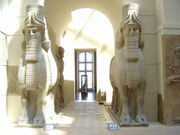
n term karabu; the Assyrian term means 'great, mighty', but the Akkadian and Babylonian cognates mean 'propitious, blessed'. In some regions the Assyro-Babylonian term came to refer in particular to spirits which served the gods, in particular to the shedu (human-headed winged bull
Bull (mythology)
The worship of the Sacred Bull throughout the ancient world is most familiar to the Western world in the biblical episode of the idol of the Golden Calf. The Golden Calf after being made by the Hebrew people in the wilderness of Sinai, were rejected and destroyed by Moses and his tribe after his...
s); the Assyrians sometimes referred to these as kirubu, a term grammatically related to karabu. They were originally a version of the shedu, protective deities sometimes found as pairs of colossal statues either side of objects to be protected, such as doorways. However, although the shedu were popular in Mesopotamia
Mesopotamia
Mesopotamia is a toponym for the area of the Tigris–Euphrates river system, largely corresponding to modern-day Iraq, northeastern Syria, southeastern Turkey and southwestern Iran.Widely considered to be the cradle of civilization, Bronze Age Mesopotamia included Sumer and the...
, archaeological remains
Archaeology
Archaeology, or archeology , is the study of human society, primarily through the recovery and analysis of the material culture and environmental data that they have left behind, which includes artifacts, architecture, biofacts and cultural landscapes...
from the Levant
Levant
The Levant or ) is the geographic region and culture zone of the "eastern Mediterranean littoral between Anatolia and Egypt" . The Levant includes most of modern Lebanon, Syria, Jordan, Israel, the Palestinian territories, and sometimes parts of Turkey and Iraq, and corresponds roughly to the...
suggest that they were quite rare in the immediate vicinity of the Israelites. The related Lammasu (human-headed winged lion
Lion
The lion is one of the four big cats in the genus Panthera, and a member of the family Felidae. With some males exceeding 250 kg in weight, it is the second-largest living cat after the tiger...
s — to which the sphinx
Sphinx
A sphinx is a mythical creature with a lion's body and a human head or a cat head.The sphinx, in Greek tradition, has the haunches of a lion, the wings of a great bird, and the face of a woman. She is mythicised as treacherous and merciless...
is similar in appearance), on the other hand, were the most popular winged-creature in Phoenicia
Phoenicia
Phoenicia , was an ancient civilization in Canaan which covered most of the western, coastal part of the Fertile Crescent. Several major Phoenician cities were built on the coastline of the Mediterranean. It was an enterprising maritime trading culture that spread across the Mediterranean from 1550...
n art, and so scholars suspect that Cherubim were originally a form of Lammasu. In particular, in a scene reminiscent of Ezekiel's dream, the Megiddo Ivories — ivory
Ivory
Ivory is a term for dentine, which constitutes the bulk of the teeth and tusks of animals, when used as a material for art or manufacturing. Ivory has been important since ancient times for making a range of items, from ivory carvings to false teeth, fans, dominoes, joint tubes, piano keys and...
carvings found at Megiddo (which became a major Israelite city) — depict an unknown king being carried on his throne by hybrid winged-creatures.
Angel
Angels are mythical beings often depicted as messengers of God in the Hebrew and Christian Bibles along with the Quran. The English word angel is derived from the Greek ἄγγελος, a translation of in the Hebrew Bible ; a similar term, ملائكة , is used in the Qur'an...
. The griffin
Griffin
The griffin, griffon, or gryphon is a legendary creature with the body of a lion and the head and wings of an eagle...
— a similar creature but with an eagle's head rather than that of a king — has also been proposed as an origin, arising in Israelite culture as a result of Hittite
Hittites
The Hittites were a Bronze Age people of Anatolia.They established a kingdom centered at Hattusa in north-central Anatolia c. the 18th century BC. The Hittite empire reached its height c...
usage of griffins (rather than being depicted as aggressive beasts, Hittite depictions show them seated calmly, as if guarding), and some have proposed that griffin may be cognate to cherubim,Also see: Robert S. P. Beekes
Robert S. P. Beekes
Robert Stephen Paul Beekes is Emeritus Professor of Comparative Indo-European Linguistics at the University of Leiden and the author of many books about Proto-Indo-European, the reconstructed parent language of most of the European languages and of the languages of Central Asia and India...
,Etymological Dictionary of Greek, volume 1, Leiden and Boston: Brill, 2010 ISBN 978-90-04-17420-7, page 289, entry for γρυπος,"From the archaeological perspective, origin in Asia Minor (and the Near East: Elam) is very probable." but Lammasu were significantly more important in Levantine culture, and thus more likely to be the origin.
Early Semitic tradition conceived the cherubim as guardians, being devoid of human feelings, and holding a duty both to represent the gods and to guard sanctuaries from intruders, in a comparable way to an account found on Tablet 9 of the inscriptions found at Nimrud
Nimrud
Nimrud is an ancient Assyrian city located south of Nineveh on the river Tigris in modern Ninawa Governorate Iraq. In ancient times the city was called Kalḫu. The Arabs called the city Nimrud after the Biblical Nimrod, a legendary hunting hero .The city covered an area of around . Ruins of the city...
. In this view, cherubim, like the shedu, were probably originally depictions of storm deities, especially the storm winds. This view is offered as a hypothesis to explain the reason for cherubim being described as acting as the chariot of the in Ezekiel's visions, the Books of Samuel
Books of Samuel
The Books of Samuel in the Jewish bible are part of the Former Prophets, , a theological history of the Israelites affirming and explaining the Torah under the guidance of the prophets.Samuel begins by telling how the prophet Samuel is chosen by...
, the parallel passages in the later Book of Chronicles, and passages in the early Psalms: "and he rode upon a cherub and did fly: and he was seen upon the wings of the wind".
In the Bible
There is some dispute about whether the Hebrew plural cherubim, or the English plural cherubims is correct, with an "s" to signify that the word is plural in number. It is acknowledged that the "-im" suffix added to cherub is the Hebrew masculine plural form. What is not widely known is that like English, the Hebrew plural can signify more than one in quantity, but "Hebrew plurals can also denote quality (very large or great)." An example is the Hebrew word elohim which can be translated as "gods" (quantity) or "a great god" (quality). The English custom is to use a great "G" for God, and small "g" for gods. Another consideration is the fact that most English speaking people would not recognize a word ending in "-im" as plural unless an "s" was added. There are a lot of singular English words with im as the last two letters.The word cherubims is the standard plural form used in the majority of English Bibles over the past 500 years. Other versions that use cherubims besides the Authorized Version include: 1525 Tyndale (in Hebrews 9:5), 1540 Cranmer (Great) Bible, 1568 Bishops' Bible, 1599 Geneva Bible, the original Douay-Rhiems, 1899 Douay, 1950 Douay, the 21st Century KJV, and 1998 Third Millenium Bible. The 1535 Coverdale Bible used the plural form cherubs, as also Young's Literal, Green's 2000 Literal, and the World English Bible. Other language Bibles that use their own plural form include: Spanish "querubines" in the Reina Valera (1909,1960,1995), 1997 La Biblia de las Américas, and the Spanish NIV; French "les chérubins" in the 1744 Martin, 1910 Louis Segond, 1996 Ostervald; Italian "cherubini" in the 1649 Diodati, 1972 Riveduta, 1991 New Diodati; and Portuguese "querubins" in the Almeida and 2000 O Livro.
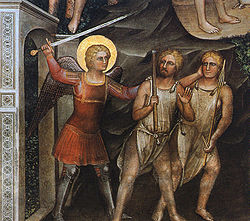
The first appearance of Cherubims in the Bible was after the man was driven from the garden:
So he drove out the man; and he placed at the east of the garden of Eden Cherubims, and a flaming sword which turned every way, to keep the way of the tree of life. (A.V.1611)
The definitive book in the Bible on Cherubims is the Book of Ezekiel
Book of Ezekiel
The Book of Ezekiel is the third of the Latter Prophets in the Hebrew Bible, following the books of Isaiah and Jeremiah and preceding the Book of the Twelve....
. When they first appear in chapter one, when Ezekiel was "by the river Chebar", they are not called cherubims, but he saw "the likeness of four living creatures". (Ezekiel 1:5) Each of them had four faces and four wings, with straight feet with a sole like the sole of a calf's foot, and "hands of a man" under their wings. Each had four faces: The face of a man, the face of a lion on the right side, the face of an ox on the left side, and the face of an eagle. (Ezekiel 1:6-10) The Cherubims were beneath the likeness of a throne in Ezekiel 1:26, but the Seraphims, (with six wings each,) of Isaiah 6:1-7 were above the throne there. Seraphims and Cherubims are not called angels in the Bible. (The holy angels in the Bible, where they appear, are always men without wings.)
In Ezekiel chapter ten, another full description of the Cherubims appears with slight differences in details. Three of the four faces are the same; man, lion and eagle; but where chapter one had the face of an ox, Ezekiel 10:14 says "face of a cherub". Ezekiel equates the Cherubims of chapter ten with the living creature of chapter one by saying: "This is the living creature that I saw by the river of Chebar", in Ezekiel 10:15, and in Ezkiel 10:20 he said: "This is the living creature that I saw under the God of Israel by the river of Chebar; and I knew that they were the cherubims."
In a psalm of David that appears in 2Samuel 22:11 and Psalms 18:10, David said that the "rode upon a cherub, and did fly: and he was seen upon the wings of the wind."
The words Cherub and Cherubims appear many other times in the holy scriptures, referring to the Cherubims of beaten gold on the mercy seat of the ark of the covenant, and images on the curtains of the tabernacle, and in Solomon's temple, including two Cherubims made of olive wood overlaid with gold that were ten cubits high.
Post-biblical Judaism
JudaismJudaism
Judaism ) is the "religion, philosophy, and way of life" of the Jewish people...
includes belief in the existence of angels, including Cherubim within the Jewish angelic hierarchy
Jewish angelic hierarchy
Maimonides, in his Yad ha-Chazakah: Yesodei ha-Torah, counts ten ranks of angels in the Jewish angelic hierarchy, beginning from the highest:- Kabbalistic angelic hierarchy :...
. The existences of angels is generally not contested within rabbinic Judaism; there is, however, a wide range of views on what angels actually are, and how literally one should interpret biblical passages associated with them.
In Kabbalah
Kabbalah
Kabbalah/Kabala is a discipline and school of thought concerned with the esoteric aspect of Rabbinic Judaism. It was systematized in 11th-13th century Hachmei Provence and Spain, and again after the Expulsion from Spain, in 16th century Ottoman Palestine...
there has long been a strong belief in Cherubim, with the Cherubim, and other angels, regarded as having mystical roles. The Zohar
Zohar
The Zohar is the foundational work in the literature of Jewish mystical thought known as Kabbalah. It is a group of books including commentary on the mystical aspects of the Torah and scriptural interpretations as well as material on Mysticism, mythical cosmogony, and mystical psychology...
, a highly significant collection of books in Jewish mysticism, states that the Cherubim were led by one of their number, named Kerubiel.
On the other end of the philosophical spectrum is the view of Rabbi Moshe ben Maimon, better known as Maimonides
Maimonides
Moses ben-Maimon, called Maimonides and also known as Mūsā ibn Maymūn in Arabic, or Rambam , was a preeminent medieval Jewish philosopher and one of the greatest Torah scholars and physicians of the Middle Ages...
. He had a neo-Aristotelian interpretation of the Bible. Maimonides writes that to the wise man, one sees that what the Bible and Talmud refer to as "angels" are actually allusions for the various laws of nature; they are the principles by which the physical universe operates. "Guide of the Perplexed" II:4 and II:6.
- For all forces are angels! How blind, how perniciously blind are the naive?! If you told someone who purports to be a sage of Israel that the Deity sends an angel who enters a woman's womb and there forms an embryo, he would think this a miracle and accept it as a mark of the majesty and power of the Deity, despite the fact that he believes an angel to be a body of fire one third the size of the entire world. All this, he thinks, is possible for God. But if you tell him that God placed in the sperm the power of forming and demarcating these organs, and that this is the angel, or that all forms are produced by the Active Intellect; that here is the angel, the "vice-regent of the world" constantly mentioned by the sages, then he will recoil.
- For he {the naive person} does not understand that the true majesty and power are in the bringing into being of forces which are active in a thing although they cannot be perceived by the senses....Thus the Sages reveal to the aware that the imaginative faculty is also called an angel; and the mind is called a cherub. How beautiful this will appear to the sophisticated mind, and how disturbing to the primitive."
Maimonides
Maimonides
Moses ben-Maimon, called Maimonides and also known as Mūsā ibn Maymūn in Arabic, or Rambam , was a preeminent medieval Jewish philosopher and one of the greatest Torah scholars and physicians of the Middle Ages...
says (Guide for the Perplexed III:45) that the figures of the cherubayim were placed in the sanctuary only to preserve among the people the belief in angels, there being two in order that the people might not be led to believe that they were the image of God.
Reform Judaism
Reform Judaism
Reform Judaism refers to various beliefs, practices and organizations associated with the Reform Jewish movement in North America, the United Kingdom and elsewhere. In general, it maintains that Judaism and Jewish traditions should be modernized and should be compatible with participation in the...
and Reconstructionist Judaism
Reconstructionist Judaism
Reconstructionist Judaism is a modern American-based Jewish movement based on the ideas of Mordecai Kaplan . The movement views Judaism as a progressively evolving civilization. It originated as a branch of Conservative Judaism, before it splintered...
generally either drop references to angels or interpret them metaphorically.
Cherubs are discussed within the midrash
Midrash
The Hebrew term Midrash is a homiletic method of biblical exegesis. The term also refers to the whole compilation of homiletic teachings on the Bible....
literature. The two cherubayim placed by God
God
God is the English name given to a singular being in theistic and deistic religions who is either the sole deity in monotheism, or a single deity in polytheism....
at the entrance of paradise (Gen. iii. 24) were angels created on the third day, and therefore they had no definite shape; appearing either as men or women, or as spirits or angelic beings (Genesis Rabbah xxi., end). The cherubim were the first objects created in the universe (Tanna debe Eliyahu R., i. beginning). The following sentence of the Midrash is characteristic: "When a man sleeps, the body tells to the neshamah (soul) what it has done during the day; the neshamah then reports it to the nefesh (spirit), the nefesh to the angel, the angel to the cherub, and the cherub to the seraph, who then brings it before God (Leviticus Rabbah xxii.; Eccl. Rabbah x. 20).
A midrash states that when Pharaoh pursued Israel at the Red Sea, God took a cherub from the wheels of His throne and flew to the spot, for God inspects the heavenly worlds while sitting on a cherub. The cherub, however, is "something not material", and is carried by God, not vice versa (Midr. Teh. xviii. 15; Canticles Rabbah i. 9).
In the passages of the Talmud
Talmud
The Talmud is a central text of mainstream Judaism. It takes the form of a record of rabbinic discussions pertaining to Jewish law, ethics, philosophy, customs and history....
that describe the heavens and their inhabitants, the seraphim, ofannim, and ḥayyot are mentioned, but not the cherubim (Ḥag. 12b); and the ancient liturgy also mentions only these three classes.
In the Talmud
Talmud
The Talmud is a central text of mainstream Judaism. It takes the form of a record of rabbinic discussions pertaining to Jewish law, ethics, philosophy, customs and history....
, Yose ha-Gelili holds, when the Birkat HaMazon
Birkat Hamazon
Birkat Hamazon or Birkath Hammazon, , known in English as the Grace After Meals, , is a set of Hebrew blessings that Jewish Law prescribes following a meal that includes bread or matzoh made from one or all of wheat, barley, rye, oats, spelt...
(Grace after Meals) is recited by at least ten thousand seated at one meal, a special blessing, "Blessed is Ha-Shem our God, the God of Israel, who dwells
Shekhinah
Shekinah is the English spelling of a grammatically feminine Hebrew word that means the dwelling or settling, and is used to denote the dwelling or settling divine presence of God, especially in the Temple in Jerusalem.-Etymology:Shekinah is derived...
between the Cherubim", is added to the regular liturgy
Jewish services
Jewish prayer are the prayer recitations that form part of the observance of Judaism. These prayers, often with instructions and commentary, are found in the siddur, the traditional Jewish prayer book....
.
Catholicism
In CatholicCatholic
The word catholic comes from the Greek phrase , meaning "on the whole," "according to the whole" or "in general", and is a combination of the Greek words meaning "about" and meaning "whole"...
theology
Theology
Theology is the systematic and rational study of religion and its influences and of the nature of religious truths, or the learned profession acquired by completing specialized training in religious studies, usually at a university or school of divinity or seminary.-Definition:Augustine of Hippo...
, following the writings of Pseudo-Dionysius
Pseudo-Dionysius the Areopagite
Pseudo-Dionysius the Areopagite, also known as Pseudo-Denys, was a Christian theologian and philosopher of the late 5th to early 6th century, the author of the Corpus Areopagiticum . The author is identified as "Dionysos" in the corpus, which later incorrectly came to be attributed to Dionysius...
, the cherubim are the second highest rank in the angelic hierarchy
Hierarchy of angels
The most influential Christian angelic hierarchy was that put forward by Pseudo-Dionysius the Areopagite in the 4th or 5th century in his book De Coelesti Hierarchia . During the Middle Ages, many schemes were proposed, some drawing on and expanding on Pseudo-Dionysius, others suggesting completely...
, following the Seraph
Seraph
A seraph is a type of celestial being in Judaism and Christianity...
im. In western art, Putti
Putto
A putto is a figure of an infant often depicted as a young male. Putti are defined as chubby, winged or wingless, male child figure in nude. Putti are distinct from cherubim, but some English-speakers confuse them with each other, except that in the plural, "the Cherubim" refers to the biblical...
are sometimes mistaken for Cherubim, although they look nothing alike.
Depictions
There were no cherubim in Herodian reconstruction of the Temple, but according to some authorities, its walls were painted with figures of cherubim. In Christian art they are often represented with the faces of a lion, ox, eagle, and man peering out from the center of an array of four wings (Ezekiel 1:5-11, 10:12,21 Revelation 4:8); (seraphim have six); the most frequently encountered descriptor applied to cherubim in Christianity is many-eyed, and in depictions the wings are often shown covered with a multitude of eyes (showing them to be all seeing beings). Since the RenaissanceRenaissance
The Renaissance was a cultural movement that spanned roughly the 14th to the 17th century, beginning in Italy in the Late Middle Ages and later spreading to the rest of Europe. The term is also used more loosely to refer to the historical era, but since the changes of the Renaissance were not...
, in Western Christianity cherubim have become confused with putti
Putto
A putto is a figure of an infant often depicted as a young male. Putti are defined as chubby, winged or wingless, male child figure in nude. Putti are distinct from cherubim, but some English-speakers confuse them with each other, except that in the plural, "the Cherubim" refers to the biblical...
—innocent souls, looking like winged children, that sing praises to God daily—that can be seen in innumerable church fresco
Fresco
Fresco is any of several related mural painting types, executed on plaster on walls or ceilings. The word fresco comes from the Greek word affresca which derives from the Latin word for "fresh". Frescoes first developed in the ancient world and continued to be popular through the Renaissance...
es and in the work of painters such as Raphael.
See also
- CupidCupidIn Roman mythology, Cupid is the god of desire, affection and erotic love. He is the son of the goddess Venus and the god Mars. His Greek counterpart is Eros...
and KamadevaKamadevaKāmadeva is the Hindu god of human love or desire. Other names for him include; Atanu , Ragavrinta , Ananga , Kandarpa , Manmatha , Manasija ,... - CherubismCherubismCherubism is a rare genetic disorder that causes prominence in the lower portion in the face. The name is derived from the temporary chubby-cheeked resemblance to putti, often confused with cherubs, in Renaissance paintings.-Presentation:...
(medical condition) - Hierarchy of AngelsHierarchy of angelsThe most influential Christian angelic hierarchy was that put forward by Pseudo-Dionysius the Areopagite in the 4th or 5th century in his book De Coelesti Hierarchia . During the Middle Ages, many schemes were proposed, some drawing on and expanding on Pseudo-Dionysius, others suggesting completely...
- PuttoPuttoA putto is a figure of an infant often depicted as a young male. Putti are defined as chubby, winged or wingless, male child figure in nude. Putti are distinct from cherubim, but some English-speakers confuse them with each other, except that in the plural, "the Cherubim" refers to the biblical...
- SeraphSeraphA seraph is a type of celestial being in Judaism and Christianity...
Further reading
- Yaniv, Bracha, The Cherubim on Torah Ark Valances, Jewish Art Department, Bar-Ilan UniversityBar-Ilan UniversityBar-Ilan University is a university in Ramat Gan of the Tel Aviv District, Israel.Established in 1955, Bar Ilan is now Israel's second-largest academic institution. It has nearly 26,800 students and 1,350 faculty members...
, published in Assaph: Studies in Art History, Vol.4, 1999
External links
- Jewish Encyclopedia: Cherub
- Catholic Encyclopedia: Cherubim
- The Cherubim - some pointers and problems by Rabbi Dr Raymond Apple