

Channelrhodopsin

Encyclopedia
Channelrhodopsins are a subfamily of opsin
protein
s that function as light-gated ion channel
s. They serve as sensory
photoreceptor
s in unicellular green algae
, controlling phototaxis
, i.e. movement in response to light. Expressed in cells of other organisms, they enable the use of light to control intracellular
acidity, calcium
influx, electrical excitability
, and other cellular processes. Three channelrhodopsins are currently known: Channelrhodopsin-1 (ChR1), Channelrhodopsin-2 (ChR2), and Volvox Channelrhodopsin (VChR1). All known Channelrhodopsins are nonspecific cation channels, conducting H+, Na+, K+, and Ca2+ ions.
Chlamydomonas reinhardtii
by Georg Nagel and Peter Hegemann in 2002. Channelrhodopsin-2 (ChR2), which was also isolated from Chlamydomonas reinhardtii
, was similarly discovered by Peter Hegemann's group in 2001, and submitted directly to GenBank
, before being characterized by Georg Nagel's group and discovered independently by John Spudich's group in 2002. In collaboration with Peter Hegemann, along with Ernst Bamberg and with Georg Nagel as first and corresponding author, it was demonstrated that channelrhodopsin-2 is also a directly light-gated ion channel like ChR1.
In 2005, three groups sequentially established ChR2 as a tool for genetically
targeted optical remote control (optogenetics
) of neuron
s, neural circuits and behavior. At first, Karl Deisseroth's lab (in a paper published in August 2005) demonstrated that ChR2 could be deployed to control mammal
ian neurons in vitro
, achieving temporal precision on the order of milliseconds (both, in terms of delay to spiking, as well as in terms of temporal jitter). This was a significant finding, since firstly, all opsins (microbial as well as vertebrate) require retinal
as the light-sensing co-factor, and it was unclear, if central mammalian nerve cells would contain sufficient retinal levels - but surprisingly, they do. Secondly, it showed despite the small single-channel conductance, sufficient potency to drive mammalian neurons above action potential threshold. Thirdly, it demonstrated channelrhodopsin to be the first optogenetic tool, with which neural activity could be controlled with the temporal precision at which neurons operate (a few milliseconds); an earlier tool for photostimulation, cHARGe, demonstrated proof of principle in cultured neurons but was never usable since it operated with a precision on the order of seconds, was highly variable, and did not allow control of individual action potential
s.
Five months later (December 2005), a second study was published by Peter Hegemann's and Stefan Herlitze's groups confirming the ability of ChR2 to control the activity of vertebrate
neurons, at this time in the chick spinal cord. This study was also the first, where ChR2 was expressed alongside an optical silencer, vertebrate rhodopsin
-4 in this case, demonstrating for the first time, that excitable cells could be activated and silenced using these two tools simultaneously, but illuminating the tissue at different wavelengths. In the same month, the groups of Alexander Gottschalk and Ernst Bamberg (with Georg Nagel taking the experimental lead) demonstrated that ChR2, if expressed in specific neurons or muscle cells, can evoke predictable behaviours, i.e. can control the nervous system of an intact animal, which in this case was the invertebrate C. elegans
. This was the first study, using the remote control via ChR2 to steer the behaviour of an animal. And it was also the first study, that deployed ChR2 for an optogenetic experiment - i.e. that rendered genetically specified cell types subject to optical remote control, while the other two studies, did not specifically target ChR2 expression genetically. Although both aspects had been illustrated earlier that year by another group, the Miesenböck
lab, deploying the indirectly light-gated ion channel P2X2, it was henceforth microbial opsins like channelrhodopsin that dominated the field of genetically targeted remote control of excitable cells, due to the power, speed, targetability, ease of use, and temporal precision of direct optical activation, not requiring any external chemical compound such as caged ligands.
To overcome its principle downsides - the small single-channel conductance (especially in steady-state), the fixation on one optimal excitation wavelength (~470 nm, blue) as well as the relatively long recovering time, not permitting controlled firing of neurons above 20–40 Hz - ChR2 has been optimized using genetic engineering
: The first optimization involved the point mutation
H134R (exchanging the amino acid Histidine in position 134 of the native protein for an Arginine), and published in the same paper, that established ChR2 as an optogenetic tool in C. elegans. Further improvements were mainly carried by the close collaboration between the groups of Peter Hegemann and Karl Deisseroth. They included the introduction of the point mutation C128S, which made the resulting ChR2-derivative a step-function tool, that stays in the open state once "switched on" by blue light, until it is switched off by yellow light - a modification that deteriorates temporal precision, but greatly increases light sensitivity (by two orders of magnitude). One year later (2010) the same authors introduced another mutation into the native molecule, E123T, yielding the ChR2-derivative ChETA, which does not only feature a higher single-channel conductance (in the desensitized/steady state), but also a much faster on- and off-kinetics
, permitting the control of individual action potentials at frequencies of at least up to 200 Hz (in appropriate cell types).
Even before these achievements, Roger Tsien's lab had also optimized ChR2 towards the same direction (higher steady-state conductance), by creating chimeras of ChR1 and ChR2 and mutating them at decisive amino acids, yielding the tools ChEF and ChIEF.
Finally, the groups of Hegemann and Deisseroth discovered VChR1 in the multicellular algae Volvox carteri, and thus provided a tool - comparable to ChR2 - but with a red-shifted absorption spectrum, thus allowing excitation of two distinct cell populations at two distinct wavelengths.
Karl Deisseroth's group has also taken the lead in developing optimal viral vectors for genetic targeting of ChR2 and its derivatives, thereby pioneering many optogenetic applications in actual experiments, alone or in collaboration, including the genetically targeted remote control in rodents in vivo
, the optogenetic induction of learning in rodents, the experimental treatment of Parkinson's disease
in rats, the combination with imaging (all-optical systems) and the combination with fMRI (opto-fMRI). Other labs have pioneered essential applications of ChR2 in paradigms such as the mapping of long-range and local neural circuits, its expression from a transgenic locus - directly or in the Cre-lox
conditional paradigm - as well as the two-photon
excitation of ChR2, permitting the activation of individual cells.
s. They are seven-transmembrane proteins like rhodopsin
, and contain the light-isomerizable chromophore
all-trans-retinal
(an aldehyde
derivative
of vitamin A
). The retinal chromophore is covalently linked to the rest of the protein via a protonated Schiff base
. Whereas most 7-transmembrane proteins are G protein-coupled receptor
s that open other ion channels indirectly via second messenger
s (i.e. they are metabotropic), channelrhodopsins directly form ion channels (i.e. they are ionotropic). This makes cellular depolarization extremely fast, robust, and useful for bioengineering and neuroscience applications, including photostimulation
.
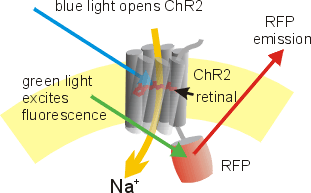 ChR2 absorbs blue light with an absorption and action spectrum
maximum at 480 nm. When the all-trans-retinal complex absorbs a photon
, it induces a conformational change from all-trans to 13-cis-retinal. This conformational change introduces a further conformational change in the transmembrane protein, opening the pore to at least 6Å. Within a few milliseconds, the retinal relaxes back to the all-trans form, closing the pore and stopping the flow of ions.
, electroporation
, gene gun
). The light absorbing pigment retinal is already present in most cells (of vertebrates) in the form of Vitamin A
. This makes depolarization
of excitable cells very straightforward, useful for many bioengineering and neuroscience applications such as photostimulation
of neurons for probing of neural circuits. The blue-light sensitive ChR2 and the yellow light-activated chloride pump halorhodopsin
together enable multiple-color optical activation and silencing of neural activity with millisecond precision. VChR1 form from the colonial alga Volvox carteri absorbs maximally at 535 nm and had been used to stimulate cells with yellow light (580 nm). The emerging field of controlling networks of genetically modified cells with light has been termed Optogenetics
.
Using fluorescently labeled ChR2, light-stimulated axons and synapses can be identified in intact brain tissue. This is useful to study the molecular events during the induction of synaptic plasticity
. ChR2 has also been used to map long-range connections from one side of the brain to the other, and to map the spatial location of specific inputs on the dendritic tree of individual neurons.
The behavior of transgenic animals expressing ChR2 in subpopulations of neurons can be remote-controlled by intense blue light. This has been demonstrated in nematodes, fruit flies, zebrafish, and in mice. Visual function in blind mice can be partially restored by expressing ChR2 in inner retinal cells. In the future, ChR2 might also find medical applications, e.g. in certain forms of retinal degeneration or for deep brain stimulation
.
Opsin
Opsins are a group of light-sensitive 35–55 kDa membrane-bound G protein-coupled receptors of the retinylidene protein family found in photoreceptor cells of the retina. Five classical groups of opsins are involved in vision, mediating the conversion of a photon of light into an electrochemical...
protein
Protein
Proteins are biochemical compounds consisting of one or more polypeptides typically folded into a globular or fibrous form, facilitating a biological function. A polypeptide is a single linear polymer chain of amino acids bonded together by peptide bonds between the carboxyl and amino groups of...
s that function as light-gated ion channel
Light-gated ion channel
Light-gated ion channels are a group of transmembrane proteins that form ion channels; pores which open or close in response to light. Most light-gated ion channels have been synthesized in the laboratory for study, though one naturally occurring example, Channelrhodopsin, is currently known...
s. They serve as sensory
Sensory
Sensory may refer to:relating to senses or smellIn biology:* Sensory preference* Sensory system, part of the nervous system of organisms* Sensory neuron, nerve cell responsible for transmitting information about external stimuli...
photoreceptor
Eyespot apparatus
The eyespot apparatus is a photoreceptive organelle found in the flagellate cells of green algae and other unicellular photosynthetic organisms such as euglenids. It allows the cells to sense light direction and intensity and respond to it by swimming either towards the light or away from the...
s in unicellular green algae
Green algae
The green algae are the large group of algae from which the embryophytes emerged. As such, they form a paraphyletic group, although the group including both green algae and embryophytes is monophyletic...
, controlling phototaxis
Phototaxis
Phototaxis is a kind of taxis, or locomotory movement, that occurs when a whole organism moves in response to the stimulus of light. This is advantageous for phototrophic organisms as they can orient themselves most efficiently to receive light for photosynthesis...
, i.e. movement in response to light. Expressed in cells of other organisms, they enable the use of light to control intracellular
Intracellular
Not to be confused with intercellular, meaning "between cells".In cell biology, molecular biology and related fields, the word intracellular means "inside the cell".It is used in contrast to extracellular...
acidity, calcium
Calcium
Calcium is the chemical element with the symbol Ca and atomic number 20. It has an atomic mass of 40.078 amu. Calcium is a soft gray alkaline earth metal, and is the fifth-most-abundant element by mass in the Earth's crust...
influx, electrical excitability
Membrane potential
Membrane potential is the difference in electrical potential between the interior and exterior of a biological cell. All animal cells are surrounded by a plasma membrane composed of a lipid bilayer with a variety of types of proteins embedded in it...
, and other cellular processes. Three channelrhodopsins are currently known: Channelrhodopsin-1 (ChR1), Channelrhodopsin-2 (ChR2), and Volvox Channelrhodopsin (VChR1). All known Channelrhodopsins are nonspecific cation channels, conducting H+, Na+, K+, and Ca2+ ions.
History
Channelrhodopsins were first discovered to be a single-component light-activated cation channel from the green algaeAlgae
Algae are a large and diverse group of simple, typically autotrophic organisms, ranging from unicellular to multicellular forms, such as the giant kelps that grow to 65 meters in length. They are photosynthetic like plants, and "simple" because their tissues are not organized into the many...
Chlamydomonas reinhardtii
Chlamydomonas reinhardtii
Chlamydomonas reinhardtii is a single celled green alga about 10 micrometres in diameter that swims with two flagella. They have a cell wall made of hydroxyproline-rich glycoproteins, a large cup-shaped chloroplast, a large pyrenoid, and an "eyespot" that senses light.Although widely distributed...
by Georg Nagel and Peter Hegemann in 2002. Channelrhodopsin-2 (ChR2), which was also isolated from Chlamydomonas reinhardtii
Chlamydomonas reinhardtii
Chlamydomonas reinhardtii is a single celled green alga about 10 micrometres in diameter that swims with two flagella. They have a cell wall made of hydroxyproline-rich glycoproteins, a large cup-shaped chloroplast, a large pyrenoid, and an "eyespot" that senses light.Although widely distributed...
, was similarly discovered by Peter Hegemann's group in 2001, and submitted directly to GenBank
GenBank
The GenBank sequence database is an open access, annotated collection of all publicly available nucleotide sequences and their protein translations. This database is produced and maintained by the National Center for Biotechnology Information as part of the International Nucleotide Sequence...
, before being characterized by Georg Nagel's group and discovered independently by John Spudich's group in 2002. In collaboration with Peter Hegemann, along with Ernst Bamberg and with Georg Nagel as first and corresponding author, it was demonstrated that channelrhodopsin-2 is also a directly light-gated ion channel like ChR1.
In 2005, three groups sequentially established ChR2 as a tool for genetically
Genetic engineering
Genetic engineering, also called genetic modification, is the direct human manipulation of an organism's genome using modern DNA technology. It involves the introduction of foreign DNA or synthetic genes into the organism of interest...
targeted optical remote control (optogenetics
Optogenetics
Optogenetics is the combination of genetic and optical methods to control specific events in targeted cells of living tissue, even within freely moving mammals and other animals, with the temporal precision needed to keep pace with functioning intact biological systems.In 2010, optogenetics was...
) of neuron
Neuron
A neuron is an electrically excitable cell that processes and transmits information by electrical and chemical signaling. Chemical signaling occurs via synapses, specialized connections with other cells. Neurons connect to each other to form networks. Neurons are the core components of the nervous...
s, neural circuits and behavior. At first, Karl Deisseroth's lab (in a paper published in August 2005) demonstrated that ChR2 could be deployed to control mammal
Mammal
Mammals are members of a class of air-breathing vertebrate animals characterised by the possession of endothermy, hair, three middle ear bones, and mammary glands functional in mothers with young...
ian neurons in vitro
In vitro
In vitro refers to studies in experimental biology that are conducted using components of an organism that have been isolated from their usual biological context in order to permit a more detailed or more convenient analysis than can be done with whole organisms. Colloquially, these experiments...
, achieving temporal precision on the order of milliseconds (both, in terms of delay to spiking, as well as in terms of temporal jitter). This was a significant finding, since firstly, all opsins (microbial as well as vertebrate) require retinal
Retinal
Retinal, also called retinaldehyde or vitamin A aldehyde, is one of the many forms of vitamin A . Retinal is a polyene chromophore, and bound to proteins called opsins, is the chemical basis of animal vision...
as the light-sensing co-factor, and it was unclear, if central mammalian nerve cells would contain sufficient retinal levels - but surprisingly, they do. Secondly, it showed despite the small single-channel conductance, sufficient potency to drive mammalian neurons above action potential threshold. Thirdly, it demonstrated channelrhodopsin to be the first optogenetic tool, with which neural activity could be controlled with the temporal precision at which neurons operate (a few milliseconds); an earlier tool for photostimulation, cHARGe, demonstrated proof of principle in cultured neurons but was never usable since it operated with a precision on the order of seconds, was highly variable, and did not allow control of individual action potential
Action potential
In physiology, an action potential is a short-lasting event in which the electrical membrane potential of a cell rapidly rises and falls, following a consistent trajectory. Action potentials occur in several types of animal cells, called excitable cells, which include neurons, muscle cells, and...
s.
Five months later (December 2005), a second study was published by Peter Hegemann's and Stefan Herlitze's groups confirming the ability of ChR2 to control the activity of vertebrate
Vertebrate
Vertebrates are animals that are members of the subphylum Vertebrata . Vertebrates are the largest group of chordates, with currently about 58,000 species described. Vertebrates include the jawless fishes, bony fishes, sharks and rays, amphibians, reptiles, mammals, and birds...
neurons, at this time in the chick spinal cord. This study was also the first, where ChR2 was expressed alongside an optical silencer, vertebrate rhodopsin
Rhodopsin
Rhodopsin, also known as visual purple, is a biological pigment of the retina that is responsible for both the formation of the photoreceptor cells and the first events in the perception of light. Rhodopsins belong to the G-protein coupled receptor family and are extremely sensitive to light,...
-4 in this case, demonstrating for the first time, that excitable cells could be activated and silenced using these two tools simultaneously, but illuminating the tissue at different wavelengths. In the same month, the groups of Alexander Gottschalk and Ernst Bamberg (with Georg Nagel taking the experimental lead) demonstrated that ChR2, if expressed in specific neurons or muscle cells, can evoke predictable behaviours, i.e. can control the nervous system of an intact animal, which in this case was the invertebrate C. elegans
Caenorhabditis elegans
Caenorhabditis elegans is a free-living, transparent nematode , about 1 mm in length, which lives in temperate soil environments. Research into the molecular and developmental biology of C. elegans was begun in 1974 by Sydney Brenner and it has since been used extensively as a model...
. This was the first study, using the remote control via ChR2 to steer the behaviour of an animal. And it was also the first study, that deployed ChR2 for an optogenetic experiment - i.e. that rendered genetically specified cell types subject to optical remote control, while the other two studies, did not specifically target ChR2 expression genetically. Although both aspects had been illustrated earlier that year by another group, the Miesenböck
Gero Miesenböck
Gero Miesenböck is Waynflete Professor of Physiology at the University of Oxford and a fellow of Magdalen College. A native of Austria, he received his M.D. from the University of Innsbruck and undertook postdoctoral training with James Rothman...
lab, deploying the indirectly light-gated ion channel P2X2, it was henceforth microbial opsins like channelrhodopsin that dominated the field of genetically targeted remote control of excitable cells, due to the power, speed, targetability, ease of use, and temporal precision of direct optical activation, not requiring any external chemical compound such as caged ligands.
To overcome its principle downsides - the small single-channel conductance (especially in steady-state), the fixation on one optimal excitation wavelength (~470 nm, blue) as well as the relatively long recovering time, not permitting controlled firing of neurons above 20–40 Hz - ChR2 has been optimized using genetic engineering
Genetic engineering
Genetic engineering, also called genetic modification, is the direct human manipulation of an organism's genome using modern DNA technology. It involves the introduction of foreign DNA or synthetic genes into the organism of interest...
: The first optimization involved the point mutation
Point mutation
A point mutation, or single base substitution, is a type of mutation that causes the replacement of a single base nucleotide with another nucleotide of the genetic material, DNA or RNA. Often the term point mutation also includes insertions or deletions of a single base pair...
H134R (exchanging the amino acid Histidine in position 134 of the native protein for an Arginine), and published in the same paper, that established ChR2 as an optogenetic tool in C. elegans. Further improvements were mainly carried by the close collaboration between the groups of Peter Hegemann and Karl Deisseroth. They included the introduction of the point mutation C128S, which made the resulting ChR2-derivative a step-function tool, that stays in the open state once "switched on" by blue light, until it is switched off by yellow light - a modification that deteriorates temporal precision, but greatly increases light sensitivity (by two orders of magnitude). One year later (2010) the same authors introduced another mutation into the native molecule, E123T, yielding the ChR2-derivative ChETA, which does not only feature a higher single-channel conductance (in the desensitized/steady state), but also a much faster on- and off-kinetics
Chemical kinetics
Chemical kinetics, also known as reaction kinetics, is the study of rates of chemical processes. Chemical kinetics includes investigations of how different experimental conditions can influence the speed of a chemical reaction and yield information about the reaction's mechanism and transition...
, permitting the control of individual action potentials at frequencies of at least up to 200 Hz (in appropriate cell types).
Even before these achievements, Roger Tsien's lab had also optimized ChR2 towards the same direction (higher steady-state conductance), by creating chimeras of ChR1 and ChR2 and mutating them at decisive amino acids, yielding the tools ChEF and ChIEF.
Finally, the groups of Hegemann and Deisseroth discovered VChR1 in the multicellular algae Volvox carteri, and thus provided a tool - comparable to ChR2 - but with a red-shifted absorption spectrum, thus allowing excitation of two distinct cell populations at two distinct wavelengths.
Karl Deisseroth's group has also taken the lead in developing optimal viral vectors for genetic targeting of ChR2 and its derivatives, thereby pioneering many optogenetic applications in actual experiments, alone or in collaboration, including the genetically targeted remote control in rodents in vivo
In vivo
In vivo is experimentation using a whole, living organism as opposed to a partial or dead organism, or an in vitro controlled environment. Animal testing and clinical trials are two forms of in vivo research...
, the optogenetic induction of learning in rodents, the experimental treatment of Parkinson's disease
Parkinson's disease
Parkinson's disease is a degenerative disorder of the central nervous system...
in rats, the combination with imaging (all-optical systems) and the combination with fMRI (opto-fMRI). Other labs have pioneered essential applications of ChR2 in paradigms such as the mapping of long-range and local neural circuits, its expression from a transgenic locus - directly or in the Cre-lox
Cre-Lox recombination
Cre-Lox recombination is a special type of site-specific recombination developed by Dr. Brian Sauer initially for use in activating gene expression in mammalian cell lines and transgenic mice . Subsequently, the laboratory of Dr...
conditional paradigm - as well as the two-photon
Two-photon excitation microscopy
Two-photon excitation microscopy is a fluorescence imaging technique that allows imaging of living tissue up to a very high depth, that is up to about one millimeter. Being a special variant of the multiphoton fluorescence microscope, it uses red-shifted excitation light which can also excite...
excitation of ChR2, permitting the activation of individual cells.
Structure
Structurally, channelrhodopsins are retinylidene proteinRetinylidene protein
Retinylidene proteins are a family of proteins that use retinal as chromophore for light reception. Proteins of this family are also called opsins...
s. They are seven-transmembrane proteins like rhodopsin
Rhodopsin
Rhodopsin, also known as visual purple, is a biological pigment of the retina that is responsible for both the formation of the photoreceptor cells and the first events in the perception of light. Rhodopsins belong to the G-protein coupled receptor family and are extremely sensitive to light,...
, and contain the light-isomerizable chromophore
Chromophore
A chromophore is the part of a molecule responsible for its color. The color arises when a molecule absorbs certain wavelengths of visible light and transmits or reflects others. The chromophore is a region in the molecule where the energy difference between two different molecular orbitals falls...
all-trans-retinal
Retinal
Retinal, also called retinaldehyde or vitamin A aldehyde, is one of the many forms of vitamin A . Retinal is a polyene chromophore, and bound to proteins called opsins, is the chemical basis of animal vision...
(an aldehyde
Aldehyde
An aldehyde is an organic compound containing a formyl group. This functional group, with the structure R-CHO, consists of a carbonyl center bonded to hydrogen and an R group....
derivative
Derivative (chemistry)
In chemistry, a derivative is a compound that is derived from a similar compound by some chemical or physical process. In the past it was also used to mean a compound that can be imagined to arise from another compound, if one atom is replaced with another atom or group of atoms, but modern...
of vitamin A
Vitamin A
Vitamin A is a vitamin that is needed by the retina of the eye in the form of a specific metabolite, the light-absorbing molecule retinal, that is necessary for both low-light and color vision...
). The retinal chromophore is covalently linked to the rest of the protein via a protonated Schiff base
Schiff base
A Schiff base, named after Hugo Schiff, is a compound with a functional group that contains a carbon-nitrogen double bond with the nitrogen atom connected to an aryl or alkyl group, not hydrogen....
. Whereas most 7-transmembrane proteins are G protein-coupled receptor
G protein-coupled receptor
G protein-coupled receptors , also known as seven-transmembrane domain receptors, 7TM receptors, heptahelical receptors, serpentine receptor, and G protein-linked receptors , comprise a large protein family of transmembrane receptors that sense molecules outside the cell and activate inside signal...
s that open other ion channels indirectly via second messenger
Second messenger system
Second messengers are molecules that relay signals from receptors on the cell surface to target molecules inside the cell, in the cytoplasm or nucleus. They relay the signals of hormones like epinephrine , growth factors, and others, and cause some kind of change in the activity of the cell...
s (i.e. they are metabotropic), channelrhodopsins directly form ion channels (i.e. they are ionotropic). This makes cellular depolarization extremely fast, robust, and useful for bioengineering and neuroscience applications, including photostimulation
Photostimulation
Photostimulation is the use of light to artificially activate biological compounds, cells, or even whole organisms. Photostimulation can be used to noninvasively probe the causal relationships between different biological processes, using only light...
.
Function
Action spectrum
An action spectrum is the rate of a physiological activity plotted against wavelength of light. It shows which wavelength of light is most effectively used in a specific chemical reaction. Some reactants are able to use specific wavelengths of light more effectively to complete their reactions...
maximum at 480 nm. When the all-trans-retinal complex absorbs a photon
Photon
In physics, a photon is an elementary particle, the quantum of the electromagnetic interaction and the basic unit of light and all other forms of electromagnetic radiation. It is also the force carrier for the electromagnetic force...
, it induces a conformational change from all-trans to 13-cis-retinal. This conformational change introduces a further conformational change in the transmembrane protein, opening the pore to at least 6Å. Within a few milliseconds, the retinal relaxes back to the all-trans form, closing the pore and stopping the flow of ions.
Designer-Channelrhodopsins
The C-terminal end of Channelrhodopsin-2 extends into the intracellular space and can be replaced by fluorescent proteins without affecting channel function. This kind of fusion construct can be very useful to visualize the morphology of ChR2 expressing cells. Channel kinetics can be modified by point mutations close to the retinal binding pocket. For example, closing of the channel after optical activation can be substantially delayed by mutating a specific protein residue, C128. This modification results in a super-sensitive Channelrhodopsin that can be opened by a blue light pulse and closed by a green or yellow light pulse. Mutating the E123 residue accelerates channel kinetics, and the resulting ChR2 mutants have been used to spike neurons at up to 200 Hz. T159 mutants display increased photocurrents, and a combination of T159 and E123 (ET/TC) is both faster and more powerful than the original ChR2. In the future, directed molecular engineering might also be applied to develop channelrhodopsins with altered spectral sensitivity.Applications
Channelrhodopsins can be readily expressed in excitable cells such as neurons using a variety of transfection techniques (viral transfectionTransfection
Transfection is the process of deliberately introducing nucleic acids into cells. The term is used notably for non-viral methods in eukaryotic cells...
, electroporation
Electroporation
Electroporation, or electropermeabilization, is a significant increase in the electrical conductivity and permeability of the cell plasma membrane caused by an externally applied electrical field...
, gene gun
Gene gun
A gene gun or a biolistic particle delivery system, originally designed for plant transformation, is a device for injecting cells with genetic information. The payload is an elemental particle of a heavy metal coated with plasmid DNA...
). The light absorbing pigment retinal is already present in most cells (of vertebrates) in the form of Vitamin A
Vitamin A
Vitamin A is a vitamin that is needed by the retina of the eye in the form of a specific metabolite, the light-absorbing molecule retinal, that is necessary for both low-light and color vision...
. This makes depolarization
Depolarization
In biology, depolarization is a change in a cell's membrane potential, making it more positive, or less negative. In neurons and some other cells, a large enough depolarization may result in an action potential...
of excitable cells very straightforward, useful for many bioengineering and neuroscience applications such as photostimulation
Photostimulation
Photostimulation is the use of light to artificially activate biological compounds, cells, or even whole organisms. Photostimulation can be used to noninvasively probe the causal relationships between different biological processes, using only light...
of neurons for probing of neural circuits. The blue-light sensitive ChR2 and the yellow light-activated chloride pump halorhodopsin
Halorhodopsin
Halorhodopsin is a light-driven ion pump, specific for chloride ions, and found in phylogenetically ancient archaea, known as halobacteria...
together enable multiple-color optical activation and silencing of neural activity with millisecond precision. VChR1 form from the colonial alga Volvox carteri absorbs maximally at 535 nm and had been used to stimulate cells with yellow light (580 nm). The emerging field of controlling networks of genetically modified cells with light has been termed Optogenetics
Optogenetics
Optogenetics is the combination of genetic and optical methods to control specific events in targeted cells of living tissue, even within freely moving mammals and other animals, with the temporal precision needed to keep pace with functioning intact biological systems.In 2010, optogenetics was...
.
Using fluorescently labeled ChR2, light-stimulated axons and synapses can be identified in intact brain tissue. This is useful to study the molecular events during the induction of synaptic plasticity
Synaptic plasticity
In neuroscience, synaptic plasticity is the ability of the connection, or synapse, between two neurons to change in strength in response to either use or disuse of transmission over synaptic pathways. Plastic change also results from the alteration of the number of receptors located on a synapse...
. ChR2 has also been used to map long-range connections from one side of the brain to the other, and to map the spatial location of specific inputs on the dendritic tree of individual neurons.
The behavior of transgenic animals expressing ChR2 in subpopulations of neurons can be remote-controlled by intense blue light. This has been demonstrated in nematodes, fruit flies, zebrafish, and in mice. Visual function in blind mice can be partially restored by expressing ChR2 in inner retinal cells. In the future, ChR2 might also find medical applications, e.g. in certain forms of retinal degeneration or for deep brain stimulation
Deep brain stimulation
Deep brain stimulation is a surgical treatment involving the implantation of a medical device called a brain pacemaker, which sends electrical impulses to specific parts of the brain...
.
Further reading
(Using channelrhodopsin in transgenic mice to study brain circuitry) (Using channelrhodopsin potentially to treat blindness)External links
- OpenOptogenetics.org, a comprehensive wiki about optogenetics.
- Optogenetics Resource Center / Deisseroth lab
- Boyden lab
- Hires' blog on optical tools for brain research
- Lab of Zhuo-Hua Pan