
Two-photon excitation microscopy is a
fluorescenceFluorescence is the emission of visible light by a substance that has absorbed light of a differing, usually invisible, wavelength. Absorption of a photon triggers the emission of a photon with a longer wavelength. A shorter wavelength emission is sometimes observed from multiple photon absorption...
imaging technique that allows imaging living tissue up to a depth of one millimeter. The two-photon excitation
microscopeA microscope is an instrument to see objects too tiny for the naked eye. The science of investigating small objects using such an instrument is called microscopy. Microscopic means invisible to the eye unless aided by a microscope.-History:An early microscope was made in 1590 in Middelburg, The...
is a special variant of the
multiphoton fluorescence microscope-Description:The MFM uses pulsed long-wavelength light to excite fluorophores within the specimen being observed. The fluorophore absorbs the energy from two long-wavelength photons which must arrive simultaneously in order to excite an electron into a higher energy state, from which it can decay,...
. Two-photon excitation can be a superior alternative to
confocal microscopyConfocal microscopy is an optical imaging technique used to increase micrograph contrast and/or to reconstruct three-dimensional images by using a spatial pinhole to eliminate out-of-focus light in specimens that are thicker than the focal plane...
due to its deeper tissue penetration, efficient light detection and reduced phototoxicity.
Two-photon excitation employs a concept first described by Maria Goeppert-Mayer (1906-1972) in her 1931 doctoral dissertation., and first observed in 1962 in cesium vapor using laser excitation by
Isaac AbellaIsaac David Abella is Professor of Physics at The University of Chicago. He specializes in laser physics, quantum optics, and spectroscopy. Isaac is the cousin of Irving Abella....
The concept of two-photon excitation is based on the idea that two
photonIn physics, a photon is an elementary particle, the quantum of the electromagnetic field and the basic "unit" of light and all other forms of electromagnetic radiation. It is also the force carrier for the electromagnetic force...
s of low energy can excite a
fluorophoreA fluorophore, in analogy to a chromophore, is a component of a molecule which causes a molecule to be fluorescent. It is a functional group in a molecule which will absorb energy of a specific wavelength and re-emit energy at a different wavelength...
in a quantum event, resulting in the emission of a fluorescence photon, typically at a higher energy than either of the two excitatory photons.
Two-photon excitation microscopy is a
fluorescenceFluorescence is the emission of visible light by a substance that has absorbed light of a differing, usually invisible, wavelength. Absorption of a photon triggers the emission of a photon with a longer wavelength. A shorter wavelength emission is sometimes observed from multiple photon absorption...
imaging technique that allows imaging living tissue up to a depth of one millimeter. The two-photon excitation
microscopeA microscope is an instrument to see objects too tiny for the naked eye. The science of investigating small objects using such an instrument is called microscopy. Microscopic means invisible to the eye unless aided by a microscope.-History:An early microscope was made in 1590 in Middelburg, The...
is a special variant of the
multiphoton fluorescence microscope-Description:The MFM uses pulsed long-wavelength light to excite fluorophores within the specimen being observed. The fluorophore absorbs the energy from two long-wavelength photons which must arrive simultaneously in order to excite an electron into a higher energy state, from which it can decay,...
. Two-photon excitation can be a superior alternative to
confocal microscopyConfocal microscopy is an optical imaging technique used to increase micrograph contrast and/or to reconstruct three-dimensional images by using a spatial pinhole to eliminate out-of-focus light in specimens that are thicker than the focal plane...
due to its deeper tissue penetration, efficient light detection and reduced phototoxicity.
Two-photon excitation employs a concept first described by Maria Goeppert-Mayer (1906-1972) in her 1931 doctoral dissertation., and first observed in 1962 in cesium vapor using laser excitation by
Isaac AbellaIsaac David Abella is Professor of Physics at The University of Chicago. He specializes in laser physics, quantum optics, and spectroscopy. Isaac is the cousin of Irving Abella....
The concept of two-photon excitation is based on the idea that two
photonIn physics, a photon is an elementary particle, the quantum of the electromagnetic field and the basic "unit" of light and all other forms of electromagnetic radiation. It is also the force carrier for the electromagnetic force...
s of low energy can excite a
fluorophoreA fluorophore, in analogy to a chromophore, is a component of a molecule which causes a molecule to be fluorescent. It is a functional group in a molecule which will absorb energy of a specific wavelength and re-emit energy at a different wavelength...
in a quantum event, resulting in the emission of a fluorescence photon, typically at a higher energy than either of the two excitatory photons. The probability of the near-simultaneous absorption of two photons is extremely low. Therefore a high
fluxIn the various subfields of physics, there exist two common usages of the term flux, both with rigorous mathematical frameworks.* In the study of transport phenomena , flux is defined as the amount that flows through a unit area per unit time...
of excitation photons is typically required, usually a femtosecond
laserA laser is a device that emits light through a process called stimulated emission. Laser light is usually spatially coherent, which means that the light either is emitted in a narrow, low-divergence beam, or can be converted into one with the help of optical components such as lenses...
.
Two-photon
microscopyMicroscopy is the technical field of using microscopes to view samples or objects. There are three well-known branches of microscopy, optical, electron and scanning probe microscopy....
was pioneered by
Winfried Denk Winfried Denk is a German physicist and neurobiologist. He is noted for being the first to implement two-photon microscopy, a breakthrough in fluorescent microscopy.-External links:*...
in the lab of
Watt W. WebbWatt W. Webb is known for his co-invention of Multiphoton Microscopy in 1990.- Biography :Professor Watt W...
at
Cornell UniversityCornell University is a private university located in Ithaca, New York, USA, that is a member of the Ivy League.Cornell counts more than 255,000 living alumni, 28 Rhodes Scholars and 41 Nobel laureates affiliated with the university as faculty or students...
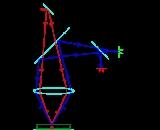
. He combined the idea of two-photon absorption with the use of a laser scanner. In two-photon excitation microscopy an infrared laser beam is focused through an objective lens. The
Ti-sapphire laserTi:sapphire lasers are tunable lasers which emit red and near-infrared light in the range from 650 to 1100 nanometers. These lasers are mainly used in scientific research because of their tunability and their ability to generate ultrashort pulses...
normally used has a pulse width of approximately 100 femtoseconds and a repetition rate of about 80 MHz, allowing the high photon density and flux required for two photons absorption and is tunable across a wide range of wavelengths. Two-photon technology has been
patentA patent is a set of exclusive rights granted by a state to an inventor or their assignee for a limited period of time in exchange for a public disclosure of an invention....
ed by Winfried Denk, James Strickler and Watt Webb at Cornell University. Carl Zeiss currently holds this patent; Olympus Inc. has licensed it to sell 2-photon microscopes.

The most commonly used fluorophores have excitation spectra in the 400–500 nm range, whereas the laser used to excite the fluorophores lies in the ~700–1000 nm (infrared) range. If the fluorophore absorbs two infrared photons simultaneously, it will absorb enough energy to be raised into the excited state. The fluorophore will then emit a single photon with a wavelength that depends on the type of fluorophore used (typically in the visible spectrum). Because two photons need to be absorbed to excite a fluorophore, the probability for fluorescent emission from the fluorophores increases quadratically with the excitation intensity. Therefore, much more two-photon fluorescence is generated where the laser beam is tightly focused than where it is more diffuse. Effectively, excitation is restricted to the tiny focal volume (~1 femtoliter), resulting in a high degree of rejection of out-of-focus objects. This
localization of excitation is the key advantage compared to single-photon excitation microscopes, which need to employ additional elements such as pinholes to reject out-of-focus fluorescence. The fluorescence from the sample is then collected by a high-sensitivity detector, such as a
photomultiplierPhotomultiplier tubes , members of the class of vacuum tubes, and more specifically phototubes, are extremely sensitive detectors of light in the ultraviolet, visible, and near-infrared ranges of the electromagnetic spectrum...
tube. This observed light intensity becomes one
pixelIn digital imaging, a pixel is the smallest item of information in an image. Pixels are normally arranged in a 2-dimensional grid, and are often represented using dots or squares. Each pixel is a sample of an original image, where more samples typically provide more-accurate representations of the...
in the eventual image; the focal point is scanned throughout a desired region of the sample to form all the pixels of the image.
The use of infrared light to excite fluorophores in light-scattering tissue has added benefits. Longer wavelengths are scattered to a lesser degree than shorter ones, which is a benefit to high-resolution imaging. In addition, these lower-energy photons are less likely to cause damage outside the focal volume. Compared to a confocal microscope, photon detection is much more effective since even scattered photons contribute to the usable signal. There are several caveats to using two-photon microscopy: The pulsed lasers needed for two-photon excitation are much more expensive then the constant wave (CW) lasers used in confocal microscopy. The two-photon absorption spectrum of a molecule may vary significantly from its one-photon counterpart. For very thin objects such as isolated cells, single-photon (confocal) microscopes can produce images with higher
optical resolutionOptical resolution describes the ability of an imaging system to resolve detail in the object that is being imaged.An imaging system may have many individual components including a lens and recording and display components...
due to their shorter excitation wavelengths. In scattering tissue, on the other hand, the superior optical sectioning and light detection capabilities of the two-photon microscope result in better performance.
Higher-order excitation
Simultaneous absorption of three or more photons is also possible, allowing for three-photon or multiphoton excitation microscopy.
See also
- 3D optical data storage
3D optical data storage is the term given to any form of optical data storage in which information can be recorded and/or read with three dimensional resolution ....
- Nonlinear optics
Nonlinear optics is the branch of optics that describes the behaviour of light in nonlinear media, that is, media in which the dielectric polarization P responds nonlinearly to the electric field E of the light. This nonlinearity is typically only observed at very high light intensities such as...
- Two-photon absorption
Two photon absorption is the simultaneous absorption of two photons of identical or different frequencies in order to excite a molecule from one state to a higher energy electronic state. The energy difference between the involved lower and upper states of the molecule is equal to the sum of the...
- Second harmonic imaging microscopy
Second harmonic imaging microscopy is based on a nonlinear optical effect known as second harmonic generation . SHIM has been established as a viable microscope imaging contrast mechanism for visualization of cell and tissue structure and function...
External links