
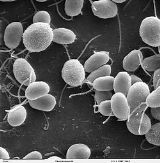
Chlamydomonas reinhardtii is a
single celledA unicellular organism, also known as a single-celled organism is an organism that consists of only one cell, in contrast to a multicellular organism that consists of multiple cells. Historically simple single celled organisms have sometimes been referred to as monads Prokaryotes, most protists,...
green alga about 10
micrometreA micrometer , is by definition 1×10⁻⁶ of a meter .In plain English, it means one-millionth of a meter . Its unit symbol in the International System of Units is μm...
s in diameter that swims with two flagella. They have a
cell wallThe cell wall is the tough, usually flexible but sometimes fairly rigid layer that surrounds some types of cells. It is located outside the cell membrane and provides these cells with structural support and protection, and also acts as a filtering mechanism. A major function of the cell wall is to...
made of hydroxyproline-rich glycoproteins, a large cup-shaped
chloroplastChloroplasts are organelles found in plant cells and other eukaryotic organisms that conduct photosynthesis. Chloroplasts capture light energy to conserve free energy in the form of ATP and reduce NADP to NADPH through a complex set of processes called photosynthesis.Chloroplasts are green...
, a large
pyrenoidIn cell biology, pyrenoids are organelles, centers of carbon dioxide fixation within the chloroplasts of algae and hornworts. Pyrenoids are not membrane-bound, but specialized areas of the plastid that contain high levels of ribulose-1,5-bisphosphate carboxylase/oxygenase .RubisCO fixes carbon...
, and an "eyespot" that senses light.
Although widely distributed worldwide in soil and fresh water,
C. reinhardtii is primarily used as a
model organismA model organism is a non-human species that is extensively studied to understand particular biological phenomena, with the expectation that discoveries made in the organism model will provide insight into the workings of other organisms. Model organisms are in vivo models and are widely used to...
in biology in a wide range of subfields. When illuminated,
C. reinhardtii can grow in medium lacking carbon and energy sources, and can also grow in the dark when supplied with these.
C. reinhardtii is also of interest in the biofuel field, as a source of hydrogen.
History
The
C. reinhardtii wild type laboratory strain c137 (mt+) originates from an isolate made near
Amherst, MassachusettsAmherst is a town in Hampshire County, Massachusetts, United States in the Connecticut River valley. As of the 2010 census, the population was 37,819, making it the largest community in Hampshire County . The town is home to Amherst College, Hampshire College, and the University of Massachusetts...
, in 1945 by Gilbert M. Smith.
The species has been spelled several different ways because of different transliterations of the name from Russian:
reinhardi,
reinhardii and
reinhardtii all refer to the same species,
C. reinhardtii Dangeard.
Model organism
Chlamydomonas is used as a
model organismA model organism is a non-human species that is extensively studied to understand particular biological phenomena, with the expectation that discoveries made in the organism model will provide insight into the workings of other organisms. Model organisms are in vivo models and are widely used to...
for research on fundamental questions in
cellThe cell is the basic structural and functional unit of all known living organisms. It is the smallest unit of life that is classified as a living thing, and is often called the building block of life. The Alberts text discusses how the "cellular building blocks" move to shape developing embryos....
and
molecular biologyMolecular biology is the branch of biology that deals with the molecular basis of biological activity. This field overlaps with other areas of biology and chemistry, particularly genetics and biochemistry...
such as:
- How do cells move?
- How do cells respond to light?
- How do cells recognize one another?
- How do cells regulate their proteome to control flagellar
A flagellum is a tail-like projection that protrudes from the cell body of certain prokaryotic and eukaryotic cells, and plays the dual role of locomotion and sense organ, being sensitive to chemicals and temperatures outside the cell. There are some notable differences between prokaryotic and...
length?
- How do cells respond to changes in mineral nutrition? (nitrogen, sulfur etc.)
There are many known mutants of
C. reinhardtii. These mutants are useful tools for studying a variety of biological processes, including flagellar motility,
photosynthesisPhotosynthesis is a chemical process that converts carbon dioxide into organic compounds, especially sugars, using the energy from sunlight. Photosynthesis occurs in plants, algae, and many species of bacteria, but not in archaea. Photosynthetic organisms are called photoautotrophs, since they can...
or protein synthesis. Since
Chlamydomonas species are normally haploid, the effects of mutations are seen immediately without further crosses.
In 2007, the complete nuclear genome sequence of
C. reinhardtii was published.
ChannelrhodopsinChannelrhodopsins are a subfamily of opsin proteins that function as light-gated ion channels. They serve as sensory photoreceptors in unicellular green algae, controlling phototaxis, i.e. movement in response to light. Expressed in cells of other organisms, they enable the use of light to control...
-2, a
proteinProteins are biochemical compounds consisting of one or more polypeptides typically folded into a globular or fibrous form, facilitating a biological function. A polypeptide is a single linear polymer chain of amino acids bonded together by peptide bonds between the carboxyl and amino groups of...
that functions as a
light-gated cation channelLight-gated ion channels are a group of transmembrane proteins that form ion channels; pores which open or close in response to light. Most light-gated ion channels have been synthesized in the laboratory for study, though one naturally occurring example, Channelrhodopsin, is currently known...
, was originally isolated from
C. reinhardtii.
Reproduction
Vegetative cells of the
reinhardtii species are haploid with 17 small chromosomes. Under
nitrogenNitrogen is a chemical element that has the symbol N, atomic number of 7 and atomic mass 14.00674 u. Elemental nitrogen is a colorless, odorless, tasteless, and mostly inert diatomic gas at standard conditions, constituting 78.08% by volume of Earth's atmosphere...
starvation, haploid
gameteA gamete is a cell that fuses with another cell during fertilization in organisms that reproduce sexually...
s develop. There are two
mating typeMating types occur in eukaryotes that undergo sexual reproduction via isogamy. Since the gametes of different mating types look alike, they are often referred to by numbers, letters, or simply "+" and "-" instead of "male" and "female." Mating can only take place between different mating...
s, identical in appearance and known as
mt(+) and
mt(-), which can fuse to form a diploid
zygoteA zygote , or zygocyte, is the initial cell formed when two gamete cells are joined by means of sexual reproduction. In multicellular organisms, it is the earliest developmental stage of the embryo...
. The zygote is not flagellated, and it serves as a dormant form of the species in the soil. In the light the zygote undergoes
meiosisMeiosis is a special type of cell division necessary for sexual reproduction. The cells produced by meiosis are gametes or spores. The animals' gametes are called sperm and egg cells....
and releases four flagellated haploid cells that resume the vegetative life cycle.
Under ideal growth conditions, cells may sometimes undergo two or three rounds of
mitosisMitosis is the process by which a eukaryotic cell separates the chromosomes in its cell nucleus into two identical sets, in two separate nuclei. It is generally followed immediately by cytokinesis, which divides the nuclei, cytoplasm, organelles and cell membrane into two cells containing roughly...
before the daughter cells are released from the old cell wall into the medium. Thus, a single growth step may result in 4 or 8 daughter cells per mother cell.
The cell cycle of this unicellular green algae can be synchronized by alternating periods of light and dark. The growth phase is dependent on light, whereas, after a point designated as the transition or commitment point, processes are light-independent.
Genetics
The attractiveness of the alga as a model organism has recently increased with the release of several genomic resources to the public domain. The Chlre3 draft of the
Chlamydomonas nuclear genome sequence prepared by Joint Genome Institute of the U.S. Dept of Energy comprises 1557 scaffolds totaling 120 Mb. Roughly half of the genome is contained in 24 scaffolds all at least 1.6 Mb in length. The current assembly of the nuclear genome is available online.
The ~15.8 Kb mitochondrial genome (database accession: NC_ 001638) is available online at the NCBI database. The complete >200 Kb chloroplast genome is available online.
In addition to genomic sequence data there is a large supply of expression sequence data available as cDNA libraries and expressed sequence tags (ESTs). Seven cDNA libraries are available online. A BAC library can be purchased from the Clemson University Genomics Institute. There are also two databases of >50 000 and >160 000 ESTs available online.
Evolution
Chlamydomonas has been used to study different aspects of evolutionary biology and ecology. It is an organism of choice for many selection experiments because (1) it has a short generation time, (2) it is both a
heterotrophA heterotroph is an organism that cannot fix carbon and uses organic carbon for growth. This contrasts with autotrophs, such as plants and algae, which can use energy from sunlight or inorganic compounds to produce organic compounds such as carbohydrates, fats, and proteins from inorganic carbon...
and facultative
autotrophAn autotroph, or producer, is an organism that produces complex organic compounds from simple inorganic molecules using energy from light or inorganic chemical reactions . They are the producers in a food chain, such as plants on land or algae in water...
, (3) it can reproduce both sexually and asexually, and (4) there is a wealth of genetic information already available.
Some examples (non exhaustive) of evolutionary work done with
Chlamydomonas include the evolution of sexual reproduction, the fitness effect of mutations, and the effect of adaptation to different levels of CO
2.
DNA transformation techniques
Gene transformation occurs mainly by homologous recombination in the chloroplast and heterologous recombination in the nucleus. The
C. reinhardtii chloroplast genome can be transformed using microprojectile particle bombardment and the nuclear genome has been transformed with both glass bead agitation and electroporation. The biolistic procedure appears to be the most efficient way of introducing DNA into the chloroplast genome. This is probably because the chloroplast occupies over half of the volume of the cell providing the microprojectile with a large target. Electroporation has been shown to be the most efficient way of introducing DNA into the nuclear genome with maximum transformation frequencies two orders of magnitude higher than obtained using glass bead method.
Clean source of hydrogen production
In 1939 the German researcher
Hans GaffronDr. Hans Gaffron is born in Lima, Peru, on May 17, 1902, as the son of the German physician Eduard Gaffron and his wife Hedwig von Gevekot....
(1902–1979), who was at that time attached to the University of Chicago, discovered the hydrogen metabolism of unicellular green algae.
Chlamydomonas reinhardtii and some other green algae can, under specified circumstances, stop producing oxygen and convert instead to the production of hydrogen. This reaction by
hydrogenaseA hydrogenase is an enzyme that catalyses the reversible oxidation of molecular hydrogen . Hydrogenases play a vital role in anaerobic metabolism....
, an
enzymeEnzymes are proteins that catalyze chemical reactions. In enzymatic reactions, the molecules at the beginning of the process, called substrates, are converted into different molecules, called products. Almost all chemical reactions in a biological cell need enzymes in order to occur at rates...
only active in the absence of oxygen, is short-lived. Over the next thirty years Gaffron and his team worked out the basic mechanics of this photosynthetic hydrogen production by algae.
To increase the production of hydrogen, two tracks are being followed by the researchers.
- The first track is decoupling hydrogenase from photosynthesis. This way, oxygen accumulation can no longer inhibit the production of hydrogen. And, if one goes one step further by changing the structure of the enzyme hydrogenase, it becomes possible to render hydrogenase insensitive to oxygen. This makes a continuous production of hydrogen possible. The flux of electrons needed for this production comes, in this case, no longer from the production of sugars, but is drawn from the breakdown of its own stock of starch
Starch or amylum is a carbohydrate consisting of a large number of glucose units joined together by glycosidic bonds. This polysaccharide is produced by all green plants as an energy store...
.
- A second track is to interrupt temporarily, through genetic manipulation of hydrogenase, the photosynthesis process. This inhibits oxygen reaching a level where it is able to stop the production of hydrogen.
Further reading
Aoyama, H., Kuroiwa, T. and Nakamura, S. 2009. The dynamic behaviour of mitochondria in living zygotes during maturation and meiosis in
Chlamydomonas reinhardtii.
Eur. J. Phycol.
44: 497 - 507.
Jamers, A., Lenjou, M., Deraedt, P., van Bockstaele, D., Blust, R. and de Coen, W. 2009. Flow cytometric analysis of the cadmium-exposed green algae
Chlamydomonas reinhadtii (Chlorophyceae).
Eur. J. Phcol.
44: 54 - 550.
External links