


Colen Campbell

Encyclopedia
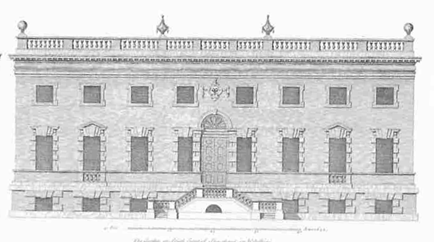
Scotland
Scotland is a country that is part of the United Kingdom. Occupying the northern third of the island of Great Britain, it shares a border with England to the south and is bounded by the North Sea to the east, the Atlantic Ocean to the north and west, and the North Channel and Irish Sea to the...
architect who spent most of his career in England
England
England is a country that is part of the United Kingdom. It shares land borders with Scotland to the north and Wales to the west; the Irish Sea is to the north west, the Celtic Sea to the south west, with the North Sea to the east and the English Channel to the south separating it from continental...
, and is credited as a founder of the Georgian
Georgian architecture
Georgian architecture is the name given in most English-speaking countries to the set of architectural styles current between 1720 and 1840. It is eponymous for the first four British monarchs of the House of Hanover—George I of Great Britain, George II of Great Britain, George III of the United...
style. A descendent of the Campbell
Campbell
-Places:In Australia:* Campbell, Australian Capital Territory, a suburb of Canberra, AustraliaIn Canada:* Campbell, Nova Scotia, on Cape Breton Island Nova Scotia* Campbell Road, Edmonton, AlbertaIn New Zealand:...
s of Cawdor Castle
Cawdor Castle
Cawdor Castle is a tower house set amid gardens in the parish of Cawdor, approximately 10 miles east of Inverness and 5 miles southwest of Nairn in Scotland, United Kingdom. It belonged to the Clan Calder. It still serves as home to the Dowager Countess Cawdor, stepmother of Colin Robert Vaughan...
, he is believed to be the Colinus Campbell who graduated from the University of Edinburgh
University of Edinburgh
The University of Edinburgh, founded in 1583, is a public research university located in Edinburgh, the capital of Scotland, and a UNESCO World Heritage Site. The university is deeply embedded in the fabric of the city, with many of the buildings in the historic Old Town belonging to the university...
in July 1695, he initially trained as a lawyer, being admitted to the Bar and to the Faculty of Graduates on the 29th July 1702. He had travelled in Italy
Italy
Italy , officially the Italian Republic languages]] under the European Charter for Regional or Minority Languages. In each of these, Italy's official name is as follows:;;;;;;;;), is a unitary parliamentary republic in South-Central Europe. To the north it borders France, Switzerland, Austria and...
from 1695–1702 and is believed to be the Colinus Campbell who signed the visitor's book at the University of Padua
University of Padua
The University of Padua is a premier Italian university located in the city of Padua, Italy. The University of Padua was founded in 1222 as a school of law and was one of the most prominent universities in early modern Europe. It is among the earliest universities of the world and the second...
in 1697. He is believed to have trained in and studied architecture
Architecture
Architecture is both the process and product of planning, designing and construction. Architectural works, in the material form of buildings, are often perceived as cultural and political symbols and as works of art...
under James Smith
James Smith (architect)
James Smith was a Scottish architect, who pioneered the Palladian style in Scotland. He was described by Colen Campbell, in his Vitruvius Britannicus , as "the most experienced architect of that kingdom".-Biography:...
, this belief is strengthened by Campbell owning several drawings of buildings designed by Smith.
Vitruvius Britannicus
His major published work, Vitruvius Britannicus, or the British Architect... appeared in three volumes between 1715 and 1725. (Further volumes using the successful title were assembled by Woolfe and GandonJames Gandon
James Gandon is today recognised as one of the leading architects to have worked in Ireland in the late 18th century and early 19th century. His better known works include The Custom House, the Four Courts, King's Inns in Dublin and Emo Court in Co...
, and published in 1767 and 1771.) Vitruvius Britannicus was the first architectural work to originate in England since John Shute
John Shute
John Shute was an English artist and architect. His book, The First and Chief Grounds of Architecture, was the first work in English on classical architecture. Shute's patron was John Dudley, 1st Duke of Northumberland, for whom he built a residential wing at Dudley Castle.- References :*Morris,...
's Elizabethan First Groundes. In the empirical
Empiricism
Empiricism is a theory of knowledge that asserts that knowledge comes only or primarily via sensory experience. One of several views of epistemology, the study of human knowledge, along with rationalism, idealism and historicism, empiricism emphasizes the role of experience and evidence,...
vein, it was not a treatise
Treatise
A treatise is a formal and systematic written discourse on some subject, generally longer and treating it in greater depth than an essay, and more concerned with investigating or exposing the principles of the subject.-Noteworthy treatises:...
but basically a catalogue of design
Design
Design as a noun informally refers to a plan or convention for the construction of an object or a system while “to design” refers to making this plan...
, containing engraving
Engraving
Engraving is the practice of incising a design on to a hard, usually flat surface, by cutting grooves into it. The result may be a decorated object in itself, as when silver, gold, steel, or glass are engraved, or may provide an intaglio printing plate, of copper or another metal, for printing...
s of English buildings by Inigo Jones
Inigo Jones
Inigo Jones is the first significant British architect of the modern period, and the first to bring Italianate Renaissance architecture to England...
and Sir Christopher Wren
Christopher Wren
Sir Christopher Wren FRS is one of the most highly acclaimed English architects in history.He used to be accorded responsibility for rebuilding 51 churches in the City of London after the Great Fire in 1666, including his masterpiece, St. Paul's Cathedral, on Ludgate Hill, completed in 1710...
, as well as Campbell himself and other prominent architects of the era.
In the introduction that he appended and in the brief descriptions, Campbell belaboured the "excesses" of Baroque
Baroque
The Baroque is a period and the style that used exaggerated motion and clear, easily interpreted detail to produce drama, tension, exuberance, and grandeur in sculpture, painting, literature, dance, and music...
style and declared British independence from foreigners while he dedicated the volume to Hanoverian
House of Hanover
The House of Hanover is a deposed German royal dynasty which has ruled the Duchy of Brunswick-Lüneburg , the Kingdom of Hanover, the Kingdom of Great Britain, the Kingdom of Ireland and the United Kingdom of Great Britain and Ireland...
George I
George I of Great Britain
George I was King of Great Britain and Ireland from 1 August 1714 until his death, and ruler of the Duchy and Electorate of Brunswick-Lüneburg in the Holy Roman Empire from 1698....
. The third volume (1725) has several grand layouts of gardens and parks, with straight allées, for courts and patterned parterre
Parterre
A parterre is a formal garden construction on a level surface consisting of planting beds, edged in stone or tightly clipped hedging, and gravel paths arranged to form a pleasing, usually symmetrical pattern. Parterres need not have any flowers at all...
s and radiating rides through wooded plantation
Plantation
A plantation is a long artificially established forest, farm or estate, where crops are grown for sale, often in distant markets rather than for local on-site consumption...
s, in a Baroque manner that was rapidly becoming old-fashioned.
Buildings were shown in plan, section and elevation, but also some were in a bird's-eye perspective. The drawings and designs contained in the book were under way before Campbell was drawn into the speculative scheme. The success of the volumes was instrumental in popularising neo-Palladian Architecture
Palladian architecture
Palladian architecture is a European style of architecture derived from the designs of the Venetian architect Andrea Palladio . The term "Palladian" normally refers to buildings in a style inspired by Palladio's own work; that which is recognised as Palladian architecture today is an evolution of...
in Great Britain and America during the 18th century. For example, Plate 16 of Vitruvius Britannicus, a rendering of Somerset House in London, was an inspiration for American architect Peter Harrison when he designed the Brick Market in Newport, Rhode Island, in 1761.
Campbell was influenced as a young man by James Smith
James Smith (architect)
James Smith was a Scottish architect, who pioneered the Palladian style in Scotland. He was described by Colen Campbell, in his Vitruvius Britannicus , as "the most experienced architect of that kingdom".-Biography:...
(ca 1645 - 1731), the pre-eminent Scots architect of his day, and an early neo-Palladian whom Campbell called "the most experienced architect" of Scotland (Vitruvius Britannicus, ii).
The somewhat promotional volume, with its excellently rendered engravings, came at a propitious moment at the beginning of a boom in country house and villa
Villa
A villa was originally an ancient Roman upper-class country house. Since its origins in the Roman villa, the idea and function of a villa have evolved considerably. After the fall of the Roman Republic, villas became small farming compounds, which were increasingly fortified in Late Antiquity,...
building among the Whig
British Whig Party
The Whigs were a party in the Parliament of England, Parliament of Great Britain, and Parliament of the United Kingdom, who contested power with the rival Tories from the 1680s to the 1850s. The Whigs' origin lay in constitutional monarchism and opposition to absolute rule...
oligarchy
Oligarchy
Oligarchy is a form of power structure in which power effectively rests with an elite class distinguished by royalty, wealth, family ties, commercial, and/or military legitimacy...
. Campbell was quickly taken up by Lord Burlington, who replaced James Gibbs
James Gibbs
James Gibbs was one of Britain's most influential architects. Born in Scotland, he trained as an architect in Rome, and practised mainly in England...
with Campbell at Burlington House
Burlington House
Burlington House is a building on Piccadilly in London. It was originally a private Palladian mansion, and was expanded in the mid 19th century after being purchased by the British government...
in London and set out to place himself at the center of English neo-Palladian architecture
Palladian architecture
Palladian architecture is a European style of architecture derived from the designs of the Venetian architect Andrea Palladio . The term "Palladian" normally refers to buildings in a style inspired by Palladio's own work; that which is recognised as Palladian architecture today is an evolution of...
. In 1718, Campbell was appointed deputy to the amateur gentleman who had replaced Wren
Christopher Wren
Sir Christopher Wren FRS is one of the most highly acclaimed English architects in history.He used to be accorded responsibility for rebuilding 51 churches in the City of London after the Great Fire in 1666, including his masterpiece, St. Paul's Cathedral, on Ludgate Hill, completed in 1710...
as Surveyor General
Surveyor General
The Surveyor General is an official responsible for government surveying in a specific country or territory. Originally this would often have been a military appointment, but is now more likely to be a civilian post....
of the Royal Board of Works, an appointment that Burlington is certain to have pressed, but a short-lived one. When Benton, the new Surveyor was turned out of office, Campbell went with him.
Campbell's main commissions
- Wanstead House, EssexEssexEssex is a ceremonial and non-metropolitan county in the East region of England, and one of the home counties. It is located to the northeast of Greater London. It borders with Cambridgeshire and Suffolk to the north, Hertfordshire to the west, Kent to the South and London to the south west...
: ca 1713/4 - 20 (illustrated left) In the first volume of Vitruvius Britannicus the most influential designs were two alternatives for a palatial Wanstead House, Essex, for the merchant-banker Sir Richard Child, of which the second design was already under way when the volume was published. (Campbell claimed that Wanstead House had Great Britain's first classical porticoPorticoA portico is a porch leading to the entrance of a building, or extended as a colonnade, with a roof structure over a walkway, supported by columns or enclosed by walls...
, but this accoladePraisePraise is the act of making positive statements about a person, object or idea, either in public or privately. Praise is typically, but not exclusively, earned relative to achievement and accomplishment...
probably belongs to The VyneThe VyneThe Vyne is a 16th-century country house outside Sherborne St John, Basingstoke, Hampshire, England.The Vyne was built for Lord Sandys, King Henry VIII's Lord Chamberlain. The house retains its Tudor chapel, with stained glass. The classical portico on the north front was added in 1654 by Inigo...
, HampshireHampshireHampshire is a county on the southern coast of England in the United Kingdom. The county town of Hampshire is Winchester, a historic cathedral city that was once the capital of England. Hampshire is notable for housing the original birthplaces of the Royal Navy, British Army, and Royal Air Force...
.)
- Burlington HouseBurlington HouseBurlington House is a building on Piccadilly in London. It was originally a private Palladian mansion, and was expanded in the mid 19th century after being purchased by the British government...
, London 1717. Remodelled the front and provided an entrance gateway for Richard Boyle, 3rd Earl of BurlingtonRichard Boyle, 3rd Earl of BurlingtonRichard Boyle, 3rd Earl of Burlington and 4th Earl of Cork PC , born in Yorkshire, England, was the son of Charles Boyle, 2nd Earl of Burlington and 3rd Earl of Cork...
(Remodelled in 1868 and the gateway demolished.)
- StourheadStourheadStourhead is a 2,650 acre estate at the source of the River Stour near Mere, Wiltshire, England. The estate includes a Palladian mansion, the village of Stourton, gardens, farmland, and woodland...
, WiltshireWiltshireWiltshire is a ceremonial county in South West England. It is landlocked and borders the counties of Dorset, Somerset, Hampshire, Gloucestershire, Oxfordshire and Berkshire. It contains the unitary authority of Swindon and covers...
, 1721–24, as a seat for the London-based banker Henry HoareHenry Hoare (banker)Henry Hoare I , known as Henry the Good, was an English banker and landowner.-Career:Born the son of Sir Richard Hoare, founder of C. Hoare & Co bankers, Henry the Good became a Partner in the bank in August 1702. Together with his father, he became a commissioner for the building of 50 new...
. Wings were added in the later 18th century, and Campbell's portico was not executed (though to his design) until 1841. The famous landscape garden round a lake, somewhat apart from the house, was developed after Campbell's death, by Henry FlitcroftHenry FlitcroftHenry Flitcroft was a major English architect in the second generation of Palladianism. He came from a simple background: his father was a labourer in the gardens at Hampton Court and he began as a joiner by trade. Working as a carpenter at Burlington House, he fell from a scaffold and broke his leg...
and Lancelot "Capability" Brown.
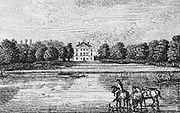
- Pembroke HousePembroke House, WhitehallPembroke House, located on Whitehall, was the London residence of the earls of Pembroke-History:It was built by the "architect earl" Henry Herbert in 1723–24 , on ground leased by the earl in 1717 and 1729 amidst the ruins of the parts of Whitehall Palace that burned down in 1698...
, WhitehallWhitehallWhitehall is a road in Westminster, in London, England. It is the main artery running north from Parliament Square, towards Charing Cross at the southern end of Trafalgar Square...
, London, for Henry Herbert, 9th Earl of PembrokeHenry Herbert, 9th Earl of PembrokeLt.-Gen. Henry Herbert, 9th Earl of Pembroke, 6th Earl of Montgomery PC FRS was the heir and eldest son of Thomas Herbert and his first wife Margaret...
, 1723, a London house in a prominent location for the heir of Jones' Wilton HouseWilton HouseWilton House is an English country house situated at Wilton near Salisbury in Wiltshire. It has been the country seat of the Earls of Pembroke for over 400 years....
. It was rebuilt in 1757 and demolished in 1913. Lord Herbert (as he then was) was inspired by it to design the similar Marble Hill at TwickenhamTwickenhamTwickenham is a large suburban town southwest of central London. It is the administrative headquarters of the London Borough of Richmond upon Thames and one of the locally important district centres identified in the London Plan...
for Henrietta Howard, Countess of SuffolkHenrietta Howard, Countess of SuffolkHenrietta Howard was a mistress of King George II of Great Britain.She was the daughter of Sir Henry Hobart, 4th Baronet, a Norfolk landowner who was killed in a duel when Henrietta was aged eight...
, the mistress of the future George IIGeorge II of Great BritainGeorge II was King of Great Britain and Ireland, Duke of Brunswick-Lüneburg and Archtreasurer and Prince-elector of the Holy Roman Empire from 11 June 1727 until his death.George was the last British monarch born outside Great Britain. He was born and brought up in Northern Germany...
. (Marble Hill was a 5-bay palladian villa with central pediment, raised on a high basement, with clumped screens of trees and formal turfed terraces descending to the Thames, illustrated right, that manifest the earliest stages of the English landscape garden.)
- Houghton HallHoughton HallHoughton Hall is a country house in Norfolk, England. It was built for the de facto first British Prime Minister, Sir Robert Walpole, and it is a key building in the history of Palladian architecture in England...
, NorfolkNorfolkNorfolk is a low-lying county in the East of England. It has borders with Lincolnshire to the west, Cambridgeshire to the west and southwest and Suffolk to the south. Its northern and eastern boundaries are the North Sea coast and to the north-west the county is bordered by The Wash. The county...
, begun 1722, for Sir Robert WalpoleRobert WalpoleRobert Walpole, 1st Earl of Orford, KG, KB, PC , known before 1742 as Sir Robert Walpole, was a British statesman who is generally regarded as having been the first Prime Minister of Great Britain....
, the Whig prime minister. Here Campbell was replaced by Gibbs, who capped the end pavilions with octagonal domes, and by William KentWilliam KentWilliam Kent , born in Bridlington, Yorkshire, was an eminent English architect, landscape architect and furniture designer of the early 18th century.He was baptised as William Cant.-Education:...
, who designed the interiors.
- Mereworth CastleMereworth CastleMereworth Castle is a grade I listed Palladian country house in Mereworth, Kent, England.Originally the site of a fortified manor licensed in 1332, the present building is not actually a castle, but was built in the 1720s as an almost exact copy of Palladio's Villa Rotunda. It was designed in 1723...
, KentKentKent is a county in southeast England, and is one of the home counties. It borders East Sussex, Surrey and Greater London and has a defined boundary with Essex in the middle of the Thames Estuary. The ceremonial county boundaries of Kent include the shire county of Kent and the unitary borough of...
1722 - 25: Campbell's most overtly palladian design, based on Villa La Rotonda, capped with a dome with no drum, through which 24 chimney flues pass to the lantern.
- Waverley AbbeyWaverley AbbeyWaverley Abbey was the first Cistercian abbey in England, founded in 1128 by William Giffard, Bishop of Winchester. It is situated about one mile south of Farnham, Surrey, in a bend of the River Wey.-History:...
, SurreySurreySurrey is a county in the South East of England and is one of the Home Counties. The county borders Greater London, Kent, East Sussex, West Sussex, Hampshire and Berkshire. The historic county town is Guildford. Surrey County Council sits at Kingston upon Thames, although this has been part of...
ca 1723-25 for John AislabieJohn AislabieJohn Aislabie or Aslabie was a British politician, notable for his involvement in the South Sea Bubble and for creating the water garden at Studley Royal.-Background and education:...
(largely altered)
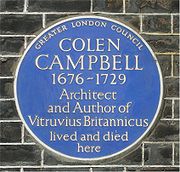
- Nos 76 and 78 Brook StreetBrook StreetBrook Street is one of the principal streets on the Grosvenor Estate in the exclusive central London district of Mayfair. It was developed in the first half of the 18th century and runs from Hanover Square to Grosvenor Square. The continuation from Grosvenor Square to Park Lane is called Upper...
, London W1, 1725 - 26. No. 76, which survives, was Campbell's own house, the designs for its interiors published in his Five Orders of architecture, (1729). It carries a blue plaqueBlue plaqueA blue plaque is a permanent sign installed in a public place to commemorate a link between that location and a famous person or event, serving as a historical marker....
commemorating him.
- Compton PlaceCompton PlaceCompton Place is an English country house in Eastbourne, a town and borough in East Sussex. It was rebuilt for Sir Spencer Compton, to designs by Colen Campbell from 1726, and completed after Campbell's death by William Kent. The Elizabethan-Jacobean house called Bourne Place had Spencer Compton,...
, EastbourneEastbourneEastbourne is a large town and borough in East Sussex, on the south coast of England between Brighton and Hastings. The town is situated at the eastern end of the chalk South Downs alongside the high cliff at Beachy Head...
, Sussex, 1726 onwards, south front and extensive internal rebuilding for Sir Spencer ComptonSpencer Compton, 1st Earl of WilmingtonSpencer Compton, 1st Earl of Wilmington KG, KB, PC was a British Whig statesman who served continuously in government from 1715 until his death. He served as the nominal head of government from 1742 until his death in 1743, but was merely a figurehead for the true leader of the government, Lord...
List of architectural works
- Shawfield Mansion, GlasgowGlasgowGlasgow is the largest city in Scotland and third most populous in the United Kingdom. The city is situated on the River Clyde in the country's west central lowlands...
(1712) demolished (1792) - Wanstead HouseWanstead ParkWanstead Park is the name of a grade II listed municipal park covering an area of about 140 acres , located in Wanstead, in the London Borough of Redbridge, historically within the county of Essex...
, Essex (1714–15) demolished (1822) - Hedworth House, Chester-le-StreetChester-le-StreetChester-le-Street is a town in County Durham, England. It has a history going back to Roman times when it was called Concangis. The town is located south of Newcastle upon Tyne and west of Sunderland on the River Wear...
(1726) - Hotham House, BeverleyBeverleyBeverley is a market town, civil parish and the county town of the East Riding of Yorkshire, England, located between the River Hull and the Westwood. The town is noted for Beverley Minster and architecturally-significant religious buildings along New Walk and other areas, as well as the Beverley...
(1716–17) demolished (c.1766) - Burlington HouseBurlington HouseBurlington House is a building on Piccadilly in London. It was originally a private Palladian mansion, and was expanded in the mid 19th century after being purchased by the British government...
, London, south front, and west wing (1717) subsequently extended and several occasions - Burlington (Ten Acre Close) Estate, London, Layout (1717–18)
- Burlington House, Great Gate and Street Wall (1718)
- Rolls House, Chancery Lane, London (1718) demolished (1895–96)
- Ebberston Lodge, EbberstonEbberstonEbberston is a small village near Pickering in the Ryedale district of North Yorkshire, England. In 2009 a 500 lb unexploded bomb was unearthed adjacent to the village. The bomb hailed from a 'Whitley Mark V Bomber', of the No...
, Yorkshire, including cascade (1718) - 34 Great Burlington Street, London (1718–19)
- 33 Great Burlington Street, London (1719–20)
- 32 Great Burlington Street, London (c.1720) this was Campbell's own house
- 31 Great Burlington Street, London (1719–24) rebuilt
- Burlington Girls' Charity School, Boyle Street, London (1719–21)
- Janssen House, Wimbledon, LondonWimbledon, LondonWimbledon is a district in the south west area of London, England, located south of Wandsworth, and east of Kingston upon Thames. It is situated within Greater London. It is home to the Wimbledon Tennis Championships and New Wimbledon Theatre, and contains Wimbledon Common, one of the largest areas...
, (1720) never completed and demolished c.1721 - Newby Park, (now Baldersby Park), BaldersbyBaldersbyBaldersby is a village and civil parish in the Harrogate district of North Yorkshire, England, about west of Thirsk and north east of Ripon on the A61. According to the 2001 census it had a population of 253....
, Yorkshire (1720–21) - Houghton HallHoughton HallHoughton Hall is a country house in Norfolk, England. It was built for the de facto first British Prime Minister, Sir Robert Walpole, and it is a key building in the history of Palladian architecture in England...
, Norfolk, one of several architects to work on the building (1721–22) - StourheadStourheadStourhead is a 2,650 acre estate at the source of the River Stour near Mere, Wiltshire, England. The estate includes a Palladian mansion, the village of Stourton, gardens, farmland, and woodland...
, Wiltshire, the portico part of Campbell's design was only added in 1840 (1721–24) interiors destroyed by fire (1902) - Mereworth CastleMereworth CastleMereworth Castle is a grade I listed Palladian country house in Mereworth, Kent, England.Originally the site of a fortified manor licensed in 1332, the present building is not actually a castle, but was built in the 1720s as an almost exact copy of Palladio's Villa Rotunda. It was designed in 1723...
, Kent (1722–23) - Pembroke Lodge, WhitehallWhitehallWhitehall is a road in Westminster, in London, England. It is the main artery running north from Parliament Square, towards Charing Cross at the southern end of Trafalgar Square...
, London acted as executed Henry Herbert, 9th Earl of PembrokeHenry Herbert, 9th Earl of PembrokeLt.-Gen. Henry Herbert, 9th Earl of Pembroke, 6th Earl of Montgomery PC FRS was the heir and eldest son of Thomas Herbert and his first wife Margaret...
's design (c.1724) demolished (1756) - Plumptre House, NottinghamNottinghamNottingham is a city and unitary authority in the East Midlands of England. It is located in the ceremonial county of Nottinghamshire and represents one of eight members of the English Core Cities Group...
(1724) - Hall Barn, Buckinghamshire, garden buildings: Great Room (only partially survives), Temple of Venus, Obelisk & Doric Pavilion (1724)
- Waverley ManorWaverley AbbeyWaverley Abbey was the first Cistercian abbey in England, founded in 1128 by William Giffard, Bishop of Winchester. It is situated about one mile south of Farnham, Surrey, in a bend of the River Wey.-History:...
, Surrey (c.1725), later extended (1770) damaged by fire and rebuilt (1833) - Greenwich HospitalOld Royal Naval CollegeThe Old Royal Naval College is the architectural centrepiece of Maritime Greenwich, a World Heritage Site in Greenwich, London, described by the United Nations Educational, Scientific and Cultural Organisation as being of “outstanding universal value” and reckoned to be the “finest and most...
, Greenwich, London, additions to Queen Mary block and Queen Anne block (1726–29) - Compton PlaceCompton PlaceCompton Place is an English country house in Eastbourne, a town and borough in East Sussex. It was rebuilt for Sir Spencer Compton, to designs by Colen Campbell from 1726, and completed after Campbell's death by William Kent. The Elizabethan-Jacobean house called Bourne Place had Spencer Compton,...
, Eastbourne, remodelled house (1726–29) - 46 Brook Street, London, internal alterations (c1726) became Campbell's new home
- Hackney House, HackneyLondon Borough of HackneyThe London Borough of Hackney is a London borough of North/North East London, and forms part of inner London. The local authority is Hackney London Borough Council....
, London (c.1727) demolished (before 1842) - AlthorpAlthorpAlthorp is a country estate of about and a stately home in Northamptonshire, England. It is about north-west of the county town of Northampton. The late Diana, Princess of Wales is buried in the estate.-History:...
, Northamptonshire, new stables, loggia gate (c.1729-33) - Lydiard HouseLydiard HouseLydiard House is a manor located in Lydiard Park at Lydiard Tregoze, Swindon, Wiltshire. The house and surrounding land was originally owned by the Viscount Bolingbroke who owned the house for several centuries until the cost of caring for the house proved too high, and they were forced to sell...
, Lydiard TregozeLydiard TregozeLydiard Tregoze is a small village and civil parish on the western edge of Swindon in the County of Wiltshire, in the south west of England. It has in the past been spelt as Liddiard Tregooze and in other ways.-History:...
, Wiltshire (c.1729) - Studley Royal ParkStudley Royal ParkStudley Royal Park is a park containing, and developed around, the ruins of the Cistercian Fountains Abbey in North Yorkshire, England. It is a World Heritage Site. The site also contains features dating from the eighteenth century such as Studley Royal Water Garden.-Origins:The Fountains Abbey was...
, Yorkshire, the stables (c.1729) built after his death by Roger Morris (1695–1749)