


Granada Television

Encyclopedia
Granada Television is the ITV
contractor for North West England
. Based in Manchester
since its inception, it is the only surviving original ITA
franchisee from 1954 and is ITV's most successful.
Broadcasting began on 3 May 1956 under the original "North of England" weekday franchise and was marked by a distinctive northern identity. Granada Group merged with Carlton to form ITV plc
in 2004.
Granada programmes have included Coronation Street
, Seven Up, The Royle Family
, World in Action
, University Challenge
and The Krypton Factor
.
in 1930 with his brother Cecil Bernstein with cinemas in the south of England. The company was incorporated as Granada Ltd in 1934 and listed on the London Stock Exchange
in 1935; Granada Theatres Ltd became a subsidiary of the new company. The company is named from the Spanish town of Granada
which Bernstein visited.
The Bernsteins became involved in commercial television, a competitor to the cinema chains. Bernstein bid for the North of England franchise with a view to creating a strong regional identity which would not affect on the company's largely southern-based cinema chain. In 1954, the Independent Television Authority
(ITA) awarded Granada the North of England contract for Monday to Friday, with ABC
, serving the same area at the weekend. The companies used the ITA's Winter Hill
and Emley Moor
transmitters covering Lancashire
and the West
and East Ridings of Yorkshire
, including the major connurbations around Liverpool
, Manchester
, Leeds
, Bradford
, Sheffield
and Doncaster
.
Bernstein selected a base from a shortlist of Leeds and Manchester. Granada executive Victor Peers believed Manchester was the preferred choice even before company executives toured of the region to find a suitable base. They found a site on Quay Street
in Manchester city centre
belonging to Manchester City Council
and Bernstein purchased the land for £82,000. It became the site of Granada Studios designed by architect Ralph Tubbs
.
Transmissions began in Lancashire on 3 May 1956, and Yorkshire six months later. The opening night featured Meet The People hosted by American Quentin Reynolds
and comedian Arthur Askey
. Reynolds a friend of Bernstein, became inebriated before the broadcast and had to sobered up.
called him a 'genial tyrant' as a result.
Bernstein constructed purpose-built studios rather than hiring or converting old buildings, an approach favoured by the BBC
at Dickenson Road Studios. The investment in new studios in 1954 contributed to Granada struggling financially and it was close to insolvency by late 1956. All four ITA franchisees were expected to make losses in the first few years of operation but Granada's was a significant sum of £175,000 (over £3m in 2005) and when it became profitable it had the lowest profits of all four.
Granada sought the help of Associated-Rediffusion
, the London weekday station, which agreed to underwrite Granada's debts in exchange for a percentage of its profits, without the consent of the ITA, who would have blocked it. Granada accepted the deal, but the popularity of ITV increased and profitability followed. Analysts questionned how Associated-Rediffusion, ABC and ATV
were making annual profits of up to £2.7m by 1959 and yet Granada's profits were under £1m. With the increase in income, Granada attempted to renegotiate the contract; Associated-Rediffusion refused, souring relations for many years. The deal was worth over £8m (2008: £129m) to Rediffusion. By the early 1960s Granada was established and its soap opera Coronation Street
quickly became popular alongside inexpensive game shows Criss Cross Quiz
and University Challenge
.
became a separate region and the contract awarded to Yorkshire Television
, broadcasting from Emley Moor transmitting station whose transmissions could be received in parts of North Lincolnshire
. Bernstein was angered by the decision to split "Granadaland", and claimed he would appeal to the United Nations
. Granada Television was now received in Greater Manchester
, Lancashire
, Merseyside
and Cheshire
, the south of Cumbria
around Barrow-in-Furness
, the High Peak district of Derbyshire
(Glossop
, Buxton
) and the Isle of Man
. Parts of North Wales can receive only the Winter Hill transmissions (i.e. Granada) rather than HTV
.
Granada retained its franchise in the 1980 franchise review, and invested in multi-million pound productions such as The Jewel in the Crown and Brideshead Revisited
.By the late 1980s the UK commercial broadcasters were considered too small to compete in the world market and the ITV franchises began to consolidate with the aim of creating a single company with a larger budget.
The Broadcasting Act of 1990 instigated the 1991 franchise auction round, in which companies had to bid for the regions. Mersey Television, a company producing the Channel Four soap opera Brookside
, bid of £35m compared to Granada's £9m but Granada won as Mersey's package did not meet the 'quality threshold' applied by the Independent Television Commission
. The quality threshold disadvantaged companies with no previous franchise experience. Granada owned popular television series such as Coronation Street
which it threatened to sell to satellite TV
if the franchise was lost. The government responded by relaxing the regulatory regime, so that ITV contractors could take over other companies, and Granada bought several companies. Some at the company considered ITV could only survive as a single merged entity in order to to have sufficient resources to produce big-budget programmes, a concern that increased when BSkyB began to take ITV's viewing share, leading to less advertising revenue
, the source of ITV's income.
David Plowright
, who had worked at Granada since 1957, resigned in 1992 citing the arrival of Gerry Robinson
who tightened the departmental budget with an uncompromising business approach. Plowright was the company's driving force producing programmes such as World in Action
, Coronation Street and promoted the Granada Studios Tour
. His departure angered well-known media-industry figures; John Cleese
faxed Robinson using 'vitriolic language' and called him an 'upstart caterer', a reference to his past employment. John Birt, Harold Pinter
and Alan Bennett
all supported Plowright.
, LWT
, Central
, Granada, and Yorkshire Television were expected to take over the ten smaller franchises. Granada wanted to consolidate with Yorkshire and Tyne Tees Television
to 'counter the potential dominance of the south east', and the prospect of being taken over by Thames Television. Granada made a hostile bid for LWT in 1994 but LWT believed Granada had little to offer despite having three times the market capitalisation; Granada, however, completed the take-over in 1994. Granada continued to expand by acquiring Yorkshire-Tyne Tees Television for £652m in 1997 and bought UNM for £1.75billion in 2000 - by which it acquired Anglia Television
and Meridian Broadcasting
and some divisions of HTV
- the remaining divisions passing to rival company Carlton
due to competition laws.
By 2002, Granada had established an effective duopoly of ITV with Carlton Television
, owning all the ITV companies in England and Wales. The franchises in Scotland, (Scottish Television
and Grampian Television
), UTV
in Northern Ireland
, and Channel Television
in the Channel Islands
, remained independent.
Granada was was in a poor financial state and closed the Granada Studios Tour in 2001 citing decreasing visitor figures and closed Granada Film. The emergence of digital television cut ITV's viewing share, decreasing advertising revenue which was suffering from competition with the internet. The failure of ITV Digital
affected Granada and Carlton with losses estimated at over £1 billion reducing the company's value from 2001 to 2003.
 On 28 October 2002, in a network-wide relaunch, Granada Television was rebranded on air to ITV1
Granada. The Granada name was initially shown only before regional programmes, but this has ceased and the name 'Granada' has vanished from screens, along with all other ITV regional identities. Since the rebranding, all continuity announcements are made from London. The Granada logo appeared at the end of its own programmes until 31 October 2004.
Granada was permitted by the government to merge with Carlton. The merger took place on 2 February 2004 and the new company called ITV plc
. The move was a takeover by Granada whose market capitalisation was double that of Carlton at nearly £2 billion. When the new company was formed, Granada owned 68% of the shares and Carlton 32%; chairman designate Michael Green
was ousted by shareholders and the majority of new board members originated from Granada. Carlton employees were subsumed in Granada operations or made redundant with three out of four new departments led by Granada staff.
From 1 November 2004, Granada Television productions were credited "Granada Manchester" productions, the brand of the unified in-house production arm but on 21 September 2005 it was announced that Granada's name would no longer appear at the end of programmes and the in-house production arm was renamed 'ITV Productions'. The change on 16 January 2006 coincided with a relaunch of ITV's on-screen graphics. Granada's name and logo were used at the end of programmes made for other networks, such as University Challenge
for BBC Two
and old programmes shown on Sky1
, 2
and 3, until 2009.
In November 2006, Granada lost its visual on-air identity, with regional programming referred to vocally as ITV1 or ITV1 Granada over a generic ident. Local news coverage was branded Granada News except for the 18.00 Granada Reports
bulletin on week nights. Granada Reports's main rival is BBC North West Tonight
, broadcast to roughly the same region. In 2009, ITV removed the Granada brand from all departments including its international production arm, Granada America which became ITV Studios America. End credits on programmes made at The Manchester Studios
were accredited to ITV Studios
.
The Granada license is owned by ITV plc and the company is obliged by Ofcom to produce 50% of programmes outside London which it failed to achieve in 2007 and 2008. With this obligation, Manchester as the northern hub and an £80m move to MediaCityUK in 2013, it would appear that ITV is committed to the Granada region for the foreseeable future.
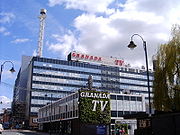 In 18 months between the award of the franchise and the start of transmission, Granada built a studio complex on Quay Street. It has been claimed that the site was previously a cemetery
containing a pauper's grave, where 22,000 people were buried. But an article in The Sun newspaper and an episode of the TV series "Most Haunted" seem to be the only sources for this so far. Twelve maps that date from between 1772 and 1960 show no evidence of a cemetery and buildings are shown on the site from 1807. The studios pre-date BBC Television Centre
by four years and were the first purpose-built television studio
s in the United Kingdom.
Bernstein wanted to make Granada Television appear a close rival to the BBC and exaggerated the scale of the studios giving them even numbers so that it appeared there were 12 despite only being six. The studios are operated by 3SixtyMedia
, ITV's joint-venture company with BBC Resources at BBC Manchester. The studios produce shows displaced by the closure of the Yorkshire Television studios in Leeds in 2009, including Channel 4's Countdown.
In September 2010, the 1950s red Granada TV sign on the roof of Granada Studios was removed for safety reasons after routine maintenance found it was badly corroded. Some have claimed the sign will return to its 'rightful place'. The Museum of Science and Industry (MOSI) has registered an interest in inheriting the Granada TV sign, deeming it to be important to Manchester's cultural heritage.
and the BBC agreed to move there. As part of MediaCityUK development, talks to relocate Granada to Trafford Wharf across the Manchester Ship Canal
were held. These discussions continued for several years and an 'agreement in principle' was reached in 2008.
In March 2009, in the recession, Granada announced would remin at Quay Street "for the forseeable future" but after a change of management, talks resumed in January 2010. On 16 December 2010, Granada announced it would move to Salford Quays and staff would move to the Orange Building in MediaCityUK alongside the University of Salford
and a studio to produce the ITV flagship soap opera Coronation Street, would be built on the opposite bank of the ship canal on Trafford Wharf. Planning permission was granted and building work started on 6 September 2011 with the aim of completion in 2012.
Granada Television was considered more bold than the other franchisees and the BBC, and placed great emphasis displaying the northern style which distinguished it from the BBC. Bernstein believed the north had untapped creative energy that needed cultivation.
In 1958, two years after Granada Television was launched, its northern style had become apparent. Kenneth Clark
, who led the Independent Television Authority
(ITA) which let the original franchises, remarked: "We did not quite foresee how much Granada would develop a character which distinguishes it most markedly from the other programmes companies and from the BBC." Peter Salmon, of the BBC said: "Granada made TV programmes in the north; for northerners, reflecting northern culture and attitudes."
 From the channel's launch in 1956 until 1968, when the pointed 'G' logo was introduced, the station used captions and animations featuring a thin arrow pointing upwards on the screen, with Granada in a stylised font in boxes. This sometimes animated, with the arrow animating in, revealing the slogan 'From the North', before the Granada name. The pointed 'G' was originally white on a grey background, after the introduction of colour, grey was substituted for blue, with the name in yellow.
The colour emblem was used by Granada from the 1970s until 1986 when it was replaced by a series of idents to celebrate Granada's 30th anniversary. These featured an animated, 3D pointed 'G' against a gradient background, a version of the previous arrow idents on the gradiented background making way for the animated G, and a cake covered in candles in the pointed G shape. In 1987 Granada reverted to using a caption featuring a gold
or chrome
3D pointed 'G' on a gradiented blue background.
Granada used in-vision continuity featuring northern personalities giving messages. It was common for the logo to be seen for a few seconds after the continuity before the programme, and continuity was rarely given over the symbol.
In 1989, Granada launched a look featuring a translucent pointed G which rotated into place in time to the music against a natural scene. When the first ITV generic look was launched, Granada refused to adopt it, because the Granada logo was incorrectly inserted into the 'V' segment of the logo. The company used a version where its translucent logo was used at the beginning, before continuing with the generic ident and ending with the generic ITV logo.
In 1990, Granada in the run up to the 1990 franchise round, relaunched its on screen branding to a blue stripe descending from the top of the screen, containing the pointed 'G', against a plain white background accompanied by the same music as previously. Variations were seen from which the stripe formed from a falling feather or was backlit. In 1992 the stripe descended, revealing a rainbow of colours before becoming the usual blue.
In 1994, to accompany idents already used, Granada introduced a series of films featuring flags with its logo against various scenes in the region, accompanied by the slogan 'Setting the Standard'. These introduced local programming, Granada Reports
, or introduce promotions.
In 1995 the stripe theme was modified; the pointed 'G' was larger on the blue stripe against a computer generated multicoloured background and the 'G' was created by filming a large perspex 'G' with motion control photography
. This ident was used, from a variety of angles, until 1999, when additional idents were introduced based on surreal surroundings such as a fish blowing a bubble with a G inside, which floated to the surface, or a camera zoom into the eye of a housewife to reveal the G in her eye.
All the idents were replaced in 1999 when Granada took the generic hearts idents. Granada kept the pointed G logo, made slightly thinner and placed in a box at the top of the screen. The dual branding of Granada and ITV lasted until 28 October 2002, when regional identities were dropped in favour of the ITV1
brand. The celebrities ident package featured plain ITV1 idents for all national programmes, and the Granada name placed under the ITV1 logo for regional programme. This practice continued through other rebrands until 2006, when no name was used on screen, and Granada Productions was replaced with ITV Productions on programme end boards. The Granada logo continued on end boards until this date. The Granada name was used on announcements before local programming over a generic ITV1 ident until all non news regional programming was scrapped.
- the first election to be covered on television in Britain. Granada's coverage was broad in scope and it also broadcast two candidate debates. Over 50 years later, Granada Studios hosted the first General Election debate between the leaders of the three main political parties.
Granada's boldness was seen in ambitious documentaries such as Seven Up!
which premièred in 1964. The programme was a social experiment which followed the lives of 14 British children aged seven. It tracked their lives at seven-year intervals to discover whether their hopes and aspirations had been achieved. The documentary was voted the greatest ever by esteemed film-makers and its next installment, 56 Up, is due for premiere in May 2012. Seven Up was part of the World in Action
documentary series between 1963 and 1998 which won awards but was controversial. It garnered a reputation for hard-hitting investigative journalism and its producer Gus Macdonald commented that the programme was 'born brash' and Paul Greengrass
stated that David Plowright
told him, "don't forget, your job's to make trouble." World in Action demonstrated hard-hitting investigative journalism and explored issues such as police corruption at the Metropolitan Police in 1985 and revealed the Royal Family's tax loophole in 1991. The programme led a campaign to prove the innocence of the Birmingham Six
in 1985 when researcher Chris Mullin
questionned the convictions and by 1991 the men had been released.
The classic northern working-class soap opera Coronation Street
started a 13-week, two-episodes-a-week regional run on 9 December 1960. It is still produced at the rate of five peak-viewing episodes a week after 50 years, and is the longest-running soap opera in the world. The company produced gritty dramas such as A Family at War
(1970–72).
Granada produced The Stars Look Down (1975), Laurence Olivier Presents
(1976–78), Brideshead Revisited
(1981), the multi-award-winning Disappearing World series (between 1969 and 1993) and, from 1984, The Adventures of Sherlock Holmes
and The Jewel in the Crown for an international audience. These shows were sold overseas by Granada Television International.
Another flagship programme, the long-running quiz show
, University Challenge
was originally aired between 1962 and 1987 and revived by the BBC in 1994 (produced by Granada). The company produced the Krypton Factor
, between 1977 and 1995 (revived by ITV in 2009). One of Granada's longest-running programmes, What The Papers Say
, was broadcast by Granada in 1956, was taken over by the BBC in the early 1990s, and was shown by Channel Four. The programme introduced the idea of discussing what the newspapers were reporting, continued by Sunday Supplement and The Wright Stuff
. In the 1970s, Granada produced situation comedies, often based around life in the north west including Nearest and Dearest
, The Lovers
and The Cuckoo Waltz
followed by Brothers McGregor and Watching
in the 1980s.
Granada drew on 1970s pop music with shows such as Lift Off with Ayshea
and the Bay City Rollers show, Shang-a-lang
. The station produced Marc, presented by glam rock
star Marc Bolan
. The show was in production when Bolan was killed in a car accident in 1977. Granada produced Allsorts from 1989 to 1995 for CITV, featuring Wayne Jackman, Andrew Wightman (who later produced Granada's talent show Stars In Their Eyes
), Virginia Radcliffe, Jane Cox
and Julie Westwood
.
. Jeremy Isaacs
developed a significant portion of Granada's factual programming, and the company produced a generation of major British TV 'players' including Lord John Birt, later Director-General of the BBC, and Lord Gus Macdonald, his fellow World in Action
producer. Many began work as researchers on the World in Action.
Writers, directors and producers
Presenters
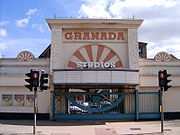 The Granada Studios Tour
opened in 1988 as an entertainment park at the Granada Studios themed around television productions. The park featured a replica set of No. 10 Downing Street, and visitors were shown how television is produced. The main feature was the set of Coronation Street
Several of Granada's programmes administered their websites using G-Wizz, including This Morning, Coronation Street and Emmerdale. Its Flash-heavy pages were mostly unusable by subscribers, who were largely modem-based, and take-up was low. Less than a year after it opened, Granada closed G-Wizz in March 2001, after it had cost the company £9 million. It combined the remainder of its online presence with fellow ITV company Carlton
to launch itv.com
.
From 1997 until 2002 Granada and Carlton invested and lost over £1 billion with a joint venture into ONdigital, a pay-TV
, digital terrestrial
broadcaster. ONdigital was rebranded ITV Digital
in summer 2001, but opposed by SMG plc
, UTV
, and Channel Television
, who felt it would damage the ITV brand. ONdigital was expected to create a new revenue stream and be floated as a separate company but by March 1999 the service only had 110,000 subscribers, well below the 2 million Granada aimed for. Granada and Carlton persevered by rebranding the service ITV Digital but this too was not successful. Competition from Sky Digital launched in 1998 was too great and ITV Digital ceased broadcasting on 1 May 2002. This led to sweeping cuts in the organisation, including cutting budgets for flagship drama serials and productions and loss of jobs at the Manchester headquarters.
 In 1996 Granada joined BSkyB
to form a joint venture, Granada Sky Broadcasting (GSB) providing content and new channels to the satellite platform. Granada launched a range of television channels broadcasting the Granada archive on the Sky satellite television
platform and other digital platforms such as ITV Digital
which closed in 2002 due to administration, NTL
and Telewest
(which merged to form Virgin Media
).
GSB operated as a joint venture until 2004 when ITV was formed. Consequently ITV purchased BSkyB's 10% stake in the venture and launched ITV3
which replaced Granada Plus
. GSB was renamed the ITV digital channels Ltd to reflect ITV PLC control.
Granada Plus
was a general entertainment channel, a 50–50 joint venture between Granada Television and British Sky Broadcasting
, aimed at older audiences using archived material. The channel, launched as Granada Plus, was later known as G Plus and finally Plus. It broadcast until 1 November 2004, when ITV bought BSkyB's stake in GSB, and closed the channel, replacing it with ITV3
, and taking Plus' low EPG position on Sky Digital
.
Originally Granada Good Life, Granada Breeze
was another GSB venture. It was a lifestyle channel aimed at women viewers and showed programmes on, cookery, health and US daytime television such as Judge Joe Brown. It provided programmes split into themed sections called Granada Talk Television, Granada Food and Wine, Granada Health and Beauty, Granada Television High Street and Granada Home and Garden. Most shows were presented from a large conservatory studio outside the Coronation Street studio which was later used for daytime ITV Play
programming. Granada Breeze was scaled down in July 2001 before ceasing operation in March 2002 due to poor viewing figures.
Another channel, Wellbeing, a joint venture with Boots, modelled on Granada Breeze was broadcast from The Leeds Studios
, although Granada made some programmes, closed in 2003. A male oriented channel, Men and Motors, lasted longest of all the channels, and ran until 2010, when it was closed to make way for ITV1 HD. Most of its programmes were transferred to ITV4
. Granada Talk TV
focused on chat shows and closed after less than a year on air.
It was the only ITA broadcaster created in 1954 that survived into the 21st century, and flourished it emerged the dominant player in the ITV network by 2000.
In the 19 BAFTA Awards for the Best Drama series
awarded since 1992, Granada Television has won five in total, Cracker
twice in 1994 and 1995, Cold Feet
in 2002 and The Street
in 2007 and 2008 - more than any other production company.
Coronation Street became the longest running serial soap in 2010 when it celebrated its 50th anniversary and the ongoing Seven Up documentary series was voted the greatest documentary in a Channel 4 program by film makers.
.
In the 1991 auction round, Mersey Television
made an audacious bid to rid Granada of its franchise, unlikely, as Granada had never lost a franchise and was well respected. Mersey Television claimed that Granada was too Manchester-centred at the expense of the Liverpool area and need to cater for the whole of North West England. Granada Television was referred to as Granada Manchester, as most productions were made in Manchester and in 2005 Granada and Manchester City Council
held a celebration recognising Granada's 50th anniversary cementing this perception further. In 1993, Brian Sedgemore
MP
, complained that promises Granada made during the 1991 franchise round to open offices in Chester
, Lancaster
and Blackburn were not made but David Liddiment
at Granada did not believe this assertion to be true.
Granada had increased investment in Liverpool moving its regional news service to the Albert Dock
complex in 1986 before moving back to the Quay Street sometime in the early 2000s. The ITV network based its daytime show This Morning
at Liverpool Docks for several years before it moved to the London Studios
in 1996, as it was difficult to get guests to travel from London to Liverpool.
Granada's bold, hard-hitting television and documentaries have resulted in legal cases. David Plowright told junior researcher, Paul Greengrass
, that Granada's role was to make trouble. World in Action
was hard-hitting but resulted in expensive, libel trials when wrong accusations were made in the 1990s.
In 1998 Granada paid £2 million in two cases, to three Metropolitan Police
officers who were wrongly accused of covering up a murder and Marks and Spencer for alleging M&S knew one of its suppliers was using child labour. World in Action was replaced by the Tonight
programme in 1998 but it was criticised as dumbing down
as the Tonight programme is markedly less hard-hitting.
In 2003, the documentary Living with Michael Jackson
resulted in the threat of legal action by Michael Jackson
. The documentary gained a large audience, 15 million in the United Kingdom
, and newspapers depicted Jackson in a negative light following the documentary.
History
ITV
ITV is the major commercial public service TV network in the United Kingdom. Launched in 1955 under the auspices of the Independent Television Authority to provide competition to the BBC, it is also the oldest commercial network in the UK...
contractor for North West England
North West England
North West England, informally known as The North West, is one of the nine official regions of England.North West England had a 2006 estimated population of 6,853,201 the third most populated region after London and the South East...
. Based in Manchester
The Manchester Studios
The Manchester Studios is a television studio on Quay Street in Manchester with the facility to broadcast live and film drama programmes. The studios have been home to Granada Television since its inception in 1954...
since its inception, it is the only surviving original ITA
Independent Television Authority
The Independent Television Authority was an agency created by the Television Act 1954 to supervise the creation of "Independent Television" , the first commercial television network in the United Kingdom...
franchisee from 1954 and is ITV's most successful.
Broadcasting began on 3 May 1956 under the original "North of England" weekday franchise and was marked by a distinctive northern identity. Granada Group merged with Carlton to form ITV plc
ITV plc
ITV plc is a British media company that operates 12 of the 15 regional television broadcasters that make up the ITV Network, the oldest and largest commercial terrestrial television network in the United Kingdom...
in 2004.
Granada programmes have included Coronation Street
Coronation Street
Coronation Street is a British soap opera set in Weatherfield, a fictional town in Greater Manchester based on Salford. Created by Tony Warren, Coronation Street was first broadcast on 9 December 1960...
, Seven Up, The Royle Family
The Royle Family
The Royle Family is a popular, BAFTA award-winning television comedy drama produced by Granada Television for the BBC, which ran for three series between 1998 and 2000, and specials from 2006 onwards...
, World in Action
World in Action
World in Action was a British investigative current affairs programme made by Granada Television from 1963 until 1998. Its campaigning journalism frequently had a major impact on events of the day. Its production teams often took audacious risks and gained a solid reputation for its often...
, University Challenge
University Challenge
University Challenge is a British quiz programme that has aired since 1962. The format is based on the American show College Bowl, which ran on NBC radio from 1953 to 1957, and on NBC television from 1959 to 1970....
and The Krypton Factor
The Krypton Factor
The Krypton Factor was a British game show produced by Granada Television for broadcast on ITV. The show originally ran from 7 September 1977 to 20 November 1995, and was hosted by Gordon Burns and usually broadcast on the ITV network on Mondays at 19:00....
.
Origins
Granada Television, a subsidiary of Granada Ltd, originated in Sidney Bernstein's Granada Theatres Ltd, a company he founded in DoverDover
Dover is a town and major ferry port in the home county of Kent, in South East England. It faces France across the narrowest part of the English Channel, and lies south-east of Canterbury; east of Kent's administrative capital Maidstone; and north-east along the coastline from Dungeness and Hastings...
in 1930 with his brother Cecil Bernstein with cinemas in the south of England. The company was incorporated as Granada Ltd in 1934 and listed on the London Stock Exchange
London Stock Exchange
The London Stock Exchange is a stock exchange located in the City of London within the United Kingdom. , the Exchange had a market capitalisation of US$3.7495 trillion, making it the fourth-largest stock exchange in the world by this measurement...
in 1935; Granada Theatres Ltd became a subsidiary of the new company. The company is named from the Spanish town of Granada
Granada
Granada is a city and the capital of the province of Granada, in the autonomous community of Andalusia, Spain. Granada is located at the foot of the Sierra Nevada mountains, at the confluence of three rivers, the Beiro, the Darro and the Genil. It sits at an elevation of 738 metres above sea...
which Bernstein visited.
The Bernsteins became involved in commercial television, a competitor to the cinema chains. Bernstein bid for the North of England franchise with a view to creating a strong regional identity which would not affect on the company's largely southern-based cinema chain. In 1954, the Independent Television Authority
Independent Television Authority
The Independent Television Authority was an agency created by the Television Act 1954 to supervise the creation of "Independent Television" , the first commercial television network in the United Kingdom...
(ITA) awarded Granada the North of England contract for Monday to Friday, with ABC
Associated British Corporation
Associated British Corporation was one of a number of commercial television companies established in the United Kingdom during the 1950s by cinema chain companies in an attempt to safeguard their business by becoming involved with television which was taking away their cinema audiences.In this...
, serving the same area at the weekend. The companies used the ITA's Winter Hill
Winter Hill transmitting station
The Winter Hill transmitting station is a broadcasting and telecommunications site situated on Winter Hill, at the southern boundary of the Borough of Chorley, and above Bolton in Greater Manchester, England...
and Emley Moor
Emley Moor transmitting station
The Emley Moor transmitting station is a telecommunications and broadcasting facility on 'Emley Moor' to the west of the village of Emley, in Kirklees, West Yorkshire, England . The station's most visible feature is its concrete tower, which is a Grade II listed building...
transmitters covering Lancashire
Lancashire
Lancashire is a non-metropolitan county of historic origin in the North West of England. It takes its name from the city of Lancaster, and is sometimes known as the County of Lancaster. Although Lancaster is still considered to be the county town, Lancashire County Council is based in Preston...
and the West
West Riding of Yorkshire
The West Riding of Yorkshire is one of the three historic subdivisions of Yorkshire, England. From 1889 to 1974 the administrative county, County of York, West Riding , was based closely on the historic boundaries...
and East Ridings of Yorkshire
East Yorkshire
East Yorkshire could be:*East Yorkshire Motor Services*An alternative name for the East Riding of Yorkshire*East Yorkshire , a former district of Humberside*East Yorkshire...
, including the major connurbations around Liverpool
Liverpool
Liverpool is a city and metropolitan borough of Merseyside, England, along the eastern side of the Mersey Estuary. It was founded as a borough in 1207 and was granted city status in 1880...
, Manchester
Manchester
Manchester is a city and metropolitan borough in Greater Manchester, England. According to the Office for National Statistics, the 2010 mid-year population estimate for Manchester was 498,800. Manchester lies within one of the UK's largest metropolitan areas, the metropolitan county of Greater...
, Leeds
Leeds
Leeds is a city and metropolitan borough in West Yorkshire, England. In 2001 Leeds' main urban subdivision had a population of 443,247, while the entire city has a population of 798,800 , making it the 30th-most populous city in the European Union.Leeds is the cultural, financial and commercial...
, Bradford
Bradford
Bradford lies at the heart of the City of Bradford, a metropolitan borough of West Yorkshire, in Northern England. It is situated in the foothills of the Pennines, west of Leeds, and northwest of Wakefield. Bradford became a municipal borough in 1847, and received its charter as a city in 1897...
, Sheffield
Sheffield
Sheffield is a city and metropolitan borough of South Yorkshire, England. Its name derives from the River Sheaf, which runs through the city. Historically a part of the West Riding of Yorkshire, and with some of its southern suburbs annexed from Derbyshire, the city has grown from its largely...
and Doncaster
Doncaster
Doncaster is a town in South Yorkshire, England, and the principal settlement of the Metropolitan Borough of Doncaster. The town is about from Sheffield and is popularly referred to as "Donny"...
.
Bernstein selected a base from a shortlist of Leeds and Manchester. Granada executive Victor Peers believed Manchester was the preferred choice even before company executives toured of the region to find a suitable base. They found a site on Quay Street
Quay Street
Quay Street is a street in the city centre of Manchester, England. The street continues Peter Street westwards towards Salford. Spinningfields, Manchester's new business district, is to the north and Castlefield, the historical area of the city to the south...
in Manchester city centre
Manchester City Centre
Manchester city centre is the central business district of Manchester, England. It lies within the Manchester Inner Ring Road, next to the River Irwell...
belonging to Manchester City Council
Manchester City Council
Manchester City Council is the local government authority for Manchester, a city and metropolitan borough in Greater Manchester, England. It is composed of 96 councillors, three for each of the 32 electoral wards of Manchester. Currently the council is controlled by the Labour Party and is led by...
and Bernstein purchased the land for £82,000. It became the site of Granada Studios designed by architect Ralph Tubbs
Ralph Tubbs
Ralph Tubbs, OBE, FRIBA was a British architect. Well known amongst the buildings he designed was the Dome of Discovery at the successful Festival of Britain on the South Bank in London in 1951....
.
Transmissions began in Lancashire on 3 May 1956, and Yorkshire six months later. The opening night featured Meet The People hosted by American Quentin Reynolds
Quentin Reynolds
Quentin James Reynolds was a journalist and World War II war correspondent.As associate editor at Collier's Weekly from 1933 to 1945, Reynolds averaged twenty articles a year...
and comedian Arthur Askey
Arthur Askey
Arthur Bowden Askey CBE was a prominent English comedian.- Life and career :Askey was born at 29 Moses Street, Liverpool, the eldest child and only son of Samuel Askey , secretary of the firm Sugar Products of Liverpool, and his wife, Betsy Bowden , of Knutsford, Cheshire...
. Reynolds a friend of Bernstein, became inebriated before the broadcast and had to sobered up.
Early years
Granada determined to develop a strong northern identity — northern voices, northern programmes, northern idents with phrases such as Granada from the north, From the north—Granada and Granadaland. Bernstein refused to employ anyone not prepared to live in or travel to Manchester and Jeremy IsaacsJeremy Isaacs
Sir Jeremy Isaacs is a British television producer and executive, winner of many BAFTA awards and international Emmy Awards. He was also General Director of the Royal Opera House, Covent Garden .-Early life:...
called him a 'genial tyrant' as a result.
Bernstein constructed purpose-built studios rather than hiring or converting old buildings, an approach favoured by the BBC
BBC
The British Broadcasting Corporation is a British public service broadcaster. Its headquarters is at Broadcasting House in the City of Westminster, London. It is the largest broadcaster in the world, with about 23,000 staff...
at Dickenson Road Studios. The investment in new studios in 1954 contributed to Granada struggling financially and it was close to insolvency by late 1956. All four ITA franchisees were expected to make losses in the first few years of operation but Granada's was a significant sum of £175,000 (over £3m in 2005) and when it became profitable it had the lowest profits of all four.
Granada sought the help of Associated-Rediffusion
Associated-Rediffusion
Associated-Rediffusion, later Rediffusion, London, was the British ITV contractor for London and parts of the surrounding counties, on weekdays between 1954 and 29 July 1968. Transmissions started on 22 September 1955.-Formation:...
, the London weekday station, which agreed to underwrite Granada's debts in exchange for a percentage of its profits, without the consent of the ITA, who would have blocked it. Granada accepted the deal, but the popularity of ITV increased and profitability followed. Analysts questionned how Associated-Rediffusion, ABC and ATV
Associated TeleVision
Associated Television, often referred to as ATV, was a British television company, holder of various licences to broadcast on the ITV network from 24 September 1955 until 00:34 on 1 January 1982...
were making annual profits of up to £2.7m by 1959 and yet Granada's profits were under £1m. With the increase in income, Granada attempted to renegotiate the contract; Associated-Rediffusion refused, souring relations for many years. The deal was worth over £8m (2008: £129m) to Rediffusion. By the early 1960s Granada was established and its soap opera Coronation Street
Coronation Street
Coronation Street is a British soap opera set in Weatherfield, a fictional town in Greater Manchester based on Salford. Created by Tony Warren, Coronation Street was first broadcast on 9 December 1960...
quickly became popular alongside inexpensive game shows Criss Cross Quiz
Criss Cross Quiz
Criss Cross Quiz was a quiz programme that combined the game Noughts and Crosses with general knowledge questions and aired on the ITV network from 1957-1967. It was produced by Granada Television....
and University Challenge
University Challenge
University Challenge is a British quiz programme that has aired since 1962. The format is based on the American show College Bowl, which ran on NBC radio from 1953 to 1957, and on NBC television from 1959 to 1970....
.
Franchise changes
In the 1968 franchise round, Granada's contract was changed from weekdays across the northern England region to the whole week in the north west from Winter Hill transmitting station. YorkshireYorkshire
Yorkshire is a historic county of northern England and the largest in the United Kingdom. Because of its great size in comparison to other English counties, functions have been increasingly undertaken over time by its subdivisions, which have also been subject to periodic reform...
became a separate region and the contract awarded to Yorkshire Television
Yorkshire Television
Yorkshire Television, now officially known as ITV Yorkshire and sometimes unofficially abbreviated to YTV, is a British television broadcaster and the contractor for the Yorkshire franchise area on the ITV network...
, broadcasting from Emley Moor transmitting station whose transmissions could be received in parts of North Lincolnshire
North Lincolnshire
North Lincolnshire is a unitary authority area in the region of Yorkshire and the Humber in England. For ceremonial purposes it is part of Lincolnshire....
. Bernstein was angered by the decision to split "Granadaland", and claimed he would appeal to the United Nations
United Nations
The United Nations is an international organization whose stated aims are facilitating cooperation in international law, international security, economic development, social progress, human rights, and achievement of world peace...
. Granada Television was now received in Greater Manchester
Greater Manchester
Greater Manchester is a metropolitan county in North West England, with a population of 2.6 million. It encompasses one of the largest metropolitan areas in the United Kingdom and comprises ten metropolitan boroughs: Bolton, Bury, Oldham, Rochdale, Stockport, Tameside, Trafford, Wigan, and the...
, Lancashire
Lancashire
Lancashire is a non-metropolitan county of historic origin in the North West of England. It takes its name from the city of Lancaster, and is sometimes known as the County of Lancaster. Although Lancaster is still considered to be the county town, Lancashire County Council is based in Preston...
, Merseyside
Merseyside
Merseyside is a metropolitan county in North West England, with a population of 1,365,900. It encompasses the metropolitan area centred on both banks of the lower reaches of the Mersey Estuary, and comprises five metropolitan boroughs: Knowsley, St Helens, Sefton, Wirral, and the city of Liverpool...
and Cheshire
Cheshire
Cheshire is a ceremonial county in North West England. Cheshire's county town is the city of Chester, although its largest town is Warrington. Other major towns include Widnes, Congleton, Crewe, Ellesmere Port, Runcorn, Macclesfield, Winsford, Northwich, and Wilmslow...
, the south of Cumbria
Cumbria
Cumbria , is a non-metropolitan county in North West England. The county and Cumbria County Council, its local authority, came into existence in 1974 after the passage of the Local Government Act 1972. Cumbria's largest settlement and county town is Carlisle. It consists of six districts, and in...
around Barrow-in-Furness
Barrow-in-Furness
Barrow-in-Furness is an industrial town and seaport which forms about half the territory of the wider Borough of Barrow-in-Furness in the county of Cumbria, England. It lies north of Liverpool, northwest of Manchester and southwest from the county town of Carlisle...
, the High Peak district of Derbyshire
Derbyshire
Derbyshire is a county in the East Midlands of England. A substantial portion of the Peak District National Park lies within Derbyshire. The northern part of Derbyshire overlaps with the Pennines, a famous chain of hills and mountains. The county contains within its boundary of approx...
(Glossop
Glossop
Glossop is a market town within the Borough of High Peak in Derbyshire, England. It lies on the Glossop Brook, a tributary of the River Etherow, about east of the city of Manchester, west of the city of Sheffield. Glossop is situated near Derbyshire's county borders with Cheshire, Greater...
, Buxton
Buxton
Buxton is a spa town in Derbyshire, England. It has the highest elevation of any market town in England. Located close to the county boundary with Cheshire to the west and Staffordshire to the south, Buxton is described as "the gateway to the Peak District National Park"...
) and the Isle of Man
Isle of Man
The Isle of Man , otherwise known simply as Mann , is a self-governing British Crown Dependency, located in the Irish Sea between the islands of Great Britain and Ireland, within the British Isles. The head of state is Queen Elizabeth II, who holds the title of Lord of Mann. The Lord of Mann is...
. Parts of North Wales can receive only the Winter Hill transmissions (i.e. Granada) rather than HTV
HTV
HTV, now legally known as ITV Wales & West, is the ITV contractor for Wales and the West of England, which operated from studios in Cardiff and Bristol. The company provided commercial television for the dual-region 'Wales and West' franchise, which it won from TWW in 1968...
.
Granada retained its franchise in the 1980 franchise review, and invested in multi-million pound productions such as The Jewel in the Crown and Brideshead Revisited
Brideshead Revisited (TV serial)
Brideshead Revisited is a 1981 British television serial produced by Granada Television for broadcast by the ITV network. The teleplay is based on Evelyn Waugh's novel Brideshead Revisited...
.By the late 1980s the UK commercial broadcasters were considered too small to compete in the world market and the ITV franchises began to consolidate with the aim of creating a single company with a larger budget.
The Broadcasting Act of 1990 instigated the 1991 franchise auction round, in which companies had to bid for the regions. Mersey Television, a company producing the Channel Four soap opera Brookside
Brookside
Brookside is a defunct British soap opera set in Liverpool, England. The series began on the launch night of Channel 4 on 2 November 1982, and ran for 21 years until 4 November 2003...
, bid of £35m compared to Granada's £9m but Granada won as Mersey's package did not meet the 'quality threshold' applied by the Independent Television Commission
Independent Television Commission
The Independent Television Commission licensed and regulated commercial television services in the United Kingdom between 1 January 1991 and 28 December 2003....
. The quality threshold disadvantaged companies with no previous franchise experience. Granada owned popular television series such as Coronation Street
Coronation Street
Coronation Street is a British soap opera set in Weatherfield, a fictional town in Greater Manchester based on Salford. Created by Tony Warren, Coronation Street was first broadcast on 9 December 1960...
which it threatened to sell to satellite TV
Satellite television
Satellite television is television programming delivered by the means of communications satellite and received by an outdoor antenna, usually a parabolic mirror generally referred to as a satellite dish, and as far as household usage is concerned, a satellite receiver either in the form of an...
if the franchise was lost. The government responded by relaxing the regulatory regime, so that ITV contractors could take over other companies, and Granada bought several companies. Some at the company considered ITV could only survive as a single merged entity in order to to have sufficient resources to produce big-budget programmes, a concern that increased when BSkyB began to take ITV's viewing share, leading to less advertising revenue
Revenue
In business, revenue is income that a company receives from its normal business activities, usually from the sale of goods and services to customers. In many countries, such as the United Kingdom, revenue is referred to as turnover....
, the source of ITV's income.
David Plowright
David Plowright
David Ernest Plowright, CBE was an English television executive and producer....
, who had worked at Granada since 1957, resigned in 1992 citing the arrival of Gerry Robinson
Gerry Robinson
Sir Gerrard Jude "Gerry" Robinson is an Irish businessman. He is the former non-executive Chairman of Allied Domecq and the ex-Chairman/Chief Executive of Granada.-Early life:...
who tightened the departmental budget with an uncompromising business approach. Plowright was the company's driving force producing programmes such as World in Action
World in Action
World in Action was a British investigative current affairs programme made by Granada Television from 1963 until 1998. Its campaigning journalism frequently had a major impact on events of the day. Its production teams often took audacious risks and gained a solid reputation for its often...
, Coronation Street and promoted the Granada Studios Tour
Granada Studios Tour
Granada Studios Tour was an entertainment theme park at the Granada Studios complex in Castlefield, Manchester which England operated from 1988 to 1999...
. His departure angered well-known media-industry figures; John Cleese
John Cleese
John Marwood Cleese is an English actor, comedian, writer, and film producer. He achieved success at the Edinburgh Festival Fringe and as a scriptwriter and performer on The Frost Report...
faxed Robinson using 'vitriolic language' and called him an 'upstart caterer', a reference to his past employment. John Birt, Harold Pinter
Harold Pinter
Harold Pinter, CH, CBE was a Nobel Prize–winning English playwright and screenwriter. One of the most influential modern British dramatists, his writing career spanned more than 50 years. His best-known plays include The Birthday Party , The Homecoming , and Betrayal , each of which he adapted to...
and Alan Bennett
Alan Bennett
Alan Bennett is a British playwright, screenwriter, actor and author. Born in Leeds, he attended Oxford University where he studied history and performed with The Oxford Revue. He stayed to teach and research mediaeval history at the university for several years...
all supported Plowright.
Takeover bids
The 'Big 5' ITV franchises, ThamesThames Television
Thames Television was a licensee of the British ITV television network, covering London and parts of the surrounding counties on weekdays from 30 July 1968 until 31 December 1992....
, LWT
London Weekend Television
London Weekend Television was the name of the ITV network franchise holder for Greater London and the Home Counties including south Suffolk, middle and east Hampshire, Oxfordshire, south Bedfordshire, south Northamptonshire, parts of Herefordshire & Worcestershire, Warwickshire, east Dorset and...
, Central
Central Independent Television
Central Independent Television, more commonly known as Central is the Independent Television contractor for the Midlands, created following the restructuring of ATV and commencing broadcast on 1 January 1982. The station is owned and operated by ITV plc, under the licensee of ITV Broadcasting...
, Granada, and Yorkshire Television were expected to take over the ten smaller franchises. Granada wanted to consolidate with Yorkshire and Tyne Tees Television
Tyne Tees Television
Tyne Tees Television is the ITV television franchise for North East England and parts of North Yorkshire. As of 2009, it forms part of a non-franchise ITV Tyne Tees & Border region, shared with the ITV Border region...
to 'counter the potential dominance of the south east', and the prospect of being taken over by Thames Television. Granada made a hostile bid for LWT in 1994 but LWT believed Granada had little to offer despite having three times the market capitalisation; Granada, however, completed the take-over in 1994. Granada continued to expand by acquiring Yorkshire-Tyne Tees Television for £652m in 1997 and bought UNM for £1.75billion in 2000 - by which it acquired Anglia Television
Anglia Television
Anglia Television is the ITV franchise holder for the East Anglia franchise region. Although Anglia Television takes its name from East Anglia, its transmission coverage extends beyond the generally accepted boundaries of that region. The station is based at Anglia House in Norwich, with regional...
and Meridian Broadcasting
Meridian Broadcasting
Meridian Broadcasting is the holder of the ITV franchise for the South and South East of England. The station is owned and operated by ITV plc, under the licensee of ITV Broadcasting Limited....
and some divisions of HTV
HTV
HTV, now legally known as ITV Wales & West, is the ITV contractor for Wales and the West of England, which operated from studios in Cardiff and Bristol. The company provided commercial television for the dual-region 'Wales and West' franchise, which it won from TWW in 1968...
- the remaining divisions passing to rival company Carlton
Carlton Television
Carlton Television was the ITV franchise holder for London and the surrounding counties including the cities of Solihull and Coventry of the West Midlands, south Suffolk, middle and east Hampshire, Oxfordshire, south Bedfordshire, south Northamptonshire, parts of Herefordshire & Worcestershire,...
due to competition laws.
By 2002, Granada had established an effective duopoly of ITV with Carlton Television
Carlton Television
Carlton Television was the ITV franchise holder for London and the surrounding counties including the cities of Solihull and Coventry of the West Midlands, south Suffolk, middle and east Hampshire, Oxfordshire, south Bedfordshire, south Northamptonshire, parts of Herefordshire & Worcestershire,...
, owning all the ITV companies in England and Wales. The franchises in Scotland, (Scottish Television
Scottish Television
Scottish Television is Scotland's largest ITV franchisee, and has held the ITV franchise for Central Scotland since 31 August 1957. It is the second oldest ITV franchisee still active...
and Grampian Television
Grampian Television
Grampian Television is the ITV franchisee for the North and North East of Scotland. Its coverage area includes the Scottish Highlands , Inverness, Aberdeen, Dundee and parts of north Fife...
), UTV
UTV
UTV is a television channel based in the UK region of Northern Ireland. The channel is the Channel 3 or Independent Television licensee for Northern Ireland and is operated by UTV Limited, a wholly owned subsidiary of UTV Media.- Terrestrial :* Analogue: Normally tuned to 3 * Freeview : 3...
in Northern Ireland
Northern Ireland
Northern Ireland is one of the four countries of the United Kingdom. Situated in the north-east of the island of Ireland, it shares a border with the Republic of Ireland to the south and west...
, and Channel Television
Channel Television
Channel Television is a British television station which has served as an Independent Television contractor to the Channel Islands since 1962. It is based in Jersey...
in the Channel Islands
Channel Islands
The Channel Islands are an archipelago of British Crown Dependencies in the English Channel, off the French coast of Normandy. They include two separate bailiwicks: the Bailiwick of Guernsey and the Bailiwick of Jersey...
, remained independent.
Granada was was in a poor financial state and closed the Granada Studios Tour in 2001 citing decreasing visitor figures and closed Granada Film. The emergence of digital television cut ITV's viewing share, decreasing advertising revenue which was suffering from competition with the internet. The failure of ITV Digital
ITV Digital
ITV Digital was a British digital terrestrial television broadcaster, which launched a pay-TV service on the world's first digital terrestrial television network as ONdigital in 1998 and briefly re-branded as ITV Digital in July 2001, before the service ceased in May 2002. Its main shareholders...
affected Granada and Carlton with losses estimated at over £1 billion reducing the company's value from 2001 to 2003.
ITV Granada and the unification of ITV
ITV1
ITV1 is a generic brand that is used by twelve franchises of the British ITV Network in the English regions, Wales, southern Scotland , the Isle of Man and the Bailiwicks of Jersey and Guernsey. The ITV1 brand was introduced by Carlton and Granada in 2001, alongside the regional identities of their...
Granada. The Granada name was initially shown only before regional programmes, but this has ceased and the name 'Granada' has vanished from screens, along with all other ITV regional identities. Since the rebranding, all continuity announcements are made from London. The Granada logo appeared at the end of its own programmes until 31 October 2004.
Granada was permitted by the government to merge with Carlton. The merger took place on 2 February 2004 and the new company called ITV plc
ITV plc
ITV plc is a British media company that operates 12 of the 15 regional television broadcasters that make up the ITV Network, the oldest and largest commercial terrestrial television network in the United Kingdom...
. The move was a takeover by Granada whose market capitalisation was double that of Carlton at nearly £2 billion. When the new company was formed, Granada owned 68% of the shares and Carlton 32%; chairman designate Michael Green
Michael Green (television magnate)
Michael Philip Green is a British businessman.He attended Haberdashers' Aske's School in Elstree, Hertfordshire on a scholarship and left, aged 17, with four O-Levels....
was ousted by shareholders and the majority of new board members originated from Granada. Carlton employees were subsumed in Granada operations or made redundant with three out of four new departments led by Granada staff.
From 1 November 2004, Granada Television productions were credited "Granada Manchester" productions, the brand of the unified in-house production arm but on 21 September 2005 it was announced that Granada's name would no longer appear at the end of programmes and the in-house production arm was renamed 'ITV Productions'. The change on 16 January 2006 coincided with a relaunch of ITV's on-screen graphics. Granada's name and logo were used at the end of programmes made for other networks, such as University Challenge
University Challenge
University Challenge is a British quiz programme that has aired since 1962. The format is based on the American show College Bowl, which ran on NBC radio from 1953 to 1957, and on NBC television from 1959 to 1970....
for BBC Two
BBC Two
BBC Two is the second television channel operated by the British Broadcasting Corporation in the United Kingdom. It covers a wide range of subject matter, but tending towards more 'highbrow' programmes than the more mainstream and popular BBC One. Like the BBC's other domestic TV and radio...
and old programmes shown on Sky1
Sky One
Sky1 is the flagship BSkyB entertainment channel available in the United Kingdom and Ireland.The channel first launched on 26 April 1982 as Satellite Television, and is the fourth-oldest TV channel in the United Kingdom, behind BBC One , ITV and BBC Two...
, 2
Sky2
Sky2 is a British television channel originally launched on 2 December 2002 as Sky One Mix. Sky2 is now available on Sky, Virgin Media, Smallworld Cable and TalkTalk TV platforms in the UK. It is also available in the Republic of Ireland on the UPC Ireland platform.-Rebrand:Sky One Mix was...
and 3, until 2009.
In November 2006, Granada lost its visual on-air identity, with regional programming referred to vocally as ITV1 or ITV1 Granada over a generic ident. Local news coverage was branded Granada News except for the 18.00 Granada Reports
Granada Reports
Granada Reports is the flagship regional news programme of ITV franchisee Granada, presented by Tony Morris and Lucy Meacock, and serving the North West of England and the Isle of Man....
bulletin on week nights. Granada Reports's main rival is BBC North West Tonight
BBC North West Tonight
BBC North West Tonight is a nightly regional news programme covering the North West of England. Produced by BBC North West, the programme airs at 6.30pm and at 10:25pm every weekday evening and is broadcast from the BBC's MediaCityUK studios at Salford Quays.-BBC North West region:The BBC North...
, broadcast to roughly the same region. In 2009, ITV removed the Granada brand from all departments including its international production arm, Granada America which became ITV Studios America. End credits on programmes made at The Manchester Studios
The Manchester Studios
The Manchester Studios is a television studio on Quay Street in Manchester with the facility to broadcast live and film drama programmes. The studios have been home to Granada Television since its inception in 1954...
were accredited to ITV Studios
ITV Studios
ITV Studios is a television production company owned by the British television network ITV. It not only makes programmes primarily for its parent company, but also for other networks...
.
Present
The Granada ITV region is considered an important hub for ITV and its ITV Studios production-arm with its northern operations centred on Manchester. ITV made cutbacks with the loss of 600 jobs in 2009 which effectively closed the Leeds Studios and more redundancies made in London left Granada relatively unscathed. In the 2009 ITV regional news cutbacks, Granada was one of only three regions which was unaffected by changes.The Granada license is owned by ITV plc and the company is obliged by Ofcom to produce 50% of programmes outside London which it failed to achieve in 2007 and 2008. With this obligation, Manchester as the northern hub and an £80m move to MediaCityUK in 2013, it would appear that ITV is committed to the Granada region for the foreseeable future.
Studios
Cemetery
A cemetery is a place in which dead bodies and cremated remains are buried. The term "cemetery" implies that the land is specifically designated as a burying ground. Cemeteries in the Western world are where the final ceremonies of death are observed...
containing a pauper's grave, where 22,000 people were buried. But an article in The Sun newspaper and an episode of the TV series "Most Haunted" seem to be the only sources for this so far. Twelve maps that date from between 1772 and 1960 show no evidence of a cemetery and buildings are shown on the site from 1807. The studios pre-date BBC Television Centre
BBC Television Centre
BBC Television Centre at White City in West London is the headquarters of BBC Television. Officially opened on 29 June 1960, it remains one of the largest to this day; having featured over the years as backdrop to many BBC programmes, it is one of the most readily recognisable such facilities...
by four years and were the first purpose-built television studio
Television studio
A television studio is an installation in which a video productions take place, either for the recording of live television to video tape, or for the acquisition of raw footage for post-production. The design of a studio is similar to, and derived from, movie studios, with a few amendments for the...
s in the United Kingdom.
Bernstein wanted to make Granada Television appear a close rival to the BBC and exaggerated the scale of the studios giving them even numbers so that it appeared there were 12 despite only being six. The studios are operated by 3SixtyMedia
3SixtyMedia
3sixtymedia is a joint venture production facilities company, based in Manchester and co-owned by Granada Television and BBC Manchester...
, ITV's joint-venture company with BBC Resources at BBC Manchester. The studios produce shows displaced by the closure of the Yorkshire Television studios in Leeds in 2009, including Channel 4's Countdown.
In September 2010, the 1950s red Granada TV sign on the roof of Granada Studios was removed for safety reasons after routine maintenance found it was badly corroded. Some have claimed the sign will return to its 'rightful place'. The Museum of Science and Industry (MOSI) has registered an interest in inheriting the Granada TV sign, deeming it to be important to Manchester's cultural heritage.
Relocation
After the ITV merger in 2004, the possibility of selling the Quay Street complex was considered and staff, studios and offices moved into the adjacent bonded warehouse. ITV anticipated that the BBC would buy the land to construct a new media development but The Peel Group proposed the MediaCityUK site in Salford QuaysSalford Quays
Salford Quays is an area of Salford in Greater Manchester, England, near the end of the Manchester Ship Canal. Previously the site of Manchester Docks, it became one of the first and largest urban regeneration projects in the United Kingdom following the closure of the dockyards in...
and the BBC agreed to move there. As part of MediaCityUK development, talks to relocate Granada to Trafford Wharf across the Manchester Ship Canal
Manchester Ship Canal
The Manchester Ship Canal is a river navigation 36 miles long in the North West of England. Starting at the Mersey Estuary near Liverpool, it generally follows the original routes of the rivers Mersey and Irwell through the historic counties of Cheshire and Lancashire. Several sets of locks lift...
were held. These discussions continued for several years and an 'agreement in principle' was reached in 2008.
In March 2009, in the recession, Granada announced would remin at Quay Street "for the forseeable future" but after a change of management, talks resumed in January 2010. On 16 December 2010, Granada announced it would move to Salford Quays and staff would move to the Orange Building in MediaCityUK alongside the University of Salford
University of Salford
The University of Salford is a campus university based in Salford, Greater Manchester, England with approximately 20,000 registered students. The main campus is about west of Manchester city centre, on the A6, opposite the former home of the physicist, James Prescott Joule and the Working Class...
and a studio to produce the ITV flagship soap opera Coronation Street, would be built on the opposite bank of the ship canal on Trafford Wharf. Planning permission was granted and building work started on 6 September 2011 with the aim of completion in 2012.
Logo and style
Throughout its history, Granada used the logo of an arrow pointing northwards in idents often accompanied by the tagline 'from the North'. Sidney Bernstein wanted to present a northern identity.Granada Television was considered more bold than the other franchisees and the BBC, and placed great emphasis displaying the northern style which distinguished it from the BBC. Bernstein believed the north had untapped creative energy that needed cultivation.
In 1958, two years after Granada Television was launched, its northern style had become apparent. Kenneth Clark
Kenneth Clark
Kenneth McKenzie Clark, Baron Clark, OM, CH, KCB, FBA was a British author, museum director, broadcaster, and one of the best-known art historians of his generation...
, who led the Independent Television Authority
Independent Television Authority
The Independent Television Authority was an agency created by the Television Act 1954 to supervise the creation of "Independent Television" , the first commercial television network in the United Kingdom...
(ITA) which let the original franchises, remarked: "We did not quite foresee how much Granada would develop a character which distinguishes it most markedly from the other programmes companies and from the BBC." Peter Salmon, of the BBC said: "Granada made TV programmes in the north; for northerners, reflecting northern culture and attitudes."
On-Screen Identity
The colour emblem was used by Granada from the 1970s until 1986 when it was replaced by a series of idents to celebrate Granada's 30th anniversary. These featured an animated, 3D pointed 'G' against a gradient background, a version of the previous arrow idents on the gradiented background making way for the animated G, and a cake covered in candles in the pointed G shape. In 1987 Granada reverted to using a caption featuring a gold
Gold
Gold is a chemical element with the symbol Au and an atomic number of 79. Gold is a dense, soft, shiny, malleable and ductile metal. Pure gold has a bright yellow color and luster traditionally considered attractive, which it maintains without oxidizing in air or water. Chemically, gold is a...
or chrome
Chrome plating
Chrome plating, often referred to simply as chrome, is a technique of electroplating a thin layer of chromium onto a metal object. The chromed layer can be decorative, provide corrosion resistance, ease cleaning procedures, or increase surface hardness.-Process:A component to be chrome plated will...
3D pointed 'G' on a gradiented blue background.
Granada used in-vision continuity featuring northern personalities giving messages. It was common for the logo to be seen for a few seconds after the continuity before the programme, and continuity was rarely given over the symbol.
In 1989, Granada launched a look featuring a translucent pointed G which rotated into place in time to the music against a natural scene. When the first ITV generic look was launched, Granada refused to adopt it, because the Granada logo was incorrectly inserted into the 'V' segment of the logo. The company used a version where its translucent logo was used at the beginning, before continuing with the generic ident and ending with the generic ITV logo.
In 1990, Granada in the run up to the 1990 franchise round, relaunched its on screen branding to a blue stripe descending from the top of the screen, containing the pointed 'G', against a plain white background accompanied by the same music as previously. Variations were seen from which the stripe formed from a falling feather or was backlit. In 1992 the stripe descended, revealing a rainbow of colours before becoming the usual blue.
In 1994, to accompany idents already used, Granada introduced a series of films featuring flags with its logo against various scenes in the region, accompanied by the slogan 'Setting the Standard'. These introduced local programming, Granada Reports
Granada Reports
Granada Reports is the flagship regional news programme of ITV franchisee Granada, presented by Tony Morris and Lucy Meacock, and serving the North West of England and the Isle of Man....
, or introduce promotions.
In 1995 the stripe theme was modified; the pointed 'G' was larger on the blue stripe against a computer generated multicoloured background and the 'G' was created by filming a large perspex 'G' with motion control photography
Motion control photography
Motion control photography is a technique used in still and motion photography that enables precise control of, and optionally also allows repetition of, camera movements. It can be used to facilitate special effects photography. The process can involve filming several elements using the same...
. This ident was used, from a variety of angles, until 1999, when additional idents were introduced based on surreal surroundings such as a fish blowing a bubble with a G inside, which floated to the surface, or a camera zoom into the eye of a housewife to reveal the G in her eye.
All the idents were replaced in 1999 when Granada took the generic hearts idents. Granada kept the pointed G logo, made slightly thinner and placed in a box at the top of the screen. The dual branding of Granada and ITV lasted until 28 October 2002, when regional identities were dropped in favour of the ITV1
ITV1
ITV1 is a generic brand that is used by twelve franchises of the British ITV Network in the English regions, Wales, southern Scotland , the Isle of Man and the Bailiwicks of Jersey and Guernsey. The ITV1 brand was introduced by Carlton and Granada in 2001, alongside the regional identities of their...
brand. The celebrities ident package featured plain ITV1 idents for all national programmes, and the Granada name placed under the ITV1 logo for regional programme. This practice continued through other rebrands until 2006, when no name was used on screen, and Granada Productions was replaced with ITV Productions on programme end boards. The Granada logo continued on end boards until this date. The Granada name was used on announcements before local programming over a generic ITV1 ident until all non news regional programming was scrapped.
Programmes
In 1958, Granada Television broadcast coverage of the Rochdale by-election, 1958Rochdale by-election, 1958
The Rochdale by-election of 13 February 1958 was a by-election for the constituency of Rochdale, in Lancashire, England, in the House of Commons...
- the first election to be covered on television in Britain. Granada's coverage was broad in scope and it also broadcast two candidate debates. Over 50 years later, Granada Studios hosted the first General Election debate between the leaders of the three main political parties.
Granada's boldness was seen in ambitious documentaries such as Seven Up!
Seven Up!
The Up Series is a series of documentary films produced by Granada Television that have followed the lives of fourteen British children since 1964, when they were seven years old. The documentary has had seven episodes spanning 49 years and the documentary has been broadcast on both ITV and BBC...
which premièred in 1964. The programme was a social experiment which followed the lives of 14 British children aged seven. It tracked their lives at seven-year intervals to discover whether their hopes and aspirations had been achieved. The documentary was voted the greatest ever by esteemed film-makers and its next installment, 56 Up, is due for premiere in May 2012. Seven Up was part of the World in Action
World in Action
World in Action was a British investigative current affairs programme made by Granada Television from 1963 until 1998. Its campaigning journalism frequently had a major impact on events of the day. Its production teams often took audacious risks and gained a solid reputation for its often...
documentary series between 1963 and 1998 which won awards but was controversial. It garnered a reputation for hard-hitting investigative journalism and its producer Gus Macdonald commented that the programme was 'born brash' and Paul Greengrass
Paul Greengrass
Paul Greengrass is an English film director, screenwriter and former journalist. He specialises in dramatisations of real-life events and is known for his signature use of hand-held cameras.-Life and career:...
stated that David Plowright
David Plowright
David Ernest Plowright, CBE was an English television executive and producer....
told him, "don't forget, your job's to make trouble." World in Action demonstrated hard-hitting investigative journalism and explored issues such as police corruption at the Metropolitan Police in 1985 and revealed the Royal Family's tax loophole in 1991. The programme led a campaign to prove the innocence of the Birmingham Six
Birmingham Six
The Birmingham Six were six men—Hugh Callaghan, Patrick Joseph Hill, Gerard Hunter, Richard McIlkenny, William Power and John Walker—sentenced to life imprisonment in 1975 in the United Kingdom for the Birmingham pub bombings. Their convictions were declared unsafe and quashed by the Court of...
in 1985 when researcher Chris Mullin
Chris Mullin (politician)
Christopher John Mullin is a British Labour Party politician and diarist who was the Member of Parliament for Sunderland South from 1987 to 2010...
questionned the convictions and by 1991 the men had been released.
The classic northern working-class soap opera Coronation Street
Coronation Street
Coronation Street is a British soap opera set in Weatherfield, a fictional town in Greater Manchester based on Salford. Created by Tony Warren, Coronation Street was first broadcast on 9 December 1960...
started a 13-week, two-episodes-a-week regional run on 9 December 1960. It is still produced at the rate of five peak-viewing episodes a week after 50 years, and is the longest-running soap opera in the world. The company produced gritty dramas such as A Family at War
A Family At War
A Family At War is a British drama series that aired on ITV from 1970 to 1972. It was created by John Finch and made by Granada Television for ITV. The director was David Giles....
(1970–72).
Granada produced The Stars Look Down (1975), Laurence Olivier Presents
Laurence Olivier Presents
Laurence Olivier Presents is a British television series made by Granada Television which ran from 1976 to 1978.The plays, with the exception of Hindle Wakes, all starred Laurence Olivier. Some of the plays were based on productions staged at the National Theatre during the period when Olivier was...
(1976–78), Brideshead Revisited
Brideshead Revisited (TV serial)
Brideshead Revisited is a 1981 British television serial produced by Granada Television for broadcast by the ITV network. The teleplay is based on Evelyn Waugh's novel Brideshead Revisited...
(1981), the multi-award-winning Disappearing World series (between 1969 and 1993) and, from 1984, The Adventures of Sherlock Holmes
The Adventures of Sherlock Holmes (TV series)
The Adventures of Sherlock Holmes is the name given to the TV series of Sherlock Holmes adaptations produced by British television company Granada Television between 1984 and 1994, although only the first two series bore that title on screen. The series was broadcast on the ITV network in the UK,...
and The Jewel in the Crown for an international audience. These shows were sold overseas by Granada Television International.
Another flagship programme, the long-running quiz show
Game show
A game show is a type of radio or television program in which members of the public, television personalities or celebrities, sometimes as part of a team, play a game which involves answering questions or solving puzzles usually for money and/or prizes...
, University Challenge
University Challenge
University Challenge is a British quiz programme that has aired since 1962. The format is based on the American show College Bowl, which ran on NBC radio from 1953 to 1957, and on NBC television from 1959 to 1970....
was originally aired between 1962 and 1987 and revived by the BBC in 1994 (produced by Granada). The company produced the Krypton Factor
The Krypton Factor
The Krypton Factor was a British game show produced by Granada Television for broadcast on ITV. The show originally ran from 7 September 1977 to 20 November 1995, and was hosted by Gordon Burns and usually broadcast on the ITV network on Mondays at 19:00....
, between 1977 and 1995 (revived by ITV in 2009). One of Granada's longest-running programmes, What The Papers Say
What the Papers Say
What The Papers Say is a BBC radio programme that originally ran for many years on British television.Its first incarnation was the second longest-running programme on British television after Panorama...
, was broadcast by Granada in 1956, was taken over by the BBC in the early 1990s, and was shown by Channel Four. The programme introduced the idea of discussing what the newspapers were reporting, continued by Sunday Supplement and The Wright Stuff
The Wright Stuff
The Wright Stuff is a British television chat show, hosted by Matthew Wright, and currently airing on Channel 5 each weekday morning from 9:15 to 11:10am....
. In the 1970s, Granada produced situation comedies, often based around life in the north west including Nearest and Dearest
Nearest and Dearest
Nearest and Dearest is a British television sitcom that ran from 1968 to 1973. A total of 46 episodes were made, 18 in monochrome and 28 in colour...
, The Lovers
The Lovers
The Lovers is the sixth trump or Major Arcana card in most traditional Tarot decks. It is used in game playing as well as in divination.- Interpretation :...
and The Cuckoo Waltz
The Cuckoo Waltz
The Cuckoo Waltz was a British television sitcom made by Granada Television for the ITV network between 1975 and 1977 and in 1980.The series which was set in 1970s and Manchester, written by Geoffrey Lancashire, produced and directed by Bill Gilmour, dealt with the comic complications that ensue...
followed by Brothers McGregor and Watching
Watching
Watching is a British television sitcom, produced by Granada Television for the ITV network and broadcast for seven series and four specials between 1987 and 1993....
in the 1980s.
Granada drew on 1970s pop music with shows such as Lift Off with Ayshea
Ayshea
Ayshea , is an English actress, singer and TV presenter.-Biography:Born in Highgate, London and educated at Arts Educational School, London, Ayshea was trained in ballet, music, drama and dance. She made her film debut at age 9 as an uncredited extra at in Tom Thumb. At seventeen, she was signed...
and the Bay City Rollers show, Shang-a-lang
Shang-a-Lang (TV series)
Shang-a-Lang was a children's pop music TV series starring the Scottish band, the Bay City Rollers. It was produced in Manchester by Granada Television for the ITV network and ran for one 20-week series in 1975....
. The station produced Marc, presented by glam rock
Glam rock
Glam rock is a style of rock and pop music that developed in the UK in the early 1970s, which was performed by singers and musicians who wore outrageous clothes, makeup and hairstyles, particularly platform-soled boots and glitter...
star Marc Bolan
Marc Bolan
Marc Bolan was an English singer-songwriter, guitarist and poet. He is best known as the founder, frontman, lead singer & guitarist for T. Rex, but also a successful solo artist...
. The show was in production when Bolan was killed in a car accident in 1977. Granada produced Allsorts from 1989 to 1995 for CITV, featuring Wayne Jackman, Andrew Wightman (who later produced Granada's talent show Stars In Their Eyes
Stars In Their Eyes
Stars in Their Eyes is a British television talent show that ran on Saturdays nights from 21 July 1990 until 23 December 2006 in which contestants impersonate showbiz stars...
), Virginia Radcliffe, Jane Cox
Jane Cox
Jane Cox is an English actress well known for her part in ITV's Emmerdale as farmer's wife Lisa Dingle.She lives in the former mill town of Hebden Bridge in West Yorkshire and trained at Rose Bruford College....
and Julie Westwood
Julie Westwood
Julie Westwood is the voice of Bessie Busybody and the voice of Pixel in the English version of LazyTown. She lives in Bolton, United Kingdom with her sons Tom, 24, and Nigel, 22...
.
Personalities
Granada Television has introduced many broadcasters and television personalities to British television and had a number of directors, producers and writers who have formed their own production companies. Some have been recognised for their achievements to British television with honours such as knighthoods, while others achieved senior posts such as Director-General of the BBCDirector-General of the BBC
The Director-General of the British Broadcasting Corporation is chief executive and editor-in-chief of the BBC.The position was formerly appointed by the Board of Governors of the BBC and is now appointed by the BBC Trust....
. Jeremy Isaacs
Jeremy Isaacs
Sir Jeremy Isaacs is a British television producer and executive, winner of many BAFTA awards and international Emmy Awards. He was also General Director of the Royal Opera House, Covent Garden .-Early life:...
developed a significant portion of Granada's factual programming, and the company produced a generation of major British TV 'players' including Lord John Birt, later Director-General of the BBC, and Lord Gus Macdonald, his fellow World in Action
World in Action
World in Action was a British investigative current affairs programme made by Granada Television from 1963 until 1998. Its campaigning journalism frequently had a major impact on events of the day. Its production teams often took audacious risks and gained a solid reputation for its often...
producer. Many began work as researchers on the World in Action.
Writers, directors and producers
- John Birt, Baron BirtJohn Birt, Baron BirtJohn Birt, Baron Birt is a former Director-General of the BBC who was in the post from 1992 to 2000.After a successful career in commercial television, first at Granada and then at LWT, Birt was brought in as deputy director-general of the BBC in 1987 for his current affairs expertise...
started his career at Granada in 1966 as a researcher for World in Action before leaving in 1971. He became Director-GeneralDirector-General of the BBCThe Director-General of the British Broadcasting Corporation is chief executive and editor-in-chief of the BBC.The position was formerly appointed by the Board of Governors of the BBC and is now appointed by the BBC Trust....
of the BBC from 1992 to 2000. - Gus Macdonald was a researcher in 1967 and worked with John Birt before leaving nearly 20 years later in 1986.
- Andy HarriesAndy HarriesAndrew D. M. Harries is a British television and film producer. After graduating from Hull University in the 1970s, Harries began his television career on the Granada Television current affairs series World in Action, before moving on to freelance work...
was researcher before starting his television career on World in Action and worked in various roles until the 2000s. - Nicola Schindler was a script-writer on CrackerCrackerCracker may refer to:* Cracker , a type of biscuit, usually salted or savory edible* Cracker , a mountain peak in Glacier National Park** Cracker , located in the Lewis Range, Glacier National Park in the U.S...
in 1993 before forming the Red Production CompanyRed Production CompanyRed Production Company is a British independent television production company, formed in 1998 by Nicola Shindler, an experienced television producer who had worked on such prestige dramas as Our Friends in the North and Cracker...
. - Jeremy IsaacsJeremy IsaacsSir Jeremy Isaacs is a British television producer and executive, winner of many BAFTA awards and international Emmy Awards. He was also General Director of the Royal Opera House, Covent Garden .-Early life:...
joined Granada in 1968 where he supervised production of World in Action and What the Papers Say. - Paul AbbottPaul AbbottPaul Abbott is a BAFTA award-winning English television screenwriter and producer. Abbott has become one of the most critically and commercially successful television writers working in Britain today, following his work on many popular series, including Coronation Street, Cracker and Shameless,...
is a former screenwriter who created State of Play and ShamelessShamelessShameless is a British television drama series set in Manchester on the fictional Chatsworth council estate. Produced by Company Pictures for Channel 4, the first seven-episode series aired weekly on Tuesday nights at 10pm from 13 January 2004...
. - Russell T Davies collaborated with Paul Abbott as a writer in the 1990s.
- Paul GreengrassPaul GreengrassPaul Greengrass is an English film director, screenwriter and former journalist. He specialises in dramatisations of real-life events and is known for his signature use of hand-held cameras.-Life and career:...
was a director of current affairs program World in Action in the 1980s before becoming a film director. - Kay MellorKay MellorKay Mellor, OBE is an English actress, scriptwriter, and director best known for her work on several successful television drama series.-Early life:...
worked with Paul Abbott on Children's Ward and wrote other drama serials such as Strictly ConfidentialStrictly Confidential (TV series)Strictly Confidential is a six part drama, written by Kay Mellor and originally shown on ITV during November and December 2006.It stars Suranne Jones as Linda, a bisexual ex police officer turned sex therapist, who shares a practice in Leeds with her brother-in-law, played by Tristan Gemmill...
and Between the SheetsBetween the Sheets (TV series)Between the Sheets is a 2003, British television mini series. This carnal drama is based around the love life and sexual hangups of several different couples that we find are all linked in some way...
. - Tom HooperTom Hooper (director)Thomas George "Tom" Hooper is a British film and television director of English and Australian background. Hooper began making short films at the age of 13, and had his first professional short, Painted Faces, broadcast on Channel 4 in 1992. At Oxford University Hooper directed plays and...
directed two episodes of Cold FeetCold FeetCold Feet is a British comedy-drama television series produced by Granada Television for the ITV network. The series was created and principally written by Mike Bullen as a follow-up to his award-winning 1997 Comedy Premiere of the same name. The storyline follows three couples experiencing the...
and directed Prime Suspect before becoming a film director. - Michael AptedMichael AptedMichael David Apted, CMG is an English director, producer, writer and actor. He is one of the most prolific British film directors of his generation but is best known for his work on the Up Series of documentaries and the James Bond film The World Is Not Enough.On 29 June 2003 he was elected...
begun his television career and stayed for over twenty years. He devised the Up series documentary. - Jack RosenthalJack RosenthalJack Morris Rosenthal CBE was an English playwright, who wrote 129 early episodes of the ITV soap opera Coronation Street and over 150 screenplays, including original TV plays, feature films, and adaptations.-Biography:...
was a prolific playwrightPlaywrightA playwright, also called a dramatist, is a person who writes plays.The term is not a variant spelling of "playwrite", but something quite distinct: the word wright is an archaic English term for a craftsman or builder...
producing The DustbinmenThe DustbinmenThe Dustbinmen was a British television sitcom made by Granada Television for ITV, which starred Bryan Pringle, Trevor Bannister, Graham Haberfield and Tim Wylton. The show was a spin-off from a one-off 90-minute TV movie "There's a Hole in Your Dustbin, Delilah" written by Jack Rosenthal and...
and The LoversThe Lovers (TV series)The Lovers is a British television sitcom by Jack Rosenthal, starring Richard Beckinsale and Paula Wilcox as a courting couple, Geoffrey and Beryl. It was made between 1970 and 1971 by Granada Television for the ITV network. The hook for the show was the mismatch between the two, particularly in...
.
Presenters
- Sir Michael Parkinson began his television career at Granada Television.
- Tony WilsonTony WilsonAnthony Howard Wilson, commonly known as Tony Wilson , was an English record label owner, radio presenter, TV show host, nightclub manager, impresario and journalist for Granada Television and the BBC....
presented Granada Reports and music programmes which promoted Manchester music which gave him the nickname Mr Manchester. - Gordon Burns joined in 1972 and presented Granada Reports, World in Action and the Krypton Factor.
- Richard MadeleyRichard MadeleyRichard Madeley is a British television presenter and columnist. With his wife Judy Finnigan, Madeley has presented This Morning and later the weekday chat show Richard & Judy...
joined Granada in 1982 where he met Judy FinniganJudy FinniganJudith "Judy" Finnigan is a British television presenter and columnist. She has usually co-presented with her husband, Richard Madeley, and the two are collectively known, informally, as Richard and Judy...
who joined as a researcher in 1972. - Sacha Baron CohenSacha Baron CohenSacha Noam Baron Cohen is an English stand-up comedian, actor, writer, and voice artist. He is most widely known for his portrayal of three unorthodox fictional characters: Ali G, Borat, and Brüno...
had a chatshow, F2F on Granada Talk TVGranada Talk TVGranada Talk TV was a channel owned and operated by Granada Sky Broadcasting, a joint venture between British Sky Broadcasting and Granada Television. It launched on 1 October 1996 with the other channels of the bouquet...
in 1996. - Lucy MeacockLucy MeacockLucy Meacock is a British television news presenter currently employed by ITV. She presents Granada Reports, a regional news programme for the North west of England.-Early life and education:...
is Granada news presenter since 1988 and occasional presenter for the ITV national news.
Other Ventures
Granada Studios Tour
Granada Studios Tour was an entertainment theme park at the Granada Studios complex in Castlefield, Manchester which England operated from 1988 to 1999...
opened in 1988 as an entertainment park at the Granada Studios themed around television productions. The park featured a replica set of No. 10 Downing Street, and visitors were shown how television is produced. The main feature was the set of Coronation Street
Coronation Street
Coronation Street is a British soap opera set in Weatherfield, a fictional town in Greater Manchester based on Salford. Created by Tony Warren, Coronation Street was first broadcast on 9 December 1960...
Several of Granada's programmes administered their websites using G-Wizz, including This Morning, Coronation Street and Emmerdale. Its Flash-heavy pages were mostly unusable by subscribers, who were largely modem-based, and take-up was low. Less than a year after it opened, Granada closed G-Wizz in March 2001, after it had cost the company £9 million. It combined the remainder of its online presence with fellow ITV company Carlton
Carlton Television
Carlton Television was the ITV franchise holder for London and the surrounding counties including the cities of Solihull and Coventry of the West Midlands, south Suffolk, middle and east Hampshire, Oxfordshire, south Bedfordshire, south Northamptonshire, parts of Herefordshire & Worcestershire,...
to launch itv.com
Itv.com
itv.com is the main website of ITV plc, the UK's largest commercial television broadcaster which operates 11 out of 15 regions on the ITV network under the ITV1 brand. The website offers on-line streaming, ITV archive, news, sport, entertainment, games, soaps, lifestyle, drama and an interactive TV...
.
From 1997 until 2002 Granada and Carlton invested and lost over £1 billion with a joint venture into ONdigital, a pay-TV
Pay TV
Pay television, premium television, or premium channels refers to subscription-based television services, usually provided by both analog and digital cable and satellite, but also increasingly via digital terrestrial and internet television...
, digital terrestrial
Digital terrestrial television
Digital terrestrial television is the technological evolution of broadcast television and advance from analog television, which broadcasts land-based signals...
broadcaster. ONdigital was rebranded ITV Digital
ITV Digital
ITV Digital was a British digital terrestrial television broadcaster, which launched a pay-TV service on the world's first digital terrestrial television network as ONdigital in 1998 and briefly re-branded as ITV Digital in July 2001, before the service ceased in May 2002. Its main shareholders...
in summer 2001, but opposed by SMG plc
SMG plc
STV Group plc is a Scottish media company. It is a constituent of the FTSE Fledgling Index. Originally formed as Scottish Television, it changed its name to Scottish Media Group in 1996 when it acquired Caledonian Publishing, owners of Glasgow-based newspapers The Herald and Evening Times...
, UTV
UTV
UTV is a television channel based in the UK region of Northern Ireland. The channel is the Channel 3 or Independent Television licensee for Northern Ireland and is operated by UTV Limited, a wholly owned subsidiary of UTV Media.- Terrestrial :* Analogue: Normally tuned to 3 * Freeview : 3...
, and Channel Television
Channel Television
Channel Television is a British television station which has served as an Independent Television contractor to the Channel Islands since 1962. It is based in Jersey...
, who felt it would damage the ITV brand. ONdigital was expected to create a new revenue stream and be floated as a separate company but by March 1999 the service only had 110,000 subscribers, well below the 2 million Granada aimed for. Granada and Carlton persevered by rebranding the service ITV Digital but this too was not successful. Competition from Sky Digital launched in 1998 was too great and ITV Digital ceased broadcasting on 1 May 2002. This led to sweeping cuts in the organisation, including cutting budgets for flagship drama serials and productions and loss of jobs at the Manchester headquarters.
British Sky Broadcasting
British Sky Broadcasting Group plc is a satellite broadcasting, broadband and telephony services company headquartered in London, United Kingdom, with operations in the United Kingdom and the Ireland....
to form a joint venture, Granada Sky Broadcasting (GSB) providing content and new channels to the satellite platform. Granada launched a range of television channels broadcasting the Granada archive on the Sky satellite television
Satellite television
Satellite television is television programming delivered by the means of communications satellite and received by an outdoor antenna, usually a parabolic mirror generally referred to as a satellite dish, and as far as household usage is concerned, a satellite receiver either in the form of an...
platform and other digital platforms such as ITV Digital
ITV Digital
ITV Digital was a British digital terrestrial television broadcaster, which launched a pay-TV service on the world's first digital terrestrial television network as ONdigital in 1998 and briefly re-branded as ITV Digital in July 2001, before the service ceased in May 2002. Its main shareholders...
which closed in 2002 due to administration, NTL
NTL Ireland
NTL Communications Limited was a cable television and Multichannel Multipoint Distribution Service company in the Republic of Ireland. As of 2005 it was owned by Liberty Global Europe , having been divested by NTL...
and Telewest
Telewest
Telewest, formerly Telewest Broadband and Telewest Communications was a cable Internet, broadband internet, telephone supplier and cable television provider in the United Kingdom...
(which merged to form Virgin Media
Virgin Media
Virgin Media Inc. is a company which provides fixed and mobile telephone, television and broadband internet services to businesses and consumers in the United Kingdom...
).
GSB operated as a joint venture until 2004 when ITV was formed. Consequently ITV purchased BSkyB's 10% stake in the venture and launched ITV3
ITV3
ITV3 is an entertainment television channel in the United Kingdom that is owned by ITV Digital Channels Ltd, a division of ITV plc. The channel was launched on 1 November 2004. ITV3 is the second largest UK multi-channel, second only to ITV2.-History:...
which replaced Granada Plus
Granada Plus
Plus was a digital channel run by Granada Sky Broadcasting. It was launched on 1 October 1996 under the original name of Granada Plus, and during its availability it underwent successive rebrands as G Plus, G+ and then simply Plus. However, it remained widely referred to by the public at large by...
. GSB was renamed the ITV digital channels Ltd to reflect ITV PLC control.
Granada Plus
Granada Plus
Plus was a digital channel run by Granada Sky Broadcasting. It was launched on 1 October 1996 under the original name of Granada Plus, and during its availability it underwent successive rebrands as G Plus, G+ and then simply Plus. However, it remained widely referred to by the public at large by...
was a general entertainment channel, a 50–50 joint venture between Granada Television and British Sky Broadcasting
British Sky Broadcasting
British Sky Broadcasting Group plc is a satellite broadcasting, broadband and telephony services company headquartered in London, United Kingdom, with operations in the United Kingdom and the Ireland....
, aimed at older audiences using archived material. The channel, launched as Granada Plus, was later known as G Plus and finally Plus. It broadcast until 1 November 2004, when ITV bought BSkyB's stake in GSB, and closed the channel, replacing it with ITV3
ITV3
ITV3 is an entertainment television channel in the United Kingdom that is owned by ITV Digital Channels Ltd, a division of ITV plc. The channel was launched on 1 November 2004. ITV3 is the second largest UK multi-channel, second only to ITV2.-History:...
, and taking Plus' low EPG position on Sky Digital
Sky Digital (UK & Ireland)
Sky is the brand name for British Sky Broadcasting's digital satellite television and radio service, transmitted from SES Astra satellites located at 28.2° east and Eutelsat's Eurobird 1 satellite at 28.5°E. The service was originally launched as Sky Digital, distinguishing it from the original...
.
Originally Granada Good Life, Granada Breeze
Granada Breeze
Granada Breeze was a lifestyle channel operated by Granada Sky Broadcasting, a joint venture between Granada Television and British Sky Broadcasting. The channel was launched as Granada Good Life on 1 October 1996....
was another GSB venture. It was a lifestyle channel aimed at women viewers and showed programmes on, cookery, health and US daytime television such as Judge Joe Brown. It provided programmes split into themed sections called Granada Talk Television, Granada Food and Wine, Granada Health and Beauty, Granada Television High Street and Granada Home and Garden. Most shows were presented from a large conservatory studio outside the Coronation Street studio which was later used for daytime ITV Play
ITV Play
ITV Play was a 24/7 participation television channel in the United Kingdom owned by ITV plc. The ITV Play name continued on the ITV Network until December 2007....
programming. Granada Breeze was scaled down in July 2001 before ceasing operation in March 2002 due to poor viewing figures.
Another channel, Wellbeing, a joint venture with Boots, modelled on Granada Breeze was broadcast from The Leeds Studios
The Leeds Studios
The Leeds Studios also known as the Yorkshire Television Studios or YTV Studios is a television production complex on Kirkstall Road in Leeds, West Yorkshire, England...
, although Granada made some programmes, closed in 2003. A male oriented channel, Men and Motors, lasted longest of all the channels, and ran until 2010, when it was closed to make way for ITV1 HD. Most of its programmes were transferred to ITV4
ITV4
ITV4 is a British television station which was launched on 1 November 2005. It is owned by ITV Digital Channels Ltd, a division of ITV plc, and is part of the ITV network. The channel has a male-oriented line-up, including sport, cop shows and US comedies and dramas, as well as classic ITV action...
. Granada Talk TV
Granada Talk TV
Granada Talk TV was a channel owned and operated by Granada Sky Broadcasting, a joint venture between British Sky Broadcasting and Granada Television. It launched on 1 October 1996 with the other channels of the bouquet...
focused on chat shows and closed after less than a year on air.
Awards and accolades
Granada Television had a reputation for strong production values. In 1999, Granada Television made eight of ITV's top-rated programmes and 30% of the UK's top-rated programmes came from its studios and in 2005 supplied 63% of ITV original production.It was the only ITA broadcaster created in 1954 that survived into the 21st century, and flourished it emerged the dominant player in the ITV network by 2000.
In the 19 BAFTA Awards for the Best Drama series
British Academy Television Award for Best Drama Series
The British Academy Television Award for Best Drama Series is one of the major categories of the British Academy Television Awards , the primary awards ceremony of the British television industry...
awarded since 1992, Granada Television has won five in total, Cracker
Cracker
Cracker may refer to:* Cracker , a type of biscuit, usually salted or savory edible* Cracker , a mountain peak in Glacier National Park** Cracker , located in the Lewis Range, Glacier National Park in the U.S...
twice in 1994 and 1995, Cold Feet
Cold Feet
Cold Feet is a British comedy-drama television series produced by Granada Television for the ITV network. The series was created and principally written by Mike Bullen as a follow-up to his award-winning 1997 Comedy Premiere of the same name. The storyline follows three couples experiencing the...
in 2002 and The Street
The Street
The Street may refer to:*The Street , a drama shown on BBC One in 2006, 2007 and 2009*"The Street" , by H. P. Lovecraft*The Street , a 1946 novel by Ann Petry...
in 2007 and 2008 - more than any other production company.
Coronation Street became the longest running serial soap in 2010 when it celebrated its 50th anniversary and the ongoing Seven Up documentary series was voted the greatest documentary in a Channel 4 program by film makers.
Criticism and controversy
Granada has attracted controversy since its inception, the most serious were libel cases in the 1990s resulting in the cancellation of World in ActionWorld in Action
World in Action was a British investigative current affairs programme made by Granada Television from 1963 until 1998. Its campaigning journalism frequently had a major impact on events of the day. Its production teams often took audacious risks and gained a solid reputation for its often...
.
In the 1991 auction round, Mersey Television
Mersey Television
Lime Pictures, formerly known as Mersey Television, is a British television production company, founded by producer and writer Phil Redmond in the early 1980s....
made an audacious bid to rid Granada of its franchise, unlikely, as Granada had never lost a franchise and was well respected. Mersey Television claimed that Granada was too Manchester-centred at the expense of the Liverpool area and need to cater for the whole of North West England. Granada Television was referred to as Granada Manchester, as most productions were made in Manchester and in 2005 Granada and Manchester City Council
Manchester City Council
Manchester City Council is the local government authority for Manchester, a city and metropolitan borough in Greater Manchester, England. It is composed of 96 councillors, three for each of the 32 electoral wards of Manchester. Currently the council is controlled by the Labour Party and is led by...
held a celebration recognising Granada's 50th anniversary cementing this perception further. In 1993, Brian Sedgemore
Brian Sedgemore
Brian Charles John Sedgemore is a former Labour Party politician in the United Kingdom; he was a Member of Parliament from 1974 until 1979, and from 1983 until 2005...
MP
Member of Parliament
A Member of Parliament is a representative of the voters to a :parliament. In many countries with bicameral parliaments, the term applies specifically to members of the lower house, as upper houses often have a different title, such as senate, and thus also have different titles for its members,...
, complained that promises Granada made during the 1991 franchise round to open offices in Chester
Chester
Chester is a city in Cheshire, England. Lying on the River Dee, close to the border with Wales, it is home to 77,040 inhabitants, and is the largest and most populous settlement of the wider unitary authority area of Cheshire West and Chester, which had a population of 328,100 according to the...
, Lancaster
Lancaster, Lancashire
Lancaster is the county town of Lancashire, England. It is situated on the River Lune and has a population of 45,952. Lancaster is a constituent settlement of the wider City of Lancaster, local government district which has a population of 133,914 and encompasses several outlying towns, including...
and Blackburn were not made but David Liddiment
David Liddiment
David Liddiment is a non-executive director of the independent production company All3Media, the largest independent production house in the UK...
at Granada did not believe this assertion to be true.
Granada had increased investment in Liverpool moving its regional news service to the Albert Dock
Albert Dock
The Albert Dock is a complex of dock buildings and warehouses in Liverpool, England. Designed by Jesse Hartley and Philip Hardwick, it was opened in 1846, and was the first structure in Britain to be built from cast iron, brick and stone, with no structural wood...
complex in 1986 before moving back to the Quay Street sometime in the early 2000s. The ITV network based its daytime show This Morning
This Morning (TV series)
This Morning is a British daytime television programme broadcast on ITV. As of September 2011, its main presenters are Phillip Schofield and Holly Willoughby, and Ruth Langsford and Eamonn Holmes, with various other presenters standing in for illness or contributing to sections of the programme.The...
at Liverpool Docks for several years before it moved to the London Studios
The London Studios
The London Studios is a television studio complex which is owned by London Weekend Television and has been home to the London Weekend ITV provider since 1972...
in 1996, as it was difficult to get guests to travel from London to Liverpool.
Granada's bold, hard-hitting television and documentaries have resulted in legal cases. David Plowright told junior researcher, Paul Greengrass
Paul Greengrass
Paul Greengrass is an English film director, screenwriter and former journalist. He specialises in dramatisations of real-life events and is known for his signature use of hand-held cameras.-Life and career:...
, that Granada's role was to make trouble. World in Action
World in Action
World in Action was a British investigative current affairs programme made by Granada Television from 1963 until 1998. Its campaigning journalism frequently had a major impact on events of the day. Its production teams often took audacious risks and gained a solid reputation for its often...
was hard-hitting but resulted in expensive, libel trials when wrong accusations were made in the 1990s.
In 1998 Granada paid £2 million in two cases, to three Metropolitan Police
Metropolitan police
Metropolitan Police is a generic title for the municipal police force for a major metropolitan area, and it may be part of the official title of the force...
officers who were wrongly accused of covering up a murder and Marks and Spencer for alleging M&S knew one of its suppliers was using child labour. World in Action was replaced by the Tonight
Tonight (TV series)
Tonight is a British television newsmagazine, produced by ITV Studios and ITN for the ITV network. Since 1999, Tonight replaced the long-running investigative series World in Action...
programme in 1998 but it was criticised as dumbing down
Dumbing down
Dumbing down is a pejorative term for a perceived trend to lower the intellectual content of literature, education, news, and other aspects of culture...
as the Tonight programme is markedly less hard-hitting.
In 2003, the documentary Living with Michael Jackson
Living with Michael Jackson
Living with Michael Jackson is a Granada Television documentary, in which British journalist Martin Bashir interviewed Michael Jackson over a span of eight months, from May 2002 to January 2003...
resulted in the threat of legal action by Michael Jackson
Michael Jackson
Michael Joseph Jackson was an American recording artist, entertainer, and businessman. Referred to as the King of Pop, or by his initials MJ, Jackson is recognized as the most successful entertainer of all time by Guinness World Records...
. The documentary gained a large audience, 15 million in the United Kingdom
United Kingdom
The United Kingdom of Great Britain and Northern IrelandIn the United Kingdom and Dependencies, other languages have been officially recognised as legitimate autochthonous languages under the European Charter for Regional or Minority Languages...
, and newspapers depicted Jackson in a negative light following the documentary.
See also
- Media in ManchesterMedia in ManchesterMedia in Manchester like music and sport has been an integral part of Mancunian culture for many generations and has been described as the only other British city to rival to London in terms of television broadcasting....
- Granada ProductionsGranada ProductionsGranada Productions was a British commercial television production and distribution company. The company took its name from the successful ITV franchise, Granada Television....
- Granada Television's production arm - Granada Ltd.Granada Ltd.Granada plc is a former British conglomerate which was best known as the former parent of the Manchester-based Granada Television....
- Granada Television's parent company
External links
- ITV Granada at OfcomOfcomOfcom is the government-approved regulatory authority for the broadcasting and telecommunications industries in the United Kingdom. Ofcom was initially established by the Office of Communications Act 2002. It received its full authority from the Communications Act 2003...
- 3SixtyMedia Granada StudiosThe Manchester StudiosThe Manchester Studios is a television studio on Quay Street in Manchester with the facility to broadcast live and film drama programmes. The studios have been home to Granada Television since its inception in 1954...
website
History
- Granada Television - History of Granada, by the British Film InstituteBritish Film InstituteThe British Film Institute is a charitable organisation established by Royal Charter to:-Cinemas:The BFI runs the BFI Southbank and IMAX theatre, both located on the south bank of the River Thames in London...
. - Granada Television - Early history of Granada TV and its founder Sidney Bernstein.